Archive for April 2, 2014

Iran, Russia working to seal $20bn oil-for-goods deal, sources say

April 2, 2014

Iran, Russia working to seal $20bn oil-for-goods deal, sources say, Al Arabiya News, April 2, 2014

(An important U.S. partner in the P5+1 farce apparently thinks either that the “deal” will result in the lifting of all sanctions or does not much care. — DM)

Iran and Russia have made progress towards an oil-for-goods deal sources said would be worth up to $20 billion, which would enable Tehran to boost vital energy exports in defiance of Western sanctions, people familiar with the negotiations told Reuters.

Russia's President Vladimir Putin meets with his Iranian counterpart Rouhani during Shanghai Cooperation Organization (SCO) summit in BishkekRussia’s President Vladimir Putin (R) meets with his Iranian counterpart Hassan Rowhani during the Shanghai Cooperation Organization (SCO) summit in Bishkek last September. (File photo: Reuters)

Iran and Russia have made progress towards an oil-for-goods deal sources said would be worth up to $20 billion, which would enable Tehran to boost vital energy exports in defiance of Western sanctions, people familiar with the negotiations told Reuters.

In January Reuters reported Moscow and Tehran were discussing a barter deal that would see Moscow buy up to 500,000 barrels a day of Iranian oil in exchange for Russian equipment and goods.

The White House has said such a deal would raise “serious concerns” and would be inconsistent with the nuclear talks between world powers and Iran.

A Russian source said Moscow had “prepared all documents from its side”, adding that completion of a deal was awaiting agreement on what oil price to lock in.

The source said the two sides were looking at a barter arrangement that would see Iranian oil being exchanged for industrial goods including metals and food, but said there was no military equipment involved. The source added that the deal was expected to reach $15 to $20 billion in total and would be done in stages with an initial $6 billion to $8 billion tranche.

The Iranian and Russian governments declined to comment.

Two separate Iranian officials also said the deal was valued at $20 billion. One of the Iranian officials said it would involve exports of around 500,000 barrels a day for two to three years.

“Iran can swap around 300,000 barrels per day via the Caspian Sea and the rest from the (Middle East) Gulf, possibly Bandar Abbas port,” one of the Iranian officials said, referring to one of Iran’s top oil terminals.

“The price (under negotiation) is lower than the international oil price, but not much, and there are few options. But in general, a few dollars lower than the market price.”

Oil is currently priced around $100 a barrel.

Iran and world powers reached an interim deal in November to ease some sanctions restrictions, which went into effect in January, in exchange for a curb to Iran’s nuclear programme. Work continues to reach a final settlement.

Under the sanctions accord, Iran’s exports are supposed to be held at an average of 1 million barrels a day for six months to July 20, but sales have stayed above that level for five straight months, oil tanker tracking sources told Reuters last week.

“The deal would ease further pressure on Iran’s battered energy sector and at least partially restore Iran’s access to oil customers with Russian help,” said Mark Dubowitz of Foundation for Defense of Democracies, a U.S. think-tank.

“If Washington can’t stop this deal, it could serve as a signal to other countries that the United States won’t risk major diplomatic disputes at the expense of the sanctions regime,” he added.

The Iranian official said missiles would also be part of the deal, together with Russia providing assistance with building two nuclear plants in Iran. The Iranian official did not produce any documentation, and Russian government officials declined to comment.
Kerry’s Hubris Leads to a Great Fall

April 2, 2014

Kerry’s Hubris Leads to a Great Fall, Commentary Magazine, April 2, 2014

(Not surprisingly, President Obama and “hubris” also have often been linked in the same sentence.– DM)

[W]hile Kerry’s self-image is sufficiently grandiose to insulate him against criticisms, those who will pay the price for his failures will not be so fortunate. The Ukrainians know they cannot count on the U.S., and by raising expectations that were inevitably dashed the secretary has increased the chances of violence in the wake of his Middle East fiasco. Nor will those who may eventually be faced with the reality of an Iranian bomb remember him kindly. Not long ago liberal pundits were singing his praises. Now he should consider himself lucky if he is not soon considered a consensus choice for the title of the worst secretary of state in recent memory.

It was just a couple of months ago that Secretary of State John Kerry was being lauded as, in the words of CNN,“a surprise success.” He was hailed by the chattering classes as having exceeded Hillary Clinton’s record by showing daring instead of her instinctive caution. After all, hadn’t he managed to preside over a nuclear deal with Iran, saved President Obama’s face by negotiating a good deal with Russia about Syrian chemical weapons, and made progress on a withdrawal agreement in Afghanistan? Most of all, his audacious decision to restart Middle East peace talks when everyone was warning him it was a fool’s errand was seen as having great promise. As the Atlantic gushed, “It’s looking more and more possible that when the history of early-21st-century diplomacy gets written, it will be Kerry who is credited with making the State Department relevant again.”

But that was then. Today, Kerry is being rightly lambasted by the left, right, and center for his idiotic decision to introduce the issue of convicted spy Jonathan Pollard’s release into the Middle East peace negotiations. The collapse of those talks and Kerry’s frantic and desperate Hail Mary pass merely to keep the sides talking after Palestinian Authority leader Mahmoud Abbas’s decision to scuttle the effort illustrates the secretary’s flawed strategy and lack of a coherent backup plan. But the Middle East is not the only place where Kerry’s supposedly inspired leadership has failed. Kerry ignored and then mishandled unrest in Egypt and alienated allies across the Middle East. The special relationship that Kerry had cultivated with Russian Foreign Minister Sergei Lavrov (according to the Times the two had bonded over their love of ice hockey) has also not only proved useless in getting the Russians to do what they promised in Syria but has led to further humiliations for the U.S. as the Putin regime overran Crimea and threatened the rest of the Ukraine. Kerry’s dependence on the Russians is also likely to lead to more failure on the Iranian nuclear front since Moscow is even less inclined than it already was to pressure Tehran to sign an agreement that can be represented as a victory for U.S. diplomacy.

A generous evaluation of Kerry’s actions might merely ascribe this to a string of bad luck. But luck has nothing to do with it. The common thread between these various diplomatic dead-ends isn’t that small-minded and recalcitrant foreign leaders thwarted Kerry’s bold initiatives. It’s that in all these situations, Kerry believed the force of his personality and his tenacity was equal to the task of solving problems that had flummoxed all of his predecessors. Aaron David Miller perceptively wrote last fall at a moment when Kerry’s fortunes seemed to be on the rise, “Rarely have I encountered anyone — let alone a secretary of state — who seemed more self-confident about his own point of view and not all that interested in somebody else’s.” It was this hubris that has led to his current humiliation.

In a rare example of agreement between the editorial boards of the New York Times and the Wall Street Journal, both ridiculed Kerry’s use of Pollard as a pathetic Hail Mary pass to revive the peace negotiations that had been scuttled by Abbas. Though the two papers came at the issue from different perspectives—the Journal correctly thought it was wrong to trade a spy for the terrorist murderers Abbas wanted Israel to free while the Times thought that the gesture would advance the negotiations—they spoke for just about everybody inside and outside the U.S. foreign-policy establishment in declaring the Pollard gambit to be a sign of desperation on the part of the secretary.

The problem here isn’t just that including Pollard in the talks was wrong-headed and unlikely to yield positive results. It’s that Kerry is so invested in trying to prop up a process that never had a chance of success that he’s willing to gamble with America’s credibility. While he proved able to pressure Israel to make concessions to the Palestinians, Kerry’s naïve miscalculation about Abbas being willing or able to make peace has led to the current stalemate. Even worse, Kerry’s desperation has emboldened Abbas to keep asking for more and more with no sign that he will ever risk signing a deal that will end the conflict. The talk about Pollard is significant not just because it’s a bad idea but because it reflects American weakness rather than boldness.

But while Kerry’s self-image is sufficiently grandiose to insulate him against criticisms, those who will pay the price for his failures will not be so fortunate. The Ukrainians know they cannot count on the U.S., and by raising expectations that were inevitably dashed the secretary has increased the chances of violence in the wake of his Middle East fiasco. Nor will those who may eventually be faced with the reality of an Iranian bomb remember him kindly. Not long ago liberal pundits were singing his praises. Now he should consider himself lucky if he is not soon considered a consensus choice for the title of the worst secretary of state in recent memory.

Ahmadinejad Urges Iranians to ‘Raise the Flag of Martyrs Over the White House’

April 2, 2014

Ahmadinejad Urges Iranians to  ‘Raise the Flag of Martyrs  Over the White House,’ Washington Free Beacon, April 2, 2014

“This was Ahmadinejad’s first political comment after a long silence, more importantly it is reported by a news agency controlled by [Iran’s] powerful Basij forces, the Iranian version of SS forces,” Saeed Ghasseminejad, cofounder of Iranian Liberal Students and Graduates, told the Washington Free Beacon.

“Ahmadinejad also got the chance to sit close to Khamenei, as Khamenei’s website and IRGC-run Fars News reported,” Ghasseminejad said.

This may be seen as “a significant sign in Iran’s politics showing that Ahmadinejad’s relation with Khamenei is improving,” he said. “It seems that Khamenei and powerful forces in his office have decided not to keep Ahmadinejad totally out of the loop.”

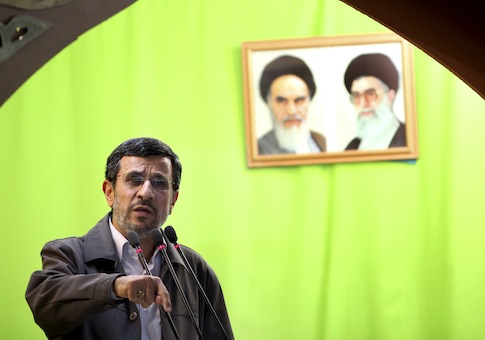
Mahmoud AhmadinejadFormer Iranian President Mahmoud Ahmadinejad / AP

Former Iranian President Mahmoud Ahmadinejad emerged from hiding on Wednesday to deliver a rare public speech in which he told Iranians, “We can rest the day that we raise the flag of martyrs over the White House,” according to an independent translation of Persian language media reports.

Ahmadinejad, most notorious for his Holocaust denial and militaristic rhetoric, visited war zones in southern Iran just a week after Iranian Supreme Leader Ali Khamenei made a similar visit to the region.

The comments were initially reported by Iran’s Basij News Agency, an official state organ controlled by the country’s powerful Iranian Revolutionary Guard Corps (IRGC).

Ahmadinejad’s reappearance on the public stage comes as Iran continues to negotiate with Western powers over its contested nuclear weapons program. The former president’s violent rhetoric is being viewed as a sign that Iranian hardliners are making a political comeback in Tehran.

“This was Ahmadinejad’s first political comment after a long silence, more importantly it is reported by a news agency controlled by [Iran’s] powerful Basij forces, the Iranian version of SS forces,” Saeed Ghasseminejad, cofounder of Iranian Liberal Students and Graduates, told the Washington Free Beacon.

“Ahmadinejad also got the chance to sit close to Khamenei, as Khamenei’s website and IRGC-run Fars News reported,” Ghasseminejad said.

This may be seen as “a significant sign in Iran’s politics showing that Ahmadinejad’s relation with Khamenei is improving,” he said. “It seems that Khamenei and powerful forces in his office have decided not to keep Ahmadinejad totally out of the loop.”

Khamenei exerts total control over Iranian politics and its figureheads, meaning that if the Supreme Leader gives the go-ahead, Ahmadinejad could regain political power.

“If Khamenei’s office gives Ahmadinejad the permission to become more active, it is a sign that Khamenei is planning to strengthen the revolutionary hardliner’s position, who surprisingly lost the presidential election to a coalition of reformists and conservatives,” Ghasseminejad said.

“Khamenei’s recent speeches and Ahmadinejad’s return show that hardliners are planning to strike back, of course after Khamenei’s permission,” he said.

Ahmadinejad’s violent rhetoric and public appearance with Khamenei may also be a signal to Iran’s political elite, particularly the Larijani brothers, who have warred with Ahmadinejad in the past and attempted to discredit him.

The Khamenei-Ahmadinejad alliance “sends a signal to the Larijani brothers who deeply hate Ahmadinejad and continuously have been seeking permission to take Ahmadinejad down,” explained Ghasseminejad.

“Recently Ahmadinejad’s vice president was summoned to court, a sign that the Larijani brothers who control legislative and judiciary branches are eager to go after Ahmadinejad himself,” he said. “Ahmadinejad is a powerful figure among hardliners and one of the few politicians in conservative camps who really enjoys popular support.”

Khamenei, in a speech last week before Ahmadinejad’s appearance in Iran’s southern region, focused on “resistance in the face of what he called ‘estekbar,’” otherwise known as “a religious translation of imperialism” that typically refers to the West and, more narrowly, the United States, Ghasseminejad explained.

Op-Ed: Obama’s Kiss of Death to Saudi Arabia

April 2, 2014

Op-Ed: Obama’s Kiss of Death to Saudi Arabia, Israel National News, Mark Langran, April 2, 2014

(Apparently to Israel as well. As observed here, Israel does not credit General Dempsey’s claim that the U.S. will use its military option against Iran if necessary. — DM)

In conclusion, this is the way the Saudi’s see it: Either Obama is so delusional that he really believes what he is saying, or Obama is the biggest fabricator the world has ever seen.  Either way, the Saudis now see Obama as an Iranian-stooge, and realize that they have to face a nuclear-Iran without any U.S. defense.

And this is the way the Israeli’s see it: Any Obama security guarantees for either the “peace” process or Iran are either total lies, or totally worthless because “It’s that after a decade of war, the United States has limits.” For Obama, after he creates a “West Bank” Palestinian state and/or if Iran develops a nuclear bomb, saving 6 million Jews will be outside “the United States’ limits.”

Israel is going to have to face Iran without the U.S., and possibly with Obama defending Iran by giving Iran a head’s-up warning when Israel launches any attack.

The kiss-of-death (In Italian: Il bacio della morte) is the sign given by a mafia boss to a family-mob-member that signifies that the specific family-mob-member has been marked for death.  Marlon Brando, playing Don Corleone, made it famous in the “Godfather” movies.

Obama has just given the Saudis a kiss-of-death, and the Saudis know it.

As a backdrop to recent events, on May 19, 2011, President Obama spoke concerning his war on Muammar Qaddafi:

“Unfortunately, in too many countries, calls for change have thus far been answered by violence.  The most extreme example is Libya, where Muammar Qaddafi launched a war against his own people, promising to hunt them down like rats…

“But in Libya, we saw the prospect of imminent massacre, we had a mandate for action, and heard the Libyan people’s call for help.  Had we not acted along with our NATO allies and regional coalition partners, thousands would have been killed.  The message would have been clear:  Keep power by killing as many people as it takes.”

During the first three days of the US attack against Qaddafi in 2011, the US  fired 124 precision Tomahawk missiles (costing 1 million dollars a piece), flew hundreds air sorties, and instituted a no-fly zone against Qaddafi.

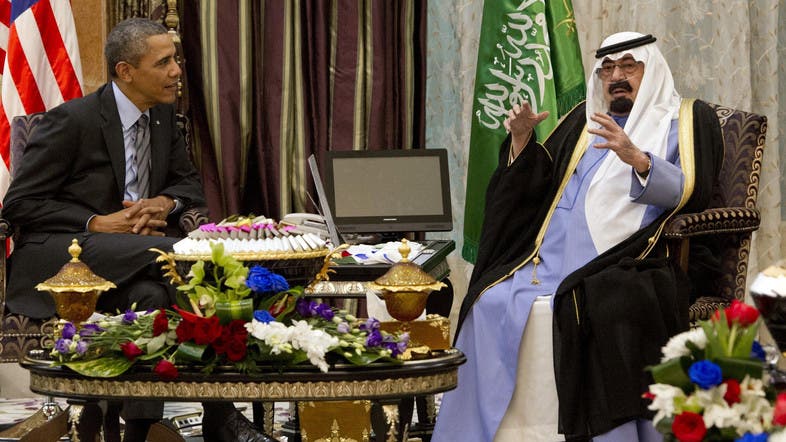
On to much more recent events. On Friday, March 28, 2014, while about to leave for Saudi Arabia, Obama opined on his failure to attack Assad when the Syrian ruler gassed over a thousand people to death:

“It is, I think, a false notion that somehow we were in a position to, through a few selective strikes, prevent the kind of hardship we’ve seen in Syria. It’s not that it’s not worth it.

“It’s that after a decade of war, the United States has limits.

“And it’s not clear whether the outcome, in fact, would have turned out significantly better.

“To look at a country like Syria and see how it’s been torn apart, to see the humanitarian crisis that’s taking place, surely, that is not consistent with any reasonable interpretation of what Islam is all about, to see children starving or murdered, to see families having to abandon their homes.”

After the Saudi meetings, Voice of America reported:

1) Topping the list of concerns is Iran – a rival of Saudi Arabia.

2) The Saudis also have grievances about Obama’s decision to not follow up on his threats to strike at the Syrian government after its poison gas attack in a Damascus suburb last year, and what the Saudis see as Washington’s reluctance to arm Syrian rebels.

3) The White House says that while the U.S. and Saudi views have – in the words of one senior official – “not been exactly aligned,” there is no fundamental split in the relationship between the United States and Saudi Arabia.

And here are a few observations:

1) The Saudis didn’t raise the Israeli-Palestinian conflict.  In fact, by the Arab League’s recent “10 No’s” vote a couple of days before, the Saudis turned Obama’s pre-condition of “Israel-Surrender-‘West-Bank’-First, then form Arab-Israel alliance against Iran-second” on its head.

The Saudis in effect made their pre-condition Obama’s neutering of their Shiite Iranian monster first and last.  Once Iran is dead and buried, the Saudis will talk about the Palestinian Arabs. The Saudis had de facto protected Israel’s flank by pushing the maximalist Arab League position which thus insured that Abbas couldn’t compromise on an inch (not that he would have anyway).

2) The Saudis will now be convinced that Obama is lying through his teeth on everything concerning Iran.  Obama says, “It’s not clear whether the [Syrian] outcome, in fact, would have turned out significantly better.”  Obama may be able to lie to American’s about ObamaCare, but he’s not going to sell the Saudis the same lying rug for a fifth time.

3) In 2011, Obama dropped 124 unmanned Tomahawks on Qaddafi in 3 days before he had barely killed even a thousand people, but in 2014, after Assad had murdered 120,000 Sunnis like “rats,” we hear that “It’s that after a decade of war, the United States has limits.”

Obama has confirmed the Saudis worst fears, no matter how one looks at it. If Obama is telling the truth, America is finished in the Middle East, and can’t defend the House of Saudi; but if Obama is lying, he is lying so badly, it’s hard to contain one’s laughter.

4) Obama reiterated over and over – before he was elected – that he’s not a “Muslim.”  However, he seems to present himself as an absolute authority on what “Islam” is all about, and especially about the specific meanings of Iran’s various anti-nuclear “fatwas” – the ones that no one has ever seen!  Nevertheless, Obama explains to us, benighted infidels, that Assad and Iran’s murdering of 200,000 Sunnis in Syria and having Shiite Muslim snipers “shoot-to-maim-not-kill” Sunni Muslim children, “is not consistent with any reasonable interpretation of what Islam is all about, to see children starving or murdered, to see families having to abandon their homes.”

Is Obama really serious about that statement?  Is he saying, “Islam is only about murdering Jews and Christians, but not other Muslims”?  Can it be that he doesn’t watch the news? He has dropped his golf-handicap a couple of strokes.

Obama is so busy 24/7/365 trying to push Israel into 1967-Auschwitz Borders that will irrevocably weaken the Jewish State, that he doesn’t think of anything else.

In conclusion, this is the way the Saudi’s see it: Either Obama is so delusional that he really believes what he is saying, or Obama is the biggest fabricator the world has ever seen.  Either way, the Saudis now see Obama as an Iranian-stooge, and realize that they have to face a nuclear-Iran without any U.S. defense.

And this is the way the Israeli’s see it: Any Obama security guarantees for either the “peace” process or Iran are either total lies, or totally worthless because “It’s that after a decade of war, the United States has limits.” For Obama, after he creates a “West Bank” Palestinian state and/or if Iran develops a nuclear bomb, saving 6 million Jews will be outside “the United States’ limits.”

Israel is going to have to face Iran without the U.S., and possibly with Obama defending Iran by giving Iran a head’s-up warning when Israel launches any attack.

War Across the Borders

April 2, 2014

War Across the Borders – PJ Media

(A good overview of the actors involved. – Artaxes)

One sectarian conflict in Iraq, Lebanon and Syria.

March 28, 2014 – 12:28 am
By Jonathan Spyer
 

It has become a commonplace to claim that the unrest in the Arab world is challenging the state borders laid down in the Arab world following the collapse of the Ottoman Empire in 1918.

This claim, however, is only very partially valid. It holds true in a specific section of the Middle East, namely the contiguous land area stretching from Iran’s western borders to the Mediterranean Sea, and taking in the states currently known as Iraq, Syria and Lebanon.

In this area, a single sectarian war is currently taking place. The nominal governments in Baghdad, Damascus and Beirut may claim to rule in the name of the Iraqi, Syrian and Lebanese peoples. But the reality of power distribution in each of these areas shows something quite different.

In each of these areas, local, long suppressed differences between communities are combining with the region-wide cold war between Iran and Saudi Arabia to produce conflict, discord and latent or open civil war.

In each case, sectarian forces are linking up with their fellow sect members (or co-ethnics, if that’s a word, in the case of the Kurds) in the neighboring “country” against local representatives of the rival sect.

Let’s take a look at the rival coalitions. These are not simply theoretical constructs. The cooperation between the relevant sides is largely overt, and has been extensively verified.

On one side, there are the Shia (and Alawi) allies of Iran. These are the Maliki government in Iraq, the Assad regime in Syria, and Hizballah, the Iranian proxy force which dominates Lebanon.

Both Hizballah and the Maliki government, at the behest of Iran, have played a vital role in the survival of Bashar Assad and his current resurgence.

Hizballah’s role is well-documented. The movement maintains around 5,000 fighters at any one time in Syria. They have just completed a spearhead role in a nearly year long campaign to drive the rebels from the area adjoining the Lebanese border. They are also deployed in Damascus.

Assad’s Achilles heel throughout has been the lack of committed fighters willing to engage on his behalf. Hizballah, working closely with Iran, has played a vital role in filling that gap.

In addition, Hizballah is working hard to suppress any Sunni thoughts of insurrection in Lebanon itself. Its forces cooperated with the Lebanese Army in crushing Sunni Islamists in Sidon in June, 2013. It also offers support to Alawi elements engaged in a long running mini-war with pro-Syrian rebel Sunnis in the city of Tripoli.

Maliki’s role on behalf of Assad is less well-reported but no less striking.

It is first of all worth remembering that the Iraqi prime minister spent from 1982-90 in exile in Iran, and his political roots and allegiances are, unambiguously, to Shia Islamism.

Regular overflights and ground convoys have used Iraqi territory since the start of the Syrian civil war to carry vital Iranian arms and supplies from Iran to Assad’s forces in Syria.

A western intelligence report obtained by Reuters in late 2012 confirmed this, noting that “planes are flying from Iran to Syria via Iraq on an almost daily basis, carrying IRGC (Iranian Revolutionary Guard Corps) personnel and tens of tons of weapons to arm the Syrian security forces and militias fighting against the rebels.”

It also asserted that Iran was “continuing to assist the regime in Damascus by sending trucks overland via Iraq” to Syria.

In addition, Iraqi Shia volunteers from the Abu Fadl al-Abbas Brigades and other formations have helped to fill Bashar’s gap in available and committed infantry.

The Maliki government has made no effort to stop the flow of such fighters across the border – even as it engages in a U.S.-supported counter insurgency against Sunni jihadis in western Anbar province in Iraq.

So the Iran-led regional bloc is running a well-coordinated, well-documented single war in three countries.

The Sunni Arab side of the line is predictably more chaotic and disunited. On this side, too, there are discernible links, but no single, clear alliance.

Unlike among the pro-Iran bloc, only the most radical fringe of the Sunnis cross the borders to engage in combat. There is no Sunni equivalent to the Qods Force cadres active in Syria and Lebanon.

Among the Sunni radicals, the Islamic State of Iraq and Syria (ISIS) group now controls a single contiguous area stretching from eastern Syria to western Anbar province in Iraq, and taking in Fallujah city in Iraq.

Jabhat al-Nusra, the Syrian franchise of al-Qaeda, is now active also in Lebanon. It has on a number of occasions penetrated Hizballah’s security sanctum in the Dahiyeh neighborhood of south Beirut.

More broadly, Saudi Arabia is the patron of the Sunni interest in both Lebanon and Syria.

It is currently backing rebel forces in the south of Syria, and pro-Saudis dominate the Syrian National Coalition, which purports to be the political leadership of the rebellion.

It also supports and promotes the March 14th movement in Lebanon, and recently pledged $3 billion for the Lebanese Armed Forces – presumably in a bid to build a force that could balance Hizballah.

But both Qatar and Turkey also play an important role in backing the Syrian rebels, and have their own clients among the fighting groups.

Saudi and Turkish fear and distrust of radical Sunni Islamist fighting groups prevent the emergence of a clear “Sunni Islamist international” to rival the Shia international of Iran.

Still, it is undeniable that cooperation exists among the various Sunni forces in Lebanon, Syria and Iraq.

It’s just that it’s a complicated and sometimes chaotic criss-crossing of various rival interests and outlooks on the Sunni side, rather than a coherent single bloc.

And finally, of course, there is a single contiguous area of Kurdish control stretching from the Iraq-Iran border all the way to deep within Syria. This zone of control is divided between the Iraqi Kurds of the Kurdish Democratic Party and the Syrian Kurds of the rival, PKK-affiliated Democratic Union Party (PYD).

Once again, it is a contiguous area of control based on ethnic affiliation.

None of this means that the official borders of these three countries are going to officially disappear in the immediate future. The U.S. administration and others are committed to their survival, so they are likely to survive for now, in the semi-fictional and porous state in which they currently exist.

This, however, should not obscure the more crucial point that the entire area between the Iraq-Iran border and the Mediterranean Sea is currently the site of a single war, following a single dynamic, fought between protagonists defined by ethnic and sectarian loyalty.

Arab state’s ‘Iran problem’ is reflected in Washington – Al Arabiya

April 2, 2014

Arab state’s ‘Iran problem’ is reflected in Washington – Al Arabiya.

Dempsey claims Israel satisfied the US will use military option against Iran. DEBKAfile: Israel doesn’t say this

April 2, 2014

Dempsey claims Israel satisfied the US will use military option against Iran. DEBKAfile: Israel doesn’t say this, DEBKAfile, April 2, 2014

Dempsey’s remark that the US “will use a military option if the Iranians choose to stray off the diplomatic path,” is the giveaway. It exposes the Obama administration’s continued refusal to admit that while Tehran sticks to “the diplomatic path” it uses that path to carry on developing its military nuclear capacity undisturbed.

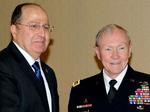
Yaalon-Dempsdy_30.3.14Gen. Martin Dempsey meets Defense Minister Moshe Ya’alon

Gen. Martin Dempsey, Chairman of the Joint US Chiefs of Staff, flew out of Israel Wednesday, April 2, from three days of talks with Israeli leaders, asserting: “I think they are satisfied we have the capability [to use a military option against Iran]. I think they believe we will use it.”

DEBKAfile sources tracking his talks did not receive that impression from Israeli officials. They did not subscribe to his statement that “Israel and the United States are in broad agreement about the threat that Iran poses to the region and how to deal with it.”

The US general admitted there were differences but added that Israel and the United States are closer now in their assessments of the threat Iran poses and America’s willingness to act. “They just wanted to know that we are maintaining and continuing to refine our military options,” he said.

During his visit, Gen. Dempsey paid calls on Prime Minister Binyamin Netanyahu, Defense Minister Moshe Ya’alon, Chief of Staff Lt. Gen. Benny Gantz and Deputy Chief of Staff Maj. Gen. Gadi Eizenkot, as well as military intelligence (AMAN) chief Maj. Gen. Aviv Kochavi. He also raised eyebrows in security circles when he made his own arrangements to see certain retired Israeli generals, including former AMAN head Amos Yadlin,

None of his interlocutors knew what he was talking about when he summed up his visit by saying, “Our clocks are more harmonized than they were two years ago.”

He was evidently referring to the summer of 2012 when Israel and the IDF were all set to stage an attack on Iran’s nuclear facilities and forced to call it off under sledgehammer pressure from President Barack Obama. Today, while Iran presses on, Israel and the US are no nearer agreement than before, Israeli security circles stress. Dempsey’s remark that the US “will use a military option if the Iranians choose to stray off the diplomatic path,” is the giveaway. It exposes the Obama administration’s continued refusal to admit that while Tehran sticks to “the diplomatic path” it uses that path to carry on developing its military nuclear capacity undisturbed.

Ministers threaten retaliation over Abbas’s UN move

April 2, 2014

Ministers threaten retaliation over Abbas’s UN move – The Times of Israel.

‘Annexation’ and ‘financial sanctions’ on the table, tourism minister says; Feiglin: Cancel ‘infernal’ Oslo accords

April 2, 2014, 11:04 am

Uzi Landau, October 2012 (photo credit: Yoav Ari Dudkevitch/Flash90)

Uzi Landau, October 2012 (photo credit: Yoav Ari Dudkevitch/Flash90)

Israel could retaliate for the Palestinian Authority’s moves to join UN agencies by annexing territory or with financial sanctions, right-wing ministers warned Wednesday.

“If they are now threatening [to go to UN institutions], they must know something simple: They will pay a heavy price,” Tourism Minister Uzi Landau told Israel Radio. “One of the possible measures will be Israel applying sovereignty over areas that will clearly be part of the State of Israel in any future solution.”
Israel could also hurt the Palestinians economically by acting “to block financial aid to them,” the minister added.
Landau’s remarks were referring to the so-called settlement blocs, areas of the West Bank that Israel hopes to retain in any future peace deal.


Palestinian Authority President Mahmoud Abbas on Tuesday made a public show of beginning steps to join several UN agencies, abandoning a pledge to freeze such action for the duration of peace talks, which are scheduled to end April 29.

Abbas made his announcement just hours after Israel reissued tenders for hundreds of homes in the east Jerusalem neighborhood of Gilo, and as Washington was working around the clock to resolve a major dispute over Palestinian prisoners.

Likud MK Moshe Feiglin addresses the Knesset plenum during a debate of Israeli sovereignty on the Temple Mount, Tuesday, February 25, 2014 (photo credit: Flash90)

Likud MK Moshe Feiglin addresses the Knesset plenum during a debate of Israeli sovereignty on the Temple Mount, Tuesday, February 25, 2014 (photo credit: Flash90)

Deputy Knesset Speaker Moshe Feiglin (Likud) called for Israel to “announce the cancellation of the infernal [Oslo] agreements and to exercise Israeli sovereignty over all the territory.”

Deputy Minister Ofir Akunis characterized Abbas’s move as “extortion.”

“The Palestinians are removing their mask to reveal their true face… that the last thing that interests them is a diplomatic solution,” he said.

“The only thing that interests them is dancing in the streets with heinous murderers,” he added, referring to demands that Israel release Palestinian prisoners, some of whom were convicted of murdering Israelis.

He added that the US also understands that “nothing satisfies Abbas and that Palestinian extortion knows no bounds.”

The standoff came soon after US Secretary of State John Kerry left Israelafter a lightning visit on Tuesday.

He had been due to fly back to the region on Wednesday for talks in Ramallah with Abbas, but he canceled his visit following the Palestinian leader’s announcement, while attempting to remain optimistic.

“It is completely premature tonight to draw… any final judgement about today’s events and where things are,” he said in Brussels.

The top US diplomat had hoped to convince the Palestinians to extend the faltering talks beyond their April 29 deadline, with the sides discussing a proposal which would have included a limited freeze on settlement construction.

US taking step back from peace talks, report says

April 2, 2014

US taking step back from peace talks, report says, Ynet News, April 2, 2014

(If accurate, Secretary Kerry is a slow learner. — DM)

New York Times quotes senior American official as saying Obama administration believes Israel and Palestinians need to work through current deadlock themselves.

US Secretary of State John Kerry’s decision to cancel a Tuesday night meeting with Palestinian President Mahmoud Abbas is indicative of the Obama administration’s “growing impatience” with the deadlocked peace talks, the New York Times reported Wednesday. The newspaper quoted a senior US official as saying that the Americans believe Israel and the Palestinians should find a way out of this latest deadlock themselves, and that Kerry’s current efforts had been exhausted.

The crumbling peace talks had appeared to be somewhat back on track early Tuesday, with reports that Israel was willing to free more than 400 Palestinian prisoners and implement a “quiet” West Bank settlement freeze in return for a Palestinian agreement to continue negotiations into 2015 and the release of convicted US spy Jonathan Pollard. Kerry had met with Prime Minister Netanyahu twice in 12 hours, and intended to return Wednesday to meet with Abbas.

But all of this seemed to fall apart later in the day, when Abbas appeared on national television to sign 15 documents that appeared to seek Palestinian membership in United Nations and other international bodies, a move that the Palestinian president had threatened if the peace talks fell apart.

In his remarks to Palestinian leaders in the West Bank city of Ramallah, Abbas made clear he did not want to abandon the negotiations, but blasted Israel’s delay in freeing prisoners it had committed to release as a goodwill gesture at the start of the talks last summer.

“We are not doing this against America, but we still don’t see other ways forward,” Abbas said, before signing the packet of papers.

Precise details of what he had signed were not given, but a senior Palestinian official, Mohammed Shtayyeh, told Reuters that one of the documents was the Geneva Convention, which lays down the standards of international law for war and occupation.

Signing the convention would give Palestinians a stronger basis to accede to the International Criminal Court and eventually lodge formal complaints against Israel for its occupation of lands captured in the 1967 Six-Day War.

Kerry subsequently cancelled his meeting with Abbas, although he insisted that while there was no agreement at present, the negotiations were not dead.

“This is a moment to be really clear-eyed and sober about this process,” Kerry told reporters in Brussels on Tuesday, where he was attending a ministerial meeting of NATO.

“It is completely premature tonight to draw any kind of judgment, certainly any final judgment, about today’s events and where things are,” he said, making clear that he would pursue his efforts to end the generations-old Middle East conflict.

“We are continuing even now as I am speaking, to be engaged with both parties to find the best way forward.”

Israel had promised in exchange to free more than 100 prisoners by the end of March, but failed to release the final batch, saying it wanted guarantees that the Palestinians would extend the negotiations beyond the April 29 deadline.

According to the New York Times, the US sees Abbas’ televised announcement as an attempt to press Israel, rather than declare the talks over. The paper said that US officials had stressed that Abbas had not actually sought to join the International Criminal Court

Abbas dumps another US-led peace effort, Kerry gives up on shuttle, Pollard release recedes

April 2, 2014

Abbas dumps another US-led peace effort, Kerry gives up on shuttle, Pollard release recedes, DEBKAfile, April 1, 2014

kerry-Geneva_9.11.13John Kerry sees his peace effort fall apart

Kerry’s peace effort has demonstrated the truism established by all its forerunners that it is only kept alive by successful Palestinian blackmail. In all former cases, this formula has brought peace diplomacy to demise.

Palestinian leader Mahmoud Abbas did not announce his walkout from the negotiations with Israel or directly turn down the package of far-reaching Israeli concessions which US Secretary of State John Kerry assembled with Binyamin Netanyahu early Wednesday, April 1. He simply turned his back on the commitment he made ahead of the talks to refrain from unilateral applications to UN bodies while they were in progress. As soon as the US Secretary flew off to Brussels, he sent out applications for  “the independent Palestinian state” to join 12 UN agencies as members.

This was after the Palestinian leader upped his price for meeting Kerry’s request to extend peace diplomacy from April up until the end of the year. He demanded that Israel raise the number of 26 Palestinians due to be released from jail this weekend, to 1,000. They must also include Israeli Arabs.

He was not satisfied with Israel’s offer to free another 400 terrorists and accept a partial settlement freeze; Israel must release the same number as it traded for Gilead Shalit, the Israeli hostage held by Hamas, he said.

Abbas further insisted on top Palestinian terrorist operatives serving sentences for multiple murder be on the list of released pirsoners, including the notorious Marwan Barghouti (who is serving six life sentences for six murders), Ahmad Saadat, (who plotted the assassination of the Israeli cabinet minister Rehavam Zeevi) and the return to their homes of terrorists exiled as too dangerous to leave at large in the Palestinian territories.

Prime Minister Binyamin Netanyahu tried to calm the anger in his cabinet and the Israeli public over the bottomless Palestinian capacity for extortion. His associates said that he shared John Kerry’s belief that buying another nine months for the negotiations would give the US-led peace track a good shot at running full course.

However, Mahmoud Abbas placed deliberate obstacles in their path by holding the diplomatic process hostage to continual Israeli concessions.

DEBKAfile’s sources report that the US Secretary’s plan to visit Ramallah and Jerusalem Wednesday, April 2, to tie up the last ends of his new package, is now up in the air, the subject of frantic consultations in Washington.

The prospect has faded for the Israeli spy Jonathan Pollard’s early release after serving 30 years of a life sentence. President Barack Obama, unwilling to be associated with the imminent collapse of yet another US-sponsored Middle East peace effort, made it clear that he has not made up his mind about Pollard’s release.

Later Tuesday, informed US sources said that it would be a long time before Secretary Kerry agreed to return to the region.

This finale followed a rapid succession of somersaults in the fate of the Middle East peace talks during Wednesday, as DEBKAfile reported earlier:.

US Secretary of State John Kerry flew to Brussels Tuesday morning, April 1, after two rounds of talks with Israeli Prime Minister Binyamin Netanyahu in Jerusalem, and missing out on a meeting with Palestinian leader Mahmoud Abbas. US officials reported that Kerry is now aiming for a major breakthrough in the stalled Israeli-Palestinian peace talks by holding out to Israel the ultimate prize of Jonathan Pollard’s early release.

It was not clear what he had achieved before he left.

When he landed in Israel Monday night, Kerry brought Israel the fresh Palestinian demand for a tenfold increase in the number of Palestinian security prisoners listed for the fourth round of releases – 420 instead of the original 30 – to include also Israeli Arabs, which a large number of ministers oppose.

Israel was also required to accept a freeze on settlement construction on the West Bank as well as Jerusalem.

These concessions were the Palestinians’ price for accepting the extension of talks up until the end of this year.

Kerry agreed to put the squeeze on Prime Minister Binyamin Netanyahu yet again. He even dangled the ultimate inducement of the possible release (no promises) of Jonathan Pollard, who has served 30 years of a life sentence in a US jail for spying for Israel.

Netanyahu has been fighting for Pollard’s freedom for more than 16 years, hoping that repeated US-initiated peace negotiations with the Palestinians would provide an opening. He came close to success in 1998 when President Bill Clinton promised to release him, but then recanted in the face of furious CIA objections.

Netanyahu explained that this US concession would provide his only hope of saving his government coalition and standing up to popular resentment for surrendering to Palestinian extortion beyond accepted bounds.

Administrations sources in Washington confirmed that the Pollard case would be open to discussion on certain conditions – i.e. further and bigger concessions to the Palestinians. The convicted spy, now 59, they said, would be eligible for a reprieve in November 2015. This had somewhat tempered the US intelligence agency’s resistance to his early release.

Appreciating the high value of the Pollard card, the US Secretary tried using it as a lever to extract a really major Israel concession, beyond even the latest Palestinians demands. He pushed Netanyahu hard for a far-reaching step capable of generating a dramatic breakthrough for the US peace effort he is leading.

He turned to Netanyahu because Abbas is frozen immovably in demand mode.

So instead of shuttling back and forth between Jerusalem and Ramallah, Kerry spent most of Monday night and again Tuesday morning leaning heavily on Netanyahu for an ultimate concession for the ultimate prize of a freed Pollard.

He faced two major obstacles: If he caved in to the US Secretary’s wishes, Netanyahu knew he couldn’t prevent the fall of his government – even if Pollard was thrown into the mix (which is still a big if). This was one cabinet crisis he could not be sure of weathering even after surviving into his third term as head of a coalition government.

The other stumbling block was that the Palestinians, fully conscious of Kerry’s objective and his pressure on Netanyahu, saw their chance to continually up their stipulations for more Israeli concessions as the price for keeping the talks afloat.

Those obstacles were still in force when the US Secretary flew out to Brussels Tuesday morning after a second round of talks with Netanyahu. What he managed to do was to shift the focus of US-Israeli-Palestinian negotiations to new terrain – American. President Barack Obama will be asked to consider making a contribution to the peace track on whose success his secretary of state has gambled heavily, by signing the papers for Jonathan Pollard’s release and then preparing it for consumption in America. Netanyahu will also be asked for some fast explaining about the price Israel is paying for him in Palestinian currency.

Pollard now has his first real chance of freedom.

But this is far from glad tidings for Israeli-Palestinian diplomacy. Kerry’s peace effort has demonstrated the truism established by all its forerunners that it is only kept alive by successful Palestinian blackmail. In all former cases, this formula has brought peace diplomacy to demise.