Archive for March 2014

Off Topic: Why Abbas wants Marwan Barghouti to go free

March 22, 2014

Why Abbas wants Marwan Barghouti to go free, Times of IsraelAvi Issacharoff, March 22, 2014

[M]ost importantly for Abbas, he could finally appoint a successor — Barghouti. This would enable Abbas to keep his primary rival, Mohammad Dahlan, from taking the presidency. Abbas knows that Dahlan, sitting in the UAE, has no electoral chance against Barghouti, who enjoys endless praise for his role in the Second Intifada and his conviction on five murder charges.

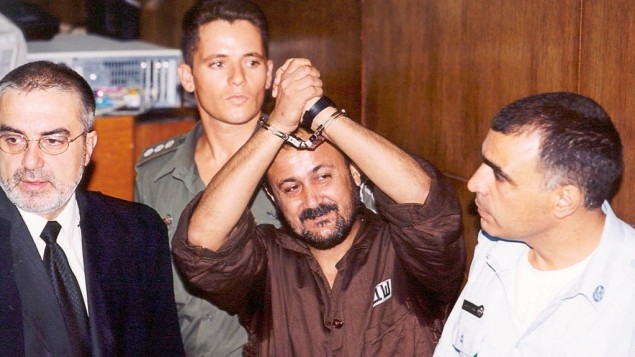
BarghouiMarwan Barghouti in court in 2002 (photo credit: Flash90)

At their White House meeting on Monday, US President Barack Obama emphasized to Palestinian Authority President Mahmoud Abbas the need to resume and extend talks with Israel, which broke down in November, rather than taking unilateral steps at the UN.

The good news is that Abbas didn’t reject the US president’s request out of hand. The not-so-good news is that Abbas said he would need to receive something from the Israelis if he were to agree: a settlement freeze, and a further prisoner release — beyond the fourth group of terror convicts scheduled to go free on March 29. And not just any prisoners, but, according to the London Arabic newspaper al-Hayat, ThePrisoner, Fatah Tanzim leader Marwan Barghouti. Arab and Palestinian sources confirmed the reports to The Times of Israel.

Is this a case of naiveté on Abbas’s part, or is it a clever ploy to prove that Israel is not ready to take a step that would foster more talks? It actually looks like neither, and more like a sort of gamble that could pay off for Abbas (if less probably for Israel).

Abbas knows that Barghouti’s release would allow him the breathing room to negotiate for many more months without fearing public criticism. Barghouti, the most popular leader in the territories today, could even sit by his side in the talks. That would be a major coup for Abbas in the eyes of the Palestinian public. Barghouti’s release would also strengthen Abbas’s support in Fatah.

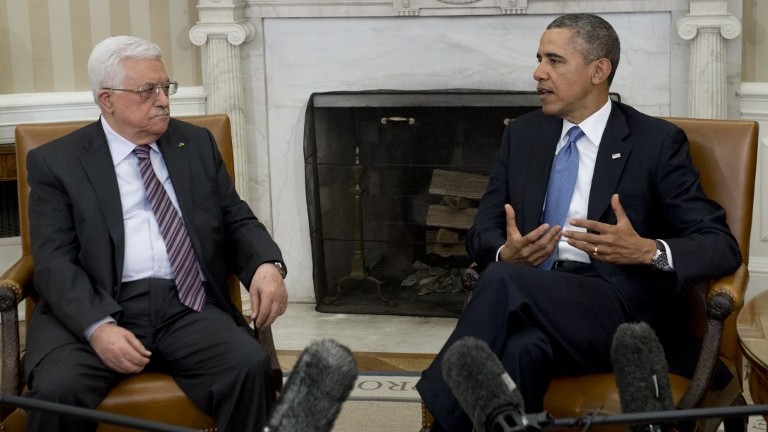
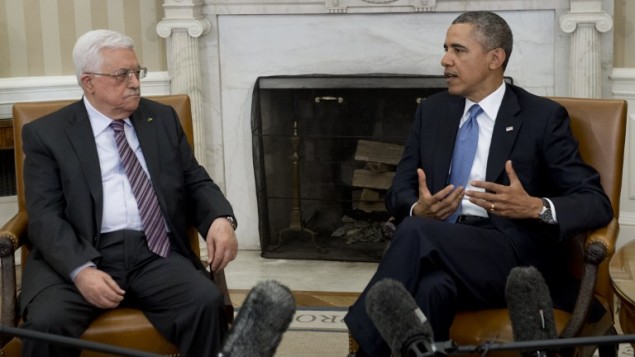
aa1Obama AbbasUS President Barack Obama, right, and Palestinian Authority President Mahmoud Abbas hold a meeting in the Oval Office of the White House in Washington, DC, Monday, March 17, 2014 (photo credit: Saul Loeb/AFP)

And perhaps most importantly for Abbas, he could finally appoint a successor — Barghouti. This would enable Abbas to keep his primary rival, Mohammad Dahlan, from taking the presidency. Abbas knows that Dahlan, sitting in the UAE, has no electoral chance against Barghouti, who enjoys endless praise for his role in the Second Intifada and his conviction on five murder charges.

Chief Palestinian negotiator Saeb Erekat called the White House meeting “long and difficult,” adding with relief that Obama did not present a framework agreement to Abbas. (This in contrast to Israel’s Channel 2 news Friday night, which quoted unnamed Israeli and American sources claiming Abbas rejected the framework plan, and gave “three no’s” on core issues of dispute.) Erekat, unlike Israeli Defense Minister Moshe Ya’alon, had the good sense not to insult the US leader or his own boss in his wrap-up of events.)

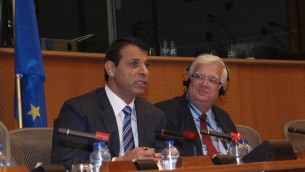
aDahlinMohammed Dahlan, left, speaks at the European Parliament, December 3, 2013 (photo credit: courtesy/Fernando Vaz das Neves)

The work now falls on US Secretary of State John Kerry, who will be forced, as usual, to mediate between the sides and manage the Middle Eastern ‘bazaar’ in future trips to the region — to ask the Israelis to give something that would see Abbas return to the talks.

Though Abbas sees Barghouti’s release as some kind of magic key, it is highly unlikely that anyone in Israel is willing to contemplate such a move, even as a means of keeping the talks going — which Prime Minister Benjamin Netanyahu wants. Even now, well before the sides have begun to talk about Barghouti, the scheduled fourth release of veteran security prisoners has run into problems.

The prisoners are supposed to go free in barely a week’s time. Most of them are not well-known to the Israeli public, and most are too old to represent any danger to Israel. Still, it won’t be easy for Netanyahu to release the group demanded by the PA, which includes 14 Israeli Arabs, without knowing first that Abbas will continue talks beyond their scheduled April cessation.

Abbas, for his part, is insisting that Israel must set free the final agreed group of prisoners whether or not talks continue, and refuses to condition their release on the political process.

Thus the sides are at another standstill, without anyone mentioning settlement freezes or the release of a man serving five life terms for murder.

Ya’alon strikes twice

March 22, 2014

Diplomacy: Ya’alon strikes twice | JPost | Israel News.

( “Rather than getting furious at Ya’alon for stating what for many is the obvious, the administration should consider that if this is what a senior leader of one of its greatest friends in the world is thinking – a friend that wants to see a powerful and respected US – then what is going through the minds of those who do not wish the US well?” – Superb article.  When the story first broke, I remarked on the importance placed on criticism from ISRAEL ! – JW )

By HERB KEINON

LAST UPDATED: 03/22/2014 14:07

US leaders regularly call Israeli policies into question, saying friends can talk honestly with each other. But when the tables are turned, all that openness and honesty is much less appreciated.

Defense Minister Moshe Ya'alon (R) looks into Syria on tour of Golan Heights

Defense Minister Moshe Ya’alon (R) looks into Syria on tour of Golan Heights Photo: Ariel Hermoni, Defense Ministry spokesman

Friends, Israel is told ad nauseam, often have to be brutally honest with one another.

US Secretary of State John Kerry often prefaces critical comments of Israeli policies in his speeches or interviews by stressing that he had a flawless voting record on Israel in the Senate for over 29 years, and shouted “Am Yisrael chai!” from Massada on his first visit here in 1986. Being a friend, he implies, means being able to be critical.

US President Barack Obama, in his keynote speech to Israel at the Jerusalem International Convention Center during his visit last year at this time, segued from the unabashedly positive part of his speech into the more critical by saying that not everyone in the hall was going to agree with what he had to say about peace.

“That’s part of the discourse between our two countries. I recognize that,” Obama said. “But I also believe it’s important to be open and honest, especially with your friends. I also believe that.”

Washington surely believes that when it comes to being open and honest with Israel.

Just take Obama’s recent interview with Bloomberg View’s Jeffrey Goldberg, the one that appeared one day before the president was to meet Prime Minister Binyamin Netanyahu in March in the Oval Office.

That interview included some very open and candid criticism of the current government’s policies, and an underlining theme that Netanyahu had so far failed to “seize the day.” Obama painted a bleak future indeed for Israel if its policies did not fundamentally change.

Kerry, over the last few months, has given speeches in which he predicted catastrophe – a third intifada, deepening international isolation and boycotts – if the elected government of the State of Israel continued down its current path.

That is all well and legitimate, part of what Obama referred to in Jerusalem as the importance of being “open and honest, especially with your friends.”

But how about the other way around? How about when that openness and honesty is not Washington criticizing Israeli policy, but rather Jerusalem passing judgment on Washington’s policies? Then, as was evident again this week with Defense Minister Moshe Ya’alon’s latest critique of American foreign policy, the US is far less forbearing.

For whatever the reason, the US cannot seem to tolerate words of criticism from Israel.

A debate can surely be held regarding the wisdom of what Ya’alon said in that closed meeting at Tel Aviv University on Monday, and whether a minister of his rank and stature should play the pundit’s role and critique American foreign policy. And one may wonder aloud about his judgment, especially coming so soon after the January debacle where, in a private conversation, he said Kerry was obsessed with the Israeli-Palestinian conflict, was motivated by a messianic complex, and should just “take his Nobel Prize and leave us alone.”

Ya’alon came under a barrage of criticism for that remark, and – as was the case this week as well – was forced to apologize.

Critics of his January comments slammed him for personalizing the censure. Even Foreign Minister Avigdor Liberman, who in the past has let slip some rather undiplomatic comments about various countries and world leaders, said at the time, “There is no call for personal attacks, even if there are, at times, disagreements.”

Valid point. But this time Ya’alon’s criticism was not personal at all. No mention of the Nobel Prize or the messiah. It was, rather, a general critique of US policies. It was also not stated in a high-profile public forum, but rather in a private discussion that was leaked.

And what did he say that was so egregious, that ignited the wrath of the administration to such a degree that it trotted out an official to say that “given the unprecedented commitment that this administration has made to Israel’s security, we are mystified why the defense minister seems intent on undermining the relationship?” On Iran, Ya’alon did not break any new ground, criticizing the US for letting the Iranians off the ropes with the current round of negotiations, and saying that Washington was being out-negotiated by the Iranians. His line about the Iranians being better negotiators in a Persian bazaar is one he has used often in the past.

Israel, Ya’alon said, has to approach the Iranian issue “as though we have nobody to look out for us but ourselves.” That is a variation of the oft-repeated line: “Israel has the right to defend itself by itself against any threat.”

Ya’alon’s criticism of the US policy on Iran, and his hint that Obama prefers to push this issue off to the next administration, is a critique often heard both an assertion that is particularly beyond the pale.

His criticism of an overall weakness in US foreign policy is also not breaking any revolutionary new ground. One would have to be blind not to recognize that America’s standing in the region, and in the world, is changing as a result of its reaction to the crisis over the last number of years, including the most recent one in Ukraine.

One would also have to be deaf to domestic US discussions not to realize that there is a potent strain of isolationism among the US public.

“If you sit and wait at home, the terrorism will come again,” Ya’alon warned, sounding a bit like an American official warning Israel what will happen to it if does not totally withdraw from the West Bank.

“Even if you hunker down, it will come,” he said. “This is a war of civilizations. If your image is feebleness, it doesn’t pay in the world. Nobody will replace the United States as global policeman. I hope the United States comes to its senses. If it doesn’t, it will challenge the world order, and the United States is the one that will suffer.”

Should the defense minister have said that he hopes America returns to its senses and charts a different policy? Maybe not.

But how many times have various administration officials said the same thing about Israeli policies? Where Ya’alon skated on thin ice was his comments about American military aid.

“The aid must be put in proportion,” he said. “It is not really an American favor, it’s an interest. It is not as if we only take, we also give not a little,” he added, saying that Israel gives the US “quality intelligence and technology.” Among the technological developments he ticked off were the Iron Dome, the wings of the F-35 stealth fighter, and the Arrow anti-ballistic missile – all Israeli inventions.

He said that with Israel, the US has an “aircraft carrier” in the Middle East which “begins in Metulla, and ends in Eilat.”

Netanyahu, wisely, picked up immediately on the problematic nature of those comments, and in a Knesset speech Wednesday stressed that the US remained Israel’s greatest ally, underlining Israel’s appreciation for the close “security and intelligence cooperation.”

Israel, as poll after poll shows, enjoys broad-based support from the American public, and it is that broad base of support which enables the US Congress to approve each year a $3 billion military aid package to Israel (74 percent of which, by the way, has to be spent in the US). If there was one glaring faux pas in Ya’alon’s comments, it was the appearance of not being sufficiently grateful for that aid.

True, the US reaps dividends from that investment, but it is a massive investment nonetheless. To minimize it is to risk alienating not only the people in Washington, but also in Topeka. And Israel needs those folks in Topeka to ensure that it can count on the votes in Washington.

This week’s incident demonstrated again the administration’s very thin skin when it comes to criticism from Israel. It seemed to go beyond mere annoyance at Ya’alon’s comment about the aid. The defense minister’s overall critique of the US policy seemed to step on a raw nerve.

He gave voice to a trend many in the world are noticing: Washington’s ability to bend the will of others to its desired goals is diminishing.

But rather than getting furious at Ya’alon for stating what for many is the obvious, the administration should consider that if this is what a senior leader of one of its greatest friends in the world is thinking – a friend that wants to see a powerful and respected US – then what is going through the minds of those who do not wish the US well.

The administration should also bear in mind that Ya’alon is not some flaky, obscure minister who is easily dismissed. According to a Channel 2 poll three weeks ago, taken on the one-year anniversary of the government being sworn in, Ya’alon is the most popular minister in the land. And that poll was taken after he called Kerry messianic and obsessive.

Squeezing yet another apology out of Ya’alon for hurt feelings risks ignoring his message – and that message, even if clumsily delivered, is not one that should be summarily dismissed, even if it is uncomfortable for some in Washington to hear.
Waltzing With Iran in the Nuclear Ballroom

March 22, 2014

Waltzing With Iran in the Nuclear Ballroom – Wall Street Journal.

There’s little sign of diplomatic progress, but the accommodations and service are splendid.

By
Claudia Rosett

March 20, 2014 7:37 p.m. ET
Vienna

Amid the splendors of this ancient city on the Danube, the Iran nuclear talks are waltzing toward a fiasco. Russia’s threat this week to change its position on the talks as payback for the West’s negative reaction to the invasion of Ukraine could hardly make things worse.

The stated aim of the U.S. and its partners is to arrive at a grand bargain ensuring that Iran will not obtain nuclear weapons. The reality is that four months have passed since the U.S. and its partners struck an interim deal with Iran in Geneva proposing to work out a “long-term comprehensive solution.” So far, under the negotiating mantra of “nothing is agreed until everything is agreed,” the parties appear to be talking mainly for the sake of talking. According to a senior U.S. official at the round of meetings that wrapped up on Wednesday, “We understand each other’s concerns.”

That might work in a marriage, but this is a nuclear negotiation with a murderous, messianic state. Meanwhile, Iran without dismantling its nuclear infrastructure is enjoying a visible easing of sanctions and a celebrity comeback on the world stage.

Iran’s Ambassador to the International Atomic Energy Agency, IAEA, Reza Najafi waits for the start of the IAEA board of governors meeting at the International Center in Vienna, Austria, Monday, March 3, 2014. Associated Press

In Vienna, the process has taken on a life of its own. And a comfortable life it is. The Austrian government, delighted to have swiped the nuclear talks from Geneva, is lavishing hospitality on all concerned. That includes the six world powers dubbed the P5+1—the U.S., Britain, France, China, Russia and Germany—led by European Union foreign-policy chief Catherine Ashton. Sharing the head table with Ms. Ashton at the main bargaining sessions, while publicly proclaiming Iran’s “inalienable right” to enrich uranium, is the star of this show, Iran’s chief nuclear negotiator and foreign minister, Mohammad Javad Zarif.

For the top negotiators, Austrian authorities have reserved one of Vienna’s most magnificent hotels, the Palais Coburg. It is an impeccably restored 19th-century palace, with a royal portico, glittering chandeliers, duplex suites, big Jacuzzis and a lobby built around portions of the historic city walls. Mr. Zarif may be an envoy of the world’s top terror-sponsoring state, but at the Vienna talks he is an honored guest; his hotel bill, along with Ms. Ashton’s, is paid by the Austrian government.

For most of the talking, the negotiators prefer to hunker down at the Coburg. When necessary, and for photo-ops, they shuttle across town to the United Nations complex that houses the International Atomic Energy Agency. The IAEA has the job of monitoring Iran’s compliance with its promise under the interim deal to ratchet back, for now, some elements of its nuclear program.

For reporters covering the talks, Austria is providing facilities in a huge convention center that adjoins the U.N. complex. The amenities include free cappuccino, cold drinks, hot meals and Austrian chocolates.

The staple largely missing from the venue is news. At the two major rounds of the Vienna talks to date, Mr. Zarif and Ms. Ashton have delivered what may be the shortest press conferences on record. Side by side, and flanked by the Iranian and EU flags, they have read brief prepared statements and then left without taking a question. Last month, they pronounced their talks “very productive.” This month, in a text that ran to all of five sentences, they described their talks as “substantive and useful.” The next round convenes in Vienna April 7-9.

Procedurally, all this counts as success. According to an EU spokesman, Ms. Ashton is “mandated to drive forward these negotiations” and “she is determined to do that.” Such determination is the classic mistake of diplomats who become so invested in bargaining that they’ll do anything to stay at the table—thus handing the advantage to the other side.

Take Russia, a member of the P5+1 team that Ms. Ashton’s office and U.S. officials say is “united.” This reflects the official urge to envelop Iran in a group hug, and so woo it to kindlier ways. But Russia has its own ideas about how to leverage this collective bargaining. Earlier this week, in response to Russia’s grab of Ukraine’s Crimea, the U.S. and EU imposed sanctions on several Russian officials. Russia’s delegate to the Iran talks, deputy foreign minister Sergei Ryabkov, is now treating the talks not as a P5+1 team venture but as a point of leverage, threatening that Russia might retaliate by taking a separate stance from the other P5 parties on the Iran talks.

Iran has its own priorities as well. Tehran is so pleased with the partial easing of sanctions that its officials have been soliciting business and nuclear talent, from Tokyo to Europe’s trade fairs. But for all the smiles at the talks, Iran is publicly stipulating that it won’t dismantle its nuclear infrastructure, won’t stop enriching uranium, won’t abandon building the plutonium factory that is its heavy-water reactor near Arak, and won’t stop developing ballistic missiles.

After the latest round ended, a senior U.S. official offered some procedural details on trying to haggle over or monitor the troubling facilities that Iran is refusing to give up. Speaking on background, the official described a process of identifying “gaps” in agreement among the negotiating parties, and working to “bridge those gaps”—a labor of such technical, political and diplomatic complexity that the official further compared it to “a Rubik’s cube—you move one part, you affect the next.”

Actually, it’s not that complex. The equipment that Iran wants to keep isn’t vital to an oil-rich and peaceful state. What Iran wants to keep are the elements of a nuclear arsenal. We’ve seen this game before, as U.S. diplomats navigated a maze of bridge-building maneuvers in nuclear talks with Iran’s close ally, North Korea. In the end, it comes down to one big gap: The unavoidable fact that the Iranians aren’t at the bargaining table to give up the bomb. They’ve come so they get a breather from sanctions while they finish building it.

Ms. Rosett is journalist-in-residence with the Foundation for Defense of Democracies, and heads its Investigative Reporting Project.

Hillary’s Dubious Iran Credentials

March 22, 2014

Hillary’s Dubious Iran Credentials – Commentary Magazine.

@tobincommentary
03.20.2014 – 7:25 PM

Last night Hillary Clinton spoke at a dinner for the American Jewish Congress and continued her effort attempt to craft a narrative in which her four years at the State Department are depicted as making her uniquely qualified for the presidency. The centerpiece of this argument is that during her time as America’s top diplomat she was a leader in the struggle to stop Iran’s nuclear program. This is a delicate task that demands both exaggerations and outright fibs, especially when it comes to her position on sanctions. It also requires her to both embrace President Obama’s foreign-policy record while at the same time position herself slightly to his right. But while her cheering section may be buying her sales pitch, a closer examination of what Clinton did on the issue undermines any notion that he she was anything but an enabler of an Obama policy of engagement that has led to the current diplomatic dead-end.

Clinton’s claim is that her toughness toward Iran and diplomatic skill helped create the international sanctions that brought the Islamist regime to the negotiating table. Though she expressed some skepticism about Iran’s willingness to listen to reason, the former first lady endorsed the interim nuclear deal signed by her successor and agreed with Obama’s opposition to the passage of any more sanctions even if they would not be put into effect until after the current talks fail. But it’s no small irony that Clinton would be bragging about her tough stand on Iran in the same week that the blowup with Russia led to the almost certain collapse of the diplomatic solution that she had banked on.

It was Clinton, after all, who was the primary champion of the comical “reset” with Russia that convinced Vladimir Putin that the Obama administration could be discounted in conflicts involving his ambition to reassemble the old Tsarist/Soviet empire. But even more importantly, the conceit of Clinton’s efforts to build the international coalition for Iran sanctions was that she would be able to harness Russia and China to American foreign-policy objectives. That assumption has been blown out of the water by the conflict over Crimea. Any idea that Russia would stick with the West to pressure Iran to give up its drive for a nuclear weapon or keep them isolated via sanctions is no longer realistic.


Of course, Clinton’s boasts about her record on Iran sanctions are also misleading. Though it is true, as Clinton said yesterday, that she “voted for any sanction on Iran that came down the pipe” when she was in the Senate, like many of her other stands on Israel-related issues, that changed once she became secretary of state. While the administration now claims that it is these tough sanctions that enabled them to make diplomacy work with Iran, it should be remembered that Clinton and her boss President Obama fiercely opposed these same sanctions when Congress was considering them.

As much as she may be trying to differentiate herself from the incumbent while trying not to sound disloyal, an honest look at Clinton’s term at Foggy Bottom is not flattering. On the two issues that count most today—Russia and Iran—she must bear a great deal of the responsibility for the current mess. Even more to the point, she was as much a champion of Iran engagement as anyone else in the administration, a point that she conveniently omits from her resume, especially when speaking to pro-Israel groups.

A lot can and probably will happen on foreign policy in the two years between now and the 2016 presidential campaign. But the likely Democratic nominee must understand that events may ultimately make her record on Iran and Russia look even worse then than it does today. On her watch, Iran moved closer to a nuclear weapon while Clinton earned frequent-flyer miles assembling a coalition in favor of weak sanctions dependent on her Russian reset partner for success. Though Democrats may not care much about her actual record, the facts about Iran and Russia hardly make for the sort of credentials that will enhance her chances of prevailing in a general election.

IDF Says It Found Largest Ever Gazan ‘Terror Tunnel’

March 22, 2014

IDF Says It Found Largest Ever Gazan ‘Terror Tunnel’ – The Washington Free Beacon.

BY:
March 21, 2014 10:23 am

This undated photo released by the Israel Defense Forces on Friday, March 21, 2014, that they claim shows a tunnel dug from the Hamas-ruled Gaza Strip that stretches hundreds of yards inside Israel / AP

This undated photo released by the Israel Defense Forces on Friday, March 21, 2014, that they claim shows a tunnel dug from the Hamas-ruled Gaza Strip that stretches hundreds of yards inside Israel / AP

The Israel Defense Forces said Friday that it uncovered a tunnel from Gaza to Israel meant for carrying out terror or kidnapping attacks, Times of Israel reports.

Hamas claimed the tunnel was old.

The tunnel reached civilian communities in Israel, according to IDF officials. It was also the largest yet discovered. IDF is still investigating the tunnel.

The army official said a generator and other tools had been found in the tunnel, attesting to the fact that work had been done on it recently.

Preempting the IDF announcement, Hamas Thursday night had said the IDF had found an “old” tunnel already blown up by the army that the terror group had begun to repair. At a press conference, the group’s Izz a-Din al-Qassam Brigades military wing said a winter storm had exposed the tunnel and not the IDF. […]

The army has accused Hamas of digging “terror tunnels” out of Gaza in the past, including three discovered in 2013.

Off Topic: TV report: Abbas said ‘no’ to Obama on 3 core peace issues

March 22, 2014

TV report: Abbas said ‘no’ to Obama on 3 core peace issues, Times of Israel, March 22, 1914

(Thus ends the “peace process?” — DM)

Rejecting Kerry framework, Palestinian leader reportedly told US president he won’t recognize ‘Jewish Israel,’ abandon ‘right of return,’ or commit to ‘end of conflict.

1Abbas and Obama March 2014US President Barack Obama, right, and Palestinian Authority President Mahmoud Abbas hold a meeting in the Oval Office of the White House in Washington, DC, Monday, March 17, 2014 (photo credit: Saul Loeb/AFP)
On his trip to Washington this week, Palestinian Authority President Mahmoud Abbas rejected US Secretary of State John Kerry’s framework document for continued peace talks with Israel, and issued “three no’s” on core issues, leaving the negotiations heading for an explosive collapse, an Israeli TV report said Friday.

Abbas “went to the White House and said ‘no’ to Obama,” Channel 2 news reported, quoting unnamed American and Israeli sources.

Specifically, the report said, Abbas rejected Prime Minister Benjamin Netanyahu’s demand that he recognize Israel as a Jewish state. He also refused to abandon the Palestinian demand for a “right of return” for millions of Palestinians and their descendants — a demand that, if implemented, would drastically alter Israel’s demographic balance and which no conceivable Israeli government would accept. And finally, he refused to commit to an “end of conflict,” under which a peace deal would represent the termination of any further Palestinian demands of Israel.

Israel has indicated that it may not release a fourth and final group of Palestinian prisoners at the end of this month, as agreed to when the current talks began last July, if Abbas does not first agree to extend the talks beyond their scheduled cessation next month. Since Abbas rejected the Kerry framework for extending the talks, the TV report said, the negotiations were now heading for an “explosion.”

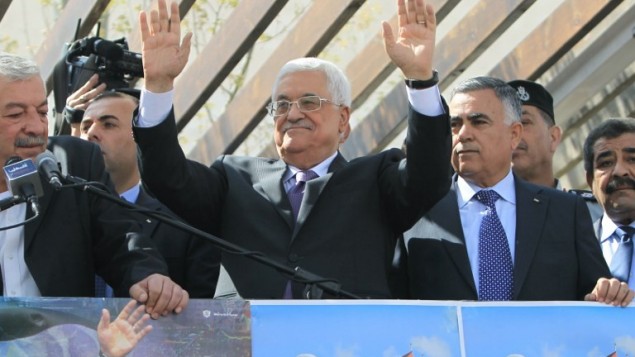
Abbas back homePalestinian Authority President Mahmoud Abbas waves to his supporters following his trip to Washington, DC, on Thursday, March 20, 2014, in the West Bank city of Ramallah (photo credit: AFP/Abbas Nomani)

Abbas returned on Thursday from the US, having held talks with Obama on Monday, and was met at his Ramallah compound by hundreds of cheering supporters.

“We carried the deposit, and we are guarding the deposit,” Abbas told those supporters somewhat cryptically. “You know all the conditions and circumstances, and I say to you that capitulating is not a possibility.” Abbas did not specify what he meant by the “deposit.”

During Monday’s meeting in Washington, Obama told Abbas that he would have to make tough political decisions and take “risks” for peace, as would Netanyahu. Abbas, for his part, reiterated his rejection of Israel’s demand that its status as a Jewish state be enshrined in a future peace accord, asserting that previous Palestinian recognition of Israel was sufficient.

“Everyone understands the outlines of what a peace deal would look like,” Obama said, describing an agreement that reflected the pre-1967 lines with agreed land swaps.

Sitting next to the president, Abbas spoke through a translator, thanking Obama for the opportunity to come to the White House and for the “economic and political support the US is extending to the Palestinian state so it can stand on its own feet.”

He outlined the Palestinian positions for negotiations, including “working for a solution that is based on international legitimacy and also the borders — the 1967 borders — so that the Palestinians can have their own independent state with East Jerusalem as its capital and so that we can find a fair and lasting solution to the refugee problem.”

On Thursday, the Palestinian Foreign Ministry notified Abbas that it is prepared to apply for full membership in international institutions if Israel fails to complete the fourth and final release of Palestinian prisoners jailed before the signing of the Oslo Accords, scheduled for March 29.

Israel agreed to release 104 such prisoners in four stages over the nine-month negotiating period, in return for a Palestinian commitment not to apply for membership in international bodies.

A number of Israeli cabinet members, including Economy Minister Naftali Bennett and Deputy Defense Minister Danny Danon, have publicly opposed the final release, which the Palestinians want to include 14 Israeli citizens, something Israel has rejected.

Abbas Greets Iranian People, Hopes to Strengthen Ties

March 22, 2014

Abbas Greets Iranian People, Hopes to Strengthen Ties, Israel National News, March 21, 2014

PA Chairman congratulates the Iranian people on Nowruz, expresses his hopes that Iran-PA ties can be strengthened.

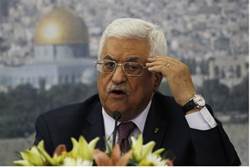
a1AbbasPalestinian Authority Chairman Mahmoud Abbas Reuters

Palestinian Authority (PA) Chairman Mahmoud Abbas on Friday congratulated the Iranian people on the occasion of the Nowruz holiday, the Iranian new year, wishing them continued prosperity and progress.

Abbas took advantage of the opportunity to express his hopes that the ties between the PA and Iran could be strengthened.

According to the Bethlehem-based Ma’an news agency, he expressed hope that the occasion would be an opportunity to strengthen the bonds of brotherhood and cooperation among all countries of the region, in order to serve the interests and stability of all peoples.

Abbas’s greetings to Iran came hours after Iran’s Supreme Leader denied the Holocaust.

In a speech marking Nowruz, Ayatollah Ali Khamenei said that “we do not know if [the Holocaust] is real or not.”

According to the Ayatollah, Europe’s criminalization of denying the Holocaust is an attack on Iranian culture.

The PA recently began to renew its ties with the regime in Tehran. This was marked by a visit to Tehran of senior Fatah official Jibril Rajoub, during which Rajoub pledged to “continue the resistance” against Israel.

Due to the success of Rajoub’s trip, it was later reported that Iran intends to invite Abbas himself to visit Tehran.

Abbas’s longtime rivals in Hamas have also begun to renew their ties with Iran, which were severely damaged after Hamas supported the rebels fighting Syrian President Bashar Al-Assad.

Just last week, Hamas announced renewed diplomatic relations with Iran. That announcement came as Israel revealed the contents of the Klos C weapons ship that was sent from Iran to Gaza.

Israel can operate in Iran if it needs to, IDF chief says

March 21, 2014

Israel can operate in Iran if it needs to, IDF chief says – The Times of Israel.

Gantz says Israel conducts ‘secret activities near and far,’ adds Iran is ‘not beyond the army’s reach’

By Adiv Sterman   March 19, 2014, 9:21 p

IDF Chief of Staff Benny Gantz, July 24, 2013. (photo credit: FLASH90)

IDF Chief of Staff Benny Gantz, July 24, 2013. (photo credit: FLASH90)

Israel’s security forces have the capability to carry out military operations in virtually every part of the globe, including Iran, IDF Chief of Staff Benny Gantz said Wednesday, adding that Israel had already conducted dozens of covert operations in foreign and enemy countries.

“Last week, the navy returned from a distant operation,” said Gantz, during a discussion with high school students, referring to the interception off the coast of Sudan of an alleged Iranian arm shipment aboard the Klos-C cargo vessel, later towed to Israel. “Our Air Force is wherever we want it to be,” he continued.

“I did not even mention the dozens of secret activities, some of which took place last week, and [some] just as we speak,” he said. ”I am talking about close range operations and long-range ones — Iran, and so on. These are not areas that are beyond the IDF’s reach.”

The remarks were recorded and broadcast by Israel’s Channel 10 News.

The TV report asserted that Gantz’s comments represented a first “definitive” acknowledgment that Israel is capable of military intervention in Iran and constituted a hint from the chief of General Staff that this kind of activity was already happening. The station’s military correspondent added that “thousands of people” are involved daily in operations — mainly involving intelligence-gathering, but also involving elite army units — aimed at preventing Israel’s enemies from arming, putting them on the defensive, preventing attacks, and notably “preventing Iran from gaining nuclear capabilities.”

Gantz, in the broadcast remarks, also referred to Israel’s reprisal strikes on Syrian targets after four soldiers were injured in a bomb attack at the Golan Border on Tuesday, and said he was heading back to the Golan after the discussion, at a school in Gan Yavneh.

He also went on to assert that the IDF would have to reoccupy the Gaza Strip if Israel wanted to halt all rocket fire from the Hamas-run territory. ”If we want no [rocket fire] to come out of there, or close to none for there’s no such thing as none, then you have to invade Gaza,” Gantz said. ”It’s a dilemma we deal with every week; we have the ability to do so… That requires a strategic decision.”

Last week, Foreign Minister Avigdor Liberman, in response to a major rocket bombardment of southern Israel, said the IDF should reoccupy the Gaza Strip so that the Israeli government could effectively defend its citizens, even if it jeopardized peace talks with the Palestinians.

Times of Israel Staff contributed to this report

Chorus of Israeli voices renews calls for Iran strike

March 21, 2014

Chorus of Israeli voices renews calls for Iran strike, Times of Israel, Tia Goldenberg, March 21, 2014

(Infrequently mentioned, Israel very likely could use Electromagnetic Pulse (EMP) technology against Iranian nuke facilities. Although many are underground, there have to be above-ground command and control (C&C) centers subject to an EMP attack. With C&C centers no longer operational, even the underground facilities would be relatively useless. — DM)

The military option, ‘in a coma’ since interim deal was reached on Tehran’s nuclear program, resurfaces in earnest.

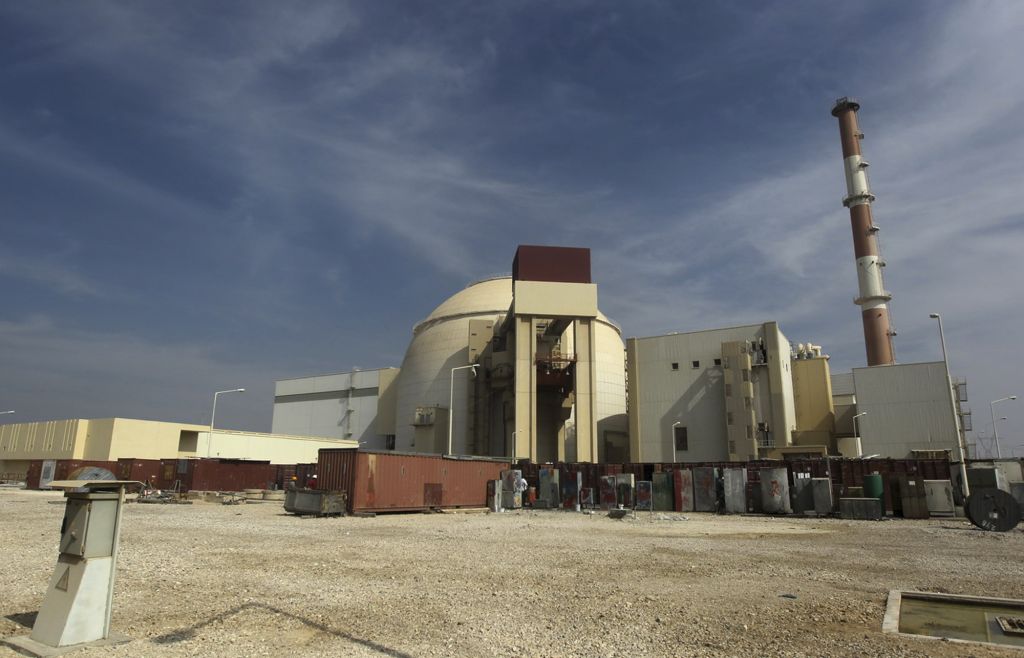
Mideast-Iran-Nuclear_Horo-1The reactor building of the Bushehr nuclear power plant is seen just outside the southern city of Bushehr, Iran (photo credit: AP/Mehr News Agency/Majid Asgaripour/File)

AP — A rising chorus of Israeli voices is again raising the possibility of carrying out a military strike on Iran’s nuclear facilities in what appears to be an attempt to draw renewed attention to Tehran’s atomic program — and Israel’s unhappiness with international negotiations with the Iranians.

In recent days, a series of newspaper reports and comments by top defense officials have signaled that the military option remains very much on the table. While Israeli officials say Israel never shelved the possibility of attacking, the heightened rhetoric marks a departure from Israel’s subdued approach since six world powers opened negotiations with Iran last November.

Prime Minister Benjamin Netanyahu has been an outspoken critic of the international efforts to negotiate a deal with Iran. He has spent years warning the world against the dangers of a nuclear-armed Iran and fears a final deal will leave much of Iran’s nuclear capabilities intact.

But since the global powers reached an interim agreement with Iran last November, Netanyahu’s warnings about Iran have been largely ignored. A frustrated Israeli leadership now appears to be ratcheting up the pressure on the international community to take a tough position in its negotiations with Iran.

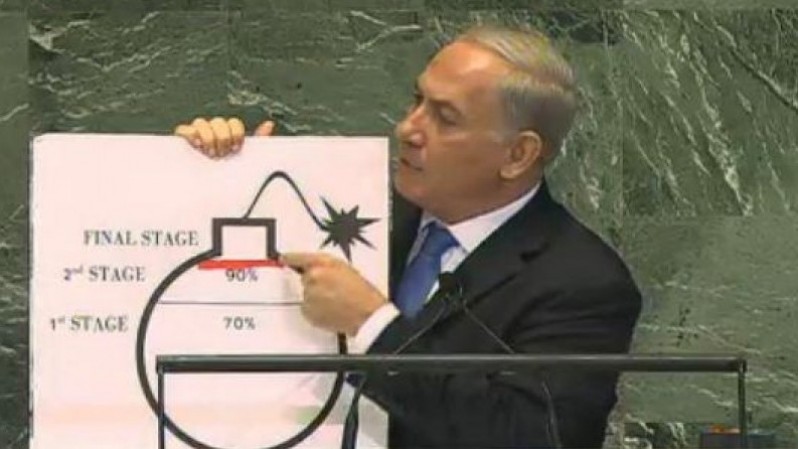
RedLine-1Prime Minister Benjamin Netanyahu sets out his ‘red line’ for Iran on a cartoon bomb drawing during a speech to the United Nations General Assembly, Sept. 27, 2012 (photo credit: Avi Ohayun, GPO)

A front-page headline in the daily Haaretz on Thursday proclaimed that Netanyahu has ordered “to prep for strike on Iran in 2014″ and has allocated 10 billion shekels (2.87 billion dollars) for the groundwork. Earlier this week, Defense Minister Moshe Ya’alon hinted that Israel would have to pursue a military strike on its own, with the US having chosen the path of negotiations. And the military chief, Lt. Gen. Benny Gantz, said this week that Iran “is not in an area that is out of the military’s range.”

An Israeli military strike would be extremely difficult to pull off, both for logistical and political reasons. Any mission would likely require sending Israeli warplanes into hostile airspace, and it remains unclear how much damage Israel could inflict on a program that is scattered and hidden deep underground. In addition, it would likely set off an international uproar, derail the international negotiations and trigger retaliation on Israeli and US targets.

Yoel Gozansky, an Iran expert at the Institute of National Security Studies, a Tel Aviv think tank, said the comments were meant as a wake-up call to the world.

“It was in a coma. It has awoken suddenly,” he said of the military-option talk. “Someone has an agenda to bring up this subject again, which has dropped off the agenda in recent months, especially after the deal with Iran.”

Netanyahu has long been at odds with his Western allies over how to dislodge Iran from its nuclear program. He has called the interim agreement a “historic mistake,” saying it grants Iran too much relief while getting little in return, and fears a final agreement would leave Iran with the capability to make a bomb.

Israel believes that Iran is trying to build a nuclear weapon, a charge Iran denies. Israel says a nuclear-armed Iran would pose an existential threat to the Jewish state, citing Iranian calls for Israel’s destruction, its development of long-range missiles and its support for hostile militant groups.

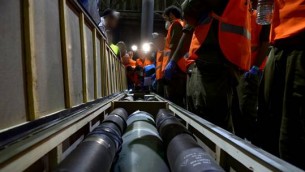
KLOSCIsraeli security forces inspect containers of missiles uncovered onboard the Klos-C earlier this month (photo credit: IDF Spokesperson)

During a swing through Washington early this month, Netanyahu tried to draw attention to the Iranian issue in stops at the White House and in an address to AIPAC, the pro-Israel lobbying group. Israel then engaged in a six-day PR blitz when naval commandos seized a ship in international waters that was carrying dozens of sophisticated rockets Israel said were bound for militants in the Gaza Strip and sent by Iran. The effort was capped by a display of the seized weapons.

But beyond placid acknowledgments from world leaders, the ship’s seizure did little to change the course of negotiations with Iran.

Netanyahu said the world’s indifference to the naval raid was “hypocritical,” and he lashed out at Western leaders for condemning Israeli settlement construction while ignoring Iran’s transgressions.

Netanyahu’s past warnings have been credited with bringing the Iran issue to the fore and galvanizing world powers to take action on the nuclear program. He made headlines in 2012 when he drew a red line on a cartoon bomb during his speech at the UN General Assembly.

Yaakov Amidror, who recently stepped down as Netanyahu’s national security adviser, said the threat of a military strike is a real possibility.

“We aren’t playing a game of neighborhood bully. This is a stated policy of the state of Israel and has been made clear … to anyone who meets Israel’s representatives.”

But if Israel is trying to raise the alarm again, the move comes at an inopportune time. The urgency of the Iran issue has taken a backseat to more pressing international crises, namely Russia’s annexation of the Crimea peninsula. With world powers charging forward with negotiations with Iran, threats from Israel are likely to be ignored at best. At worst, they could alienate Israel’s closest allies.

Gozansky said the renewed threats were largely empty because if Israel carried out a strike with diplomacy underway, it would be seen as a warmonger out to destabilize the region. But he said the threats could nonetheless serve as leverage on Iran while it conducts talks. Netanyahu has suggested that may be the case.

“The greater the pressure on Iran,” he said in his speech to AIPAC, “the more credible the threat of force on Iran, the smaller the chance that force will ever have to be used.”

Off Topic: Negotiating against ourselves

March 21, 2014

Negotiating against ourselves, Israel Hayom, David M. Weinberg, March 21, 2014

(If not against herself, against what? The “flexible” Obama Administration? Its flexibility has tended to be against Israel, see Kerry on the Jewish State.– DM)

There is nothing “final” about any framework with the Palestinians. They always “pocket” Israel’s concessions, and press for more as the price for “implementation” on their part or as the price of “buying in” other Palestinian factions. This has been the repeated pattern of Israeli-Palestinian negotiations, after each of the Oslo-era accords.

The “framework” for Israeli-Palestinian peace that U.S. Secretary of State John Kerry seeks to promulgate sounds an awful lot like the “shelf agreement” concept of 2008. Then, as now, conceptual agreements have proven to be a disincentive, not an incentive, to Palestinian political maturation and moderation. They create a situation where Israel ends up negotiating against itself with a phantom Palestinian partner.

Let’s go back into the peace process archives, and remind ourselves: In 2008, former U.S. Secretary of State Condoleezza Rice discovered that Palestinian leaders (then, as now, Mahmoud Abbas and coterie) were completely unable to deliver on any of their obligations under the celebrated “Road Map” — which outlined a cautious and logical step-by-step approach to peace.

So instead of focusing on the messy here and now, Rice hit on the idea of turning to the future. She sought to advance a “shelf agreement” for Israeli-Palestinian peace. The newfangled “shelf agreement” idea was to give the Palestinians a clear picture of the big prize awaiting them in the future; what Rice called a “political horizon.”

Israel was to negotiate an “agreement-in-principle” on an endgame solution with Palestinians, but then place this agreement out of reach — high up on a “shelf” where the Palestinians could see it, but not yet attain it. The concept was that this transcendent trophy — the horizon — would come down off the shelf and be activated only when the Palestinians would mature and fulfill all their “implementation” obligations.

Moderate Palestinians, it was said, would be strengthened by the shelf agreement, and then be able to do the difficult things demanded of them in the accord — such as confronting the terrorists in their midst and building reliable institutions of uncorrupt government.

This made for nice, but seriously flawed, diplomatic thinking.

This plan was based on an assumption — actually, a fantasy — that Palestinians would be encouraged to play according to the rules of the game in order to attain their prize; that the “horizon” fashioned by the agreement would provide an overwhelming incentive for Palestinians to live up to the terms of the agreement.

Unfortunately, the opposite proved to be true. The more the world talked positively and definitively about Palestinian statehood, the more the Palestinians sought to grab statehood unilaterally and force Israel to forgive the Palestinians on their implementation obligations.

And in fact, the Palestinian Authority has spent the years since 2008 defiantly “climbing up the shelf” to independently snatch their “horizon” and have their state willed into existence by the international community without having completed the promised chores on security and democratic reform.

Thus Israel has found itself in a situation where it has become well-nigh impossible to block the emergence of a runaway Palestinian state that has not delivered on many of the key commitments that constitute Israel’s security safeguards.

In short, “shelf” agreements have not led to greater Palestinian moderation and cooperation with Israel. And while a “framework declaration” by Kerry is not exactly like the “shelf agreement” sought by Rice, the dynamic is the same. Each places Israel at a diplomatic disadvantage.

In fact, there is little basis for believing that even if the PA is “strengthened” by the halo of Kerry-calibrated framework that further solidifies the contours of Palestinian statehood, Abbas will have the resolve to bite the bullet on the critical issues important to Israel.

There is no indication that the Abbas government, or any future PA governing coalition, will be willing to explain to its public that the West Bank (including the Jordan Valley and eastern Jerusalem) must be shared, that the “right” of refugee return must be set aside, and that Israel is the rightful, legitimate homeland of the Jewish People.

There is an additional problem with Kerry’s framework concept. The framework assumes best case scenarios regarding the intentions and capabilities of a future Palestinian state. Aside from the fact that this may have no basis in reality, it is tactically counter-intuitive and strategically unwise. Rather, endgame talks must take into account all worst-case scenarios.

Any defense lawyer conducting a negotiation on behalf of a client will tell you that an agreement will be durable only if safeguards are built-in that ensure the agreement’s ability to withstand most performance failures. For Israel specifically, this means a wide margin of error on security matters if the Palestinian state fails to staunch terrorism against Israel.

But how can Israel, for example, sign onto a sustainable endgame “framework” with workable border crossing arrangements if it does not know the character or capabilities of the future Palestinian entity, and all it can do is assume the “nice” qualities of such?

The type of Israel army-police presence needed at the border checkpoints depends on the reliability and capabilities of the Palestinian partner. Yet the framework approach throws the requirement for Palestinian reform and performance into the amorphous future, and thus Israel has no way of professionally knowing now how to calibrate its minimum security needs on the borders.

This is just one example. There are hundreds of similar matters that currently cannot be assessed, because Israel is negotiating against itself in a vacuum with a phantom Palestinian partner. Israel is seeking to will into existence a “moderate, stable, capable and democratic” Palestinian government that does not yet exist in the West Bank, not to mention in Gaza.

Contrary to the framework approach, it should be obvious that an endgame agreement can be negotiated only the other way around: With a Palestinian partner that has proven its mettle over time.

Kerry’s framework approach unhappily fails a third critical test: it ignores the historical record. Alas, experience attests that with the Palestinians, negotiations are never over.

Even if Israel and the PA were to grasp the fabled horizon, and royally set a grand “final status” framework in a jeweled case high up on a shelf of honor, experience shows that the Palestinians would not really settle on that framework or work towards its implementation. Instead, they would proceed to bargain with Israel for additional concessions as the price of implementation.

For example, if Israel promises to forgo half of Jerusalem and dozens of Jewish towns in Judea and Samaria, it might still be expected to yield further concessions in order “to keep the process alive and the Palestinian moderates in power.”

And thus, Washington and the world community will demand that Israel go beyond the “ultimate” sacrifices it already had made in order to secure the framework or keep the horizon glowing.

Indeed, this week Abbas issued just such a demand: that Israel release hundreds more Palestinian prisoners in exchange for Palestinian agreement to extend talks on Kerry’s framework.

In sum, there is nothing “final” about any framework with the Palestinians. They always “pocket” Israel’s concessions, and press for more as the price for “implementation” on their part or as the price of “buying in” other Palestinian factions. This has been the repeated pattern of Israeli-Palestinian negotiations, after each of the Oslo-era accords.

Of course, there is also the Gaza conundrum. The push for an accord might have validity were it to offer the theoretical possibility of a real resolution that would rope in the vast majority of Palestinians. But that is no longer the case. With the military takeover of the Gaza Strip by the radical Islamic Hamas movement, Gaza has become a Palestinian mini-state unto its own, and it answers to no other Palestinian “Authority.” Hamas-Israel relations inevitably will yet involve additional significant military confrontation, a reality that will make Israeli-Palestinian rapprochement in the West Bank tenuous at best. Thus the two-state paradigm on which the “framework” concept rests seems an anachronism, for the moment.

In sum, the impatient hunt for a “horizon” or “framework” with guaranteed outcomes is based on faulty, and for Israel, dangerous assumptions. Contrary to the hopes of its advocates, it will likely prove a disincentive to the steps required of the parties that might lead to real peace.

Unfortunately, Washington seems to have lost patience with toughing it out the old-fashioned way: building confidence between the parties by measured, verifiable and concrete steps along a long road towards stability. Such a performance-based peace process remains the only proven and sustainable model towards a durable final settlement.