Archive for March 2014

Off Topic: Egyptian court bans Hamas

March 4, 2014

Egyptian court bans Hamas | The Times of Israel.

Islamist terror group blasts move against ‘the resistance,’ says Cairo ‘serves the Israeli occupation’

March 4, 2014, 11:48 am

Palestinian Hamas security guards walk near an Egyptian watch tower on the border with Egypt in Rafah, southern Gaza Strip, on July 5, 2013 (photo credit: Abed Rahim Khatib/Flash90)

Palestinian Hamas security guards walk near an Egyptian watch tower on the border with Egypt in Rafah, southern Gaza Strip, on July 5, 2013 (photo credit: Abed Rahim Khatib/Flash90)

A Cairo court has ordered a ban activities by the Palestinian Islamist group Hamas in Egypt, branding it a terror organization. The court also ordered that Hamas offices in the country be shut down and all dealings with the group suspended.

Hamas blasted the move as ”an attempt to besiege the resistance.” A senior Hamas official told the AFP that the ban “serves the Israeli occupation.”

Egypt’s relations with Hamas have sharply deteriorated since the military removed Islamist leader Mohammed Morsi last July. Hamas, which rules neighboring Gaza Strip, is a Palestinian offshoot of Morsi’s Muslim Brotherhood movement.

Morsi and scores of Brotherhood leaders are in detention, facing a multitude of trials on charges that carry the death penalty.

Two of those cases involve Hamas members, accused of assisting Morsi and others in escaping from prison in 2011. Morsi and others are also charged in a separate trial of leaking state secrets to Hamas.

Since the military regained power in Egypt, it has moved to severely curtail militant Islamic activity in the country and is engaged in an ongoing struggle against terrorists in the Sinai Peninsula. Egypt has also engaged in a campaign to destroy smuggling tunnels between Gaza and Sinai that Hamas uses to bring in supplies, weapons and other items.

Earlier this week, Hamas accused Egypt of “allying with the [Israeli] occupation” by discussing the appeal to classify it as a terror organization.

On December 25, the military-backed Egyptian government declared the Muslim Brotherhood a terror group, having toppled its government six months earlier. Hamas said it was the first time in history that an Arab court would discuss such a claim, calling it “a violation of all national norms.”

“Classifying Hamas as a terror organization is a Zionist classification,” Hamas charged in a press release posted on its website Sunday. “The tendency of some to adopt such a classification expresses an alliance with the occupation and support of it … what is expected of our nation is to support the Palestinian resistance, not try it.”

In addition to Israel, the United States, Canada, the European Union and Japan all include Hamas in their lists of terror organizations.

Analysis: Putting it all on Netanyahu’s shoulders

March 4, 2014

Analysis: Putting it all on Netanyahu’s shoulders | JPost | Israel News.

By HERB KEINON

03/04/2014 07:10

If Netanyahu were to make tough decisions, then peace would flow through the region like the Jordan River in the middle of a rainy winter, many believe.

The first words out of Prime Minister Binyamin Netanyahu’s mouth when he landed in Washington late Sunday evening were pretty innocuous.

“The tango in the Middle East needs at least three,” he said, using this particular dance metaphor for the umpteenth time.

“For years there have been two – Israel and the US. Now it needs to be seen if the Palestinians are also present.”

Taken on their own, these words were unremarkable; rather bland stuff. But they cannot be taken on their own.

No, they must be seen in the context of the interview US President Barack Obama gave Bloomberg’s Jeffrey Goldberg that was published as Netanyahu was flying somewhere over the Atlantic Ocean on his way to Washington.

In that interview Obama seemed to place the entire onus of responsibility for making a deal with the Palestinians on Netanyahu’s shoulders. In this construct, if Netanyahu would just make the tough decisions, then peace would flow through the region like the Jordan River in the middle of a rainy winter.

In looking at the situation, Obama cited some homespun wisdom imparted to him by his mother: “If there’s something you know you have to do, even if it’s difficult or unpleasant, you might as well just go ahead and do it, because waiting isn’t going to help. When I have a conversation with Bibi, that’s the essence of my conversation: If not now, when? And if not you, Mr. Prime Minister, then who? How does this get resolved?” To which Netanyahu, when he landed, essentially replied, “Mr. President, it takes three to dance. We’re there; are the Palestinians?” What was striking about Obama’s construct was that it appeared just a few hours after US Secretary of State John Kerry made a point, in an interview with NBC’s Meet the Press, to stress that there are indeed expectations of the Palestinians.

Asked whether Monday’s meeting with Obama was Netanyahu’s moment of truth, whether he has “to act for the peace process to be successful,” Kerry responded – in stark contrast to Obama’s theme – that “everybody has to act.”

“This isn’t just a question or a series of questions for Prime Minister Netanyahu,” Kerry said. “He’s been very courageous and he’s made tough decisions with respect to entering into these negotiations and some of the things that he’s indicated he’s willing to do in the negotiations. It’s also up to [Palestinian Authority] President [Mahmoud] Abbas. The Palestinians need to decide whether or not they’re prepared to compromise, whether or not they’re willing to do some of the things necessary. This is not a burden exclusive to one party or the other.”

While Obama said that Kerry briefed him almost every week on the Middle East process, apparently one briefing point that he missed – or did not accept – was that it is not all up to Netanyahu, and that whether this current stab at an agreement has any more chance of success than previous tries depends not only on what Netanyahu is willing to give, but also – to the same degree – on what Abbas is willing to give.

Netanyahu was not the only one who read with great interest Obama’s interview, and responded to it immediately.

So did Abbas.

Abbas had to like what he heard, especially about the settlements and the likelihood of international pressure on Israel if the process falls apart.

“If you see no peace deal and continued aggressive settlement construction – and we have seen more aggressive settlement construction over the last couple years than we’ve seen in a very long time – if Palestinians come to believe that the possibility of a contiguous sovereign Palestinian state is no longer within reach, then our ability to manage the international fallout is going to be limited,” Obama said.

“In today’s world,” he continued, “where power is much more diffuse, where the threats that any state or peoples face can come from non-state actors and asymmetrical threats, and where international cooperation is needed in order to deal with those threats, the absence of international goodwill makes you less safe. The condemnation of the international community can translate into a lack of cooperation when it comes to key security interests. It means reduced influence for us, the United States, in issues that are of interest to Israel. It’s survivable, but it is not preferable.”

Obama, in his first meeting with Netanyahu in the Oval Office in May 2009, made settlements the issue and called for a settlement freeze. The Palestinians, who until that point had never made a total settlement freeze – including in areas beyond the Green Line in Jerusalem – a condition for negotiations, heard Obama and pounced. If this was what the American president was saying, how could they ask for anything less? This essentially killed negotiations for four years.

Now, again, Obama struck the settlement chord, and not only did he hit it, but he coupled this with hints of serious trouble for Israel in the international arena – in international organizations – if Israel does not concede this point.

Abbas got the message, and it didn’t take him 12 hours before he pounced, telling Meretz head Zehava Gal-On, with whom he met in Ramallah, “If the American framework does not resolve fundamental principles on core issues, we will not permit extending the talks, and we will turn to international organizations.”

He also heard what Obama said about the settlements, throwing into the mix new conditions for extending negotiations after Kerry presents a framework agreement.

“The only way we would agree to extend the talks would be if Netanyahu declares a settlement freeze and agrees to free more prisoners beyond the next round, including women, young people, and administrative detainees,” he said.

Obama’s interview, as Goldberg said in a Channel 2 interview Monday night, might have been aimed at showing the Palestinians, who believe Kerry is giving too much to Israel in the framework document, that he is willing to pressure Israel.

Abbas is coming to Washington next week for his own talks with Obama. What will be telling is whether that meeting will be preceded by another Obama interview, only this time one in which Obama publicly takes Abbas to task over issues such as incitement and refusal to recognize Israel as the nation-state of the Jewish people.

What will be telling is whether in that interview Obama will say, “When I have a conversation with Abu Mazen, that’s the essence of my conversation: If not now, when? And if not you, Mr. President, then who? How does this get resolved?

McCain pans Obama’s ‘feckless’ policy on Iran, Syria, Ukraine

March 4, 2014

McCain pans Obama’s ‘feckless’ policy on Iran, Syria, Ukraine | The Times of Israel.

‘Nobody believes in America’s strength anymore,’ veteran senator who lost 2008 presidential bid tells AIPAC

March 3, 2014, 6:33 pm

US Senator John McCain, R-AZ, delivers remarks during the morning general session of the American Israeli Political Action Committee Conference in Washington, DC, Monday, March 3, 2014. (photo credit: AFP/Jim Watson)

WASHINGTON — Senator John McCain used his address to the AIPAC conference here Monday to launch a bitter attack on what he called the lack of US leadership in foreign policy under President Barack Obama.

The Arizona senator, who was defeated by Obama in the presidential race of 2008, said the current situation in Ukraine, the failure to support reformists in Iran in 2009, and the decision not to intervene in Syria after President Bashar Assad used chemical weapons against his own people, all reflected “a feckless foreign policy where nobody believes in America’s strength anymore.”

While Obama might want to believe that the Cold War is over, said McCain, Russian President Vladimir Putin does not. That’s why Putin was intervening in Ukraine, and that’s why Putin was “assisting Assad’s slaughter” of the Syrian people by sending planeloads of weaponry to Damascus.

Obama’s public flip-flop about punitive action against Assad last summer sent a message of weakness that resonated “around the world,” McCain charged.

If Assad prevails in the civil war, he said, that would “directly endanger the security of Israel.” The war was already destabilizing Jordan, he noted. “The whole situation cries out for American leadership, and I’m sorry to tell you, it’s MIA.”

On Iran, McCain urged a vote now on new sanctions to take effect if the current talks on a permanent resolution over Iran’s rogue nuclear weapons program fail. Iran has the right to peaceful nuclear energy, he stressed, but that did not require industrial enrichment capacities, a heavy water rector, sophisticated centrifuges, “and nuclear facilities dug deep into mountains.”

He lamented that “the president of the United States didn’t say a word” when domestic opponents of the Iranian regime sought support in 2009, and warned that Iran remains “categorically devoted” to the destruction of Israel.

Strikingly, McCain made no reference in his address to the Israeli-Palestinian conflict.

With Putin making trouble, Obama goes easy on Netanyahu

March 4, 2014

With Putin making trouble, Obama goes easy on Netanyahu | The Times of Israel.

Despite the harshly worded interview he gave last week, the US president takes a softer tone in meeting with PM

March 4, 2014, 7:09 am

US President Barack Obama listens as Prime Minister Benjamin Netanyahu speaks in the Oval Office of the White House in Washington, Monday, March 3, 2014 (photo credit: AP/Pablo Martinez Monsivais)

US President Barack Obama listens as Prime Minister Benjamin Netanyahu speaks in the Oval Office of the White House in Washington, Monday, March 3, 2014 (photo credit: AP/Pablo Martinez Monsivais)

The Ukraine crisis changed everything. After the unusually harsh comments US President Barack Obama made in an interview with Jeffrey Goldberg last week – it was published on Sunday — Prime Minister Benjamin Netanyahu was expected to receive another verbal lashing Monday in the Oval Office. But Obama’s tone was surprisingly gentle.

The president’s statement made immediately prior to his meeting with Netanyahu sounded quite different from the interview, in which Obama chastised the prime minister for “continued aggressive settlement construction,” warned that the US might no longer be able to protect Israel in the international arena, and predicted that “the window is closing for a peace deal.”

Obama did not radically change his position from one day to the next, neither on Iran nor on the peace process. Some “tough decisions are going to have to be made,” he told Netanyahu Monday in the White House, and difficult compromises will have to be made to reach an agreement with the Palestinians.

While his views have stayed the same, the difference in tone was drastic. And this despite the Israeli government’s announcement that settlement construction increased by 123% in 2013 compared to the previous year, which could have potentially given the president even more ammunition to attack the prime minister.

According to Goldberg, Obama was ready to tell Netanyahu that if he failed to endorse an American peace plan, Israel “could face a bleak future — one of international isolation and demographic disaster.”

And yet, at least in the public statements the two leaders made before their nearly three-hours-long meeting, it didn’t look like the president was about to berate Netanyahu with a lecture on settlements — or on anything else that could ostensibly indicate Israel’s intransigence, for that matter. Obama did not utter the word “settlements” a single time on Monday during his public remarks.

Obviously, the president knows not to offend his guests by attacking and accusing them in person. But there’s more to the sudden change of tone. Obama’s interview with Goldberg took place last Thursday, before the Russian-Ukrainian crisis escalated. By Monday, Obama understood that Russian President Vladimir Putin was serious about his ambitions regarding Crimea, and that a possible military showdown near the Black Sea could become the defining moment of his presidency.

The US public isn’t really that worried about Iran becoming a nuclear threshold state, and the fact that Bashar Assad is still killing in Syria doesn’t keep many Americans awake at night. While in the eyes of Israelis, and the Sunni Arab states in the region, Obama is a weak leader who cannot be trusted to enforce the red lines he occasionally draws, when he has no other choice, the average Joe in the US has other worries.

But the Crimea crisis, a throwback to the Cold War, is a different ballgame. Putin’s challenge to the West, and particularly the US — which has vowed that “there is a huge price to pay” for violating Ukrainian sovereignty – is a bigger headache for Obama than the entire Middle East. And the last thing the president needs right now is a public spat with Netanyahu, who enjoys near-universal admiration in Congress. And Obama might need Congress if he is to act decisively against Moscow’s territorial appetite in Eastern Europe.

Does that mean that the US administration is going to decrease pressure on Israel in the coming weeks and months? Certainly not. As Washington prepares to get Israelis and Palestinians to sign on to a framework agreement that would allow the sides to continue negotiations toward a final-status peace accord, Obama and Secretary of State John Kerry will be relentless in trying to get Netanyahu to show flexibility and make concessions. But as long as the specter of war looms in Europe, and Ukrainians and Europeans look to the leader of the free world to counter Russian provocations, Obama will be careful not to open other unnecessary fronts.

Ukraine casts shadow over US-Israel talks on Iran

March 4, 2014

Ukraine casts shadow over US-Israel talks on Iran | The Times of Israel.

Watching developments in Crimea, some officials ponder its meaning for stopping Tehran’s nuclear program

March 4, 2014, 2:28 am

US President Barack Obama talks on the phone in the Oval Office with Russian President Vladimir Putin about the situation in Ukraine, Saturday, March 1, 2014 (photo credit: Pete Souza/White House/Flickr )

US President Barack Obama talks on the phone in the Oval Office with Russian President Vladimir Putin about the situation in Ukraine, Saturday, March 1, 2014 (photo credit: Pete Souza/White House/Flickr )

‘He’s asking us to trust him. Now we’re watching Ukraine and wondering,” a senior member of the Israeli government told The Times of Israel on Monday, speaking about US President Barack Obama’s response to the Russian incursion in the Crimea this week.

The official noted that the United States has a defense agreement with Ukraine, the 1994 Budapest Memorandum signed by President Bill Clinton and Russian President Boris Yeltsin, which affirms that “The United States of America, the Russian Federation, and the United Kingdom of Great Britain and Northern Ireland, reaffirm their commitment to Ukraine…to respect the Independence and Sovereignty and the existing borders of Ukraine.”

The Israeli skepticism mirrors criticism of the Obama administration from some domestic critics.

The Ukraine crisis “is directly related to what happens in the Middle East,” Senator John McCain (R-AZ) told the AIPAC Policy Conference in Washington on Tuesday. The crisis “is the ultimate result of a feckless foreign policy where nobody believes in America’s strength anymore,” charged McCain.

That message resonates with Israeli political leaders.

“There’s a limit to what the president [Obama] can ask of us if America isn’t willing to stand by its promises,” the Israeli official said.

But that concern, while it reflects continued skepticism over American dependability on the world stage on the part of much of the Israeli political leadership, is not necessarily shared by defense officials. One senior Israeli defense official said the American equivocation on Ukraine was understandable.

“We shouldn’t be too quick to apply lessons from Ukraine to Israel,” said the official on Monday. “Crimea has been an overriding strategic imperative for Russia for centuries. They have a military base there. So what’s America going to do? Send troops?”

That’s a very different situation from the Israel-Iran standoff, the official added.

McCain, too, acknowledged the lack of a military option.”I have to be very honest with you,” he told the pro-Israel lobby Tuesday. “There is not a military option that can be exercised now. But the most powerful nation in the world should have plenty of options,” he insisted, calling for personal and economic sanctions to be levied against Russia and its leaders.

Prime Minister Benjamin Netanyahu is in Washington Tuesday for talks with Obama over the Iranian nuclear issue and US-brokered Israeli-Palestinian peace talks.

The visit is marked by increasing tensions between the two leaders, with the American leader openly chastising the Israeli government over West Bank settlement construction and the slow pace of negotiations, while the Netanyahu government has vociferously protested US-led nuclear talks between Western powers and Iran.

Iran says Obama remarks damage nuclear talks

March 4, 2014

Iran says Obama remarks damage nuclear talks, Trend, March 4, 2014

(She provided no specificity as to which of President Obama’s remarks she had in mind. She also failed to allude to his demands that all Israeli and U.S. television stations weekly broadcast simulations of joint Israeli and U.S. nuclear attacks on Tehran. What? He didn’t? Oh. — DM)

Afkham stressed non-militaristic nature of Iranˈs peaceful nuclear program and underlined that Iran, by protecting its legitimate rights upon international treaties, has maintained its nuclear program structure and will continue its peaceful activities upon its programs.

Iran FM spokesperson

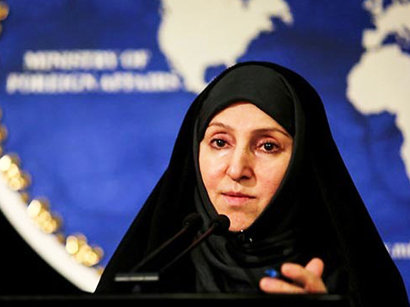
Foreign Ministry Spokeswoman, in reaction to remarks of US President in an interview with a US newspaper, said that ambiguous remarks of President Obama will cause continuation of mistrust and damage nuclear talks, IRNA reported.

According to the report of Foreign Ministry Media Department on Monday evening, Marzeiyeh Afkham added that part of President Obamaˈs remarks was contradictory to the international law principles and is opposed to the spirit of diplomatic talks.

Another part of President Obamaˈs remarks was an illusion about Iranˈs motive to attend the diplomatic dialogues, said Afkham.

She added that such remarks have lost their effects in the international atmosphere.

Afkham stressed non-militaristic nature of Iranˈs peaceful nuclear program and underlined that Iran, by protecting its legitimate rights upon international treaties, has maintained its nuclear program structure and will continue its peaceful activities upon its programs.

Referring to certain efforts to damage Iranˈs relations with its neighbors through Iranophobia, Afkham underlined that such a policy had no results in the past and will never have any in the future.

She also referred to efforts by certain pressure groups and Israel lobby to have an effect on the US foreign policy.

She said unfortunately it seems that the US government is under influence of such radical viewpoints and this has increased pessimism of the Muslim nations toward the USA.

Off Topic: The President’s Prophetic Threats to Israel

March 4, 2014

The President’s Prophetic Threats to Israel, Commentary Daily, , March 2, 2014

(President Obama must view the “peace process” as wonderful in and of itself, no matter where — if anywhere — it may lead; like the P5+1 “negotiations” with Iran. Does he live in a world of fantasy?– DM)

The Palestinians, in Obama’s view, do not actually need to make changes; astonishingly, he says, they’re ready for peace. . . . Rather, they are still engaging in a pseudo-national fantasy about Israel’s disappearance or destruction. 

In an extraordinary—and I don’t use the word in a complimentary way—interview with Jeffrey Goldberg of Bloomberg, President Obama follows his secretary of state in warning Israel and its leader that a failure to “make peace” now with the Palestinians will have terrible consequences. Israel is “more isolated internationally,” and will become more so; there will be more Palestinians and Israeli Arabs as time goes on, not fewer, so Israel had better move now; and not to move now is to create the conditions for a “permanent Israeli occupation of the West Bank….there comes a point when you cannot manage this anymore.”

The wild logical contradictions in his remarks expose the degree to which the American approach in the Kerry peace talks is to haunt Israel with the dire nightmare it will face should the talks fail; Palestinian rejectionism plays almost no role in the Obaman calculus here.

The Palestinians, in Obama’s view, do not actually need to make changes; astonishingly, he says, they’re ready for peace. “The Palestinians,” the president says, overlooking every piece of polling data we have about the opinions of the Palestinians, “would still prefer peace. They would still prefer a country of their own that allows them to find a job, send their kids to school, travel overseas, go back and forth to work without feeling as if they are restricted or constrained as a people. And they recognize that Israel is not going anywhere.”

Ah. So that 2011 poll that says 60 percent of the Palestinians reject a two-state solutionis bunk—a poll whose findings have not been  contradicted since. If Palestinians refuse to accept a two-state solution, they do not “recognize that Israel is not going anywhere.” Rather, they are still engaging in a pseudo-national fantasy about Israel’s disappearance or destruction. And they are so eager for peace and coexistence with Israel that they remain the only significant Muslim population that still has a favorable view of suicide bombings, according to a Pew survey.

“The voices for peace within the Palestinian community will be stronger with a framework agreement,” the president says. But why would the “voices for peace” need to be “stronger” if they reflect the actual views of the Palestinian people? They should be more than strong enough on their own now. Indeed, if they are so strong, we would not be hearing repeated denunciations of the “framework” process from Palestinian negotiators.

The president’s fantasies about the Palestinians also  involve Mahmoud Abbas, president of the Palestinian Authority. “I think,” he says, “nobody would dispute that whatever disagreements you may have with him, he has proven himself to be somebody who has been committed to nonviolence and diplomatic efforts to resolve this issue.” Nobody would dispute? In 2008, offered a peace deal by then-Israeli Prime Minister Ehud Olmert that involved Abbas actually drawing a new West Bank map giving the Palestinians something between 92 and 95 percent of the territory, Abbas basically fled the table and didn’t return. Granted, he didn’t do what Yasser Arafat did after a similar deal at Camp David in 2000 and begin the second intifada, but this hardly demonstrates a commitment to a diplomatic effort—except for one that fails.

So the Palestinians, in the president’s view, are all in. It’s really quite wonderful, in fact: “You’ve got a partner on the other side who is prepared to negotiate seriously, who does not engage in some of the wild rhetoric that so often you see in the Arab world when it comes to Israel, who has shown himself committed to maintaining order within the West Bank and the Palestinian Authority and to cooperate with Israelis around their security concerns — for us to not seize this moment I think would be a great mistake.”

Yes, the PA is such a partner for peace that even with negotiations going on, it celebrates acts of violence against Israel on a constant basis, as this report details.

Not to mention the little wrinkle that Abbas doesn’t speak in any way for half of the Palestinian polity, the half living under the terrorist group Hamas in Gaza. Ah, but that’s no problem, in the president’s view. “There would still be huge questions about what happens in Gaza,” the president says, “but I actually think Hamas would be greatly damaged by the prospect of real peace.” Really! Unlike Abbas, who has not faced Palestinian voters since 2004, Hamas actually won a free election in the past decade and its unquestioned commitment to Israel’s destruction is clearly shared by the people who live under its aegis. They do not want peace.

All of this is folderol, anyway, because the president clearly thinks peace is solely Israel’s to make, and basically, Binyamin Netanyahu should listen to Obama’s mother and rip off the band-aid: “One of the things my mom always used to tell me and I didn’t always observe, but as I get older I agree with — is if there’s something you know you have to do, even if it’s difficult or unpleasant, you might as well just go ahead and do it, because waiting isn’t going to help. When I have a conversation with Bibi, that’s the essence of my conversation: If not now, when? And if not you, Mr. Prime Minister, then who?”

Now that’s some chutzpah right there, because of course the president is invoking the words of Hillel, the ancient Jewish sage, as a rhetorical tool against the Israeli prime minister. Of course, Obama leaves out the key words of Hillel’s famed plaint, which are: “If I am not for myself, then who will be for me?” Israel must be for itself, because there is almost no country left in the world that will be for it; while the president says the American commitment to Israel is “rock-solid,” clearly he does not believe it will necessarily be so in the future…nor should it be.

Says the president of Netanyahu, “if he does not believe that a peace deal with the Palestinians is the right thing to do for Israel, then he needs to articulate an alternative approach. And as I said before, it’s hard to come up with one that’s plausible.” That’s ridiculous. A peace deal with the Palestinians is of course the right thing to do for Israel. But if there can be no peace deal, or can be no peace deal that does not pose a severe danger to Israel’s survival, then it is not the right thing to do.

The only “plausible” thing to do is to challenge the Palestinians to cure themselves of their psychotic political culture and become a rational actor with whom a true peace can be made. Is that a tragedy? It sure is. Sometimes there are tragedies, and they must be faced realistically, not wished away.

One thing that cannot be wished away is the president’s insistence on placing the burdens on Israel. This is something else his apologists can no longer wish away.

President Obama’s foreign policy is based on fantasy

March 4, 2014

President Obama’s foreign policy is based on fantasy, Washington Post, by Editorial Board, March 2, 2014

(“Editorials represent the views of The Washington Post as an institution, as determined through debate among members of the editorial board.”  The article is interesting principally because of its source: not merely presenting the views of one opinion writer but presenting those of the Washington Post, an often left-leaning newspaper, as an institution.. —  DM)

[A]s long as some leaders play by what Mr. Kerry dismisses as 19th-century rules, the United States can’t pretend that the only game is in another arena altogether. Military strength, trustworthiness as an ally, staying power in difficult corners of the world such as Afghanistan — these still matter, much as we might wish they did not. While the United States has been retrenching, the tide of democracy in the world, which once seemed inexorable, has been receding. In the long run, that’s harmful to U.S. national security, too.

FOR FIVE YEARS, President Obama has led a foreign policy based more on how he thinks the world should operate than on reality. It was a world in which “the tide of war is receding” and the United States could, without much risk, radically reduce the size of its armed forces. Other leaders, in this vision, would behave rationally and in the interest of their people and the world. Invasions, brute force, great-power games and shifting alliances — these were things of the past. Secretary of State John F. Kerry displayed this mindset on ABC’s “This Week” Sunday when he said, of Russia’s invasion of neighboring Ukraine, “It’s a 19th century act in the 21st century.”

That’s a nice thought, and we all know what he means. A country’s standing is no longer measured in throw-weight or battalions. The world is too interconnected to break into blocs. A small country that plugs into cyberspace can deliver more prosperity to its people (think Singapore or Estonia) than a giant with natural resources and standing armies.

Unfortunately, Russian President Vladimir Putin has not received the memo on 21st-century behavior. Neither has China’s president, Xi Jinping, who is engaging in gunboat diplomacy against Japan and the weaker nations of Southeast Asia. Syrian president Bashar al-Assad is waging a very 20th-century war against his own people, sending helicopters to drop exploding barrels full of screws, nails and other shrapnel onto apartment buildings where families cower in basements. These men will not be deterred by the disapproval of their peers, the weight of world opinion or even disinvestment by Silicon Valley companies. They are concerned primarily with maintaining their holds on power.

Mr. Obama is not responsible for their misbehavior. But he does, or could, play a leading role in structuring the costs and benefits they must consider before acting. The model for Mr. Putin’s occupation of Crimea was his incursion into Georgia in 2008, when George W. Bush was president. Mr. Putin paid no price for that action; in fact, with parts of Georgia still under Russia’s control, he was permitted to host a Winter Olympics just around the corner. China has bullied the Philippines and unilaterally staked claims to wide swaths of international air space and sea lanes as it continues a rapid and technologically impressive military buildup. Arguably, it has paid a price in the nervousness of its neighbors, who are desperate for the United States to play a balancing role in the region. But none of those neighbors feel confident that the United States can be counted on. Since the Syrian dictator crossed Mr. Obama’s red line with a chemical weapons attack that killed 1,400 civilians, the dictator’s military and diplomatic position has steadily strengthened.

The urge to pull back — to concentrate on what Mr. Obama calls “nation-building at home” — is nothing new, as former ambassador Stephen Sestanovich recounts in his illuminating history of U.S. foreign policy, “Maximalist.” There were similar retrenchments after the Korea and Vietnam wars and when the Soviet Union crumbled. But the United States discovered each time that the world became a more dangerous place without its leadership and that disorder in the world could threaten U.S. prosperity. Each period of retrenchment was followed by more active (though not always wiser) policy. Today Mr. Obama has plenty of company in his impulse, within both parties and as reflected by public opinion. But he’s also in part responsible for the national mood: If a president doesn’t make the case for global engagement, no one else effectively can.

The White House often responds by accusing critics of being warmongers who want American “boots on the ground” all over the world and have yet to learn the lessons of Iraq. So let’s stipulate: We don’t want U.S. troops in Syria, and we don’t want U.S. troops in Crimea. A great power can become overextended, and if its economy falters, so will its ability to lead. None of this is simple.

But it’s also true that, as long as some leaders play by what Mr. Kerry dismisses as 19th-century rules, the United States can’t pretend that the only game is in another arena altogether. Military strength, trustworthiness as an ally, staying power in difficult corners of the world such as Afghanistan — these still matter, much as we might wish they did not. While the United States has been retrenching, the tide of democracy in the world, which once seemed inexorable, has been receding. In the long run, that’s harmful to U.S. national security, too.

As Mr. Putin ponders whether to advance further — into eastern Ukraine, say — he will measure the seriousness of U.S. and allied actions, not their statements. China, pondering its next steps in the East China Sea, will do the same. Sadly, that’s the nature of the century we’re living in.

Russia reportedly gives Ukraine’s forces deadline to surrender in disputed Crimea region | Fox News

March 3, 2014

Russia reportedly gives Ukraine’s forces deadline to surrender in disputed Crimea region | Fox News.

Russia’s fleet has ordered Ukraine’s forces in the disputed Crimea Peninsula to surrender by 3 a.m. local time or “face a storm,” a Ukrainian defense ministry source says.

The source spoke to the Interfax news agency, according to Sky News.

The threat came hours after Ukraine’s new leaders called for Western nations to rally against Russia’s invasion of the peninsula, making a plea for economic and political support as Moscow continued to be defiant.

Ukrainian Prime Minister Arseniy Yatsenyuk insisted that Crimea remains Ukrainian territory despite the presence of thousands of Russian troops who have secured control over the region without suffering any casualties or firing a shot.

“Any attempt of Russia to grab Crimea will have no success at all. Give us some time,” he said at a news conference with British Foreign Secretary William Hague, who is visiting Kiev.

“For today, no military options [are] on the table,” he said, adding that what they urgently need is an economic and political support.

“Real support. Tangible support. And we do believe that our Western partners will provide this support,” he said.

Hague said on the BBC that Moscow would face “significant costs” for taking control of Crimea.

But Russian Foreign Minister Sergey Lavrov on Monday justified the use of Russian troops streaming into the neighboring Crimea region as a necessary protection for his country’s citizens living there.

The use of Russian troops is necessary “until the normalization of the political situation” in Ukraine, Lavrov said at an opening of a month-long session of the U.N. Human Rights Council in Geneva.

“We are talking here about protection of our citizens and compatriots, about protection of the most fundamental of the human rights — the right to live, and nothing more,” Lavrov said.

Ukraine has accused Russia of a military invasion and has called on the Kremlin to withdraw its troops. Lavrov dismissed the criticism, and said that “information is coming in about preparations for new provocations that are being committed, including against the Russian Black Sea fleet,” which is based in Crimea, a strategic peninsula now effectively under Russian control.

“Those who are trying to interpret the situation as a sort of aggression and threatening us with sanctions and boycotts, these are the same partners who have been consistently and vigorously encouraging the political powers close to them to declare ultimatums and renounce dialogue,” Lavrov said. “We call upon them to show a responsibility and to set aside geopolitical calculations and put the interests of the Ukrainian people above all.”

Lavrov will meet later Monday with U.N. Secretary General Ban Ki-moon to discuss the situation.

Lavrov called on Ukraine to return to the Feb. 21 agreement signed by pro-Russian President Viktor Yanukovych aimed at ending his country’s three-month political crisis. He fled after signing an agreement with the opposition and foreign ministers of France, German and Poland to hold early elections this fall and surrender much of his powers. But opposition supporters kept pushing for his immediate dismissal.

Lavrov said Yanukovych kept up the agreement, but criticized the opposition, saying they “did nothing.”

“The illegal arms have not been relinquished, the government buildings and streets of Kiev have not been completely freed, radicals maintain control of cities,” Lavrov said. “Instead of a promised national unity government a ‘government of the victors’ has been created.”

European Union foreign ministers are working on a joint response to Russia’s military incursion that could include economic sanctions.

The 28 foreign ministers are holding an emergency meeting on Ukraine Monday to discuss what Germany’s foreign minister, Frank Walter Steinmeier, called “Europe’s most dramatic crisis” since the end of the Cold War.

The uncertainty of the situation sent global stocks tumbling on Monday.

On Sunday, a senior Obama administration official told reporters that Russia had taken “complete operational control of the Crimean peninsula, some 6,000-plus airborne and naval forces, with considerable materiel [equipment].

“There is no question,” the official continued, “that they are in an occupation position in Crimea, that they are flying in reinforcements, and they are settling in.”

Pro-Russian troops on Monday took over a ferry terminal in the city of Kerch, on the easternmost tip of the peninsula, approximately 12 miles by boat from Russian territory. The men refused to identify themselves, but they spoke Russian and the vehicles transporting them had Russian license plates.

Troops that Ukraine says are Russian soldiers have also occupied airports in Crimea, smashed equipment at an air base and besieged a Ukrainian infantry base.

On Sunday night, Ukraine’s defense ministry said two Russian fighter jets violated the country’s airspace in the Black Sea and that it scrambled an interceptor aircraft in response, according to Sky News.

Faced with the Russian threat, Ukraine’s new government moved to consolidate its authority, naming new regional governors in the pro-Russia east, enlisting the support of the country’s wealthy businessmen and dismissing the head of the country’s navy after he declared allegiance to the pro-Russian government in Crimea.

Yatsenyuk said there was no reason for Russia to invade Ukraine and warned that “we are on the brink of disaster.”

Western leaders were left scrambling for possible ways to defuse the crisis as phone calls were exchanged and threats and protests were made.

The Group of Seven nations — including the United States, Canada, France, Germany, Italy, Japan and Britain — said Sunday night that they’re suspending participation in the upcoming economic summit scheduled to be held in Sochi, the recent site of the Winter Olympics, in protest of Russia’s actions.

Earlier Sunday, President Obama spoke with British Prime Minister David Cameron, Polish President Bronislaw Komorowski and German Chancellor Angela Merkel, and the four leaders expressed their “grave concern” over “Russia’s clear violation of Ukrainian sovereignty and territorial integrity,” the White House said. The leaders pledged to work together on a package of financial assistance to Ukraine, which is nearly bankrupt.

Outrage over Russia’s military moves mounted in world capitals, with U.S. Secretary of State John Kerry calling on President Vladimir Putin to pull back from “an incredible act of aggression.” Kerry also announced Sunday that he would go to Kiev Tuesday for diplomatic talks.

Following an emergency meeting of NATO in Brussels Sunday, NATO Secretary General Anders Fogh Rasmussen said at a press conference that Russia should pull back its forces and refrain from interfering elsewhere in Ukraine, according to Reuters. NATO is urging the two countries to seek a peaceful resolution through dialogue.

Ukraine is not a NATO member, which means the United States and Europe are not obligated to come to its defense. But Ukraine has taken part in some alliance military exercises and contributed troops to its response force.

So far, however, Ukraine’s new government and the West have been powerless to counter Russia’s tactics. Russia has also said China is largely “in agreement” with its response to Ukraine, according to Sky News.

Russia has long wanted to reclaim the lush Crimean Peninsula, part of its territory until 1954. Russia’s Black Sea Fleet pays Ukraine millions annually to be stationed at the Crimean port of Sevastopol and nearly 60 percent of Crimea’s residents identify themselves as Russian.

The Associated Press contributed to this report.

Ukraine’s Mess: Made in the EU

March 3, 2014

Ukraine’s Mess: Made in the EU, Gatestone Institute, Peter Martino, March 3, 2014

The situation might have been different if in April 2008 the West had extended NATO membership to Ukraine and Georgia. Russia would never have dared to deploy troops on NATO territory.

Give that Europe opposed the admission of Ukraine to NATO, it should not then have tempted the Ukrainians with EU membership, exacerbating the divisions between the Ukrainians and their ethnic Russian minority.

It seems to be a tragic but hard lesson of history that Jews are often forced to play the role of canary in the mineshaft. Today, we are witnessing that phenomenon in Ukraine.

As the situation in Ukraine, where nationalists last week deposed pro-Russian president Viktor Yanukovych, is worsening, Jews are receiving blows from both sides. They are distrusted by the Ukrainian nationalists as well as the pro-Russian separatists.

With Ukraine descending into civil war, people on both sides are blaming “Jewish conspiracies” and attacking Jewish targets. The Jews, however, are not to blame for the crisis in Ukraine. The European Union is to a large extent to blame. Ukraine is an ethnically mixed country, with a large Russian minority. Preserving the balance succeeded relatively well until the EU began to foment trouble.

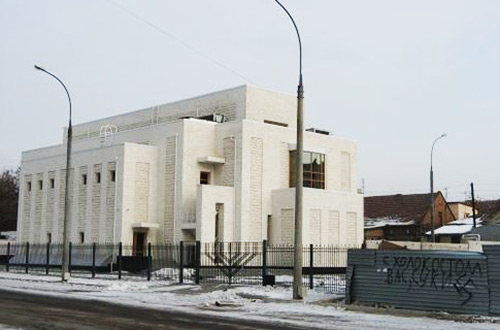
Synagogue in KeivA recently built synagogue in Kiev, which was inaugurated in January 2012. The fence in the foreground is defaced by a swastika.

The turmoil in Ukraine began last November after President Yanukovych refused to sign an EU association treaty, preferring instead closer economic ties with neighboring Russia. Opposition parties staged demonstrations in Kiev, which were attended by EU VIPs, such as the German and Dutch Foreign Ministers, who last Decembermingled with demonstrators, giving the impression that the Europeans would come to Ukraine’s aid if it should provoke a conflict with Russia. Meanwhile, Baroness Catherine Ashton, the face of EU diplomacy, rather than calming Ukrainian nerves, was devoting her attention to criticizing Israel and helping Iran to broker a nuclear deal with the West.

Ukraine’s Russian ethnic minority is a majority in the country’s eastern provinces and on the Crimean Peninsula. Crimea is a majority ethnic Russian region, which became part of Ukraine in 1954, when Soviet leader Nikita Khrushchev, who was partly of Ukrainian descent, transferred it from Russia to Ukraine, where it enjoys the status of an autonomous region. Last week, when Crimea’s local parliament reacted to the ousting of Yanukovych, its leader, the pro-Russian politician Sergiy Aksyonov, announced a referendum on Crimean independence to be held 30 March.

There is little doubt that the Crimean separatists will win this referendum. Russia, which has its fleet’s largest naval base in Sevastopol on the Crimea, seems to be pushing for an “Abkhazia scenario.” Abkhazia is an autonomous region of Georgia, which declared independence in 2008 after Russian troops invaded the region. Apart from Russia and Venezuela, however, hardly any country recognizes its independence. Nevertheless, Georgia is no longer in control of it, and the situation on the ground is that it is ruled by its ethnic Russian leaders, while the rest of the world does not seem to care.

Despite the rattling of sabers by Ukraine’s interim president, Oleksandr Turchynov, who declared that “Ukraine’s military will fulfill its duties,” and U.S. President Barack Obama’s expression of “concern” over the deployment of Russian troops in the Crimea and the violation of Ukrainian territorial integrity, there is little doubt that the West will ultimately acquiesce to a situation in which the Crimea comes under de facto Russian control, just as it acquiesced to the Russian control of Abkhazia.

The situation might have been different if in April 2008 the West had extended NATO membership to Ukraine and Georgia. Russia would never have dared to deploy troops on NATO territory. However, though America was willing to consider NATO membership for Ukraine and Georgia, the Europeans – Germany’s Chancellor Angela Merkel in particular – opposed it.

In March 2008, Merkel declared that “countries entangled in regional conflicts can not become NATO members,” and then specifically referred to Georgia and Ukraine. Later that year, in August, Russian troops invaded Abkhazia. Similarly, the ultimate fate of the Crimea and Ukraine was settled in March 2008. The current warningsof Merkel and other European leaders to Russian President Vladimir Putin that “the world is watching” and “the territorial integrity of Ukraine must be preserved,” are totally hypocritical. Putin knows that the Europeans signed Ukraine away six years ago. If Obama were to contemplate interfering militarily in the Crimea, the Europeans would be the first to advise against it. In the 1930s, the Europeans were not willing to “die for Danzig.” Today, they are not willing to die for Kiev, let alone the Crimea. In fact, the West may consider itself lucky if Putin settles only for the Crimea, instead of pressing for the de facto secession of the entire eastern half of Ukraine.

Given that Europe opposed the admission of Ukraine to NATO, it should not then have tempted the Ukrainians with EU membership, exacerbating the divisions between the Ukrainians and their ethnic Russian minority. As a result of this reckless policy, Ukraine is about to lose territorial control over the Crimea and everyone will be worse off.

Fortunately for Ukraine’s estimated 350,000 Jews, the third largest Jewish community in Europe, there is Israel. Last week, Russian-born Knesset Member Rina Frenkel, who lived in Kiev before moving permanently to Israel in 1990, sent a letter to Prime Minister Netanyahu, asking him to initiate an immediate rescue effort for Ukrainian Jews, to provide a framework to help Jews emigrate to Israel, and referring to Ukrainian history, which is replete with anti-Semitic murders and pogroms.

She also could also have referred to Europe’s history of turning a blind eye to Jewish suffering – one of the reasons why the existence of Israel as a safe haven for Jews is, unfortunately, still so significant.