Archive for March 2014

John Kerry’s departure from reality – Washington Post

March 31, 2014

John Kerry’s departure from reality – Washington Post.

(Jacquelyn Martin/Associated Press) – Secretary of State John Kerry in Rome on Thursday.

By , Monday, March 31, 1:43 AM

During a tour of the Middle East in November, Secretary of State John F. Kerry portrayed the region as on its way to a stunning series of breakthroughs, thanks to U.S. diplomacy. In Egypt, he said, “the roadmap” to democracy “is being carried out, to the best of our perception.” In Syria, a peace conference would soon replace the Assad regime with a transitional government, because “the Russians and the Iranians . . . will make certain that the Syrian regime will live up to its obligation.”

Last but hardly least, the Israeli-Palestinian conflict was on its way to a final settlement — by April. “This is not mission impossible,” insisted the secretary of state. “This can happen.”

Some people heaped praise on Kerry for his bold ambitions, saying he was injecting vision and energy into the Obama administration’s inert foreign policy. Others, including me, said he was delusional.

Four months have passed, and, sadly for Kerry and U.S. interests, the verdict is in: delusional. Egypt is under the thumb of an authoritarian general. The Syrian peace talks imploded soon after they began. Kerry is now frantically trying to prevent the collapse of the Israeli-Palestinian negotiations, which are hanging by a thread — and all sides agree there will be no deal in April.

It might be argued that none of this is Kerry’s fault. It was Gen. Abdel Fatah al-Sissi who hijacked Egypt’s promised political transition. It was the Assad regime that refused to negotiate its departure . It was Benjamin Netanyahu who kept building Jewish settlements in the West Bank. It was Mahmoud Abbas who refused to recognize Israel as a Jewish state.

All true; and yet all along the way, Kerry — thanks to a profound misreading of the realities on the ground — was enabling the bad guys.

Start with Egypt. Since last summer the State Department and its chief have been publicly endorsing the fiction that the military coup against the elected government of Mohamed Morsi was aimed at “restoring democracy,” as Kerry put it. As late as March 12, Kerry — spun by his friend Nabil Fahmy, the regime’s slick foreign minister — declared that “I’m very, very hopeful that, in very short order, we’ll be able to move forward” in certifying that Egypt was eligible for a full resumption of U.S. aid.

Twelve days later, an Egyptian court handed death sentences to 529 members of the Muslim Brotherhood after a two-day trial. Two days after that, Sissi appeared on television, in uniform, to announce that he would “run” for president.

Kerry was no less credulous of Vladi­mir Putin. Having taken office with the intention of boosting support for Syrian rebels as a way of “changing Assad’s calculations,” Kerry abruptly changed course last May after a visit to the Kremlin. Russia and the United States, he announced, would henceforth “cooperate in trying to implement” a transition from the Assad regime. “Our understanding,” Mr. Kerry said of himself and Putin, “is very similar.”

Only it wasn’t. Putin, who loathes nothing more than U.S.-engineered regime change, spent the next nine months pouring weapons into Damascus, even as Kerry continued to insist that Moscow would force Assad to hand over power in Geneva. When the Geneva conference finally convened, Russia — to the surprise of virtually no one, other than Kerry — backed Assad’s contention that the negotiations should be about combating “terrorism,” not a transitional government.

That brings us to the Israeli-Palestinian quagmire, which Kerry made his personal cause even thoughthe Obama administration already had tried and abjectly failed to broker a deal between Netanyahu and Abbas and Israel and the Palestinian territories are currently an island of tranquility in a blood-drenched Middle East. Ignoring the counsel of numerous experts who warnedneither side was ready for a deal, Kerry lavished time on the two men, convinced that his political skills would bring them around.

Predictably, that didn’t happen. The leaders have not budged a millimeter from the positions they occupied on Palestinian statehood a year ago, and Abbas has been strident in publicly rejecting terms Kerry tried to include in a proposed peace “framework.”

Kerry offered an answer to my first critique of him in an interview with Susan Glasser of Politico: “I would ask” anyone “who was critical of our engagement: What is the alternative?” Well, the alternative is to address the Middle East as it really is. Recognize that Egypt’s generals are reinstalling a dictatorship and that U.S. aid therefore cannot be resumed; refocus on resuscitating and defending Egypt’s real democrats. Admit that the Assad regime won’t quit unless it is defeated on the battlefield and adopt a strategy to bring about that defeat. Concede that a comprehensive Israeli-Palestinian peace isn’t possible now and look for more modest ways to build the groundwork for a future Palestinian state.

In short, drop the delusions.

Jackson Diehl

The Post’s deputy editorial page editor, Diehl also writes a biweekly foreign affairs column and contributes to the PostPartisan blog.

Off Topic: Peace process as an obstacle to peace

March 31, 2014

Peace process as an obstacle to peace, Ynet News, A. B. Yehoshua, March 31, 2014

(The “peace process” has become the goal rather than a means to achieve peace. That does not augur well  for peace. — DM)

Op-ed: In recent years, writes novelist A. B. Yehoshua, ‘peace process’ has become an independent diplomatic entity whose outward appearance conceals not only real inaction but deeds which clearly contradict peace itself.

In the past two years, the “peace process” concept has become a problematic, and perhaps even harmful, phrase. If I may express myself in a slightly absurd manner, I would say that in the past few years the peace process has become the obstacle to peace itself.

The “peace process” has been turned – by the Israelis, Palestinians, Americans and in some sense the Europeans too – into a sort of independent diplomatic entity, whose ethical and political rhetoric is more important than its deeds, whose outward appearance conceals not only real inaction but sometimes even worse – deeds which clearly contradict peace itself. The peace process deludes us, and therefore calms us too, to believe that peace will certainly come. It induces tolerance which is eventually complete passivity.

For the sake of illustration, let us recall the short and efficient peace process between Israel and Egypt, two countries which waged major, bloody wars against each other. This peace process began dramatically with Egyptian President Sadat’s visit to Israel in November 1977,and less than a year later the sides already agreed upon the main principles at Camp David. A withdrawal, demilitarization, uprooting communities and opening embassies. The agreement itself was signed several months later. And this peace agreement has lasted more than 35 years now.

On the other hand, while the first contact between Israel and the Palestinians was signed in Oslo in 1993, more than 20 years have passed since then and the peace agreement is still far off. During these years, several interim agreements were signed, most of which were violated, and serious bloody brawls erupted between the two sides, some of which are still ongoing, not to mention the Israeli settlements which have expanded immensely.

Lo and behold, in the years which have passed since Oslo dozens if not hundreds of European and American – and other – mediators and emissaries have been running back and forth between the sides, dozens of different types of summits have been held, direct talks have taken place on all levels, US presidents and foreign and defense ministers from the US and many European countries have arrived in Jerusalem and Ramallah to talk, persuade and make new offers. American Secretary of State John Kerry has been in Israel and the Palestinian Authority 11 times in the past year in order to advance the peace process, which continues to stay put.

Officially cancel peace process

The most reliable evidence of the lack of hope that the peace process will indeed reach its goal – peace itself – will be provided in random talks on every street in Israel and in every city in the West Bank. Even moderate people on both sides will agree about one thing – their hopelessness that the current peace process will indeed reach its goal. And there are also those, on the left and on the right, who don’t see any hope in ever achieving peace.

And yet, the vast majority will still agree that the peace process must not be stopped under any circumstances, out of the sense that after an entire day of deeds contradicting any possibility of an agreement, it would be good to go to sleep at night with the peace process lying restfully by the pillow.

It’s interesting that the vast majority of Israelis and Palestinians, and all the mediators too of course, will outline more or less the same realistic content of the appropriate and proper peace process between Palestine and Israel; but in the meantime, it is this infinite peace process which is creating all kinds of imaginary fantasies of further possible concessions each side can get from the other side, and so within the infinite and inexhaustible creation of illusions in regards to the concessions each side might be able to achieve in the “peace process” negotiations, peace itself is wearing out and moving farther away.

That being the case, what can we do? In my opinion, only a real dramatic crisis can advance peace. Not necessarily a crisis related to violent outbursts, but a crisis which has to do with breaking off contact and officially canceling – although temporarily – the peace process. And this applies of course not just to the two sides, but mainly to the different mediators, and especially to the US, which is acting like a spineless social worker in a day care center for backward people.

An official US withdrawal from the entire peace process out of despair will create panic among broad circles, both among the Palestinians and among the Israelis, and will perhaps motivate them to take real initiative in a practical and businesslike – and preferably secret – dialogue, ahead of a possible agreement.

Iran launches floating condensate export terminal

March 30, 2014

Iran launches floating condensate export terminal, Trend, March 30, 2014

(Is Iran confident that the sanctions will not be revived? Who would have thunk? — DM)

[T]he floating terminal will be able to meet growing demand for the country’s condensates. The floating terminal was under overhaul for the past two years and by putting it back into operation, currently two floating terminal are being used to transfer condensates on to tankers offshore at Asaluyeh.

Persian_Gulf_300808

Iran has launched a second floating terminal to export condensates in the southern port of Asaluyeh, located in the Persian Gulf, managing director of the Iranian Oil Terminals Company, Pirouz Mousavi said, the country’s Mehr news agency reported on March 27.

Mousavi went on to say that the terminal has the capacity to export 600,000 barrels of condensate per day. Gas condensates are a kind of light and expensive crude oil extracted from gas fields.

Mousavi underlined that the floating terminal will be able to meet growing demand for the country’s condensates. The floating terminal was under overhaul for the past two years and by putting it back into operation, currently two floating terminal are being used to transfer condensates on to tankers offshore at Asaluyeh.

Each terminal is capable of transferring 600,000 barrels of condensate per day to oil tankers with capacity of maximum 320,000 tons.

Earlier in March Iranian media outlets reported that the country’s condensate export capacity will increase from some 450,000 barrels per day to 1.2 million bpd in the next two months after the new floating terminal’s inauguration.

The Iranian Customs Administration’s latest report released on Feb. 23 shows that the country’s monthly gas condensates exports in the past four months stood at an average figure of $1.388 billion, up 247 percent compared to the average figure of the first seven months of the solar year (ended March 21).

Iran’s average gas condensates exports in the first seven months of the fiscal year were $561 million per month. Iran’s total gas condensate exports in the first 11 months of the year ending March 21 were around $9.479 billion. The figure is $1.021 billion more than the same period of the previous year.

Iran’s gas condensate exports in the Iranian calendar year of 1391(ended on March 21, 2013) faced a 12.56 percent decrease compared to the preceding year, stand at $8.881 billion.

Iran Names 1979 U.S. Embassy Hostage-Taker Its UN Envoy

March 30, 2014

Iran Names 1979 U.S. Embassy Hostage-Taker Its UN Envoy – Bloomberg.

(This very fitting representative of the criminal regime in Iran has been chosen by, drumroll please … , the wonderfully ‘moderate’ Hassan Rouhani. – Artaxes)

By Kambiz Foroohar       Mar 30, 2014 6:00 AM GMT+0200

Iran has named a member of the militant group that held 52 Americans hostage in Tehran for 444 days to be its next ambassador to the United Nations.

The Iranian government has applied for a U.S. visa for Hamid Aboutalebi, Iran’s former ambassador to Belgium and Italy, who was a member of the Muslim Students Following the Imam’s Line, a group of radical students that seized the U.S. embassy on Nov. 4, 1979. Imam was an honorific used for Ayatollah Ruhollah Khomeini, the leader of the Islamic Revolution.

Relations between the Islamic Republic and the U.S. and its allies are beginning to emerge from the deep freeze that began when the self-proclaimed Iranian students overrun the embassy and took the hostages. The State Department hasn’t responded to the visa application, according to an Iranian diplomat.

A controversy over Aboutalebi’s appointment could spark demands on Capitol Hill and beyond during this congressional election year for the Obama administration to take the unusual step of denying a visa to an official posted to the UN. It also could hamper progress toward a comprehensive agreement to curb Iran’s nuclear program, which the U.S. and five other world powers are seeking to negotiate with Iran by July 20.

Iranian President Hassan Rouhani chose Aboutalebi to serve at the UN, which is headquartered in New York City on international, soil after the interim nuclear deal was forged last Nov. 24.

Compensation Issue

“There’ll not be any rapprochement with Iran until hostages are compensated for their torture,” said Tom Lankford, an Alexandria, Virginia-based lawyer who’s been trying to win compensation for the hostages since 2000. “It’s important that no state sponsor of terror can avoid paying for acts of terror.”

Anyone connected with the hostage-takers shouldn’t get a U.S. visa, said a former hostage and U.S. diplomat. He requested anonymity to avoid renewed attention.

Aboutalebi has said he didn’t take part in the initial occupation of the embassy, and acted as translator and negotiator, according to an interview he gave to the Khabaronline news website in Iran.

“On a few other occasions, when they needed to translate something in relation with their contacts with other countries, I translated their material into English or French,” Aboutalebi said, according to Khabaronline. “I did the translation during a press conference when the female and black staffers of the embassy were released, and it was purely based on humanitarian motivations.”

He referred to the release of some embassy staff members during the first few weeks of the crisis in November 1979.

Photo Displayed

Although Aboutalebi downplays his involvement, his photograph is displayed on Taskhir, the website of the Muslim Students Following the Imam’s Line. Taskhir can mean both capture and occupation in Persian.

According to Mohammad Hashemi, one of the students who led the occupation of the embassy, Iran’s revolutionary government sent Aboutalebi and Abbas Abdi, another architect of the occupation, as emissaries to Algiers. The Algerian capital at that time was a mecca of third-world liberation movements, including the Palestine Liberation Organization.

Hamid Babaei, a spokesman for the Iran’s UN Mission in New York, declined to comment.

“We don’t as a matter of practice comment on visa applications.” said Marie Harf, deputy State Department spokeswoman. “People are free to apply,” and the U.S. has a process to review all visas, she said.

Asked if the U.S. is aware that Aboutalebi was a member of the hostage-taking group, Harf declined to comment.

No Speculation

“Anyone can submit a visa application, and it will be evaluated as we do all visa applications, in accordance with our procedures,” she said. “We don’t speculate on what the outcome might be.”

The U.S. is obliged to grant entry visas to representatives of UN member-states in accordance with an agreement signed in 1947.

Sudanese President Omar al-Bashir decided not to attend last year’s General Assembly session after not receiving a response to his visa application from the State Department. Bashir is subject to outstanding arrest warrants from the International Criminal Court for crimes against humanity and referral for trial in The Hague. While the U.S. isn’t a party to the ICC, the court has asked American authorities to surrender Bashir if he enters U.S. territory.

Abkhazia Dispute

Russian UN Ambassador Vitaly Churkin accused the U.S. of denying a visa for Abkhazia’s then-foreign minister Sergei Shamba in 2007, when he sought to attend a Security Council meeting. Then-National Security Council spokesman Sean McCormack, now a vice president of Chicago-based Boeing Co. (BA), said Shamba withdrew his visa request before the U.S. made a decision on his application.

The U.S. doesn’t recognize Abkhazia as an independent territory because it broke away from Georgia in 2008.

Some U.S. foes have received visas in the past, said Gary Sick, the top Iran expert on President Jimmy Carter’s National Security Council staff during the hostage crisis.

“All kinds of leaders from Cuba to Africa who could be accused of horrible crimes and opposing U.S. policies have received visas,” Sick said. “There is no way to know why some people get the visa and some don’t.”

Some of the students who took the hostages formed the backbone of Iran’s Intelligence Ministry, according to the book “Guests of the Ayatollah,” by Mark Bowden.

Others have had extended political careers. Masoumeh Ebtekar, a former spokeswoman for the hostage-takers, is a vice president in Iran under Rouhani and head of the Department of Environment.

Others fell out of favor amid shifting political developments in Iran. Abdi, one of the first to enter the embassy compound, became the editor of reformist newspaper Salaam, which was shut down in 1999. He was sentenced to five years in prison in 2003, and released in 2005.

To contact the reporter on this story: Kambiz Foroohar in New York at kforoohar@bloomberg.net

To contact the editors responsible for this story: John Walcott at jwalcott9@bloomberg.net; Andrew J. Barden at barden@bloomberg.net Don Frederick

PA: Talks can go on if Israel frees 1,000 prisoners

March 30, 2014

PA: Talks can go on if Israel frees 1,000 prisoners, Times of Israel, Avi Issacharoff, March 30, 2014

(Washington apparently urged the 400 prisoner release and is engaged in discussions about the current Palestinian demand.  Accordingly, there should be no problem with another 600 terrorists or whatever else the consistently reasonable and impartial Team Obama may favor. Right? — DM)

Abbas rejects offer of 400 more freed Palestinians to continue negotiations, hands counteroffer to US mediators

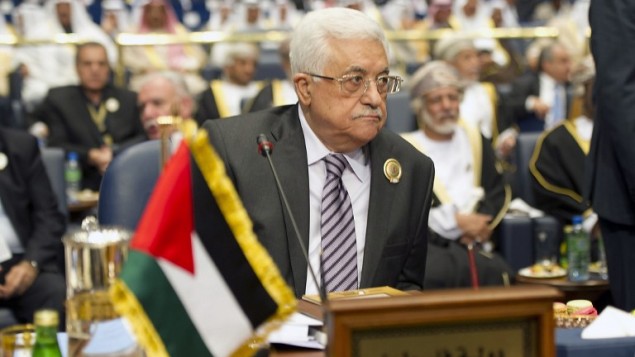
Abbas March 25thPalestinian leader Mahmoud Abbas attends the 25th Arab League summit, March 25, 2014 (photo credit:AFP/Yasser al-Zayyat)

The Palestinian Authority has rejected a purported Israeli offer to release a new group of 400 Palestinian security prisoners if the Palestinians agree to extend peace talks for another six months, The Times of Israel learned Sunday.

On Saturday, The Times of Israel learned from a Palestinian source that Jerusalem, backed by Washington, offered to release 400 more prisoners of Israel’s choosing, in addition to a fourth and final group of longtime terrorism convicts who were set to go free this weekend – on the condition that the Palestinian Authority agrees to prolong the ongoing negotiations beyond the April 29 deadline.

However, on Sunday, the Palestinian leadership rejected the offer and presented a counteroffer of its own to American mediators – that Israel release 1,000 more prisoners, of the Palestinian Authority’s choosing. Palestinian Authority President Mahmoud Abbas also demanded that Israel freeze settlement construction and transfer some Area C regions to the Palestinian Authority’s control.

In exchange, peace talks would be extended until the end of 2014.

Although the Palestinian leadership rejected Israel’s offer, which was an attempt to at least partially fill Abbas’s prerequisites for the extension of talks, the Palestinian Authority was holding intensive talks Sunday to discuss the matter further.

Palestinian chief negotiator Saeb Erekat, who has resigned several times since peace talks started up again in July under US mediation, said Sunday that he was still holding secret talks with Jerusalem and Washington, far from the public eye.

On the prisoner release that was meant to take place Saturday, Erekat said it might still be carried out, as Israel was obligated to release inmates imprisoned before the Oslo Accords.

Erekat stressed that Abbas was making every effort to secure the prisoners’ release independent of any agreement to extend the talks. In return, the Palestinians would continue to abide by their obligation to refrain from applying to UN and other international bodies for the duration of the talks.

On Saturday, some sources claimed Israel was holding off on freeing the prisoners because of rumors that the PA would back out of peace talks once the fourth group of convicts was released. Israel has also balked at releasing Israeli Arabs.

As of Saturday evening, however, Abbas was insisting that the prisoners be released before he would consider extending the talks beyond their current deadline.

Saturday’s offer had stipulated that Israel would determine which additional 400 security prisoners would go free, Palestinian sources said. The demand was rejected by the Palestinian leadership, which insisted on determining which prisoners would be freed.

Israel is said to be holding close to 5,000 Palestinian security prisoners.

Jewish Home’s Uri Ariel, the minister of housing and construction, was said to be ready to recommend that his right-wing party leave the coalition if the release of the extra prisoners goes through.

Transportation Minister Yisrael Katz, a member of Netanyahu’s own Likud party, told Israel Radio Saturday night that he was against the release of all further prisoners, and that moves to free them should be stopped immediately, particularly “since there hasn’t been any forward movement in the peace process.”

The Minister of Prisoners in the PA, Issa Karake, on Saturday night urged Abbas to leave the negotiations and instead take the cause of Palestinian statehood to the UN and other international organizations if Israel does not release the fourth group of prisoners within the next few days.

State Department Spokeswoman Jen Psaki said Saturday night, “In regard to reports this evening on an agreement on the release of prisoners, no deal has been arrived at, and we continue to work intensively with both sides. Any claims to the contrary are inaccurate.”

Meanwhile, US Special Envoy for Israeli-Palestinian Negotiations Martin Indyk met with Erekat and Israel’s envoy to the peace talks, Yitzhak Molcho, in Jerusalem Saturday night. Erekat was quoted by Army Radio saying he believed the deadlock would be broken and the fourth group of prisoners would go free early in the coming week.

Earlier Saturday, it was reported that Prime Minister Benjamin Netanyahu has told US Secretary of State John Kerry that he feared his coalition could fall apart if Israel frees the fourth batch of Palestinian prisoners who were slated for release this weekend — among them 14 Israeli Arabs.

Citing sources in the Palestinian Authority, the London-based pan-Arab al-Hayat newspaper reported that US negotiators had told Abbas Netanyahu feared his coalition, which includes the right-wing Jewish Home and Yisrael Beytenu parties, might disintegrate over the prisoner release.

Off Topic -Netanyahu: UNHRC continues its ‘march of hypocrisy’ against Israel

March 30, 2014

Netanyahu: UNHRC continues its ‘march of hypocrisy’ against Israel | JPost | Israel News.

By TOVAH LAZAROFF

 03/30/2014 14:44

PM slams UN Human Rights Council for condemning Israel in five resolutions last week; Israeli official: European countries failed to show moral leadership.

THE MEETING hall of the United Nations Human Rights Council.

THE MEETING hall of the United Nations Human Rights Council. Photo: Reuters

 Prime Minister Binyamin Netanyahu on Sunday slammed the United Nations Human Rights Council for “absurdly” condemning Israel in five resolutions last week while censuring Syria and Iran only once.

“This march of hypocrisy is continuing and we will continue to condemn it and expose it,” he told his cabinet at the start of its weekly meeting in Jerusalem.

“The UN Human Rights Council condemned Israel five times, this at a time when the slaughter in Syria is continuing, innocent people are being hung in the Middle East and human rights are being eroded.

“In many countries free media are being shut down and the UN Human Rights Council decides to condemn Israel for closing off a balcony. This is absurd,” said Netanyahu.

On Friday the UNHRC ended its 25th session by almost unanimously, voting 46-1, on four resolutions condemning Israeli treatment of Palestinians. It also condemned Israeli human rights abuses against Syrian citizens of Israel who live on the Golan Heights, voting 33 to 1, with 13 abstentions.

Out of the 42 resolutions adopted by the council on a wide range of human issues only 10 censured the actions of a specific country, out of which five of the condemnations were leveled against Israel.

A resolution on the situation of human rights in Myanmar was approved by consensus.

But none of the condemnations of other countries, including those of Iran and Syria, on the issue of human rights received the same level of support from member states as the charges against Israel.

The 47-member UN Human Rights Council voted 21-to-9, with 16 abstentions on the situation of human rights in the Islamic Republic of Iran.

It voted 23-to-12, with 12 abstentions on “reconciliation, accountability and human rights in Sri Lanka.”

It voted 30-to-6 ,with 11 abstentions on the situation of human rights in the Democratic People’s Republic of Korea.

It voted 32-to-4, with 11 abstentions on the grave deterioration of human rights and the humanitarian situation in the Syrian Arab Republic. This resolution strongly condemned the use of chemical weapons. It also condemned the “bombardment of civilian areas, in particular the indiscriminate use of barrel bombs, ballistic missiles and cluster bombs and other actions which may amount to war crimes against humanity.”

An Israeli official said the fact that Israeli actions on the Golan Heights garnered slightly more support, with 33 countries approving it, was “almost a bad joke.”

It was particularly upsetting, the Israeli official said, that the UNHRC approved such a resolution at a time when hospitals in the north of Israel are treating scores of Syrian victims from the civil war in their country.

The Israeli official also took issue with the strong united stance against Israel by nine member states of the European Union including: Germany, France, Italy, the United Kingdom, Austria, Romania, the Czech Republic, Estonia and Ireland.

All nine EU countries supported the four resolutions which condemned Israeli treatment of Palestinians, supporting the Goldstone Report on Israeli actions in Gaza and encouraged a boycott of West Bank settlements and Jewish neighborhoods of east Jerusalem. They abstained but did not reject the resolution condemning Israeli violations of of human rights against Syrian citizens of Israel on the Golan Heights.

“It’s a pity that some western democracies choose to jump on the automatic anti-Israel band wagon at the UNHRC,” an Israeli official said.

“It is a pity they did not use that moment to demonstrate moral leadership, instead of that they became part of the travesty. They became partners in a cynical one sided farce,” the official said.

But the official lauded the United States, which was the sole country to stand with Israel and reject all five resolutions.

“They showed moral leadership,” the official said.

The Palestinians, however, welcomed the almost unanimous support at the UNHRC and said such resolutions showed Israel that it could not “flout” international law.

“This vote confirms the world’s clear condemnation of the systematic human rights violations committed by Israel, the occupying power, against the Palestinian people and their fundamental rights,” said Palestinian Authority Foreign Minister Riad Malki.

The Foreign Ministry was not present at the UNHRC’s meetings this week, due to its ongoing strike against the government over equitable wages.

Off Topic: Palestinians welcome almost unanimous UNHRC support

March 30, 2014

Palestinians welcome almost unanimous UNHRC support | JPost | Israel News.

( A sign of things to come…  Scary shit. – JW )

PA foreign minister says result of council’s vote on 4 resolutions condemning Israel reaffirms “indisputable right” for Palestinian independence.

OVERVIEW OF the Human Rights Council at the UNHRC

OVERVIEW OF the Human Rights Council at the UNHRC Photo: Reuters

 The Palestinians on Saturday welcomed the almost unanimous show of support they received at the United Nations Human Rights Council as it ended its 25th session in Geneva.

Four resolutions condemning Israeli treatment of Palestinians in the West Bank, east Jerusalem and Gaza passed by a 46-to-1 vote. Italy, Germany and France on behalf of the European Union were among the nations that stood against Israel.

“This vote confirms the world’s clear condemnation of the systematic human rights violations committed by Israel, the occupying power, against the Palestinian people and their fundamental rights,” said Palestinian Authority Foreign Minister Riad Malki.

“The vote also reflects a clear affirmation by the international community on the indisputable right of the Palestinian people to self-determination, establishment of their independent state and return based on UN Resolution 194,” Malki said.

One of the four resolutions encouraged the boycott of West Bank settlements and the Jewish neighborhoods of eastern Jerusalem.

Malki in a statement to the media highlighted that item and said, “Most pertinently, it signals that the world is committed to ensuring that no profiteering is allowed from the occupation regime.”

Although the council often votes to condemn Israel, it is unusual for all such resolutions to be approved nearly unanimously. The EU in past council sessions has often been split on these resolutions with some member states abstaining and others voting in support of the Palestinians.

Italy’s representative to the UNHRC, Maurizio Enrico Serra, told the council that the EU supports these motions and that “EU member states would be voting in favor” of them.

A fifth resolution against Israel condemned its continued presence on the Golan Heights and its treatment of the Syrian population that lives there passed with the approval of 33 nations. There were 13 abstentions, including EU member states, and one vote against.

The United States was the only nation to support Israel in all five resolutions.

Israel was not present at the meeting, due to the ongoing Foreign Ministry strike.

Prior to Friday’s vote, the US issued a scathing attack against the UNHRC for its continued biased treatment of Israel and charged that the council was harming the peace process.

The PLO’s Ambassador to the UN in Geneva, Ibrahim Khraishi, however, told the council such resolutions help the peace process.

“There is an Israeli occupation. Israel would like to continue with this occupation and to continue with its daily violations. We utterly refuse this situation and we will continue to resist this situation with all means available, in conformity with the provisions of the international law,” Khraishi said.

He took issue with statements Foreign Minister Avigdor Liberman had made about Palestinians and the council, and charged that he is a “liar.”

Khraishi said that Israel “thinks this whole action [the council resolutions] is tantamount to anti-Semitism. We do not know what is really meant by anti-Semitism when it is claimed by Israelis.”

The issue for the Palestinians, he said, is to end the occupation and to force Israel to comply with international law.

But the US said that the council held Israel to a higher standard than any other nation. It took particular issue with the council’s Agenda Item 7, which mandates that Israel must be debated at every UNHRC session. Israel is the only country with such a standing agenda item

“We are deeply troubled once again to be presented with a slate of one-sided resolutions that undermine efforts to make progress in the negotiations,” said Paula Schriefer, who headed the US delegation to the 25th UNHRC session.

She noted in particular that the US remains “deeply troubled, however, by this council’s standalone agenda item directed against Israel, and by the many repetitive and one-sided resolutions under that agenda item.

“None of the world’s worst human rights violators, some of whom are the object of resolutions at this session, has their own stand-alone agenda item at this council. Only Israel, a vibrant and open democracy, receives such treatment,” she said.

Schriefer noted that the US provided financial and technical assistance to the Palestinian people and is the largest donor to UNRWA.

“We are disappointed that this council continually singles out Israel for criticism without acknowledging the violent attacks directed at its people, nor the obligations and difficult steps required of both sides to resolve their conflict,” Schriefer said.

She explained that the US supports the Palestinians’ right to self-determination, but that it does not believe these resolutions help advance a two-state solution or the peaceful resolution of the conflict.
The US said that the resolution on the Golan is an example of the problematic treatment Israel continues to receive at the hands of the UNHRC.

“Especially disturbing is this council’s complacency with the repeated introduction of a resolution focusing on the Golan Heights. To consider such a resolution while the Syrian regime continues to slaughter its own citizens by the tens of thousands exemplifies the absurdity of this agenda item and each of the other resolutions on Agenda Item 7,” Schriefer said.

Israel was the only country at the UNHRC’s 25th session in Geneva to have multiple resolutions leveled against it and resolutions censuring other countries lacked the same level of support. The resolutions on the People’s

Republic of Korea, was approved by 30 votes, the one on Iran by 21 and Syria by 32.

Syrian rebels allowed to attack Latakia from Turkish soil under Turkish air cover. Iran raises Cain in Ankara

March 30, 2014

Syrian rebels allowed to attack Latakia from Turkish soil under Turkish air cover. Iran raises Cain in Ankara.

DEBKAfile Exclusive Report March 29, 2014, 10:45 PM (IST)
Intense fighting for Kasab in northwest Syria

Intense fighting for Kasab in northwest Syria

Turkey has ratcheted up its intervention in the Syrian war to an unprecedented level, according to exclusive debkafile military and intelligence sources.

For the first time in the three-year conflict the Turkish army is allowing Syrian rebel forces, including the Al-Qaeda-affiliated Nusra Front, passage through Turkish territory for their offensive to capture the northwestern Syrian coastal area where the Assad clan’s lands are situated.

Ankara’s support for the rebels is inclusive: Turkish troops are posted at the roadside with supplies of ammo, fuel, food, mechanical repair crews and medical aid for rebel forces as they head north. The Turkish air force gives them air cover and Turkish agents arm them with surveillance data on Syrian military movements ahead.

The Syrian fighter jet shot down on March 23 just inside the Turkish border was in fact downed in a dogfight with Turkish warplanes, while trying to bomb the rebel convoy heading for the new combat arena. Both sides preferred to stay quiet about the incident and its causes.
The rebels receiving Turkish military support are disclosed by our sources as belonging to two militias: The Syrian Revolutionaries Front under the command of Jamal Maarouf, which has gathered in remnants of the disbanded Free Syrian Army; and the Islamic Front, sponsored until recently by Saudi intelligence.  They number around 4,000 fighting men including elements of the Nusra Front.

With powerful Turkish backing, this force has been able to carve a very narrow corridor into northwest Syria from the tall Jabal al-Zawiya in the Idlib region up to a point near Syria’s northern Mediterranean coast, thereby severing the northwestern link between Syria and Turkey.

This was the first time rebel forces had gained full control of a strategic corridor. First, they had to battle through and capture the towns of Kazab, Khirbet and Samra northwest of the coastal town of Latakia.
The Syrian army is throwing air, armored and heavy artillery strength against the rebels to stop them firming up their positions in those towns, while also aiming to regain command of the Syrian-Turkish border region.

The fighting Saturday, March 29 was most intense around Kasab.

This new development in the Syrian war raises two questions:

1. For how long can the Syrian rebels hold out against constant battering by superior military strength?

2. If the rebels are thrown out of their new positions, will the Turkish army come to their aid?  If so, it would be Ankara’s first outright military incursion into Syrian territory and the first intrusion by a NATO member in its civil conflict.
Our sources in Ankara report that Prime Minister Tayyip Erdogan is in favor of going ahead. He is vehemently opposed by the Turkish chief of staff.

It is this argument which triggered the banning of YouTube by the Turkish government Friday, March 28 – not the important municipal elections taking place Monday. A leaked recording published anonymously purported to reveal a conversation between Turkey’s foreign minister, Ahmet Davutoglu, spy chief Hakan Fidan and a general discussing how to drum up a pretext for a Turkish attack inside Syria. A voice identified as that of Fidan appeared to suggest a missile assault as the pretext for a Turkish invasion.

Erdogan and Turkish intelligence chiefs are convinced that the leak was orchestrated by generals who are against deeper Turkish involvement in the Syria war

In the meantime, debkafile’s Iranian sources report that Tehran was so jittery about this turn of events that a Iranian military delegation was rushed to Ankara, arriving Saturday, to force the Erdogan to take his hands off the Syrian war by any means, including a threat to suspend oil supplies. The two sides are still talking.

US: We won’t be able to stop Palestinian UN statehood bid if talks fail

March 29, 2014

US: We won’t be able to stop Palestinian UN statehood bid if talks fail, Attila Somfalvi, AFP, Ynet News, March 29, 2014

(In other words, “Nice unimportant little country you have here; we sure hope you can keep it. Of course we aren’t trying to pressure you or anything.” — DM)

Washington demands flexibility of Israel, raising the possibility of another prisoner release of long-serving prisoners as a gesture to the Palestinians.

The United States will not be able to stop a Palestinian campaign to the United Nations for statehood should peace talks with Israel fail, American diplomats told The Washington Post on Saturday.

The Obama administration has been working to salvage the peace talks that have been tittering on the brink of collapse for weeks, after Israel refused to released the fourth and final group of Palestinian security prisoners on Saturday.

Palestinian Minister of Prisoner Affairs Issa Qaraqae told AFP that “today the prisoners will not be released… maybe in the coming days.”

“There are efforts to solve the crisis and I believe that in 24 hours everything will be clearer,” he added.

If negotiations continue, it is possible that the prisoner release will be postpone [sic] until the end of April.

Jibril Rajub, a member of Fatah’s central committee, told AFP Friday that “the Israeli government has informed us through the American mediator that it will not abide with its commitment to release the fourth batch of Palestinian prisoners scheduled for tomorrow.”

“Israel has refused to commit to the names that were agreed upon of prisoners held by Israel since before the 1993 Oslo agreements,” he added.

He called the Israeli move a “slap in the face of the US administration and its efforts,” and said the Palestinians would resume their international diplomatic offensive against Israel as a consequence.

If Palestinian Authority President Mahmoud Abbas agrees to postpone the release, he may demand more concessions of Israel.

The Palestinians have been repeatedly threatening to abandon peace talks if Israel does not release the prisoners, some of which were convicted of terror crimes against Israeli citizens. The Americans, led by Secretary of State John Kerry, have been trying to prevent that by reaching a commitment from Israel to either free the prisoners as promised, or by reaching a new compromise.

An editorial published in The New York Times warned Abbas and Prime Minister Benjamin Netanyahu to “think carefully” before they pass up this opportunity for peace, because they will have to shoulder the blame should the talks fail. If the two sides can’t reach an agreement on a framework to continue talks, the US should stick to its principles by setting the borders according to the 1967 lines, and recognizing Jerusalem as the joint capital of both states, the Times’ editorial urged.

‘Israel can be flexible, be patient’

The Americans are demanding that Israel shows flexibility and have raised several options to do so, among them a “gesture” release of prisoners who have been imprisoned for a very long time, or those who are similar to other prisoners previously freed. At present, it is still unclear how many prisoners would be included in such a “gesture.”

Israel is examining the different options and Israeli officials said that “the Palestinians need to continue negotiations if they want a prisoners release. Israel is prepared to show certain flexibility to allow that to happen. We have to be patient and see where this goes.”

Israel has committed to releasing 104 Palestinian security prisoners who were jailed prior to the 1993 Oslo Accords. The names on the fourth group’s list are the hard core of prisoners, many of which were convicted of very serious crimes. Israel has previously cautioned that this release will not go ahead as planned if the Palestinians refuse to continue talks beyond the April 29 deadline.

On Saturday morning, the London-based Arabic Al-Hayat newspaper quoted western diplomats as saying that Kerry was trying to overcome the impasse over the recognition of Israel as a “Jewish state” by changing the definition to “the homeland of the Jewish people.” In return, the Palestinians would have to agree to a Palestinian capital in a part of East Jerusalem and not all of it. According to the report, the Palestinians have rejected that proposal as well.

On Friday, Palestinian news agency Ma’an quoted Palestinian Minister of Prisoners’ Affairs Issa Qaraqe as saying that the release was crucial for any future progress in the peace talks and served as a test of Israel’s reliability in the peace process.

“Israel has been playing an ugly game of blackmail … using Palestinian prisoners as a pressure tool to obtain political gains, which we completely reject,” Ma’an quoted Qaraqe as saying.

Qaraqe said that he holds Israel responsible for the consequences of not releasing the prisoners on time, warning of the “anger” in the Palestinian street.

Since the beginning of peace talks in July, Israel has released 78 pre-Oslo prisoners in three groups. For the fourth group, the Palestinians demanded to release 14 Arab-Israeli terrorists, but Jerusalem insists it did not commit to such a demand.

Op-Ed: More Than Ever, Israel Must Rely Upon Itself

March 29, 2014

Op-Ed: More Than Ever, Israel Must Rely Upon Itself, Israel National News, Prof. Louis René Beres, March 29, 2014

(If Prof. Beres’ analyses and prognostications are even partially correct, the future resulting from the Kerry – Obama “peace process” seems likely to be even more dismal that I had thought. — DM)

An internationally renowned expert weighs in on the conventional and nuclear threats inherent in Obama’s plans, asserting that the President’s position is constructed upon assorted historical and legal misunderstandings.

In his recent public remarks about American foreign policy, and U.S.-Israeli relations, Defense Minister Moshe Ya’alon simply stated the obvious. Under no circumstances, Ya’alon correctly maintained, should Israel ever consent to sub-contracting its core national security obligations to the United States.

This assertion was not meant to suggest that Israel and the U.S. should in any way depart from their long and mutually gainful relationship on vital defense matters. On the contrary, it represented a thoroughly prudent extrapolation from American President Barack Obama’s own declared views of the Middle East.

In essence, whatever else might be disclaimed in Washington, Mr. Obama still subscribes to the most narrowly Palestinian narrative of an Israeli “occupation.”  Without any intended prejudice against the orthodox Israeli account of pertinent history and law, he somehow remains convinced that this protracted regional struggle between an existing Jewish State, and an aspiring (23rd) Arab state, concerns two equally-reasonable claims. Accordingly, in the President’s own sweepingly deductive logic, each side is now entitled to a state of its own.

Nothing, he confidently believes, could be more fair.

But the premises of this argument are either erroneous or contrived. In consequence, the President’s position is constructed upon assorted historical and legal misunderstandings.

At some point, when the Palestinian Authority (PA) and Hamas are finally able to smooth over their most refractory internal disagreements, they will jointly announce the arrival of “Palestine.” The U.N. General Assembly already elevated the PA to the status of a “non-member observer state,” but this particular elevation fell far short of granting authentic statehood.

Nonetheless, this expected Palestinian announcement, with predictably full support of President Obama’s “Peace Process,” will mock critical expectations of codified international law, especially the governing treaty on statehood, known as The Convention on the Rights and Duties of States, or (less formally) The Montevideo Convention (1934).

A new state of  Palestine – any new state of Palestine – will promptly seek territorial extensions beyond its initially constituted borders. Assuredly, however, the “civilized” world will then look away. After all, according to the ritualistic Palestinian narrative  accepted by President Obama, any such extensions would be consistent with the presumptive interests of “fairness.”

The official PA map still shows all of Israel as part of Palestine. The official logo of PA Television still shows all of Israel as Palestine, with the Palestinian capital in Jerusalem. Fatah’s official insignia is Israel smothered  by a grenade, bayoneted rifle, and sub-machine gun. All PA school textbooks still use a map of the Middle East in which Israel simply does not exist, and  has been conspicuously replaced by “Palestine”.

Fatah’s Charter states unambiguously: “Our struggle will not cease unless the Zionist state is demolished, and Palestine is completely liberated.” Fatah effectively controls the Palestinian Authority.

Any Palestinian Arab state would have a deeply injurious impact on Israel’s physical survival. After “Palestine”, as Minister Ya’alon was entirely correct to anticipate, Israel would require ever-greater increments of self-reliance. In turn, such requirements would demand, among other things: (1) a more complex nuclear strategy involving deterrence, preemption, and war fighting capabilities; and (2) a corollary and inter-penetrating conventional war strategy.

As any Palestinian Arab state would make Israel’s conventional capabilities more problematic, the national command authority would likely need to make the country’s implicit nuclear deterrent less ambiguous.

Taking the Israeli bomb out of the  “basement”  could enhance Israel’s security for a while, but ending “deliberate ambiguity” could simultaneously heighten the chances of actual nuclear weapons use. If Iran is allowed to “go nuclear,” as now seems certain (thanks, in large part, to naive agreements fashioned in Washington),  resultant nuclear violence might not necessarily be limited to the immediate areas of Israel and environs.

A nuclear war could arrive in Israel not only as a “bolt-from-the-blue” surprise missile attack, but also as a result, intended or inadvertent, of escalation.  If  an enemy state were to begin “only” conventional and/or biological attacks upon Israel, Jerusalem might then respond with fully nuclear reprisals.  If this enemy state were to begin with solely conventional attacks upon Israel, Jerusalem’s conventional reprisals might still be met, in the future, with enemy nuclear counterstrikes.

This outcome would become possible only if a still-nuclearizing Iran were spared any residual forms of Israeli or American pre-emptive attack. A persuasive Israeli conventional deterrent, to the extent that it could prevent enemy state conventional and/or biological attacks in the first place, would  likely reduce Israel’s overall risk of exposure to nuclear war.

After “Palestine”, as Moshe Ya’alon clearly understood, the regional correlation of forces would become markedly less favorable to Israel. Then, the only credible way for Israel to deter large-scale conventional attacks would be by maintaining visible and large-scale conventional capabilities.  Enemy states contemplating first-strike attacks upon Israel using chemical and/or biological weapons would be apt to take more seriously Israel’s nuclear deterrent.

Whether or not this nuclear deterrent had remained undisclosed, could also affect Israel’s threat credibility. In this connection, however, Washington’s only predictable posture would be to endorse continued nuclear ambiguity, a posture sorely contrary to Israel’s long-term deterrence requirements.

A strong conventional capability is needed by Israel to deter or to preempt conventional attacks, attacks that could lead via escalation to unconventional war.  Here, President Barack Obama’s Peace Process would impair Israel’s strategic depth, and, when recognized by enemy states, Israel’s associated capacity to wage conventional warfare.

Defense Minister Moshe Ya’alon merely stated the obvious. Acknowledging America’s evident fiasco of lost wars in Iraq and Afghanistan, and Washington’s significant impotence vis-à-vis Russian aggression in the Ukraine, Jerusalem must finally come to terms with the core imperatives of national self-reliance.

To be sure, Israel should continue to do everything possible to maintain meaningful mutual defense arrangements with the United States – advice that would be fully endorsed by Mr. Ya’alon himself –  but it must also remain aware that in any still-evolving matters of existential urgency, American support should never be taken as absolutely necessary or sufficient.


