Archive for March 2014

Russia warns West it may change stance on Iran, in retaliation over sanctions

March 19, 2014

Russia warns West it may change stance on Iran, in retaliation over sanctions, Fox News, March 19, 2014

(The article does not indicate in what respect(s) Russia may change her stance. Would she favor Iran’s positions more, or less? Would the Obama Administration notice, care or take a harder or softer position on Iran’s nukes — Parchin, other military sites, warhead and deliver systems, etc?  — DM)

Russia reportedly is prepared to change its stand on Iran nuclear talks in a high-stakes gamble to counter expanded sanctions by the United States and the European Union over Crimea.

After the Obama administration on Monday hit 11 Russian and Ukrainian officials with sanctions — a move criticized by Republican lawmakers as too timid — Russia’s Deputy Foreign Minister Sergei Ryabkov was quoted Wednesday by the Interfax news agency as saying the country may have to alter its position on the negotiations over Iran’s nuclear program.

The statement is the most serious threat of retaliation by Moscow since the disputed Crimea region voted to join Russia over the weekend, and Vladimir Putin’s government moved to annex the peninsula.

NATO and U.S. leaders say they’re prepared to do more.

White House Press Secretary Jay Carney said Wednesday that the administration is looking to expand the sanctions further. “If you look at the executive orders, they provide a great deal of flexibility and an expansive range potential designations for sanctions including Russian government officials, the arms sector of Russia, and individuals who, while not holding positions within the Russian government, have influence over or provide material support to senior Russian government officials,” he said.

NATO Secretary General Anders Fogh Rasmussen on Wednesday called Russia’s advances in Ukraine a “wake-up call” — and the “gravest threat to Europe since end of Cold War.”

Speaking at the Brookings Institution in Washington, D.C., he also said NATO, as a first step, is suspending joint planning for operations removing chemical weapons from Syria.

Meanwhile, leading members of Congress are demanding that the Organization for Security and Cooperation in Europe immediately deploy international monitors to eastern and southern Ukraine.

A letter sent by Sen. Dick Durbin, an Illinois Democrat, Arizona Republican Sen. John McCain, and six other lawmakers says monitors are needed to defuse tensions in Ukraine after Russia’s takeover of the Crimean peninsula. The lawmakers visited Ukraine last week and say Russia is using “provocateurs and intelligence agents to brazenly stir trouble” in eastern Ukraine as a possible “manipulated pretext for additional military action.”

The OSCE is a 57-nation body based in Vienna, and Russia has thus far blocked such a deployment.

UPDATE

Bryan Preston at PJ Tatler offers this perception:

Russia has traditionally regarded Iran as a non-threat to itself, and has traditionally played its influence with Iran against U.S. interests. Iran’s nuclear program is built on Russian technology. While Russia does not want a radical Islamic state armed with nuclear weapons, Russia here is signalling that it will fight any U.S.-led effort to slow down Iran’s nuclear weapons program. Couple that with Obama’s own Hamlet-esque dithering, and the bottom line is that Iran will obtain nuclear weapons. Iran has previously threatened to obliterate Israel. Russia and Iran have an understanding about who their real enemy is.

The American celebrity and media culture that elevated Barack Obama to the presidency is going to have a lot of reality to come to grips with. Presidents have to know more than just college basketball stats and the odd hard-left ideological trope. Their skills must go beyond those of the average insult comic. They have to be more than glib and photogenic. The Russia-China-Iran axis, with junior partners in Pyongyang and Karachi, may be about to make some very consequential moves.

Iran’s Fortunes Rising in a Middle East Vacuum

March 19, 2014

Iran’s Fortunes Rising in a Middle East Vacuum – Jerusalem Center for Public Affairs.
, March 19, 2014

Vol. 14, No. 7 March 19, 2014

Iranian Foreign Minister Mohammad Javad Zarif and Palestinian Islamic Jihad leader Ramadan Shalah

Iranian Foreign Minister Mohammad Javad Zarif and Palestinian Islamic Jihad leader Ramadan Shalah
  • On March 12, 2014, Israel was hit by massive rocket fire from Gaza by Palestinian Islamic Jihad (PIJ). PIJ is completely dependent on Iran for its funding and equipment, and some of its operatives have also undergone training in Iran for the manufacture of rockets and explosives and for guerrilla warfare. There have also been recurring attacks on IDF border forces in Israel’s north as well – including along the Syrian border – where Hizbullah’s ties with Iran are well-known. All of these attacks on Israel come in the wake of the green light given by Iran against the backdrop of changing power equations in the broader Middle East.
  • Iran has been leading an “axis of evil” as it devises and implements an ambitious plan to increase its influence across the Middle East and mold it in line with its revolutionary Islamic ideology. Central to that plan is ejecting the United States and the West from the region, along with what remains of their influence.
  • The change in Iran’s behavior reflects its growing self-confidence since the recent rounds of nuclear negotiations with the West began, along with America’s rapidly declining regional and international status (vivid in the Ukrainian crisis as well). The more the United States’ regional and international status sinks, the more Iran’s self-confidence rises.
  • Iran regards the U.S., and the West in general, as lacking the capacity to use military force to stop its nuclearization, or to curtail Iran’s assertive measures against the Gulf States and in the Middle East generally. Iran sees an opportunity to continue driving the U.S. and the West out of the region.
  • Iran views Hizbullah and the Palestinian terror organizations as major components in its national security strategy, part of its long arm. Iran acts ceaselessly to provide these actors with rockets and the knowledge to manufacture them, along with other weapons. The latest developments, coupled with Iran’s growing realization that it is immune to a Western military attack, could lead it to make even bolder moves by itself and through its proxies.
  • U.S. policy is increasingly impelling states in the Middle East to alter their framework of alliances. They view the United States as less and less reliable, and are seeking an alternate power instead. Possibilities include Russia, China, or – closer to home – Iran.

A Green Light from Iran to Strike at Israel

The massive rocket fire from Gaza at Israel by Palestinian Islamic Jihad (PIJ) on March 12, 2014, under the rubric of “breaking the silence,” coupled with the detonation of explosive charges by Hizbullah along the northern border fence on Mt. Dov on March 14 and in the northern Golan Heights on March 18, suggests that Iran’s two main allies in the region were given a green light to step up the friction with Israel and gradually change the rules of the game that has been played so far.

PIJ is completely dependent on Iran for its funding and equipment, and some of its operatives have also undergone training in Iran for the manufacture of rockets and explosives and for guerrilla warfare. The already well-known ties between Iran and Hizbullah are now reaching a new level as Iran involves Hizbullah in the effort to rescue the Assad regime in Syria. President Bashar Assad’s war on the numerous, fragmented opposition factions has entered its fourth year, while so far costing some 150,000 lives.

These recent attacks on Israel, whose timing is not coincidental, were preceded by Israel’s interdiction of the Klos C weapons ship with its cargo of forty Syrian-made M-203 long-range missiles, along with mortars. The intended recipient was PIJ in Gaza. These large-warhead, precision missiles were meant as a game-changer in Gaza, to give Iran’s client a strategic advantage over Hamas, which has been increasingly beleaguered, with Sinai and al-Sisi’s Egypt in turmoil.

Iran is also reestablishing its ties with Hamas after a two-year hiatus in the wake of disagreements over support for Assad in the Syrian civil war. According to Palestinian sources, a high-level Hamas delegation headed by Khaled Mashal, head of its political bureau, intends to visit Iran soon to discuss “important issues.” The same source denied that “Tehran has closed all its doors in Hamas’ face,” and emphasized that “the relationship between the two sides has started to be restored in a positive and gradual manner.”1

According to the pan-Arab daily Al-Quds al-Arabi, Mahmoud al-Zahar, a Hamas co-founder and member of the political bureau, and Marwan Isa, deputy commander of Al-Qassam Brigades, Hamas’ military wing, played a crucial role in arranging the meeting in Tehran.2 Ali Larijani, head of the Iranian Majlis, said recently that the relationship between Iran and Hamas has returned to the way it was in the past and that Iran supports Hamas since it belongs to the resistance front, and since “our Islamic duty commands us to support the resistance.”3

Improving Ties among Iran, Syria, and Hizbullah

The course taken by the Klos C cargo – from Syria to Iran to Iraq – again reveals the key points of the “axis of evil” and the tightening links between them. This axis is led by Iran, which has been devising and implementing an ambitious plan to increase its influence in the Middle East and mold it in line with its revolutionary ideology. Central to that plan is ejecting the United States and the West from the region, along with what remains of their influence.

Especially noteworthy in this context is the intensifying cooperation among the Iran-Syria-Hizbullah triangle. At Iran’s behest, Hizbullah has entered the struggle to salvage Iran’s strategic asset, the Assad regime. Despite growing domestic criticism, in part due to scores of Hizbullah casualties on Syrian soil, Nasrallah has been carrying out Tehran’s directives. He has been compensated with advanced weapons (some of them Russian-made) that have been transferred to Hizbullah from Syria (according to foreign reports, some of these weapons consignments have been destroyed by Israel). Among other weaponry, Yakhont (Sapphire) surface-to-sea missiles along with surface-to-air missiles could affect the IDF’s future operational range. In addition, Iran has generously paid off Hizbullah with UAVs for attacking and intelligence-gathering, as well as in funds. From Iran’s standpoint, Syria and Lebanon have somewhat coalesced.

The Decline of the West

The change in Iran’s behavior reflects its growing self-confidence since the nuclear negotiations with the West began, along with America’s rapidly declining regional and international status (seen in the Ukrainian crisis as well). That decline was especially evident in Washington’s hesitant approach to the Syrian crisis after the regime’s use of chemical weapons was revealed, and in the adoption of the Russian diplomatic solution. Tehran saw this compromise as a victory for Iran in particular and for its resistance axis in general, and as clearly indicating the future deterrent capability of this axis vis-à-vis the U.S.-led West. The commander of the Iranian Revolutionary Guard Corps, Mohammad Ali Jafari, said the United States had been defeated in Syria. “The scheme whereby they wanted to intervene militarily in Syria was defeated and their main plan failed, like the rest of their plans….This while the enemy said, ‘If we do not succeed to overcome Syria, we also will not succeed to overcome Iran.’”4

The more the United States’ regional and international status sinks, the more Iran’s self-confidence rises. That, in turn, will affect Iran’s approach to the nuclear talks and its willingness to compromise; the chances of its doing so were never high in the first place.

As Washington continues in its conciliatory course, which has come to be known as “leading from behind,” and Russia’s international status and power projection keep improving, Russia’s partners, including Iran, will take increasingly bold, subversive action in the region. Iran regards the United States, and the West in general, as lacking the capacity to use military force to stop its nuclearization, or to curtail Iran’s assertive measures against the Gulf States and in the Middle East generally (including supplying terror organizations with advanced weapons, promoting subversion, and aiding Islamic organizations). On the contrary, Iran sees an opportunity to continue driving the United States and the West out of the region.

Lessons for Iran from the Ukrainian Crisis

In that spirit, the Iranian Kayhan newspaper, which usually reflects the views of Supreme Leader Ali Khamenei, wrote that Iran should draw lessons from the Crimean crisis and learn from Russia’s conduct. The paper said Iran should rely on its military (implicitly, also nuclear) power and exploit evolving regional crises. Iran already seems to be applying these lessons.

Kayhan also claimed the events in Ukraine had again shown the effectiveness of military force, notwithstanding international relations theories about the supposed primacy of economic and media factors over military ones. “Military forces can decide, at a sensitive moment, the fate of a particular conflict…as long as they are under wise leadership. That is what happened in the Ukraine affair….We learn that the way to overcome a certain country, and stop its other kinds of power from functioning, is to weaken its military status.” For thirty-five years, Kayhan asserts, the West has striven to weaken Iran militarily, and is continuing to do so in the nuclear talks. And yet,

the resolve of the Russians and the alacrity of President Putin have brought the West to passivity. The fact that the Western states are (again) talking of economic sanctions and the fact that NATO (despite having signed a defense pact with Ukraine) has not mounted a military response to Russia’s military move and maneuvers in Ukraine, instead settling (as is typical) for declarations – shows that the West is in a passive position.

Kayhan draws links between the West’s frictions with Iran and with Russia, and remarks:

From a national perspective, Russia is helped by Iran in addressing most of its security and diplomatic concerns, and in return Iran is helped by Russia’s support on the Syrian, Lebanese, Iraqi, Afghan, nuclear, and other issues. Furthermore, in this affair Russia is in conflict with our enemies, that is, the West. That in itself means we must be pleased with the defeat of our enemies, even if we have criticism of the Russian side.

Kayhan went on to criticize Iranian Foreign Minister Mohammad Javad Zarif for saying Iran was worried by the developments in Ukraine, and concluded that “it was Russia that had learned from Iran to stand firm against the West and cause it to be passive….We have to look at the benefits accruing from the Ukrainian crisis and use them to extend our power and influence.”5

Iran views Hizbullah and the Palestinian terror organizations as major components in its national security strategy, part of its long arm. Iran acts ceaselessly to provide these actors with rockets, missiles, and the knowledge to manufacture them, along with other weapons (antitank, antiaircraft, etc.). The latest developments, coupled with Iran’s growing realization that it is immune to a Western military attack, could lead it to make even bolder moves, sometimes through its proxies, than it has taken so far. The more confidence Iran feels, the more this tendency will grow, affecting its behavior toward its Persian Gulf neighbors as well.

Israel’s Destruction Is on the Islamic Agenda

Iran’s confidence is also apparent in its ongoing calls for Israel’s destruction. As the Supreme Leader and the Revolutionary Guard commanders move further from the “Rouhani effect” of Iran’s June 2013 presidential elections, even as Rouhani keeps winning international favor, they have been resuming their harsh anti-Israeli and anti-Western statements. For example, the Guard’s deputy commander, Hossein Salami, said recently at a conference on “The Islamic World’s Role in the Geometry of the World Power,” under a headline stating “Iran’s Finger on Trigger to Destroy Zionist Regime”:

Today, we can destroy every spot which is under the Zionist regime’s control with any volume of fire power (that we want) right from here….

Islam has given us this wish, capacity and power to destroy the Zionist regime so that our hands will remain on the trigger from 1,400 km. away for the day when such an incident (confrontation with Israel) takes place.6

He added, hinting at the aid Iran provides to states bordering Israel, that Iran is not the only state with such capabilities, since some of the other Muslim states’ artillery can reach targets within Israel.

There Is No Vacuum in the Middle East

In sum, if one connects the dots between the recent developments in the regional and international arenas, it emerges that the more America’s regional and international power wanes, the more Iran’s self-confidence grows. In the Middle East, Iran aspires to fill the void. The perception of American weakness makes Iran more self-assured and impels it toward more audacious moves on the Syrian-Lebanese and Palestinian fronts, as Iran makes use of the resistance camp in waging its ongoing anti-Israel struggle. If Iran continues to perceive American weakness, it will also step up its activities against its Persian Gulf neighbors.

One should view Iran’s reconciliation with Hamas against this background. It is not occurring due to ideology but as part of the wider struggle for influence that Iran is waging against Saudi Arabia in various parts of the Middle East as part of the broader Sunni-Shiite struggle. Iran seeks to benefit from the disagreements within the Sunni camp (such as between Qatar and the rest of the Gulf States) on various issues (such as the role of the Muslim Brotherhood in Egypt). Iranian control in Gaza would enable it to more broadly influence its political associates as well as the newly reconstituted Egyptian arena.

Ongoing American weakness and mounting tensions with Russia will likely have negative implications in general and on the nuclear talks in particular. Russia, which so far has played a negative role in those talks and usually has shielded Iran from strong measures, will be even less prepared to countenance such measures as the talks approach the point of decision. Hence, the chances of the talks diverting Iran from its military nuclear path, which were quite low to begin with, will dwindle to nothing. Moreover, given U.S. behavior in the recent crises, Iran has concluded that it will be able to violate a nuclear agreement without incurring penalties.

As Iran and other regional states view the matter, the Ukrainian crisis is another in a long series of regional and international crises in which Putin has emerged as a resolute, decisive leader on regional issues, while Obama has appeared weak, indecisive, and passive. The region’s Arab leaders, especially those of states once considered U.S. allies (Egypt, Saudi Arabia, the Gulf States, and even Jordan), are not impressed by U.S. conduct in the Syrian crisis and are closely watching Obama’s moves in the Ukrainian predicament; they are likely to be disappointed once more.

U.S. policy is increasingly impelling these states to alter their framework of regional and international alliances. They view the United States as less and less reliable, and are seeking an alternate power instead. Possibilities include Russia, China, or – closer to home – Iran. In the Middle East, where change occurs at a dizzying pace, anything can happen.

Iran, in any case, is acting to make itself the dominant, stable power of the region.

* * *
Notes

1. http://alarabalyawm.net/?p=130781
2. Al-Quds al-Arabi, March 15, 2014.
3. http://www.irna.ir/en/News/81080143/Politic/Larijani_Zionist_regime_unlikely_to_start_a_new_war
4. http://www.mehrnews.com/detail/News/2136361
5. http://kayhan.ir/fa/news/7585/%D9%86%DA%AF%D8%A7%D9%87-%D9%85%D8%A7-%D8%A8%D9%87-%D8%AA%D8%AD%D9%88%D9%84%D8%A7%D8%AA-%D8%A7%D9%88%DA%A9%D8%B1%D8%A7%DB%8C%D9%86-%DB%8C%D8%A7%D8%AF%D8%AF%D8%A7%D8%B4%D8%AA-%D8%B1%D9%88%D8%B2
6. http://english.farsnews.com/newstext.aspx?nn=13921220000944

About Lt. Col. (ret.) Michael Segall

IDF Lt.-Col. (ret.) Michael (Mickey) Segall, an expert on strategic issues with a focus on Iran, terrorism, and the Middle East, is a senior analyst at the Jerusalem Center for Public Affairs and the Terrogence Company.

Syria confirms Israeli airstrike, warns against endangering stability in region

March 19, 2014

Syria confirms Israeli airstrike, warns against endangering stability in region – Jerusalem Post.

Syrian army say 1 killed, 7 wounded in Israeli strike early Wednesday that targeted 3 sites near Qunaitra.

By REUTERS 03/19/2014 13:19

Al- Qaida linked fighters in Syria.

Al- Qaida linked fighters in Syria. Photo: REUTERS

Israeli air strikes on Wednesday against Syrian military sites near the Golan Heights killed one person and wounded seven others, Syria’s armed forces said, warning that the attacks endangered stability in the region.
An armed forces statement said the strikes targeted three sites near the town of Qunaitra

It is periodically necessary for Israel to take “aggressive action” so that the quiet in the north will be maintained, Prime Minister Binyamin Netanyahu said Wednesday just hours after the IAF hit targets in Syria in response to Tuesday’s attack on an IDF jeep on the Golan Heights.

Netanyahu, speaking at the weekly cabinet meeting that was postponed from Sunday because of Purim, said that the targets hit belonged to Syrian elements who not only allowed the attack to take place, but assisted in it.

“Our policy is very clear,” he said. “We strike those who strike us.”

Netanyahu also said that Israel, to the best of its ability, consistently thwarts the transfer of weapons.

Amos Yadlin, a former chief of Israeli military intelligence, said there was “no desire for escalation” on Israel’s part, noting the air force was capable of carrying out attacks far more dramatic than Wednesday’s pre-dawn strikes.

The Israeli military said targets of the latest air strikes had included a Syrian military headquarters, a training facility and artillery batteries on the Syrian-held side of the Golan.

Occasional spillover violence on the Golan from the Syrian civil war has often drawn Israeli return fire against Syrian positions, ending what had previously been a stable ceasefire between the foes since the 1973 Middle East war.

“There is no spillover here,” Yadlin told Army Radio, referring to the roadside bombing.

“When the other side changes the rules of the game, Israel has to make clear it carries a very high price. I think Assad understands the price,” said Yadlin, who heads Tel Aviv University’s Institute for National Security Studies.

Off Topic Joke: Another Such Isolation and We Are Undone

March 19, 2014

Off Topic Joke: Another Such Isolation and We Are Undone.

(I’ve just realized that we need a new category for artcles. 
Off Topic Jokes.
 – Artaxes)

@jpundit

Secretary of State Kerry held a town hall yesterday, delivering remarks to students on “Making Foreign Policy Less Foreign” and then taking questions. The last question came from a woman named “Yulia,” a University of Georgia student originally from Kiev in Ukraine. She was disturbed by the rise in Putin’s approval ratings and the inability to inform the Russian public of the facts relating to Ukraine: 

QUESTION: … Given [Putin’s] policy in Ukraine, that’s frankly a little bit terrifying. And the fact that I heard the other day a statistic that only about 11 percent of Russians have regular access to the internet also makes it difficult for us to give them any other kind of message besides what they’re hearing from the likes of Dmitry Kiselev and (inaudible) and the kind of just nasty propaganda that’s being told about us.   

SECRETARY KERRY: … you’re right; [Putin’s] approval ratings have gone up significantly. They’re at 70 percent or something. Everybody’s feeling great about flexing their muscles about this, quote, “achievement,” as they put it. But in the end, I think it’s going to be very costly if they continue to go down that kind of a road. Because it will wind up – I mean, the vote in the United Nations on a resolution the other day about this was 13 in favor of the resolution; one abstention, China; and one no, Russia. I call that isolation. [Emphasis added].  

I call it an un-adopted UN resolution. In UN parlance, the “no” from Russia was a “veto.” 

The Obama administration prides itself on “isolating” U.S. adversaries. (1) North Korea: last year, after its third nuclear test, following a ballistic missile launch two months before, President Obama issued a written statement calling it “a highly provocative act” that violated numerous UN resolutions and agreements and threatened U.S. and international security, declaring North Korea “increasingly isolated.” (2) Syria: during the third 2012 presidential debate, Obama declared: “What we’ve done is organize the international community, saying Assad has to go. We’ve mobilized sanctions against that government. We have made sure that they are isolated.” (3) Iran: Obama declared at a 2012 press conference, “When I came into office, Iran was unified, on the move, had made substantial progress on its nuclear program … [currently] Iran is politically isolated.”

Now Russia joins the list: it is supposedly isolated because of an un-adopted UN resolution. 

They are laughing at the American president in North Korea, Syria, Iran, and Russia (literally in the latter case): do not cross President Obama, or he might “isolate” you. Meanwhile, the nuclear tests, ICBM launches, civilian massacres (using only conventional weapons), centrifuge whirrings, and cross-border military moves go on, undeterred by past or prospective Obama “isolations.”

Off Topic: Baltic States, Poland Said Unimpressed by U.S. Response to Ukraine Crisis

March 19, 2014

Off Topic: Baltic States, Poland Said Unimpressed by U.S. Response to Ukraine Crisis – Global Security Newswire.

March 19, 2014

U.S. Vice President Joe Biden arrives with Latvian President Andris Berzins, right, and Lithuanian President Dalia Grybauskaite, left, for a press conference after a Vilnius meeting on Wednesday. The Baltic states reportedly are concerned that the U.S. response thus far to Russian annexation of Crimea has not sent a strong enough deterrence signal.

U.S. Vice President Joe Biden arrives with Latvian President Andris Berzins, right, and Lithuanian President Dalia Grybauskaite, left, for a press conference after a Vilnius meeting on Wednesday. The Baltic states reportedly are concerned that the U.S. response thus far to Russian annexation of Crimea has not sent a strong enough deterrence signal. (Petras Malukas/AFP/Getty Images)

Eastern European NATO countries are not yet satisfied by the U.S. response to Russian aggression in Ukraine, according to news reports.

U.S. and European sanctions against a handful of Russian government officials and stepped-up U.S. military drills and patrols in Eastern Europe have not deterred Russian President Vladimir Putin from annexing Crimea. Former Soviet satellite states such as Estonia, Latvia, Lithuania and Poland are watching Russia’s actions in Ukraine and are worried they could be targeted next, the Associated Press reported on Tuesday.

“The punishment doesn’t fit the crime, and the Baltic states and central European states know this,” Wilson Center Europe expert Michael Geary said. “They’re worried that the U.S. response has been mediocre at best, and there’s a palpable sense they need reassurance. Will they be protected in the event of further westward march by Russia?”

U.S. Vice President Joe Biden was in Vilnius, the Lithuanian capital, on Wednesday for meetings with the leaders of Latvia and Lithuania, with the aim of reassuring them of the U.S. commitment to their security. A day earlier, he was in Warsaw, Poland, on the same mission.

“Have no doubt: The United States will honor its commitment,” Biden said on Tuesday. “We always do.”

Biden said that additional economic sanctions on Russia were in the works, as were additional NATO military maneuvers planned to take place in Poland.

Still, there was not much new in his description of the slight uptick in military force deployments. Recent augmentations of F-16 jets to Poland and additional F-15 aircraft to participate in a NATO air patrol mission are only temporary, and will be replaced by other nations’ forces when Washington pulls its equipment back, the New York Times reported.

A long-planned deployment of advanced U.S. missile interceptors at Redzikowo in 2018 is still on schedule, Biden told Warsaw. However, a recent congressional investigation concluded that the Defense Department was likely being too optimistic in its forecast of the schedule for establishing the desired intermediate-range antimissile capability in Poland.

Off Topic: Duck and Cover

March 19, 2014

Off Topic: Duck and Cover – The Washington Free Beacon.

Study: Effective civil defenses in Israel town have greatly reduced deaths via terrorist rocket attacks

Hamas members hold up a replica of a Qassam missile in a demonstration / AP

Hamas members hold up a replica of a Qassam missile in a demonstration / AP

BY:
March 19, 2014 9:56 am

JERUSALEM—An effective civil defense system has cut casualties in Israeli towns near the Gaza Strip by 86 percent, according to a study led by professor Edward Kaplan of Yale University’s School of Management.

Taking as a case study the town of Sderot, only a mile from the Gaza Strip, Kaplan and one of his former students, Lian Zucker, calculated that it had been hit by 5,000 Qassam rockets between 2001 and 2010. Ninety percent of residents reported a rocket landing on their street or one adjacent. There were 10 fatalities in the town during this period.

Kaplan told the Jerusalem Post this week that a scenario based on shrapnel dispersal and “spatial allocation models” projected a median death toll of 75 for these randomly fired rockets during the decade. A “best case” scenario showed three times as many fatalities as Sderot suffered and a “worst case” scenario would have nine times as many.

“Casualties are low because Israel is protecting its citizens via its civil defense infrastructure,” Kaplan said.

These defenses include bomb shelters, safe rooms, and an early warning system that sets off sirens when a rocket lift-off in Gaza is picked up by an advanced radar system. There are also small shelters spaced along the streets where residents can go when the sirens sound.

The Iron Dome system, which has been highly effective in downing longer-range rockets, is not effective for Sderot because the range from Gaza is too short for Iron Dome’s interceptors to engage incoming Qassams. However, the Israel Defense Ministry has announced plans to unveil next year a laser weapon, dubbed Iron Beam, which would down short-range rockets.

This is not to suggest that the constant rocket barrage has not had a cost.

Although fatalities have been relatively few in Sderot, there have been 500 reports of injuries over the decade, either physical or psychological. Almost 50 percent of children in Sderot and other communities on the Gaza perimeter have suffered post-traumatic stress disorder. Medical authorities also report a high rate of depression and miscarriages from years of rocket attacks.

Kaplan said he had been motivated to undertake the study by the fact that Israel has suffered relatively few fatalities despite the thousands of rockets fired at it. “There has been a concerted attempt by [critics of Israel] to portray Qassam rockets as essentially harmless, symbolic weapons,” Kaplan said. “These rockets are not harmless.”

The Qassam rockets are relatively simple devices produced in Gaza by Hamas and smaller militant groups. The warhead is filled with smuggled TNT and fertilizer.

Since Israel’s withdrawal from the Gaza Strip in 2005, the Palestinians have smuggled in from Sinai larger rockets produced abroad, including Iran. The foreign rockets can reach the Tel Aviv metropolitan area and have much heavier warheads.

Israel, in turn, has stepped up its anti-rocket capabilities. When the pace of rocketing becomes unbearable, Israel has responded either with ground incursions into Gaza or intensive air attacks, which generally bring a halt or diminution in rocketing for a period of time.

Dennis Ross: Netanyahu, Obama at odds on Iran — and they’re both right

March 19, 2014

Dennis Ross: Netanyahu, Obama at odds on Iran — and they’re both right – Jewish Telegraphic Agency.

(Dream on, Mr. Ross. Are you blind or are you a deceiver?
If Putin “has no real interest in having the Iranians with a nuclear weapons capability either” why is he allowing Iran to go all the way to having such a capability? Do you imply that Putin relies on the US/Israel to stop Iran at the last moment? Or do you imply that Putin himself is willing to stop Iran at the last moment either by force, by sanctions or by breaking his alliance with Iran?
Please, don’t make me laugh.
For this and other delusions, read the whole article.
– Artaxes)

By Ron Kampeas | March 19, 2014 9:00am
 

Dennis Ross says it makes no sense at this point for Israeli Prime Minister Benjamin Netanyahu to concede that Iran will be allowed to retain a uranium enrichment capability.

Ross, who guided President Obama’s Iran policy for the first three years of his administration, also says it was reasonable for the major powers, led by the Obama administration, to concede a degree of enrichment to the Iranians, even in the interim talks.

Ross, speaking to me last week, was not arguing against himself: He was delineating the difference in interests between Israel and the United States, and how these were manifest in differing strategies — and how the strategies could even complement one another.

Insisting on zero enrichment makes sense for Netanyahu, Ross said, “partly to affect the character of the negotiations” but also because of a broader strategy to prevent proliferation.

Ross, now a counselor at the Washington Institute for Near East Policy, explained why he believed the Joint Plan of Action, the interim agreement that led to the talks now underway between Iran and the major powers, already anticipates a final deal that includes a degree of enrichment.

“The Joint Plan of Action basically says the negotiations for a comprehensive agreement is about finding whether there’s mutual acceptable limitations on enrichment,” he said. “So we may not have accepted the principle of enrichment, the right to enrichment for the Iranians, but we certainly have signaled the tactical acceptance of it already, not just us but the other members of the five plus one.”

“P5+1” refers to the five permanent, veto-wielding U.N. Security Council members — the United States, Russia, China, Britain and France — and Germany, the grouping negotiating with Iran.

“So there is obviously a gap there,” between the United States and Israel, Ross said.

“But I would also say that even if Prime Minister Netanyahu was in the final analysis prepared to live with some kind of a form of enrichment, he wouldn’t say it now,” he said. “It may well be a principle with him, but also, from a practical standpoint, he has no incentive whatsoever to say it now, because he’d assume that what he would say in this regard wouldn’t be taken as the absolute end point, it would be accepted as the starting point.”

The enrichment issue has loomed large over the relationship between Netanyahu and Obama. Before and after the two leaders met two weeks ago, Netanyahu said Israel could not accept any enrichment capacity for Iran. Obama administration officials — including the president — have said that a limited 5 percent enrichment capacity is likely.

“I believe that letting Iran enrich uranium would open up the floodgates,” Netanyahu told AIPAC on March 4, a day after he and Obama discussed the issue at length. “It really would open up a Pandora’s box of nuclear proliferation in the Middle East and around the world. That must not happen. And we will make sure it does not happen.”

Israel’s insistence on no enrichment acts as a spur on the P5+1 to intensify the intrusiveness of monitoring mechanisms that would keep Iranian enrichment within the bounds of peaceful use, Ross said — and that intrusiveness may inhibit other nations from launching any kind of nuclear program.

“You’re obviously better off if nobody is enriching and they’re getting their fuel from the outside, that’s the best outcome, from a nonproliferation standpoint that is the preferred best outcome,” he said. “If you can’t achieve that, then the next best outcome is one where the limitation on the numbers are significant and the scope of the verification measures is very intrusive. It may well be that other states will say we don’t that kind of intrusiveness, therefore we’ll accept getting our fuel from the outside.”

Did the negotiators give up too much, then, by mooting the likelihood of an enrichment capability?

“Would it have been better” not to anticipate a degree of enrichment? Ross asked. “Yeah of course, it would have been. But I think those people who were negotiating would say, ‘Look, would we like that? Yes, but our ability to achieve that was something that we thought was beyond what was possible. Looking at what was possible in a context of what’s also acceptable made sense.”

Acceptable to Israel?

“Can I envision a circumstance that [Israel] would maybe not like but accept the idea that Iran had a limited enrichment capability that was limited, in fact it was very limited in terms of numbers and had very extensive verification mechanisms to ensure that you had a very clear picture and were able to monitor the restrictions?” Ross asked. “It might not be enthusiastically accepted, but it certainly wouldn’t be the same as an agreement where they really were a threshold state.”

He rejected the notion that a limited enrichment capability would position Iran as a nuclear threshold state.

“It depends on how much you roll back the program,” Ross said. “If you roll back their program to where they have very small numbers of centrifuges, and a small amount of accumulated enrichment, they’re not very close. They’re not close to being a threshold state. They’re a threshold state only if they can maintain very large numbers of centrifuges or they can have significant numbers of advanced centrifuges.”

Ross said that Vladimir Putin’s interests in keeping Iran from going nuclear outweighed whatever utility that unsettling the Iran talks might bring the Russian leader in his face-off with the West over Ukraine — agreeing with the consensus of the experts I canvassed last week on the topic.

“The instinct Putin will have if we begin to impose certain kinds of penalties, or sanctions will be to try to show we have a lot to lose from that,” he said. “If we try to pressure him, he has opportunities to make life uncomfortable for us. The question is will he do that on something like Iran. Because in the end Iran is not a favor, P5 +1 is not a favor that he does to us. He has no real interest in having the Iranians with a nuclear weapons capability either.”

I asked Ross, a veteran of three decades of involvement in Israeli-Palestinian talks, what he thought of Obama’s decision, on the eve of his March 3 meeting with Netanyahu, to lambast the prime minister’s handling of peace talks — particularly regarding settlement expansion — in an interview with Bloomberg News.

“What he was clearly trying to do was to highlight that there’s a moment and if you lose the moment then the implication is where are you going to be,” he said — and, like the Anti-Defamation League’s Abe Foxman, Ross suggested that Obama should give a similar interview ahead of his meeting with Palestinian Authority President Mahmoud Abbas, which took place Monday.

The equivalent to the president’s complaint about Israel’s settlement expansion would be a rejoinder to Abbas’ warnings that he would resume efforts to obtain statehood recognition in international bodies, absent peace talks.

“A comparable interview makes sense, because then you’re basically offering a judgment to both sides about a there’s a moment and there really isn’t a good alternative that’s available to either one of you,” Ross said. “The message to Abu Mazen would say, ‘Look, there’s a moment, you shouldn’t lose the moment and don’t think that internationalization is going to produce a Palestinian state because it won’t.’”

I asked Ross about Abbas’ rejection of recognizing of Israel as a Jewish state.

“Palestinians are being asked to accept [that] the Jewish people have a right to self-determination in a part of what was historic Palestine,” he said. “And in effect the equivalent is the Jewish people and the Israelis are recognizing that the Palestinians have a right to self determination in a part of historic Palestine. It’s pretty hard to understand how that’s something that in the end isn’t going to be a part of an agreement because without it you’re not going to have an agreement.”

Off Topic: Northern Command Warns: Situation with Hezbollah ‘Explosive’

March 19, 2014

Northern Command Warns: Situation with Hezbollah ‘Explosive,’ Israel National News, Tova Dvorin, March 19, 2014

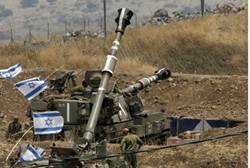
IDF mobile artilleryIDF mobile artillery pieces at the Lebanese border Reuters

Yair Golan, the Major General of the Northern Command, has warned the world at large that Israel’s situation with Lebanon is extremely volatile.

“The situation on the border[with Lebanon] is explosive and the smallest spark can cause a border clash – even if neither side is looking to engage in fighting,” Golan told French newspaper Le Figaro onTuesday.

Golan, who provided the interview before three IDF soldiers were injured in a bomb attack in the Golan Heights – which appears to have been an attempted kidnapping – also noted that Sunni jihadis in Syria had turned their eyes against Israel. “After Assad, Israel will be their next target,” the general stated.

He elaborated that in light of recent escalations – including the infiltration of the border with Lebanon by terrorists – the IDF is in the midst of taking several drastic measures to ramp up security. Among them, the general claimed, are the building of a “smart” fence to help detection and a greater focus on gathering intelligence.

“There are only about 300 fighters” building on the border so far, according to Golan, “and they haven’t attacked yet.” But he stressed that the IDF is making preparations, nonetheless, ahead of a possible border clash.

Hezbollah Building an Arsenal

Maj. Gen. Golan noted that since the Second Lebanon War concluded in 2006, Hezbollah has maintained a “status quo” along the border with Israel – but added that the Shi’ite organization has been making a “supreme” effort to obtain weapons made in Iran or Russia, transported via Syria.

“Hezbollah seeks to bridge the gap in the quality of their arsenal versus ours, and increase its military capabilities,” Golan stated.

“A Third Lebanon War will not be limited to air strikes, and we will use all our capabilities, including sea and land, to remove the destructive capacity of the enemy,” Golan warned. Maj. Gen. Golan also referred to the fact that Hezbollah invest its money and resources in developing bases in civilian areas – both in and underneath villages in southern Lebanon.

“This fact will not prevent us from using force to defend our citizens,” he threatened.

Iran will not give up uranium enrichment: Rouhani

March 19, 2014

Iran will not give up uranium enrichment: Rouhani – The Daily Star.

March 19, 2014 05:36 PM

File-This Feb. 11, 2014, file photo shows Iranian President Hassan Rouhani, delivering a speech during an annual rally commemorating anniversary of the 1979 Islamic revolution, at the Azadi 'Freedom' Square in Tehran, Iran. (AP Photo/Vahid Salemi, File)

File-This Feb. 11, 2014, file photo shows Iranian President Hassan Rouhani, delivering a speech during an annual rally commemorating anniversary of the 1979 Islamic revolution, at the Azadi ‘Freedom’ Square in Tehran, Iran. (AP Photo/Vahid Salemi, File)

TEHRAN: President Hassan Rouhani insisted Wednesday that Iran would not abandon its enrichment of uranium, after US senators called for it to be denied any such right under a long-term nuclear deal.

“The world has admitted that Iran is, and will be, among the countries which have nuclear technology, including enrichment, and there is no doubt about this for anyone,” state media quoted Rouhani as telling a cabinet meeting.

His comment came after an overwhelming majority of US senators signed a bipartisan letter to President Barack Obama on Tuesday urging him to reject Iran’s claim to the right to enrich uranium for civilian purposes in talks under way with the major powers.

“We believe that Iran has no inherent right to enrichment under the nuclear Non-Proliferation Treaty,” the letter signed by 83 of the 100 members of the US Senate said.

Rouhani said Iran was ready to be more transparent about its nuclear programme to allay Western concerns about its ambitions.

“We do not want to make anybody worried… today we are negotiating for a final agreement which is reachable within six months,” he said.

The latest round of talks between Iran and the six powers wrapped up on Wednesday, with EU foreign policy chief Catherine Ashton describing them as “substantive and useful”.

The next round is scheduled for April 7 in the quest for a long-term deal by a July 20 target date set under an interim agreement reached last November.

The six powers — Britain, China, France, Russia and the United States plus Germany — want Iran to reduce permanently, or at least for a long time, the scope of its nuclear activities in order to make it extremely difficult for it ever to develop nuclear weapons.

This would likely include Iran slashing the number of centrifuges enriching uranium — which can be used for peaceful purposes but also in a bomb, if highly purified — and allowing tougher UN inspections.

US: ‘Hard work’ needed to agree with Iran on enrichment

March 19, 2014

US: ‘Hard work’ needed to agree with Iran on enrichment – Ynet.

Iran and 6 world powers lock horns over Arak nuclear reactor that could yield plutonium as negotiations meeting comes to end.

Published:  03.19.14, 17:09 /

VIENNA – It will be very difficult to overcome differences between Iran and six world powers over Tehran’s uranium enrichment programme, though all parties aim to adhere to their 6-month deadline to reach a nuclear deal, a senior US official said on Wednesday.

“It’s a gap (on enrichment) that’s going to take some hard work to get to a place where we can find some agreement,” the senior US administration official said after the latest round of negotiations on Iran’s atomic programme in Vienna.

The official said the differences over Iran’s planned Arak heavy-water reactor, which Western powers fear could yield weapons-grade plutonium, remained similarly wide. However, Tehran’s foreign minister voiced optimism that their July 20 deadline for a deal is within reach.

Negotiators for Iran and six world powers on Wednesday adjourned what they described as “substantive and useful” nuclear talks and said they will resume April 7 in Vienna.

The two sides spoke at the end of two days of negotiations focused on curbing Tehran’s atomic activities in exchange for full sanctions relief. Their joint statement was read by EU foreign policy chief Catherine Ashton, who speaks for the six countries negotiating with Iran, and Iranian Foreign Minister Mohammed Javad Zarif.

At this week’s round, the two sides attempted to iron out their positions on two of the most thorny issues: the level of uranium enrichment conducted in Iran, and its Arak heavy water reactor that the West sees as a possible source of plutonium.

The United States has called on Iran to scrap or radically alter the planned reactor, but Tehran has so far rejected that idea while hinting they could modify it. A Western diplomat said on condition of anonymity that the goal of the current round of negotiations was not to reach any final agreements.

“The goal of these sessions is not to solve any topics at this point (but) to be talking through the gaps and working on how to narrow them,” the diplomat told Reuters.

Iran's nuclear agreement, Geneva (Photo: AP)

Iran’s nuclear agreement, Geneva (Photo: AP)

Western nations want to ensure that the Arak reactor, which is still under construction, is modified sufficiently to ensure it poses no bomb profiferation risk. Iran insists the facility will be free to operate under any deal, saying it will be geared solely to producing radio-isotopes for medical treatments.

Possible options that could allow Iran to keep the reactor while satisfying the West that it would not be used for military purposes include reducing its megawatt capacity and altering the way it would be fuelled.

Iran and the six powers aim to wrap up a lasting settlement by late July, when their groundbreaking interim deal from last November expires and would need to be extended, complicating diplomacy.

The talks are meant to overcome ingrained mutual mistrust and give the West confidence that Iran would not be able to produce atomic bomb and Tehran – in return – deliverance from economic sanctions that have crippled the OPEC state’s economy.

Iran denies that its declared civilian atomic energy programme is a front for developing the means to make nuclear weapons, but its restrictions on U.N. inspections and Western intelligence about bomb-making research raised concerns.

Tehran’s chief delegate voiced optimism about the talks.

“At this stage we are trying to get an idea … of the issues that are involved and how each side sees various aspects of this problem,” Iranian Foreign Minister Mohammed Javad Zarif told Reuters at the start of the second day of talks in Vienna.

Asked whether he expected negotiators to be able to meet their deadline, he said: “Yes, I do … I am optimistic about July 20”.

Zarif said talks were going well so far but few details have emerged. One Western diplomat told Reuters on Tuesday that no agreements on any individual issues would be reached at the Vienna discussions, expected to end late on Wednesday.

The sides are conscious it may be difficult to reach gradual deals without having the overall picture in sight and are insisting that “nothing is agreed until everything is agreed”.

Much of the progress so far has been achieved since last year’s election of pragmatist President Hassan Rouhani, who launched a policy of “constructive engagement” to end Iran’s international isolation.

Since then, the day-to-day relations between Iranian and six-power negotiators have improved dramatically, with senior officials addressing each other by their first names and using English in talks, rather than going through onerous translation.

But the vast gap of expectations about the final deal could still scupper diplomacy.

Both the U.S. and Iranian delegations – the two pivotal players in the negotiations – face intense pressure from hawkish critics back home. In Washington, a big majority of U.S. senators urged President Barack Obama to insist that any final agreement state that Iran “has no inherent right to enrichment under the Nuclear Non-Proliferation Treaty”.

That would be a non-starter for Iran, which cites a right under the NPT to produce nuclear energy for civilian purposes.

The final settlement will also have to address the acceptable level of uranium enrichment, the extent of research Iran is allowed to conduct into new enrichment technologies, and its remaining nuclear facilities.

The powers will also want to spread out the sanctions relief over years, or possibly decades, to ensure they maintain their leverage over Tehran and that it meets its end of the deal.

The Islamic Republic has already suspended its most sensitive, higher-grade enrichment – a potential path towards bomb fuel – under the November accord and won modest respite from sanctions.

The Vienna talks were being held under the shadow of the Ukraine crisis, which has pitted the United States and the European Union against Russia over its move to annex the Russian-majority Ukrainian region of Crimea.

Iran’s top nuclear negotiator, Abbas Araqchi, said that the crisis in Ukraine – the worst confrontation between the West and the East since the Cold War – had so far had “no impact” on talks with the six nations.

“We also prefer the (powers) to have a unified approach for the sake of negotiations,” he told reporters late on Tuesday, noting that the first day of talks was “positive and very good”.

A spokesman for European Union foreign policy chief Catherine Ashton, who coordinates diplomacy with Iran on behalf of the six, said the powers were working in a “unified fashion”.

Araqchi said that the next round of talks were expected to be held in the Austrian capital on April 7-9.

In the past, Russia has generally enjoyed warmer relations with the Islamic Republic and suggested Western fears about any nuclear weapons designs by Tehran are overblown.

Reuters and the Associated Press contributed to this report