Archive for March 30, 2014

Iran launches floating condensate export terminal

March 30, 2014

Iran launches floating condensate export terminal, Trend, March 30, 2014

(Is Iran confident that the sanctions will not be revived? Who would have thunk? — DM)

[T]he floating terminal will be able to meet growing demand for the country’s condensates. The floating terminal was under overhaul for the past two years and by putting it back into operation, currently two floating terminal are being used to transfer condensates on to tankers offshore at Asaluyeh.

Persian_Gulf_300808

Iran has launched a second floating terminal to export condensates in the southern port of Asaluyeh, located in the Persian Gulf, managing director of the Iranian Oil Terminals Company, Pirouz Mousavi said, the country’s Mehr news agency reported on March 27.

Mousavi went on to say that the terminal has the capacity to export 600,000 barrels of condensate per day. Gas condensates are a kind of light and expensive crude oil extracted from gas fields.

Mousavi underlined that the floating terminal will be able to meet growing demand for the country’s condensates. The floating terminal was under overhaul for the past two years and by putting it back into operation, currently two floating terminal are being used to transfer condensates on to tankers offshore at Asaluyeh.

Each terminal is capable of transferring 600,000 barrels of condensate per day to oil tankers with capacity of maximum 320,000 tons.

Earlier in March Iranian media outlets reported that the country’s condensate export capacity will increase from some 450,000 barrels per day to 1.2 million bpd in the next two months after the new floating terminal’s inauguration.

The Iranian Customs Administration’s latest report released on Feb. 23 shows that the country’s monthly gas condensates exports in the past four months stood at an average figure of $1.388 billion, up 247 percent compared to the average figure of the first seven months of the solar year (ended March 21).

Iran’s average gas condensates exports in the first seven months of the fiscal year were $561 million per month. Iran’s total gas condensate exports in the first 11 months of the year ending March 21 were around $9.479 billion. The figure is $1.021 billion more than the same period of the previous year.

Iran’s gas condensate exports in the Iranian calendar year of 1391(ended on March 21, 2013) faced a 12.56 percent decrease compared to the preceding year, stand at $8.881 billion.

Iran Names 1979 U.S. Embassy Hostage-Taker Its UN Envoy

March 30, 2014

Iran Names 1979 U.S. Embassy Hostage-Taker Its UN Envoy – Bloomberg.

(This very fitting representative of the criminal regime in Iran has been chosen by, drumroll please … , the wonderfully ‘moderate’ Hassan Rouhani. – Artaxes)

By Kambiz Foroohar       Mar 30, 2014 6:00 AM GMT+0200

Iran has named a member of the militant group that held 52 Americans hostage in Tehran for 444 days to be its next ambassador to the United Nations.

The Iranian government has applied for a U.S. visa for Hamid Aboutalebi, Iran’s former ambassador to Belgium and Italy, who was a member of the Muslim Students Following the Imam’s Line, a group of radical students that seized the U.S. embassy on Nov. 4, 1979. Imam was an honorific used for Ayatollah Ruhollah Khomeini, the leader of the Islamic Revolution.

Relations between the Islamic Republic and the U.S. and its allies are beginning to emerge from the deep freeze that began when the self-proclaimed Iranian students overrun the embassy and took the hostages. The State Department hasn’t responded to the visa application, according to an Iranian diplomat.

A controversy over Aboutalebi’s appointment could spark demands on Capitol Hill and beyond during this congressional election year for the Obama administration to take the unusual step of denying a visa to an official posted to the UN. It also could hamper progress toward a comprehensive agreement to curb Iran’s nuclear program, which the U.S. and five other world powers are seeking to negotiate with Iran by July 20.

Iranian President Hassan Rouhani chose Aboutalebi to serve at the UN, which is headquartered in New York City on international, soil after the interim nuclear deal was forged last Nov. 24.

Compensation Issue

“There’ll not be any rapprochement with Iran until hostages are compensated for their torture,” said Tom Lankford, an Alexandria, Virginia-based lawyer who’s been trying to win compensation for the hostages since 2000. “It’s important that no state sponsor of terror can avoid paying for acts of terror.”

Anyone connected with the hostage-takers shouldn’t get a U.S. visa, said a former hostage and U.S. diplomat. He requested anonymity to avoid renewed attention.

Aboutalebi has said he didn’t take part in the initial occupation of the embassy, and acted as translator and negotiator, according to an interview he gave to the Khabaronline news website in Iran.

“On a few other occasions, when they needed to translate something in relation with their contacts with other countries, I translated their material into English or French,” Aboutalebi said, according to Khabaronline. “I did the translation during a press conference when the female and black staffers of the embassy were released, and it was purely based on humanitarian motivations.”

He referred to the release of some embassy staff members during the first few weeks of the crisis in November 1979.

Photo Displayed

Although Aboutalebi downplays his involvement, his photograph is displayed on Taskhir, the website of the Muslim Students Following the Imam’s Line. Taskhir can mean both capture and occupation in Persian.

According to Mohammad Hashemi, one of the students who led the occupation of the embassy, Iran’s revolutionary government sent Aboutalebi and Abbas Abdi, another architect of the occupation, as emissaries to Algiers. The Algerian capital at that time was a mecca of third-world liberation movements, including the Palestine Liberation Organization.

Hamid Babaei, a spokesman for the Iran’s UN Mission in New York, declined to comment.

“We don’t as a matter of practice comment on visa applications.” said Marie Harf, deputy State Department spokeswoman. “People are free to apply,” and the U.S. has a process to review all visas, she said.

Asked if the U.S. is aware that Aboutalebi was a member of the hostage-taking group, Harf declined to comment.

No Speculation

“Anyone can submit a visa application, and it will be evaluated as we do all visa applications, in accordance with our procedures,” she said. “We don’t speculate on what the outcome might be.”

The U.S. is obliged to grant entry visas to representatives of UN member-states in accordance with an agreement signed in 1947.

Sudanese President Omar al-Bashir decided not to attend last year’s General Assembly session after not receiving a response to his visa application from the State Department. Bashir is subject to outstanding arrest warrants from the International Criminal Court for crimes against humanity and referral for trial in The Hague. While the U.S. isn’t a party to the ICC, the court has asked American authorities to surrender Bashir if he enters U.S. territory.

Abkhazia Dispute

Russian UN Ambassador Vitaly Churkin accused the U.S. of denying a visa for Abkhazia’s then-foreign minister Sergei Shamba in 2007, when he sought to attend a Security Council meeting. Then-National Security Council spokesman Sean McCormack, now a vice president of Chicago-based Boeing Co. (BA), said Shamba withdrew his visa request before the U.S. made a decision on his application.

The U.S. doesn’t recognize Abkhazia as an independent territory because it broke away from Georgia in 2008.

Some U.S. foes have received visas in the past, said Gary Sick, the top Iran expert on President Jimmy Carter’s National Security Council staff during the hostage crisis.

“All kinds of leaders from Cuba to Africa who could be accused of horrible crimes and opposing U.S. policies have received visas,” Sick said. “There is no way to know why some people get the visa and some don’t.”

Some of the students who took the hostages formed the backbone of Iran’s Intelligence Ministry, according to the book “Guests of the Ayatollah,” by Mark Bowden.

Others have had extended political careers. Masoumeh Ebtekar, a former spokeswoman for the hostage-takers, is a vice president in Iran under Rouhani and head of the Department of Environment.

Others fell out of favor amid shifting political developments in Iran. Abdi, one of the first to enter the embassy compound, became the editor of reformist newspaper Salaam, which was shut down in 1999. He was sentenced to five years in prison in 2003, and released in 2005.

To contact the reporter on this story: Kambiz Foroohar in New York at kforoohar@bloomberg.net

To contact the editors responsible for this story: John Walcott at jwalcott9@bloomberg.net; Andrew J. Barden at barden@bloomberg.net Don Frederick

PA: Talks can go on if Israel frees 1,000 prisoners

March 30, 2014

PA: Talks can go on if Israel frees 1,000 prisoners, Times of Israel, Avi Issacharoff, March 30, 2014

(Washington apparently urged the 400 prisoner release and is engaged in discussions about the current Palestinian demand.  Accordingly, there should be no problem with another 600 terrorists or whatever else the consistently reasonable and impartial Team Obama may favor. Right? — DM)

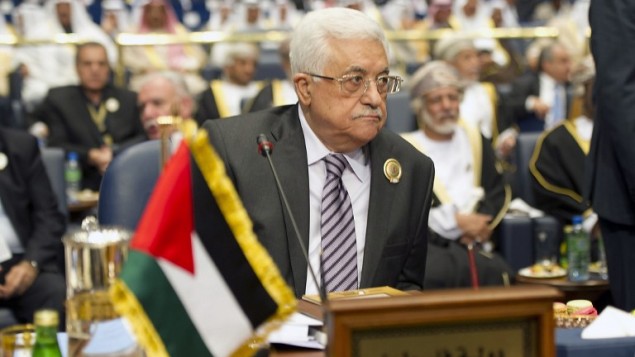
Abbas rejects offer of 400 more freed Palestinians to continue negotiations, hands counteroffer to US mediators

Abbas March 25thPalestinian leader Mahmoud Abbas attends the 25th Arab League summit, March 25, 2014 (photo credit:AFP/Yasser al-Zayyat)

The Palestinian Authority has rejected a purported Israeli offer to release a new group of 400 Palestinian security prisoners if the Palestinians agree to extend peace talks for another six months, The Times of Israel learned Sunday.

On Saturday, The Times of Israel learned from a Palestinian source that Jerusalem, backed by Washington, offered to release 400 more prisoners of Israel’s choosing, in addition to a fourth and final group of longtime terrorism convicts who were set to go free this weekend – on the condition that the Palestinian Authority agrees to prolong the ongoing negotiations beyond the April 29 deadline.

However, on Sunday, the Palestinian leadership rejected the offer and presented a counteroffer of its own to American mediators – that Israel release 1,000 more prisoners, of the Palestinian Authority’s choosing. Palestinian Authority President Mahmoud Abbas also demanded that Israel freeze settlement construction and transfer some Area C regions to the Palestinian Authority’s control.

In exchange, peace talks would be extended until the end of 2014.

Although the Palestinian leadership rejected Israel’s offer, which was an attempt to at least partially fill Abbas’s prerequisites for the extension of talks, the Palestinian Authority was holding intensive talks Sunday to discuss the matter further.

Palestinian chief negotiator Saeb Erekat, who has resigned several times since peace talks started up again in July under US mediation, said Sunday that he was still holding secret talks with Jerusalem and Washington, far from the public eye.

On the prisoner release that was meant to take place Saturday, Erekat said it might still be carried out, as Israel was obligated to release inmates imprisoned before the Oslo Accords.

Erekat stressed that Abbas was making every effort to secure the prisoners’ release independent of any agreement to extend the talks. In return, the Palestinians would continue to abide by their obligation to refrain from applying to UN and other international bodies for the duration of the talks.

On Saturday, some sources claimed Israel was holding off on freeing the prisoners because of rumors that the PA would back out of peace talks once the fourth group of convicts was released. Israel has also balked at releasing Israeli Arabs.

As of Saturday evening, however, Abbas was insisting that the prisoners be released before he would consider extending the talks beyond their current deadline.

Saturday’s offer had stipulated that Israel would determine which additional 400 security prisoners would go free, Palestinian sources said. The demand was rejected by the Palestinian leadership, which insisted on determining which prisoners would be freed.

Israel is said to be holding close to 5,000 Palestinian security prisoners.

Jewish Home’s Uri Ariel, the minister of housing and construction, was said to be ready to recommend that his right-wing party leave the coalition if the release of the extra prisoners goes through.

Transportation Minister Yisrael Katz, a member of Netanyahu’s own Likud party, told Israel Radio Saturday night that he was against the release of all further prisoners, and that moves to free them should be stopped immediately, particularly “since there hasn’t been any forward movement in the peace process.”

The Minister of Prisoners in the PA, Issa Karake, on Saturday night urged Abbas to leave the negotiations and instead take the cause of Palestinian statehood to the UN and other international organizations if Israel does not release the fourth group of prisoners within the next few days.

State Department Spokeswoman Jen Psaki said Saturday night, “In regard to reports this evening on an agreement on the release of prisoners, no deal has been arrived at, and we continue to work intensively with both sides. Any claims to the contrary are inaccurate.”

Meanwhile, US Special Envoy for Israeli-Palestinian Negotiations Martin Indyk met with Erekat and Israel’s envoy to the peace talks, Yitzhak Molcho, in Jerusalem Saturday night. Erekat was quoted by Army Radio saying he believed the deadlock would be broken and the fourth group of prisoners would go free early in the coming week.

Earlier Saturday, it was reported that Prime Minister Benjamin Netanyahu has told US Secretary of State John Kerry that he feared his coalition could fall apart if Israel frees the fourth batch of Palestinian prisoners who were slated for release this weekend — among them 14 Israeli Arabs.

Citing sources in the Palestinian Authority, the London-based pan-Arab al-Hayat newspaper reported that US negotiators had told Abbas Netanyahu feared his coalition, which includes the right-wing Jewish Home and Yisrael Beytenu parties, might disintegrate over the prisoner release.

Off Topic -Netanyahu: UNHRC continues its ‘march of hypocrisy’ against Israel

March 30, 2014

Netanyahu: UNHRC continues its ‘march of hypocrisy’ against Israel | JPost | Israel News.

By TOVAH LAZAROFF

 03/30/2014 14:44

PM slams UN Human Rights Council for condemning Israel in five resolutions last week; Israeli official: European countries failed to show moral leadership.

THE MEETING hall of the United Nations Human Rights Council.

THE MEETING hall of the United Nations Human Rights Council. Photo: Reuters

 Prime Minister Binyamin Netanyahu on Sunday slammed the United Nations Human Rights Council for “absurdly” condemning Israel in five resolutions last week while censuring Syria and Iran only once.

“This march of hypocrisy is continuing and we will continue to condemn it and expose it,” he told his cabinet at the start of its weekly meeting in Jerusalem.

“The UN Human Rights Council condemned Israel five times, this at a time when the slaughter in Syria is continuing, innocent people are being hung in the Middle East and human rights are being eroded.

“In many countries free media are being shut down and the UN Human Rights Council decides to condemn Israel for closing off a balcony. This is absurd,” said Netanyahu.

On Friday the UNHRC ended its 25th session by almost unanimously, voting 46-1, on four resolutions condemning Israeli treatment of Palestinians. It also condemned Israeli human rights abuses against Syrian citizens of Israel who live on the Golan Heights, voting 33 to 1, with 13 abstentions.

Out of the 42 resolutions adopted by the council on a wide range of human issues only 10 censured the actions of a specific country, out of which five of the condemnations were leveled against Israel.

A resolution on the situation of human rights in Myanmar was approved by consensus.

But none of the condemnations of other countries, including those of Iran and Syria, on the issue of human rights received the same level of support from member states as the charges against Israel.

The 47-member UN Human Rights Council voted 21-to-9, with 16 abstentions on the situation of human rights in the Islamic Republic of Iran.

It voted 23-to-12, with 12 abstentions on “reconciliation, accountability and human rights in Sri Lanka.”

It voted 30-to-6 ,with 11 abstentions on the situation of human rights in the Democratic People’s Republic of Korea.

It voted 32-to-4, with 11 abstentions on the grave deterioration of human rights and the humanitarian situation in the Syrian Arab Republic. This resolution strongly condemned the use of chemical weapons. It also condemned the “bombardment of civilian areas, in particular the indiscriminate use of barrel bombs, ballistic missiles and cluster bombs and other actions which may amount to war crimes against humanity.”

An Israeli official said the fact that Israeli actions on the Golan Heights garnered slightly more support, with 33 countries approving it, was “almost a bad joke.”

It was particularly upsetting, the Israeli official said, that the UNHRC approved such a resolution at a time when hospitals in the north of Israel are treating scores of Syrian victims from the civil war in their country.

The Israeli official also took issue with the strong united stance against Israel by nine member states of the European Union including: Germany, France, Italy, the United Kingdom, Austria, Romania, the Czech Republic, Estonia and Ireland.

All nine EU countries supported the four resolutions which condemned Israeli treatment of Palestinians, supporting the Goldstone Report on Israeli actions in Gaza and encouraged a boycott of West Bank settlements and Jewish neighborhoods of east Jerusalem. They abstained but did not reject the resolution condemning Israeli violations of of human rights against Syrian citizens of Israel on the Golan Heights.

“It’s a pity that some western democracies choose to jump on the automatic anti-Israel band wagon at the UNHRC,” an Israeli official said.

“It is a pity they did not use that moment to demonstrate moral leadership, instead of that they became part of the travesty. They became partners in a cynical one sided farce,” the official said.

But the official lauded the United States, which was the sole country to stand with Israel and reject all five resolutions.

“They showed moral leadership,” the official said.

The Palestinians, however, welcomed the almost unanimous support at the UNHRC and said such resolutions showed Israel that it could not “flout” international law.

“This vote confirms the world’s clear condemnation of the systematic human rights violations committed by Israel, the occupying power, against the Palestinian people and their fundamental rights,” said Palestinian Authority Foreign Minister Riad Malki.

The Foreign Ministry was not present at the UNHRC’s meetings this week, due to its ongoing strike against the government over equitable wages.

Off Topic: Palestinians welcome almost unanimous UNHRC support

March 30, 2014

Palestinians welcome almost unanimous UNHRC support | JPost | Israel News.

( A sign of things to come…  Scary shit. – JW )

PA foreign minister says result of council’s vote on 4 resolutions condemning Israel reaffirms “indisputable right” for Palestinian independence.

OVERVIEW OF the Human Rights Council at the UNHRC

OVERVIEW OF the Human Rights Council at the UNHRC Photo: Reuters

 The Palestinians on Saturday welcomed the almost unanimous show of support they received at the United Nations Human Rights Council as it ended its 25th session in Geneva.

Four resolutions condemning Israeli treatment of Palestinians in the West Bank, east Jerusalem and Gaza passed by a 46-to-1 vote. Italy, Germany and France on behalf of the European Union were among the nations that stood against Israel.

“This vote confirms the world’s clear condemnation of the systematic human rights violations committed by Israel, the occupying power, against the Palestinian people and their fundamental rights,” said Palestinian Authority Foreign Minister Riad Malki.

“The vote also reflects a clear affirmation by the international community on the indisputable right of the Palestinian people to self-determination, establishment of their independent state and return based on UN Resolution 194,” Malki said.

One of the four resolutions encouraged the boycott of West Bank settlements and the Jewish neighborhoods of eastern Jerusalem.

Malki in a statement to the media highlighted that item and said, “Most pertinently, it signals that the world is committed to ensuring that no profiteering is allowed from the occupation regime.”

Although the council often votes to condemn Israel, it is unusual for all such resolutions to be approved nearly unanimously. The EU in past council sessions has often been split on these resolutions with some member states abstaining and others voting in support of the Palestinians.

Italy’s representative to the UNHRC, Maurizio Enrico Serra, told the council that the EU supports these motions and that “EU member states would be voting in favor” of them.

A fifth resolution against Israel condemned its continued presence on the Golan Heights and its treatment of the Syrian population that lives there passed with the approval of 33 nations. There were 13 abstentions, including EU member states, and one vote against.

The United States was the only nation to support Israel in all five resolutions.

Israel was not present at the meeting, due to the ongoing Foreign Ministry strike.

Prior to Friday’s vote, the US issued a scathing attack against the UNHRC for its continued biased treatment of Israel and charged that the council was harming the peace process.

The PLO’s Ambassador to the UN in Geneva, Ibrahim Khraishi, however, told the council such resolutions help the peace process.

“There is an Israeli occupation. Israel would like to continue with this occupation and to continue with its daily violations. We utterly refuse this situation and we will continue to resist this situation with all means available, in conformity with the provisions of the international law,” Khraishi said.

He took issue with statements Foreign Minister Avigdor Liberman had made about Palestinians and the council, and charged that he is a “liar.”

Khraishi said that Israel “thinks this whole action [the council resolutions] is tantamount to anti-Semitism. We do not know what is really meant by anti-Semitism when it is claimed by Israelis.”

The issue for the Palestinians, he said, is to end the occupation and to force Israel to comply with international law.

But the US said that the council held Israel to a higher standard than any other nation. It took particular issue with the council’s Agenda Item 7, which mandates that Israel must be debated at every UNHRC session. Israel is the only country with such a standing agenda item

“We are deeply troubled once again to be presented with a slate of one-sided resolutions that undermine efforts to make progress in the negotiations,” said Paula Schriefer, who headed the US delegation to the 25th UNHRC session.

She noted in particular that the US remains “deeply troubled, however, by this council’s standalone agenda item directed against Israel, and by the many repetitive and one-sided resolutions under that agenda item.

“None of the world’s worst human rights violators, some of whom are the object of resolutions at this session, has their own stand-alone agenda item at this council. Only Israel, a vibrant and open democracy, receives such treatment,” she said.

Schriefer noted that the US provided financial and technical assistance to the Palestinian people and is the largest donor to UNRWA.

“We are disappointed that this council continually singles out Israel for criticism without acknowledging the violent attacks directed at its people, nor the obligations and difficult steps required of both sides to resolve their conflict,” Schriefer said.

She explained that the US supports the Palestinians’ right to self-determination, but that it does not believe these resolutions help advance a two-state solution or the peaceful resolution of the conflict.
The US said that the resolution on the Golan is an example of the problematic treatment Israel continues to receive at the hands of the UNHRC.

“Especially disturbing is this council’s complacency with the repeated introduction of a resolution focusing on the Golan Heights. To consider such a resolution while the Syrian regime continues to slaughter its own citizens by the tens of thousands exemplifies the absurdity of this agenda item and each of the other resolutions on Agenda Item 7,” Schriefer said.

Israel was the only country at the UNHRC’s 25th session in Geneva to have multiple resolutions leveled against it and resolutions censuring other countries lacked the same level of support. The resolutions on the People’s

Republic of Korea, was approved by 30 votes, the one on Iran by 21 and Syria by 32.

Syrian rebels allowed to attack Latakia from Turkish soil under Turkish air cover. Iran raises Cain in Ankara

March 30, 2014

Syrian rebels allowed to attack Latakia from Turkish soil under Turkish air cover. Iran raises Cain in Ankara.

DEBKAfile Exclusive Report March 29, 2014, 10:45 PM (IST)
Intense fighting for Kasab in northwest Syria

Intense fighting for Kasab in northwest Syria

Turkey has ratcheted up its intervention in the Syrian war to an unprecedented level, according to exclusive debkafile military and intelligence sources.

For the first time in the three-year conflict the Turkish army is allowing Syrian rebel forces, including the Al-Qaeda-affiliated Nusra Front, passage through Turkish territory for their offensive to capture the northwestern Syrian coastal area where the Assad clan’s lands are situated.

Ankara’s support for the rebels is inclusive: Turkish troops are posted at the roadside with supplies of ammo, fuel, food, mechanical repair crews and medical aid for rebel forces as they head north. The Turkish air force gives them air cover and Turkish agents arm them with surveillance data on Syrian military movements ahead.

The Syrian fighter jet shot down on March 23 just inside the Turkish border was in fact downed in a dogfight with Turkish warplanes, while trying to bomb the rebel convoy heading for the new combat arena. Both sides preferred to stay quiet about the incident and its causes.
The rebels receiving Turkish military support are disclosed by our sources as belonging to two militias: The Syrian Revolutionaries Front under the command of Jamal Maarouf, which has gathered in remnants of the disbanded Free Syrian Army; and the Islamic Front, sponsored until recently by Saudi intelligence.  They number around 4,000 fighting men including elements of the Nusra Front.

With powerful Turkish backing, this force has been able to carve a very narrow corridor into northwest Syria from the tall Jabal al-Zawiya in the Idlib region up to a point near Syria’s northern Mediterranean coast, thereby severing the northwestern link between Syria and Turkey.

This was the first time rebel forces had gained full control of a strategic corridor. First, they had to battle through and capture the towns of Kazab, Khirbet and Samra northwest of the coastal town of Latakia.
The Syrian army is throwing air, armored and heavy artillery strength against the rebels to stop them firming up their positions in those towns, while also aiming to regain command of the Syrian-Turkish border region.

The fighting Saturday, March 29 was most intense around Kasab.

This new development in the Syrian war raises two questions:

1. For how long can the Syrian rebels hold out against constant battering by superior military strength?

2. If the rebels are thrown out of their new positions, will the Turkish army come to their aid?  If so, it would be Ankara’s first outright military incursion into Syrian territory and the first intrusion by a NATO member in its civil conflict.
Our sources in Ankara report that Prime Minister Tayyip Erdogan is in favor of going ahead. He is vehemently opposed by the Turkish chief of staff.

It is this argument which triggered the banning of YouTube by the Turkish government Friday, March 28 – not the important municipal elections taking place Monday. A leaked recording published anonymously purported to reveal a conversation between Turkey’s foreign minister, Ahmet Davutoglu, spy chief Hakan Fidan and a general discussing how to drum up a pretext for a Turkish attack inside Syria. A voice identified as that of Fidan appeared to suggest a missile assault as the pretext for a Turkish invasion.

Erdogan and Turkish intelligence chiefs are convinced that the leak was orchestrated by generals who are against deeper Turkish involvement in the Syria war

In the meantime, debkafile’s Iranian sources report that Tehran was so jittery about this turn of events that a Iranian military delegation was rushed to Ankara, arriving Saturday, to force the Erdogan to take his hands off the Syrian war by any means, including a threat to suspend oil supplies. The two sides are still talking.