Archive for March 28, 2014

Middle East Matters Most to Obama – Not Putin

March 28, 2014

Middle East Matters Most to Obama–Not Putin, TimeMichael Crowley, March 28, 2014

(The Ukrainian mess has also obscured the crisis in Venezuela, much closer to the U.S. and arguably a no less important U.S (but not necessarily Obama Administration) interest than Ukraine or even the Middle East. Why has it?– DM)

The crisis in Ukraine has obscured the region where Obama has the most at stake.

Earlier this week, Barack Obama again rejected Mitt Romney’s 2012 campaign claim that Russia is America’s biggest “geopolitical foe.” In fact, Obama said, Russia is a regional power acting out of “weakness,” adding that he worries more about a mushroom cloud over New York City than he does about Vladimir Putin.

Although Putin is dangerous and nuclear terrorism is an extremely serious threat, neither one sits at the very top of his foreign policy agenda. For a clue towards what occupies the president most, look no farther than his visit Friday with the king of Saudi Arabia.

Even after Putin’s thuggish annexation of Crimea, it’s not Russia and Europe that matter most to Obama’s agenda. It’s the Middle East. Let us count the ways.

First, the Middle East is the site of Obama’s two most ambitious foreign policy projects. One is Obama’s negotiation with Iran over its nuclear program. Preventing an Iranian bomb has been a top American priority for more than a decade. Iran has been one of the U.S.’s most hostile enemies for 35 years. The outcome of the talks has stakes for nuclear nonproliferation—refer back to Obama’s comment about a nuke in Manhattan—as well as Israeli security and the region’s balance of power.

The second project is the effort to make peace deal between Israel and the Palestinians—which are at an especially critical point. Israeli Prime Minister Benjamin Netanyahu must decide by this weekend whether to proceed with a planned release of Palestinian prisoners; the Israeli leader is reportedly hesitant given signs that the peace process has stalled out. If Netanyahu decides not to release those prisoners, the talks couple collapse—potentially triggering for a new wave of violenceand killing the prospects for a historic deal for years, possibly forever.

Then there’s Syria, whose savage civil war is destabilizing the entire region, whipping up sectarian violence from Lebanon to Iraq, and threatening the stability of Jordan. Perhaps more ominously, Syria has become a training ground for jihadis who dream of killing westerners. Just this week the New York Times reported that Islamic radicals are traveling from Pakistan to Syria “to lay the foundation for future strikes against Europe and the United States.” There’s virtually no chance of a shooting war between America and Russia anytime soon. But the risk of a big terror attack that originates in the Middle East is quite real. Remember last summer’s terror alert, which led to the closure of embassies around the region? Nor is Syria the only Middle Eastern country from which terrorists could strike. Don’t forget the strong al Qaeda presence in Yemen, home to the group’s terrifying master bomb maker—or the recent resurgence of al Qaeda in Iraq.

Finally, there’s oil. America is growing more energy independent, and now imports only about a quarter of its oil supplies from the Persian Gulf. But energy markets are global, so any disruption in oil supplies—or even fear of regional instability—cranks up prices for everyone. Global oil prices surged at the mere threat of a U.S. strike on Syria last summer, even though Syria’s oil exports are relatively puny. The world economy still depends mightily on the Middle East’s black crude.

None of this means that Vladimir Putin’s recent actions don’t have important implications for questions like the future of Europe, the fate of NATO and a world economy that could be dented by reciprocal sanctions. And certainly, if Putin orders his army into eastern Ukraine, the situation will escalate to dangerous new levels.

Even so, it will be hard to compete with the Middle East’s implications for nuclear proliferation, terrorism, Israeli security and the global economy. That’s why the most important stop on Obama’s world trip may well be the one he makes Friday in the desert kingdom of Saudi Arabia.

Bandar Is Back

March 28, 2014

Bandar Is Back – The Weekly Standardk.

And in Friday’s meeting between Obama and King Abdullah, he’s poised to stand against Obama administration policy on Iran and Syria.

2:38 PM, Mar 27, 2014 • By HUSSAIN ABDUL-HUSSAIN

Kuwait City
Friday’s meeting in Riyadh between King Abdullah and President Obama is likely to be a tense one. First, there’s the fact that the Saudis and the White House differ on a host of regional issues, from Egypt and Bahrain to Syria and Iran. Moreover, there are also the secondary players likely to be in attendance, one of which from each side the other considers a nuisance.  The Saudis think that newly named National Security Council staffer Robert Malley is an irritant, and the White House doesn’t like Prince Bandar bin Sultan, the Saudi intelligence chief and formerly longtime ambassador to Washington.

Bandar bin Sultan

Bandar bin Sultan

For the Saudis’ taste, Malley, who worked on the Arab-Israeli peace process in the Clinton administration, got too close with Syrian regime officials when he was program director for Middle East and North Africa at the International Crisis Group. From Riyadh’s perspective, Malley’s appointment merely confirms their worst fears about Obama’s regional strategy—U.S. rapprochement with a host of figures it considers deadly adversaries, from Assad to Iran and Hezbollah, and at the expense of the Saudis and other longtime U.S. allies in the Persian Gulf.

For the Obama administration, Bandar, a former Washington power player and Bush family confidante, is a thorn in its side. First, he’s been publicly critical of White House policy, frequently leaking anti-Obama tidbits to the U.S. press. He’s also reached out to Vladimir Putin in an effort to buy arms from the Russians—and show up the White House. Speculation in Saudi circles is that the last straw was when Secretary of State John Kerry requested a meeting with him during a trip to Riyadh only to be told that since Bandar was on his way out of town that they meet at the airport. From the administration’s perspective, the problem with US-Saudi relations isn’t the White House’s and Riyadh’s diverging regional policies, but Bandar himself. The White House allegedly pushed to have Bandar put on administrative leave, and suddenly the man who had revived Riyadh’s Syria policy was out of the headlines. While Saudi spokesmen repeatedly explained that the prince was on travel for health reasons, in Marrakesh most recently for shoulder surgery, rumor was that the kingdom had succumbed to U.S. pressure by sidelining its top spy.

Now that Bandar appears to be back, perhaps Friday he’ll ask the American side why it compelled Jordan to shut down its border to arms shipments going to rebels in southern Syria. This action may have tipped the balance of power against the rebels and on behalf of Bashar al-Assad’s allied forces in the battle for Yabroud.

The Syrian opposition had believed that opening a southern front might distract Assad from his siege of Yabroud, a town northwest of Damascus, and force him to redeploy some of his assets. Rebels therefore launched an offensive from areas they control around the town of Quneitra and scored some successes. When they sought rearmament through a cross point they control on the Syrian border with Jordan, Amman shut down the arms route, and the Quneitra front faltered as Assad managed to retake control without having to reinforce his own troops. Less than two weeks later, the joint Assad-Hezbollah-Iraqi forces swept through Yabroud.  

Even if Jordan takes its orders from Washington to shut down its borders, Turkey might be a different story. Gulf sources believe that Turkey has an interest in preventing a linkup between the Alawis of northern Syria and those in its southern province of Hatay, and thus has facilitated a rebel advance to the strategic border crossing of Kasab, which overlooks the coast. Sources also argue that the Syrian MiG shot down earlier this week was brought down not by Turkish ground fire but an F-16—moreover, Gulf sources say, the Syrian jet was targeted not in Turkish airspace, but Syrian and when the pilot ejected he went down in Syrian territory. In other words, Turkish Prime Minister Recep Tayyip Erdogan seems to be eager to revive his pro-Syrian revolution credentials and play a more active role in the crisis—to cut Turkey’s Alawi community off from their Syrian brethren, and perhaps in order to deflect attention away from corruption scandals that are hitting him hard at home.

Way Off Topic: Valerie Jarrett to Hollywood to Get Obamacare in Movie, TV Scripts

March 28, 2014

Way Off Topic: Valerie Jarrett to Hollywood to Get Obamacare in Movie, TV Scripts – The Weekly Standard.

(Disgusting! Shows you how the totalitarian mindset works. You’re just too stupid to know what’s good for you. That’s why you have to be brainwashed until you do what they want. – Artaxes)

‘I’m a really good nag.’

11:46 AM, Mar 28, 2014 • By DANIEL HALPER

A top of advisor to President Barack Obama is in Los Angeles to try to get Obamacare written into scripts of TV shows and movies. Valerie Jarrett explained in an appearance on Top That! on PopSugar.com:

“That’s the cool thing,” a host said to the presidential advisor. “You’ve been reaching out to people that are, you know, outside of the norm of what the president might work with. Who else are you working with? Like celebrities, personalities, things like that?”

“You name it,” said Jarrett. “That’s part of why I’m in L.A. I’m meeting with writers of various TV shows and movies to try to get it into the scripts.” When Jarrett says “it into the scripts,” she’s referring to getting references to Obamacare, the president’s signature legislation, into the scripts of TV shows and movies.

She continued: “We’re talking to celebrities. We’re talking to athletes, because obviously they get injured a lot and many of them are the same age as the market we’re going after. And what they can say is, ‘Look, you never know when life is going to throw you a curve ball. You’re walking down the street, you’re a little clumsy, you trip, you fall — where do you end up? Emergency room. A couple grand just to walk in the door.”

“Right,” said the host.

“Who can afford that?” asked Jarrett.

“Nobody,” said a host.”

Jarrett would explain that mothers are really good at nagging — which is why mothers have been promoting the health care bill. “What do moms do?” asked Jarrett. “We try to take care of our children. Even when they’re grown. And what we want to do here is like nag. We’re really good at nagging. I’m a mom so I know. I’m a really good nag. And I can come at the same issue like 20 different ways until my daughter goes, ‘Ok, I’m cool, I’ll just do it.'”

The Supreme Leader is getting the gang back together

March 28, 2014

The Supreme Leader is getting the gang back together – American Enterprise Institute.

Image Credit: AslanMedia (Flickr) CC

Image Credit: AslanMedia (Flickr) CC

As the Syrian crisis enters the beginning of its fourth year, Iran’s Supreme Leader is taking stock of the sectarian and political conflicts in the region. By expending vast resources to bolster the Bashar al-Assad regime and Lebanese Hezbollah, the Islamic Republic has been able to prevent its ally’s overthrow. Meanwhile, Khamenei appears to be looking elsewhere in the Levant and among the Gulf countries to rebuild Iran’s alliances with Sunni states and groups that were lost during the upheaval of the Arab Spring in 2011.

Changing dynamics in the Levant

The Syrian crisis is jeopardizing the position of Iran’s most valuable regional asset—Lebanese Hezbollah. Hezbollah’s support for Assad has proved unpopular and Khamenei has surely noted with concern the recent uptick in targeted violence against Hezbollah strongholds and Iranian assets in Lebanon. These attacks are direct spillovers from Syria in response to the fall of the last rebel stronghold near the Lebanese border in Qalamoun last week. The Lebanese people increasingly see Hezbollah as neglecting its social obligations to the Shia communities at home to fight someone else’s – Iran’s – war. This erosion of Hezbollah’s domestic support is a long-term threat to the Supreme Leader’s interests.

However, there are some positive trends developing in the Levant for the Islamic Republic. Hamas and Iran have recently renewed their bilateral relations after a three-year freeze. Khamenei is reportedly receiving Hamas leader Khaled Meshaal in Tehran soon. Amidst these recent diplomatic overtures, Israeli Defense Forces intercepted advanced Iranian munitions bound for Gaza earlier this March. Indeed, this shipment signals Khamenei’s commitment to the Islamist group as the US-brokered April deadline for the Palestinian-Israeli peace talks approaches.

Exploiting a split in the GCC

One thing the Supreme Leader will be keeping an eye on during this week’s Arab League summit is the growing foreign policy rift between Qatar and Saudi Arabia that has led to the split of the Gulf Cooperation Council (GCC). Bahrain, Kuwait, Saudi Arabia, and the United Arab Emirates are determined to combat Iran’s regional ambitions, whereas Oman and Qatar are on the best terms with the Islamic Republic since the Arab Spring and see Tehran as a manageable partner in a volatile region. Qatar’s unwillingness to buy into the Sunni narrative on the existential threat posed by the Islamic Republic to the Gulf countries was in part behind the Saudi decision to recall its ambassador from Doha. The Supreme Leader may attempt to exploit this split in the GCC via economic and cooperative agreements with Oman and Qatar. Iran’s recent $60 billion 25-year contract with Oman, for example, shows the Supreme Leader’s willingness to employ an array of economic incentives to reshape the GCC and more importantly the regional dynamics in Iran’s favor.

Looking Ahead 

The Supreme Leader or his surrogates will likely have some choice words for the US and the Saudi leadership, as President Obama arrives in Riyadh on Friday. Khamenei has enjoyed watching the Saudi-American alliance fray as negotiations for a final deal on the Iranian nuclear program proceed and the US commitment to the region is increasingly questioned. Expect some subtle, or not so subtle, hints from Iran that the US is a fickle friend and the Arab World would do better without it.

This is the twelfth post in the series titled “What is keeping the Ayatollah up at night?” Written in collaboration with Katherine Earle. Special thanks for assistance from Iran interns Mehrdad Moarefian and Amir Toumaj.

Follow AEIdeas on Twitter at @AEIdeas.

Opinion: Tehran and the temptation of a power grab in Lebanon – Asharq Al Awsat

March 28, 2014

Opinion: Tehran and the temptation of a power grab in Lebanon – Asharq Al Awsat.

Written by :
on : Friday, 28 Mar, 2014

Until recently, the consensus among analysts of regional politics was that none of the powers involved in Lebanon’s tangled politics had an interest in plunging the country into a major crisis. Three reasons were cited to back that view. The first was that neither of the rival blocs in Lebanon had the initial advantage needed to seek total power. The second was that rival regional and global players were too busy elsewhere, including in Iraq and Egypt, to want to open a new arena of crisis in Lebanon. Finally, the conflict in Syria meant that both sides—that is to say, the Russo–Iranian tandem and the Arab bloc backed by the West—had to prioritize their options by focusing on the struggle for control in Damascus.

Now, however, the three reasons cited above may no longer be convincing.

To start with, the bloc led by Iran clearly feels that it now has the edge. The Islamic Republic has succeeded in hooking the United States into endless negotiations over the nuclear issue, thus removing any possibility of military action against it by either Israel or the US. Tehran’s leaders know that once President Barack Obama’s term ends, US policy may well change radically. Thus they feel they have a maximum of two years in which to exploit America’s confusion and weakness, consolidating their regional gains. That assumption may tempt the mullahs into redeploying their Lebanese pawns in a bid for total domination.

Next, though still full of imponderables, the situation in both Egypt and Iraq has achieved a measure of stability. Even if it proves to be a temporary stratagem, the elimination of the Muslim Brotherhood from the Egyptian scene allows the Arab bloc that is worried about Iranian ambitions to shift its attention back to the Levant. In Iraq, Prime Minister Nuri Al-Maliki, though no admirer of the mullahs in his heart of hearts, knows he has no choice but to temporize with Tehran, even if that means antagonizing the Arab bloc.

The third reason things might have changed as far as Lebanon is concerned is the course of the conflict in Syria. The Russo–Iranian tandem that maintains the present Syrian regime in power is now convinced that it could achieve some kind of military victory. The current strategy is to focus on “useful Syria,” that is to say, Damascus and its southern hinterland, providing the link with Lebanon and the Mediterranean coastline. That is similar to the strategy the French adopted when faced with a series of anti-colonial rebellions during their occupation of Syria. With “useful Syria” under control, the Russo–Iranian axis could go after other gains, and why not in Lebanon?

At the other end of the spectrum, the Arab bloc that wants Syrian President Bashar Al-Assad out may come to the conclusion that crushing the despot’s Hezbollah allies in Lebanon is a crucial step towards liberating Syria.
Signs that Tehran is not shy of throwing its weight around in and around Lebanon are everywhere. Supreme Guide Ali Khamenei has pointedly rebuffed Obama’s attempts at drawing Iran into talks over Syria and has ordered President Hassan Rouhani to limit talks with the P5+1 group of major powers to the nuclear issue.

Maj. Gen. Hassan Firuzabadi, the chief of staff of the Islamic Republic’s armed forces, has repeatedly described Syria and Lebanon as “part of our glacis.”

“We need those places so that we could fight our enemies far from our own borders,” Firuzabadi told a meeting of the military in Tehran last February.

Ayatollah Mahmoud Nabawian, a member of the Security Commission of the Islamic Majlis (Iran’s ersatz parliament), goes even further. “Some say we are making sacrifices for Syria,” he said in a speech at the Jihad Conference in Tehran last February. “The truth is that it is Syria that makes sacrifices for us.”

Claiming that Iran was on the verge of a “great victory” in Syria, he said: “We brought 150,000 Syrians to Iran and gave them military training. We also sent 50,000 fighters from the Lebanese branch of Hezbollah to fight alongside them. We also gave Hezbollah 80,000 missiles with which to hit Israel, and that ensured America’s defeat.”

The expected “victory” in Syria is only a prelude to “the greatest victory” (fath al-mobin) that awaits the Islamic Republic, according to the Quds Corps’ deputy commander, Gen. Ismail Qaanai. “We cannot stop at Syria,” Qaanai said last month. “Our aim is and has always been to lead the whole Muslim world.” He added: “It is obvious that no other power has the capabilities needed to assume leadership in the Muslim world.” Part of the cockiness in Tehran is due to the belief that the US has knocked itself out of the regional, if not international, equation. “The Americans know that we could hit them hard everywhere, including inside their own territory,” says Islamic Revolutionary Guards Commander Mohammad-Ali Jaafari.

However, some senior mullahs have injected an openly sectarian tone into Tehran’s expression of hubris. For example, Ayatollah Mohammad-Taqi Mesbah-Yazdi, godfather of the radical faction in Tehran, claims that Iran ought to gain control of Syria to “efface the damage done to Islam by the Umayyads.”

Last January, in a bitter attack on Othman, the third Caliph of Islam, Mesbah-Yazdi claimed that Muawyyah, a relative of Othman, tricked Ali Ibn-Abi Talib, the fourth caliph, and managed to set up a dynasty that “falsified” Islam. Now Iran’s task was to restore “true Islam” everywhere.

“Syria and Lebanon are the forward positions of our revolutionary Islam,” Mesbah-Yazdi said.” Whatever we spend there must not be regarded as an ordinary military budget, as is the case with American and Russian military expenditure, for we are spending on defense of true religion.”

As things stand today, Lebanon seems vulnerable. Its army is not yet in a position to ensure law and order is maintained throughout the country. Thanks to Iranian investment, the Lebanese branch of Hezbollah often has more modern weapons and in greater quantities than the Lebanese army.

Worse still, Hezbollah leaders appear to have no independent will of their own and are kept on a tight leash by Tehran. The party’s official organs no longer operate, as strategy is set in Tehran and executed by Secretary-General Hassan Nasrallah, who is treated by Iranian media as a functionary of the Islamic Republic. Covering Nasrallah’s latest visit to Tehran, official news agency IRNA reported that the Lebanese politician had been “granted an audience by the Supreme Guide” to “give a report of the situation in Lebanon and receive the necessary instructions.”

A power grab in Lebanon might enable Khamenei to divert attention from the concessions he is forced to give on the nuclear issue to prevent economic meltdown in Iran. And, if that happens, it could be bad news for Lebanon.

Amir Taheri

Amir Taheri was the executive editor-in-chief of the daily Kayhan in Iran from 1972 to 1979. He has worked at or written for innumerable publications, published eleven books, and has been a columnist for Asharq Al-Awsat since 1987. Mr. Taheri has won several prizes for his journalism, and in 2012 was named International Journalist of the Year by the British Society of Editors and the Foreign Press Association in the annual British Media Awards. 

Congress Eyes New Iran Terror Sanctions After Failed Push on Nuclear Penalties

March 28, 2014

Congress Eyes New Iran Terror Sanctions After Failed Push on Nuclear Penalties – Global Security Newswire.

Firefighters seek to contain flames from an apparent January suicide bombing in a Hezbollah stronghold in Beirut, Lebanon. U.S. legislators are considering a potential push to impose new sanctions on Iran for supporting Hezbollah.

Firefighters seek to contain flames from an apparent January suicide bombing in a Hezbollah stronghold in Beirut, Lebanon. U.S. legislators are considering a potential push to impose new sanctions on Iran for supporting Hezbollah. (AFP/Getty Images)

A stalled U.S. push to advance new nuclear sanctions against Iran has lawmakers mulling how to hit it with terrorism-related penalties instead, al-Monitor reports.

A proposal to further exact a cost on Iran for supporting Hezbollah has been under consideration at the House Foreign Affairs Committee for months, the publication said in a Thursday article. However, the initiative reportedly gained new momentum after Democratic lawmakers stopped pushing to advance separate legislation that would threaten new nuclear sanctions against the Middle Eastern nation.

The United States and five other countries agreed not to impose fresh atomic penalties against Iran for the duration of a six-month atomic deal that took effect in January. Any new nuclear sanctions, according to Tehran, would prompt it to withdraw from an ongoing dialogue over concerns about its nuclear program.

Iran extended that warning to cover any sanctions that would be triggered if Tehran does not agree to specific terms in a potential final nuclear accord. The Persian Gulf power insists its atomic ambitions are purely peaceful, but has voiced openness to potentially accepting long-term restrictions on the efforts in return for sanctions relief from the five permanent U.N. Security Council member nations and Germany.

President Obama previously issued a veto threat for the Nuclear Weapon Free Iran Act, one bill containing Iran penalties. Senate Majority Leader Harry Reid (D-Nev.) subsequently blocked floor consideration of the proposal, which has 59 co-sponsors.

According to one House staffer, Obama officials “can’t say to Congress that we’re going to blow up the nuclear negotiations by passing further authorizations for Hezbollah sanctions.”

Former U.S. Treasury Department Matthew Levitt, though, suggested that a number of Obama insiders “would probably not want to see it right now if it has anything to do with Iran at all.”

Tough talk expected as Obama lands in Saudi Arabia

March 28, 2014

Tough talk expected as Obama lands in Saudi Arabia, Times of IsraelJim Kuhnhenn and Julie Pace, March 28, 2014

(His lack of skill in juggling fragile eggs, while mumbling about his successes as they break, combine to make his foreign policy weaknesses increasingly apparent.– DM)

US president will seek to reassure King Abdullah that America is not abandoning Arab interests in the region. . . . “We are in a better place today than we were seven months ago,” [Deputy National Security Adviser] Rhodes said.

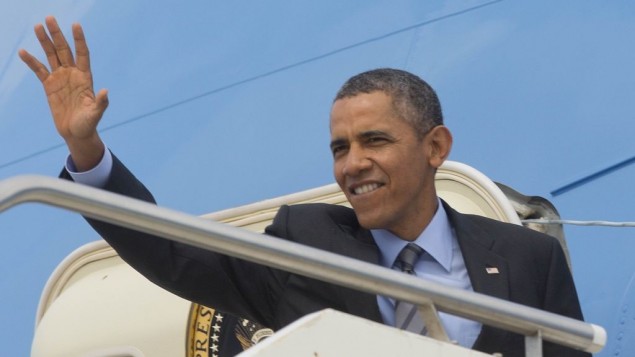
Obama wavesUS President Barack Obama waves as he boards Air Force One at Fiumicino Airport in Rome, Italy, on Friday, March 28, 2014 (photo credit: AP/Pablo Martinez Monsivais)

RIYADH, Saudi Arabia (AP) — President Barack Obama opened a fence-mending visit to Saudi Arabia Friday, arriving in the oil-rich Gulf nation for meetings to reassure its elderly monarch of the U.S. commitment to the Arab world.

Despite its decades-long alliance with the United States, Saudi’s royal family has become increasingly anxious in recent years over Obama’s outreach to Iran and his tepid involvement in the Syrian civil war. During his evening meetings with the king, Obama will seek to reassure Saudi Arabia that the U.S. is not abandoning Arab interests despite troop withdrawals from Iraq and Afghanistan, greater energy independence back home and nuclear talks with predominantly Persian Iran.

Obama arrived in Riyadh after four days in Europe, where he held talks with the continent’s leaders about the crisis in Ukraine and had an audience with Pope Francis. The president’s focus in Saudi Arabia shifts quickly to the array of Middle East matters that have complicated U.S. ties in the already combustible region.

Obama left Friday for an overnight trip to Saudi Arabia that has only two items on its public schedule: a meeting and a dinner with King Abdullah at his desert camp, a 30-minute helicopter ride from the capital of Riyadh. Secretary of State John Kerry traveled with Obama for what will be the president’s third official meeting with the king in six years.

White House officials and Mideast experts say the Saudi royal family’s main concern is Iran. They fear Iran’s nuclear program, object to Iran’s backing of the Bashar Assad regime in Syria and see the government of Tehran as having designs on oil fields in Saudi Arabia and Bahrain.

Deputy national security adviser Ben Rhodes told reporters aboard Air Force One on the flight to Saudi Arabia that the issues at the heart of Obama’s meetings with Abdullah include Gulf security, Middle East peace, Syria, Iran and Egypt.

On Syria, Rhodes said Obama did not plan to make any specific announcements about additional assistance to opposition forces. He said the U.S. and Saudi Arabia have been working together closely to coordinate their assistance to the rebels.

Rhodes said that coordination has helped put the U.S. relationship with Saudi Arabia “in a stronger place today than it was in the fall when we had some tactical differences about our Syria policy.”

“We are in a better place today than we were seven months ago,” Rhodes said.

Obama angered Saudi officials by scrapping plans to launch a military strike against Syria, choosing instead to back a plan to strip Syrian President Bashar Assad of his chemical weapons.

Rhodes said Obama would update the king on the nuclear talks with Iran. He said Obama would also make the point that those negotiations do not mean U.S. concerns about other Iranian activities have lessened, including its support for Assad and Hezbollah, as well as its destabilizing activity in Yemen and the Gulf.

“Those concerns remain constant and we’re not in any way negotiating those issues in the nuclear talks,” he said.

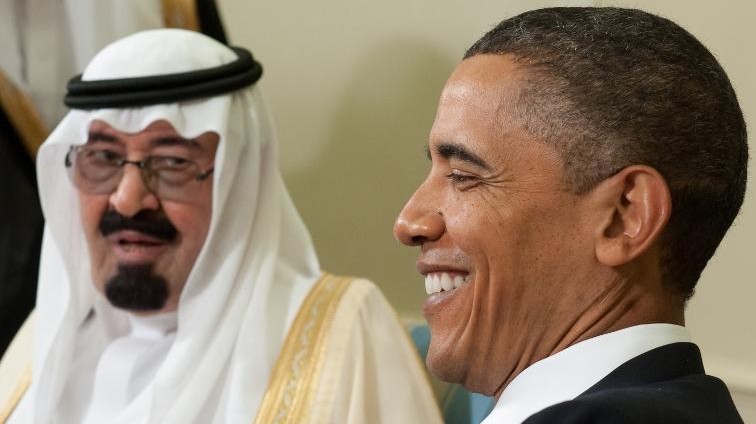
Obama and KingUS President Barack Obama and King Abdullah of Saudi Arabia at the White House in Washington, DC, on June 29, 2010 (photo credit: Saul Loeb/AFP)

Rhodes said human rights, including women’s rights, would be on the agenda for Obama’s meetings. But he said the U.S. has a broad range of security interests with Saudi Arabia that would be most prominent on the agenda.

“We’ve raised concerns around human rights issues, issues related to women’s rights,” Rhodes said, adding that the U.S. has to maintain “the ability to cooperate” with the Saudis on other issues.

The Saudi anxieties have been building over time, according to Simon Henderson, a fellow at The Washington Institute, a think tank focused on Middle East policy.

“Ever since Washington withdrew support for President (Hosni) Mubarak of Egypt in 2011, Abdullah and other Gulf leaders have worried about the reliability of Washington’s posture toward even longstanding allies,” Henderson wrote this week. “President Obama’s U-turn on military action against Syria over its use of chemical weapons last summer only added to the concern, which has likely morphed into exasperation after recent events in Crimea, where the Saudis judge that President Obama was outmaneuvered by Vladimir Putin.”

The technological advances that have increased oil and gas production in the United States have also made Gulf states nervous, said Tamara Cofman Wittes, a senior fellow at the Brookings Institution and director of its Saban Center on Middle East Policy

“A lot of people in the region, I think, are naturally asking themselves what America’s energy independence means for America’s willingness to invest in the security of energy and supply from the Gulf,” she said.

Friday’s talks also come in the aftermath of Saudi Arabia’s refusal to grant a visa to the Washington bureau chief of The Jerusalem Post who had sought to cover Obama’s trip. Rhodes told reporters that the U.S. government reached out to Riyadh to intervene but to no avail.

Iran’s Fortunes Rising in a Middle East Vacuum

March 28, 2014

Iran’s Fortunes Rising in a Middle East Vacuum.

Lt. Col. (ret.) Michael Segall

Lt. Col. (ret.) Michael Segall, March 19, 2014

Iranian Foreign Minister Mohammad Javad Zarif and Palestinian Islamic Jihad leader Ramadan Shalah

Iranian Foreign Minister Mohammad Javad Zarif and Palestinian Islamic Jihad leader Ramadan Shalah

On March 12, 2014, Israel was hit by massive rocket fire from Gaza by Palestinian Islamic Jihad (PIJ). PIJ is completely dependent on Iran for its funding and equipment, and some of its operatives have also undergone training in Iran for the manufacture of rockets and explosives and for guerrilla warfare. There have also been recurring attacks on IDF border forces in Israel’s north as well – including along the Syrian border – where Hizbullah’s ties with Iran are well-known. All of these attacks on Israel come in the wake of the green light given by Iran against the backdrop of changing power equations in the broader Middle East.

Iran has been leading an “axis of evil” as it devises and implements an ambitious plan to increase its influence across the Middle East and mold it in line with its revolutionary Islamic ideology. Central to that plan is ejecting the United States and the West from the region, along with what remains of their influence.

The change in Iran’s behavior reflects its growing self-confidence since the recent rounds of nuclear negotiations with the West began, along with America’s rapidly declining regional and international status (vivid in the Ukrainian crisis as well). The more the United States’ regional and international status sinks, the more Iran’s self-confidence rises.

Iran regards the U.S., and the West in general, as lacking the capacity to use military force to stop its nuclearization, or to curtail Iran’s assertive measures against the Gulf States and in the Middle East generally. Iran sees an opportunity to continue driving the U.S. and the West out of the region.

Iran views Hizbullah and the Palestinian terror organizations as major components in its national security strategy, part of its long arm. Iran acts ceaselessly to provide these actors with rockets and the knowledge to manufacture them, along with other weapons. The latest developments, coupled with Iran’s growing realization that it is immune to a Western military attack, could lead it to make even bolder moves by itself and through its proxies.

U.S. policy is increasingly impelling states in the Middle East to alter their framework of alliances. They view the United States as less and less reliable, and are seeking an alternate power instead. Possibilities include Russia, China, or – closer to home – Iran.

A Green Light from Iran to Strike at Israel

The massive rocket fire from Gaza at Israel by Palestinian Islamic Jihad (PIJ) on March 12, 2014, under the rubric of “breaking the silence,” coupled with the detonation of explosive charges by Hizbullah along the northern border fence on Mt. Dov on March 14 and in the northern Golan Heights on March 18, suggests that Iran’s two main allies in the region were given a green light to step up the friction with Israel and gradually change the rules of the game that has been played so far.

PIJ is completely dependent on Iran for its funding and equipment, and some of its operatives have also undergone training in Iran for the manufacture of rockets and explosives and for guerrilla warfare. The already well-known ties between Iran and Hizbullah are now reaching a new level as Iran involves Hizbullah in the effort to rescue the Assad regime in Syria. President Bashar Assad’s war on the numerous, fragmented opposition factions has entered its fourth year, while so far costing some 150,000 lives.

These recent attacks on Israel, whose timing is not coincidental, were preceded by Israel’s interdiction of the Klos C weapons ship with its cargo of forty Syrian-made M-203 long-range missiles, along with mortars. The intended recipient was PIJ in Gaza. These large-warhead, precision missiles were meant as a game-changer in Gaza, to give Iran’s client a strategic advantage over Hamas, which has been increasingly beleaguered, with Sinai and al-Sisi’s Egypt in turmoil.

Iran is also reestablishing its ties with Hamas after a two-year hiatus in the wake of disagreements over support for Assad in the Syrian civil war. According to Palestinian sources, a high-level Hamas delegation headed by Khaled Mashal, head of its political bureau, intends to visit Iran soon to discuss “important issues.” The same source denied that “Tehran has closed all its doors in Hamas’ face,” and emphasized that “the relationship between the two sides has started to be restored in a positive and gradual manner.”1

According to the pan-Arab daily Al-Quds al-Arabi, Mahmoud al-Zahar, a Hamas co-founder and member of the political bureau, and Marwan Isa, deputy commander of Al-Qassam Brigades, Hamas’ military wing, played a crucial role in arranging the meeting in Tehran.2 Ali Larijani, head of the Iranian Majlis, said recently that the relationship between Iran and Hamas has returned to the way it was in the past and that Iran supports Hamas since it belongs to the resistance front, and since “our Islamic duty commands us to support the resistance.”3
Improving Ties among Iran, Syria, and Hizbullah

The course taken by the Klos C cargo – from Syria to Iran to Iraq – again reveals the key points of the “axis of evil” and the tightening links between them. This axis is led by Iran, which has been devising and implementing an ambitious plan to increase its influence in the Middle East and mold it in line with its revolutionary ideology. Central to that plan is ejecting the United States and the West from the region, along with what remains of their influence.

Especially noteworthy in this context is the intensifying cooperation among the Iran-Syria-Hizbullah triangle. At Iran’s behest, Hizbullah has entered the struggle to salvage Iran’s strategic asset, the Assad regime. Despite growing domestic criticism, in part due to scores of Hizbullah casualties on Syrian soil, Nasrallah has been carrying out Tehran’s directives. He has been compensated with advanced weapons (some of them Russian-made) that have been transferred to Hizbullah from Syria (according to foreign reports, some of these weapons consignments have been destroyed by Israel). Among other weaponry, Yakhont (Sapphire) surface-to-sea missiles along with surface-to-air missiles could affect the IDF’s future operational range. In addition, Iran has generously paid off Hizbullah with UAVs for attacking and intelligence-gathering, as well as in funds. From Iran’s standpoint, Syria and Lebanon have somewhat coalesced.
The Decline of the West

The change in Iran’s behavior reflects its growing self-confidence since the nuclear negotiations with the West began, along with America’s rapidly declining regional and international status (seen in the Ukrainian crisis as well). That decline was especially evident in Washington’s hesitant approach to the Syrian crisis after the regime’s use of chemical weapons was revealed, and in the adoption of the Russian diplomatic solution. Tehran saw this compromise as a victory for Iran in particular and for its resistance axis in general, and as clearly indicating the future deterrent capability of this axis vis-à-vis the U.S.-led West. The commander of the Iranian Revolutionary Guard Corps, Mohammad Ali Jafari, said the United States had been defeated in Syria. “The scheme whereby they wanted to intervene militarily in Syria was defeated and their main plan failed, like the rest of their plans….This while the enemy said, ‘If we do not succeed to overcome Syria, we also will not succeed to overcome Iran.’”4

The more the United States’ regional and international status sinks, the more Iran’s self-confidence rises. That, in turn, will affect Iran’s approach to the nuclear talks and its willingness to compromise; the chances of its doing so were never high in the first place.

As Washington continues in its conciliatory course, which has come to be known as “leading from behind,” and Russia’s international status and power projection keep improving, Russia’s partners, including Iran, will take increasingly bold, subversive action in the region. Iran regards the United States, and the West in general, as lacking the capacity to use military force to stop its nuclearization, or to curtail Iran’s assertive measures against the Gulf States and in the Middle East generally (including supplying terror organizations with advanced weapons, promoting subversion, and aiding Islamic organizations). On the contrary, Iran sees an opportunity to continue driving the United States and the West out of the region.
Lessons for Iran from the Ukrainian Crisis

In that spirit, the Iranian Kayhan newspaper, which usually reflects the views of Supreme Leader Ali Khamenei, wrote that Iran should draw lessons from the Crimean crisis and learn from Russia’s conduct. The paper said Iran should rely on its military (implicitly, also nuclear) power and exploit evolving regional crises. Iran already seems to be applying these lessons.

Kayhan also claimed the events in Ukraine had again shown the effectiveness of military force, notwithstanding international relations theories about the supposed primacy of economic and media factors over military ones. “Military forces can decide, at a sensitive moment, the fate of a particular conflict…as long as they are under wise leadership. That is what happened in the Ukraine affair….We learn that the way to overcome a certain country, and stop its other kinds of power from functioning, is to weaken its military status.” For thirty-five years, Kayhan asserts, the West has striven to weaken Iran militarily, and is continuing to do so in the nuclear talks. And yet,

the resolve of the Russians and the alacrity of President Putin have brought the West to passivity. The fact that the Western states are (again) talking of economic sanctions and the fact that NATO (despite having signed a defense pact with Ukraine) has not mounted a military response to Russia’s military move and maneuvers in Ukraine, instead settling (as is typical) for declarations – shows that the West is in a passive position.

Kayhan draws links between the West’s frictions with Iran and with Russia, and remarks:

From a national perspective, Russia is helped by Iran in addressing most of its security and diplomatic concerns, and in return Iran is helped by Russia’s support on the Syrian, Lebanese, Iraqi, Afghan, nuclear, and other issues. Furthermore, in this affair Russia is in conflict with our enemies, that is, the West. That in itself means we must be pleased with the defeat of our enemies, even if we have criticism of the Russian side.

Kayhan went on to criticize Iranian Foreign Minister Mohammad Javad Zarif for saying Iran was worried by the developments in Ukraine, and concluded that “it was Russia that had learned from Iran to stand firm against the West and cause it to be passive….We have to look at the benefits accruing from the Ukrainian crisis and use them to extend our power and influence.”5

Iran views Hizbullah and the Palestinian terror organizations as major components in its national security strategy, part of its long arm. Iran acts ceaselessly to provide these actors with rockets, missiles, and the knowledge to manufacture them, along with other weapons (antitank, antiaircraft, etc.). The latest developments, coupled with Iran’s growing realization that it is immune to a Western military attack, could lead it to make even bolder moves, sometimes through its proxies, than it has taken so far. The more confidence Iran feels, the more this tendency will grow, affecting its behavior toward its Persian Gulf neighbors as well.
Israel’s Destruction Is on the Islamic Agenda

Iran’s confidence is also apparent in its ongoing calls for Israel’s destruction. As the Supreme Leader and the Revolutionary Guard commanders move further from the “Rouhani effect” of Iran’s June 2013 presidential elections, even as Rouhani keeps winning international favor, they have been resuming their harsh anti-Israeli and anti-Western statements. For example, the Guard’s deputy commander, Hossein Salami, said recently at a conference on “The Islamic World’s Role in the Geometry of the World Power,” under a headline stating “Iran’s Finger on Trigger to Destroy Zionist Regime”:

Today, we can destroy every spot which is under the Zionist regime’s control with any volume of fire power (that we want) right from here….

Islam has given us this wish, capacity and power to destroy the Zionist regime so that our hands will remain on the trigger from 1,400 km. away for the day when such an incident (confrontation with Israel) takes place.6

He added, hinting at the aid Iran provides to states bordering Israel, that Iran is not the only state with such capabilities, since some of the other Muslim states’ artillery can reach targets within Israel.
There Is No Vacuum in the Middle East

In sum, if one connects the dots between the recent developments in the regional and international arenas, it emerges that the more America’s regional and international power wanes, the more Iran’s self-confidence grows. In the Middle East, Iran aspires to fill the void. The perception of American weakness makes Iran more self-assured and impels it toward more audacious moves on the Syrian-Lebanese and Palestinian fronts, as Iran makes use of the resistance camp in waging its ongoing anti-Israel struggle. If Iran continues to perceive American weakness, it will also step up its activities against its Persian Gulf neighbors.

One should view Iran’s reconciliation with Hamas against this background. It is not occurring due to ideology but as part of the wider struggle for influence that Iran is waging against Saudi Arabia in various parts of the Middle East as part of the broader Sunni-Shiite struggle. Iran seeks to benefit from the disagreements within the Sunni camp (such as between Qatar and the rest of the Gulf States) on various issues (such as the role of the Muslim Brotherhood in Egypt). Iranian control in Gaza would enable it to more broadly influence its political associates as well as the newly reconstituted Egyptian arena.

Ongoing American weakness and mounting tensions with Russia will likely have negative implications in general and on the nuclear talks in particular. Russia, which so far has played a negative role in those talks and usually has shielded Iran from strong measures, will be even less prepared to countenance such measures as the talks approach the point of decision. Hence, the chances of the talks diverting Iran from its military nuclear path, which were quite low to begin with, will dwindle to nothing. Moreover, given U.S. behavior in the recent crises, Iran has concluded that it will be able to violate a nuclear agreement without incurring penalties.

As Iran and other regional states view the matter, the Ukrainian crisis is another in a long series of regional and international crises in which Putin has emerged as a resolute, decisive leader on regional issues, while Obama has appeared weak, indecisive, and passive. The region’s Arab leaders, especially those of states once considered U.S. allies (Egypt, Saudi Arabia, the Gulf States, and even Jordan), are not impressed by U.S. conduct in the Syrian crisis and are closely watching Obama’s moves in the Ukrainian predicament; they are likely to be disappointed once more.

U.S. policy is increasingly impelling these states to alter their framework of regional and international alliances. They view the United States as less and less reliable, and are seeking an alternate power instead. Possibilities include Russia, China, or – closer to home – Iran. In the Middle East, where change occurs at a dizzying pace, anything can happen.

Iran, in any case, is acting to make itself the dominant, stable power of the region.

Arabs No Longer Take Obama Administration Seriously

March 28, 2014

Arabs No Longer Take Obama Administration Seriously, Gatestone Institute, Khaled Abu Toameh, March 28, 2014

(Who, at least in matters of foreign relations, does? If the report that Israel will not release more Palestinian prisoners is correct, neither do Israel’s leaders. If so, the chances of additional Israeli concessions may well have diminished significantly. — DM)

The extension of the peace talks means only one thing: that Abbas will be able to use the new time given to him to try to extract further concessions from the U.S. and Israel, while all the time bearing in mind that Obama and Kerry are willing to do almost anything to avoid a situation where they are forced to admit that their efforts and initiatives in the Middle East have failed.

The communiqué issued by Arab heads of state at the end of their summit in Kuwait this week shows that the Arab countries do not hold the Obama Administration in high regard or even take it seriously.

The Arab leaders also proved once again that they do not care much about their own people, including the Palestinians.

The Arab leaders, at the end of their two-day meeting, announced their “total rejection of the call to consider Israel a Jewish state.”

This announcement came despite pressure from the Obama Administration on the Arab leaders to refrain from rejecting the demand.

A top Arab diplomat was quoted as saying that U.S. Secretary of State John Kerry contacted Arab leaders on the eve of their 25th summit in Kuwait to “warn” them against rejecting Israel as a Jewish state.

Kerry, according to the diplomat, asked the Arab leaders completely to ignore the issue of Israel’s Jewishness and not to make any positive or negative reference to it in their final statement.

Kerry did not want the Arab heads of state to repeat the same “mistake” that the Arab League foreign ministers made on March 9, when they too issued a statement declaring their refusal to recognize Israel as a Jewish state.

The Arab leaders, however, decided to ignore Kerry’s warning and went on to endorse Palestinian Authority [PA] President Mahmoud Abbas’s refusal.

The Arab summit’s statement was published shortly before Kerry cut short a European tour to hold an emergency meeting with Abbas in Amman in a last-minute effort to salvage the peace process with Israel.

01Abbas KerryU.S. Secretary of State John Kerry cut short a European tour to hold an emergency meeting with PA President Mahmoud Abbas in Amman, Jordan, pictured above on March 26, 2014. (Image source: U.S. Sate Department)

In light of the Arab summit’s announcement, all that is left for Kerry to do is to put heavy pressure on Abbas to agree to the extension of the peace talks after the April 29 deadline set by the U.S. Administration.

At the meeting in Amman, Kerry warned Abbas that failure to comply with his demand would result in U.S. sanctions against the PA, including suspending financial aid and closing the PLO diplomatic mission in Washington.

Emboldened by the Arab leaders’ backing, however, Abbas does not seem to take Kerry’s threats seriously, particularly in light of previous threats by the U.S. Administration that were never carried out.

In 2012, Abbas had also ignored U.S. threats and pressure by seeking UN recognition of a Palestinian state. The Obama Administration did not take any retaliatory measures against the PA or against Abbas himself.

Like most of the Arab leaders, Abbas apparently understands that the Obama Administration has been weakened to a point where it is no longer able to impose its will on any Arab leader.

The way things appear now, it is Abbas who is setting new conditions and coming up with new demands, evidently from a conviction that the Obama Administration has no choice but to succumb.

Abbas today seems to feel confident enough to set his own conditions for accepting Kerry’s demand to extend the peace talks.

Abbas has therefore now come up with a new requirement: that Israel release three senior Palestinians from Israeli prison: Fatah leader Marwan Barghouti, PFLP Secretary-General Ahmed Sa’dat and Gen. Fuad Shobaki. All three are serving lengthy prison sentences for their role in terrorist activities, including the assassination of Israeli Tourism Minister Rehavam Ze’evi.

The Palestinians also continue to accuse the Obama Administration of exerting heavy pressure on Abbas to soften his position and accept some of Israel’s demands, including the issue of Israel’s Jewishness. Some senior Palestinian officials in Ramallah have even accused Obama and Kerry of practicing “political and financial blackmail” against Abbas.

Abbas seems assured that Obama and Kerry are so desperate to avoid a collapse of the peace talks that they will be willing to accept anything he or the Arab leaders ask for.

The Arab summit stance on the issue of recognizing Israel as a Jewish state is a blow to the Obama Administration’s efforts to achieve a peace agreement between the Palestinian Authority and Israel.

There is a feeling among many Arabs and Palestinians that the Obama Administration has no clue as to what it wants from the Arab world. They point out that the Obama Administration has failed in its policies toward several Arab countries, especially Egypt, Libya and Syria.

Abbas, in wake of growing US pressure on him, evidently sees the Arab summit as a “victory” for the Palestinians. As one of his aides explained, “The Arab summit’s announcement is a political and moral boost for the Palestinian leadership.”

Abbas might eventually agree to the American demand to extend the peace talks at least until the end of the year. But this does not mean that he is going to change his position regarding recognition of Israel as a Jewish state. Nor does it mean that Abbas is about to make real concessions on any of the core issues, such as the future of Jerusalem or the issue of borders.

The extension of the talks means only one thing: that Abbas will be able to use the new time given to him to try to extract further concessions and gestures from the U.S. and Israel, while all the time bearing in mind that Obama and Kerry are willing to do almost anything to avoid a situation where they are forced to admit that their efforts and initiatives in the Middle East have failed.

Off Topic: Rajoub: Israel said it will not release prisoners

March 28, 2014

Rajoub: Israel said it will not release prisoners, Times of Israel, March 28, 2014

Senior PA official says US mediator passed along message as talks teeter; Israel has not commented.

Rajoub
Fatah official Jibril Rajoub (Photo credit: Yossi Zamir/Flash 90)MALLAH (AFP)

Israel told the Palestinians it will not free the final batch of prisoners they had been expecting alongside US-brokered peace talks, a senior Palestinian official said on Friday.Under the deal that relaunched the talks last July, Israel said it would release 104 Arabs held since before the 1993 Oslo peace accords in exchange for the Palestinians not pressing their statehood claims at the United Nations.

Israel has so far freed 78 prisoners, in three batches, but cabinet members had warned they would block the final release, anticipated for the end of March, if the Palestinians refused to extend the talks beyond their April 29 deadline.

“The Israeli government has informed us through the American mediator that it will not abide by its commitment to release the fourth batch of Palestinian prisoners scheduled for tomorrow, Saturday 29,” Jibril Rajoub told AFP.

“Israel has refused to commit to the names that were agreed upon of prisoners held by Israel since before the 1993 Oslo agreements,” Rajoub said.

Israeli officials had no immediate comment.

But Israeli ministers have said previously that the prisoner releases were always conditional on progress in the talks, which had failed to materialize.

Awaiting Pal heroesA Palestinian woman waits in the northern Gaza Strip for released prisoners to come through the Erez Crossing, December 31, 2013 (photo credit: AP/Hatem Moussa)

Many also balked at the inclusion of Israeli Arabs among the prisoners slated for release.

Rajoub called the Israeli move a “slap in the face of the US administration and its efforts,” and said the Palestinians would resume their international diplomatic offensive.

“Not releasing the prisoners will mark the beginning of the efforts in the international community to challenge the legality of the occupation,” he said.

The talks have been teetering on the brink of collapse, with Washington fighting an uphill battle to get the two sides to agree to a framework for continued negotiations until the end of the year.

US Secretary of State John Kerry met Palestinian Authority President Mahmoud Abbas in Amman on Wednesday in a bid to salvage the talks, with US special envoy Martin Indyk meeting the Palestinian leader in Ramallah on Thursday.