Archive for March 25, 2014

‘IDF More Advanced And Accurate Than Ever’

March 25, 2014

‘IDF More Advanced And Accurate Than Ever’ – Israel National News.

Army source reveals airstrike preparation time since 2006 dropped from half hour to two minutes, ground maneuvers key despite budget cuts.

By Kobi Finkler, Ari Yashar
First Publish: 3/25/2014, 6:49 PM

(Illustration)

(Illustration)
IDF Spokesperson Unit

A senior IDF source discussed the encouraging advancements as well as the budget constraints of the army on Tuesday, exactly a week after an IAF airstrike hit Syrian army posts in response to an explosive placed on Israel’s border.”All of the national infrastructure is in the IDF’s scopes,” reported the source. “The army is preparing for the threats of the enemy, and for all scenarios demanding an immediate attack without time to prepare.”

Speaking about the IDF’s capabilities, the source noted “we are armed today with the most effective, advanced and, most importantly, precise weapons, that are much faster than in the past.”

“If in the (2006) Second Lebanon War a time frame of half an hour was needed to conduct an air strike to take out an immediate threat, today that time frame stands at a mere two minutes,” revealed the source.

IDF acquisitions ensure that the army will only continue to improve, according to the source.

“We are about to acquire a new cannon, which not only fires at a rate four times faster than previous cannons, but also its precision and destructive power allow the army to respond immediately to threats, and also to drastically minimize the number of fighters in the cannon battery and unit,” emphasized the IDF source.

“We’re a very effective army,” acknowledged the official. “You can compare the number of fighters under the Israeli air force’s brigadier general as opposed to the same general in Western armies to understand how effective we are.”

Despite budget cuts, ground maneuvers remain key

The senior captain subtly criticized IDF budget cuts, noting “the budget sword raised against the army forces us constantly to make creative technological solutions that can make operational activities cheaper while conserving human resources, such as in the new cannon. We’re losing every fifth person in the standing army, and that isn’t easy.”

While efforts are being made to streamline the IDF and its chain of command, the source emphasized the importance of a strong presence on the ground.

“It’s true there is accurate fire, and quality information,” noted the IDF official, “but still it’s clear that the topic of ground maneuvers was and remains the greatest preparation need in the army.”

Without controlling the ground the IDF will never win a war, reports the source. “Without the exposed chest of the regiment commander standing opposite the terrorist and killing him, we won’t be able to finish the fighting, and therefore the need for ground maneuvers is essential.”

In closing, the source noted “we need to reach a situation where the amount of time fighting is reduced to minimize the damage to the home front as much as possible. That’s our mission and we are preparing for it intensively, even in these days of resource cuts and reserve duty day cuts.”

Off Topic: Kerry to meet Abbas in Amman in last ditch effort to salvage talks

March 25, 2014

Off Topic: Kerry to meet Abbas in Amman in last ditch effort to salvage talks – Jerusalem Post.

Abbas tells Arab League Israel would “bury” Kerry framework document; Israeli officials regret Abbas not seeking Arab world support for compromise.

By HERB KEINON, KHALED ABU TOAMEH 03/25/2014 22:29

US Secretary of State John Kerry meets with PA President Mahmoud Abbas in Ramallah, January 4, 2014.

John Kerry and Mahmoud Abbas.
Photo: Reuters

US Secretary of State John Kerry will meet Palestinian Authority President Mahmoud Abbas in Amman on Wednesday, hours after Abbas – speaking to the Arab league — dismissed as unnecessary the framework document Kerry has been toiling on for months.

Abbas, addressing a meeting of Arab heads of state in Kuwait, said in reference to Kerry’s document that was envisioned as a basis for continuing talks beyond the April 29 deadline, that the Palestinians did not need new agreements that would be “buried” by Israel through reservations and pre-conditions.

Kerry’s efforts come just days before Israel is scheduled to release on Saturday night the final batch of 26 Palestinian security prisoners it agreed to set free as part of the package enabling the nine-month talks to begin last July. Prime Minister Binyamin Netanyahu has not given any indication whether he plans to go through with that release. Some in his cabinet are calling on him not to do so until Abbas commits to continuing the talks.

Abbas claimed that the Israeli government was now trying to avoid carrying out the release, and the PA government in the West Bank accused Israel of “political blackmail” in linking the issue with extending the negotiations.

State Department spokeswoman Jen Psaki said Kerry, currently in Europe accompanying US President Barack Obama on a trip there, will meet Abbas to “continue to narrow the gaps between the parties.”

Israeli officials said at this stage they knew nothing of a possible Kerry meeting in Jerusalem with Netanyahu, and Psaki said only that the two men would be in touch “over the phone or video conference.”

According to Israeli officials, there have been ongoing discussions in recent days to salvage the process, and US envoy Martin Indyk has been in the area since the weekend meeting with both sides.

In his speech to the Arab leaders, however, Abbas showed no sign that he was on the verge of showing flexibility, reiterating his refusal to recognize Israel as a Jewish state and stating that the Palestinians want an independent state on “all the territories that were occupied in 1967.” He said that such a state should have full control on the ground, airspace, borders, water and natural resources.

He accused Israel both of foiling the US efforts to achieve peace in the Middle East, and of seeking to “perpetuate its occupation.” He also called for a just and agreed solution to the issue of Palestinian refugees.
Abbas told the Arab summit that Israel was trying to “divide” the Aksa Mosque between Muslims and Jews as is the case with the Tomb of the Patriarchs in Hebron. He said that the Palestinians were strongly opposed to any attempt to divide the holy site. He also accused Israel of stepping up its campaign to “scrap the Arab, Islamic and Christian identity of Jerusalem.”

Abbas’ words fell on fertile ears, with the Arab League expected to draft a resolution at the end of the two day summit categorically refusing to recognize Israel as nation state of the Jewish people, and rejecting pressure on the Palestinian leadership to do so.

Arab League Secretary-General Nabil Elarabi blasted Israel as as an “apartheid system” and a final bastion of colonialism. Saudi Prince Salman bin Abdel-Aziz said Israel was working against peace with its settlement policies, as well as with its demand to recognize Israel as a Jewish state.

One Israeli government official noted the irony that, while the Arab leaders were blasting Israel publicly, “behind the scenes there is almost an unprecedented willingness among leaders in the Arab world to engage with us.”

Unwilling to give examples, the official said that among many in the region Israel is seen not as the enemy, but rather as an ally against the common enemy of Iran and radical Shia.

None of this is expressed in the Arab league, he said, partly because it is a “vehicle for consensus politics, which often needs to play to the lowest common denominator.”

The official said that among senior leaders in the Arab world there is a willingness for fair compromises by the Palestinians with Israel. “If Abbas was interested in getting cover for compromises, he would get that cover,” the official said. By the same token, he said, Abbas is interested in getting Arab League support for his inflexible positions.

Meanwhile, Economy Minister Naftali Bennett slammed the Arab League’s refusal to recognize Israel as the Jewish state and compared Abbas to former Syrian president Hafez Assad.

During a tour of the Golan Heights, the Bayit Yehudi faction head said “the Arab League today returned to the the days of Khartoum, when they ruled out peace with us. Today they are denying our right to exist in a Jewish state.”

“As I stand here at the Quneitra observation post on the Golan Heights, I can only wonder what would happen if al-Qaida terrorists were here, threatening our children,” Bennett said.

“Unfortunately, security experts who explained to us why we need to leave the Golan Heights are the same experts that tell us today to relinquish our assets for a piece of paper from the Arab League and Abu Mazen [Abbas],” he added.

“This did not happen in the Golan, and it will not happen in any part of the Land of Israel,” he vowed.

In a reference to talks Israel held with Syria in 1999, in which then-prime minister Ehud Barak discussed the possibility of an Israeli withdrawal from the Golan Heights in exchange for peace, Bennett referred to Abbas as “a more extreme version of the 1999 model of Assad.”

Jpost staff contributed to this report

Draft Russia-Sanctions Bill May Also Tighten Iran Penalties

March 25, 2014

Draft Russia-Sanctions Bill May Also Tighten Iran Penalties – Global Security Newswire.

Obama: I’m Concerned About a Loose Nuke Being Detonated in Manhattan

March 25, 2014

Obama: I’m Concerned About a Loose Nuke Being Detonated in Manhattan – The Weekly Standard.

(Oh My God. I can’t bear it any longer.
After he threatened Russia with consequences what did Putin do?
That’s right. He gave him the middle finger and went ahead.
What is the clown’s answer?
“Russia is a regional power that is threatening some of its immediate neigbors, not out of strength, but out weakness.”
I guess if someone detonates a nuke in Manhattan, it will also because that someone is weak.
What is Mr. Hope and Change  doing to prevent Iran from aquiring nukes?
Yep, killing potential sanctions, killing the Tomahawk and Hellfire missile programs and hoping that Putin is a nice boy and that he does not sabotage his negtiations with Iran.
Well, clown in chief, what if Putin because of his ‘weakness’ does exactly that?
It’s unbelievable how much this guy lives in lala land.
– Artaxes)

Romney still wrong about Russia, says Obama.

11:56 AM, Mar 25, 2014 • By DANIEL HALPER

Speaking at a brief news conference in the Hague, President Obama said he’s more worried about a loose nuke being detonated in Manhattan than he is about Russia:
 

“With respect to Mr. Romney’s assertion that Russia is our number one geopolitical foe, the truth of the matter is that America has a whole lot of challenges,” said the president.

“Russia is a regional power that is threatening some of its immediate neigbors, not out of strength, but out weakness.

“Ukraine has been a country which Russia had enormous influence for decades, since the break-up of the Soviet Union, and we have considerable influence on our neighbors, we generally don’t need to invade them in order to have a strong cooperative relationship with them. The fact that Russia felt compelled to go in militarily and laid bear these violations of internationl law indicates less influence not more.

“So my response then continues to be what I believe today, which is: Russia’s actions are a problem. They don’t pose the number one national security threat to the United States. I continue to be much more concerned when it comes to our security with the prospect of a nuclear weapon going off in Manhattan,” said Obama.

Daniel Halper is online editor of The Weekly Standard and author of the forthcoming book Clinton, Inc.: The Audacious Rebuilding of a Political Machine.

Report: Former head of al Qaeda’s network in Iran now operates in Syria

March 25, 2014

Report: Former head of al Qaeda’s network in Iran now operates in Syria – The Long War Journal.
By

mohsen-al-fadhli.jpg

Muhsin al Fadhli, who has reportedly relocated from Iran to Syria

Muhsin al Fadhli, a senior al Qaeda leader who once headed the organization’s network in Iran, relocated to Syria in mid-2013, according to a report in The Arab Times on March 21. Citing anonymous sources, the publication reports that al Fadhli has joined the Al Nusrah Front, al Qaeda’s official branch in Syria. He was apparently sent to the country after a dispute broke out between Al Nusrah and the Islamic State of Iraq and the Sham (ISIS).

Al Fadhli was one of the trusted operatives who reported back to Ayman al Zawahiri on the dispute, according to the Arab Times, and he influenced al Qaeda’s decision to eventually disown ISIS.

Today, al Fadhli reportedly recruits European Muslims to join the jihad in Syria and “trains them on how to execute terror operations in the western countries, focusing mostly on means of public transportation such as trains and airplanes.”

The Arab Times account does not identify its sources and parts of it do not ring true. For example, al Fadhli’s “four main targets” inside Syria are supposedly Bashar al Assad’s forces, the Free Syrian Army, the Islamic Front, and ISIS. However, only two of these targets make sense in the current operational environment. The Al Nusrah Front is closely cooperating with the Islamic Front, which is a coalition of several jihadist and Islamist rebel groups, and also works with the Free Syrian Army.

Still, the story makes sense in the context of other known aspects of al Qaeda’s operations.

Al Fadhli became the leader of al Qaeda’s network inside Iran after a senior al Qaeda leader known as Yasin al Suri was detained by Iranian authorities. In July 2011, the US Treasury Department identified al Suri as the head of the network, which it said operates under an agreement between the Iranian regime and al Qaeda. Several months later, in December 2011, the State Department announced a reward of $10 million for information leading to al Suri’s arrest.

This put pressure on the Iranians to shelve al Suri for a time. In February 2012, press reporting indicated that al Fadhli had replaced al Suri as al Qaeda’s chief inside Iran. And in October 2012 the Treasury Department confirmed that al Fadhli had indeed filled in for al Suri.

But earlier this year, the US government announced that al Suri had assumed his leadership role inside Iran once again. In late January, Treasury and State Department officials spoke with Al Jazeera, saying that al Suri was supporting the Al Nusrah Front from Iranian soil despite the fact that Al Nusrah is currently fighting Iran’s ally and proxies in Syria. In early February, the Treasury Department officially confirmed that al Suri has “resumed leadership of al Qaeda’s Iran-based network after being temporarily detained there in late 2011.”

With al Suri back in the game, al Qaeda had the operational freedom to deploy al Fadhli to Syria. Al Qaeda’s senior leaders dispatched trusted operatives to Syria once the dispute between Al Nusrah and ISIS became heated. Therefore, al Fadhli’s reported presence inside Syria makes sense in the context of al Qaeda’s decision to reshuffle its personnel.

The Arab Times report draws from Kuwaiti sources, who have an interest in tracking al Fadhli since he is a native of their country. In 2009, the publication accurately reported that al Fadhli was then living along the Iran-Afghanistan border.

And according to the US government, al Qaeda’s Iran-based network relies on Kuwait-based donors and facilitators, who support the Al Nusrah Front and other parts of al Qaeda’s operations. This provides even more reasons for Kuwaiti authorities to keep close tabs on al Fadhli’s movements.

Connected to high-profile terrorist plots against Western interests

If al Fadhli is indeed inside Syria and training recruits to attack the West, then this is a significant cause for concern among counterterrorism authorities.

Al Fadhli was first designated as a terrorist by the US Treasury Department in 2005. Treasury noted at the time that his dossier was extensive.

Al Fadhli has long been an elite member of al Qaeda. In early September 2001, Treasury explained, he “possibly received forewarning that US interests would be struck.” The Sept. 11 operation was compartmentalized and only select members of the network received advance notice.

The Kuwaiti al Qaeda operative has been tied to the Oct. 6, 2002 attack on the French ship MV Limburg and the Oct. 8, 2002 attack against US Marines stationed on Kuwait’s Faylaka Island. One Marine was killed during the Faylaka Island shootout. He may have also been involved in the bombing of the USS Cole on Oct. 12, 2000.

He went on to support Abu Musab al Zarqawi’s operations inside Iraq.

An al Qaeda cell responsible for the 2009 plot against Camp Arifjan, a US military installation in Kuwait, had ties to al Fadhli. That cell was broken up by Kuwaiti authorities before it could launch an attack.

And Egyptian officials have alleged that still another plot, targeting the US Embassy in Cairo and other Western interests, involved al Qaeda’s Iran-based network. The May 2013 plot was tied to a terrorist known as Dawud al Asadi, who had been in contact with the cell responsible in the months beforehand.

Dawud al Asadi is one of the aliases used by Muhsin al Fadhli, but Egyptian officials have not publicly confirmed al Asadi’s real identity. Al Asadi reportedly put members of the cell in contact with Muhammad Jamal al Kashef, a longtime subordinate to al Qaeda emir Ayman al Zawahiri, as well as with other members of Jamal’s network.

Washington and the Middle East: What in the world is the US playing at?

March 25, 2014

Washington and the Middle East: What in the world is the US playing at? | JPost | Israel News.

By ZVI MAZEL

03/24/2014 21:45

America is disengaging itself from the Middle East while seemingly encouraging extremist forces. It is a well-known fact that nature abhors a vacuum. What happens next is anybody’s guess.

obama

US President Barack Obama. Photo: REUTERS

An unidentified source at the US State Department recently told the Kuwaiti daily Al Rai that the Muslim Brotherhood doesn’t constitute a danger to the United States, adding that no one has asked Washington to put it on the list of terrorist organizations.

The last part of this statement is probably true, but was it the right moment for such a public declaration when that same organization is engaged in a terrorist war against Egypt – Washington’s long-standing Arab ally in the Middle East? When Cairo has declared the Brotherhood a terrorist organization?

This statement looks more like a political gesture than an innocuous piece of information. The Muslim brothers certainly interpreted it as a mark of continued support for their cause. The fact it that since the demonstrations started against Hosni Mubarak in January 2011 Washington has been unfailingly supporting the Brotherhood, and went as far as suspending most of its military assistance to Egypt after the ousting of Mohammed Morsi.

One may well ask what the rationale is behind this policy. Not so long ago the Obama administration was bragging it had killed Osama bin-Laden, America’s archenemy and a devoted follower of such dedicated Muslim Brothers as Abdulla Azzam and Mahmud Qutb. The first, a Palestinian member of the Egyptian MB, was bin-Laden’s teacher and mentor and among the founders of al-Qaida; the second, brother of Sayyed Qutb, taught bin-Laden at King Abd Al Aziz University in Jeddah. Sayyed Qutb’s teachings are considered the fount of ideology that gave rise to radical Islam in the 20th century, with disastrous consequences for the whole world. Omar Abdel Rahman, the blind sheik who masterminded the first attack on the world trade center 1993 and is now serving a life sentence in a US prison, was the leader of the Gama’a al-Islamia, an offshoot of the Brotherhood responsible for the Sadat assassination in 1981, and a friend of bin-Laden from their shared fight in Afghanistan. One could go on and on.

For the past 85 years the Brotherhood and the groups it spawned have been spreading terror and mayhem both against fellow Muslims and against the West. Yet the American administration does not hesitate to say publicly that the Brotherhood is not a threat. There are rumors about a number of Arab Americans connected to the Brotherhood allegedly in the White House, the State Department and even the Counter Terrorism Bureau. Lists of names are circulating, but one is loath to believe it could be true.

Egypt is the most conspicuous victim of this bizarre policy. It is in urgent need of some of the military equipment withheld by American administration – such as Apache helicopters and sophisticated monitoring devices – in its fight against the Brotherhood and jihadist terror. Egyptian Foreign Minister Nabil Fahami said lately that the US is even delaying the return of a number of Apache helicopters sent for periodical revision.

German customs authorities also recently seized recently a perfectly legitimate shipment of weapons from Poland destined to Egypt consecutive to the embargo on weapons imposed by the European Union. In other words the US and the EU are jointly ostracizing Egypt, the largest Arab country fighting radical Islam. Left with no other option, Egypt turned to Russia for closer cooperation; a major arms deal is being processed. And under the pressure of the war against terrorism Egypt now asks the Russians to hasten the shipment of the Russian combat helicopters.

AMERICAN POLICY has also brought a rift with Saudi Arabia and the Gulf countries, which already feel they have been betrayed after learning that Washington had negotiated behind their back with Iran, their declared enemy, on a compromise regarding its nuclear plans. Challenging Washington, Saudi Arabia, the Emirates and Kuwait let it be known that they would finance the Egyptian- Russian weapons deal. President Barack Obama’s scheduled visit to the kingdom in mid-March for some fence-mending was canceled or at least postponed because of sharp differences with the Gulf countries.

The relations between Saudi Arabia and the US have never been the same since 9/11 when it was discovered that 16 out of the 18 terrorists involved were Saudis. Riyadh tried to make up for it by banning the Brotherhood from the kingdom. Saudi imams have even issued a fatwa forbidding terrorism, including attacks against third countries. This explains why Saudi Arabia applauded the ouster of Morsi; it is also at the heart of its feud with Qatar, a staunch supporter of the Brotherhood. Indeed Saudi Arabia, the Emirates and Bahrain lately recalled their ambassadors from Doha and warned the emir to change its policy.

The Middle East has never been a stable region. Its short history since World War I is replete with wars, military coups and massacres. The countries of that region never fully developed their economies in spite of their vast natural resources, and were always leaning on the great powers of England, France, the US or the Soviet Union. The disappearance of England and France as colonial powers and the disintegration of the Soviet Union left America the sole ally of the pragmatic Arab countries facing Iran and al-Qaida. Now even that is fast disappearing. The failed Arab spring made the situation worse and the Middle East is now in shambles. Somalia, Libya, Syria, Iraq, Yemen are fast dislocating. Lebanon is tottering on the brink; so is Sudan. Egypt is in crisis.

Only the traditional kingdoms – Gulf countries, Jordan and Morocco – have kept their stability but, for how long? The disintegration of Libya is a disaster since its huge stockpiles of sophisticated weapons have been looted and are now fueling terror in Egypt and other Arab countries. The all-important alliance in the region which kept Iran at bay is no more. Traditional allies such as Egypt, Saudi Arabia and the Gulf countries cannot rely any more on America. Extremism and fanaticism are on the rise and the Middle East has become a ticking time-bomb.

It is hard to fathom US policy in the Middle East. However what is beyond dispute is that America is disengaging itself from the Middle East while seemingly encouraging extremist forces. It is a well-known fact that nature abhors a vacuum. What happens next is anybody’s guess.

The author is a former Israeli ambassador to Egypt.


To get at Obama and Kerry, Arab League summit drafts hard-line ultimatums for Israeli-Palestinian peace track

March 25, 2014

To get at Obama and Kerry, Arab League summit drafts hard-line ultimatums for Israeli-Palestinian peace track, DEBKAfile, March 25, 2014

(U.S. relations in the Middle East continue to deteriorate. Does President Obama have even an inkling about why? — DM)

The radical stance the Arab rulers have adopted on Mid East peacemaking is designed to warn the US president to expect a hard time in his talks with Saudi leaders in Riyadh. A large group of Arab nations – Saudi Arabia, Egypt, the UAE, Bahrain and Kuwait – is telling him through the vehicle of a hard line on Mid East peacemaking that they can be just as unyielding on other issues, starting with their vendetta against the Brotherhood.

Arab leaders whose summit begins in Kuwait Tuesday, March 25, are set to carry hard-line ultimatums for the US-sponsored Palestinian-Israeli negotiations as a means of derailing US Secretary of State John Kerry’s stubborn effort for a peace accord, and as a red flag for President Barack Obama three days before he lands in Riyadh..

DEBKAfile’s Middle East sources report the Arab League summit’s two-day agenda includes a veto on recognizing Israel as the Jewish national state,a resolution that will be binding on all members including Palestinian leader Mahmoud Abbas.

Another resolution would mandate the proclamation of all parts of East Jerusalem, including Al Quds al Sharif (Temple Mount) and the entire Old City of Jerusalem, the location of the shrines of three faiths, as the capital of a Palestinian state. This is diametrically opposed to US and Israeli positions.

Another ultimatum the Arab leaders propose to issue would halt Jewish settlement on the West Bank and Jerusalem, freeze development and ultimately dismantle all traces of a Jewish presence in a future Palestinian state.

Yet another demand will be for “the immediate release of all the Palestinian political prisoners in Israeli jails” – by which they mean all Palestinians serving time after being convicted of terrorist crimes, including Israeli Arabs.

The special US envoy for the peace talks, Martin Indyk, spent the past week in a desperate bid to avert the passage of these extreme all-or-nothing demands by the Kuwait summit. He leaned hard on Jordan’s King Abdullah and the Palestinian leader to hold back from voting on these resolutions (which must be unanimous under the Arab League charter). He maintained that their impact would be inevitably to bury yet another Israel-Palestinian peace track.

Indyk’s effort was in vain. He was also disappointed by the pointed lack of support he received from Anne Patterson, Assistant US Secretary of State for Near Eastern Affairs and former ambassador to Cairo, where she became a fervent supporter of an alliance with the Muslim Brotherhood – an organization which most Arab League leaders meeting in Kuwait view as a threat to their stability. For Patterson, Indyk is an outsider.

The radical stance the Arab rulers have adopted on Mid East peacemaking is designed to warn the US president to expect a hard time in his talks with Saudi leaders in Riyadh. A large group of Arab nations – Saudi Arabia, Egypt, the UAE, Bahrain and Kuwait – is telling him through the vehicle of a hard line on Mid East peacemaking that they can be just as unyielding on other issues, starting with their vendetta against the Brotherhood.

That vendetta tops their agenda, although it is worded as a draft resolution calling for “a collective Arab position in the war on terror.” It was rated as important enough for the conference to choose Egypt’s interim president Adly Mansour to address the opening session of the conference with a speech devoted to the subject of “terrorism.”

And indeed, Sunday, March 23, just ahead of the Arab League summit, an Egyptian court sentenced 529 Muslim Brotherhood adherents to death for attacking government centers and killing soldiers and police officers.

It is more than likely that the Egyptian strongman, Defense Minister Gen. Abdel-Fattah El-Sisi, will allow the sentences to be executed as a brutal message to the Brothers not to expect any let-up in the war he is pursuing to stamp out their influence.

Another key item on the summit agenda revolves around the same issue. It is the campaign the same group of Arab leaders is waging against Qatar over its support for the Brotherhood. The Saudi, Egyptian, UAE, Bahraini and Kuwaiti governments have recalled their ambassadors from Doha; and Riyadh has threatened Qatar with a military, land and air blockade unless it withdraws this support and shuts down the Al Jazeera TV broadcasting station.

Palestinians Dream of Destroying Israel, Peace Treaty or Not

March 25, 2014

Palestinians Dream of Destroying Israel, Peace Treaty or Not, Gatestone Institute,  Khaled Abu Toameh, March 25, 2014

(Do the rose colored glasses perpetually worn by President Obama, Secretary Kerry et al obscure from view the Palestinians helping PA President Abbas to end the “peace process?” Perhaps it should be renamed: “the terrorism perpetuation process.” — DM)

U.S. President Barack Obama and Secretary of State John Kerry may be able to force Palestinian Authority President Mahmoud Abbas, under threats and pressure, to sign a “framework agreement” with Israel. But as this week’s rally of hatred in the Gaza Strip shows, even after the signing of a Palestinian-Israeli “peace” treaty, a large number of Palestinians will not abandon there dream of destroying Israel.

“Jihad in Palestine is not terrorism. Jihad in Palestine is a sacred duty.” — Yusef Rizka, representative of Hamas.

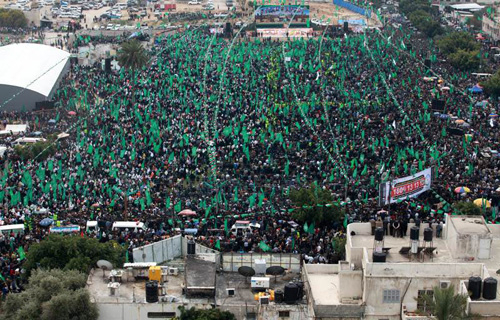
A mass rally held in the Gaza Strip on March 23 showed that Hamas continues to enjoy popular support among Palestinians. Tens of thousands of Palestinians took to the streets to attend the rally commemorating the 10thanniversary of the assassination of Hamas founder Sheikh Ahmed Yassin.

Hamas officials claim that nearly one million Palestinians attended the rally in the center of Gaza City.

Gaza Hamas rallyThe mass rally supporting Hamas in Gaza, March 23, 2014. (Image source: The Palestinian Information Center)

This means that Hamas, which seeks to destroy Israel, remains as strong as ever in the Gaza Strip, despite Egypt’s undeclared war against the Palestinian Islamist movement.

The Egyptian war has indeed hurt Hamas, especially in wake of the destruction of hundreds of smuggling tunnels along the border between the Gaza Strip and Egypt. Hamas’s popularity among Palestinians, however, as shown by the mass rally, evidently remains unaffected.

Addressing the crowd, Hamas Prime Minister Ismail Haniyeh admitted that the Egyptian war has harmed his movement. “Hamas is going through difficult times,” he said. “We are also facing harsh challenges.”

Haniyeh added that despite Egyptian security measures against his movement and the Gaza Strip, Hamas was not in a state of panic.

At the rally, defiant Hamas leaders repeated threats to pursue terror attacks against Israel. One Hamas official, Fathi Hammad, even expressed optimism that his movement and other Palestinian terror groups would be able to destroy the “Zionist entity in a few years.”

Hamas seems to be hoping, however, that the rally will send a message not only to Israel, but also to the Palestinian Authority and Egypt. The message that Hamas is seeking to relay to Egypt is that, despite the ongoing Egyptian blockade of the Gaza Strip, the movement is not showing any sign of weakness.

As Hamas representative Yusef Rizka explained, “This is a message to those who are trying to undermine Hamas and damage its reputation. We do not meddle in the internal affairs of Arab countries.”

Addressing the Egyptians, who have accused Hamas of involvement in terrorist attacks inside Egypt, Rizka said, “Jihad in Palestine is not terrorism. Jihad in Palestine is a scared duty.”

Still, the strongest message coming out of the rally was directed toward the Palestinian Authority.

Palestinian Authority [PA] President Mahmoud Abbas has good reason to be worried in the aftermath of the latest show of force by Hamas. When tens of thousands of Palestinians take to the streets of the Gaza Strip to call for the destruction of Israel and an end to the peace talks between the PA and Israel, it is clear that a large segment of Palestinian society remains opposed to any compromise with Israel.

The pro-Hamas rally is also aimed at sending a message to the U.S. Administration that Mahmoud Abbas does not have a mandate to sign any document that declares an end to the conflict with Israel.

U.S. President Barack Obama and Secretary of State John Kerry may be able to force Abbas, under threats and pressure, to sign a “framework agreement” with Israel. But as this week’s rally of hatred in the Gaza Strip shows, even after the signing of an Israeli-Palestinian “peace” treaty, a large number of Palestinians will not abandon their dream of destroying Israel .

Off Topic: Happy Greek Independence Day

March 25, 2014

Today we Greeks celebrate our independence day.
On March 17, 1821 the Maniots (the descendants of the Spartans) were the very first to rise up in rebellion and on March 25, 1821 the revolution to liberate Greece from the Ottoman yoke was proclaimed.
Following a bloody war of independence under the motto “Liberty or death”, in 1829 Greece was the first country of the Ottoman Empire to gain its independence.
I always found inspiration in the fact that my people after almost 400 years of oppression finally fought and gained its freedom.
This story is as inspiring as the story of the return of the Jewish people to its homeland after 2000 years of exile.

To all the Greeks out there: Happy independence day.
To all the others: May this day be an inspiration in your struggle for freedom and in the defense of your liberty.

Artaxes

Putin’s Iran Threat is good for Israel

March 25, 2014

Articles: Putin’s Iran Threat is good for Israel.

In a column analyzing Russia’s recent threat to rethink its position on Iran, Walter Russell Mead and his staff at The American Interest postulated, “Linking the Ukraine crisis with the Iran negotiation is an American nightmare; it might just be a Russian dream come true.”  Mead is on to something; however, he stops short in his analysis. Russia’s threat could also be quite helpful to Israel.

Obama entered into the Iran negotiations in order to avoid a military confrontation, as well as to constrain the “true barrier” to peace in the region – Israel.  His hope was to bide time, notwithstanding that Iran’s centrifuges would continue to spin, bringing its nuclear capability to the brink or to fruition.

If Iran does in fact go nuclear on Obama’s watch, so be it; he will proceed to sell containment to the American public for the little time left in his term.  The carnival salesmen in the White House are quite talented at selling the American people a bill of goods – just look at ObamaCare.  While Russia invades a European country and threatens all-out war, the administration spends $52 million of taxpayer funds in just three months on advertising this debacle.  One can only imagine what they will spend to convince Americans that a nuclear Iran poses no threat to our national security.

Alas, since reality has yet to penetrate the White House bubble, Obama has likely never lost sleep thinking about Iran’s nuclear capabilities (his Baracketology, next vacation, and golf game, perhaps, but national security, not so much) – that is, until Vladimir Putin stepped into the picture.  Obama’s failure to realize that he is now unmasked as a fool on the world stage does not mean that the rest of the world’s leaders have not noticed.  It is not a coincidence that just six months after Putin manipulated Obama out of bombing Syria despite its having crossed Obama’s disingenuous red line, Putin took to annexing Crimea from Ukraine.  And Putin did so despite a U.S. promise to protect Ukraine.  As one Ukranian parliamentarian stated, “[e]veryone believed that for good or bad the United States would be the world’s policeman.  Now that function is being abandoned by President Obama, and because of that Russia invaded Crimea.”

So Mead is correct that linking Ukraine with Iran is good policy for Russia while thrusting Obama into a nightmarish situation.  It will cause Obama to quake in his mom-jeans and further diminish American power.  Obama has already stated that he will not act militarily in response to the Ukrainian situation.  What are his choices if Russia acts on its threat and allies with Iran?  Cancel Putin’s Netflix account?

But linking Ukraine and Iran just might be an Israeli dream come true as well.  Mead stated, “The Obama strategy has always been a risky one; if Russia shifts into active cooperation with Iran, it is hard to see how the White House can keep hope alive.”  True enough.  But if Russia moves into Iran’s camp, Israel has the perfect excuse to move ahead with a military strike on Iran’s nuclear installations and will likely have the support of the entire Western world (in addition to America’s Mideast allies like Saudi Arabia), all of which will be relieved that at least someone is standing up to the bad guys.

Middle East and foreign policy experts have vacillated for years analyzing Israel’s capability to conduct a successful unilateral military strike against Iran’s nuclear facilities, guessing when it might proceed, and wondering whether the United States is holding Israel back from doing so.  Some ask why U.S. support is a necessary prerequisite to an Israeli strike that is in Israel’s own national security interests.  One need only look at a map of the region and the fact that the country, the size of the state of New Jersey and only nine miles wide at its narrowest point, is surrounded by 21 Arab nations, the vast majority of whom are adversaries, to understand Israel’s need for supportive friends.

When the most powerful nation on earth, the one that provides Israel with the most support both militarily and diplomatically, orders its ally not to attack another country, Israel is left with little choice but to listen.  That is why Obama, Kerry, Clinton, and Panetta have been able to publicly abuse Israel with little backlash.  But it is also why the administration’s threats of international isolation and abandonment have left Israel with little choice but to loudly proclaim her legal right to take all measures necessary in order to ensure the safety and security of her people – to defend herself, by herself.

And there are many signs that Israel is prepared to do so.  In the sixth year of Obama’s administration, Israelis know full well that the American president who promised, “The United States will always have Israel’s back when it comes to Israel’s security” has no intention of actually following through on that assurance.  The U.S. may have been “shocked” (just shocked!) at the statements of Israeli Defense Minister Moshe Ya’alon this week when he opined that Israel must “behave as though we have nobody to look out for us but ourselves,” in part because:

… [w]e had thought the ones who should lead the campaign against Iran is the United States. But at some stage the United States entered into negotiations with them, and unhappily, when it comes to negotiating at a Persian baazar, the Iranians were better.

But Ya’alon was certainly speaking truth to power.  And speaking of power, let us turn to a real superpower.  Not the type that we reminisce about from the pre-Obama glory days of the Pax Americana that kept stability in the world, but the superpower that presents itself in the form of a democratic dynamo – the economic and military powerhouse known as Israel. As reported in the Times of Israel this week:

Israel’s security forces have the capability to carry out military operations in virtually every part of the globe, including Iran, IDF Chief of Staff Benny Gantz said Wednesday, adding that Israel had already conducted dozens of covert operations in foreign and enemy countries….

The TV report asserted that Gantz’s comments represented a first “definitive” acknowledgment that Israel is capable of military intervention in Iran and constituted a hint from the chief of General Staff that this kind of activity was already happening.

And according to a report in Ha’aretz, despite the ongoing talks with Iran and P5+1, Netanyahu and Ya’alon have ordered the IDF to begin preparations for a possible 2014 Iranian strike, earmarking at least $2.89 billion for the operation.  (As an aside, think about that dollar amount in the context of the $52 billion that Obama has spent on three months of ObamaCare advertising and try not to throw something at the television the next time you see him joking around with Jimmy Fallon, Ellen DeGeneres, Zach Galifianakis, Kobe Bryant, and the rest of his adoring entourage.)

Many Israel-supporters had hoped that Netanyahu would attack Iran prior to Obama’s 2012 victory, believing that Obama would have been forced to support Israel for fear of reprisal from the electorate if he failed to do so.  That is why now, when the world’s good guys are shirking their responsibilities and shrinking in stature in the face of ever more powerful bad guys enabled by the U.S. president, is the time for Israel to act.

Putin has given Netanyahu the gift of a second window.  In the lead-up to the 2014 midterm elections, in which Obama must keep the Senate in control of the Democrats, Obama would have no choice but to stand behind Israel if she attacks Iran.  If Russia stands with Iran, Obama will be forced to stand with Israel or lose the American people to the Republican Party.  He cannot risk that happening. And Netanyahu cannot afford not to act on that knowledge.