Archive for March 24, 2014

Saudi Arabia Moves to Confront Regional Rivals

March 24, 2014

Saudi Arabia Moves to Confront Regional Rivals – The Weekly Standard.

Disarray in the Persian Gulf reflects White House Middle East policy.

11:49 AM, Mar 24, 2014 • By HUSSAIN ABDUL-HUSSAIN

Kuwait City
The Gulf Cooperation Council, consisting of Kuwait, United Arab Emirates, Bahrain, Oman, Qatar, and led by Persian Gulf superpower Saudi Arabia, has fallen into disarray. After the Saudis, Emiratis, and Bahrainis withdrew their ambassadors from Qatar two weeks ago, they are planning to turn the heat up further on this GCC spoiler. In addition, they’ve also decided to raise the stakes on Iran by backing forces, like the Yemeni military and the Syrian rebels, squared off against Iranian proxies.

The view here from Kuwait City, which is hosting the 25th Annual Arab summit this week, is that without a turnaround in the White House’s Iran policy, there’s not much anyone can do to change the equation. Kuwait has tried its hand at GCC reconciliation, but the emirate often referred to as “everybody’s friend” has had little success. Saudi Arabia believes it is under existential threat with uprisings across the region threatening the status quo order and Qatar is helping to undermine it. And most dauntingly, Riyadh sees the United States reaching out to Iran for a deal that the Saudis fear will come at their expense.

If Gulf watchers believed that the appointment of 33-year-old Sheikh Tamim Al-Thani to replace his father Hamad as the emir of Qatar last June would moderate Doha’s adventurist foreign policy, those assessments have been proven wrong. Saudi Arabia is furious with Qatar for continuing to fund Islamist groups in Syria, Egypt and elsewhere since the Saudis consider the Islamists a threat to their own rule. Further, Qatar’s infamous Al-Jazeera TV has raised Saudi ire with its bombastic broadcasts and “revolutionary” overtones. Perhaps most dangerously, Qatar had tried to seek its own advantage by playing Saudi Arabia and Iran against each other. In Syria, for example, Qatar has stood with Saudi Arabia by demanding that Bashar al-Assad step down. Yet at the same time, Qatar has sponsored radical Islamists, who in turn have fought the more moderate Saudi-sponsored factions. As the U.S. designation last month of an Iranian al-Qaeda network showed, many of the al-Qaeda elements fighting in Syria have come via Iran, and many Gulf officials believe that their brutality has alienated many Syrians and reinforced the regime’s narrative depicting all rebels as terrorists. 

After several warnings to Qatar, Saudi Arabia was moving to take more aggressive steps against Doha when Kuwait intervened and attempted to mediate. In November, the emir of Kuwait, Sheikh Sabah Al-Sabah, took Sheikh Tamim Al-Thani to meet the King of Saudi Arabia Abdullah bin Abdul-Aziz Al-Saud in Riyadh, where the new Qatari emir promised the elder Saudi sovereign that Doha would fall in line behind the GCC leader. 

At first, Kuwaiti efforts bore fruit. In December, Kuwait hosted the annual GCC summit where the Saudis had hoped that the council would announce steps toward GCC unity that would bar the Iranians from encroaching on Gulf affairs. Two of the key concerns were Bahrain, where the Iranians are believed to be sponsoring the violent part of political unrest, and Yemen, where Tehran funds and trains the rebellious Houthis in the north.

Another issue was Oman, which the Obama administration had been using as a back channel to negotiate with Iran. From Riyadh’s perspective, the role that Tehran and the White House had carved out for Oman undermined Gulf unity. Kuwait’s 84-year old sovereign counseled patience and compelled Qatar’s Prince Tamim to keep his promises, which they now believe he has broken. According to sources involved in the Kuwaiti reconciliation effort, UAE’s Vice President Sheikh Mohamed bin Rashed Al-Maktoum is angered that Tamim “lied” to him.

Amidst the internal squabbling, the raging civil war in Syria, the turbulence in Egypt, Iraq, Yemen and Lebanon, and Iran’s march toward to nuclear weapons program, Saudi Arabia, the UAE, and Bahrain drew a line in the sand. They decided not only to cut off Qatar but also to confront Iran. The Yemeni army will receive substantial support to beat the Houthis, and so will Syria’s rebels. If the rebels cannot topple Assad, they will at least bog down his forces and strain Iranian resources in an endless war of attrition. Sympathizers with Iran or Hezbollah will lose their high-paying jobs and will be ejected from Saudi Arabia and the UAE. 

Kuwait again tried its hand with mediation as it prepared to host the Arab Summit. But this time Saudi leaders told their Kuwaiti counterparts that while they value their friendship, they were not in the mood for reconciliation with Qatar, Oman or Iraq, effectively under Iranian tutelage now thanks to the divisive sectarian policies of Prime Minister Nuri al-Maliki.

Therefore, Saudi Arabia’s Crown Prince Salman, who came to Kuwait City in December for the Gulf summit, will likely be skipping the Arab summit. UAE’s Sheikh Mohamed and Bahrain’s King Hamad bin Issa, who both participated in December, have already announced their decision not to attend. 

To avoid offending the host country and keep the Kuwaitis from losing face, the Saudis leaked through their official media that Gulf mediation would resume after the summit. However, according to sources here, there will be no rapprochement between the Saudis and the Qataris. Moreover, Riyadh is planning to further escalate against Doha by closing airspace to Qatari overflights and outbidding the Qataris in Syria and Egypt in order to shut down the Islamists—and Qatar’s adventurist regional policy.

It is against this background of internal GCC dissension that Obama will arrive in Riyadh later this week to meet King Abdullah. Sources on both sides explain that Obama will “assure” the Saudis that the alliance between the two countries remains strong, and that the administration is committed to the security of Saudi Arabia against any foreign aggression and that Riyadh should not fear that US-Iranian negotiations will come at Saudi’s expense.

The Saudis will listen, but with reservations. From their perspective, Obama has scrapped most of America’s past arrangements with the Saudi kingdom, arrangements first forged when President Roosevelt met with the founder of modern Saudi Arabia King Abdul-Aziz ibn Saud on Egypt’s Great Bitter Lake in 1944.  The deal was that in exchange for holding the balance of power of the world’s oil reservoir, the United States would protect the Saudis against all comers. Now Riyadh feels that it is on its own, and the Saudis are not in the mood for the empty promises that the Obama White House calls diplomacy. Instead, the Saudis are moving aggressively to confront adversaries, from GCC rivals like Qatar to Gulf revolutionaries like Iran.

Legendary Marine General James Mattis: Here’s What Happens If Iran Gets A Nuke

March 24, 2014

Legendary Marine General James Mattis: Here’s What Happens If Iran Gets A Nuke – Business Insider.


Mar. 20, 2014, 4:51 PM

AP110201148779

AP Photo/Matt Dunham

BERKELEY, Calif. — Responding to questions following a lecture at the University of California-Berkeley on Wednesday, retired Marine Gen. James Mattis said that if Iran eventually builds a nuclear weapon, there would be “bleak options” in response, no matter who happens to be in the White House.

While Israel has long opposed an Iranian nuclear program, touting a “red line” that cannot be crossed, Mattis also offered his opinion of whether Israel would indeed launch an attack.

“Of course that’s the $64,000 question,” Mattis said. ” … Do I think Israel will act in its own best interest? Yes. Will they automatically attack? No, it’ll be a calculated decision if they do.”

If there is a diplomatic agreement reached between the U.S. and Iran, but it does not include limits to the number of nuclear centrifuges and allow U.N. the freedom to inspect the sites, then “we’ve got a problem,” Mattis said.

“To get a deal like that, you’ve got a bad deal, and that’s worse.”

In addition to the threat of a nuclear-armed Iran, the former commander of Central Command reasoned that other Arab states such as Saudi Arabia, Qatar, and U.A.E. would build their own nuclear weapons programs in response.

“If the Iranians come away from this with a nuclear program intact, I think there are very bleak options.”

“Americans certainly have no appetite for attack,” Mattis said, then paraphrasing Winston Churchill’s opinion of how the U.S. responds to challenges, “‘[But] once the Americans exhaust all possible alternatives, they’ll do the right thing.”

Although, he said, “Another war in that part of the world would be terrible.”

Cautious about “forecasting” exactly what would occur, the general said that economic sanctions and diplomacy can help avoid a war, “but something’s got to happen.”

EU, UN Blame Settlements, not Palestinian Violence

March 24, 2014

EU, UN Blame Settlements, not Palestinian Violence, Commentary Magazine, March 24, 2014

The talk of “expanding” settlements gives the sense of more territory being enveloped by Israel. In reality all building in these communities takes place within the existing perimeter boundaries of already established settlements. And the suggestion that creating more homes in these towns in any way prejudges “final status issues” is no less problematic. It has long been understood that the major settlement blocks would be annexed to Israel under any peace agreement.

These international diplomats live in a topsy-turvy version of reality in which homes for Jews are antithetical to peace, while the proliferation of Islamist terror groups in the West Bank are unworthy of comment. Indeed, in his Bloomberg interview President Obama repeatedly described settlements as “aggressive” so as to create the sense that building homes for Jews is comparable with acts of violence.

In recent days both the European Union and the United Nations have issued statements condemning Israel for issuing housing permits to build additional homes in West Bank Jewish communities. Naturally, both statements equated these moves to Israel sabotaging the peace process, a completely dishonest claim that only makes it easier for the Palestinian side to use these moves as the very pretext that they are looking for to flee negotiations. In opposing the building of homes for Jews in communities that under just about any conceivable arrangement would remain part of Israel, these international bodies utterly ignore the most critical threat to peace in the area: the growing levels of Islamist violence in the territories, and the Palestinian Authority’s total neglect of its responsibility to confront this.

Indeed, the same Office of the United Nations Special Coordinator for the Middle East Peace Process (UNSCO), which issued the statement condemning the settlement construction, issued another statement only days earlier criticizing the activities of Israeli security forces operating in the West Bank, calling for investigations of any violations of international law.

In response to the publication of Israeli plans to move ahead with the construction of new housing projects in existing West Bank settlements, the EU’s Catherine Ashton said she was “deeply disappointed by the Israeli plans to expand settlements” and bemoaned how “unilateral action prejudging final status issues threatens the current peace negotiations.” Yet this is simply a misrepresentation of what is actually happening here. The talk of “expanding” settlements gives the sense of more territory being enveloped by Israel. In reality all building in these communities takes place within the existing perimeter boundaries of already established settlements. And the suggestion that creating more homes in these towns in any way prejudges “final status issues” is no less problematic. It has long been understood that the major settlement blocks would be annexed to Israel under any peace agreement.

For those who support the two-state proposal, there is a fundamental question to be answered about why settlements are indeed so problematic for their plan. Two-state plans almost always envisage the settlements either being annexed to Israel or otherwise evacuated. Yet, the need for such arrangements only highlights the fact that just as the Palestinians are refusing to agree to live alongside a Jewish state, they even refuse to live peacefully alongside Jewish neighbors. They have made it very clear that they have absolutely no intention of tolerating a Jewish minority within their state in the same way that Israel has always embraced having an Arab minority within its borders. When Ashton addresses the settlement issue, it seems she does not stop for a moment to ask herself why she is backing the establishment of a Jew-free state.

Even if EU and UN officials genuinely believe that unilateral actions will hurt prospects for an agreement, where are all their statements giving equal condemnation of Palestinian moves? It would seem that they are deaf to what are now almost daily statements coming from president Abbas, declaring his refusal to sign up to the U.S.-sponsored framework and his intention to end the talks and return to pursuing Palestinian statehood unilaterally.

Given that Palestinian schools and broadcast media (in many instances funded by both the EU and the UN) put out a never-ending stream of incitement against Israel, in direct contravention of agreements that the PA is signed up to, wouldn’t you expect to occasionally hear some protest about this from Ashton or the UN’s special Middle East envoy Robert Serry? Instead, both of these figures pave Abbas’s way to fleeing talks by endorsing his narrative that settlement construction warrants just such a reaction.

These international diplomats live in a topsy-turvy version of reality in which homes for Jews are antithetical to peace, while the proliferation of Islamist terror groups in the West Bank are unworthy of comment. Indeed, in his Bloomberg interview President Obama repeatedly described settlements as “aggressive” so as to create the sense that building homes for Jews is comparable with acts of violence. Meanwhile Obama praised Abbas as having rejected violence. In truth Abbas’s PA continues to glorify and honor terrorism, but it also now seems that Abbas has adopted a parallel policy of inaction that only makes the proliferation of terrorism against Israelis more likely.

The growing threat of terror coming from the West Bank has become ever more apparent in recent months. It appears that, under pressure from a Palestinian public supportive of jihadist groups, the PA security forces have simply stopped policing certain neighborhoods of such radicalized cities as Jenin and Nablus. This has obliged the Israeli military to step up its involvement in these areas and over the weekend the IDF was engaged in a firefight in Jenin as they pursued Hamas operative Hamza Abu al-Hija, having already attempted to arrest him back in December. Despite the fact that these measures were necessitated by PA inaction, the Palestinian Authority actually condemned this incursion by Israel.

On Sunday Israeli border police officers were also injured by Palestinian rioters during aviolent flare-up close to the Jewish holy site of Rachel’s Tomb in Bethlehem. Meanwhile Palestinians assaulted an Israeli man near a Nablus village after PA police dispersed a group of Israelis visiting the site of the former Jewish community of Homesh. These are the kinds of activities that by their very nature break the peace and yet while Robert Serry apparently chooses to remain silent about the activities of terrorist groups, his office has no such qualms about chastising the Israeli security forces that have to try and deal with this threat.

Ashton accuses Israel of “squandering” opportunities for peace. What word, then, would she use to describe Abbas’s policy of presiding over a government that at once promotes and permits this kind of violence?

Our World: Why bring down Ya’alon?

March 24, 2014

Our World: Why bring down Ya’alon? Jerusalem Post,  Caroline B. Glick, March 24, 2014

(Those who make sense are often disparaged by those who don’t. — DM)

The media chose to focus the campaign against Ya’alon on his purported irresponsibility and loose lips because they cannot argue with him on substance.


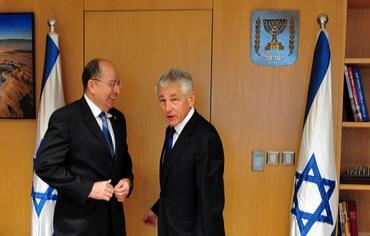
Hagel and YaalonUS Secretary of State Chuck Hagel and Defense Minister Moshe Ya’alon. Photo: Courtesy of Ministry of Defense

If this is a coincidence, it is an extraordinary one. Twice in less than two months, remarks that Defense Minister Moshe Ya’alon made in closed forums about key issues on Israel’s national security agenda were leaked to the media. In both cases, the media used the leaked remarks to foment a crisis in relations between Israel and the Obama administration.

In both cases, the Obama administration has used the opportunities created by the Israeli media to bash Ya’alon and pressure Prime Minister Binyamin Netanyahu to fire him.

In January, Yediot Aharonot leaked Ya’alon’s private remarks about US Secretary of State John Kerry’s irrational focus on the mordant peace process between Israel and the Palestinians at a time when there is both relative peace in Israel, and Israel’s neighbors are undergoing political upheavals and civil war. Together with the other two musketeers of Israel’s far-left media – Haaretz and Channel 2, Yediot used the story to provoke a fight between the Netanyahu government and the Obama administration. Acting on cue, the White House and State Department demanded that Ya’alon apologize for remarks that were made in private. Ya’alon sufficed with a terse statement that he was sorry if anyone took offense from his private remarks.

And now, two months later, Ya’alon’s remarks have been leaked again.

Last week Ya’alon spoke at a forum at Tel Aviv University that was closed to the media. There he bemoaned the Obama administration’s abandonment of the US’s traditional role as the world’s policeman and considered its significance for Israel. With regard to Iran’s nuclear program, Ya’alon said that the time had come for Israel to recognize that the US has not met its expectations and taken the lead to prevent Iran from acquiring nuclear weapons. As a consequence, “We [Israelis] have to look out for ourselves.”

Haaretz published Ya’alon’s leaked remarks and then, with its partners, Yediot and Channel 2, set about fomenting a crisis in relations with the US. As it did in January, last week the Obama administration jumped at the opportunity. State Department spokeswoman Jan Psaki stopped just short of demanding Ya’alon’s resignation.

What is going on here? Obama and Kerry say far worse things about Israel’s leaders as a matter of course than Ya’alon said about either of them. And nothing Ya’alon said was wrong. Nothing that he said was unique. Similar statements are being heard from spurned US allies around the region and the world. Not only were Ya’alon’s statements reasonable, the vast majority of Israelis share his sentiments both on the untrustworthiness of US security guarantees and on the absence of prospects for peace with the PLO.

So why leak his remarks and present them as unforgivable faux pas?

The first reason is that the media have been working for seven years to intimidate Israel’s policymakers into not noticing that the US will do nothing to prevent Iran from developing nuclear weapons. And they can’t intimidate Ya’alon.

The US effectively abandoned the option of using military force to prevent Iran from acquiring nuclear weapons at the end of 2007 with the publication of the National Intelligence Estimate. The 2007 NIE falsely reported Iran had abandoned its quest for nuclear weapons in 2003. After the report was released, then president George W. Bush had no political capacity to attack Iran.

The remote chance that the US would attack Iran’s nuclear installations at some future date was taken off the table completely with Obama’s inauguration in 2009. From the outset Obama made clear through word and deed that his goal was to appease the mullahs, not confront them.

The fact that Israel continued to cling to the empty claim that the US would act to prevent Iran from acquiring nuclear weapons for seven years after the 2007 NIE is testament to both the media’s power to intimidate and to its corruption. The media is supposed to facilitate the free flow of information. But they blocked it by stifling discussion of the credibility of US leadership in dealing with Iran’s nuclear program. And they attacked as reckless every leader that indicated a willingness to act independently against Iran.

Ya’alon apparently is not afraid of the media. He knows he can credibly demonstrate to the public that Israel can and must secure its own interests, regardless of the US position. Since they cannot get him to toe their line, the media triumvirate has apparently decided to undermine the public’s trust in him by presenting him as a reckless amateur.

Here the issue of the leak is critical to understand. In holding the off-record briefings, Ya’alon did nothing wrong.

Indeed, he behaved as a leader ought to. When the leader in an open society is considering a significant shift in national policies, it is reasonable for him to share his thinking with policy elites, whether in academia or the media, to prepare the ground and gauge their responses. Doing so in private enables leaders to consider major shifts away from the spotlight.

It was the leakers, not Ya’alon, who behaved recklessly and unprofessionally.

He spoke off the record to prevent a diplomatic embarrassment for himself and the country. They leaked his remarks in order to embarrass him and initiate a diplomatic crisis.

Luckily – and ironically – their plan backfired. To discredit Ya’alon the media inadvertently enabled Ya’alon, one of the most trusted men in Israel, to initiate discussion about the Palestinians and the Iranians that they have blocked for years – and to do it on his terms.

And now it is too late to stop the conversation.

The media chose to focus the campaign against Ya’alon on his purported irresponsibility and loose lips because they cannot argue with him on substance.

His claim that there is no chance that Palestinians will agree to a peace deal with Israel is self-evident.

His assertion that Israel cannot trust Obama to prevent Iran from becoming a nuclear power is undeniable.

And this is why the media chooses to create artificial crises with the US over Ya’alon’s private remarks and why the Obama administration so enthusiastically cooperates with Channel 2, Yediot and Haaretz.

Both understand that the only hope they have of coercing the government and the public to maintain faith with their failed and dangerous policies regarding the PLO and Iran is by threatening that Israel will pay a price for abandoning them. And the price they quote is the durability of the US-Israel alliance.

To date, the public hasn’t been moved by their antics. Polls taken after the first leak in January revealed that Ya’alon is the most popular minister in the government.

And while it is important to be concerned when the media colludes with a hostile US administration to bring down the defense minister, it is also important not to get too carried away.

Israelis know that they can trust Ya’alon more than either Obama or the media. And they agree with him. With these assets in hand, it is hard to see how Ya’alon can lose this fight.

The writer is the author of The Israeli Solution: A One-State Plan for Peace in the Middle East.

Off Topic: Obama to Kill Tomahawk, Hellfire Missile Programs

March 24, 2014

Off Topic: Obama to Kill Tomahawk, Hellfire Missile Programs – The Washington Free Beacon.

(What the hell is this f..ing moron doing. At this particular point in time, when US credibility is at an alltime low, this should be the last thing the US should do. How reassuring for the US allies in the mideast. How threatening for Iran. If there was any doubt in anyone’s  mind that “all options are on the table” is a bad joke this decision should remove it. – Artaxes)

Cornerstone of U.S. Naval power eliminated under Obama budget

The guided-missile destroyer USS Barry launches a Tomahawk cruise missile / AP

The guided-missile destroyer USS Barry launches a Tomahawk cruise missile / AP

BY:
March 24, 2014 1:23

President Barack Obama is seeking to abolish two highly successful missile programs that experts say has helped the U.S. Navy maintain military superiority for the past several decades.

The Tomahawk missile program—known as “the world’s most advanced cruise missile”—is set to be cut by $128 million under Obama’s fiscal year 2015 budget proposal and completely eliminated by fiscal year 2016, according to budget documents released by the Navy.

In addition to the monetary cuts to the program, the number of actual Tomahawk missiles acquired by the United States would drop significantly—from 196 last year to just 100 in 2015. The number will then drop to zero in 2016.

The Navy will also be forced to cancel its acquisition of the well-regarded and highly effective Hellfire missiles in 2015, according to Obama’s proposal.

The proposed elimination of these missile programs came as a shock to lawmakers and military experts, who warned ending cutting these missiles would significantly erode America’s ability to deter enemy forces.

“The administration’s proposed budget dramatically under-resources our investments in munitions and leaves the Defense Department with dangerous gaps in key areas, like Tomahawk and Hellfire missiles,” said Rep. Randy Forbes (R., Va.), a member of House Armed Services Committee.

“Increasing our investment in munitions and retaining our technological edge in research and development should be a key component of any serious defense strategy,” he said.

The U.S. Navy relied heavily on them during the 2011 military incursion into Libya, where some 220 Tomahawks were used during the fight.

Nearly 100 of these missiles are used each year on average, meaning that the sharp cuts will cause the Tomahawk stock to be completely depleted by around 2018. This is particularly concerning to defense experts because the Pentagon does not have a replacement missile ready to take the Tomahawk’s place.

“It doesn’t make sense,” said Seth Cropsey, director of the Hudson Institute’s Center for American Seapower. “This really moves the U.S. away from a position of influence and military dominance.”

Cropsey said that if someone were trying to “reduce the U.S. ability to shape events” in the world, “they couldn’t find a better way than depriving the U.S. fleet of Tomahawks. It’s breathtaking.”

The Navy has used various incarnations of the Tomahawk with great success over the past 30 years, employing them during Desert Storm and its battle zones from Iraq and Afghanistan to the Balkans.

While the military as a whole is seeing its budgets reduced and equipment scaled back, the Tomahawk cuts do not appear to be due to a lack of funds.

The administration seems to be taking the millions typically spent on the Tomahawk program and investing it in an experimental missile program that experts say will not be battle ready for at least 10 years.

“It is definitely short-sighted given the value of the Tomahawk as a workhorse,” said Mackenzie Eaglen, a former Pentagon staffer who analyzes military readiness. “The opening days of the U.S. lead-from-behind, ‘no-fly zone’ operation over Libya showcased how important this inventory of weapons is still today.”

Overall, the Navy has essentially cut in half its weapons procurement plan, impacting a wide range of tactical weapons and missiles.

Navy experts and retired officials fear that the elimination of the Tomahawk and Hellfire systems—and the lack of a battle-ready replacement—will jeopardize the U.S. Navy’s supremacy as it faces increasingly advanced militaries from North Korea to the Middle East.

The cuts are “like running a white flag up on a very tall flag pole and saying, ‘We are ready to be walked on,’” Cropsey said.

Retired Army Lt. Col. Steve Russell called the cuts to the Tomahawk program devastating for multiple reasons.

“We run a huge risk because so much of our national policy for immediate response is contingent on our national security team threatening with Tomahawk missiles,” said Russell, who is currently running for Congress.

“The very instrument we will often use and cite, we’re now cutting the program,” Russell said. “There was a finite number [of Tomahawk’s] made and they’re not being replenished.”

“If our national policy is contingent on an immediate response with these missile and we’re not replacing them, then what are we going do?” Russell asked.

North Korea, for instance, has successfully tested multi-stage rockets and other ballistic missiles in recent months. Experts say this is a sign that the Navy’s defensive capabilities will become all the more important in the Pacific in the years to come.

Meanwhile, the experimental anti-ship cruise missile meant to replace the Tomahawk program will not be battle ready for at least 10 years, according to some experts.

The Long Range Anti Ship Missile has suffered from extremely expensive development costs and has underperformed when tested.

“You have to ask yourself: An anti-ship missile is not going to be something we can drive into a cave in Tora Bora,” Russell said. “To replace it with something not needed as badly, and invest in something not even capable of passing basic tests, that causes real concern.”

The Pentagon did not return requests for comment.

Off Topic: Palestinian Authority: 1,700 Hamas Millionaires in Gaza

March 24, 2014

Palestinian Authority: 1,700 Hamas Millionaires in Gaza, Front Page Magazine, March 24, 2014

(Fatah says that seventeen hundred Hamas members in Gaza are filthy rich and corrupt. Is Fatah jealous? — DM)

Gaza poverty

The Palestinian Authority, the world’s welfare state, is having another internecine feud between the Hamas militias which control Gaza and the Fatah militias which control the West Bank.

And Fatah, which controls the official Palestinian Authority apparatus thanks to Obama’s support, despite not actually doing the whole ‘elections’ thing, has let slip a little fact about life in horribly oppressed and besieged Gaza.

It’s full of welfare millionaires.

Palestinian Authority (PA) Chairman Mahmoud Abbas’s Fatah faction went on the offensive Thursday, claiming that Hamas in Gaza is corrupt and “doesn’t represent the Palestinian people.”

The Fatah spokesman claimed that while Gaza is one of the poorest places in the world, there are 1,700 millionaires among Hamas members, hinting that the terror group imposes steep taxes on its citizens for goods entering from Egypt and Israel, and that this money finds its way into Hamas officials’ pockets.

That’s the number of millionaires in Hamas, not the total number of millionaires in Gaza. We still don’t know what the total number is.

gaza-atrocities-450x274

A report in 2012 claimed that there were 600. There clearly are a lot more than that based on a statement from Fatah. It’s conceivable that the Fatah spokesman was including Hamas leaders living abroad, but that’s still too big a discrepancy. An unknown PA diplomat claimed that there were 1,200 millionaires in Gaza last year.

Considering that much of the economy in the West Bank and Gaza consists of foreign aid, black marketeering and corruption, there’s probably no way to be sure.

Palestinian Authority leader Mahmoud Abbas, whose son lost his monopoly on imported cigarettes when Hamas took over Gaza, charged that, “800 millionaires and 1,600 near-millionaires control the tunnels at the expense of both Egyptian and Palestinian national interests.”

The Palestine Pulse claimed that the tunnels had created over 1,000 new millionaires. And that’s the tunnels alone, it doesn’t account for Gaza’s extensive construction industry, its luxury hotels and all the rest of it.

Meanwhile anti-Israel activists claim that Gaza is a concentration camp. Apparently it’s a concentration camp with luxury five-star hotels.

gaza-suffering-233x350

In Syria: Assad may now be the greater evil

March 24, 2014

In Syria: Assad may now be the greater evil – The Times of Israel.

March 23, 2014, 3:56 pm

By Ely Karmon

The U.S., European democracies, and Israel, see the Sunni jihadist in Syria as significant and immediate threat to the future of Syria as a potential basis for al-Qaeda and global jihadists. The West’s hesitation to earnestly support the rebel forces and the U.S.-Russian deal for the dismantling of the Syrian chemical arsenal, has actually given the Assad regime a free hand to quell the disunited opposition forces. At the same time, the West tends to ignore or minimize the Syrian regime’s historical record of support for terrorist forces in the region and beyond. In addition, they ignore the potential threat of the various Shia forces involved in the conflict alongside the Assad regime and strong support offered by Iran.

On March 18, four Israeli soldiers were wounded, one seriously, by a bomb that hit their jeep in the Golan Heights along the Syrian border. This major attack, the most serious since the eruption of the Syrian uprising three years ago, comes after several other similar incidents for which the Lebanese Hezbollah organization was responsible: On March 14 an explosive charge detonated near Har Dov in the vicinity of the Israel-Lebanon border (IDF tanks fired at a Hezbollah position near the border); ten days earlier, on March 4, Israeli army forces spotted several individuals attempting to plant an explosive charge near the border fence with Syria (IDF forces fired artillery shells and bullet rounds in response).

Tensions have risen in the north since the February 24 airstrike targeting a Hezbollah weapons convoy in Lebanon. Foreign reports have attributed the strike to the Israeli Air Force. Hezbollah threatened to attack Israel in retaliation.

Israeli forces responded to the March 18 blast with artillery fire and hours later by retaliatory air strikes against Syrian military sites near the city of Quneitra (an army training facility, a military headquarters and artillery batteries). The Israeli strikes killed one soldier and injured seven, according to Syrian sources. Damascus warned the strikes could further destabilize the region and warned Israel against escalating the situation.

In this author’s opinion, the latest events on the Golan border are not simply the result of Hezbollah’s desire to retaliate for the recent Israeli attacks against the convoys of Syrian strategic weapons transferred to Lebanon, but rather the consequence of the latest military successes of the Assad regime, with the critical support of Iran and its Shia proxies.

First the numbers: according to Israeli sources Shia foreign fighters operating in support of the Assad regime number at least 7,000-8,000, while Western sources evaluate them at perhaps 10,000.

The main celebrated Shia force is represented by several thousand elite Hezbollah fighters, whose numbers change from time to time. Hezbollah has probably already lost more than 500 fighters, including senior commanders.

The second important element is the Iraqi Shia units which began arriving in Syria from spring 2012 onward. Shia leaders claimed last summer there are between 3,800 and 4,700 Iraqi fighters in Syria. Their declared goal is to defend Sayyida Zaynab’s Holy Shrine (the daughter of Ali and Fatimah and the granddaughter of the Prophet Mohammed) near Damascus. This was at the beginning the pretext and cover of the Hezbollah intervention in the Syrian civil war too.

As of today there are some 14 Iraqi Shi’ite brigades (Liwa’as or Katiba’s) involved in the conflict, the most prominent of which is the Liwa’a Abu Fadl al-Abbas. Contrary to the initial allegations, some of the groups, like Liwa’a ‘Ammar Ibn Yasir (LAIY), are already operating in the Aleppo area. A second important group is Asa’ib Ahl al-Haq (League of the Righteous), formed in 2008 from a breakaway group of Muqtada al-Sadr’s Mahdi Army, whose stated objective is “to promote the religious and political principles of the Iranian Revolution inside and beyond Iraq.” Its expeditionary force in Syria, Liwa’a Kafeel Zaynab, is closely cooperating with the Lebanese Hezbollah.

(For more detailed information on this subject see the International Institute for Counter-Terrorism (ICT) Report by K. Gilbert, The Rise of Shiʿite Militias and the Post-Arab Spring Sectarian Threat.)

In July 2013, the Badr Organization (BO) announced it had sent 1,500 fighters to Syria in the framework of an Expeditionary Force, Quwet al-Shahid Muhammed Baqir al-Sadr. The BO was originally a brigade developed with Iranian assistance in the 1980s to fight Saddam Hussein’s regime, and for a long time its leaders were based in exile in Iran. The organization has close links with the Iranian Revolutionary Guards and it has been reported that one of its senior figures has been acting on behalf of Iran to coordinate and liaise between Assad’s government and the various Iraqi militant groups operating in Syria.

The number of Iraqi volunteers could see a rise since Iran-based Grand Ayatollah Kazim al-Haeri issued a fatwa in December permitting Iraqi Shias to fight in support of Bashar al-Assad.

Iran has encouraged Iraqi Shia to fight in Syria and has played a key role in the formation, training and financing of Iraqi volunteer groups. They have been taught how to move from the insurgent tactics used in Iraq (roadside bombs, hit-and-run rocket attacks, assassinations) to the urban street-fighting required for regime operations in Syria.

In addition to the hardcore Hezbollah and Iraqi Shia fighters, there are several hundred foreign fighters from the Shia communities in Bahrain, Yemen (some 200 Houthi rebels), Kuwait (a hundred or more), Saudi Arabia, Pakistan, Afghanistan, and even some from Azerbaijan.

The vital support of Hezbollah in the capture of the strategic town of al-Qusayr on the Lebanese border in June 2013 has permitted the continuation of the fight for the control of the strategic road that links Damascus to the Alawite Coast, to Homs and Aleppo through the Qalamoun Mountains. This sustained offensive has led recently to the occupation of Yabroud, last stronghold of the rebels in the region, and the encirclement of the important Sunni town of Arsal in Lebanon, the supplier of fighters and weapons to the opposition forces in the region.

The Iraqi forces have helped the Syrian army to reoccupy much of Damascus’ southern suburbs and ease the siege on the capital. Syrian military sources announced that the army is planning to launch a new phase of military operations in a strategic area in the Damascus countryside.

At the same time, the anticipated rebel spring offensive by the new Islamic Front alliance and the FSA in southern Syria, planned by the U.S. and Saudi Arabia after the collapse of the peace talks in Geneva last month, has not materialized. Nor have the promised supplies of strategic weapons from the foreign backers arrived.

The lack of reaction by the U.S. and Europe in the face of the fierce bombings of the Syrian big cities, the advances of the regime army, as well as the perceived Western weakness during the Ukraine crisis and the success of Syria’s Russian ally, have no doubt emboldened Assad, Iran and Hezbollah.

On the political level, the Geneva II talks in mid-February failed to generate meaningful discussion of a political resolution to the conflict or to improve humanitarian conditions, as Assad’s delegation refused to discuss opposition’s transition plan. Assad has even stepped up preparations for presidential elections due to be held in June under the terms of the current constitution.

On the military level, the warming of the Golan border with Israel by using Hezbollah fighters and possibly other proxies is also a sign of the degree of self-confidence the Damascus regime and its allies have reached.

From Iran’s point of view, after achieving a strong grip on Iraq, the Damascus regime now becomes a vassal that will better serve the strategic needs of its patron. Iran thus achieves a presence on the Mediterranean coast and a direct border with Israel.

The new situation allows Iran and Hezbollah to expand to the Golan the strategy they have used in Lebanon and Gaza. As the latest attempt to transfer by ship strategic missiles to Hamas and the Palestinian Islamic Jihad has failed, the Syrian front is more suitable for this kind of war of attrition.

The new Syrian strategic set-up also serves Russia in a period where it is managing successfully, for the moment at least, the Crimean and Ukrainian crisis. The presence of the Russian fleet in Tartous seems now secure and Russian officials have recently expressed the view that Assad has practically won the war.

Syria is likely the best strategic card in the hands of the U.S. if it wants to seriously challenge President Putin’s move in Crimea.

On March 18 the U.S. suspended the operations of Syria’s embassy including its consular services and asked for the pullout of Syrian diplomats. Moscow called the move “worrying and disappointing” and the Russian Foreign Ministry suggested Washington’s actions were aimed at “regime change”.

It remains to be seen see if Washington will be able to play this card as cleverly as Moscow.

The Israeli government and military now have the difficult task of devising a strategy that deters Syria and Hezbollah from attacking the Golan and at the same time makes sure that the Syrian jihadist forces do not take control of the zone close to the border.

Israel could finally decide that the Assad regime and its alliance with Iran and Hezbollah is indeed the greater evil, and act accordingly.

Obama is setting up Israel to take the fall – Washington Post

March 24, 2014

Obama is setting up Israel to take the fall.

In advance of Israeli Prime Minister Benjamin Netanyahu’s recent visit to the United States, President Obama gave an interview in which he viciously attacked Israel, suggesting that Israel was the cause of the peace process failure, that the United States could no longer protect Israel if the peace process failed and that Palestinian Authority President Mahmoud Abbas was a man of peace.

epa04129968 US President Barack Obama (R) meets with Palestinian President Mahmoud Abbas (L) in the Oval Office of the White House in Washington, DC, USA, 17 March 2014. President Obama met with President Abbas to discuss the progress in the Israeli-Palestinian negotiations and the establishment of a Palestinian state. EPA/ALEX WONG / POOL AFP OUT

President Obama meets with Palestinian President Mahmoud Abbas in the Oval Office. (Alex Wong/European Pressphoto Agency)

This past week, Abbas came to visit Obama at the White House. In advance of his trip, Obama made no statements expressing displeasure with the Palestinian Authority’s intransigence and its continued demonization of Israel. Just before the meeting Obama told the assembled press corps:

I have to commend President Abbas.  He has been somebody who has consistently renounced violence, has consistently sought a diplomatic and peaceful solution that allows for two states, side by side, in peace and security; a state that allows for the dignity and sovereignty of the Palestinian people and a state that allows for Israelis to feel secure and at peace with their neighbors.  . . . I also want to point out that the Palestinian Authority has continued to try to build strong institutions in preparation for a day in which the Palestinians have their own state, and I will continue to emphasize the importance of rule of law, transparency, and effective reform so that not only do the Palestinians ultimately have a state on paper, but, more importantly, they have one that actually delivers on behalf of their people.

In fact, Abbas last year forced out the only true Palestinian reformer Salam Fayyad, has refused to hold elections and occupies the presidency beyond the legally allotted term. Moreover, as former deputy national security adviser Elliott Abrams explains: “By making the ‘right of return’ a personal right for each Palestinian, Abbas is saying the PLO has no right to negotiate over it and no right to sign an agreement that defeats or even limits that ‘right.’ If that’s really the PLO position, there will never be an agreement.”

How did the Abbas-Obama meeting go? The Times of Israel reports:

On his trip to Washington this week, Palestinian Authority President Mahmoud Abbas rejected US Secretary of State John Kerry’s framework document for continued peace talks with Israel, and issued “three no’s” on core issues, leaving the negotiations heading for an explosive collapse, an Israeli TV report said Friday. . . .

Specifically, the report said, Abbas rejected Prime Minister Benjamin Netanyahu’s demand that he recognize Israel as a Jewish state. He also refused to abandon the Palestinian demand for a “right of return” for millions of Palestinians and their descendants — a demand that, if implemented, would drastically alter Israel’s demographic balance and which no conceivable Israeli government would accept. And finally, he refused to commit to an “end of conflict,” under which a peace deal would represent the termination of any further Palestinian demands of Israel.

We can therefore see that Obama’s words are entirely at odds with the conduct of the parties in the region. He either chooses to misrepresent the facts or he is blinded by unremitting hostility to Israel. In any event, he indulges the PA’s intransigence despite replete evidence that this only worsens the divide between the parties. The inescapable takeaway  is that Obama lacks real affection for the Jewish state and when things fail intends to blame Israel.

In that vein, Jonathan Schanzer of the Foundation for Defense of Democracies predicts:

Led by Secretary of State John Kerry and managed by veteran diplomat Martin Indyk, Washington has labored to restart the peace process. And while the administration has placed significant pressure on Israel to make concessions on borders, Jerusalem and settlements, one of the major demands on the Palestinians has been to halt the international bid for recognition.

Skeptical of the entire process after decades of fruitless negotiations, the Palestinians have nevertheless abided by this demand. But they have also made it clear that they continue to study steps to join UN treaties and bodies. . . . Abbas himself has threatened, “If we don’t obtain our rights through negotiations, we have the right to go to international institutions.” Palestinian official Hanan Ashrawi also warned that the Palestinian leadership was ready to join sixteen agencies beginning in April 2014. “Everything is in place and will be set in motion,” Ashrawi claimed. By late December, Saeb Erekat told Maan News Agency that there were no less than sixty-three member agencies of the UN that the PLO sought to join.

While Schanzer concludes that “it is clear that the Palestinians have a ready-made policy to pursue should the current talks break down. Unlike in 2000, when the collapse in diplomacy prompted a violent intifada, this failure will yield a diplomatic intifada,whereby the Palestinians pressure Israel using their leverage with the international community. It’s nonviolent, but its war by other means.” And it is equally clear that the administration will be a willing partner in assigning blame to Israel. The president is setting Israel up, and Israel and its friends should be prepared to vigorously and publicly reveal the president’s mendacity.

Off Topic: Strike terrorism relentlessly

March 24, 2014

Strike terrorism relentlessly, Israel Hayom, Zvika Fogel, March 24, 2014

(Israel suffers — on a per capita or any other rational basis — from dramatically more terrorist attacks than the United States. That’s good for the U.S. and bad for Israel. The Obama Administration worsens Israel’s situation by remaining adamant in pressuring her to yield to the apparently unending demands of those who terrorize her so that they can do even more of the same. Why? — DM)

According to reports made public by the Shin Bet security agency, the past year has seen more than 100 terror attacks a month in Jerusalem and Judea and Samaria. Not attempted attacks or intended attacks, but actual terror attacks, which included planting explosives, the use of Molotov cocktails, and shooting and stabbing attacks. [Emphasis added.]

. . . .

It is a daily battle against an enemy that is trying to destroy us, and it has a name — it is called a struggle for survival.

The search for a less intimidating name for terrorism has become all the rage lately. It started with the term “low-intensity conflict,” meant to differentiate the war on terror from a full-scale war with an organized enemy’s army, and has recently settled on the term the “battle between the wars.”

Is there anyone out there who believes the soldiers on the ground — those whose mission it is to storm terrorists — care about the euphemisms used by politicians and generals? Field commanders and the troops on the ground know exactly what it is — a war for the very future of the State of Israel.

According to reports made public by the Shin Bet security agency, the past year has seen more than 100 terror attacks a month in Jerusalem and Judea and Samaria. Not attempted attacks or intended attacks, but actual terror attacks, which included planting explosives, the use of Molotov cocktails, and shooting and stabbing attacks.

The operations and intelligence efforts security forces pursue are neither a “low-intensity conflict” nor a “battle between wars.” It is a daily battle against an enemy that is trying to destroy us, and it has a name — it is called a struggle for survival.

The recent operation in Jenin, like the interception of the arms shipment at sea, thousands of miles from Israel’s shores, and the various airstrikes in Sudan and Syrian that foreign media sources have attributed to Israel, are acts of war perpetrated in self-defense.

The Iranian and Syrian weapons bound for radical terror groups like Hamas, Islamic Jihad and al-Qaida are not meant to rust away on a shelf somewhere — they are meant to inflict harm on Israel, to strike the greater Tel Aviv area, the Gaza Strip border communities, and the Israeli communities adjacent to the northern border.

The terror groups fostered by the Palestinian Authority are hardly dovish. They spend their time recruiting suicide bombers and collecting intelligence with aim of abducting and killing Israelis. These individuals are not armed with good intentions, but with guns and rockets launchers.

The only thing we can do to prevent a terror attack from hitting close to home is to target our enemies in their beds. That is the essence of defense. Those who wish to avoid the dubious pleasure of having a rocket explode in their backyard or a Palestinian suicide bomber explode on their street would do better to support and encourage those who tirelessly work to keep such threats at bay.

Those who speak of peace would do better to listen to the words of Hamas Prime Minister in Gaza Ismail Haniyeh, who, while speaking at a rally honoring Hamas co-founder Sheikh Ahmed Yassin, vowed to “make Tel Aviv quiver.” If he truly means that, then I must ask: Are we going to sit around and let it happen?

Ya’alon is simply setting the record straight

March 24, 2014

Ya’alon is simply setting the record straight – Israel Opinion, Ynetnews.

Op-ed: US should admit that Israel’s defense minister is reading regional map much better than Secretary of State Kerry.

Published: 03.24.14, 12:22 / Israel Opinion

Defense Minister Moshe Ya’alon showed up at a television studio last weekend and declared for the umpteenth time that in our generation there is no chance for a permanent agreement between Israel and the Palestinians. For the umpteenth time, he also noted that in the distant past he had actually believed in the “territories for peace” formula, but that in the meantime he had recovered from his naivety.

As you know, Ya’alon is not the only minister who has the habit of recycling his beliefs in interviews with the media. Almost all his fellow government members do the same, each with his own beliefs. Even the most skillful politician cannot reinvent himself in every interview. The justice minister always says that Israel must make more concessions for peace, and the defense minister always says that there is no point in making any concessions. Nonetheless, we have developed a strange habit of responding to Livni’s comments with a yawn and breaking into cries of despair after every Ya’alon interview: Oh no, Bogie doesn’t believe in peace.

Actually, Ya’alon himself has developed his own strange habit: He is unmoved by the cries of despair. Despite the heavy psychological pressure exerted on him from all directions, he has a consistent tendency to maintain his composure, to the point of complete indifference to surrounding hysteria. His rhetoric is not subject to instructions from public opinion leaders. As the former Military Intelligence head and as a retired IDF chief of staff, he already has a solid opinion about the chances of the agreement between Jerusalem and Ramallah. It is his duty to reveal it to the public even if a certain camp doesn’t like it. He is the defense minister, not the political correctness minister.

Who is right and who is obsessive?

While doing that, Ya’alon managed to irritate the Americans too, not just the peace seekers here, but there is no need to exaggerate in describing the extent of this irritation. Our defense establishment leader simply set the record straight when he said last week that the United States was showing global weakness and that its allies in the Middle East were disappointed with it. Every child in Damascus, Kiev or Manhattan knows that Obama’s US is pursuing a spineless global policy. The opinion pages in the American press are filled with similar indictments against the Obama administration. According to all signs, even the administration itself knows it, but it’s convenient to pull an insulted face when the Israeli defense minister joins the criticism.

Washington is now accusing Ya’alon of intentionally undermining the relationship between the two countries, no less. It is forgetting its own contribution to undermining the relations. Obama is the least pleasant American president towards Israel in the past 50 years, both in his words and in his actions. In his five years in the White House, the president insulted the prime minister more than two or three times, while the prime minister actually made sure not to throw insults back at him. Ya’alon is less strict, but is still quite polite. Despite the asymmetry between the sides, the American president should reflect on his own actions instead of imposing sanctions on our defense minister.

After all, America doesn’t have many friendly alternatives in the Middle East. It should even admit to itself that Ya’alon is reading the regional map much better than John Kerry. Last summer, when Kerry promised us peace within nine months, Ya’alon already voiced contradictory promises. Is there still any doubt in Washington who will be right in the end and who will be revealed as obsessive?