Archive for March 22, 2014

Why doesn’t Netanyahu back Ya’alon? Other prominent ME voices fault Obama’s policies too

March 22, 2014

Why doesn’t Netanyahu back Ya’alon? Other prominent ME voices fault Obama’s policies too, DEBKAfile, March 22, 2014

Ya’alon is . . .  in good company among his peers in the region’s top security and military circles when he disparages the Obama administration’s handling of matters in a way which he regards as detrimental to the region and Israel’s national security.

Israel’s blunt-spoken Defense Minister Moshe Ya’alon has found little backing at home for his outspoken criticism of Obama Administration’s policies. Up until Saturday night, March 22, Prime Minister Binyamin Netanyahu let him face the music alone when US Secretary of State John Kerry demanded an apology – and even when his spokeswoman Jen Psaki said the clarifications Ya’alon offered of his remarks to Defense Secretary Chuck Hagel were not good enough.

“The US still had concerns about Ya’alon’s pattern of behavior. An apology from Ya’alon would be a natural next step,” she said. “His comments, as we’ve stated a couple of times, don’t reflect the true nature of our relationship with Israel.”

Sounding like a schoolteacher reprimanding a delinquent pupil, Ms Psaki implicitly accused Israel’s defense minister of misrepresenting the nature of US-Israel relations. And, most of all, he was required to say sorry for daring to say that US policy was weak and wavering – not just on Ukraine, but on Iran, in a way that directly impinged on Israel’s security. His ultimate sin, for the spokeswoman, was to urge that his country  stop waiting for America to pull the Iranian chestnut out of the fire and take matters in its own hands.

In a previous episode, the defense minister agreed he was out of line when he characterized Kerry in a much-quoted private conversation as “obsessive and messianic” over his dogged pursuit of an Israeli-Palestinian final accord.  For that remark he did apologize.

However, when it comes to finding extreme fault with the Obama administration’s foreign policy, Ya’alon is not the only high-ranking politician in the Middle East – or even the most vehement, although not all the others have been told by Ms Psaki to apologize.

A similar perspective has been openly articulated even more vigorously by, for instance, top Saudi leaders, including King Abdullah and Foreign Minister Prince Saud al Faisal.

Nor is Ya’alon the only senior defense official whom the Obama administration wuld like to see the back of. Egypt’s Defense Minister Gen. Abdul-Fatteh El-Sisi is another. The general’s criticism of Washington’s policies is hardly restrained. He has paid for it with a cold US shoulder, even though he will almost certainly be elected the next president of the most populous Middle East country.

Punishing the Egyptian general for his crackdown on the Muslim Brotherhood, which he removed from power in a coup, Obama refused to let Egypt have urgently needed warplanes, helicopters and surveillance equipment to fend off the al Qaeda-Iraq (ISIS)’s advance into the Sinai Peninsula. Our counterterrorism sources report the jihadis are using Sinai as a jumping-off base and have begun infiltrating cities in the Nile Valley.

El-Sisi has since appealed to Moscow for the necessary hardware.

The administration’s treatment of Prince Bandar bin Sultan, Director of Saudi General Intelligence, was still tougher, punishing him for the campaign he led in support of certain Syrian rebel militias contrary to the Washington line. That campaign aimed, with the king’s approval, to remove Bashar Assad from power.

This is not the place to analyze what went wrong. At the same time, it is important for Israel to understand that, so long as Bandar’s agents were proactive in the Syrian civil war, neither Hizballah nor al Qaeda’s affiliates were able to reach the Syrian-Israeli border dividing the Golan. In the two months since the Saudi prince and his agents were purged from the Syrian scene, the two terrorist organizations are more deeply involved than ever in the civil war, and have also started mounting cross-border attacks on Israel from Syrian territory.

Certain US quarters planted stories that Bandar had fallen out of royal favor and was stripped of all his official duties, including the directorship of intelligence. But the prince surfaced in Beijing two weeks ago, ahead of a state visit by Crown Prince Salman bin Abdulaziz, to negotiate the purchase of Chinese ballistic missiles. It turned out that Bandar was still Chief of intelligence minus only the Syrian dossier.

Ya’alon is therefore in good company among his peers in the region’s top security and military circles when he disparages the Obama administration’s handling of matters in a way which he regards as detrimental to the region and Israel’s national security.

What is conspicuously missing is a sign of support from Binyamin Netanyahu at a time when the defense minister needs a solid lineup for handling the dangerous and complex hostile fronts evolving on three of Israel’s borders – the Golan, the Gaza Strip and the South, as well as the West Bank, where Hamas forces are gathering anew to spring back into active terrorist mode.

US Senators urge Obama to push for strict Iran nuclear deal

March 22, 2014

US Senators urge Obama to push for strict Iran nuclear deal | JPost | Israel News.

By REUTERS

LAST UPDATED: 03/22/2014 22:25

Twenty three US senators send letter to the President urging him to stand firm on him; legislators ask that Obama insist on a final agreement in which Iran would not be able to build or buy a nuclear weapon.

obama

US President Barack Obama. Photo: REUTERS

WASHINGTON – Twenty-three US senators kept the spotlight on Iran nuclear negotiations on Saturday with a letter to President Barack Obama urging that he stand firm, after a second round of talks wound up in Vienna.

The letter from Democratic senators and one independent, was identical to one sent to Obama earlier this week by the House of Representatives, asking that he insist on a final agreement in which Iran would not be able to build or buy a nuclear weapon.

The House letter was signed by 395 of the 435 members of the chamber and was sent as Iran and six world powers met to persuade Iran to scale back its contested nuclear activities.

The meeting in Vienna was the second in a series that the six nations – United States, China, Russia, Germany, France and UK – hope will produce a verifiable settlement, ensuring that Iran’s nuclear program is oriented to peaceful purposes only.

The 23 senators said they embraced Obama’s two-track approach twinning sanctions against Tehran with negotiations, but urged strict procedures of transparency and verification to ensure Iran does not obtain a nuclear weapon.

The US Congress has long taken a harder line on Iran than the White House, but Saturday’s letter was an indication of how sensitive the issue is, even among members of the same party.

Many in this group of senators, including Carl Levin, whose office released Saturday’s letter, did not sign a letter sent earlier this week from 83 of their colleagues.

That letter, spearheaded by Democrat Robert Menendez, took a more aggressive stance, urging Obama to insist that any final agreement state that Iran “has no inherent right to enrichment under the Nuclear Non-Proliferation Treaty.”

That would be a non-starter for Iran, which cites a right under the NPT to produce nuclear energy for civilian purposes.

Both the US and Iranian delegations – the two pivotal players in the negotiations – face intense pressure from hawkish critics back home.

Bennett Lauds Defense Minister for Speaking Out

March 22, 2014

Bennett Lauds Defense Minister for Speaking Out – Inside Israel – News – Israel National News.

( Good for Bennett.  Israelis should rally behind Yaalon.  Even more so should Amercans… – JW )

Jewish Home Chairman defends Ya’alon for criticizing the US, noting ‘his mouth and heart are the same’ and in Israel’s best interests.

By Uzi Baruch and Elad Benari

First Publish: 3/22/2014, 7:59 PM

Defense Minister Moshe Yaalon

Defense Minister Moshe Yaalon

Economics Minister and Jewish Home Chairman Naftali Bennett strongly condemned the ongoing media and political tirade against Defense Minister Moshe Ya’alon, who is under fire for criticizing the US’s policy toward Israel.

“The media attack on the defense minister and top IDF official is unnecessary and mostly false, and so far there is no one who says: enough,” Bennett wrote on a Facebook post on Saturday night.

“[Ya’alon] is an excellent defense minister, [and] his mouth and heart are the same – even if the positions [he has] are not the same positions these commentators and others [hold]. (Which is good),” he added.

Over the past year, quiet – and interesting developments – have returned to the Defense system,” Bennett continued. “The State of Israel has regained its deterrence. Nowadays, everyone knows we will not hesitate to work at length to cut off the hands of our enemies.”

“Israel’s intelligence framework has undergone a true revolution,” Bennett continued. “We have new and bold capabilities. Within the turbulent sea that is the Middle East, Israel stands as a beacon of stability. Sometimes you can – and you should – say a few good words [about it].”

The United States harshly criticized Ya’alon this week, over his remarks that the United States “shows weakness” in various arenas around the world, including Ukraine, and has a “soft” approach over Iran’s nuclear program.

In fact, Secretary of State John Kerry personally protested to Prime Minister Binyamin Netanyahu over Ya’alon’s strong criticism which the U.S. saw as trying to hurt U.S.-Israel relations.

Later, Ya’alon phoned Defense Secretary Chuck Hagel and clarified that his remarks were not meant to insult the United States.

However, the apology was not enough for US State Department spokeswoman Jen Psaki, who indicated that the US is still waiting for a more substantial apology.

Border Skirmishes

March 22, 2014

Border Skirmishes – The Weekly Standard.

The Iran-Israel struggle heats up.

Mar 31, 2014, Vol. 19, No. 28 • By LEE SMITH

Last week the Israeli Air Force bombed Syrian military and security positions in retaliation for an operation on the Syrian-Israeli border in the Golan Heights. Four Israeli soldiers were wounded when Hezbollah attacked their Jeep. Hezbollah it seems was looking to kidnap them. This time they failed, but, said Hezbollah sources, “We are sure we will succeed in the near future.”

AP / JINIPIX

A wounded Israeli soldier is evacuated after an attack on his Jeep, March 18.AP / JINIPIX

Maybe. If so, it is sure to resonate throughout the Middle East. The last time Hezbollah kidnapped Israeli soldiers it touched off a monthlong conflict in the summer of 2006. After the devastation Hezbollah suffered, hundreds of its elite troops dead and billions of dollars’ worth of damage done, the party’s general secretary, Hassan Nasrallah, said that had he known how the Israelis would respond, he never would have taken their soldiers in the first place. So now that Nasrallah knows what Israeli countermeasures look like, what could he possibly be thinking?

The answer is that it’s not Nasrallah calling the shots. Hezbollah is Iran’s long arm in Lebanon. Accordingly, its activities on Israel’s northern border, taken together with the maneuvers of other Iranian allies on the southern frontier—weapons transfers to Gaza-based militants and their rocket fire on Israel—are evidence of a new Iranian boldness. Perhaps as a consequence of the interim nuclear agreement Iran struck last November with the P5+1 powers (the United States, Russia, China, the United Kingdom, France, and Germany), Tehran imagines that the White House will rein in Jerusalem. But if that’s what Obama is advising, Israel isn’t paying attention. Israel’s aggressive defense suggests that if Iran keeps pushing, it may soon find itself in open warfare.

For the last year and a half, Israel has kept Iran’s allies on its borders almost totally quiet. The 2006 war that many, including Hezbollah, believed Jerusalem had lost served instead to reestablish the credibility of Israeli deterrence. To the south, Israel’s November 2012 Pillar of Defense campaign in Gaza left Hamas reeling, while the Syrian civil war and the sectarian furies it unleashed loosened the bonds that tied Iran to its chief Palestinian asset. Even as the conflict in Syria burned, Israel was careful to show that it had no stake in the outcome and would stand aside so long as neither Assad nor the rebels tried to involve it—or transfer weapons to Hezbollah.

Israel has repeatedly targeted weapons convoys moving strategic, or game-changing, arms from Syria to Lebanon, typically striking at their point of origin rather than their destination. The reasoning seems to be that with Assad under fire already and reluctant to open another front against Israel, it’s advisable to hit there rather than in Lebanon, where Hezbollah might be compelled to act to save face. Nonetheless, on February 24 the Israeli Air Force struck a Hezbollah position in Lebanon’s Bekaa Valley. Hezbollah’s retaliatory campaign has included at least four border incidents. In one of them, Hezbollah fighters crossed several hundred yards into Israeli territory and planted IEDs.

Until last week, Israeli responses had typically been measured—firing artillery rounds into Syrian territory, for instance. The decision to target Assad’s forces now—as Israel did not do during the 2006 war, when Damascus kept transferring supplies to Hezbollah—is something of a game-changer itself, and needs to be seen in the context of Israel’s southern front.

Earlier in March, Israeli naval commandos boarded a Panamanian-flagged vessel, the Klos C, in the Red Sea carrying arms destined for Gaza, most likely intended for Palestinian Islamic Jihad but undoubtedly with the acquiescence of Hamas. If Prime Minister Benjamin Netanyahu hoped that the interdiction of Iranian arms was something like a public relations coup that would change the White House’s mind about its bargaining partner in Tehran, the administration paid little heed. “It’s entirely appropriate to continue to pursue the possibility of reaching a resolution on the nuclear program,” White House spokesman Jay Carney said after the arms seizure.

However, the fact that the administration showed itself unmoved was perhaps the key factor in Jerusalem’s strategic messaging campaign, for Washington wasn’t Jerusalem’s only intended audience. The Israeli government was also signaling to its own citizens. The message was twofold: First, Iran is a strategic threat, not merely because of its nuclear weapons program, but also because of its support for the axis of resistance on Israel’s borders, a message underscored when Palestinian Islamic Jihad rained dozens of missiles on Israeli towns. Second, the Obama administration isn’t greatly bothered by the fact that Iran doesn’t, as the president put it, “operate in a responsible fashion.”

As Defense Minister Moshe Ya’alon said last week: “We had thought the one who should lead the campaign against Iran is the United States. But at some stage the United States entered into negotiations with them, and, unhappily, when it comes to negotiating at a Persian bazaar, the Iranians were better. .  .  . Therefore, on this matter, we have to behave as though we have nobody to look out for us but ourselves.”

If the weapons seizure was meant to drive home to Israelis that they’re on their own when it comes to Iran, then the raid on Syrian targets last week was intended to reassure them. Jerusalem showed that it will stop Iran’s allies on its borders, and also that it’s willing to go to the source—states that sponsor terrorist war, like Syria and, if the clerical regime continues to escalate, perhaps Iran, too.

Lee Smith is a senior editor at The Weekly Standard.

Off Topic: Hamas urges PNA to halt security ties with Israel after 3 dead

March 22, 2014

Hamas urges PNA to halt security ties with Israel after 3 dead, Xinhua Net, March 22, 2014

The three militant groups, Hamas, Islamic Jihad and Fatah, said in a joint statement that “military actions in the West Bank will be resumed soon and the Palestinian armed resistance against the Israeli occupation will never stop.”

RAMALLAH/GAZA, March 22 (Xinhua) — Islamic Hamas movement on Saturday urged the Palestinian National Authority (PNA) to halt security cooperation with Israel after the Israeli army killed three militants in the northern West Bank refugee camp of Jenin.

In response to the Israeli raid, Hamas said that “the PNA must immediately sever security cooperation with the Israeli occupation, ” adding “the PNA should release all political prisoners and stand to the side of our people, heal their wounds and end their suffering.”

Earlier on Saturday, a special Israeli army force targeted a building in Jenin refugee camp where several militants were hiding, including fugitives who are wanted by Israel over involvement in planning attacks on Israel.

Palestinian witnesses and security sources said that Hamza Abu al-Heija, a Hamas militant, was killed. The two other dead militants belong to Islamic Jihad and al-Aqsa Brigades, the armed wing of Fatah Party of President Mahmoud Abbas.

The three militant groups, Hamas, Islamic Jihad and Fatah, said in a joint statement that “military actions in the West Bank will be resumed soon and the Palestinian armed resistance against the Israeli occupation will never stop.”

Off Topic: Why Abbas wants Marwan Barghouti to go free

March 22, 2014

Why Abbas wants Marwan Barghouti to go free, Times of IsraelAvi Issacharoff, March 22, 2014

[M]ost importantly for Abbas, he could finally appoint a successor — Barghouti. This would enable Abbas to keep his primary rival, Mohammad Dahlan, from taking the presidency. Abbas knows that Dahlan, sitting in the UAE, has no electoral chance against Barghouti, who enjoys endless praise for his role in the Second Intifada and his conviction on five murder charges.

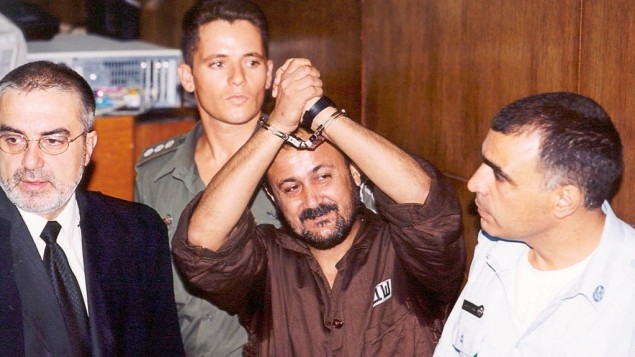
BarghouiMarwan Barghouti in court in 2002 (photo credit: Flash90)

At their White House meeting on Monday, US President Barack Obama emphasized to Palestinian Authority President Mahmoud Abbas the need to resume and extend talks with Israel, which broke down in November, rather than taking unilateral steps at the UN.

The good news is that Abbas didn’t reject the US president’s request out of hand. The not-so-good news is that Abbas said he would need to receive something from the Israelis if he were to agree: a settlement freeze, and a further prisoner release — beyond the fourth group of terror convicts scheduled to go free on March 29. And not just any prisoners, but, according to the London Arabic newspaper al-Hayat, ThePrisoner, Fatah Tanzim leader Marwan Barghouti. Arab and Palestinian sources confirmed the reports to The Times of Israel.

Is this a case of naiveté on Abbas’s part, or is it a clever ploy to prove that Israel is not ready to take a step that would foster more talks? It actually looks like neither, and more like a sort of gamble that could pay off for Abbas (if less probably for Israel).

Abbas knows that Barghouti’s release would allow him the breathing room to negotiate for many more months without fearing public criticism. Barghouti, the most popular leader in the territories today, could even sit by his side in the talks. That would be a major coup for Abbas in the eyes of the Palestinian public. Barghouti’s release would also strengthen Abbas’s support in Fatah.

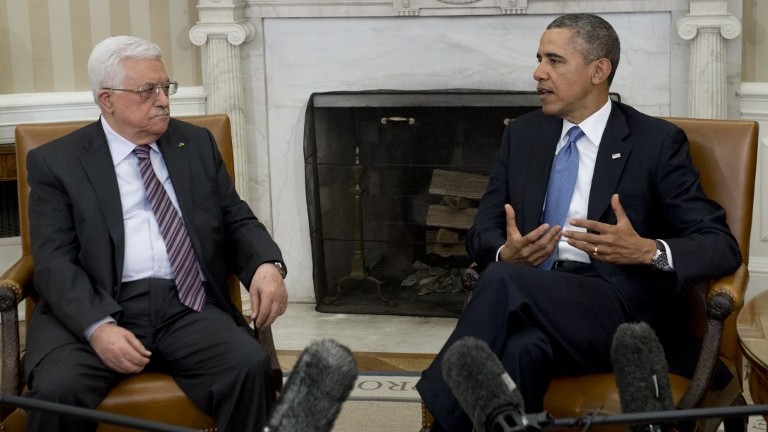
aa1Obama AbbasUS President Barack Obama, right, and Palestinian Authority President Mahmoud Abbas hold a meeting in the Oval Office of the White House in Washington, DC, Monday, March 17, 2014 (photo credit: Saul Loeb/AFP)

And perhaps most importantly for Abbas, he could finally appoint a successor — Barghouti. This would enable Abbas to keep his primary rival, Mohammad Dahlan, from taking the presidency. Abbas knows that Dahlan, sitting in the UAE, has no electoral chance against Barghouti, who enjoys endless praise for his role in the Second Intifada and his conviction on five murder charges.

Chief Palestinian negotiator Saeb Erekat called the White House meeting “long and difficult,” adding with relief that Obama did not present a framework agreement to Abbas. (This in contrast to Israel’s Channel 2 news Friday night, which quoted unnamed Israeli and American sources claiming Abbas rejected the framework plan, and gave “three no’s” on core issues of dispute.) Erekat, unlike Israeli Defense Minister Moshe Ya’alon, had the good sense not to insult the US leader or his own boss in his wrap-up of events.)

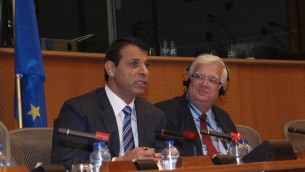
aDahlinMohammed Dahlan, left, speaks at the European Parliament, December 3, 2013 (photo credit: courtesy/Fernando Vaz das Neves)

The work now falls on US Secretary of State John Kerry, who will be forced, as usual, to mediate between the sides and manage the Middle Eastern ‘bazaar’ in future trips to the region — to ask the Israelis to give something that would see Abbas return to the talks.

Though Abbas sees Barghouti’s release as some kind of magic key, it is highly unlikely that anyone in Israel is willing to contemplate such a move, even as a means of keeping the talks going — which Prime Minister Benjamin Netanyahu wants. Even now, well before the sides have begun to talk about Barghouti, the scheduled fourth release of veteran security prisoners has run into problems.

The prisoners are supposed to go free in barely a week’s time. Most of them are not well-known to the Israeli public, and most are too old to represent any danger to Israel. Still, it won’t be easy for Netanyahu to release the group demanded by the PA, which includes 14 Israeli Arabs, without knowing first that Abbas will continue talks beyond their scheduled April cessation.

Abbas, for his part, is insisting that Israel must set free the final agreed group of prisoners whether or not talks continue, and refuses to condition their release on the political process.

Thus the sides are at another standstill, without anyone mentioning settlement freezes or the release of a man serving five life terms for murder.

Ya’alon strikes twice

March 22, 2014

Diplomacy: Ya’alon strikes twice | JPost | Israel News.

( “Rather than getting furious at Ya’alon for stating what for many is the obvious, the administration should consider that if this is what a senior leader of one of its greatest friends in the world is thinking – a friend that wants to see a powerful and respected US – then what is going through the minds of those who do not wish the US well?” – Superb article.  When the story first broke, I remarked on the importance placed on criticism from ISRAEL ! – JW )

By HERB KEINON

LAST UPDATED: 03/22/2014 14:07

US leaders regularly call Israeli policies into question, saying friends can talk honestly with each other. But when the tables are turned, all that openness and honesty is much less appreciated.

Defense Minister Moshe Ya'alon (R) looks into Syria on tour of Golan Heights

Defense Minister Moshe Ya’alon (R) looks into Syria on tour of Golan Heights Photo: Ariel Hermoni, Defense Ministry spokesman

Friends, Israel is told ad nauseam, often have to be brutally honest with one another.

US Secretary of State John Kerry often prefaces critical comments of Israeli policies in his speeches or interviews by stressing that he had a flawless voting record on Israel in the Senate for over 29 years, and shouted “Am Yisrael chai!” from Massada on his first visit here in 1986. Being a friend, he implies, means being able to be critical.

US President Barack Obama, in his keynote speech to Israel at the Jerusalem International Convention Center during his visit last year at this time, segued from the unabashedly positive part of his speech into the more critical by saying that not everyone in the hall was going to agree with what he had to say about peace.

“That’s part of the discourse between our two countries. I recognize that,” Obama said. “But I also believe it’s important to be open and honest, especially with your friends. I also believe that.”

Washington surely believes that when it comes to being open and honest with Israel.

Just take Obama’s recent interview with Bloomberg View’s Jeffrey Goldberg, the one that appeared one day before the president was to meet Prime Minister Binyamin Netanyahu in March in the Oval Office.

That interview included some very open and candid criticism of the current government’s policies, and an underlining theme that Netanyahu had so far failed to “seize the day.” Obama painted a bleak future indeed for Israel if its policies did not fundamentally change.

Kerry, over the last few months, has given speeches in which he predicted catastrophe – a third intifada, deepening international isolation and boycotts – if the elected government of the State of Israel continued down its current path.

That is all well and legitimate, part of what Obama referred to in Jerusalem as the importance of being “open and honest, especially with your friends.”

But how about the other way around? How about when that openness and honesty is not Washington criticizing Israeli policy, but rather Jerusalem passing judgment on Washington’s policies? Then, as was evident again this week with Defense Minister Moshe Ya’alon’s latest critique of American foreign policy, the US is far less forbearing.

For whatever the reason, the US cannot seem to tolerate words of criticism from Israel.

A debate can surely be held regarding the wisdom of what Ya’alon said in that closed meeting at Tel Aviv University on Monday, and whether a minister of his rank and stature should play the pundit’s role and critique American foreign policy. And one may wonder aloud about his judgment, especially coming so soon after the January debacle where, in a private conversation, he said Kerry was obsessed with the Israeli-Palestinian conflict, was motivated by a messianic complex, and should just “take his Nobel Prize and leave us alone.”

Ya’alon came under a barrage of criticism for that remark, and – as was the case this week as well – was forced to apologize.

Critics of his January comments slammed him for personalizing the censure. Even Foreign Minister Avigdor Liberman, who in the past has let slip some rather undiplomatic comments about various countries and world leaders, said at the time, “There is no call for personal attacks, even if there are, at times, disagreements.”

Valid point. But this time Ya’alon’s criticism was not personal at all. No mention of the Nobel Prize or the messiah. It was, rather, a general critique of US policies. It was also not stated in a high-profile public forum, but rather in a private discussion that was leaked.

And what did he say that was so egregious, that ignited the wrath of the administration to such a degree that it trotted out an official to say that “given the unprecedented commitment that this administration has made to Israel’s security, we are mystified why the defense minister seems intent on undermining the relationship?” On Iran, Ya’alon did not break any new ground, criticizing the US for letting the Iranians off the ropes with the current round of negotiations, and saying that Washington was being out-negotiated by the Iranians. His line about the Iranians being better negotiators in a Persian bazaar is one he has used often in the past.

Israel, Ya’alon said, has to approach the Iranian issue “as though we have nobody to look out for us but ourselves.” That is a variation of the oft-repeated line: “Israel has the right to defend itself by itself against any threat.”

Ya’alon’s criticism of the US policy on Iran, and his hint that Obama prefers to push this issue off to the next administration, is a critique often heard both an assertion that is particularly beyond the pale.

His criticism of an overall weakness in US foreign policy is also not breaking any revolutionary new ground. One would have to be blind not to recognize that America’s standing in the region, and in the world, is changing as a result of its reaction to the crisis over the last number of years, including the most recent one in Ukraine.

One would also have to be deaf to domestic US discussions not to realize that there is a potent strain of isolationism among the US public.

“If you sit and wait at home, the terrorism will come again,” Ya’alon warned, sounding a bit like an American official warning Israel what will happen to it if does not totally withdraw from the West Bank.

“Even if you hunker down, it will come,” he said. “This is a war of civilizations. If your image is feebleness, it doesn’t pay in the world. Nobody will replace the United States as global policeman. I hope the United States comes to its senses. If it doesn’t, it will challenge the world order, and the United States is the one that will suffer.”

Should the defense minister have said that he hopes America returns to its senses and charts a different policy? Maybe not.

But how many times have various administration officials said the same thing about Israeli policies? Where Ya’alon skated on thin ice was his comments about American military aid.

“The aid must be put in proportion,” he said. “It is not really an American favor, it’s an interest. It is not as if we only take, we also give not a little,” he added, saying that Israel gives the US “quality intelligence and technology.” Among the technological developments he ticked off were the Iron Dome, the wings of the F-35 stealth fighter, and the Arrow anti-ballistic missile – all Israeli inventions.

He said that with Israel, the US has an “aircraft carrier” in the Middle East which “begins in Metulla, and ends in Eilat.”

Netanyahu, wisely, picked up immediately on the problematic nature of those comments, and in a Knesset speech Wednesday stressed that the US remained Israel’s greatest ally, underlining Israel’s appreciation for the close “security and intelligence cooperation.”

Israel, as poll after poll shows, enjoys broad-based support from the American public, and it is that broad base of support which enables the US Congress to approve each year a $3 billion military aid package to Israel (74 percent of which, by the way, has to be spent in the US). If there was one glaring faux pas in Ya’alon’s comments, it was the appearance of not being sufficiently grateful for that aid.

True, the US reaps dividends from that investment, but it is a massive investment nonetheless. To minimize it is to risk alienating not only the people in Washington, but also in Topeka. And Israel needs those folks in Topeka to ensure that it can count on the votes in Washington.

This week’s incident demonstrated again the administration’s very thin skin when it comes to criticism from Israel. It seemed to go beyond mere annoyance at Ya’alon’s comment about the aid. The defense minister’s overall critique of the US policy seemed to step on a raw nerve.

He gave voice to a trend many in the world are noticing: Washington’s ability to bend the will of others to its desired goals is diminishing.

But rather than getting furious at Ya’alon for stating what for many is the obvious, the administration should consider that if this is what a senior leader of one of its greatest friends in the world is thinking – a friend that wants to see a powerful and respected US – then what is going through the minds of those who do not wish the US well.

The administration should also bear in mind that Ya’alon is not some flaky, obscure minister who is easily dismissed. According to a Channel 2 poll three weeks ago, taken on the one-year anniversary of the government being sworn in, Ya’alon is the most popular minister in the land. And that poll was taken after he called Kerry messianic and obsessive.

Squeezing yet another apology out of Ya’alon for hurt feelings risks ignoring his message – and that message, even if clumsily delivered, is not one that should be summarily dismissed, even if it is uncomfortable for some in Washington to hear.

Waltzing With Iran in the Nuclear Ballroom

March 22, 2014

Waltzing With Iran in the Nuclear Ballroom – Wall Street Journal.

There’s little sign of diplomatic progress, but the accommodations and service are splendid.

By
Claudia Rosett

March 20, 2014 7:37 p.m. ET
Vienna

Amid the splendors of this ancient city on the Danube, the Iran nuclear talks are waltzing toward a fiasco. Russia’s threat this week to change its position on the talks as payback for the West’s negative reaction to the invasion of Ukraine could hardly make things worse.

The stated aim of the U.S. and its partners is to arrive at a grand bargain ensuring that Iran will not obtain nuclear weapons. The reality is that four months have passed since the U.S. and its partners struck an interim deal with Iran in Geneva proposing to work out a “long-term comprehensive solution.” So far, under the negotiating mantra of “nothing is agreed until everything is agreed,” the parties appear to be talking mainly for the sake of talking. According to a senior U.S. official at the round of meetings that wrapped up on Wednesday, “We understand each other’s concerns.”

That might work in a marriage, but this is a nuclear negotiation with a murderous, messianic state. Meanwhile, Iran without dismantling its nuclear infrastructure is enjoying a visible easing of sanctions and a celebrity comeback on the world stage.

Iran’s Ambassador to the International Atomic Energy Agency, IAEA, Reza Najafi waits for the start of the IAEA board of governors meeting at the International Center in Vienna, Austria, Monday, March 3, 2014. Associated Press

In Vienna, the process has taken on a life of its own. And a comfortable life it is. The Austrian government, delighted to have swiped the nuclear talks from Geneva, is lavishing hospitality on all concerned. That includes the six world powers dubbed the P5+1—the U.S., Britain, France, China, Russia and Germany—led by European Union foreign-policy chief Catherine Ashton. Sharing the head table with Ms. Ashton at the main bargaining sessions, while publicly proclaiming Iran’s “inalienable right” to enrich uranium, is the star of this show, Iran’s chief nuclear negotiator and foreign minister, Mohammad Javad Zarif.

For the top negotiators, Austrian authorities have reserved one of Vienna’s most magnificent hotels, the Palais Coburg. It is an impeccably restored 19th-century palace, with a royal portico, glittering chandeliers, duplex suites, big Jacuzzis and a lobby built around portions of the historic city walls. Mr. Zarif may be an envoy of the world’s top terror-sponsoring state, but at the Vienna talks he is an honored guest; his hotel bill, along with Ms. Ashton’s, is paid by the Austrian government.

For most of the talking, the negotiators prefer to hunker down at the Coburg. When necessary, and for photo-ops, they shuttle across town to the United Nations complex that houses the International Atomic Energy Agency. The IAEA has the job of monitoring Iran’s compliance with its promise under the interim deal to ratchet back, for now, some elements of its nuclear program.

For reporters covering the talks, Austria is providing facilities in a huge convention center that adjoins the U.N. complex. The amenities include free cappuccino, cold drinks, hot meals and Austrian chocolates.

The staple largely missing from the venue is news. At the two major rounds of the Vienna talks to date, Mr. Zarif and Ms. Ashton have delivered what may be the shortest press conferences on record. Side by side, and flanked by the Iranian and EU flags, they have read brief prepared statements and then left without taking a question. Last month, they pronounced their talks “very productive.” This month, in a text that ran to all of five sentences, they described their talks as “substantive and useful.” The next round convenes in Vienna April 7-9.

Procedurally, all this counts as success. According to an EU spokesman, Ms. Ashton is “mandated to drive forward these negotiations” and “she is determined to do that.” Such determination is the classic mistake of diplomats who become so invested in bargaining that they’ll do anything to stay at the table—thus handing the advantage to the other side.

Take Russia, a member of the P5+1 team that Ms. Ashton’s office and U.S. officials say is “united.” This reflects the official urge to envelop Iran in a group hug, and so woo it to kindlier ways. But Russia has its own ideas about how to leverage this collective bargaining. Earlier this week, in response to Russia’s grab of Ukraine’s Crimea, the U.S. and EU imposed sanctions on several Russian officials. Russia’s delegate to the Iran talks, deputy foreign minister Sergei Ryabkov, is now treating the talks not as a P5+1 team venture but as a point of leverage, threatening that Russia might retaliate by taking a separate stance from the other P5 parties on the Iran talks.

Iran has its own priorities as well. Tehran is so pleased with the partial easing of sanctions that its officials have been soliciting business and nuclear talent, from Tokyo to Europe’s trade fairs. But for all the smiles at the talks, Iran is publicly stipulating that it won’t dismantle its nuclear infrastructure, won’t stop enriching uranium, won’t abandon building the plutonium factory that is its heavy-water reactor near Arak, and won’t stop developing ballistic missiles.

After the latest round ended, a senior U.S. official offered some procedural details on trying to haggle over or monitor the troubling facilities that Iran is refusing to give up. Speaking on background, the official described a process of identifying “gaps” in agreement among the negotiating parties, and working to “bridge those gaps”—a labor of such technical, political and diplomatic complexity that the official further compared it to “a Rubik’s cube—you move one part, you affect the next.”

Actually, it’s not that complex. The equipment that Iran wants to keep isn’t vital to an oil-rich and peaceful state. What Iran wants to keep are the elements of a nuclear arsenal. We’ve seen this game before, as U.S. diplomats navigated a maze of bridge-building maneuvers in nuclear talks with Iran’s close ally, North Korea. In the end, it comes down to one big gap: The unavoidable fact that the Iranians aren’t at the bargaining table to give up the bomb. They’ve come so they get a breather from sanctions while they finish building it.

Ms. Rosett is journalist-in-residence with the Foundation for Defense of Democracies, and heads its Investigative Reporting Project.

Hillary’s Dubious Iran Credentials

March 22, 2014

Hillary’s Dubious Iran Credentials – Commentary Magazine.

@tobincommentary
03.20.2014 – 7:25 PM

Last night Hillary Clinton spoke at a dinner for the American Jewish Congress and continued her effort attempt to craft a narrative in which her four years at the State Department are depicted as making her uniquely qualified for the presidency. The centerpiece of this argument is that during her time as America’s top diplomat she was a leader in the struggle to stop Iran’s nuclear program. This is a delicate task that demands both exaggerations and outright fibs, especially when it comes to her position on sanctions. It also requires her to both embrace President Obama’s foreign-policy record while at the same time position herself slightly to his right. But while her cheering section may be buying her sales pitch, a closer examination of what Clinton did on the issue undermines any notion that he she was anything but an enabler of an Obama policy of engagement that has led to the current diplomatic dead-end.

Clinton’s claim is that her toughness toward Iran and diplomatic skill helped create the international sanctions that brought the Islamist regime to the negotiating table. Though she expressed some skepticism about Iran’s willingness to listen to reason, the former first lady endorsed the interim nuclear deal signed by her successor and agreed with Obama’s opposition to the passage of any more sanctions even if they would not be put into effect until after the current talks fail. But it’s no small irony that Clinton would be bragging about her tough stand on Iran in the same week that the blowup with Russia led to the almost certain collapse of the diplomatic solution that she had banked on.

It was Clinton, after all, who was the primary champion of the comical “reset” with Russia that convinced Vladimir Putin that the Obama administration could be discounted in conflicts involving his ambition to reassemble the old Tsarist/Soviet empire. But even more importantly, the conceit of Clinton’s efforts to build the international coalition for Iran sanctions was that she would be able to harness Russia and China to American foreign-policy objectives. That assumption has been blown out of the water by the conflict over Crimea. Any idea that Russia would stick with the West to pressure Iran to give up its drive for a nuclear weapon or keep them isolated via sanctions is no longer realistic.


Of course, Clinton’s boasts about her record on Iran sanctions are also misleading. Though it is true, as Clinton said yesterday, that she “voted for any sanction on Iran that came down the pipe” when she was in the Senate, like many of her other stands on Israel-related issues, that changed once she became secretary of state. While the administration now claims that it is these tough sanctions that enabled them to make diplomacy work with Iran, it should be remembered that Clinton and her boss President Obama fiercely opposed these same sanctions when Congress was considering them.

As much as she may be trying to differentiate herself from the incumbent while trying not to sound disloyal, an honest look at Clinton’s term at Foggy Bottom is not flattering. On the two issues that count most today—Russia and Iran—she must bear a great deal of the responsibility for the current mess. Even more to the point, she was as much a champion of Iran engagement as anyone else in the administration, a point that she conveniently omits from her resume, especially when speaking to pro-Israel groups.

A lot can and probably will happen on foreign policy in the two years between now and the 2016 presidential campaign. But the likely Democratic nominee must understand that events may ultimately make her record on Iran and Russia look even worse then than it does today. On her watch, Iran moved closer to a nuclear weapon while Clinton earned frequent-flyer miles assembling a coalition in favor of weak sanctions dependent on her Russian reset partner for success. Though Democrats may not care much about her actual record, the facts about Iran and Russia hardly make for the sort of credentials that will enhance her chances of prevailing in a general election.

IDF Says It Found Largest Ever Gazan ‘Terror Tunnel’

March 22, 2014

IDF Says It Found Largest Ever Gazan ‘Terror Tunnel’ – The Washington Free Beacon.

BY:
March 21, 2014 10:23 am

This undated photo released by the Israel Defense Forces on Friday, March 21, 2014, that they claim shows a tunnel dug from the Hamas-ruled Gaza Strip that stretches hundreds of yards inside Israel / AP

This undated photo released by the Israel Defense Forces on Friday, March 21, 2014, that they claim shows a tunnel dug from the Hamas-ruled Gaza Strip that stretches hundreds of yards inside Israel / AP

The Israel Defense Forces said Friday that it uncovered a tunnel from Gaza to Israel meant for carrying out terror or kidnapping attacks, Times of Israel reports.

Hamas claimed the tunnel was old.

The tunnel reached civilian communities in Israel, according to IDF officials. It was also the largest yet discovered. IDF is still investigating the tunnel.

The army official said a generator and other tools had been found in the tunnel, attesting to the fact that work had been done on it recently.

Preempting the IDF announcement, Hamas Thursday night had said the IDF had found an “old” tunnel already blown up by the army that the terror group had begun to repair. At a press conference, the group’s Izz a-Din al-Qassam Brigades military wing said a winter storm had exposed the tunnel and not the IDF. […]

The army has accused Hamas of digging “terror tunnels” out of Gaza in the past, including three discovered in 2013.