Archive for March 20, 2014

Israel Under Siege as Nuke Talks Open

March 20, 2014

Israel Under Siege as Nuke Talks Open, Front Page Magazine, , March 20, 2014

(Lt. General Chesty Puller is thought to have said, while commanding U.S. Marines during the November, 1950 Chosin River campaign after the June, 25 1950 North Korean invasion of South Korea, “We’re surrounded. That simplifies our problem of getting to these people and killing them.” Unlike too many, he did not have the luxury of relishing a world of fantasy. Neither does Israel now.– DM)
APphoto_Mideast Israel Syria

Unlike the Western diplomats launching yet another round of talks in Vienna this week with a brutal regime, Israel does not have the luxury of living in a fantasy world. Jerusalem is well aware that Iran is capable of accurately taking the measure of a weak, bumbling U.S. president and his allies and feels emboldened.

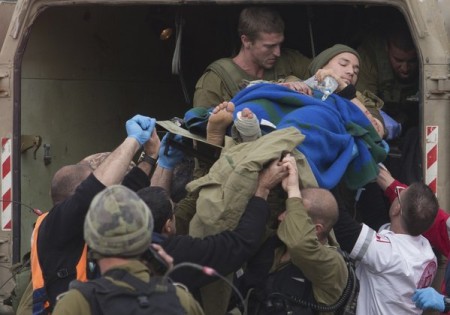
On Tuesday an explosive device that was planted along the Israeli-Syrian border wounded four Israeli soldiers, one of them seriously. Early Wednesday morning Israeli planes struck back—notably, not against Hizballah but against Syrian military targets, killing one Syrian soldier and wounding seven.

Israeli prime minister Binyamin Netanyahu said the Syrian targets that were hit “not only enabled the attack on our troops, they cooperated with it. Our policy is very clear—we strike at those who strike at us.”

A former chief of military intelligence said:

The execution of [Tuesday’s] attack was professional. There is no doubt that the Syrians knew about it—they may even have carried it out for Hizballah. Something like this, if it proves true, is a game changer….

It’s a game changer because, while there has been a string of attacks along the Syrian and Lebanese borders involving Hizballah and global-jihad elements, and while Syria has long been part of the Iran-Syria-Hizballah axis, Israel’s operative assumption has been that Syria’s Assad regime has its hands full with the country’s civil war and no desire to open another front with Israel.

Although Tuesday’s attack was probably carried out on the ground by Hizballah operatives, direct Syrian facilitation appears to be a new development and part of a threatening trend.

The incident comes—ironically—against the backdrop of the opening of yet another round of nuclear talks with Iran.

That Israel takes a dim view of the talks was made explicit this week by Defense Minister Moshe Yaalon, who said that “the U.S. at a certain stage began negotiating with them, and unfortunately in the Persian bazaar the Iranians were better. [Therefore] we [Israelis] have to look out for ourselves.”

White House officials reportedly reacted with shock and outrage. Yaalon had already taken an enfant terrible posture by dismissing the U.S.-orchestrated Israeli-Palestinian negotiations as pointless and even calling Secretary of State John Kerry’s role in them “messianic” and “obsessive,” a choice of words for which Yaalon later apologized.

But if Washington was upset by Yaalon’s latest words on Iran, it could hardly take comfort from a report in Haaretz on Wednesday that Netanyahu and Yaalon had ordered the Israeli army to prepare for a possible strike on Iran’s nuclear facilities in 2014.

Given that Yaalon, as strategic affairs minister in Netanyahu’s previous government, opposed a strike on Iran but now publicly acknowledges that he has changed his mind, and that the third member of Israel’s top political-security echelon, Foreign Minister Avigdor Lieberman, is a known Iran hawk, the report carries plausibility.

It also carries plausibility because of a recent, marked escalation against Israel by Iran’s proxies. On March 5, the Israeli navy intercepted an Iranian arms ship carrying Syrian-manufactured rockets to the Iranian-sponsored Islamic Jihad terror group in Gaza. On March 12 Islamic Jihad fired dozens of rockets at Israel from Gaza. And incidents along the northern border reached a new peak on Tuesday with apparent direct Syrian involvement.

Unlike the Western diplomats launching yet another round of talks in Vienna this week with a brutal regime, Israel does not have the luxury of living in a fantasy world. Jerusalem is well aware that Iran is capable of accurately taking the measure of a weak, bumbling U.S. president and his allies and feels emboldened.

Jerusalem is also well aware that if Iran had the bomb, the current difficult situation of attacks by Iran’s proxies and allies would turn into a nightmare. Yaalon’s words may be grating, but Israelis are getting subjected to even less pleasant sounds.
Obama and Peres Polish Up their Persian for Iran’s New Year

March 20, 2014

Obama and Peres Polish Up their Persian for Iran’s New Year, Jewish Press, March 20, 2014

(Oh well. — DM)

How do you say “annihilate Israel with a nuclear bomb” in Persian?

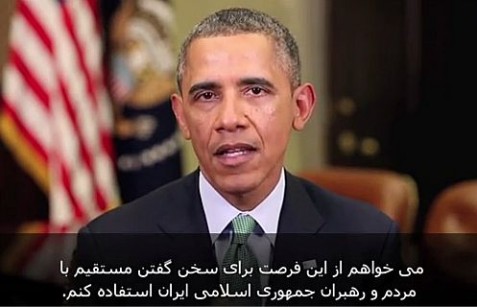
Obama-persian-477x307Obama soft-pedals Iranians with a greeting for the new Persian new year. Photo Credit: Screenshot

President Shimon Peres and President Barack Obama delivered their annual greetings to Iranians celebrating the new Persian year and played up prospects of peace.

Peres showed off his language skills – actually those of his speech writers – by starting with, “Iraniane Gerami, Novruzetan Piruz Bad,” which can be translated as “Iranian citizens, wherever you are, Happy Nowruz.”

Obama began his video greetings with “Dorood,” or “to praise.” It is said by Muslims every time they hear the name of the Islamic prophet Mohammed.”

Presidents love impressing foreign people with greetings such as “Shalom,” which they don’t understand not only mneans “Peace” and “Hello” but also means “goodbye,” but unfortunately without the connotation of “good riddance.”

“The Jewish people and the Persian people, the Iranian people have a very long history and we’re going to have a long future,” said Peres, implying optimism that Iran will not succeed to wipe Israel off the face of the earth.

“We are old cultures, we learn history, we make history and we respect history,” he said.” We have a heritage of values; we are not just business peoples but two nations that respect culture, that respect human dignity. We call to live in peace and understanding.”

That is why brining Israeli flags is such a popular sport in Iran.

On the other side of the ocean, President Obama said, “Since taking office, I’ve offered the Iranian government an opportunity –if it meets its international obligations, then there could be a new relationship between our two countries, and Iran could begin to return to its rightful place among the community of nations.”

The odd thing is that that he already has given Iran a spot closer to center stage in the international community although it has not met its “international obligations,” but there is nothing like trust to usher in the new year.

“Last fall, I spoke with President Rouhani,” Obama continued, “It was the first conversation between an American president and an Iranian leader since 1979. I conveyed to President Rouhani my deep respect for the Iranian people, just as he expressed his respect for the American people….

“Since then, we’ve made progress. For years, the international community has had concerns that Iran’s nuclear program could lead to Iran acquiring a nuclear weapon, which would be a threat to the region and to the world. Under the initial agreement we reached in November, the Iranian government has agreed to limit key parts of its nuclear program. Along with our international partners, the United States is giving Iran some relief from sanctions.” Iran has “agreed” but has not carried out the agreement, but trust the president, because he said, “As I’ve said before, I’m under no illusions…. If Iran meets its international obligations, we know where the path of dialogue and greater trust and cooperation can lead…

“Real diplomatic progress this year can help open up new possibilities and prosperity for the Iranian people for years to come.

And what happens is Iran does not meet its international obligations? Obama undoubtedly will be back next year with the same speech.

If you want to hear all four minutes and 47 seconds of it, here it is.

Off Topic: U.S.-Egyptian Relations on the Brink?

March 20, 2014

Off Topic: U.S.-Egyptian Relations on the Brink? – The National Interest.

Chuck Freilich | March 19, 2014

Forty years ago deft American diplomacy, along with the foresight of Egypt’s then president Anwar Sadat, led to a dramatic reorientation in Egypt’s foreign policy, from the leading member of the pro-Soviet camp in the Middle East, to a major American ally. The result was the emergence of a moderate and stable pro-American Arab camp, close cooperation with these countries in containing and deterring regional radicals such as Iraq, Libya and Iran, and peace between Israel and Egypt—and later Jordan, too.

Today, American-Egyptian relations are in tatters, the result of Egypt’s domestic convulsions and an American response which may be driving it back into the hands of Russia, with which it recently signed, or at least initialed, a Saudi-financed multibillion-dollar arms deal. Signs of an Egyptian-Russian rapprochement have been brewing for months, with reciprocal visits of top diplomatic and military officials, including by putative Egyptian President Sisi in Moscow, and a possible visit by President Putin to Cairo. The purported arms deal includes advanced fighter aircraft, air-defense systems, missiles, joint military training, counterterrorism cooperation and Russian naval port calls in Egypt.

If finalized, it would be Egypt’s first arms deal with Russia since the early 1970s and a potentially dramatic reversal in Cairo’s foreign-policy orientation, with major ramifications for regional stability and peace. It would also be an intentional Egyptian-Saudi slap in America’s face. It may also be a cry for greater American attention and consideration. In either event, it is a deal which Egypt feels it is being forced into by American policy and presumably one that it would be willing to reverse, were the US to show greater openness to the new military regime’s needs.

Since President Mubarak’s ousting in 2011, well-meaning American policy has succeeded in alienating virtually all segments of Egyptian society. Some believe that the US was too hasty in abandoning Mubarak, its longtime ally, and that its embrace of the successor Muslim Brotherhood government was deeply misguided. Although democratically elected, the Brotherhood is anything but a force for democracy. Indeed, it is a radical theocratic organization, rabidly anti-American and anti-Semitic, which failed grossly in its short year in power. Consequently, the vast majority of Egypt’s population, including the liberals, overwhelmingly supported the coup that overthrew the Brotherhood last summer and continue to support the military’s efforts to stabilize the country, prevent a total economic meltdown and gradually restore at least limited civilian government.

Recognizing the complexities, the administration has repeatedly equivocated. It refused to recognize the coup as such to avoid triggering legislation which would have forced a complete cessation of economic and military aid to Egypt and led to a rupture in relations. Bending to Congressional pressure and its own values, it subsequently announced a partial cut in military aid, including such high-visibility items as F-16s. Since then it has sent further mixed signals, criticizing the harsh measures adopted by the new regime, along with its desire to end the bilateral crisis and renew military assistance. The result has been the worst of all worlds, with the Egyptian public even further alienated and the new military regime furious and flirting with Moscow.

Relations with authoritarian regimes have long posed a deep dilemma for American policy, between US strategic interests and the exigencies of realpolitik—the need to deal with the world as it is, not as we want it to be—and America’s democratic ideals. In the pursuit of the former, the US has long supported numerous heinous regimes, none more so than the Saudi oil theocracy, or South Korea and South Vietnam in the 1960s and 1970s. Conversely, it has rarely failed to support democracies, or countries undergoing democratic transitions.

Unfortunately, Egypt was not undergoing a “transition to democracy” under the Muslim Brotherhood, as touted by so much of the American media and many political leaders. Free elections are only one component of democracy, along with a separation of powers, respect for the rule of law and more. The sad truth is that Egypt probably does not have, and likely will not have for decades to come, the prerequisites for becoming a stable democracy.

In all likelihood, the next Egyptian government, following the upcoming elections, will be one in which the military remains the primary locus of power and final arbiter of all policy, but in which it will allow the civilian government some latitude for day-to-day governance. In effect, it will be a somewhat liberalized version of the military dictatorship that has long ruled Egypt, or something like the semi-democratic Turkish model of the 1990s, in which the military had the final word.

The United States should encourage the new government to gradually allow greater political freedoms, primarily for liberal forces in Egyptian society and moderate religious ones, while recognizing that the Muslim Brotherhood and other Islamist extremists are fundamentally antidemocratic forces that should be suppressed. Democratization in Egypt will be a long-term process, if it succeeds at all. Over time, as moderate and responsible political parties emerge, they and the parliament should be given a greater role. It is a difficult balancing act and requires that we compromise on deeply held values. This is the reality the US will have to deal with.

US influence in the region is at a decades long nadir, with Russia increasingly appearing to be on the winning side, whether in Syria, Iran and now possibly Egypt, not to mention events in Crimea. The prospects for a successful resolution of the Iranian nuclear issue, Syrian civil war and Israeli-Palestinian talks, are mixed at best. Lebanon, Iraq, Yemen, Libya, Jordan and other Arab countries all face severe domestic crises, and their future stability is at risk. Saudi Arabia is in the midst of a deep succession crisis, and the directions of change in Iran are similarly unclear. In these circumstances, the US must prioritize its strategic objectives in Egypt, which are for a strong ongoing bilateral relationship, in which Egypt remains a moderate ally, a force for regional stability, at peace with Israel.

To this end, it is time to end the standoff with Egypt, cooperate with the new military regime along the lines suggested above, and prevent both a possible renewal of military ties between Egypt and Russia and change in Egypt’s strategic orientation.

Chuck Freilich, a former deputy national-security advisor in Israel, is a senior fellow at Harvard’s Kennedy School and the author of Zion’s Dilemmas: How Israel Makes National Security Policy.

Iran Spending Medical Funds on Luxury Cars

March 20, 2014

Iran Spending Medical Funds on Luxury Cars – The Washington Free Beacon.

(There goes the myth of people dying because of those evil sanctions. – Artaxes)

NIAC ‘propaganda’ collapses under facts

An Iranian pharmacist/AP

An Iranian pharmacist/AP

BY:
March 20, 2014 9:56 am

The Iranian parliament’s recent investigation into a scheme to import luxury cars instead of medicine threatens to erode the credibility of a leading pro-Iran lobbying group that has long claimed that economic sanctions are preventing access to medicine in Iran.

An investigation by Iranian lawmakers recently revealed that nearly $2 billion that had been allocated to the importation of medicine into Iran was actually spent on the purchase of luxury cars, according to Farsi and English reports.

While it had long been suspected that the Iranian government was squandering funds for medicine, pro-Tehran advocacy groups like the National Iranian American Council (NIAC) used the medicine shortage as a hook to claim that sanctions were causing the shortage.

NIAC, which has long been suspected of lobbying on behalf of Iran, continues to make the claim and has been raising money off the issue, prompting criticism from those who say the group’s “propaganda machine” is disingenuously misleading lawmakers and the media.

NIAC’s repeated claims that U.S. sanctions led to the medicine shortage have been widely picked up and repeated by the Western media, which has done little to verify these claims.

NIAC even brought up the issue during a 2012 meeting at the White House with Obama administration officials.

NIAC’s campaign also has gained traction on Capitol Hill, where Rep. Jim Moran (D., Va.) authored a letter on the issue that was then used in one of the group’s action alerts stations, “Don’t let sanctions block medicine for Iranians.”

NIAC has also sent its representative to congressional events in order to pester lawmakers about the issue. During one such confrontation last year, Rep. Ed Royce (R., Calif.) chastised a NIAC official for pushing factually inaccurate “propaganda” about the medicine shortage.

This has not deterred NIAC, which has gone on to launch the “Iranian medical access project” to push the narrative that the United States is to blame for the medicine crisis.

“Why are U.S. sanctions blocking medicine for Iranians and how can we fix this?” NIAC asked in another one of its policy briefs.

The group’s continued dissemination of this narrative led to articles in CNN, the Washington Post, and several other media outlets that repeated NIAC’s talking points.

News of the luxury car scheme throws into question the factual accuracy of NIAC’s years-long campaign.

“NIAC has manufactured excuse after excuse for weakening sanctions and helping the mullahs,” said one senior official at D.C.-based pro-Israel organization. “Their talking points have been exposed as fabrications again and again. It’s no wonder that many people, including sitting members of Congress, accuse them of spreading regime propaganda.”

“The real mystery is why the White House and its allies insist on taking meetings with them,” the source said.

Other recent reports have indicated that Iranian pharmaceutical companies owned by the Iranian regime have manufactured the medicine shortage in order to drive up prices.

Profits to many of these companies soared despite economic sanctions and money is believed to have flowed directly to Iranian Supreme Leader Ali Khamenei.

As average Iranians struggle to obtain key medications, Iran’s ruling class has enjoyed relatively unfettered access to top-notch healthcare, a fact that has not been raised in NIAC’s talking points.

When rumors of the medicine scam first emerged in 2012, then-president Mahmoud Ahmadinejad sacked the country’s health minister in order to keep her silent.

It is also believed that another $20 billion was diverted from Iran’s health sector to a housing project. The diversion of these funds reportedly sparked a shortage of nurses and sick beds for ICU patients.

U.S. Treasury Department officials have repeatedly confirmed that Iran’s healthcare crisis has nothing to do with economic sanctions.

“It has been the longstanding policy of the United States not to target Iranian imports of humanitarian items, such as food, medicine and medical devices,” a Treasury official was quoted as saying by Reuters. “If there is in fact a shortage of some medicines in Iran, it is due to choices made by the Iranian government, not the U.S. government.”

However, the Iranian government and its advocates in the United States have used the crisis to divert attention away from Iran’s massively corrupt political system.

Obama to Iranians: ‘We have the opportunity to start down a new path’

March 20, 2014

Obama to Iranians: ‘We have the opportunity to start down a new path’ – CNN.

(YESS, we can! And don’t forget your famous reset button that worked like a charm with Putin.
Hach, it’s all hope and change all over again. I feel a thrill. What wonderful exciting times so full of hope  and optimism.
What? You’ve got already a Nobel Peace Prize? How about the Nobel Piss Prize?  – Artaxes
)

By Greg Botelho, CNN
March 20, 2014 — Updated 1708 GMT (0108 HKT)


(CNN) — In a message to the Iranian people, an upbeat President Barack Obama said Thursday that the long isolated Middle East nation can soon improve its economy, its world standing and its people’s lives if there’s a breakthrough nuclear deal.”For the first time in many years, we have the opportunity to start down a new path,” Obama said in a message timed for Nowruz, the Persian new year.

A lot has changed since the last Nowruz.

For one, Iranians elected Hassan Rouhani — who campaigned, in part, on opening up Iran more to the world including negotiations on its nuclear program — as president last summer.

Significant changes in Tehran’s approach followed, leading to an interim agreement in November involving Iran and the so-called P5+1 — the United States, China, Russia, Britain, France and Germany. The deal called for Iran to roll back parts of its nuclear program in return for relief from some sanctions. That agreement went into effect in January.

The challenge now is to reach a permanent deal acceptable to all sides.

Obama said Thursday that “a comprehensive agreement … this year can help open up new possibilities and prosperity for the Iranian people for years to come.” That includes more open trade, more jobs and “more opportunities for Iranian students,” according to the President.

Noting the progress that has been made, Obama stressed that “this will be difficult.” At the same time, he insisted the United States is ready to talk.

“I’m committed to diplomacy,” the President said, “because I believe there is the basis for a practical solution.”


Off Topic: Abbas pledges to promote Palestinian rights in talks with Israel

March 20, 2014

Abbas pledges to promote Palestinian rights in talks with Israel, Xinhua Net, March 20, 2014

(Failure in the peace talks would damage whatever remains of President Obama’s foreign policy legacy. However, an Obama success would be far worse for Israel than any damage to his legacy resulting from failure.– DM)

“Obama focused on extending the talks instead of focusing on the U.S. framework peace agreement,” said the official, adding “it was obvious that Obama was concerned about avoiding any American failure in the peace talks.”

RAMALLAH, March 20 (Xinhua) — Palestinian President Mahmoud Abbas said on Thursday that he will advocate Palestinian rights during negotiations with Israel, as the United States urges Palestinians to extend the peace talks.

“I will not give away the Palestinian rights,” Abbas told hundreds of loyalists at his office upon his arrival in Ramallah after a four-day visit to Washington to discuss the Israeli- Palestinian peace negotiations with President Barack Obama.

Earlier, a Palestinian official source told Xinhua that the discussions between Abbas and Obama were difficult and not decisive, adding no agreement has been reached on the American framework for the peace deal or on extending the peace talks with Israel.

“Obama focused on extending the talks instead of focusing on the U.S. framework peace agreement,” said the official, adding “it was obvious that Obama was concerned about avoiding any American failure in the peace talks.”

The official, who spoke on condition of anonymity, said that Abbas asked Obama to press Israel to release prisoners its jails and freeze settlement activities in order to extend the current peace talks, demands that many Palestinians consider essential for finding peace.

Direct peace talks between Israel and the Palestinians resumed last July and are set to end in April, but both Israeli and Palestinian officials have said no tangible progress has been made during negotiations.

Since the resumption of the peace negotiations, the U.S. has been leading mediation efforts to get the Palestinians and the Israelis to agree on a framework plan for peace.

The U.S. peace plan tackles final status issues including the borders of the future Palestinian state, Palestinian refugees, security and the contested status of Jerusalem, claimed by both as their capital.

Off Topic: Warning lights

March 20, 2014

Warning lights, Israel Hayom, Dr. Haim Shine, March 20, 2014

There can never be peace with a society whose national heroes are murderers. The welcome the killers received in Ramallah expresses the Palestinian essence, not the hugs and smiles at the White House.

The echoes of the beginning of the universe picked up recently by the equipment of leading astrophysicists prove that Einstein was right. God doesn’t roll dice, and leaders are not supposed to release doves (an ancient method of gambling.)

Unfortunately, there is a small group of people in Israel today, some of whom hold senior public positions, who know what will happen 50 or 100 years from now but haven’t the slightest clue what will happen tomorrow or next week. In a weird spring ritual, they are trying tirelessly to revive the dove of peace that was slaughtered in Oslo.

Those who are declaring to Israelis and to the world that Palestinian Authority President Mahmoud Abbas is a loyal partner in peace are the ones who put Yasser Arafat on a pedestal and celebrated a brave peace. They were prepared to give up the Golan Heights, and today they explain that there is no need for Israel to control the Jordan Valley. As far as they are concerned, Jerusalem can once again be divided and a partial right of return for Palestinians implemented.

But Israeli society is lucky — those same dreamers have been distanced from decision-making; they were woken up and paid a heavy price. You have been warned about illusions. There will never be peace with the Palestinian Arabs under Abbas’ leadership if their precondition for negotiations is the release of cold-blooded killers of women and children. There can never be peace with a society whose national heroes are murderers. The welcome the killers received in Ramallah expresses the Palestinian essence, not the hugs and smiles at the White House. We can only hope that Israel will not agree to stop construction in the settlements and release more imprisoned terrorists.

Any Arab leader who wants peace must come with hands that are clean, not blood-stained. A dangerous threat is growing around Israel’s borders. Branches of Islamist terror are becoming entrenched next to Israel’s cities and villages. The serious incident on the northern Golan Heights is a hint of what is to come. There is no central government in Lebanon, so Hezbollah allows itself to do what it wants. Syria is falling apart and bleeding and Assad is trying to shift attention by inciting against the Zionist enemy, Egypt is investing resources in fighting al-Qaida in Sinai and it will take years before its Muslim Brotherhood and its allies are checked. Thousands of rockets bought by the Gazans’ poverty and want are stored in the Gaza Strip.

The changes taking place on the country’s borders demand that Israel keep every strategic asset it has. Any concession of even an inch of the land of Israel is a security risk these days, beyond the Jews’ right to the land. The Israeli leadership must stand firm in face of the U.S. and European nations. U.S. President Barack Obama must realize that Israel is not a weak link that he can use to score international public relations points.

The world must know that casting aspersions on the prime minister and defense minister’s intentions to make peace will not hurt the strong spirit of the people of Israel. Rather than trying to attack the defense minister, spokespeople in America and the rest of the world had better start looking for the black hole into which their own security disappeared.

Another round, another deception

March 20, 2014

Another round, another deception, Israel Hayom, Emily Landau, March 20, 2014

(The only English language text of the P5+1 November 24th “deal” of which I am aware has enough “linguistic engineering” to make any con artist jealous. — DM)

A diplomat closely involved with the [P5+1] process was quoted as saying “linguistic engineering” was needed to hide modifications enabling the West’s reduction of proliferation problems. Linguistic engineering? Beware — it can boomerang.

As the world remains riveted by the crisis in Crimea, gleaning information about the second round of talks between Iran and the P5+1 over a comprehensive nuclear agreement has never been harder. Any reports there were focused mostly on the question of whether the Crimean crisis would affect Russia’s position in the P5+1. There was little reporting on the actual content of the talks, other than the fact that two issues were central to the discussion: the level of uranium enrichment in Iran, and the facility in Arak, which, if it keeps functioning at its current rate, could produce enough plutonium for Iran to have a nuclear weapon.

Despite the slight interest, the issues up for discussion, which must be answered within the framework of a comprehensive deal, are very serious indeed, and the gaps between both sides are still huge. Despite the U.S. government’s narrative, according to which Iran has upheld the conditions of its interim deal, halting its progress and even reversing the program, the reality is much more complex.

Iran has actually made sure that the interim deal does not affect the viability of its nuclear-weapons “threshold” capability. It concocted the “20 percent enrichment” notion as a bargaining chip. When it successfully maneuvered the international community into agreeing that the interim deal should not prohibit the research and development of new and advanced centrifuges, Iran realized it had nothing to worry about.

Iran has maintained huge stockpiles of 5% enriched uranium, and when it finally decides to enrich that uranium enough for a nuclear weapon, the advanced centrifuges will allow it to do so expeditiously. In other words, when it becomes equipped with centrifuges spinning at speeds much higher than those it currently has, the issue of 20% enrichment will lose all its significance.

What allowed Iran to manipulate the international community over its advanced centrifuges was the ambiguous wording of the interim agreement, which allowed the parties to reach an agreement from the outset without actually having to reach consensus. Iran exploited the ambiguity to contrive a comfortable interpretation for itself. One of the reports covering the current talks raises fears that officials representing the P5+1 have exposed themselves yet again to the same trap, this time involving the facility at Arak.

One of the ways to neutralize the potential dangers inherent in the operation of the Arak reactor is changing the facility’s technical specification. Of course, Iran will probably oppose the idea. A diplomat closely involved with the process was quoted as saying “linguistic engineering” was needed to hide modifications enabling the West’s reduction of proliferation problems. Linguistic engineering? Beware — it can boomerang.

One of the most unsettled observers of these talks is the U.S. Congress. A toughly worded letter signed by 83 senators was sent to U.S. President Barack Obama this week. The U.S. lawmakers said an unambiguous message must be sent to Iran warning of new sanctions if talks falter and Iran’s military program persists — rather “dramatic.”

Despite previous White House attempts to paint U.S. lawmakers supportive of ramped-up pressure on Iran as “warmongers,” these lawmakers’ true intention is simply to bolster the international community’s ability to effectively negotiate with Iran. The Obama administration should pay heed.

Ya’alon apologizes for remarks disparaging the US, again

March 20, 2014

Ya’alon apologizes for remarks disparaging the US, again | The Times of Israel.

In a phone call with his American counterpart, defense minister says he had no intent to harm Israel-US relations

March 20, 2014, 12:14 am
Defense Minister Moshe Ya'alon, left, points during a helicopter tour of the Golan Heights with US Defense Secretary Chuck Hagel, April 2013 (photo credit: Ariel Hermoni/Ministry of Defense/Flash90)

Defense Minister Moshe Ya’alon, left, points during a helicopter tour of the Golan Heights with US Defense Secretary Chuck Hagel, April 2013 (photo credit: Ariel Hermoni/Ministry of Defense/Flash90)

Two days after sparking a dispute between Israel and the US by disparaging Washington, Israeli Defense Minister Moshe Ya’alon walked back his statement in a phone call with his American counterpart late Wednesday night.

Ya’alon told Chuck Hagel he had no intention of harming the US or ties with it, according to a Hebrew-language statement released by his office. The apology was Ya’alon’s second in two months for remarks disparaging the Obama administration.

“In my statements, there was no antagonism or criticism or intent to harm the United States or [Israel’s] relations with it,” he said. “The strategic relationship between the two countries as well as the personal relationship and mutual interests are of utmost importance. I value the relationship at all levels, between Israel and the United States in general and the security establishment in particular.”

Ya’alon on Monday had accused the Obama administration of being weak on Iran and questioned its commitment to Israel’s security, saying Israel would have to act alone to thwart Tehran’s nuclear drive.

The statements, delivered in a closed event at a university but promptly leaked, provoked a harsh response from the US, with Secretary of State John Kerry calling Prime Minister Benjamin Netanyahu earlier Wednesday in protest.

“It is certainly confusing to us why Defense Minister Ya’alon would continue his pattern of making comments that don’t accurately represent the scope of our close partnership on a range of security issues and on the enduring partnership between the United States and Israel,” State Department Spokesperson Jen Psaki told reporters.

According to the issued statement, Ya’alon told Hagel, “I have a very deep appreciation for the relationship between [Israel and the US] and for you personally. I greatly admired these relations even as Chief of Staff and I appreciate them to this day as defense minister, and I am aware of their full depth and significance. I have a total commitment to these relations and to [advancing] the cooperation between Israel and the United States in every way.”

Hagel was said to have been empathetic in talking to Ya’alon, and suggested that some of his remarks might have been taken out of context, Israel’s Channel 2 news reported late Wednesday.

Two months ago, Ya’alon was also forced to issue an apology to Kerry over private comments in which the minister blasted the top American diplomat, among other critiques, for his “inexplicably obsessive” and “messianic” efforts to produce an agreement between Israel and the Palestinians.

Israel said to be budgeting billions for Iran strike

March 20, 2014

Israel said to be budgeting billions for Iran strike | The Times of Israel.

Military chiefs reportedly say they were given top-level orders to keep prepared for action despite nuclear talks


March 20, 2014, 1:49 pm


An Israeli fighter jet takes off during a training sortie in February 2010. (photo credit: Ofer Zidon/Flash90)

An Israeli fighter jet takes off during a training sortie in February 2010. (photo credit: Ofer Zidon/Flash90)

Israel is still preparing for a strike on Iran’s nuclear facilities, including a specific military budget running to NIS 10 billion ($2.89 billion), despite the developments in talks between world powers and Tehran.

Details of the budgeting came to light during Knesset joint committee sessions on IDF plans that were held in January, Haaretz reported on Thursday.

Three MKs, who were present during the hearings but asked to remain anonymous, said that the funding was to cover preparations throughout 2014 and was similar in size to the Iran strike budget for 2013, the report said.

According to the report, some of the legislators present at the sessions grilled Deputy Chief of Staff Maj. Gen. Gadi Eizenkot, and Brig. Gen. Agai Yehezkel of the IDF’s Planning Directorate, about the necessity of a strike plan despite talks between world powers and Iran. Those talks led to an initial agreement in November 2013 for Tehran to scale back its nuclear program, and are still ongoing.

The IDF officials responded that they had received instructions from the highest levels of government, apparently Prime Minister Benjamin Netanyahu and Defense Minister Moshe Ya’alon, to continue with preparations for a strike, the report said.

Haaraetz noted that both the Prime Minister’s Office and the IDF’s Spokesperson declined to comment on the report.

Last week Ya’alon hinted at a change in his stance from opposing to supporting solo action by Israel on Iran’s nuclear program.

“The one who should lead the campaign against Iran is the US,” he said, but instead, “the US at a certain stage began negotiating with them, and unfortunately in the Persian bazaar the Iranians were better,” he said. Therefore, “we (Israelis) have to look out for ourselves.”

Two days of talks between world powers and Iran came to an end on Wednesday with what EU foreign policy chief Catherine Ashton described as “substantive and useful discussions covering a set of issues including (uranium) enrichment, the Arak reactor, civil nuclear cooperation and sanctions.” The parties agreed to reconvene April 7-9.

However, Russia has warned that tensions with the US over the Crimea crisis could lead to it altering its position regarding Iran to erode the unified front that Western countries have presented against Tehran. The US and Europe have been strongly critical of Russian actions to annex Crimea following a revolution in Ukraine last month.


