Archive for March 15, 2014

Iran’s Ramped-Up Cold War With Israel Is a Sign of Tehran’s Weakness, Not Strength

March 15, 2014

Iran’s Ramped-Up Cold War With Israel Is a Sign of Tehran’s Weakness, Not Strength – Tablet Magazine.

As the war in Syria deepens sectarian splits among Muslims, Iran’s choice to send rockets to Gaza is a sign the emperor has no clothes

By Josh Nason|March 14, 2014 12:00 AM

Forty rockets, 181 mortar shells, and approximately 400,000 7.62-calibre rounds are put on display by the Israeli military on March 10, 2014. The ammunition was found on a vessel allegedly transporting arms from Iran to Gaza and was seized on March 5, 2014. (JACK GUEZ/AFP/Getty Images)

This week, when Israeli Prime Minister Benjamin Netanyahu inspected a cache of Iranian arms seized earlier this month from a Gaza-bound ship, he told the TV cameras accompanying him that the array of rockets represented “the true face of Iran.” In a way, he was right: Tehran is months into negotiations over limiting the scope of its nuclear program in exchange for relaxing international sanctions but still decided to risk sending a shipment of advanced weaponry to terrorists in Israel’s backyard.

But the cargo wasn’t evidence of Tehran’s incorruptible commitment to destroying the Jewish state. Rather, it was a window into the dynamics of intra-Muslim politics—and a sign that Iran is actually a weakened power desperately trying to hold on to regional influence among its Muslim neighbors and allies. It is telling that both the rockets on the ship, as well as the rockets fired into Israel over the past few days, are being tied not to Hamas, a fair-weather ally of Tehran and the undisputed power in Gaza, but rather to the much smaller Palestinian Islamic Jihad.

A look across the region today suggests that Iran’s primary friends are essentially the same small group of proxies and allies it had a quarter-century ago: Palestinian Islamic Jihad, Hezbollah, and the Assad regime in Syria. That is a problem for Iran, which invested years in the aftermath of the Cold War trying to expand its authority as a Muslim power and establish itself as a credible opponent of the United States.

As recently as the 2008 Gaza War Iran could claim real pull among Sunni leaders. But now, as the brutal civil war in Syria has inflamed sectarian rivalries in the region, Iran finds itself relegated to enemy status in the growing ranks of Sunni extremists and increasingly toxic to the Gulf monarchs and others trying to maintain their hold on power in the wake of the Arab Spring.

The demonstrated commitment of the Obama Administration, and the rest of the P5+1, to negotiating with Iran on its nuclear program makes it look like a global player, but Tehran knows it needs to win points on the Arab street—and so it has fallen back on the one time-tested, foolproof strategy it has for winning popular affection among its Sunni Arab neighbors: threatening Israel.

***

In October 1991, with the Cold War firmly decided in favor of the United States, the George H.W. Bush Administration convened the Madrid Conference, ostensibly the launching point for peace negotiations between Israel and its Arab neighbors. But the conference also held significance as an assertion of America’s new role as the world’s unrivaled hegemon and of Washington’s willingness to seize the initiative and assert its interests.

The United States was not the only country trying to seize the moment in hope of reshaping the Middle East. A week before the Madrid gathering, Iran attracted 400 participants from 45 countries to the International Conference to Support the Islamic Revolution of the People of Palestine. It was not the first attempt by Iran to use a call for jihad against Israel to rally Muslims, nor was it even the only country to convene a conference calling for jihad that year; Iraq, under the leadership of Saddam Hussein, did so as well. But the timing of the Tehran conference so close to the Madrid conclave helped make it far more successful than any previous attempt.

Iran spared no expense on the conference, budgeting $20 million originally but spending closer to $100 million, and the attendees came from across the Muslim world. Some were key Iranian proxies, including Sayyed Muhammad Hussein Fadlallah and Abbas al-Musawi from Hezbollah in Lebanon, and Fathi al-Shiqaqi from Palestinian Islamic Jihad. Also in attendance were representatives from Syria, the PLO, and Algeria, who hoped their presence would deflect some of the popular criticism of their participation in the Madrid Conference—and prevent the Tehran conference from being too explicit in its condemnation of them as Western collaborators.

But it was the presence of Sunni Islamists from across the Middle East and beyond that conferred legitimacy on the conference among Islamist activists and cemented its long-term legacy for Tehran. In its desire to gain influence in the Middle East, post-revolutionary Iran has always struggled to bridge the sectarian divide. In 1991, the memory of the decade-long Iran-Iraq War, in which the vast majority of Sunni Islamists staunchly backed Iraq, was still fresh. But a combination of fury over the Madrid Peace Conference and the sense of betrayal stemming from Saudi Arabia’s decision to call in foreign troops during the Gulf War left an opening for Tehran.

Jordanian Islamists were especially well-represented. Among the prominent Islamists in attendance were Abd al-Rahman Khalifa, general supervisor of the Muslim Brotherhood in Jordan, and Abd al-Latif Arabbiyat, the Islamic speaker of the Jordanian Parliament. They were joined by representatives from the Egyptian Muslim Brotherhood, various groups from countries such as Sudan and Afghanistan, and perhaps most important, Hamas. Iran knew that if it were to make real inroads in Palestinian society, it needed to court Hamas. Though fully committed to the ideals of the Iranian Revolution, Palestinian Islamic Jihad could not come close to competing for popularity with Hamas on the Palestinian street.

The Iran-Hamas alliance was certainly not preordained. Prior to the Gulf War, Hamas had mostly shunned Iranian support, given Tehran’s ties to Palestinian Islamic Jihad, Hamas’ rival in Gaza. During the Gulf War, Hamas remained somewhat ambivalent, stuck between needing to support Kuwait, a financial supporter of Hamas, against Saddam’s invading forces, and wanting to cheer Saddam’s Scud attacks on Tel Aviv. (It didn’t help that supporting Saddam also would have put Hamas on the same side as Yasser Arafat and the PLO, its primary enemy within Palestinian society.) While Hamas had sent delegates to a similar 1990 conference in Tehran, it was not until after the Gulf War and the beginning of the Peace Process that Hamas and Iran began to see the potential for a mutually beneficial relationship.

Hamas spokesman Ibrahim Ghawsha’s attendance at the Tehran conference set in motion a series of events that would build the foundations of the Iran-Hamas alliance. While in Tehran, Ghawsha had the opportunity to meet with President Rafsanjani and praised Iran’s support for the “holy ideals of Palestine” and submitted a report on the latest developments in the Islamic uprising in Palestine. Rafsanjani responded by urging all the Muslim world to support the uprising.

The October meeting in Tehran led to a follow-up meeting between Iran and Hamas at a January 1992 conference in Damascus that brought together members of the rejectionist camp to oppose Fatah’s policy of engaging in peace negotiations with Israel. The relationship continued to grow during an October 1992 visit to Tehran by a Hamas delegation led by Musa Abu Marzuq, who met with the Supreme Leader Ayatollah Khamenei. It was reported that Iran pledged $30 million annually to Hamas, as well as making a promise to provide training at camps in Iran, Lebanon, and Sudan. Iranian contributions to Hamas ranged from $20 million to $50 million annually throughout the 1990s.

The final piece of the puzzle that built the early Iran-Hamas relationship was Israel’s deportation of 415 Palestinian Islamic activists to Lebanon in December 1992, including notable leaders such as Abd al-Aziz al-Rantisi, Ismail Haniyya, and Mahmud al-Zahar. Whether Israel was right or wrong to use deportation as a counterterrorism policy, it unwittingly delivered the Hamas activists right into the arms of a waiting Hezbollah, Tehran’s most loyal and capable proxy.

Neither the conference in Tehran in 1991, nor the set of meetings and events over the 14 months that followed created the full-blown Iran-Hamas alliance that thrived in the first decade of the 21st century. But they did plant the seeds of an effective relationship, put a public face on Iran’s play for influence throughout the region, stake Iran’s claim as the leader of the anti-Israel camp, and give Iran a real foothold among Sunni Islamists. As Elie Rekhess, an expert in Palestinian affairs, has described it, “From that point onwards the cooperation and coordination between Iran and the Palestinian Islamic movement became tighter and more pronounced. Both parties, Hamas on the one hand and the Iranians on the other, united in pursuing a joint political goal, to foil the peace process. Iranian influence on the Palestinian Islamic militants became more visible and salient.”

But influence is not static; what was gained in the early 1990s can and to some extent has been lost. In 2006, Hezbollah leader Hassan Nasrallah was one of the most popular leaders in the Middle East after Hezbollah’s impressive showing in its war with Israel. During the 2008-2009 Gaza War, Iran was credited with helping Hamas sustain a two-week offensive against Israel. But since the start of the Syrian War, Iran has come to be almost exclusively viewed as a crutch for Assad—which means Tehran is implicated in the slaughter of the Sunnis fighting the Alawite regime. Nasrallah, who lent his support to Assad, is now reviled, as many question what fighting in Syria has to do with Hezbollah’s mission of resistance against Israel. With sectarianism now raging across Lebanon, Syria, and Iraq, it is becoming nearly impossible for Iran and its proxies to be viewed in outside of this context. Sunni Salafists fighting in Syria now regularly refer to their Shiite opponents by all sorts of derogatory terms meant to dehumanize them—exactly the opposite of the image Tehran wants to project.

Were Iran to attempt to rally supporters to Tehran today, for the Palestinian cause or for anything else, it is unlikely many outside of the Iran-Syria-Hezbollah-Palestinian Islamic Jihad axis would show up. The leadership knows that, and with so much in the Middle East, it was inevitable that the battle against Israel would heat up again, because it’s the only hand Tehran has left to play.

Off Topic: Ya’alon: Abbas is not a partner for peace

March 15, 2014

Ya’alon: Abbas is not a partner for peace, Times of Israel, March 15, 2014

(On whose behalf do President Abbas and Secretary Kerry speak? — DM)

Defense minister intimates Kerry not an honest broker, says won’t be deal in his lifetime, warns Hamas will take over if IDF leaves West Bank.

Ya'alon at West BankDefense Minister Moshe Ya’alon (second from left), alongside the chief of the General Staff, Lt. Gen. Benny Gantz, during a 2013 visit to the West Bank. (photo credit: Ministry of Defense/Flash 90)

Palestinian Authority President Mahmoud Abbas is not a partner for a genuine peace deal, Defense Minister Moshe Ya’alon said Saturday in an interview in which he poured ice-cold water on US-led peace efforts, also predicting that a permanent accord would not be attained in his lifetime.

Speaking to Channel 2, the Likud minister said bitterly that the Palestinian leader was “a partner for taking, but not a partner for giving. He’s not a partner for a final agreement, at the end of which there is recognition of Israel’s rights as the nation state of the Jewish people, an end of the conflict and an end to all demands. He [Abbas] says this openly,” said Ya’alon.

The defense minister, a former IDF chief of staff and a very senior government figure, who has filled in as prime minister when Benjamin Netanyahu is indisposed, said he believed full peace “won’t happen in my generation.”

Ya’alon, who has previously been highly critical of US-proposed security arrangements for the West Bank, also warned that if Israel pulled out of the territories, Hamas would topple Abbas, and said the only thing keeping Abbas in power was Israel. ”If we won’t be in the West Bank, Hamas will rule there and Abbas will not be relevant,” he said, warning of the potential formation of a second “Hamas-stan” alongside Israel. ”Today Abbas exists because of our bayonets.”

Ya’alon panned Abbas for making no concessions at all during the past eight months of negotiations with Israel. ”He only received [released Palestinian] prisoners,” but made no concessions toward a peace deal, Ya’alon said of Abbas.

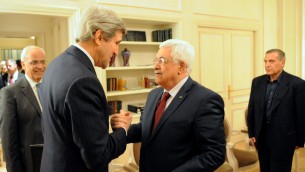
aKerry and AbbJohn Kerry, left, with Mahmoud Abbas in Paris on Wednesday, February 19. (photo credit: US State Department)

“It’s impossible to make an agreement without recognition by the other side of our right to exist as the national state of the Jewish people in some kind of borders,” he said.

Concerning the possible freeing of Israeli Arabs in the fourth and final batch of prisoner releases set for later this month, Ya’alon said Israel only agreed to free Palestinian prisoners held in Israeli jails from before Oslo, and said that he opposed Abbas’s attempt to represent Israeli Arabs.

He implied that Secretary of State John Kerry had failed to act as an honest broker on the issue, saying that Abbas “maybe got from Kerry” the impression that Israel was prepared to free Israeli Arab terrorists in the context of the ongoing peace talks. But no such indication was given by the government of Israel, Ya’alon said.

Kerry has been trying to broker an extension of the current talks, which began last July and are set to end in April. The secretary has been drafting a framework accord as a basis for further talks, but has yet to formally present it to the sides.

Abbas is set to hold talks with US President Barack Obama at the White House on Monday. Palestinian officials have repeatedly indicated that Abbas intends to reject Kerry’s framework document and refuse to extend the talks.

The Iranian UAV Industry is Booming

March 15, 2014

The Iranian UAV Industry is Booming – Israel Defense.

(Thanks to the generous sanctions relief by Mr. Hope and Change it booms even more.
“… Try with a little help from my friends …” – Artaxes)

The tendency to regard reports of modern Iranian-made weapon systems as “merely a whim and PR spectacle” notwithstanding, the Iranian UAV industry succeeds in developing vehicles that are worthy of more serious consideration

Tal Inbar | 15/3/2014
 
The Iranian UAV Industry is Booming

Observers of formal Iranian reports dealing with the development of various weapon systems have been familiar, for years now, with the ritual where various weapons are presented to senior officials, normally in the presence of the Iranian Defense Minister, who has the honor of unveiling “the world’s best and most advanced” weapon systems, as they are normally introduced. Knowledgeable authorities in the field of ordnance, platforms and weapon systems, upon carefully examining the images distributed by the various Iranian news agencies, often find themselves chuckling in the face of non-operational systems.

Do the armed forces of Iran rely on weapon systems made of fiberglass and sheet-metal? Apparently, various journalistic sources (worldwide as well as in Israel) tend to dismiss the Iranian presentations as a capricious whim of the Iranian regime or as a spectacle put on for the benefit of the masses of the Iranian people, who are not fully familiar with the intricacies and secrets of the trade.

Over the years, we have become accustomed to seeing tanks mobilized on trailers, old missiles repainted over and over again, and various other outdated items or mock-ups. It would seem, however, that with regard to very few categories, the Iranian presentations are not misrepresentations. This applies, for example, to Iran’s heavy missiles and satellite launchers. Recently, another category of Iranian products has joined the realm of “real stuff” rather than just a spectacle – Unmanned Airborne Vehicles.

In July 2006, during the second Lebanon war, UAVs operated by Hezbollah in Lebanon entered Israel’s airspace. These UAVs, shot down over Israeli territory, were identified by the media as Ababil (“swallow”) UAVs and their technical quality was rather poor. Over the years, Iran presented an extensive range of UAVs at exhibitions, military exercises and through various official publications.

Some of the Iranian developments make one wonder. One example that comes to mind is the Unmanned Combat Airborne Vehicle designated Karrar (“striker”): this turbojet UAV carries unguided GP bombs but does not have even a rudimentary surveillance system. Another example was the public introduction of a UAV fitted with an oversized canopy designed to accommodate a satellite communication system (like similar western vehicles) – while Iran has no communication satellites of its own, and relying on commercial communication satellites for communicating with an operational vehicle of this type appears questionable at best. Many of the experts who evaluated the Iranian capabilities in the field of UAVs tended to remain unimpressed. Apparently, however, the Iranian manufacturing capabilities in the field of UAVs have undergone a substantial change recently, and some of the vehicles unveiled by the Islamic Republic seem fairly advanced, although they tend to resemble western vehicles generally and Israel-made UAVs in particular.

Iran’s latest developments in the field of UAVs are based in part on direct copying of foreign UAVs that had crashed in Iranian territory and were subsequently salvaged, as in the case of the small, tactical ScanEagle UAV built by Boeing (through its subsidiary Insitu), which evolved in Iran into the Yassir UAV. An analysis of various images and video clips distributed by the Iranians has shown that an Iranian facility manufactures copies of the original UAV, and many dozens of UAVs were seen at the facility in various assembly stages. A close examination of the materials released by Iran revealed that the actual building of the Iranian UAV conforms to much higher quality standards than the cruder and more familiar UAVs, including those employed in the skies over Syria – a fact that signifies an improvement in the work and assembly procedures of aerial platforms made from composite materials. One bit of information that has not been clarified until now involves the source supplying the engines for these UAVs – that and the quality characteristics of the payload. It may be assumed, with a high degree of probability, that external resemblance, regardless of how high the quality of the copying has been, cannot necessarily indicate equally high quality standards of the avionics and surveillance systems. This UAV has two configurations that differ in their tail sections.

In October 2013, a Yassir UAV was presented to a Russian military delegation visiting Tehran as a gesture of goodwill, and possibly as an act of defiance toward the USA. In November 2013, clips filmed in Syria began to crop up on the web, showing an airborne Yassir UAV in the service of the Assad regime. Photographs of such vehicles that had crashed or were shot down and subsequently presented to the media by rebel organizations indicate with certainty that the vehicle in question is the Iranian-made UAV. Another interesting UAV presented by Iran is the Shahed-129 (“eye witness”) UAV, defined as a Medium-Altitude, Long-Endurance (MALE) UAV. This UAV was introduced to the world in 2012, and resembles the Elbit System Hermes-450 UAV made in Israel. The vehicle was unveiled initially through a series of rather blurred clips, with no breakdown of its capabilities. In September 2013, during the visit of senior Iranian officials at the plant that manufactures this UAV, additional information was made available. Of particular interest was the fact that this UAV is armed. The ordnance it carries looks like TOW antitank missiles, probably with a laser guidance head. The configuration in which the missiles were presented – carried under the wings of the UAV – was a departure from standard operational installation (which requires canisters), but it was obvious that the two armament suspension points under the wings of the UAV carried four missiles. Photographs enable a close examination of the payload carried by this UAV, which appears to be an industry standard product containing a stabilized camera with day and night channels, and possibly also a system for guiding precision guided munitions. A relatively advanced airborne vehicle, possessing a reasonable carrying capacity and an endurance of twenty hours or more constitutes a major breakthrough as far as Iran’s UAV capabilities are concerned. The operational implication for Israel is fairly obvious and presents a challenge to the Israeli air defense systems. Penetration by a single UAV from Lebanon during peacetime, against which IAF fighters may be scrambled to engage and shoot down the enemy UAV is not the same as the ‘trickling’ of numerous vehicles during an all-out confrontation, during which massive amounts of rockets are also launched into Israel. The status picture of the sky that Israel should assemble, as well as the advance identification required, present complex challenges. It should be stressed, however, that the damage sustained by the State of Israel thus far as a result of penetrating enemy UAVs was mainly a damage to morale, and the Israeli public perceives such incidents as serious and even as “failures”.

The latest innovation presented by Iran, for now (November 2013), is the Fotros UAV, defined by Iranian spokesmen as a “strategic” vehicle. It is a large UAV with a central fuselage and twin-boom configuration and a wingspan of about 15 meters. Its endurance is up to 30 hours, its official service ceiling is up to 25,000 feet and its range is 2,000 kilometers. If these performance characteristics, officially presented by Iran, are reliable, then for the first time, Iran possesses an indigenous UAV capable of flying from Iran to Israel. The UAV was presented in an armed configuration, carrying missiles that resemble the US-made AGM-114 Hellfire antitank missiles. It is unknown whether Iran actually possesses real missiles of the type described above. The resemblance between the Iranian Fotros UAV and the IAI Heron UAV made in Israel was clearly visible, and there is no doubt that the Iranian engineers were “inspired” by the Israeli UAV. One should not rule out the possibility that in their configuration selection considerations the Iranians did not just want to rely on successful and proven designs, but also attempted to reach a high degree of visual resemblance that would make it difficult to identify their UAVs as hostile, thereby improving their survivability should they be employed over Israel. In conclusion, it appears that the Iranian UAV industry has undergone a substantial transformation in recent years, as it currently presents products that are more advanced than those presented in the past. The UAVs we currently see in Iran are employed, in part, in various areas of conflict (Syria, Sudan) and are also being delivered to Hezbollah.

The Israeli defense establishment should pay heed and prepare to deal with these threats well in advance.

***

The writer is the head of the Space Research Center at the Fisher Institute for Air and Space Strategic Studies


Al-Qaeda-linked group claims border attack on IDF

March 15, 2014

Al-Qaeda-linked group claims border attack on IDF – The Times of Israel.

Islamic State of Iraq and the Levant, an enemy of Hezbollah, tweets responsibility for targeting Israeli patrol at Lebanon border

By Times of Israel staff March 14, 2014, 11:22 pm

Israeli military medics examine comrades in an ambulance near Har Dov, on Israel's northern border with Lebanon, March 14, 2014 (photo credit: AFP/Jalaa Marey)

Israeli military medics examine comrades in an ambulance near Har Dov, on Israel’s northern border with Lebanon, March 14, 2014 (photo credit: AFP/Jalaa Marey)

An Al-Qaeda-linked group that has been operating increasingly in Lebanon claimed responsibility via Twitter for an attack on an IDF patrol Friday.

The Islamic State of Iraq and the Levant (ISIL) has been fighting against Hezbollah and the Bashar Assad regime in Syria, with clashes and targeted bombings spilling over into Lebanon in recent months.

It was initially reported by Israeli media that the attack on the IDF jeep in the Har Dov area, near the Israeli-Lebanese border, was perpetrated by Hezbollah. The IDF fired on several targets across the border in retaliation, including tank fire at a Hezbollah position in the Lebanese village Kfar Kileh.

Three Israeli soldiers were taken to a hospital to “rule out” any internal injuries from the blast, according to Israel Radio.

Residents in the area of Har Dov reported hearing two loud explosions.

Hezbollah’s Al-Manar TV station said that Israeli forces had fired shells into the area of Kfar Chouba, north of the border. There were no injuries reported.

The army said it was investigating the circumstances surrounding the incident.

An IDF vehicle patrols near the border with Lebanon, May 2013 (photo credit: Avishag Shaar Yashuv/Flash90)

An IDF vehicle patrols near the border with Lebanon, May 2013 (photo credit: Avishag Shaar Yashuv/Flash90)

Residents of northern Israel, from Kiryat Shmona eastward to the Golan Heights, were cautioned to stay away from the border.

The Lebanese army declared a state of alert, according to Israel’s Channel 1 News, and eyewitnesses reported seeing increased UNIFIL patrols in the border area late in the evening.

The long arm of Iran’s Revolutionary Guard

March 15, 2014

The long arm of Iran’s Revolutionary Guard – Israel Hayom.

Iran arms, funds and trains Hamas and Islamic Jihad to cause death and destruction inside Israel • Last week’s capture of the Klos C was just one chapter in the ongoing struggle against the Iranian threat.

Nadav Shragai

The weaponry captured on the Klos C last week
Photo credit: IDF
Spokesperson’s Unit

Kfir Rosen heard the reports last week about the capture of the weapons ship Klos C and his heart muscles immediately expanded. He was listening to the commentators describe the capabilities of the M-302 missiles that were discovered underneath the large bags of cement stashed in the belly of the ship. Then, in one fell swoop, he flashed back in his mind to the images, the sounds, the smell, and the awful quiet which ensued following the direct hit his apartment in Rishon Lezion sustained when a Fajr-5 missile exploded inside it one day in November 2012.

During Operation Pillar of Defense, 1,506 rockets were fired at Israel. Just 421 were intercepted by the Iron Dome anti-rocket system. On November 20th, the seventh day of Israel’s military campaign in Gaza, sirens were heard in Rishon Lezion. Instead of sprinting toward a bomb-proof zone, Rosen went out to his balcony in order to witness the Iron Dome interception. Only, it never came.

The Fajr-5 rocket carries 90 kilograms (200 pounds) worth of explosives in its warhead. This powerful weapon directly struck a residential building that is home to 70 people, turning part of it into a mangled piece of bent iron and pieces of concrete.

“I felt a wave of heat passing over my shoulder,” Rosen said, recalling that fateful night. “Today, I know it was a rocket. Afterward, there was a loud boom, and a torrent of stones and dust fell on us from the top floor. We went downstairs. We didn’t recognize our building, which was partially turned into rubble. It was as if somebody did copy-paste on an image from the blitz in London [during World War II].”

The building was eventually restored, but the traumatic mark left on Rosen led him to move.

“God help us,” he told us this week. “If a rocket with a 90-kilogram warhead crushed a building in Rishon Lezion, I don’t want to think what a missile with a 170-kilogram warhead, the kind that the IDF confiscated from the Klos C, would do. What a stroke of luck, huge luck.”

Israel knows well what a missile carrying 170 kilograms (375 pounds) worth of explosives is capable of. It has also “gotten a taste”of them in the past. In the summer of 2006, during the Second Lebanon War, these powerful missiles struck Hadera, Afula, and Haifa, leaving behind a trail of destruction while claiming casualties.

S., one of the IDF soldiers involved in the seizure of the arms-carrying ship Victoria some 200 miles off Israel’s coast, also experienced a kind of deja vu when he heard about the capture of Klos C. The Victoria was carrying Iranian-manufactured C-704 surface-to-sea missiles hidden underneath bags of cotton and vegetables.

Over the years, Iran has used various means in attempting to smuggle arms that it wishes to deliver to terrorist organizations in the south. Even when it managed to smuggle into Gaza 122-millimeter Grad rockets, Iran made sure that its engine was comprised of four parts in order to make it easier to conceal.

With thanks, the Palestinians

Now Iran is denying that it is behind the shipment of arms found on Klos C. The international community is also living in a sort of denial, closing its eyes and ignoring the incriminating facts that have been unearthed. Even in Israel, some in the news media are trying to downplay the significance of the event.

It would be worthwhile to dive head-first into the treasure trove of material accumulated in recent years by the staff members of the Meir Amit Intelligence and Terrorism Information Center. This information points to a direct link between Iran and Palestinian terrorist groups operating in the Gaza Strip, in particular Islamic Jihad.

These materials generated renewed interest this week. Obviously, they are much more relevant in light of the current circumstances. The ITIC is an independent, semi-official organization that uncovers facts and figures that are difficult to bring to the public’s attention.

The latest ITIC report about Iranian assistance to Palestinian terrorist organizations offer a detailed account of what the capture of Klos C confirmed: Iran is the party most responsible for Hamas and Islamic Jihad’s buildup of its military capabilities. It is Iran that is constantly working to rebuild their military capabilities which were rolled back during Pillar of Defense. It is Iran that has placed an emphasis on rebuilding the rocket and missile infrastructure in Gaza, the reason being that it believes these arms pose the greatest threat to the Israeli homefront.

The Revolutionary Guards’ Quds Force, the elite paramilitary outfit that serves as the spearhead of Iran’s drive to “export the Islamic revolution,” is the organization whose task it is to deliver military assistance to terrorist groups in the Palestinian Authority.

For many years, the Iranians preferred to keep this part of its foreign policy secret. Following Pillar of Defense, however, they changed their approach, openly acknowledging the aid they extend to terrorist groups in Gaza, something which they are now denying. As it appears, Tehran is keen on preventing other Muslim countries who supported Hamas from reaping undeserved political dividends. At the same time, spokespersons for Hamas, Islamic Jihad, and Hezbollah profusely thanked Iran for the assistance.

There have been too many public comments to count. Israel will soon make use of them in order to score public relations points (hasbara). The most explicit statements made thus far came from the mouth of Ramadan Shalah, the leader of the Islamic Jihad Movement in Palestine (operating in Gaza). Shalah’s group is wholly affiliated with the Iranians. Its operatives view terrorism as the exclusive means to attain their goals, chief among them the liquidation of the State of Israel and the establishment of a theocratic, Islamist Palestinian state on all of “Palestine.” Islamic Jihad is considered a terrorist organization by Israel, the United States, Britain, the European Union, Japan, Canada, and Australia.

“Iran provided us with assistance and support,” Shalah, who is based in Damascus, said following Pillar of Defense. “The weapons used by the resistance — the entire world knows that their primary supplier was Iran, or that [its delivery] was financed by Iran.”

Ziyad al Nakhalah, Islamic Jihad’s deputy secretary general, also offered effusive praise for Iran.

“I would like to thank our brothers in Iran,” he said. “The weapons with which the resistance is fighting, and even the weapons used by Hamas, are Iranian weapons, from the first bullet to the last missile. Even everything that is manufactured locally is for all intents and purposes Iranian. The Fajr-5 rockets which brought us victory were also given to us by Iran.”

“It’s no secret that the arms supplied to the Palestinian resistance, from A to Z, from bullets to rockets, is from the Islamic Republic,” said Daoud Shahab, an Islamic Jihad spokesman. “It is Iranian assistance.”

Even Hamas officials like Ali Barakeh, its chief representative in Lebanon, acknowledge that “Iran is the chief military supporter and financier of most Palestinian organizations in the Gaza Strip, with no strings attached and expecting nothing in return.”

Weapons ties

What is even more significant now, given Iran’s denial of its involvement in the Klos C affair, is that the Iranians have in the past boasted proudly of their assistance to the Palestinians. Ali Larijani, the current chairman of the Iranian parliament, bragged that “our support for the Palestinians came in the form of money and armaments.”

The Iranian newspaper Kayhan wrote that Hamas was launching Iranian missiles at Israel. The Iranian news site Tabnak observed: “If it weren’t for Iran’s financial and military support for Hamas, the results of the current clash (Pillar of Defense) would’ve been completely different. The Iranian missiles launched toward Israel are the main reason for the fear that is now surfacing among Israelis and the cease-fire that was imposed on Israel.”

Iran has provided the organizations in Gaza with a variety of rockets, chief among them are the Fajr-5 models. These projectiles have longer ranges (75 kilometers, 50 miles). Some of them were manufactured in Gaza, with training and guidance from Iran. Most of these rockets were destroyed by the IDF on the first day of Pillar of Defense. They have struck targets in Rishon Lezion as well as the outskirts of Jerusalem. There are also the 122-millimeter Grad rockets capable of reaching targets at a distance of 20 to 40 kilometers (12 to 25 miles). These are the weapons that have wreaked havoc on Beersheba and Ashdod.

Iran has also provided various mortars, anti-tank missiles (like the Sagger, the Fagot, and the Konkurs) that were used extensively by Hezbollah during the Second Lebanon War.

Another missile supplied by Iran is the Kornet, one of which was fired at a bus carrying schoolchildren in the western Negev in April 2011. One child was killed and two others were wounded. Iran has also provided anti-tank rockets, shoulder-fired missiles, and technological know-how for the production of weaponry, with a special emphasis on medium-range artillery and sophisticated explosives.

Not only have Hamas and Islamic Jihad operatives received Iranian weapons, information, and assistance, but they have also undergone training and instruction in Iran itself. Upon their return, they disseminated the information they were taught to large numbers of terror operatives. The British newspaper Sunday Times has exposed details of these training sessions in the past. It revealed that the Revolutionary Guards trained hundreds of Hamas operatives who came to Iran by way of Egypt. From there, they flew to Syria before continuing to Tehran.

The Iranians have also assisted terrorist organizations in the Gaza Strip to prepare the infrastructure for the manufacturing of unmanned aerial vehicles which were to be launched toward Israel. These factories were destroyed by the Israeli air force. At one point, Palestinians floated barrels of explosives toward Israeli beaches, some of which reached close to Palmachim Beach, but they were neutralized by sappers.

The Sudanese corridor

The major route through which Iranian arms reached Gaza passed through Sudan by sea and by air. From there, the weapons were transferred through Egypt to the Gaza Strip by means of a complicated tunnel system that was built along the Sinai-Gaza border. A significant amount of the weapons came from the storage facilities in Libya which were looted following the fall of Moammar Gadhafi.

The smuggling system that stretches from Sudan to Gaza is aided by a network of smugglers whose motives are primarily economic. The weapons are first loaded onto ships that are docked in the Syrian port of Latakia and, like the Victoria, sent on their way to Alexandria, Egypt.

Israel has not been sitting idly by, watching these developments unfold. In March 2009, Arab and American media outlets reported that Israeli warplanes attacked a convoy of arms in Sudan. The convoy, which was said to be carrying a variety of armaments, was on its way to the Gaza Strip. According to the reports, the shipment originated in Iran and was financed by the Imam Khomeini Relief Foundation. It was said to include Fajr rockets capable of reaching Tel Aviv. That same month, Israel attacked again in Sudan, at least according to foreign media reports.

Researchers with the ITIC believe that Iran has also used cargo flights with the Sudanese carrier Badr Airlines in order to load arms from Iran and send them to Sudan, where smugglers would transport them to Palestinian groups in the Gaza Strip.

“The containers were transported on the Iran-Sudan route by way of Oman and Saudi Arabia as well as the Syria-Sudan route by way of Jordan and Egypt,” ITIC researchers wrote, basing their information on WikiLeaks documents dated March 29, 2009. According to the secret diplomatic communiques revealed by WikiLeaks, the U.S. warned Sudan, Oman, Saudi Arabia, and Yemen that enabling the transport of Iranian arms through their territory constituted a violation of U.N. resolutions.”

In 2010, five containers of weapons were delivered from Iran to Sudan. In 2012, arms were sent to Sudan via cargo flights. The mysterious explosion which occurred at the Yarmouk weapons factory in the Sudanese capital of Khartoum in October 2012 was reportedly the result of arms manufacturing and the smuggling of arms to Palestinian groups in Gaza. The site in question was owned by the Iranian Revolutionary Guards.

Iranian assistance to Palestinian terrorism also included the transfer of large sums of cash to various organizations, including Islamic Jihad. The money would be funneled through banks based in Syria, Lebanon, and the Palestinian territories. In years past, these funds were used to subsidize the worst terrorist atrocities committed against Israelis.

The Izzedine al-Qassam Brigades received a lump sum of $400,000 and the Islamist opposition groups in the PA received $700,000. Documents obtained by the defense and security establishments revealed that these sums were earmarked for the Hamas military wing, and the purpose for the transfer was for these funds to be used to encourage suicide bombings.

Iran’s closest ties to a Palestinian organization are the ones it shares with the Islamic Jihad, which was founded in the Gaza Strip in the mid-1980s. The al-Quds Brigades are the Islamic Jihad’s military wing. This organization has been responsible for some of the deadliest terrorist attacks, the most notorious among them is the double-bombing of the Beit Lid junction in 1995, in which 21 soldiers and civilians were killed. It also masterminded the 2001 car bomb attack in the Mahane Yehuda open air market. Over the course of the second intifada, it carried out 422 attacks which claimed the lives of 134 Israelis and maimed 880.

Annually, Iran provides millions of dollars to this organization, a large chunk of which is earmarked for terrorism. Since the lull that was agreed upon in 2005, Islamic Jihad has become one of the main groups responsible for rocket fire against Israel. Experts believe that the Klos C shipment was at least partially intended for Islamic Jihad operatives.

During the annual conference held by the Institute of National Security Studies, Military Intelligence chief Maj. Gen. Aviv Kochavi said that Israel is currently being threatened by 170,000 missiles pointed at it, particularly from the north. The one organization that is deemed to be “most unpredictable” is Islamic Jihad, which doesn’t even take its orders from Hamas.

Defense experts believe that Iran will continue to try to bolster the arsenals of both Jihad and Hamas. Tehran is determined to beef up the potential to threaten Israel, which managed to scale back the threat significantly during Pillar of Defense. After the operation, the Palestinian organizations were left with just 7,000 rockets of various kinds and models in their possession. Since the operation, that number has doubled, defense officials believe.

Off Topic: Eight Crucial Questions for Abbas (and One for President Obama)

March 15, 2014

Eight Crucial Questions for Abbas (and One for President Obama), Gatestone Institute, March 15, 2014

Question #1: Does Israel have a right to exist?

There seems to be a double-standard when it comes to how Israel’s Prime Minister, Benjamin Netanyahu, and the Palestinian Authority’s erstwhile President, Mahmoud Abbas — now in the tenth year of his four-year term — are treated by the Obama White House, as well as by many journalists. While Netanyahu is humiliatedinsulted,threatened, and told that he must make “painful concessions” for peace, such as releasing more than 100 terrorists merely to get the Palestinians to come to a negotiating table, Abbas – a facilitator and supporter of these terrorists – is treated with kid gloves, and with Obama virtually begging him to visit.

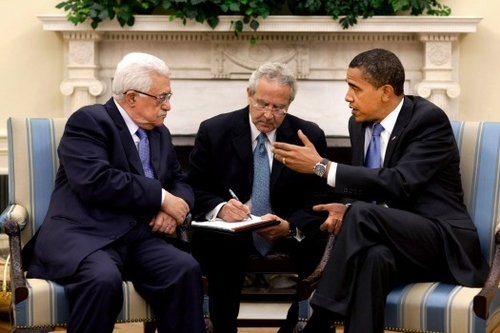
Obama and AbbasPresident Barack Obama meets with Palestinian Authority President Mahmoud Abbas in the Oval Office in 2009. (Image source: Official White House photo)

Here, however, are some questions, starting with the most important, that should be posed to Abbas when he takes a seat in the White House on March 17:

  1. Does Israel have a right to exist?
  2. Yasser Arafat, the first president of the Palestinian Authority [PA], accepted Israel as a Jewish state, and the homeland of the Jewish people. As the recent UNESCO exhibit documented, Jews have been on Israeli land, and in the disputed areas in Judea and Samaria (the West Bank) for 3,500 years, 2,000 years prior to the advent of Islam. You, however, recently said that you do not accept Israel as a Jewish state. Why?
  3. Will you stop using the humanitarian aid money given to you by the U.S. and the U.N. for prohibited purposes, such as paying salaries to and glorifying terrorists, and inciting mass hatred against Jews, even among Palestinian children?
  4. Why did you not immediately fire Jibril Rajoub, the supposedly “moderate” senior PA official, after he said in May 2013 that if the PA had a nuclear bomb, it would drop it on Israel that very day?
  5. Are you prepared to make any concessions to advance the peace process? For example, will you rescind your July 2013 statement that if you get your own state, not a single Jew will be allowed anywhere within it?
  6. If you strike a deal for peace, how will you ensure that all Palestinian parties, both in the West Bank and the Gaza Strip, uphold it; that the next president of the PA does not say, “Abbas signed that; I did not.”?
  7. If and when you get a Palestinian state, will you announce – in Arabic – that this agreement brings an end to the conflict?
  8. And will you then formally order the PA to stop glorifying terrorists and calling for the destruction of Israel in the Palestinian media, school textbooks, summer camps, sports stadiums, crossword puzzles and other outlets?

It would be telling to hear how Abbas answers these questions.

It would also be telling to hear how President Barack Obama answers one question: If Abbas refuses to agree to these “painful concessions,” will you stop issuing executive waivers that enable American taxpayer money to still be sent to him, even though you know it is being used for prohibited purposes?

It’s a Sabotage

March 15, 2014

It’s a Sabotage. foreignpolicy.com

Iran’s hard-liners are using mass executions to undermine the nuclear deal.

BY Ryan Costello , Trita Parsi

MARCH 14, 2014

Negotiations between Iran and the world powers will determine not just the future of Iran’s nuclear program, but also whether moderate forces can consolidate their tentative hold on power and shape the country’s direction for years to come. If Iranian President Hassan Rouhani secures a nuclear deal that delivers sanctions relief and boosts the economy, he will validate his argument that reconciliation with the outside world benefits Iran and unlock the possibility of far-reaching domestic reform. If the talks fail, however, hard-liners will have the ammunition they need to undercut the new president and shift the political pendulum back in their favor.

With so much at stake, Iran’s hard-liners are determined to sabotage Rouhani at every turn. Their latest effort appears aimed at spoiling the international community’s appetite for diplomacy: In a deeply troubling turn, Iran’s judiciary — which is not under the control of the Rouhani administration — has dramatically increased the number of executions in the country. At least 500 people were executed last year, according to U.N. Secretary-General Ban Ki-moon, while at least another 176 have been hanged so far in 2014.

Rouhani has thus far insulated himself from criticism on nuclear negotiations by gaining the backing of Supreme Leader Ali Khamenei. While Khamenei is more closely aligned with the hard-liners and is skeptical of diplomacy, his shift can be partially attributed to the need to shore up political legitimacy in the wake of the stolen 2009 presidential election and subsequent crackdown on Green Movement activists. If Khamenei openly denied the Iranian people’s will yet again, he would risk deepening political fissures that could threaten the survival of the regime. Instead, the supreme leader has gone along with Rouhani’s diplomacy, gambling that he will either be credited with helping secure a nuclear deal, or that the negotiations will collapse and the West will impose new sanctions, giving him an excuse to rein in Rouhani and his moderate allies.

Rather than directly challenge Rouhani — and by extension Khamenei — on the nuclear issue, the hard-liners have instead worked to stymie domestic reform. Overcoming their obstruction will likely depend on striking a nuclear deal that strengthens moderate forces and vindicates the new president’s leadership. If the threat of war remains, hard-liners will be able to further perpetuate Iran’s security-dominated political atmosphere in order to hinder domestic reform. Similarly, if sanctions continue, middle-class Iranians that could form the core of a democratic movement will continue to bear the brunt of the country’s economic plight.

Iran’s hard-liners have bet their political future on the hope that the international community will fall into their trap.

Iran’s hard-liners have bet their political future on the hope that the international community will fall into their trap. The spike in executions — which frequently target alleged drug offenders, as well as political opponents and religious minorities — has been overseen by the head of the judiciary, Sadeq Larijani. The Larijani family represents a formidable political bloc in Iran: Sadeq and his four brothers all hold prominent positions in Iran’s political establishment. Sadeq’s brother Ali currently heads Iran’s parliament, which is also dominated by hard-liners, ensuring that the Larijanis exert a powerful influence over two very powerful institutions.

But if Rouhani is successful and fulfills many of his campaign promises, moderates have a strong shot at winning the parliamentary elections in 2016 and booting Ali Larijani from his speakership. Hence, the Larijanis and their hard-line allies have added motivation to ensure that Rouhani fails. The Iranian people, unfortunately, are suffering the consequences.

If Rouhani openly takes on the conservatives over human rights abuses, he will have opened a new front in this political war — but one in which he does not enjoy Khamenei’s support. This in turn could overextend his political capital and limit his ability to get a nuclear deal. If he chooses to deprioritize human rights and stay silent in the face of these abuses — which appears to be the case — the situation is likely to deteriorate even further, and the Green Movement veterans and reformist-oriented voters, who make up an important portion of his base, will be jeopardized.

The rising number of executions also presents the world community with a dilemma. If the United States and Europe use the human rights violations as a justification to punish Iran with sanctions, the hard-liners will get their excuse to end nuclear negotiations. But if the world ignores the abuses, the hard-liners may further intensify the violations to beget a response.

This balancing act will be difficult for both the Rouhani government and the international community. Ignoring the human rights abuses cannot be an option, nor can cancellation of diplomacy. In the near term, diplomats can shine a spotlight on these abuses and push for them to stop — if the international community specifically calls out the conservative-controlled judiciary as the responsible party, the hard-liners will be put on the defensive. Their effort to pass the responsibility for their abuses to the moderates will have failed.

In this process, dialogue is a far more effective method of pressure than threats. European Union High Representative Catherine Ashton’s recent trip to Iran serves as a prominent example. While nuclear negotiations were the primary purpose of her trip, Ashton pressed Iranian Foreign Minister Javad Zarif on human rights and was able to meet with Iranian women’s rights activists at the Austrian Embassy. The world also has other avenues of  highlighting abuses and pressing for change: U.N. Special Rapporteur for Human Rights Ahmed Shaheed just issued a new report outlining concerns with the human rights situation in Iran, and should continue his important work.

This balancing act also shows the importance of reaching a nuclear accord — and doing so quickly. The sooner a nuclear deal is struck, the sooner the hard-liners’ trap will fall apart.

Off Topic: Gaza’s sole power plant shuts down due to fuel shortage

March 15, 2014

Gaza’s sole power plant shuts down due to fuel shortage, Jerusalem Post, March 15, 2014

(Remember the boy being tried for murdering his parents who asked for mercy because he was an orphan? — DM)

The power plant is one of the main sources of electricity for Gazans, and without it, daily blackouts of around 12 hours are expected.

. . . .

The Gaza Strip is run by the Islamist group Hamas, which is sworn to Israel’s destruction and the two sides have no direct dealings.

Gaza power outagePalestinians in Gaza brave a power outage this past November. Photo: REUTERS

The Gaza Strip’s sole power station stopped generating electricity on Saturday, causing blackouts throughout the territory after it ran out of fuel, officials said.

The power plant is one of the main sources of electricity for Gaza’s 1.8 million people and without it, daily blackouts of around 12 hours are expected. Electricity is also received directly from Israel and Egypt.

Gaza lacks much basic civil infrastructure and lives under an Egyptian-Israeli blockade meant to cut off arms flows but which also curbs imports of fuel and building supplies.

A few months ago the plant was switched off for 43 days due to a fuel shortage that arose after neighboring Egypt closed off smuggling tunnels. Israel eventually allowed in fuel paid for by Qatar when a storm swept the region.

But that fuel has run out, said Ahmed Abu Al-Amrain, a spokesman Gaza’s energy authority.

The Gaza Strip is run by the Islamist group Hamas, which is sworn to Israel’s destruction and the two sides have no direct dealings.

Last time there were blackouts, Qatar gave funds to Hamas’s West Bank-based rival, President Mahmoud Abbas’s Palestinian Authority, which then ordered fuel for the enclave from Israel.

Gaza’s energy authority said on March 12 that Qatar had agreed to extend its funding of fuel for three more months.

For the arrangement to work again, Israel would have to open its commercial crossing on the border with Gaza, which it closed after violence erupted along the frontier this week.

“The closure of the crossing by the Israeli occupation is an act of collective punishment,” Amrain said.

Off Topic: Is Kerry an honest broker? ‘We’ll see,’ Israel’s defense minister says

March 15, 2014

Is Kerry an honest broker? ‘We’ll see,’ Israel’s defense minister says, Jerusalem Post, March 15, 2014

(In recent times, the Palestinians have repeatedly and heatedly refused to recognize Israel as a Jewish state. Even if dubious arguments can be made that they once did, they have nothing to do with the current “peace process,” beyond a specious contention that since the Palestinians won’t cave Israel should.  — DM)

“The only thing that can ‘save’ us is for John Kerry to win his Nobel Prize and leave us alone,” the defense minister reportedly said.

In an interview with Channel 2, Defense Minister Moshe Ya’alon disputes notion that Palestinians have already recognized Israel as a Jewish state.

Kerry and YaalonUS Secretary of State John Kerry (R) and Defense Minister Moshe Ya’alon Photo: REUTERS

One day after US Secretary of State John Kerry told lawmakers in Washington that raising the idea of Palestinian recognition of Israel as a Jewish state was a mistake, Defense Minister Moshe Ya’alon declined to say whether Kerry is an honest broker in peace talks between the Israeli government and the Palestinian Authority.

In an interview which aired Saturday on Channel 2’s Meet the Press, Ya’alon disputes Kerry’s contention that Israel erred in demanding Palestinian recognition of its Jewish character.

“[Late Palestinian leader Yasser] Arafat never recognized Israel as a Jewish state,” the defense minister told Channel 2. “That was one of his manipulations. [The idea that the Palestinians already recognized Israel as a Jewish state] is simply not true.”

Ya’alon was responding to Kerry’s remarks to members of Congress on Thursday that international law already declares Israel a Jewish state, and called Prime Minister Benyamin Netanyahu’s insistence on a public declaration of Israel’s Jewish character from the Palestinians “a mistake” in the diplomatic process.

“I think it’s a mistake for some people to be raising it again and again as the critical decider of their attitude toward the possibility of a state, and peace, and we’ve obviously made that clear,” Kerry told the House Foreign Relations Committee, in a hearing on budget matters.

When asked by Channel 2 if Kerry was an honest broker for peace, Ya’alon sidestepped the issue.

“That’s something we will have to see during the course of the negotiations,” the defense minister said.

Ya’alon has been bitterly critical of Kerry, particularly due to what is perceived by some in Israel as the secretary’s preoccupation with the Israeli-Palestinian peace process.

Earlier this year, Ya’alon was quoted by the daily tabloidYedioth Ahronoth as saying Kerry was “obsessive” and “messianic.”

According to the newspaper, the defense minister told associates in private conversations that Kerry “should take his Nobel Prize and leave us alone.”

“Abu Mazen lives and dies by our sword,” Ya’alon was quoted as saying by Yedioth. “Once we leave Judea and Samaria, he is finished. In effect, during these past months, there haven’t been negotiations with the Palestinians, but with the Americans.”

“The only thing that can ‘save’ us is for John Kerry to win his Nobel Prize and leave us alone,” the defense minister reportedly said.

Minister: Fateh submarine soon to join Iran Navy

March 15, 2014

Minister: Fateh submarine soon to join Iran Navy, Trend, March 15, 2014

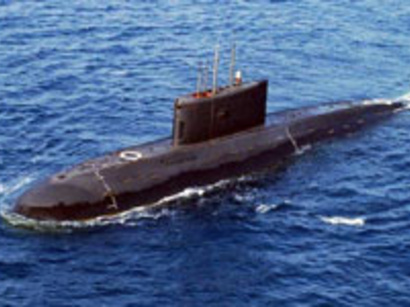
(A new Fateh (Conqueror) defensive submarine for Iran. — DM)

Iranian submarine

Iran’s Defense Minister Brigadier General Hossein Dehqan says the indigenous Fateh (Conqueror) submarine will join the Navy in May, Press TV reported.

Dehqan said on Saturday that the submarine has undergone necessary tests and its faults have been corrected.

He said the submarine will probably join the Navy on May 24 which marks the anniversary of the liberation of Khorramshahr city during the eight-year imposed war with Iraq.

Fateh weighs nearly 500 tons and it is Iran’s newest semi-heavy submarine.

In recent years, Iran has made major breakthroughs in its defense sector and attained self-sufficiency in producing important military equipment and systems.

Iran has so far launched different classes of indigenous advanced submarines including Fateh, Ghadir, Qaem, Nahang, Tareq and Sina.

The Islamic Republic has also conducted several military drills to enhance the defense capabilities of its armed forces and to test modern military tactics and equipment.

Iran says its military might poses no threat to other countries, stating that its defense doctrine is based on deterrence.