Archive for March 14, 2014

IDF fires on Hezbollah position after blast on Lebanon border

March 14, 2014

IDF fires on Hezbollah position after blast on Lebanon border – Diplomacy and Defense Israel News | Haaretz.

Explosive charge detonated in Har Dov; no wounded reported.

By | Mar. 14, 2014 | 8:23 PM |

An IDF soldier patrolling Israel's border with Lebanon.

An IDF soldier patrolling Israel’s border with Lebanon, August 2010. Photo by Yaron Kaminsky

An explosive charge detonated Friday evening near Har Dov in the vicinity of the Israel-Lebanon border.

No wounded were reported in the attack which targeted an IDF force. The Israeli army said it is investigating the incident.

The IDF fired at a Hezbollah position near the border north of the Israeli city of Metula, using tanks stationed in the area and artillery.

A high-ranking officer told reporters that no Hezbollah casualties are known, and noted that the retaliatory fire was “automatic, as a result of understanding the incident.” He added that the IDF currently considers Hezbollah as involved in the incident. The IDF is still uncertain where exactly the charge was placed and what was it made of.

Lebanese sources reporedt the IDF fired five artillery shells at open terrain near Lebanese villages, causing no injuries.

The Lebanese army announced a state of alert along the border, and eyewitnesses reported increased activity by UNIFIL forces in the area.

Today, March 14, marks the 36th anniversary of the Litani Operation, in which the Israeli army invaded Lebanon up to the Litani River in 1978 in response to the Coastal Road massacre.

About ten days ago a similar incident occurred in the northern Golan Heights, when an IDF force spotted several persons suspected of attempting to plant a charge near the border fence with Syria. The force fired at the persons, using both artillery shells and bullet rounds.

An IDF source said the activity was directed by Hezbollah.

Tensions have risen in the north since an airstrike, attributed by foreign reports to the Israeli Air Force, targeted a Hezbollah weapons convoy in Lebanon.

Hezbollah threatened to attack Israel in retaliation, and Israeli authorities directed civilians to stir clear of the border to avoid possible sniper fire.

Lebanese security forces told the Lebanese newspaper a-Nahar after the attack that “Israel has taken Hezbollah’s threats very seriously.” According to the report, in addition to the increased alertness along the northern border, Israel has also related a message through UNIFIL to Lebanon’s government according to which all Lebanon will come under fire if Hezbollah carries out its threats.

IDF convoy hit by explosive device on Lebanese border, sustain no injuries

March 14, 2014

IDF convoy hit by explosive device on Lebanese border, sustain no injuries | JPost | Israel News.

By YAAKOV LAPPIN

03/14/2014 19:18

Israeli tanks, artillery fire and destroy Hezbollah post; no injuries sustained by IDF soldiers.

Tanks fire rounds as part of an intensive ‘master gunner’ course.

Tanks fire rounds as part of an intensive ‘master gunner’ course. Photo: IDF Spokesman

An IDF convoy moving in the area of Har Dov, on the border with Lebanon, was the target of an explosive device activated by Hezbollah terrorists in Lebanon on Friday night.

One of the armored vehicles was directly hit by the explosion, the IDF sustained no injuries. However, three of the soldiers were taken to Ziv Medical Center in Tzfat for precautionary reasons.

The IDF concluded within minutes of the attack that Hezbollah was behind the explosion. In response, IDF tanks and artillery fired on and destroyed a Hezbollah post in Metullah, Lebanon.

Since the incident, there has been no further exchange of fire; however, IDF sources added that the situation is still ongoing.

An IDF source stated regarding the incident, “The coming hours will tell whether or not this will lead to an escalation.”

Off Topic: Jordan: Not in our interest to cut ties with Israel

March 14, 2014

Jordan: Not in our interest to cut ties with Israel, Times of Israel, March 14, 2014

As thousands protest outside the Israeli Embassy, PM Ensour points to issues of mutual concern like water, refugees and Jerusalem.

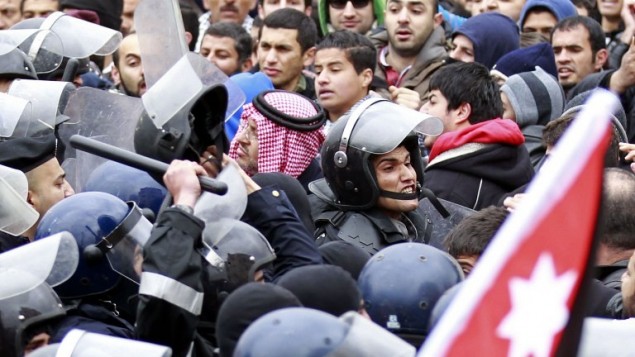
Jordanian riot policeJordanian riot police confront protesters during a demonstration in front of the Israeli Embassy in Amman on Friday (photo credit: AFP/Khalil Mazraawi)

AMMAN, Jordan — Some 2,000 protesters demonstrated in front of the Israeli Embassy in Jordan on Friday over the killing of a Jordanian judge earlier in the week.

The death of Raed Zeiter, a Jordanian magistrate of Palestinian descent, has caused an uproar in Jordan, triggering street protests and calls in parliament to annul the 1994 peace agreement with Israel.

The IDF said that guards shot Zeiter on Monday after he tried to grab a rifle from a soldier at the Allenby border crossing between the West Bank and Jordan.

Jordanian Prime Minister Abdullah Ensour addressed the parliament’s concerns on Friday, saying that it was not in the national interest to cut ties with Israel. He also said such a step could hurt Israeli-Palestinian peace negotiations and US aid to Jordan.

Ensour said that water issues, borders, Palestinian refugees and sovereignty over Jerusalem were all issues of mutual concerns for both countries.

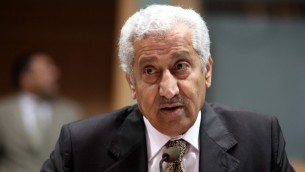
Jordanian PMJordanian Prime Minister Abdullah Ensour (photo credit: AP)

Protesters on Friday chanted anti-Israel slogans and called upon the Jordanian government to deport the Israeli ambassador, to return the Jordanian ambassador from Tel Aviv and to annul the peace treaty. Thousands of riot police stood on hand and stopped protesters from attacking the embassy.

Opposition Islamists, youth groups, leftists and nationalists took part in the demonstration that started after Friday prayers in Kaluti mosque. Jordan’s Muslim Brotherhood organized the protest.

Demonstrators waved Jordanian flags and banners reading “the people want to cancel the peace treaty,” and “shut down the Zionist entity’s embassy and kick the ambassador out for the sake of the martyr’s blood.”

“Zeiter you are a martyr and our rulers are slaves. We will not forget you,” they chanted.

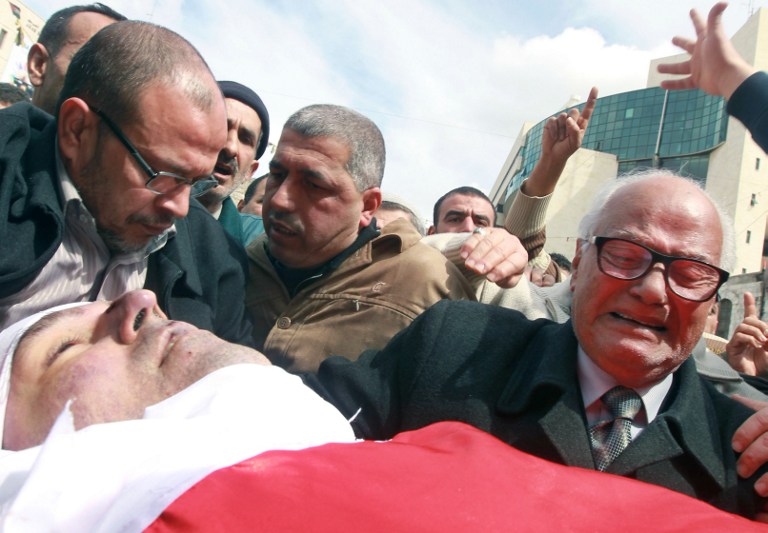
PALESTINIAN-ISRAEL-JORDAN-CONFLICTThe father of Raed Zeiter grieves over his son’s body during his funeral in the northern West Bank city of Nablus, on March 11, 2014 (photo credit: AFP/Jaafar Ashtiyeh)

Several protesters were arrested for trying to break through the barrier formed by police, reported the country’s Ammon News.

On Wednesday, the lower house of Jordan’s parliament demanded in a non-binding resolution the government free Jordanian soldier Ahmad Dakamseh, who was jailed after he opened fire on a group of Israeli schoolgirls in 1997, killing seven.

Preventing an Iranian Breakout after a Nuclear Deal

March 14, 2014

Preventing an Iranian Breakout after a Nuclear Deal – The Washington Institute for Near East Policy.

Washington must urgently reestablish the credibility of its military threat, along with other steps, to guard against noncompliance from Tehran.

James F. Jeffrey and David Pollock
March 12, 2014

Assuming a final Iranian nuclear agreement is achieved, whatever the details, the task of the United States, the rest of the P5+1 (Britain, China, France, Russia, and Germany), and U.S. allies and friends in the region to manage the threat of an Iranian nuclear program will not slacken. Thus, the arrangements to encourage Iran to stick with an agreement will be every bit as important as the specifics of an agreement itself. It is thus important to begin thinking about these arrangements now.

Furthermore, even with an agreement, the United States and its partners will face a long-term Iranian push for hegemony in the Middle East. That fact, plus analogous recent Russian and Chinese behavior and questions about U.S. responses, offers the context within which any nuclear deal, and plans to maintain it, must be considered. 

In any likely final agreement with Iran, a residual nuclear enrichment program, however undesirable, will likely be permitted. This will necessitate a regime to prevent Iran from breaking out of that agreement to develop nuclear weapons, or exploiting the threat of a breakout for regional intimidation. Such a regime would require three interlocking components: specific limitations on Iran’s program, in order to maximize Iran’s prospective breakout time; extensive verification, monitoring, and intelligence capabilities, inside and outside the agreement, to spot any breakout as soon as possible; and, finally, credible response scenarios should a breakout occur. Steps for achieving these essential goals are inventoried as follows:

Immediate next steps. The path to enforcing a final deal begins with enforcement of the current interim deal. The administration has rejected the option of passing conditional congressional sanctions in case a final deal proves beyond reach. But neither that nor the language of the Joint Plan of Action (JPOA), as the interim agreement is known, should stop the White House from immediately underlining that any Iranian infringement of the interim deal will incur new sanctions, along with other enforcement actions. Iran will protest, but this should be the first signal of U.S. resolve in enforcing any deal with Tehran. Iran is unlikely to walk away from the talks in response. And if it does, that will be an invaluable warning of the inherent fragility of agreements with the regime. Moreover, if the United States cannot credibly enforce a limited interim deal, how will it ever enforce a final one?

One way for the White House to reinforce this crucial early message would be to clearly state that it prefers no extension of the interim deal beyond its first six-month timeframe. As it is unlikely that this call would gain wider acceptance, however, Washington could lay down a clear marker that only one six-month extension will be acceptable. Otherwise, the temptation to extend the interim deal indefinitely, offering no real rollback of Iran’s nuclear program while sanctions erode, may well prove irresistible to Iran and to some other interested parties.

Verification of a final deal. Verification is critical to deterring Iranian breakout, spotting Iranian noncompliance, and triggering a rapid international-community reaction, including sanctions and ultimately use of force. It is thus essential that the most intrusive monitoring regime possible be secured in any agreement, building on the enhanced International Atomic Energy Agency (IAEA) inspection regime in the JPOA and following up on Iranian commitments to sign the Nuclear Nonproliferation Treaty’s Additional Protocol as part of the final agreement. National means of verification must be strengthened and their findings accepted, once tested and confirmed, as a supplement to the IAEA.

Any UN Security Council resolution adopting a final agreement should empower the IAEA’s on-site personnel to provide certain reporting to the Security Council through — but not requiring votes by — the IAEA board. A precedent is UN Security Council Resolution 1022 on the Dayton Accords, which directed NATO’s Implementation Force (IFOR) commander to report through its channels to the Security Council.

Enforcement of a final deal. Any agreement, or the UN Security Council resolution adopting the agreement, necessarily would have provisions for alleged or proven noncompliance. At a minimum, these provisions would resemble those of UN Security Resolution 3118, on Syrian chemical weapons, which “Decides, in the event of non-compliance with this resolution…to impose measures under Chapter VII of the United Nations Charter.” Even better would be to include the specific enforcement measures directly in the UN Security Council resolution under Chapter VII.

Second, certain current UN sanctions on Iran, rather than being lifted, should be suspended. Third, sanctions relief, rather than occurring immediately, should be phased in as an incentive for compliance, especially concerning the inspections regime.

Setting a military redline. Most important of all, the U.S. administration must maintain, convincingly, its explicit threat to use force if Iran attempts to develop a nuclear weapon, as the president has affirmed repeatedly. To reinforce this aim, the United States should push for military force authority in the adopting UN resolution, as a complement to, but not a prerequisite for, a unilateral U.S. threat. The United States should, further, make clear its redline that would spark a military response. At least as important will be the strict avoidance of mixed public messages, such as previous statements by senior officials about how “destabilizing” or “unpredictable” a necessary military action might be. Any such statement should be immediately and publicly disavowed by the president, or else his own credibility will suffer.

The Obama administration understandably has previously refused to spell out what specific Iranian action would trigger a U.S. military response, along with the details of that response. But a verified violation of a nuclear agreement is different from an ambiguous development of a dual-use capability.

Recent experience and various other factors point to a limited military response focused on nuclear infrastructure and missile systems. But the United States also has a compelling interest in neutralizing Iran’s retaliation to a U.S. or international strike. So it should prepare if Iran retaliates not to slog out an air-sea campaign in the Gulf but rather to strike back asymmetrically against Iran’s strategic command, control and communications, fuel production, and electrical generation capabilities, with standoff, precision-guided weapons — making sure Iran is aware of these intentions.

Establishing military credibility. For any planned military response to serve as a deterrent, the threat must be credible. Given the present administration’s considerable deficit in this area, it must strengthen its regional military presence and encourage other states, such as France and Britain, to follow suit. Some such developments are under way, but public attention needs to be kept on this issue. Moreover, U.S. military actions, from Afghanistan to NATO missile defense and deployment cancellations, can color perceptions of its determination and thus of its deterrence. Worst of all is an administration that actually intends to respond militarily to a breakout, with an Iran that does not believe it.

Restoring the balance following a breakout attempt. The United States needs a game plan for “the day after” any breakout attempt is stopped, whether by negotiations, sanctions pressure, or military action. Possibilities include ending Iranian enrichment altogether, restricting oil exports, confidence-building measures including U.S. and other military presence, and diplomatic steps to sustain P5+1 and alliance solidarity.

Diplomatic Efforts

Implementing the program just outlined requires multiple simultaneous negotiations. A breakout response regime, especially one automatically linking Iranian failure to comply with a UN Security Resolution to the use of force, would be controversial. Washington would have to persuade its fellow P5+1 states, some of which recoil at the idea of military action, that such a regime is a sine qua non of any agreement. Likewise, Iran would have to tolerate intrusive verification and breakout enforcement provisions. Aside from the “sticks” discussed in this piece, “carrots” to encourage Iran to remain with any agreement, while outside the scope of this discussion, will likewise be important. Finally, Gulf allies and Israel will need to be convinced of the wisdom of any nuclear agreement.

Domestic Considerations

The U.S. Congress and the American people are skeptical about a deal with Iran, but, as the Syrian chemical weapons scenario showed, both can also be leery about using force. Here, only the president can make the case. He should make clear that he would use his presidential prerogatives, consulting with but not requiring consent from Congress, if military force were needed. Congress, in turn, could relieve some of the administration’s burden at the time an agreement was reached by passing a general resolution of support, including for a U.S. military response if the deal were violated. Because this would significantly enhance the military option’s credibility, it would be well worth the advance consultations with Congress, starting right now, required to secure its explicit endorsement.

Concluding Recommendations

For any agreement to secure regional stability and prevent a nuclear-armed Iran, the elements discussed here for a breakout response must be strong and mutually supporting. And they must be reinforced with the following understandings: (1) an agreement with Iran would not signal the creation of a new ally; (2) a credible, internationally endorsed response to any violation is obligatory; (3) U.S. military action must be at the core of any such response; and (4), relatedly, credibility must urgently be restored to the much-doubted U.S. threat of military force against Iran.

James F. Jeffrey is the Philip Solondz Distinguished Visiting Fellow at The Washington Institute. David Pollock is the Institute’s Kaufman Fellow and director of Fikra Forum.

Weapons Seizure: The Photos

March 14, 2014

Weapons Seizure: The Photos.

For the first time, the IDF is releasing photos of Iran’s entire weapons shipment to Gaza terrorists. Iran attempted to hide its involvement in terror, but the evidence is clear and on display

Weapons Seizure: The Photos

“We have solid information that proves Iran’s relationship with the shipment,” a senior IDF Intelligence officer said Monday. He spoke after a combined IDF task force from various units inspected the Klos-C and unloaded the Iranian weapons shipment concealed aboard the ship. “Firstly, the containers were sealed in Iran, and they have Iranian authenticity seals on them, including seals of the Iranian postal company. The cement bags that were used to hide the weapons were clearly marked as coming from Iran,” he said.

The shipment contained 181 heavy mortars, 400,000 bullets, and dozens of M-302 rockets that have the capability to strike almost anywhere in Israel.

“In the cargo hold of the ship you can see that 100 out of 150 of the containers were transferred from Iran to Iraq,” the Intelligence officer said. “There they added additional containers, and changed the loading form in order to make it look like the entire shipment came from Iraq. This can be cross-referenced with the documents that we discovered on the ship. Generally speaking, Iran was trying to hide its involvement in any form.”

The shipment would have equipped Gaza terrorist organizations with strike capabilities far exceeding those they currently hold. “We’re talking about weapons that are out of the ordinary; different from previous smuggling attempts. These warheads are far larger than other rockets (currently present in) Gaza. Take the rocket from Operation Pillar of Defense that hit a home in Rishon Lezion. That rocket destroyed one floor. This warhead would have destroyed the entire building.”


***

U.S. Senators Tailor Ukraine Bill to Maintain Moscow’s Mideast Backing

March 14, 2014

U.S. Senators Tailor Ukraine Bill to Maintain Moscow’s Mideast Backing – Global Security Newswire.

(“… The Obama administration and U.S. legislators want to convey their disapproval of any Russian steps to undercut the new, Western-backed regime in Kiev …”
Yeah, that will impress Mr. Putin.
US foreign policy has become an utter joke. They’ve made themselves completely dependend on Russian goodwill.
– Artaxes)

March 13, 2014

A man handles a Russian military vehicle's machine gun on Thursday at a checkpoint on Ukraine's Crimean Peninsula. Republican and Democratic U.S. senators said they do not expect an advancing Ukraine-aid bill to affect Russian cooperation on anti-WMD initiatives involving Iran and Syria.

A man handles a Russian military vehicle’s machine gun on Thursday at a checkpoint on Ukraine’s Crimean Peninsula. Republican and Democratic U.S. senators said they do not expect an advancing Ukraine-aid bill to affect Russian cooperation on anti-WMD initiatives involving Iran and Syria. (Filippo Monteforte/AFP/Getty Images)

A key U.S. Senate panel passed a Ukraine aid bill designed not to interfere with Russian anti-WMD work involving Iran and Syria, al-Monitor reports.

The measure that the Senate Foreign Relations Committee approved on Wednesday would address Russia’s incursion in Ukraine’s Crimean Peninsula. However, the bill is not expected to undermine collaborative initiatives aimed at stanching the proliferation of weapons of mass destruction in Iran or Syria, or affect other matters, Democratic and Republican lawmakers told the publication. The Obama administration and U.S. legislators want to convey their disapproval of any Russian steps to undercut the new, Western-backed regime in Kiev, according to al-Monitor.

Senator Bob Corker (R-Tenn.) said the bill’s drafters “narrowed it to Ukraine involvement only.” Corker was among the authors of the legislation, which would extend $1 billion in financial assistance to Ukraine’s interim government.

According to one of Corker’s colleagues, Moscow is unlikely to respond to the tensions over Ukraine by curbing support for an international operation to remove chemical-warfare materials from Syria.

“The Russians aren’t anxious to have chemical weapons floating around, because the same people that get ahold of those could use them against us or against them in a terrorist capacity,” said Senator James Risch (Idaho), the foreign relations panel’s No. 2 Republican.

Dennis Ross, a former Obama administration Middle East adviser, said Moscow is likely to maintain its cooperation on Iran’s nuclear program based on similar reasoning.

The expert said that Russian leaders may want the United States to “pay a price” for its actions in the Ukraine crisis, “but they’re not part of the [Iran nuclear talks] as a favor to the United States.”

“The possibility of Iran becoming a nuclear weapons state … is not something that has a high degree of attractiveness to the Russians,” he said.

Elsewhere, Belarus plans to request that Russia deploy over a dozen more combat jets on its territory in response to a slight uptick in the number of fighter aircraft NATO is fielding in member countries in the Baltics, Russia Today reported on Wednesday. NATO air patrols over Estonia, Latvia and Lithuania are to increase — as are similar flights over Poland — as a counter-move to Russia’s military presence in Crimea.

Kerry angers Right by calling recognition demand ‘a mistake’

March 14, 2014

Israel Hayom | Kerry angers Right by calling recognition demand ‘a mistake’.

( It sure as hell angered me, and I’m not “Right.”  I like to think I’m sensible. – JW )

Habayit Hayehudi official: “In Washington, they do not hear the sirens going off in Ashkelon, and that is sad” • U.S. Secretary of State John Kerry says trust between Israelis and Palestinians is at an all-time low.

Mati Tuchfeld, Daniel Siryoti and Hezi Sternlicht

U.S. Secretary of State John Kerry on Thursday

|

Photo credit: Reuters

The fallacy of Iranian-American rapprochement

March 14, 2014

The fallacy of Iranian-American rapprochement, Al Arabiya net, Dr. Majid Rafizadeh, March 14, 2014

(Al Arabiya, a Saudi owned publication, was created to be a direct competitor of the Qatar-based Al Jazeera. — DM)

Iranian leaders’ recent foreign policies, particularly with regards to its nuclear program, are not strategic changes as depicted by the White House. The policies enacted by Rowhani’s government are tactical.

. . . .

The crucial issue is that the tactical policies implemented by Rowhani’s government are temporary and when the political and economic objectives of Tehran are achieved, all the agreements on the nuclear issues can be reversed, as Iranian authorities, including Iran’s Deputy Foreign Minister Abbas Araqchi, have repeatedly pointed towards.

While listening to U.S. Secretary of the State John Kerry’s speech at AIPAC’s annual policy conference in Washington, DC this year, several issues and comments reflected the White House’s underlying, fundamental, policy position regarding the Islamic Republic of Iran.

Usually, President Obama would deliver the speech at this conference, as he did in previous years, however the administration decided to send Kerry instead of the president or Vice President Joe Biden. This decision reflects the recent clashes between the U.S. administration and Israeli Prime Minister Benjamin Netanyahu, particularly on the prospects of Iranian-American rapprochement and reaching a comprehensive nuclear deal that would force the international community and United Nations Security Council members to revert all sanctions imposed over the last decade.

The bulk of Kerry and Netanyahu’s speeches concentrated on Iran, pushing for a comprehensive and final nuclear deal, recent negotiations between the P5+1 (a group of six powers constituting the permanent members of the United Nations Security Council plus Germany) and prospects of Tehran’s nuclear program.

Kerry’s comments reflect a policy position from the White House that an endgame to the Iranian nuclear crisis might involve an Iran that retains its nuclear infrastructure and continues enriching uranium.

Is diplomacy the sole avenue?

Kerry voiced support for diplomacy in Iranian nuclear negotiations and appealed for patience and trust in Iran. He emphasized that a diplomatic path is the only available avenue to reach a permanent nuclear deal and to remove the nuclear threat posed by the Islamic Republic. He pointed out that the diplomatic initiatives have been working and have yielded positive results until now, with no need to alter the ongoing negotiation and diplomatic process.

The United States believes that the Islamic Republic under Rowhani’s administration is making a strategic shift in its policies

Dr. Majid Rafizadeh

The White House has even clashed with Congress due to the bipartisan sanctions bill advocated by both Republicans and Democrats. The Obama administration has repeatedly pointed out that the sanctions bill against Iran would undermine the nuclear talks with Iranian leaders, and President Obama has threatened to veto it.

There is not doubt that reaching a permanent and comprehensive nuclear deal aimed to remove all security concerns about Iran’s nuclear ambitions is totally legitimate and desirable for all parties involved including the regional powers. Yet there is still a real security risk: if the comprehensive nuclear deal leaves Iranian leaders with some sort of path to become a nuclear armed state and if it simultaneously relieves Iran from all economic and political sanctions, then the regional security risk of reaching a final deal is much higher than the status quo.

Reaching a comprehensive nuclear deal will require the United Nations Security Council members to revert all the accumulated economic sanctions against the Islamic Republic. If the final deal is flimsy and weak and if it permits Iranian leaders to continue enriching uranium, keeping the plutonium reactors of Arak and Fordow, retaining the nuclear infrastructure, spinning centrifuges and adding to the numbers of centrifuges, the final comprehensive nuclear deal will pose more threats and make more concerns for the region.

The underlying U.S. fallacy

Kerry’s recent speech and U.S. foreign policy moves towards Tehran indicate that Washington views the current status of American-Iranian rapprochement as similar to the American-Chinese rapprochement in the early 1970s with President Nixon’s trip to Beijing.

The United States believes that the Islamic Republic under Rowhani’s administration, like Zedong’s China, is making a strategic shift in its policies with Iranian leaders searching for a fundamental policy change and a fresh era of geopolitical and strategic relationships with Washington, the West, and other regional powers.

However, the fallacy in this inaccurate analogy arises from the notion that Iranian leaders’ recent foreign policies, particularly with regards to its nuclear program, are not strategic changes as depicted by the White House. The policies enacted by Rowhani’s government are tactical.

Rowhani’s government, in addition to all the technocrats that he brought to his administration, can be characterized as the most competent Iranian administration since 1979. Rowhani’s team is made up of individuals that made incredible mistakes in the late 1980s and 1990s. They have learned from their mistakes though, and are applying new tactical policies to survive, remove sanctions, and regain their economic and geopolitical power. Tactical policies are reversible at anytime.

In one of his speeches, Khamenei gave an example of such tactical moves in recent nuclear talks by referring to wrestling (a popular sport in Iran), where sometimes, when the wrestler faces a strong rival, he must show some “heroic flexibility” in order to win the match or survive.

President Rowhani clearly wrote in his memoir that the negotiations he led during the Khatami era, and the agreement to suspend Iran’s nuclear enrichment for two years, not only did not halt the advancement of the nuclear program, but actually moved the program forward, expanding the centrifuges and nuclear infrastructure in those years. This is a prominent example of tactical policies. He added that through his policies he was capable of buying time and progressing the nuclear program to 20 percent enriched uranium with higher number of centrifuges.

The crucial issue is that the tactical policies implemented by Rowhani’s government are temporary and when the political and economic objectives of Tehran are achieved, all the agreements on the nuclear issues can be reversed, as Iranian authorities, including Iran’s Deputy Foreign Minister Abbas Araqchi, have repeatedly pointed towards.

Off Topic: A good week for Abbas

March 14, 2014

A good week for Abbas, Israel Hayom, Ruthie Blum, March 14, 2014

(Shouldn’t pacifist political commissars be hired to teach the IDF brutes how to deal tenderly and lovingly with all attempts to kill them? Surely, the Palestinian response would be proportionate. Why not simply disband the IDF and beg for immediate peace on Palestinian terms? Perhaps Secretary Kerry and President Obama will offer their wise military/diplomatic counsel. — DM)

Palestinian Authority President Mahmoud Abbas must be feeling pretty pleased with himself. In anticipation of his upcoming meeting at the White House, he needed something that would take the heat off PA rejection of U.S. Secretary of State John Kerry’s “framework for peace.”

His prayers to Allah were answered, when two events unfolded that gave him the opportunity to condemn Israel from above the fray.

The first occurred on Monday morning at the Allenby (or King Hussein) Bridge between the West Bank and Jordan. Though details of the event are not entirely clear, what has emerged so far is that 38-year-old Raed Zeiter, a Palestinian judge residing and working in Amman, was killed by Israeli soldiers at the border crossing.

According to witnesses, Zeiter charged at the soldiers with a metal pole, while shouting “Allahu akbar” (“God is great”) and attempting to grab one of their weapons. When a soldier shot him in the leg, Zeiter lunged at and started strangling him. This prompted additional shooting, which led to Zeiter’s death.

Though Prime Minister Benjamin Netanyahu’s office issued a statement of “regret” (if the incident happened the way the Israel Defense Forces recounted, there is nothing to apologize for) and “…sympathies to the people and government of Jordan” — as well as agreeing “to a Jordanian request to establish a joint Israeli-Jordanian team to complete the investigation” — both Jordanians and Palestinians went berserk.

Claiming that Zeiter was not only a judge, but a law-abiding married man with two children (one of whom is in a coma, no less), protesters in Jordan and the PA accused the IDF of committing cold-blooded murder.

The PA leadership, giddy at this turn of events, immediately demanded an international investigation. This is in spite of the fact that if any joint Israeli-Jordanian examination reveals wrongdoing on the part of the soldiers, the IDF will court-martial and hold them legally — and morally — accountable.

Jordanian Prime Minister Abdullah Ensour said, “The Israeli government’s excuses do not justify that treacherous act.”

The lower house of the Jordanian parliament announced, “What happened proved that Israel is a racist country that does not want peace.”

In addition, it not only demanded the expulsion of the Israeli ambassador in Amman and the recall of the Jordanian ambassador in Israel, but passed a unanimous resolution demanding the release of Ahmed Daqamseh from jail.

Daqamseh was a soldier in the Jordanian army who opened fire on a group of Israeli middle-school girls on a class trip to the “Island of Peace,” a joint Israeli-Jordanian tourist site in Naharayim, near the Jordanian border and under Jordanian rule.

The upshot of the massacre, which took place on March 13, 1997, was that seven girls were dead and six others seriously wounded. Daqamseh was tried by a Jordanian military court and sentenced to life in prison. Rather than expressing remorse, he maintains to this day that his actions were not criminal, but rather the fulfillment of his national and religious duty.

Many Jordanian officials and members of the public consider Daqamseh a hero and have been lobbying for his release. Monday’s killing of Zeiter is fanning the flames of this campaign. His funeral on Tuesday in Nablus allowed Abbas to gloat from the sidelines.

The second occurrence that made Abbas’ week was the flare-up in the Gaza Strip. On Tuesday, while Zeiter’s corpse was being paraded around and hailed as a martyr, the IDF killed three members of the Iranian-backed terrorist group, Islamic Jihad, in Gaza. These targeted killings were undertaken after the terrorists fired a mortar bomb at Israeli troops.

To “retaliate,” Islamic Jihad began to bombard southern Israel with dozens of Qassam and Grad rockets, sending civilians preparing for the Purim holiday into shelters.

The IDF response was quick and precise. Twenty-nine terror bases in Gaza were hit from the air, with no human casualties. Fear that Netanyahu meant business when he said, “If there is no quiet … for the residents of Israel, there will be … lots of noise in Gaza. And that’s putting it mildly,” Islamic Jihad agreed on Thursday evening to “calm things down.” Still, several missiles have been launched from Gaza since then.

Abbas couldn’t have written a better script for himself. Now he can fly to Washington with a new set of “moderate” credentials and a replenished supply of anti-Israel ammunition.

UPDATE: High Alert in the South Due to Fears of Rocket Attacks During Purim

March 14, 2014

UPDATE: High Alert in the South Due to Fears of Rocket Attacks During Purim – Jerusalem Online

This morning, educational institutions across the country celebrated Purim. Despite the recent escalation in the south, it was decided that studies would continue like normal. During the night, the IDF attacked terror groups inside the Gaza Strip. This morning, southern Israel is on high alert in case of renewed rocket fire.

Mar 14, 2014, 10:36AM | Rachel Avraham

Despite the announcement by Islamic Jihad of a lull yesterday afternoon, rockets continued to be fired on Israel in the evening hours and the Israeli Air Force attacked Gaza last night in response.

Nevertheless, classes are held as usual today in Southern Israel.

The IDF stated that last night they attacked three targets in northern Gaza and four targets in the southern part of the coastal strip. The IDF stressed that despite the fact that the Islamic Jihad was the one who fired the rockets at Israel; Hamas is responsible for all of the shooting directed at Israel from Gaza.

Local authorities in the cities surrounding Gaza—Ashdod, Ashkelon, Be’ersheva and Sderot—decided to hold school as usual this morning and not to damage the Purim celebrations held annually in schools and kindergartens.