Archive for March 13, 2014

Sporadic rocket fire from Gaza continues to hit South despite ‘ceasefire’

March 13, 2014

Sporadic rocket fire from Gaza continues to hit South despite ‘ceasefire’ | JPost | Israel News.

By YAAKOV LAPPIN, JPOST.COM STAFF

03/13/2014 20:18

3 rockets land in Sha’ar Hanegev and 1 in Ashkelon Coast area despite Islamic Jihad’s claims that Egypt brokered a ceasefire; Israel vows to react if provocations continue as two day rocket total nears 70.

gaza

Islamic Jihad underground rocket launcher Photo: screenshot

Sporadic rocket fire from the Gaza Strip fell in southern Israel on Thursday evening hours after the Islamic Jihad claimed that Egypt had brokered a ceasefire to end two days of hostilities that has seen nearly 70 rockets fall in the South.

A rocket fell in the Ashkelon Coast Council area around 5 p.m. Wednesday and just before 8 p.m. three rockets fell in the Sha’ar Hanegev Regional Council area.

Israel has denied that an official ceasefire is in effect, and has maintained that it will respond forcefully to rocket fire.

Defense Minister Moshe Ya’alon said earlier Thursday that “quiet would be met with quiet” but he added “if provocations continue, we will know how to pound whoever needs to be pounded.”

“We do not seek an escalation but we will not resign ourselves to any provocation from the organizations in Gaza,” Ya’alon said.

The defense minister sent “a message of strength” to the residents of southern Israel who faced a barrage of rocket fire over the past days asking them to continue their routine, saying that the IDF would continue to defend them.

Earlier in the day it appeared that Egyptian efforts to broker a ceasefire may have succeeded with an Islamic Jihad official saying that a truce had been reached.

“Following intensive Egyptian contacts and efforts, the agreement for calm has been restored in accordance with understandings reached in 2012 in Cairo,” Islamic Jihad official Khaled al-Batsh wrote on Facebook, referring to a truce that ended an eight-day Gaza war two years ago.

Batsh said Islamic Jihad, a militant group that began launching rockets into Israel on Wednesday after Israeli soldiers killed three of its fighters a day earlier, would hold its fire as long as Israel did the same.

The news came shortly after the Israel Air Force struck seven terror targets in the southern Gaza Strip in response to two rockets fired earlier in the day.

Two rockets fired on Thursday morning by Palestinian terrorists in Gaza landed in open territory near Ashkelon and Ashdod, following several hours of tense quiet after Wednesday night’s barrage of heavy fire.

Yasser Okbi and Reuters contributed to this report.

Off Topic: Palestinian Authority President’s Representative: “Allah Will Gather Israelis So We Can Kill Them”

March 13, 2014

President’s Representative: “Allah Will Gather Israelis So We Can Kill Them,” Front Page Magazine, , March 13, 2014

(Partners for true peace, if that’s what death brings. — DM)

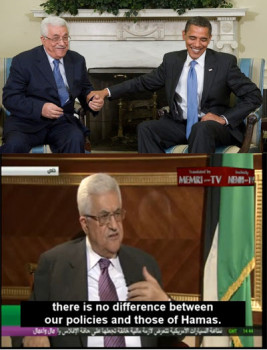
obama-abbas-hamas1-267x350

Obama keeps insisting that Mahmoud Abbas, the dictator of the Palestinian Authority, is Israel’s peace partner.

“But while I know you have had differences with the Palestinian Authority,” Obama continued, “I genuinely believe that you do have a true partner in President Abbas and Prime Minister Fayyad. I believe that. And they have a track record to prove it.”

OBAMA:” I believe that President Abbas is sincere about his willingness to recognize Israel and its right to exist, to recognize Israel’s legitimate security needs, to shun violence, to resolve these issues in a diplomatic fashion…

“In that kind of environment, where you’ve got a partner on the other side who is prepared to negotiate seriously, who does not engage in some of the wild rhetoric that so often you see in the Arab world when it comes to Israel.”

Meanwhile here is what President Abbas’ personal representative to Syria , Abbas Zaki, has to say.

“These Israelis have no belief, no principles. They are an advanced instrument of evil. They say, the Holocaust, and so on – fine, why are they doing this to us? Therefore, I believe that Allah, will gather them so we can kill them. I am informing the murderer of his death.”

[Official PA TV, March 12, 2014]

Zaki’s public anticipation of the extermination of the Israelis is significant because, as Palestinian Media Watch has reported, he is a close associate of Mahmoud Abbas. He was sent to Syria as Mahmoud Abbas’ personal representative in October 2013, and he speaks at public events representing Fatah.

Crowding more Israelis into denser areas while creating a Palestinian state certainly aids in that goal.

Abbas Zaki had previously expressed Abbas’ real agenda in various interviews.

“The agreement is based on the borders of June 4 [1967]. While the agreement is on the borders of June 4, the President [Mahmoud Abbas] understands, we understand, and everyone knows that it is impossible to realize the inspiring idea, or the great goal in one stroke. If Israel withdraws from Jerusalem, if Israel uproots the settlements, 650,000 settlers, if Israel removes the (security) fence – what will be with Israel? Israel will come to an end. If I say that I want to remove it from existence, this will be great, great, [but] it is hard. This is not a [stated] policy. You can’t say it to the world. You can say it to yourself.”

Syrian TV host: “When they talk about [the US] imposing a solution, we know that it will be deficient.”
Member of Fatah Central Committee Abbas Zaki: “You can relax. We find ourselves united for the first time. Even the most extreme among us, Hamas, or the fighting forces, want a state within the ’67 borders. Afterward, we [will] have something to say, because the inspiring idea cannot be achieved all at once. [Rather] in stages.”

[Al-Jazeera TV, Sept. 23, 201[4? — DM]

Expressing his refusal to recognize Israel earlier this year during a public lecture, Abbas Zaki started to refer to Israel’s Ben Gurion Airport as “Israel’s Airport,” but then stopped himself and corrected himself:

“When Mr. Obama came to the region during his visit, as soon as he arrived at the airport of Isra… [corrects himself], I mean, the airport where the Israelis are. I don’t want… [corrects himself] this whole country is ours, and Allah willing, the airport will also return to us.”

Yes, I’m sure a terrorist state will find lots of use for an airport.

With Gaza flaring up, the trail leads to Iran

March 13, 2014

With Gaza flaring up, the trail leads to Iran | The Times of Israel.

Islamic Jihad has been drawing closer to Tehran, and it will continue to challenge Hamas’s authority in the Strip

March 13, 2014, 10:51 am

Islamic Jihad militants in the Rafah Refugee Camp, southern Gaza Strip.  (photo credit: Abed Rahim Khatib/Flash90)

Islamic Jihad militants in the Rafah Refugee Camp, southern Gaza Strip. (photo credit: Abed Rahim Khatib/Flash90)

Let’s start with the good news: As of Thursday morning, it appears as if the parties involved in the fighting along the Israel-Gaza border, Hamas and Islamic Jihad, have calmed down. Israeli strikes Wednesday focused solely on targeting unmanned rocket launch sites. In other words, there were no Palestinian casualties in any of the 29 strikes.

Islamic Jihad stopped firing at Israel in the early evening hours of Wednesday. And while two lone rockets were fired overnight, as well as a few more Thursday morning, compared to Wednesday’s barrage it seems that the militant organization is signaling that is does not desire any further escalation.

But here is the not-so-good news. Although Hamas has exhibited impressive control of the situation in the Gaza Strip in recent years, the last sequence of events indicates that its power is no longer what it once was.

Moreover, and for the umpteenth time, Israelis received further evidence of the damaging implications internal Palestinian politics can have on Israel.

Islamic Jihad’s actions, as well as statements made by its spokesman afterwards, lead to the obvious conclusion that the organization is challenging Hamas and trying to market itself as the new leader of the Gaza Strip. It started a day beforehand, when Islamic Jihad sent its operatives to confront IDF forces near Khan Younis. During the exchange of fire, where three Palestinians were killed, Hamas stood on the sidelines and did not intervene. That same day, two more Palestinians were killed in the West Bank, and Hamas and the Palestinian Authority similarly refrained from responding — prompting Islamic Jihad’s rocket salvo on Wednesday.

Arguably the culmination of its challenge to the status quo arrived overnight, when Islamic Jihad published a statement warning the residents of Gaza that it would act against anyone suspected of collaborating with Israel. So now, Islamic Jihad, not Hamas, is punishing alleged collaborators with the Jewish state.

Islamic Jihad’s Secretary General Ramadan Shalah gave a telling interview Wednesday on Iranian TV, saying that the response of the organization would expand and become much harsher if Israel continued its actions against the Palestinians.

The message is familiar and predictable. However, Shalah’s decision to go on air in Iran suggests that Islamic Jihad is operating against Hamas’s interests under the guidance and encouragement of the Islamic Republic. Iran’s Revolutionary Guards are trying to strengthen Islamic Jihad (see: Kloc-C arms shipment) and build up its military capabilities in order to weaken Hamas, as a form of punishment to the Gaza-ruling party for participating in the fight against the Assad regime in Syria.

It now seems reasonable to assume that Iran will continue to try to undermine the relative calm in the region, either through Islamic Jihad in the Gaza Strip to the south, or Hezbollah in Lebanon and the Golan Heights to the north.

Off Topic: Strike Syria

March 13, 2014

Off Topic: Strike Syria – The Weekly Standard.

It would send a message to Russia.

4:15 PM, Mar 10, 2014 • By LEE SMITH

Who’s surprised that the Obama administration, evolved, urbane and forward-looking, is having a hard time dealing with Vladimir Putin’s unreconstructed Cold War mentality in Ukraine? “We’re hoping that Russia will not see this as sort of a continuation of the Cold War,” John Kerry said last week.  Even before the Russian invasion of Crimea, Obama was warning of the dangers of seeing the world in terms of Great Power conflict. “We’re no longer in a Cold War,” the president said at the U.N. General Assembly in September. “There’s no Great Game to be won.”

Well, to paraphrase Leon Trotsky, you might not be interested in the Cold War, but the Cold War is interested in you.  In foreign policy you never get to dictate the rules entirely since the other players also have a say. That’s true even for superpowers, and doubly so for superpowers that choose to lead from behind. If you don’t want to be backed into the Cold War, then don’t choose a former KGB officer as your dance partner.

The unpleasant fact is that Putin has not only bested the White House, but that Obama has enabled him from the very beginning of his first term. “Reset” with Russia, with the intended goals of getting Moscow to agree to Iran sanctions and to keep open the northern transport route to and from Afghanistan, made the administration subject to Putin’s whims. The White House wouldn’t dare cross the Russian strongman lest it risk policy aims the importance of which the “reset” had only underscored.

With the Syrian conflict, the White House turned Putin into the indispensable Russian. First, the administration begged him without success to abandon his Arab client. There was only a political solution to the crisis, said the White House, and Russia had the answers. Accordingly, traditional U.S. allies flocked to Sochi to petition Putin for relief. The Saudis promised to buy $15 billion worth of Russian arms if only the Russians would temper their support for Assad. Putin turned down the Saudi offer because what was more valuable than the cash was the public show that Obama couldn’t keep his allies in line and happy. Not Russia—Putin would back Bashar al-Assad till the very end which, given American impotence, virtually guaranteed Assad’s survival.

By the time Putin offered Obama a joint initiative to rid Assad of his chemical weapons, thereby saving Obama the embarrassment of not getting congressional authorization for strikes he never wanted to launch in the first place, the Russian was just telling Obama to turn over his king because the game was over. The situation in Ukraine is the culmination of “reset” and Syria.

The White House may be correct—this is not the Cold War. But history shows that, contrary to what Obama professes, the world is more often than not “a zero-sum endeavor.” There are clear winners and losers, and right now the White House is losing. 

The administration’s confused response to the crisis in Ukraine suggests that it may finally have come to understand the role of American power. U.S. foreign policy has a dual nature that, says my colleague Christopher Caldwell, is something like the medieval idea of the king’s two bodies. The king is a real man, with a body subject to the pleasures and afflictions of all men. But the king is also a symbol of the divine order that ties man to God. Similarly, the United States is at once both a nation-state like any other that pursues its own interests, while it is also something much larger, the guarantor of global security—in short, order. There are growing numbers on both the American right and left who announce they are tired of the United States having to serve as “the world’s policeman.” However, events in Ukraine are evidence that without a strong America things occur that seem distasteful and dangerous to all, like the violation of national sovereignty.

The United States has no narrow national interest in Ukraine, but as caretaker of the world’s security architecture it has a vital interest in pushing back against Putin. In order to send Putin a message in a language that will make sense to a man who has repeatedly posed bare-chested, political and diplomatic measures need to be integrated with hard power. Putin needs to be hit hard somewhere. Cold War thinking shows that there are a number of vulnerable pieces on the board and possible moves for the White House to make. The most obvious is to go back to the origin of Putin’s campaign—Syria.

Assad is not getting rid of his chemical weapons as Putin promised, so the administration should move to show that, in fact, it’s the Russian’s word that can’t be trusted, not America’s. The strikes on regime targets that Obama planned last September could serve as the White House’s notice that as far as the United States is concerned the deal’s off. Destroying the air force that Assad has used to drop barrel bombs on innocent civilians would not only restore some order to the international system, but also highlight the fact that, contrary to his boasts, the former KGB officer is incapable of protecting his allies. American allies on the other hand, from the Middle East to Asia and central Europe, will once again be reassured that their interests are safe in American hands. What a gift for Obama to bear the Saudi king when the president visits Riyadh later this month: “I told you—I got your back.”

For America and our allies, the most salutary effect of Putin’s machinations is to remind the White House of what the Cold War looks like in reality. If the administration believes that it can contain and deter an Iranian nuclear weapon, it has to reckon truly the costs involved. As it stands, Obama administration officials have an academic conception of containment and deterrence, meaning that it’s the opposite of anything like military action. As the half-century-long U.S.-Soviet standoff showed, real containment and deterrence of a nuclear power is bloody and expensive. Ensuring that the Iranians never acquire the bomb, whether that’s through sanctions and a credible threat of force, or more perhaps eventually a bombing campaign to show that the regime in Tehran will never get there, means safeguarding the global order. Let Putin and Assad serve as an example to put Iran on notice.

Israel denies truce deal with Islamic Jihad, says calm will be met by calm

March 13, 2014

Israel denies truce deal with Islamic Jihad, says calm will be met by calm – Ynet.

Despite efforts to calm the situation, Ya’alon has instructed the IDF to prepare for further escalation, and a limited amount of reserve soldiers have been called up.

Ron Ben-Yishai

Published:  03.13.14, 17:15 / Israel News

Israel has not reached a ceasefire agreement with the Islamic Jihad and will continue with the policy that “calm will be answered with calm,” as it has been doing since the end of the 2012 Operation Pillar of Defense, an Israeli security source said Thursday.

Duing the day, the Egyptians launched an attempt to end hostilities between the two sides, and it appears the message has been passed on and understood by the Gaza terror organizations.

It is now clear that the Hamas knew of Islamic Jihad’s intention to fire rockets at Israel, but it was surprised of the extent of it
almost 100 rockets and mortar shells fired since Wednesday afternoon. Despite the fact Hamas is the ruling party in the Strip, it was Islamic Jihad that negotiated with the Egyptians, and released a statement on the matter.
This undermines Hamas’ authority, but the Egyptians are having difficulties holding direct talks with Hamas so soon after declaring it a terror organization.

Despite intentions to calm things down, Defense Minister Moshe Ya’alon has instructed the IDF to be ready for the possibility that the terror organizations in the Strip will resume fire. In addition, the IDF has decided after an evaluation of the situation to call up a limited amount of reserves for its air defense, in case there is a need to the deploy more Iron Dome batteries if the situation continues to escalate.

In any escalation of violence in the Gaza Strip there’s an almost repeating pattern, especially when it’s a limited round of hostilities in which neither side has an interest in further exacerbating the situation. The round of hostilities usually starts with an incident in which many rockets are launched simultaneously from the Strip, after which the IDF responds with force. And, if there are no casualties or extensive damage to civilian property on either side – the rocket fire significantly decreases and so does the IDF response.

Islamic Jihad had already announced Thursday afternoon that an agreement on a ceasefire had been reached with Israel, and the Egyptians confirmed it. The announcement was made shortly after IAF jets attacked a terror target in the south of the Strip, including a smuggling tunnel in Rafah and likely a rocket launcher. The strike was in response to rocket fire earlier Thursday at Ashdod, Ashkelon and Yavne.

An Islamic Jihad official, Khaled al-Batsh, claimed on his Facebook page that the understandings with Israel were reached following Egyptian efforts. According to his post, the understandings are based on those reached between Israel and the Palestinian factions after Operation Pillar of Defense, according to which Israel will be committed to a calm and will not break agreements. He thanked Egypt for its efforts.

Off Topic: Was there a deal with Iran over Lockerbie bombing?

March 13, 2014

Off Topic: Was there a deal with Iran over Lockerbie bombing? – The Telegraph.

The West should come clean about who really bombed Pan Am flight 103 in 1988 – we owe it to the victims’ families

Pan Am flight 103 crashed in Lockerbie

Even though no conclusive proof could be found to link Tehran directly to the worst terrorist atrocity committed in Britain, few – myself included – were under any illusions that Iran’s Islamic republic was the centre of global terrorism Photo: AP

By
8:42PM GMT 11 Mar 2014

It seems a long time ago, that dreadful December night in 1988 when fire and aeroplane debris rained down on the Scottish village of Lockerbie. A generation of Britons has been born unaware of the sense of foreboding we all felt that night, when news broke that a civilian passenger flight had been blown up in mid-air, killing 270 people, by a terrorist bomb concealed in a radio cassette player.

It is easy to see why a younger generation finds it hard to understand that we need to be wary of Iran and its nuclear ambitions. But, back in 1988, few people were in doubt about Iran’s malign intent towards the West. Even though no conclusive proof could be found to link Tehran directly to the worst terrorist atrocity committed in Britain, few – myself included – were under any illusions that Iran’s Islamic republic was the centre of global terrorism. The ayatollahs had made clear their intention to confront the West by all means possible when Ayatollah Ruhollah Khomeini, the leader of Iran’s Islamic revolution, sanctioned the seizure of 52 American diplomats and their staff and held them hostage for 444 days, after the Revolutionary Guards stormed the US embassy in Tehran in 1979. The crisis put paid to President Carter’s hopes of re-election, and by the early Eighties the Iranians were intent on inflicting similar embarrassment on his successor, Ronald Reagan.

By using their newly created Hizbollah militia in Lebanon, they forced Washington to withdraw American peacekeeping troops from Beirut, after a series of suicide lorry bombs reduced the US embassy and marine barracks to rubble. When this attack failed to end American efforts to broker a peace deal in war-torn Lebanon, they reverted to hostage-taking, targeting American aid workers and journalists. They then turned their attention to other Western nationals such as the British, with John McCarthy and Terry Waite soon falling into their clutches.

Syria was involved throughout this anti-Western campaign. By supporting Damascus, Moscow had a rare opportunity to heap humiliation on the US. Then, as now, Syria also enjoyed a close alliance with Tehran based on their mutual hatred of their neighbour, Iraqi dictator Saddam Hussein. So Syria was more than happy to facilitate Iran’s terrorist operations in Lebanon while funding its own agenda, which focused on dissident Palestinian bodies, such as Ahmed Jibril’s Popular Front for the Liberation of Palestine (PFLP).

It is hardly surprising, therefore, that in the aftermath of Lockerbie, investigators should concentrate their efforts on the two states most closely associated with sponsoring international terror – Iran and Syria. To put it bluntly, the Iranians had the motive, while the Syrians had the expertise. After the Americans mistakenly shot down an Iranian civilian Airbus, killing 290 people, Iran felt it had good reason to seek revenge. If the evidence of a former Iranian intelligence officer is to be believed, the revenge attack was authorised by Ayatollah Khomeini, who ordered that the bombing “must copy exactly what happened to the Airbus”. As Iranian intelligence officers were already working closely with Syrian and Libyan counterparts in Malta on plots to attack the West, once the Ayatollah had authorised retaliation, it was just a question of hiring the right people for the job.

The one aspect of the inquiry that never made sense to me, as someone who has closely followed the Lockerbie case from the outset, was why Western investigators were so keen to overlook the activities of the PFLP bomb-making cell in Germany, which was caught red-handed making exactly the same kind of bomb – packed in a Toshiba radio cassette recorder – that brought down Pan Am flight 103. I was told repeatedly that there was no DNA or other evidence to link the cell with the bombing, while there was certainly enough to implicate Libya and Abdelbaset al-Megrahi, the Libyan intelligence officer eventually convicted of the crime.

In the mid-Nineties, I gleaned a tantalising insight into what really happened, when a senior British intelligence official, who had been involved in the original investigation, told me that, although there was more than enough evidence to show Iran’s involvement, there was not enough material to secure a conviction in a British court. British and American intelligence officers have – in private, at least – made no secret of their suspicions about Iran. But the issue was swept under the carpet after Washington (or so I was led to believe) did a secret deal with Tehran on the eve of the first Gulf War in 1991 to secure Iran’s support for the liberation of Kuwait, in which the West agreed to drop charges over Lockerbie in return for the release of hostages such as McCarthy and Waite.

Far-fetched as this sounds, we now know, thanks to the revelations about immunity given to IRA bomb-makers by the Blair government, that Western powers are not above making such shabby pacts. Indeed, at a time when Washington and the EU are desperate to strike a deal with Iran over its nuclear programme, the latest reports about Iran’s potential involvement in the Lockerbie bombing might be considered a great inconvenience.

If the Iranian defector can corroborate his claims, then it is high time Britain and America came clean about any deals made with Iran to hide the truth. We owe it to the victims and their families to give a full account of what happened during the events leading up to that terrible night.

Off Topic: A Baleful Peace Process

March 13, 2014

Off Topic: A Baleful Peace Process- The Weekly Standard.

For how many decades will we pursue this diplomatic dead end?

Mar 17, 2014, Vol. 19, No. 26 • By REUEL MARC GERECHT

To be outrageously iconoclastic among the Washington foreign-policy crowd is easy: Just suggest that the Israeli-Arab peace process is not merely pointless but actually damaging to America’s position in the Middle East and bad for both Israelis and Palestinians. Such a view is anathema not only to the liberal foreign-policy establishment, which instinctively does the peace process because Americans have been doing it for five decades (it’s what problem-solving, well-intentioned Americans do), but also to the establishment’s “realist” set, who usually view Israel as a strategic liability: Israel vs. 22 Arab countries; 6 million Jews vs. 425 million Arabs, with another billion Muslims howling from the bleachers. 

Masked nostalgists in the West Bank, 2013

Masked nostalgists in the West Bank, 2013. Newscom

Liberals and realists mix, of course, which is what we’ve got in Barack Obama and his secretary of state, John Kerry. The president also gives off a whiff of a sentiment common on the left, especially in Europe and increasingly in Israel itself: The creation of Israel denationalized the Palestinians. America supported Israel’s birth, but failed, so the argument goes, to give equal justice to the Palestinians. And without justice for the Palestinians, the Middle East will not be stable. It’s a stunning tribute to the perdurability of this belief that even after the Great Arab Revolt—which has roiled the entire region, unleashing in Egypt the rise and fall of the Muslim Brotherhood and a new wave of fascism; in Syria, regime savagery and virulent Islamic militancy; and in the Gulf, Mesopotamia, and the Levant, a Sunni-Shiite rivalry that could well provoke the spread of nuclear weapons—serious people in Washington want to spend America’s capital on talks between West Bank Palestinians and the Israelis, neither of whom appear to care as much about these discussions as American officials.

Some do want to move beyond the peace process. In Europe, and in many academic quarters in the United States, Israel’s birth is akin to original sin, a naqba or calamity as the Arabs put it, which now can be relieved only by a “one-state solution”—the Jewish homeland ceases to exist—since the Israelis simply will not make the concessions necessary for a “two-state solution” to work. The one-state solution, like the two-state approach advanced by Westerners feeling guilty about the Palestinians’ plight, has a strong moral pull for its advocates since they see Palestinian claims as at least equal to Jewish ones. Israel’s founding generation mostly fled lethal anti-Semitism in Europe and the Middle East. But anti-Semitism wouldn’t have become so acute among Muslims, many suggest, if modern Israel had never been born. Therefore Jewishness ought to be the minority identity in the Holy Land. By their years in residence and their numbers, Arabs have the more compelling case. 

It’s astonishing that thoughtful people can actually advocate this scenario. (See the former Wall Street Journal foreign correspondent Hugh Pope’s memoir, Dining with Al-Qaeda, for a straightforward expression of a sophisticated Brit’s exasperation with Israeli “intransigence.”) Even the briefest trip to Israel, where rampant individualism and muscular capitalism have transformed a rather primitive socialist state into an economic, military, and cultural powerhouse, should suggest that the Jewish state isn’t going to self-immolate because of European distaste and Israeli angst. But bad ideas are sticky when fueled by Western guilt. 

Although many anti-Zionists in America and especially abroad back the “peace process” as a way of righting a perceived wrong and, sometimes, camouflaging old-fashioned anti-Semitism, it is actually well-wishers of Israel who regard peace-processing as the eleventh commandment. The American Israel Public Affairs Committee and the Washington Institute for Near East Policy both view the Middle East through an Israeli security lens, and both adamantly hope for a happy outcome through multilateral, American-guided diplomacy. Among members of the influential American Jewish Committee, which works hard to protect Jews worldwide, the peace process is almost as sacred as the determination to be politically bipartisan. American Jewry may not be overwhelmed by arguments about Palestinian rights, but it wants Israel to be secure, and the peace process is seen as the only path, however tortuous, to the permanent normalization of Israel’s existence. 

Then there are those, like Jeffrey Goldberg, Thomas Friedman, and Peter Beinart, who sincerely worry about the democratic and moral identity of a Jewish state that rules over 2.5 million Palestinians on the West Bank. Israel’s occasional violent intrusions into Gaza are also distressing, but they aren’t as corrosive to the Israeli spirit, so it seems, because Hamas, a fundamentalist, jihadist outfit with a fondness for Qassam missiles, runs the Strip. President Obama and Secretary of State Kerry appear now to be in this camp. In a recent interview with Goldberg, the president expressed his foreboding: 

Do you resign yourself to what amounts to a permanent occupation of the West Bank? Is that the character of Israel as a state for a long period of time? Do you perpetuate, over the course of a decade or two decades, more and more restrictive policies in terms of Palestinian movement? Do you place restrictions on Arab-Israelis in ways that run counter to Israel’s traditions? 

Israel needs to solve this fundamental challenge to its moral integrity lest it feed the boycott movement in Europe and the United States, which Obama and Kerry have underscored. Although both men have said they don’t support this movement, it doesn’t take a logician to see that if the Israelis are guilty of unnecessary coercion and theft, as Obama and Kerry are saying they are, then why shouldn’t they be boycotted? Obama and Kerry may have put a time-delay on their opprobrium, but their judgment is clear. This growing angst about Israel’s integrity, and thus its existential legitimacy, seems to have gained ground since 9/11 among liberals, both Gentiles and Jews, even among those who’ve usually been more concerned about the Palestinian cause than Israeli democracy. 

A more liberal, more democratic Israel

It has always been part of the American gospel to believe “that the rule of one people over another offends against a basic principle of nature, if not a higher edict,” to borrow from the Middle Eastern historian J.B. Kelly. Since the collapse of Europe’s empires, Europeans too have made anti-imperialism part of their moral DNA—though they, like Americans, get much less exercised about this offense when non-Westerners are lording it over other non-Westerners (Tibetans, Uighurs, Kurds, Muslim Caucasians, and so on don’t elicit the same passion as the Palestinians). Most Israelis would surely prefer to have as little administratively to do with the Palestinians as possible. And it would certainly be better for Israelis and especially Palestinians if Palestinian terrorists planning a strike against Israelis, or receiving aid from Iran, were always taken down by Palestinian security forces without Israeli assistance on the ground. It would no doubt be an incredible relief to Israelis to have a responsible Palestinian gendarmerie in the Jordan Valley that could police the -border to ensure nothing crosses that threatens Israel or Jordan. Israelis and Palestinians ought to know that their good fortune or bad luck is in their own hands. 

But Israeli democracy has been doing extremely well since 1967, when Israeli forces took East Jerusalem and the West Bank from Jordan’s late King Hussein, who considered both his rightful patrimony. Israel has become vastly more liberal, and even more sensitive to Arab concerns, both Palestinian and Israeli, in the last 20 years. Israelis may be rough in their views of Arabs, but they are more concerned about civil liberties for all citizens—Jewish, Christian, and Muslim—even through the intifadas and suicide bombings. Israeli Arabs, it should be noted, show no desire to leave Israel for the West Bank, Gaza, or Jordan. It is odd to depict the Jewish state’s democracy as mortally threatened by its soldiers’ continued presence on the West Bank when the last 47 years have seen the efflorescence of this culture. 

Duty on the West Bank is certainly no fun for Israeli soldiers, and may well coarsen many of them; it’s probably worse for the officers of Shin Bet, the internal-security service, who really have the front-line duty. What Andrew Sullivan said about America fighting in the ethically challenging Middle East, that it tarnishes our virtue, is no less true for Israelis who must operate cheek by jowl with Muslims who might use young women as suicide bombers. Yet this morally harsh service hasn’t retarded the growth of a much more vibrant, open, and self-critical culture and politics. Israel in 2014 is a healthier country than Israel in 1966. It’s possible that Israel’s difficulties on the West Bank have actually sped this evolution. 

Israel’s complicated and challenging supervision of the West Bank hasn’t slowed the engine of individualism, the defining creed of the West, which in Israel as elsewhere keeps seizing new ground from traditional mores, local communities, and the state. It’s not unusual to see Israeli tourism ads aimed at Europe showing off the physical beauty of Israeli men and women, for both heterosexuals and gays. Orthodox Israeli Jews may be having more babies than their secular compatriots, but the thrust of Israeli society is ever more “global.” It may be galling to some to imagine Prime Minister Benjamin Netanyahu, icon of Likud bellicosity, as a promoter of liberal culture, but the capitalist ethic that he helped unleash has made Israeli society much more nonconformist and varied, more like Western Europe and America—and culturally more distant from the Muslim Middle East, which has become more conservative as it has modernized. It has also probably made Israel open to, if not optimistic about, the possibility of peace with Muslim Arabs. 

Fatah’s right to power

Since Israel turned over part of the West Bank to Fatah, the lead group within the Palestinian Liberation Organization, in 1994, Israelis have become understandably more nervous. Until the building of the West Bank barrier, started in 2002, Fatah-orchestrated security, despite tutorials from the Central Intelligence Agency, was an inadequate, lethal mess. The death in 2004 of -Yasser Arafat, the longtime chairman of the PLO and the spirit-ual father of Palestinian nationalism, helped improve the situation considerably since Arafat had personally orchestrated suicide-bombings. (The PLO documents that Israeli forces seized in Operation Defensive Shield in 2002 prove the Nobel Peace Prize winner’s guilt.) Mahmoud Abbas, Arafat’s successor as the head of the Palestinian Authority, has been much better. Corrupt, authoritarian, old, charisma-free, and ideologically off-balance in confronting the Islamist challenge from Hamas, the Palestinian offshoot of the Egyptian Muslim Brotherhood, Abbas is less ideologically and religiously complicated than Arafat, whose identity was deeply entwined with insurgency and violence. 

Since the Oslo Accords of the early 1990s, the Israelis and the PLO have divided the West Bank into three zones: Area A, where Abbas and his men have complete control; Area B, where Palestinians are responsible for civil administration and Israelis and Fatah share security duty; and Area C, where Israelis are solely responsible for administration and security. In areas under Fatah’s sway and in the shared zone, the Palestinian Authority has erected a police state of Palestinian design and method. If West Bank Palestinians actively support Hamas, it is Fatah’s or Israel’s security services or both together who will come calling. If liberal secular Palestinians not enamored of Fatah’s endemic corruption and heavy-handed rule protest too loudly and live outside Israel’s zone, it’s Abbas’s men who will do the thumping. The Palestinian police state is financed in part by Israeli tax-transfer payments and in part by American and European aid.

Depending on where they live in the West Bank, Palestinians may regularly encounter Israeli checkpoints that mostly secure the Jordan Valley and protect Israeli settlements surrounding Jerusalem and hugging the 1948 armistice line. Security checkpoints are time-consuming, degrading, and provide endless opportunities for cultural clashes. Many of these Israeli checkpoints went up because Palestinian jihadists were detonating themselves among Israeli civilians. It’s an astonishingly shallow and Western view of Islam to believe that Palestinian suicide bombers incinerated themselves, as well as Jewish, Muslim, and Christian Israelis, because they were upset about the boundary lines proposed in the failed 2000 Camp David negotiations. It’s also an exceedingly naïve view of intra-Palestinian relations to believe that Hamas’s men, who are dedicated to the liberation and Islamicization of all of Palestine (Israel, the West Bank, and quite possibly Jordan, too) will give up their divine mission if Abbas and Fatah can declare East Jerusalem and Israeli settlements theirs. 

In 2000 Arafat, and in 2008 Abbas, refused to make a final deal with Israel. Israeli prime ministers Ehud Barak and Ehud Olmert were willing to give far more, in East Jerusalem, the West Bank, and the Jordan Valley, than any Israeli government is likely to offer again, but small land swaps and the Palestinian “right of return” reportedly separated the two sides. Most likely, the deal was impossible because the men of Fatah know that it isn’t just the true believers of Hamas who are deeply uncomfortable with renouncing the claim to all of “Palestine.” The right of return for Palestinians has been such a sticking point because it is in essence their claim to Israel.

If implemented in the “just” way envisioned by the Palestinian side, the right of return would immediately convulse Israeli society—which is, of course, the point. Philosophically, the right of return is the Palestinian Trojan horse, the last chance Palestinian Muslims have to break down Israel’s walls. No self-respecting Muslim Palestinian nationalist would dream of putting thousands, let alone hundreds of thousands, of his own people under Israeli dominion unless he thought it was a liberating act. Indeed, many in Fatah would doubtless like to try to fleece the West for as much money as they could get through a cash-per-refugee deal so long as Palestinians abroad didn’t actually move to the West Bank. Many Palestinian “refugees” (using this term after 66 years is problematic) would be totally unacceptable to Fatah for the simple reason that they might be sympathetic to Hamas. And Palestinians abroad would not necessarily want to live on the West Bank, while the status-quo-loving, Hamas-fearing elite of Fatah, who have done well in what President Obama has described as an “unsustainable” situation, certainly do not want hundreds of thousands of disruptive immigrants to invade their little world. For Fatah, there is only one safe place to put Palestinian refugees—inside Israel. 

Palestinian activists want to make their cause a Middle Eastern imperative. The Iraqi-American intellectual Kanan Makiya took a real hit to his reputation among Arab and Western leftists when he argued that Arab intellectuals had done an enormous disservice to Arabs by highlighting the Palestinian cause above democracy and human rights within Arab states. Fouad Ajami, the Lebanese-American scholar, has accumulated many sins in the eyes of the Middle Eastern cognoscenti, but among the most annoying has been his sensitivity to issues beyond the Israeli-Palestinian clash that created “the Arab predicament.” Because of their profound affection for the Jewish state, well-wishers of Israel also tend to make Israel the center of the Middle East—a position that the state simply does not deserve. 

The Muslim Middle East

Take any of the major movements in modern Islamic history, and Israel’s role in their formation has been minor. Arab militarism started long before 1948, with the Westernization of the Middle East in the 19th century. The Ottoman Empire, which dominated the Near East and much of North Africa before the rise of European power, naturally put a heavy focus on the creation of a Westernized professional military class once it became obvious that hitherto fearsome Ottoman armies could be sliced-and-diced by more mobile, smaller European forces using artillery with increasing precision and speed. Egypt’s Muhammad Ali Pasha (who reigned 1805-1848) and his descendants set the stage for the militarized Arabism that came with the triumph of the “Free Officers” in 1952. In Egypt, Sudan, Syria, Algeria, and the always-intellectually-vivacious Lebanon, “Arabist” ideas percolating since the 1890s gained a following in the tumult following World War I. Arabism, like its less Westernized relative, the Islamism of the Muslim Brotherhood, developed because of the perceived rot of Islamic societies. The creation of Israel and the military triumph of Jewish armed forces in 1948 were simply further proof of the decay and corruption of Muslim lands and their rulers. Israel’s devastating defeat of Arab armies in 1967 accelerated the collapse of Arabism as a motivating ideal, and strengthened the Islamist critique of Muslim weakness. But Israeli power didn’t cause the rise or fall of Arabism; it had nothing to do with the flowering of Islamic fundamentalism. 

The most extreme forms of Islamic militancy—al Qaeda on the Sunni side and the Iranian revolution on the Shiite—treat Israel as a subset of a much larger Western threat, led by the United States. Israel has taken center stage for militant groups face-to-face with the Jewish state—Hamas in Gaza and the West Bank and Hezbollah in Lebanon. But that is the exception, not the rule. Many commentators view Hamas as a byproduct of the Israeli-Palestinian collision. A peace deal with Fatah would thus blunt, if not kill Hamas, since a partial Palestine with the Temple Mount flying the Palestinian flag would cripple the Islamist cause. 

But Islamism has grown among Palestinians, as it has among Arabs everywhere, because Muslims have failed to compete militarily, economically, and culturally with the West. The brutality, cultural obsequiousness, and corruption of the ruling Westernized Palestinian elite has also helped. Hamas’s total rejection of Israel has deep Muslim roots; this is also true, oddly enough, of the secular Arab nationalist and pan-Arabist rejection of the Jewish state. Israel defies the Koranic narrative, according to which the great Jewish prophets are actually Muslims before the coming of the final prophet, Muhammad. Israel’s foundational narratives—the Hebrew Bible and the Diaspora, the historical mainspring of the Jewish claim to modern Israel—are nonsensical and repellent to believing Muslims. In the same way that secularized Muslims have been unable to outflank decisively the fundamentalists on social issues, especially those relating to family law where stipulations are clear in the Koran, secular Muslims have been unable to ignore the religious narrative about the Jews. For most, even the most secular, religious sensibilities are operating in the background. Europe and America, where secular political elites rule, have always shied away from religion in the Israeli-Palestinian conflict since it makes an already complicated situation intractable. 

The explosive growth of anti-Semitism in the Muslim world is obviously connected to Israel, its victorious wars over Muslim armies, and the Israeli-Palestinian imbroglio. But even here, one needs to be cautious in assessing the catalyst and proffering cures. Classical Muslim bias against Jews is rooted in the communal struggles on full display in the Koran. The prophet Muhammad, who drew deeply from both Jewish and Christian sources to create his narrative, depicts Jews as being learned but treacherous. His characterization undoubtedly reflects frustration with the Jews of Medina who failed to accept his prophecy, even though he’d rooted Islam firmly in Judeo-Christian history. Islam’s staunch monotheism and, later in its development, the omnipresent Holy Law have more in common with Judaism than Christianity, where the Trinity and Mary and the emphasis on theology over law create a different, more anthropomorphic, more feminine spirituality. 

This traditional Muslim bias against Jews, which occasionally led to persecution but rarely to pogroms, in the 1930s began to mix with modern European anti-Semitism, which gives the original Christian gravamen against the Jews (their rejection of Jesus) an ever-nastier twist, becoming, via Christendom’s inquisitional period, a sin of blood as much as creed. European anti-Semitism’s nastiest versions, in the Third Reich and the Soviet Union (Jews as nefarious, irretrievably clannish, devilishly clever, capitalist oppressors), gained traction in the Middle East as Zionism gained ground and Israel gained strength. Israel’s existence was for many Muslims proof of a global Jewish conspiracy. It’s possible that a resolution of the Israeli-Palestinian clash could break the growth of virulent anti-Semitism in the Middle East, which is now mainstream. But it’s increasingly doubtful unless the larger intra-Muslim tugs-of-war, between secularism and the faith, and between authenticity and modernity, are resolved. 

Let Palestinians vote

America has always wanted to cheat in the peace -process: to import into the Middle East the mores and preferences dominant in the West since World War II, minus one rather important principle: democracy. The Israelis would trade post-1967 land for peace. Given enough land, the Israelis and Palestinians would get along. How the Palestinians ruled themselves was irrelevant to this scheme. It’s not a coincidence that the peace process has again risen in America’s agenda as dictatorship has reasserted itself in the region. With the fall of the democratically elected president Mohamed Morsi in Egypt and the rise of Field Marshal Abdel Fattah al-Sisi’s military junta, which has sent Hamas in Gaza into a deep funk, the Obama administration can more easily advance a top-down approach to West Bank Palestinian politics and the peace process. That Abbas has been ruling for over five years without an electoral mandate doesn’t matter. The peace process transcends the question of democracy and civil rights. And Abbas is, as President Obama confidently tells us, a man of exceptional gifts in the Middle East since he is “sincere about his willingness to recognize Israel and its right to exist, to recognize Israel’s legitimate security needs, to shun violence, to resolve these issues in a diplomatic fashion.” 

And Israelis are likely to play along since they, like Abbas and his Fatah lieutenants, are content with the status quo and scared to death of change. President Obama is right that the Israelis should take risks for peace: They should insist that the Palestinian Authority be ruled democratically. But Israelis, understandably, are subject to the authoritarian temptation since free elections in the West Bank, Gaza, Jordan, and Egypt could bring Islamists to power. Westernized authoritarian rulers, after their unsuccessful wars against Israel, have signed treaties with the Jewish state. But as the tumult of the Great Arab Revolt showed, the Arab authoritarian states are built on shifting sands. The emergence of democracy was erratic and ugly in the West; it’s proven tumultuous in the Middle East. But if the anti-Zionist and anti-Semitic cancer is to be stopped among Muslims, it will only be because faithful Muslims have come to terms with Zion in their midst. 

New elections in Gaza and the West Bank might reveal that Hamas has lost its sway; they might reveal that Fatah has gained ground in Gaza, thanks to Hamas’s Islamist tyranny, but lost ground on the West Bank; they might reveal that the Palestinian people have grown less enamored of both parties; or that the Palestinians, overwhelmingly Muslim, have no desire whatsoever to renounce their “right of return” or accept land swaps. Democracy could kill the peace process. 

If so, so be it. There won’t be lasting peace between the Israelis and Palestinians—the kind of peace where Israeli forces are withdrawn from the West Bank, Shin Bet no longer unilaterally undertakes night raids, and the barrier comes down—until peace is a democratic mandate, born of a civil society that demands its own rights before demanding rights from Israelis. That time is probably far off—though we may be only in the early stages of the Great Arab Revolt, and time moves quickly in a revolutionary age. An American-led effort to use the West’s financial weight to improve and democratize Palestinian governance would be arduous but not hopeless; certainly no more arduous and frustrating than the egregiously misnamed peace process has been for 40 years. American determination to improve Palestinian governance and civil liberties, which will surely infuriate Israelis who’ve grown comfortable with the Fatah police state and settlements that make no security sense, could most likely derail any divestment movement in the European Union. The EU isn’t a hopeless political theater for Israel, especially not with American diplomatic muscle behind it.

It’s still too soon to know whether Barack Obama and John Kerry will do as much harm in the Holy Land as Bill Clinton and his peace-processing minions did (Yasser Arafat deserves the lion’s share of the credit for the second intifada, but the naïve, Clinton-propelled Camp David talks get partial credit for the blood later spilled). Odds are another blood bath isn’t in the making since Abbas and his spoils system might be the first victims. For Arafat, chaos was always an opportunity. By comparison, Abbas and company are downright timid. Yet Washington still might help plunge Israel, the West Bank, and Gaza into violence. When this round of peace-processing fails, as it will, the United States will not look wiser or more powerful. And that, in the Middle East, is never a good thing.

Reuel Marc Gerecht is a contributing editor to The Weekly Standard and a senior fellow at the Foundation for Defense of Democracies.
This round of the undeclared Iranian-Israeli war – the Jihad missile offensive – winds down

March 13, 2014

This round of the undeclared Iranian-Israeli war – the Jihad missile offensive – winds down – Debka.

DEBKAfile Special Report March 13, 2014, 10:57 AM (IST)

Israeli civilians run for cover from Palestinian rockets

Israeli civilians run for cover from Palestinian rockets

A fresh volley of rockets was fired against Ashkelon, Ashdod, Yavneh, and Gedera Thursday, March 13, as Israel’s inner security cabinet met to determine how the IDF should handle Jihad Islami’s massive assault against Israel Wednesday. After Israel retaliated with 29 air strikes against its positions, the Palestinian Jihad decided to follow up on its first round of 70 missiles Wednesday, that were fired on orders from its boss, Al Qods Brigades chief Gen. Qassem Soleimani, to punish Israel for capturing the Iranian missile ship last week. 

 Military sources reported that the barrage had consisted of up 100 rockets fired, but one-third fell short and exploded inside the Gaza Strip.

The follow-up round Thursday targeted Israel towns within a wider radius than the first.

Prime Minister Binyamin Netanyahu and Defense Minister Moshe Ya’alon warned that Jihad and Hamas too, as overlords of the Gaza Strip, would rue the day they harmed Israel. This the military initiative in the hands of Jihad Islami and its puppet master, Gen.Soleimani.

So far, Israel and Iran have kept their undeclared war within certain limits.

But the capture of the Iranian missile ship led Iran’s Palestinian proxy, Jihad Islami, end-users of its arms cargo, to even the score. On Tuesday, three Jihad operatives fired mortars from southern Gaza at an Israeli military patrol. They were shot dead as they fled the scene. Jihad had fabricated the pretext for letting loose a continuous volley of Qassam and Grad missiles across a broad front that sent more than half a million Israeli civilians running for shelter.

Iron Dome batteries intercepted no more than three, although property was damaged in downtown Sderot. The day was overcast and rainy, which the Palestinian terrorists judged would obviate Israeli Air Force retaliation. But that night, the Israeli air force pounded 29 Jihad positions up and down the Gaza Strip.

By then, they had emptied out and so no one was hurt. Neither were there casualties from the Palestinian rocket offensive, the most extensive since the Israel’s Pillar of Defense Gaza operation in 2011.

This was because the Palestinians in their first round aimed for the shock effect of surprise rather than precise targeting and so most of the rockets landed outside residential areas. Jihad possesses more accurate weapons with far longer ranges than those used Wednesday, but held them back until Thursday.

Israel and Iran are conducting an unusual kind of war: Israel has struck Iranian and allied military targets in Syria, Lebanon, the Gaza Strip and the Red Sea. Tehran has hit back by activating allied Palestinian and Lebanese pro-Hizballah terrorist organizations against Israel. Israeli reprisals were confined to air strikes on empty terrorist buildings.

So both sides appeared to be keeping to certain boundaries.

But the Jihad was ordered – or tempted – to carry on.
The Jewish festival of Purim begins Friday, March 14, with children parading in costume and carnivals in Israeli towns, presenting an attractive target for provoking violence that would spread to additional sectors in southern Israel, or even Sinai and northern Israel’s borders with Syria and Lebanon.

The first three rockets fired from the Gaza Strip Thursday morning appeared to have come from Salafist groups linked to al Qaeda. They also demonstrated the tinderbox quality of the atmosphere around Israel’s borders and provided Jihad with a surrogate of its own for blasting Israel untouchably from Egyptian Sinai.

Islamic Jihad in Iran’s arms

March 13, 2014

Islamic Jihad in Iran’s arms, Israel Hayom, Dan Malgalit, March 13, 2014

The elements are well known. Iran probably gave the green light to Islamic Jihad’s militias, commanding them to respond to the seizure of its missile ship in the Red Sea, which was meant to be unloaded in Sudan and smuggled overland to the Gaza Strip. That operation marked a serious blow to Iran’s status, and it is responding with measures that will bury Israeli claims against the ayatollah regime.

The firing of 60 rockets and mortar shells from the Gaza Strip on Wednesday at towns across the western Negev sent a more resolute message than anything Israel has known since the launching of Operation Pillar of Defense some 16 months ago. It doesn’t take a prominent think tank using information based on confidential intelligence reports to asses with a high degree of probability, albeit with a low degree of certainty, what may have caused Islamic Jihad to set the southern region ablaze.

The elements are well known. Iran probably gave the green light to Islamic Jihad’s militias, commanding them to respond to the seizure of its missile ship in the Red Sea, which was meant to be unloaded in Sudan and smuggled overland to the Gaza Strip. That operation marked a serious blow to Iran’s status, and it is responding with measures that will bury Israeli claims against the ayatollah regime.

Under explicit instruction from Tehran, Islamic Jihad could make emphatic demands from the Hamas regime in Gaza. They encounter a degree of understanding, especially because relations between Iran and Hamas have grown closer since Hamas was seriously disconnected from the central government in Egypt. This is the first time since Operation Pillar of Defense — which was more successful than its predecessor Operation Cast Lead — that Palestinian terrorist groups have come together with this much understanding against Israel and Egypt.

The rest of the dividends are of secondary importance. From Islamic Jihad’s and Hamas’ perspectives, this is an opportunity to sabotage the negotiations between Israel and the Palestinian Authority, which rules from Ramallah, and to disrupt British Prime Minister David Cameron’s visit to the Knesset.

The necessary Israeli response is not the one suggested by Foreign Minister Avigdor Lieberman on Channel 2. He would like to see a complete occupation of the Gaza Strip. The price of occupation would not be very high. But afterward, the cost of maintaining control of Gaza would be steep indeed, both in terms of increasing terrorist attacks against Israeli soldiers on the field and in terms of the fact that the international community, in its self-righteousness, will forget within a few days why Israel had to recapture that loathsome strip of land in the first place. Israel won’t know how to get out of that one without bowing its head in shame.

The government, however, isn’t even going to discuss his declaration. We could even guess that Lieberman won’t deliberate his own suggestion; it signified nothing more than a political-populist proclamation.

As was anticipated, Defense Minister Moshe Ya’alon ordered the closure of the Israel-Gaza crossing to prevent Gazan residents from paying visits to security prisoners, but in a few days Israel will ease the punitive measures. The EU is already preparing a perturbed statement condemning the starvation of Gaza’s residents, with the backing of several individuals in Israel.

On Wednesday, Israel opted for proportional retaliation: impressive, thunderous and damaging enough to Islamic Jihad, but not enough to engender another round by Palestinian terrorists. The cease-fire will resume for a while. But the developing reality on the Gazan front is a good reason to be extremely attentive to every meticulous security arrangement Israel needs in all arenas and along the border.

Ministers to hold emergency meeting as rocket fire resumes

March 13, 2014

Ministers to hold emergency meeting as rocket fire resumes | The Times of Israel.

Iron Dome downs missile fired at Ashkelon; politicians reject FM’s suggestion that the IDF occupy the Strip

March 13, 2014, 10:12 am

Israelis stand near a hole caused by a rocket fired from the Gaza strip into the southern city of Sderot on Wednesday, March 12, 2014 (photo credit: Flash90)

Israelis stand near a hole caused by a rocket fired from the Gaza strip into the southern city of Sderot on Wednesday, March 12, 2014 (photo credit: Flash90)

Prime Minister Benjamin Netanyahu was set to convene an emergency cabinet meeting Thursday morning to discuss the situation in the south after terrorists hit Israel a day earlier with the largest barrage of rockets since 2012.

Early Thursday morning, the IDF reported that two additional rockets were fired from Gaza but landed in open areas within the strip. Later in the morning, alert sirens sounded in coastal cities of Ashdod and Ashkelon as rockets were fired from the Strip. The Iron Dome system downed one of the rockets over Ashkelon, while two others fell in unpopulated areas.

On Thursday morning, Netanyahu vowed to respond forcefully to further strikes. “There are no free shots, and terrorist elements in the Gaza Strip should start internalizing the fact that they are dealing with a very determined government and a very strong army,” Netanyahu said Thursday morning.

He also noted that Palestinian Authority President Mahmoud Abbas did not condemn the rocket fire from Gaza but rather only the Israeli response. Netanyahu added that in order to move toward peace, the PA must be unequivocal in condemning terror.

“Our policy in the south is clear — we thwart and strike anybody who tries to strike us, and we respond with great force against every attack,” he said. “I want to make it clear that anyone who tries to disrupt our Purim celebrations – we will strike them hard.”

On Wednesday night, Economy Minister Naftali Bennett (Jewish Home) visited a family in the embattled city of Sderot near the Gaza border.

“The IDF is responding [to the rocket fire from Gaza] intensely now,” he said in a statement posted to Facebook. “If there is no quiet for the Abutbol family, there will be no quiet in Gaza,” he added, echoing a statement made earlier by Netanyahu.

Two rockets fired from Gaza landed in the Eshkol Region overnight after the Israel Air Force launched airstrikes on 29 targets in the Gaza Strip Wednesday night in retaliation for over 50 rockets and mortar shells that were fired into Israel earlier that evening.

Israeli military sources said after the late-night retaliatory strikes that Israel would now wait to see how Hamas and Islamic Jihad responded. If there were no further rocket attacks on Israel, the flare-up would be over. But if there was more rocket fire, Israel would again respond.

Palestinians said at least five strategic points were hit in the coastal enclave, primarily in areas around the cities of Khan Younis and Rafah.

Environmental Protection Minister Amir Peretz (Hatnua), himself a resident of Sderot, told Israel radio that Hamas must be held accountable even for the actions of other terrorist groups.

“Hamas can impose its authority [if it wants], but instead it allows more radical elements to ignite the region,” he said, adding that Foreign Minister Avigdor Liberman’s call for a reoccupation of Gaza was not the answer.

Liberman told Channel 2 Wednesday night that the IDF was prepared to take immediate action in order to eradicate the threat of rocket fire from the Strip.

“There is no way to avert a full occupation of the Gaza Strip; only then can we ensure that these images do not recur,” the foreign minister said. “We cannot ignore such an attack, a barrage of 50 rockets and mortar shells.”

Deputy Minister of Defense Danny Danon (Likud) agreed with Peretz that it was too early to start talking about occupation, despite the fact that he found the prospect “enticing.” He added, however, that “if the IDF said that it was the only way to ensure peace in the south, the political leadership would discuss the matter, but there is no quick-fix solution” to the problem.

Meretz Chairwoman Zahava Gal-on took to Facebook Thursday morning to express solidarity with residents of the south and to take Liberman to task for his suggestion.

“Tell me, Mr. Foreign Minister, have you lost your mind?” she wrote. “Do you want to give Islamic Jihad the biggest prize they could have hoped for and to the residents of the south the greatest punishment that could befall them?

“I am sure that you don’t particularly care about the thousands of Palestinians who would be killed in this invasion, and it’s also not clear how many Israeli casualties you are ready to absorb in order to fulfill this apocalyptic fantasy. A hundred? Two hundred? Five hundred? How many military funerals are you prepared to attend?”

Gal-on went on to question how occupying Gaza jelled with Liberman’s previous suggestions that Israel completely cut itself off from the Strip and employ population exchanges in order to make a peace agreement viable.

“I have a simple suggestion,” she added. “If the foreign minister misses Gaza so much, he is welcome to pack his bags and move there himself, without taking with him half of the IDF and without putting the lives of southern residents in danger.”


