Archive for March 12, 2014

As rockets rain down, Liberman calls for IDF to recapture Gaza

March 12, 2014

As rockets rain down, Liberman calls for IDF to recapture Gaza | The Times of Israel.

Amid largest Palestinian attack since 2012, FM says government must ensure security even at the cost of terminating peace talks

March 12, 2014, 7:02 pm

Foreign Minister Avigdor Liberman (photo credit: Miriam Alster/Flash90)

Foreign Minister Avigdor Liberman (photo credit: Miriam Alster/Flash90)

Foreign Minister Avigdor Liberman on Wednesday evening said the IDF should reoccupy the Gaza Strip in response to an ongoing, massive rocket bombardment of southern Israel, and said that the Israeli government must defend its citizens even at the cost of terminating peace talks with the Palestinians.

Liberman told Channel 2 that Israel could not abide the firing of dozens of rockets at civilian targets in a single day, and added that the IDF was ready to take immediate action in order to eradicate the threat of rocket fire from the Strip.

“There is no way to avert a full occupation of the Gaza Strip; only then can we ensure that these images do not recur,” the foreign minister said. ”We cannot ignore such an attack, a barrage of 50 rockets and mortar shells.”

The Islamic Jihad, which took responsibility for the attacks, put the number at 90 rockets.

Liberman insisted that only a full-scale military invasion of Gaza could sufficiently counter the rocket threat, and stressed that he would not accept a smaller-scale operation across the border.

“I will vote against any limited operation,” he said. ”They have [arms] caches, hideouts for thousands of missiles, and every day they increase their efforts.”

Asked whether he would push for military action even at the expense of peace talks, Liberman said that the security of Israel’s citizens outweighed concerns over the success of the political process.

“No sovereign state can accept a situation in which its citizens are not secure,” the foreign minister stated. ”There is no price to big to pay in order to ensure that the citizens of Israel stay protected.”

No Israeli casualties were initially reported in the largest attack from the Strip since Operation Pillar of Defense in late 2012.

Illustrative photo of a Grad rocket fired toward Israel from the Gaza Strip. (photo credit: Jorge Novominsky/Flash90/File)

Illustrative photo of a Grad rocket fired toward Israel from the Gaza Strip. (photo credit: Jorge Novominsky/Flash90/File)

Most of the rockets were reported to have fallen in open areas, though at least one rocket landed in a residential neighborhood. Damage was reported in two impact sites.

IAF jets were reportedly flying over the Strip, apparently in an effort to thwart further rocket launches, and tanks fired shells at several targets in the coastal territory.

The army said some of the rockets were intercepted by the Iron Dome defense system.

Officers in the southern command convened Wednesday evening to discuss possible responses to the attack.

Meanwhile, security agencies in the Strip evacuated their headquarters for fear of Israeli reprisal, Sky News reported.

The Islamic Jihad took responsibility for firing some of the rockets at Israel, and indicated that the attack was retaliation for the Tuesday killing at the hands of the IDF of three Islamic Jihad operatives as they prepared to fire at Israel from the Gaza Strip.

“The Al-Quds Brigades responded to (Israeli) aggression with a volley of rockets,” the group said in a statement Wednesday, minutes after the rocket attack.

Following the rocket attack, Prime Minister Benjamin Netanyahu said Israel would forcefully respond to any threat on its citizens.

Prime Minister Benjamin Netanyahu speaks in Eilat on March 10, with the Iranian missile shipment behind him (photo credit: AFP/Jack Guez)

Prime Minister Benjamin Netanyahu speaks in Eilat on March 10, with the Iranian missile shipment behind him (photo credit: AFP/Jack Guez)

“It seems that the rocket fire came in response to our counter-terrorism operations yesterday,” Netanyahu said. “We will continue to thwart and harm those who wish to harm us, and we will act against them with great intensity.

“Last year, the number of rockets fired from Gaza was the lowest in a decade, but we will not settle for that. We will continue to ensure the security of Israeli citizens in the south and throughout the country.”

Last week, Israel intercepted what it said was an Iranian shipment of rockets intended for terror groups in Gaza. Israeli military sources said the arms, including 409 rockets, were destined for Islamic Jihad.

AFP contributed to this report

Iranian official names Ban Ki-moon most powerless U.N. Secretary-General

March 12, 2014

Iranian official names Ban Ki-moon most powerless U.N. Secretary-General, Trend, March 12, 2014

Ban Ki-moon is completely controlled by the U.S.

ban_ki_moon_060913

The U.N. Secretary-General Ban Ki-moon is the most powerless U.N. secretary-general Compared to his predecessors, said Iranian conservative politician, Akbar Velayati. while commenting on Ban`s criticism about human rights` condition in Iran.

Velayati, a senior advisor on international affairs to Iranian Supreme Leader Ayatollah Ali Khamenei said that Ban Ki-moon is completely controlled by the U.S., the country’s ISNA news agency reported on March 12.

“Mr. Ban Ki-Moon repeats the U.S. officials` statements via the UN tribune,” he added.

Ban Ki-moon said on March 11 that Iranian President Hassan Rouhani has failed to fulfill campaign promises to allow greater freedom of expression and there has been a sharp rise in executions since his election, Reuters reported.

In a report to the U.N. Human Rights Council, Ban Ki-moon highlighted the prevalent use of capital punishment in Iran and called for the release of political prisoners including house-arrested opposition leaders Mehdi Karoubi and Mirhossein Mousavi as well as activists, lawyers and journalists. Karroubi and Mousavi have been under house arrest since 2011 due to protests against the 2009 disputed presidential election.

In 2009, after Mahmoud Ahmadinejad was elected president of Iran for the second straight term, the opposition leaders protested the decision, which later resulted in massive protests across Iran, in particular in Tehran. Many people were arrested and were imprisoned.

On Feb. 11, Iran’s Prosecutor General Gholam Hossein Mohseni Ejei said that the opposition leaders will remain under house arrest until they “repent.”

“Some people are pointlessly trying to lift the house arrests, but their efforts will not lead to any result,” the prosecutor underlined.

The U.N. special rapporteur on Iran, Ahmed Shaheed, a former Maldives foreign minister, is to issue his own report in the coming days. The Geneva forum is expected to renew his mandate for a year before its current session ends on March 28.

At least 50 rockets fired from Gaza into Israel – pro-Iranian Jihad Islami payback for missile ship seizure

March 12, 2014

At least 50 rockets fired from Gaza into Israel – pro-Iranian Jihad Islami payback for missile ship seizure, DEBKAfile, March 12, 2014

(It’s starting to look a lot like the end of the beginning. — DM)

( Sirens continuing into the night.  New one at 18:56 Israel time. – JW )

[T]he Palestinian Jihad Islami operates under the direct command of the Iranian Al Qods Brigades commander Gen. Qassem Soleimani, who was given charge by Tehran last month of Middle East areas of conflict in which Iran has an interest, including the Palestinian-Israeli sector. His modus operandi is known to be never to let an Israeli strike against Iran or any of its allies go unanswered.

The pro-Iranian Palestinian Jihad Islami terror group rained Wednesday, March 12 a heavy, continuous missile barrage against Israel, just two days after the Israeli presentation in Eilat of the illicit cargo of Iranian arms destined for terrorists aboard the Klos C, which Israeli commandos captured on the Red Sea last week. The presentation included 60 M302 short-range missiles made in Syria and flown to Iran for shipment to Gaza and Sinai via Sudan.

The Jihad Islami took advantage of the heavy cloud and rain over the region, conditions which impede Israeli air force action, to release a heavy barrage of Qassam and Grade rockets against Israeli towns and villages. By nightfall, at least 50 rockets had been fired at the towns of Sderot and Netivot and the regions of Shear Hanegev, Eshkol and Bnei Shimon.

Iron Dome missile interceptors were activated against the barrage. No casualties or damage have been so far reported. Red alert signals sent hundreds of thousands of citizens running for shelter.

DEBKAfile’s military sources note that the Palestinian Jihad Islami operates under the direct command of the Iranian Al Qods Brigades commander Gen. Qassem Soleimani, who was given charge by Tehran last month of Middle East areas of conflict in which Iran has an interest, including the Palestinian-Israeli sector. His modus operandi is known to be never to let an Israeli strike against Iran or any of its allies go unanswered.

The massive rocket attack from the Gaza Strip is seen his payback for Israel’s interception of the Iranian missile ship, just as Iran’s Lebanese proxy, Hizballah, may be expected to hit back for Israel’s aerial bombardment of its missiles on the Syrian-Lebanese border and more attacks to come from Gaza.

Gazans bombard southern Israel in massive rocket attack

March 12, 2014

Gazans bombard southern Israel in massive rocket attack | The Times of Israel.

Over 50 rockets rain down; no casualties reported in largest such barrage since 2012; Islamic Jihad says assault a response to IDF’s killing of 3 of its men; PM vows forceful response

March 12, 2014, 5:15 pm

Illustrative photo of a Grad rocket fired toward Israel from the Gaza Strip . (photo credit: Jorge Novominsky/Flash90/File)

Illustrative photo of a Grad rocket fired toward Israel from the Gaza Strip . (photo credit: Jorge Novominsky/Flash90/File)

Up to 55 rockets as well as mortar rounds were fired from the Gaza Strip Wednesday at southern Israeli towns.

No Israeli casualties were initially reported in the largest attack from the Strip since Operation Pillar of Defense in late 2012.

Most of the rockets were reported to have fallen in open areas, though at least one rocket landed in a residential neighborhood. Damage was reported in two impact sites.

Four consecutive alarms were heard by residents of Sderot as well as the nearby Eshkol Regional Council. Residents throughout the entire region were instructed to remain in protected areas. Explosions were heard in Sderot, Netivot and surrounding areas.

Some of the rockets were reported to have been launched from the east Gaza City neighborhood of Shuja’iyya.

IAF jets were reportedly flying over the Strip, apparently in an effort to thwart further rocket launches.

The army said three of the rockets were intercepted by the Iron Dome defense system.

Officers in the southern command were set to convene Wednesday evening to discuss possible responses to the attack.

Meanwhile, security agencies in the Strip evacuated their headquarters for fear of Israeli reprisal, Sky News reported.

An alarm was also heard in Beersheba, although it was unclear whether a rocket was actually fired at the major city, which is further away from the Strip than the smaller towns of Sderot and Netivot.

“I heard some explosions,” Ya’akov Shoshani, a resident of Netivot, told Channel 2. “I exited the taxi I was in and clung to the wall for safety.”

Rafi, a resident of Sderot, told the news channel that a rocket had nearly hit his home. “A Kassam [rocket] fell next to my house, right on the sidewalk. Luckily there were no casualties.”

The Islamic Jihad took responsibility for firing some of the rockets at Israel, and indicated that the attack was retaliation for the Tuesday killing at the hands of the IDF of three Islamic Jihad operatives as they prepared to fire at Israel from the Gaza Strip.

“The Al-Quds Brigades responded to (Israeli) aggression with a volley of rockets,” the group said in a statement Wednesday, minutes after the rocket attack.

Following the rocket attack, Prime Minister Benjamin Netanyahu said Israel would forcefully respond to any threat on its citizens.

“It seems that the rocket fire came in response to our counter-terrorism operations yesterday,” Netanyahu said. “We will continue to thwart and harm those who wish to harm us, and we will act against them with great intensity.

“Last year, the number of rockets fired from Gaza was the lowest in a decade, but we will not settle for that. We will continue to ensure the security of Israeli citizens in the south and throughout the country.”

Last week, Israel intercepted what it said was an Iranian shipment of rockets intended for terror groups in Gaza. Israeli military sources said the arms, including 409 rockets, were destined for Islamic Jihad.

AFP contributed to this report.

UN: Rouhani has not increased freedoms in Iran

March 12, 2014

UN: Rouhani has not increased freedoms in Iran, Israel Hayom, March 12, 2014

(The Charmin Offensive is for external use only; not to be taken internally. — DM)

U.N. secretary-general calls for release of political prisoners jailed for exercising rights to free speech, assembly • Ban: New government has not changed approach to using death penalty • Political prisoners, ethnic minorities among those put to death.

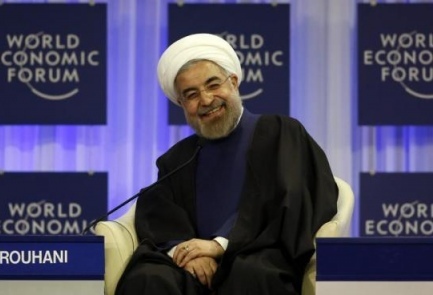
a1 RouhaniIranian President Hassan Rouhani | Photo credit: Reuters

Iranian President Hassan Rouhani has failed to fulfill campaign promises to allow greater freedom of expression and there has been a sharp rise in executions since his election, U.N. Secretary-General Ban Ki-moon said on Tuesday.

Rouhani, who won a landslide in June, has led Iran to an initial nuclear deal with world powers. But, perhaps wary of further antagonizing powerful hardliners, he has not made significant reforms at home that moderate voters had hoped for.

In a report to the U.N. Human Rights Council, Ban highlighted the prevalent use of capital punishment in Iran and called for the release of activists, lawyers and journalists as well as political prisoners that were in custody for exercising their rights to free speech and assembly.

“The new administration has not made any significant improvement in the promotion and protection of freedom of expression and opinion, despite pledges made by the president during his campaign and after his swearing in,” Ban said.

“Both offline and online [news] outlets continue to face restrictions including closure,” he said.

Iranians expressing dissenting views or beliefs still face arrest and prosecution, he added.

Ban welcomed the release of 80 political prisoners since September, including human rights lawyer Nasrin Sotoudeh, and the reinstatement of some university students and lecturers.

But he said there was still a “large number of political prisoners,” including lawyers, women rights activists and journalists.

Ban highlighted the fact that Mehdi Karroubi and Mir-Hossein Mousavi, presidential candidates in 2009, have been under house arrest since 2011, despite never being charged with a crime. Ban urged Rouhani “to consider the immediate release of the two opposition leaders and to facilitate their urgent and adequate access to medical care.”

Prominent activists and lawyers Abdol Fattah Soltani, Mohammad Ali Dadkhah and Mohammad Seifzadeh, “detained solely for exercising their rights to freedoms of expression, association and assembly,” should be freed, Ban said.

Soltani led a hunger strike last November protesting the denial of external medical care for some prisoners, he said.

Thirty-five journalists were held in Iranian prisons as of December and 16 Internet activists were arrested that month on charges of providing contents and developing websites for foreign elements, Ban’s report said.

“Some of those arrested were reportedly the administrators of popular cultural and social pages on Facebook,” it said.

Ban said that most executions in Iran were for drug offences, but political prisoners and ethnic minorities were also among those put to death.

Between 500 and 625 people were executed last year, including 57 in public, he said, echoing concerns by U.N. High Commissioner for Human Rights Navi Pillay.

More than 40 people were executed during the first half of January 2014, Ban said.

“The new government has not changed its approach regarding the application of the death penalty and seems to have followed the practice of previous administrations, which relied heavily on the death penalty to combat crime,” Ban said.

Iran has not allowed any U.N. rights investigators to visit since 2005 despite repeated requests, Ban said.

At least 20 rockets hit Israeli communities in Gaza envelope

March 12, 2014

At least 20 rockets hit Israeli communities in Gaza envelope – Israel News, Ynetnews.

Published: 03.12.14, 17:08 / Israel News

At least 20 rockets were fired from the Gaza Strip at Israeli communities Wednesday evening, as sirens of impending strikes sounded across the region.

At least one rocket has reportedly hit a residential area.

The rocket fire comes days after Israel seized an Iranian ship that was carrying long-range rockets headed for Gaza. (Ynetnews)

Massive Rocket Barrage from Gaza

March 12, 2014

There have been 16 separate alerts over the past ten minutes.

My “Red Alert” app is reporting a heavy barrage of Kassam rockets on the south.

– JW

Off Topic: Support Denied

March 12, 2014

Support Denied, Washington Free Beacon, March 12, 2014

(Why does the Obama Administration continue to support Muslim Brotherhood terrorism against American, Jordian and Israeli interests? Might supporting Egyptian and Israeli interests be contrary to the perceived interests of the Palestinians?– DM)

“The Egyptians are fighting in the Sinai to protect their own interests, Jordanian interests, and Israeli interests,” the official said. “They’re in a tough fight and the administration is refusing to provide the Apaches, which is tantamount to supporting the Muslim Brotherhood.”
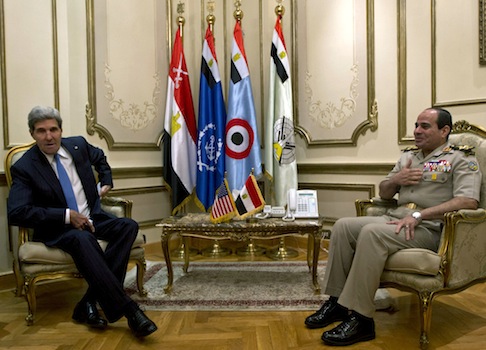
Nabil Fahmy, John KerryU.S. Secretary of State John Kerry, meets with Egyptian Gen. Abdel Fattah el-Sissi / AP

The Obama administration has turned down an urgent appeal from Egypt’s government for the delivery of U.S. Apache attack helicopters needed for counterterrorism operations in the Sinai Peninsula.

U.S. officials and a Western diplomat said the 10 AH-64 attack helicopters had been blocked from delivery in October in response to the administration’s opposition to the military ouster of Muslim Brotherhood President Mohammad Morsi last year.

The U.S. Embassy in Cairo within the past several weeks relayed the Egyptian government’s appeal to send the new Apaches in a cable to the State Department.

According to U.S. officials, the Egyptians said the attack helicopters were urgently needed for Cairo’s fight in the Sinai against a new al Qaeda-linked terrorist group called Ansar Bait al-Maqdis, or Ansar Jerusalem.

One official said the embassy cable reported that the Egyptians do not understand why the Obama administration, by blocking delivery of the Apaches, appears to be supporting the ousted Morsi regime.

The embassy stated that the Egyptians’ explained that their security needs should be met or the United States risks turning Cairo into an enemy, something the Egyptians do not favor.

“The Egyptians are fighting in the Sinai to protect their own interests, Jordanian interests, and Israeli interests,” the official said. “They’re in a tough fight and the administration is refusing to provide the Apaches, which is tantamount to supporting the Muslim Brotherhood.”

An Egyptian Embassy spokesman had no comment. However, a western diplomat familiar with the issue confirmed that the Apaches were requested recently and the response was that U.S. military aid remains on hold.

Asked about Egypt’s request for Apaches, a senior administration official told the Washington Free Beacon: “At this time we have no announcements to make regarding changes to our assistance to the government of Egypt.”

The senior official said the administration recognizes “the significant terrorist threats that the government of Egypt continues to face in the Sinai and throughout Egypt.”

“We continue to work constructively with the interim government and to provide assistance that advances our security objectives such as countering terrorism, countering proliferation, and ensuring security in the Sinai,” the senior official said.

The administration blocked most of a $1.6 billion military aid package in October following the ouster of Morsi by Egyptian military forces.

The cutoff was a White House policy decision that is to remain in effect until Egypt shows progress toward democratic reform. The policy also stated that U.S. counterterrorism support would continue, a position that appears at odds with the decision to block the delivery of new Apaches.

In response to the U.S. pressure, the Egyptian government in January approved a new constitution that calls for both parliamentary and presidential elections.

Sen. James Inhofe (R., Okla.), a member of the Senate Armed Services Committee, is pushing the administration to send the Apaches. The successful referendum in January and the signing of a presidential election law earlier this month are signs of progress toward more democratic rule, he said.

“Egypt is a cornerstone for stability in a part of the world where terrorist activity is rapidly growing,” Inhofe told the Free Beacon in a statement.

The senator said Egypt has shown both determination and willingness to assist U.S. efforts to defeat terrorists, and is continuing to play a crucial role in security and stability for North Africa and the Middle East.

“With Morsi gone, the Egyptian armed forces remain the most trusted institution in the country and they need the military equipment they’ve already purchased from the United States in order to continue to effectively combat and defeat terrorism in the region,” Inhofe said.

Ansar Bait al-Maqdis is an al Qaeda-linked jihadist group that has carried out several terror attacks in the Sinai since last year.

The group claimed credit for the suicide bombing Feb. 16 of a tourist bus in the eastern Sinai border town of Tabah that killed three South Koreans and an Egyptian driver.

Ansar Bait al-Maqdis also tried to bomb the gas pipeline between Egypt and Israel and has conducted attacks against Egyptian military targets.

Other attacks by the group have included the failed assassination bombing attempt against a vehicle convoy carrying Egyptian Interior Minister Mohammed Ibrahim in Cairo Sept. 5, and a suicide truck bombing against a Sinai security building in Al-Tur, in southwest Sinai.

Egypt has been a strategic U.S. ally in the Middle East since the 1980s until the ouster of Egyptian President Hosni Mubarak in 2011.

The revolution that followed brought elections that voted in the anti-democratic Muslim Brotherhood regime, headed by Morsi, that received Obama administration backing.

Then Morsi was ousted in July amid large-scale pro-democracy protests. He was recently put on trial.

Egypt controls the strategic Suez Canal at the far eastern edge of the Mediterranean Sea that is a key transit point for U.S. warships headed for the strategic Persian Gulf.

The current military leader, Defense Minister Abdel Fattah al Sisi, recently traveled to Moscow for talks with Russia on purchasing military equipment, raising the prospect that the United States will lose its influence in Egypt after decades of military and financial support.

David Schenker, director of Arab politics at the Washington Institute for Near East Policy, said despite its current fleet of 35 Apaches, Egypt needs the new attack helicopters because of the harsh desert-operating environment. The Apaches require frequent maintenance, he said.

In addition to Apaches, the administration is also holding up deliveries of F-16 jets, M1A1 tank parts, and Harpoon missiles. But it is the Apaches that were the Egyptians’ most urgent military need.

Under the administration’s policy toward Egypt, counterterrorism efforts should not be lessened, a policy that should permit delivery of the Apaches, Schenker said.

“Egypt is in the midst of a burgeoning insurgency, not only in the Sinai but in the Nile Valley as well,” Schenker said.

At a Senate Armed Services Committee hearing March 6, Inhofe questioned Gen. Lloyd Austin, commander of the U.S. Central Command, on the need to send Apaches to Egypt.

Austin said the Egyptians were stepping up counterterrorism operations in the Sinai. “This fight is important not only for the country of Egypt but potentially for the region as a whole,” he said.

“Would the resumption of the delivery of the Apache helicopters assist the Egyptians in their efforts to fight terrorism?” Inhofe asked.

“First sir, I’ll say that I support the president’s policy,” said Austin who met al Sisi in December. “But from a military perspective, just looking at what the Egyptians have done in the Sinai and the equipment that they’re using, the Apache has been very instrumental in their efforts there.”

“Is that yes?” Inhofe asked.

“That’s a yes, sir,” Austin replied.

Sen. Lindsey Graham (R., S.C.) remains opposed to resuming arms deliveries.

“We’re nowhere near where I want to be with stability, civilian control of Egypt, to go down that road,” Graham told Congressional Quarterly earlier this month, adding that democratic reform and not Apaches will win the war against terrorism in Egypt.

A Graham spokesman declined to comment.

A Senate aide said $1.5 billion in U.S. aid to Egypt is contained in the 2014 omnibus spending bill and that the new aid is restricted by provisions requiring Secretary of State John Kerry to hold up aid until he certifies Egypt’s progress toward democracy.

The Egyptians “are in a big fight right now,” said the aide who recently visited the Sinai.

“This is probably the biggest fight they’ve had in years and they are trying to take it to the terrorists in the Sinai,” the aid said. “The Apache is a big piece of that.”

Off Topic: The Questions No One Asks

March 12, 2014

The Questions No One Asks, Gatestone Institute, Bassam Tawil, March 12,2014

(They do appear to be good questions and should be asked. — DM)

The Palestinians aspire to control all the holy sites in the Old City of Jerusalem, not only those holy to Islam, but those holy to Christianity and Judaism as well.

They understand that [in a peace agreement] they would have to declare the end of the conflict. That is not a situation the Palestinians are ripe for yet.

The next Palestinian leader will simply say that any agreement was Abbas’s, not his, and does not commit them or the Palestinian people. Both Palestinian society and public policy are based on the rejection of peace with Israel, and the Palestinian street is bombarded daily with propaganda from the Palestinian establishment advocating war, the return of refugees and the destruction of Israel.

American Secretary of State John Kerry recently asked Palestinian leader Mahmoud Abbas about the possibly of locating the capital of Palestine in Beit Hanina, the eastern neighborhood of west Jerusalem. That would allow the Palestinians, for the first time in annals of the emerging Palestinian people, to have a capital in Jerusalem, in the eastern section known as Al-Quds. The proposal was ostensibly an achievement for the Palestinians, but actually it was a bad omen. It would end the Palestinian dream of controlling the holy sites of Islamic and Christianity in Jerusalem, and the Palestinians would no longer be able to demand the Old City Jerusalem as the capital of their country.

The Palestinians aspire to control all the holy sites in the Old City, not only those holy to Islam but those holy to Christianity and Judaism as well. Needless to say, that is to be accomplished at the expense of both Israel and Jordan, which manages the Islamic holy sites as part of its peace agreement with Israel.

Secretary Kerry’s question was the reason Jordan reacted badly to suggestions in the Israeli parliament from the Israeli right to give sovereignty over Al-Aqsa mosque – managed by the Jordanian Waqf – to Israel. Kerry told Abbas that, as part of the agreement being formulated, the Palestinians would have to recognize Israel as a Jewish state. Mahmoud Abbas and his close associates understand that this request would force them to accept that they will no longer be able to claim the “right of return” of the Palestinians refugees to the State of Israel or destroy it by changing its demography. They understand that the refugees would have to settle in the future state of Palestine and that the Palestinians would have to declare the end of the conflict. That is not a situation the Palestinians are ripe for yet.

Kerry also told Abbas that the Palestinians would have to waive security control of the Jordan Valley corridor along the border with the Kingdom of Jordan. The Americans have therefore foiled the Palestinian plan of “stages,” Yasser Arafat’s original plot, never abandoned by the Palestinians, of dismantling Israel one slice at a time like a roasted lamb. The initial plan of “stages” was for Islamists to cross the Jordan river, join the Palestinian Authority’s armed security forces (or those of Hamas, if it managed to take over the West Bank), and attack Israel’s cities with missiles, cross its borders and slaughter its citizens.

If Israel were to waive security control, first the Palestinians would reap the political and territorial fruits of the agreement, then soon they would violate it by flooding the West Bank with mujahidin from all over the world.

In rejecting the American proposal the Palestinians now accuse Kerry of being a foil for the Israelis, ad have told him that Abbas is the one rational man with whom Israel can make peace. Some Palestinian leaders threaten that if no agreement is reached, a third intifada may break out. For Israel, that clearly means the entire peace process depends on one man alone, not on the will of the Palestinian people. The result of such a deal will be that the conflict will not have been resolved even after Abbas’s eventual departure from the political scene: the next Palestinian leader will simply say that any agreement was Abbas’s, not his. Thus, according to Palestinian reasoning, Israel’s one chance for peace depends on one rational man, and will evaporate when he quits, is ousted or dies. The enterprise is not only fragile, it is doomed to failure from the outset.

The Israeli demand for the end of incitement and threats against Israel is directly related to its demand to construct a foundation for the Palestinian people which includes a real peace that will continue even after Mahmoud Abbas is no longer the Palestinian leader.

It is therefore obvious why Israel hesitates to sign a peace agreement in which all its political and territorial concessions are liable to fall into the lap of Hamas or the other subversives waiting to oust Abbas. This highly collapsible situation is also the reason Israel insists on dealing with the fate of the agreement should Abbas’s successors suddenly change their minds and claim that whatever Abbas signs does not commit them or the Palestinian people.

Israeli has good reason to be suspicious, especially in view of the amateur and irresponsible policies of the current Obama administration, which now has a pattern of abandoning friends in need. Kerry’s proposal reflects an understanding of historical truth: the need for both a Palestinian state and Israel’s security needs — but what will happen if Arab or European pressure forces the Americans to alter their policies, as they have done so often before?

The Arabs regard Israel as a well-oiled, state-of-the-art war machine, but in reality it is vulnerable, fragile and easily blackmailed, unable fully to implement its forces to counteract the Islamic terrorism deliberately hidden within the Palestinian population in the territories. In the meantime, Hamas continues to use human shields and the Palestinian Authority continues its anti-Israeli incitement, especially via Qatar’s Al-Jazeera TV channel in Arabic. Qatar funds Hamas and supports Islamic terrorist organizations all over the Arab world. *

In addition, the permanent support the Arabs and the Europeans give the Palestinians — such as the Europeans’ demand for “proportional” force and the expectation that Israel will compromise its own security by sacrificing its territorial assets — only serves to encourage terrorism, makes the Palestinians less flexible and leads them to believe that between pressure from the Arabs and the sanctions and boycotts they expect to be imposed by the Europeans, they will eventually be able to defeat Israel.

The Arabs seem to have forgotten that Israel already overcame Arab and Palestinians boycotts. During the last two intifadas, when there was a Palestinian boycott of Israeli-made products and Palestinians were forbidden to work in Israel, Israel began using automated industrial building techniques, thereby leaving the tens of thousands of Palestinians who had previously worked in construction permanently without jobs.

Now the EU is trying to impose a boycott on goods manufactured in the Israeli settlements, but ignoring that most of the workers there are Palestinians. The result will be that Palestinian workers will again be let go and again find themselves unemployed. Palestinians were also always the ones who were harmed.

The Palestinian leadership might do well to understand that the consequences of a third intifada will be even more destructive, with no chance of success. It can be assumed that Abbas understands the situation, but unfortunately the Palestinian people still think they will be able to destroy Israel and install a Palestinian state on the ruins.

When it comes to changing their situation, the Palestinians still refuse to ask the right questions. Is there a single Palestinian, for example, who really thinks Israel will sign an agreement that would settle millions of Palestinians into its territory? Would Israel agree to have its future depend on a leader like Mahmoud Abbas, who does not enjoy either a consensus or a legal Palestinian constitutional status? ******Can Israel ignore that both Palestinian society and public policy are based on the rejection of peace with Israel, and that the Palestinian street is bombarded daily with propaganda from the Palestinian establishment advocating war, the return of refugees and the destruction of Israel?

And is there really a single Palestinian who thinks Israel will rush to sign an agreement while the Palestinian Authority works unceasingly in international forums to delegitimize it, boycott it and maneuver to achieve unilateral international recognition without a gesture towards Israel?

There are other questions the Palestinians refuse to ask themselves: for instance, is there a single Palestinian who really believes that Israel places faith in the upper echelons of the Palestinian Authority who are now planning to have Israel’s leaders tried as war criminals in the International Criminal Court in The Hague and threatening of a third intifada? Can Israel make concessions to the Palestinians in the Jordan Valley and ignore what happened after the Israeli army withdrew from south Lebanon, which it saw it turn into a vipers’ nest of Hezbollah-instigated terrorism? Will Israel ignore the lessons of the past, especially after Hamas’s border with Egypt turned into a highway for smuggling arms and the Gaza Strip itself became a regional and global stronghold of Islamism?

The Palestinians fool only themselves as they waste their time theorizing, inventing excuses and plotting, while the Jews engage in practical matters, and do not plan their future on the unattainable. Do the Palestinians not understand that once the murderers terrorizing the civilian population of Syria in the name of jihad have finished there, they will turn their attention to the Palestinian Authority and do the same to the Palestinian population there? The Palestinians, who expect the jihad fighters in Syria to liberate “Palestine” for them, do not understand that the men who went to fight the Assad regime in Syria have nothing to lose. Their own families are far from the confrontation and when they enter the Palestinian Authority, Palestinian women will be their first victims.

The peace process is not simple, it requires time and the building of trust. Israel has territories the Palestinians want and holds the key to the international recognition of “Palestine.” The Palestinians have the resources of trust necessary to win over the hearts of the Israelis. The more that time passes, the more the Palestinians waste that precious resource. The Israelis dig in their heels and the Western world is gradually coming around to their way of thinking. If the Palestinians really want to establish a Palestinian state, they might start by asking themselves the right questions.

Israel-America relations vis-à-vis the Crimean War

March 12, 2014

Israel-America relations vis-à-vis the Crimean War | JPost | Israel News.

By NACHMAN SHAI

03/12/2014 02:27

As a regional power, Israel is certainly keeping on top of any new movement in the area, and following its coverage in international discourse.

crimea

A Ukrainian soldier stands on a military vehicle at a checkpoint at the road near a Crimea region border March 9, 2014. Photo: REUTERS

The new Crimean war is still in its infancy and we should hope it doesn’t reach the threatening level of the first Crimean War, which cost one million people their lives and ended inconclusively, although in retrospect Russia seems to have been the bigger loser. In the “new war” model, and as befits new wars, the use of force is reduced, whereas the use of diplomacy is much more significant, and a large part of this diplomacy takes place through the media. Images from the battleground are intertwined with political declarations. The fact that US President Barack Obama is making statements is very striking, especially since Russian President Vladimir Putin is taking action and then – at times – making statements. Once again, we are witnessing a power play of engagement between the US and Russia, between the former’s “soft power” and the latter’s “hard power.”

This old/new round of conflict between East and West proves that the Cold War never really ended. Despite the fact that the Cold War was officially declared over in the 1980s, the walls were torn down, the Eastern Bloc disintegrated, and the former USSR supposedly embraced democracy, Russia is once again carrying out its foreign policy with an iron fist. First of all, Russia is fearful of its former federated states; it demonstrated this in Georgia and it is now showing this again in Ukraine. But even beyond these two cases, Russia is standing up to and intimidating the US and Europe at every possible opportunity.

During both of his terms, Obama chose not to go to war. Obama’s was the first case in history of a Nobel Peace Prize being offered to someone for his future actions, and indeed it appears the US president is making every effort to fulfill the world’s expectations of him.

He removed US troops from Iraq and Afghanistan despite the fact they had not accomplished what they had set out to do there, and left these countries to fend for themselves against terrorism. At the same time, Obama is making every effort to avoid the conflicts in Libya, Iran and Syria.

The ridiculous phrase “leading from behind” has become Obama’s identifying expression. He has been true to his belief and translated these words into action via dialogue and signing agreements in place of using force or even threatening to use force. And if we look at his record in the three most recent crises (Libya, Iran and Syria), the US can feel well satisfied with the fact that, at least for now, all three ended with relative success and a limited use of force.

The Americans might think they are winning in all these spheres, but that depends whether you view the situation like it’s a 15-round boxing match in which if there’s no knockout, the points are tallied at the end. Or, alternatively, you might assume that every three minutes, whoever is winning receives a point. The Russians believe that the winner is whoever won the last battle, whereas the Americans believe that they can add up all the points they won round after round. And since we’re smack in the middle of a round right now, it’s impossible to declare who the winner is going to be – Putin or Obama.

Of course, there is also the distinct Israeli viewpoint of the situation. Granted, Israel is not directly connected to every international crisis, but it is to the ones that occur in our area. However, as a regional power, Israel is certainly keeping on top of any new movement in the area, and following its coverage in international discourse.

Regarding events in Syria and Iran, Israel has not hidden its disappointment that the US chose the diplomatic channel. The Israelis believe that it would have been smarter to combine economic and military power to both block the Iranian nuclear plan and punish Syrian President Bashar Assad at the same time. In this way, foreign sources claim, Israel could have taken action against Syria, especially regarding Syria’s close relationship with Hezbollah. “We are very adept at drawing red lines,” Prime Minister Binyamin Netanyahu said at the recent AIPAC conference.

Israel has not made any public statements about the Crimean crisis. This might be because it’s uncomfortable doing so, or perhaps because it doesn’t want to or does not know what to say. In his aforementioned enthusiastic AIPAC speech, which drew tremendous applause, Netanyahu managed to glide right through without even touching on the hottest topic in Washington now. For unknown reasons, he decided once again to take his aggression out on Iran. At one point, he even mentioned that Iranian missiles could reach US territory.

But this is of no importance since the US is surely not worried about such an occurrence. Last week, Russia carried out a successful test-launch of an “advanced” intercontinental ballistic missile; this was a clear message to show the US who its truly threatening enemy is.

The US will not be spending much time dealing with Iran or the Israeli-Palestinian conflict in the near future.

As we can see from Jeffrey Goldberg of Bloomberg’s interview with Obama, the president believes that reaching an agreement is first and foremost Israel’s responsibility, and that Israel is not doing enough to achieve this goal.

Obama’s stern stance on Israel’s international standing in light of recent calls for boycotts and sanctions is certainly disturbing, to say the least. And this time Obama didn’t add his usual line promising that the US would stand alongside Israel to fight off sanctions.

I believe, though, that it would have been in Israel’s best interests for Netanyahu (and it’s not too late) to side with Obama and support him. Obama’s seeming weakness, or what people choose to see as weakness, might make a few fools happy, but the sad truth is that this is bad for Israel. We need a strong America and a strong American president, and if they are weak, we should bolster them. Netanyahu needs to support US Secretary of State Kerry’s actions to prove that Israel trusts the American government, and that the path it is leading us down is the right one for us. We need to send this powerful and important message right now, when Europe and other world powers are questioning the US’s leadership capabilities. We have no alternative.

In the economic sphere, we could possibly search for new markets, although this would not be simple at all.

But in the political sphere, we have absolutely no alternatives.

Foreign Minister Avigdor Liberman once attempted to think aloud about the possibility of looking toward the East, but in his current term, he is once again focusing his full attention on Israel’s relationship with the US. The idea of trying to manipulate the two blocs will not help us with the Palestinian issue because both the US and Russia have similar positions on this matter: they both believe that Israel should withdraw from the territories, and both are involved in the negotiations.

But – and this is a big but – the US, unlike Russia, is ready to invest (literally) in this process. Sometimes it offers financial assistance, and at other times they support Israel by making it dependent on our international standing. Whereas the Russians just stand on the sidelines and watch; only when they see something they don’t like do they take action.

In the political sphere too, Israel has no other option but to help make sure that America is strong, since we have no alternative partner waiting in the wings. A strong America is good for Israel, and a weak America weakens Israel – this needs to be our guiding principle.

It’s a shame that the prime minister missed this point in his recent speech in Washington. But he still has time to repair the situation and mend Israel’s ties with America.

We must remember – there is no other America.

The author is a member of the Knesset Foreign Affairs and Defense Committee and chairman of the Knesset Caucus for Israel-US Relations.