Archive for March 8, 2014

The Ukraine crisis: Russia may halt (START) strategic weapons inspections, revert to Cold War tactics

March 8, 2014

The Ukraine crisis: Russia may halt (START) strategic weapons inspections, revert to Cold War tactics, DEBKAfile Special Report March 8, 2014

(Is the apparent chill just a phase of global smarming warming, or is it meaningful? — DM)

Russia ratcheted up international tensions over Ukraine by a big notch Saturday, March 8, the day after mobilizing air and coastal defenses for a large-scale month-long drill to prevent the disruption of the May 16 Crimean referendum. The defense ministry in Moscow announced: “Russia is considering halting foreign inspections of its strategic weapons arsenal, including nuclear-capable missiles, in response to “threats” from the United States and NATO over the Ukraine crisis.

Lines of tanks were seen Saturday heading from Russian bases towards Crimea.

A high-ranking defense ministry official in Moscow, who was not named, released this statement to all Russian news agencies: “The unfounded threats towards Russia from the United States and NATO over its policy on Ukraine are seen by us as an unfriendly gesture that allows the declaration of force majeure circumstances.”

By this statement, Moscow announces that due to “force majeure circunstances” it no longer feels bound by its commitment to international inspections under the Strategic Arms Reduction Treaty (START) with the United States and the Vienna Document between Organization for Security and Cooperation in Europe (OSCE) member states.

START, which was signed between the United States and Russia in 1991, mandated the mutual reduction by the two powers of nuclear warheads, missiles and nuclear missiles carried by submarines, under international inspection..

The signing of the first START treaty in 1991 marked the historic end of the Cold War and the Soviet empire’s breakup.

Two years ago, Presidents Barack Obama and Dmitry Medvedev renewed the treaty. The incumbent Russian president Vladimir Putin is now threatening to abdicate from the 23-year pact, i.e., warning the United States and the West that Moscow is prepared to revert to the belligerent posture maintained by the Soviet Union in the years of the Cold War unless they back off on punitive measures over the Ukraine dispute.

In a phone conversation to US Secretary of State John Kerry, Friday night, Russian Foreign Minister Sergey Lavrov warned against “hasty and reckless steps capable of causing harm to Russian-American relations – particularly… sanctions, which,” he said,  “would inevitably hit the United States like a boomerang.”

DEBKAfile Friday tracked the military escalation centering on Crimea.

Amid spiraling tensions between Moscow and the West over the fate of Crimea, Russia has mobilized its air and coastal defenses and more than 1,000 missile and tank units for a month-long drill in Kapustin Yar, around 450 km from the Ukraine border in the Astrakhan district. DEBKAfile’s military sources report that this facility is home to one of Russia’s biggest missile bases. The exercise covers the whole of March and early April, including the March 16 Crimean referendum on secession and its aftermath.

It will conclude with live-firing drills and the deployment of air defense systems in early April, when Moscow calculates they may be needed to thwart any Ukrainian or Western attempt to disrupt Crimea’s expected application to join the Russian Federation.

The referendum, put forward by two weeks to March 16, will ask roughly three million Crimean citizens for a straight “yes” or “no” on whether to remain part of Ukraine or secede to Russia. Since around 65 percent of the voters are ethnic Russians, the region’s future is not hard to predict.

The Russian parliament announced voting on a bill enabling annexation of Crimea to the Russian Federation at the request of a majority would take place on March 21.

President Barack Obama, in an hour-long phone call to President Vladimir Putin early Friday, March 7, declared the referendum was a violation of international law, echoing European Union leaders.

After imposing sanctions on individuals abetting Crimea’s breakaway from Ukraine, Obama urged the Russian leader to cancel the referendum and return his forces to the bases Russia holds on lease in Crimea.

Putin replied that the regime in Kiev and its decisions were “absolutely illegitimate.” He said he appreciated the importance of the Russian-American relationship to global security, and maintained that bilateral ties “should not be sacrificed for individual – albeit rather important – international issues.”

Col. Oleg Kochetkov of the Kapustin Yar district command described the new Russian deployment as “the largest-ever exercise held by air defense units of the Western Military District.” He added: “It is for the first time that all air defense units from the district, including coastal defenses of the Northern Fleet, have gathered in one place.”

Taking part in the exercise are S-300 long-range surface-to-air missiles, Buk-M1 medium-range missiles and Strela-10 short-range missiles.

DEBKAfile’s military sources report that Kapustin Yar is home to one of Russia’s biggest missile bases. From there, the army tested on March 3 its new anti-air missile system S-500, followed the next day by the test-launch of an RT-2PM Topol (NATO codenamed SS-25 Sickle) IBCM.

This flurry of Russian military momentum is partly in response to the military steps announced by the Pentagon in the last 48 hours:

Friday, March 7, the USS Truxtun guided-missile destroyer crossed the Bosporus into the Black Sea to join the fleets of NATO allies Rumania and Bulgaria in a naval exercise, the day after the Pentagon unveiled plans to put another six US F-15 fighters on an air patrol mission over the Baltic states of Estonia, Latvia and Lithuania.

Twelve US F-16 fighter bombers and 300 military personnel are to be transferred to Poland over the weekend and more US military exercises are planned in areas around the Russia starting Sunday.

Israeli Navy arrives in Eilat with Iranian missile ship – YouTube

March 8, 2014

Israeli Navy arrives in Eilat with Iranian missile ship – YouTube.

My brothers in active service…

God bless them!!!

– JW

Ship with Iran missile cargo escorted into Eilat port

March 8, 2014

Ship with Iran missile cargo escorted into Eilat port | The Times of Israel.

3 days after IDF interception, Israel prepares to unload Klos-C with its dozens of Iranian-sent missiles intended for Gaza

March 8, 2014, 4:49 pm

Israeli Navy ships entering Eilat Port after accompanying Klos C weapons ship (Photo: EPA)

Klos-C enters port of Eilat Saturday afternoon with the INS Hanit alonside her. (screen capture: Ynet)

The Klos-C and its Israeli Navy escort entered the port of Eilat Saturday afternoon after a voyage of three-and-a-half days following Israel’s interception of the ship off the coast of Sudan early Wednesday.

The Klos-C, which was captured with what the IDF says is a cargo of Iranian arms in its hold, is to be unloaded at the civilian port over the course of Saturday and Sunday. Its Croatian crew was to disembark and be held for questioning. IDF sappers were standing by on shore to search the ship for booby traps and handle explosives in the Klos-C’s hold.

Masked soldiers of the crack Shayetet 13 naval commando unit were visible standing on the decks of the Klos-C as it docked.

The arms found aboard the ship will be shown to the media at a press conference scheduled for Monday.

Masked Shayetet 13 soldiers standing on the bow of the Klos-C as it docks in Eilat on Saturday, March 8, 2014. (screen capture: Ynet)

Masked Shayetet 13 soldiers standing on the bow of the Klos-C as it docks in Eilat on Saturday, March 8, 2014. (screen capture: Ynet)

The cargo ship entered port just after 4:30 p.m. Saturday with the INS Hanit cruising along its port side. The INS Hetz sailed into port shortly thereafter. Civilian craft welcomed the ships back to Israeli waters with a chorus of horn-blowing, Israel Radio reported.

The Klos-C is expected to be released with her Turkish captain and her crew in the coming days after the weapons in its hold are offloaded.

Israeli commandos boarded the Panamanian-flagged ship early on Wednesday in the Red Sea, and found it to be carrying an Iranian arms shipment headed for the Gaza Strip, Israel’s military said. The consignment had been tracked by Israeli intelligence for months, officials said.

The army said Wednesday that soldiers carried out a preliminary inspection of the ship and found several dozen advanced Syrian M-302 missiles, with a range of up to 200 kilometers (125 miles) and a payload of up to 170 kilograms (375 pounds). The missiles were hidden in shipping containers also carrying sacks of concrete with Iranian markings.

The INS Hetz sails into Eilat with all hands on deck on Saturday, March 8, 2014. (screen capture: Ynet)

The INS Hetz sails into Eilat with all hands on deck on Saturday, March 8, 2014. (screen capture: Ynet)

Israel and the US coordinated intelligence and military activities leading up to Israel’s seizure of the Klos-C off the coast of Port Sudan, US Ambassador to Israel Dan Shapiro and the State Department said Wednesday.

After consultations between American and Israeli officials, it was decided that Israel would act against the vessel, Shapiro told Israel Radio, even though the Pentagon had already drafted plans to intercept the ship.

Israel captured the Klos-C near early Wednesday with Israeli officials saying the naval operation followed heavy intelligence work tracking the missile shipment from Damascus to Iran and from there to Iraq before being captured en route to Gaza.

Intelligence minister: Enemy more sensitive to Iran’s active defence system

March 8, 2014

Intelligence minister: Enemy more sensitive to Iran’s active defence system, Trend, March 8, 2014

(Although success through trickery is not a new strategy for Iran, for Iran’s Minister of Intelligence to acknowledge it expressly and apparently for publication seems a bit odd, particularly while the P5+1 negotiations continue. — DM)

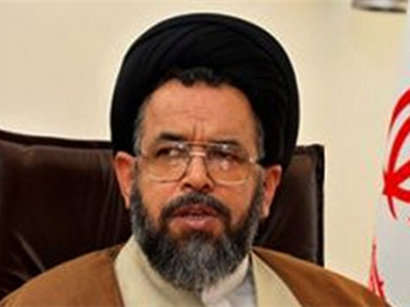
Iran Minister of Intelligence

“As the Supreme Leader, Ayatollah Ali Khamenei believes in his seminary lectures, the diplomacy is a war front, and thus we are licensed to resort to tricks in diplomacy,” Alavi said.

“When the enemy tries to have a dialogue with you, you should keep alert to use the tricks when necessary, since the enemy would not abandon you but fashion new ruses,” Alavi noted.

Iran’s minister of intelligence, Seyed Mahmoud Alavi said that enemies are more sensitive to country’s active defence systems, Iranian Mehr news agency reported on March 8.

Alavi, who was addressing a meeting of heads of passive defence committees, ministries, organizations, and provincial governorates in the Ministry of Interior conference hall on March 8 morning, said that Iran should convert all active defence systems to passive systems.

“As such, the enemy would feel these centres out of its access; but even if we cover our nuclear sites with several layers of active defence systems, yet the enemy would have some hope to infiltrate these layers,” the minister added.

Alavi then gave an example of his claim. “The enemy is more sensitive to Natanz system than to Fordow defense system, since Fordow is a passive defence system,” he asserted, believing that the modern war was a war of ethics.

“As the Supreme Leader, Ayatollah Ali Khamenei believes in his seminary lectures, the diplomacy is a war front, and thus we are licensed to resort to tricks in diplomacy,” Alavi said.

“When the enemy tries to have a dialogue with you, you should keep alert to use the tricks when necessary, since the enemy would not abandon you but fashion new ruses,” Alavi noted.

Alavi assessed the active defence system in culture as a defence of Revolutionary principles and ideals. “In using active defence system in culture, we should improve the public understanding of the enemies’ tricks and to protect themselves from the lurking threats of the enemies,” he said.

Assad taking advantage of U.S.-Russia split over Ukraine, observers say – The Washington Post

March 8, 2014

Assad taking advantage of U.S.-Russia split over Ukraine, observers say – The Washington Post.

Khaled Al-Hariri/Reuters – Supporters of Syrian President Bashar al-Assad hold up his pictures during a rally supporting him and the army in Damascus on Feb. 19, 2014.

By , Published: March 7

BEIRUT — Syrian President Bashar al-Assad is taking advantage of the rift between Russia and the United States over Ukraine to press ahead with plans to crush the rebellion against his rule and secure his reelection for another seven-year term, unencumbered by pressure to compromise with his opponents.

The collapse last month of peace talks in Geneva, jointly sponsored by Russia and the United States, had already eroded the slim prospects that a negotiated settlement to the Syrian war might be possible. With backers of the peace process now at odds over the outcome of the popular uprising in Ukraine, Assad feels newly confident that his efforts to restore his government’s authority won’t be met soon with any significant challenge from the international community, according to analysts and people familiar with the thinking of the regime.

As the crisis in Ukraine reaches Cold War proportions, here’s what chief correspondent Dan Balz, senior national security correspondent Karen DeYoung, foreign editor Douglas Jehl and chief White House correspondent Scott Wilson have to say about what it all means.

Russian President Vladimir Putin’s defiant response to the toppling of Ukrainian President Viktor Yanukovych has further reinforced Assad’s conviction that he can continue to count on Russia’s unwavering support against the armed rebellion challenging his rule, said Salem Zahran, a Damascus-based journalist and analyst with close ties to the Syrian regime.

“The regime believes the Russians now have a new and stronger reason to keep Assad in power and support him, especially after the experience of Libya, and now Ukraine,” he said. “In addition, the regime believes that any conflict in the world which distracts the attention of the Americans is a factor which eases pressure on Syria.”

On Friday, tensions between Moscow and Washington showed no sign of abating, with Putin angrily rejecting the Obama administration’s attempt to bring about a withdrawal of Russian troops from Crimea by imposing sanctions.“Russia cannot ignore calls for help, and it acts accordingly, in full compliance with international law,” Putin said in a statement.

The Syrian war is only one of a number of contentious issues in the Middle East that expose the vulnerability of U.S. interests to a revival of Cold War-era tensions with Russia such as those that have surfaced in Ukraine. The nuclear accord with Iran and the Israeli-Palestinian peace talks, both of which rank higher on the Obama administration’s foreign policy agenda than Syria, are also dependent to an extent on Moscow’s cooperation.

In a less-noted development in recent months, newly ambivalent U.S. allies such as Egypt and Iraq have been quietly concluding significant arms deals with Moscow, largely spurred by concerns that the Obama administration’s reluctance to become embroiled in the messy outcomes of the Arab Spring means that Washington can no longer be counted on as a reliable source of support.

Most Arab countries have remained silent on the Ukraine crisis, and some could well move further into Russia’s orbit should Washington be seen to be wavering, said Theodore Karasik of the Dubai-based Institute for Near East and Gulf Military Analysis.

“They see Russia as a major current and future partner in the region, because in their perspective, the U.S. is retreating,” he said.

It is in Syria, however, where strains between the United States and Russia are likely to have the most immediate impact. For most of the three years since the Syrian uprising began, the Obama administration’s Syria policy has been predicated on the assumption that Russia would be a willing partner in efforts to persuade Assad to relinquish power.

That policy, perhaps unlikely ever to have worked, has now been exposed as unrealistic, said Amr Al Azm, a professor of history at Shawnee State University in Ohio. Putin’s defense of Yanukovych means “three years of Syrian diplomacy has gone down the toilet,” he said. “It’s a huge failure for the White House.”

Even if the Russians had ever been inclined to collaborate with the United States on a solution for Syria, “they’ll be unlikely to do so now, because they won’t want to hand Obama a victory,” said Andrew Tabler of the Washington Institute for Near East Affairs.

Two other areas of U.S.-Russia cooperation in Syria will now also be put to the test: last summer’s agreement to destroy Syria’s arsenal of chemical weapons, and the recent U.N. resolution calling on Syria to facilitate the delivery of humanitarian aid and halt attacks such as the deadly barrel bombings that have claimed hundreds of lives in the past two months.

There are no indications that Assad is in a hurry to comply with either. Syria has already missed two deadlines for the removal of chemical weapons, and officials at the Organization for the Prohibition of Chemical Weapons indicated this week that it is likely to miss a third, on March 15. The barrel bombings have continued unabated, and there has been no discernible progress toward relieving the crippling sieges of rebel-held towns, which have put thousands of people at risk of starvation.

Instead, Assad is stepping up preparations for a presidential election due to be held in June under the terms of the current constitution. Though no date has been set and Assad has not officially announced his candidacy, Syrian government officials have repeatedly stressed that the election will go ahead, that Assad will run and that he expects to win.

A suggestion made before the Geneva talks opened in January that Syria would permit international monitoring was dismissed as unnecessary this week by Assad adviser Buthaina Shaaban in an interview with a Lebanese television network. “We have credibility and we don’t accept any interference,” she said, stressing that the election would go ahead on schedule.

Intense discussions are underway in Damascus, people familiar with government thinking say, over ways to create legitimacy for the election at a time when many parts of the country have fallen under rebel control, large swaths have been depopulated by violence and more than 2 million citizens are refugees. The government is hoping to persuade at least one candidate to run against Assad, though none has yet emerged.

In the absence of serious political reforms such as those it was hoped the Geneva talks would produce, the chances are good that Assad will repeat the 97 percent victory he won the last time elections were held, in 2007, said Tabler, who witnessed that poll while living in Damascus. “It was farcical,” he said.

The preparations coincide with slow but steady gains on the battlefield by forces loyal to Assad, including advances in the northern province of Aleppo, which was once regarded as having slipped far beyond the reach of the government. The advances have been aided by significant support from Russia, which has sustained a steady supply of arms to the Syrian military — routed mainly through the Ukrainian port of Odessa.

A significant shift in U.S. policy in favor of more robust support to the rebels could yet tilt the balance of power on the ground, analysts say. But it is more likely that Washington’s attention will be further diverted from Syria while Russia sustains its steadfast support for Assad, said Salman Shaikh of the Brookings Doha Center in Qatar.

“Putin sees the world as one big chessboard on which he can play two or three moves at the same time. I am not sure the West can do that,” he said. “I don’t see the Russians backing off their support for Assad, and I think Assad will continue to do what he has always wanted to do, which is to win militarily.”

Suzan Haidamous contributed to this report.

Hagel congratulates Israel on Iranian arms capture

March 8, 2014

Hagel congratulates Israel on Iranian arms capture | The Times of Israel.

US defense secretary speaks to Israeli counterpart, reaffirms commitment to stopping destabilizing actions by Tehran

March 8, 2014, 9:59 am

US Defense Secretary Chuck Hagel (photo credit: AP/Wong Maye-E/File)

US Defense Secretary Chuck Hagel (photo credit: AP/Wong Maye-E/File)

US Defense Secretary Chuck Hagel has congratulated Israeli officials on the successful capture of an Iranian weapons shipment headed to the Gaza Strip, the Pentagon said on Friday.

In a phone call Thursday, Hagel spoke with Israeli Defense Minister Moshe Y’aalon and commended Israel’s operation early Wednesday morning to take control of the Klos-C in the Red Sea.

According to Pentagon Press Secretary Navy Rear Adm. John Kirby, Hagel stressed the US was committed to preventing Iran from engaging in activities that would destabilize the region, “even as we continue efforts to resolve our concerns over Iran’s nuclear program through diplomacy.”

“Secretary Hagel made clear that illicit actions by Iran are unacceptable to the international community and in gross violation of Iran’s UN Security Council obligations,” Kirby said.

Israel and the US had cooperated and shared intelligence ahead of the Israeli operation. Kirby said such close contact would continue.

“The secretary and the minister pledged to continue this close consultation as Israel completes its final inspection of the vessel and reaffirmed the strength of the US-Israel defense relationship,” Kirby said.

Israeli forces intercepted the ship as it headed to a Sudanese port in an early morning raid Wednesday. They said the ship was laden with M-302 long-range missiles to be smuggled into Gaza via Egypt.

The missiles, which Israel said originated in Iran, would allow rockets fired from Gaza to reach anywhere in Israel

The Klos-C was being towed to Eilat by the Israeli navy and was expected to reach it on Saturday.

Of Topic: Will Obama Blame Israel for Abbas’ ‘No?’

March 8, 2014

Will Obama Blame Israel for Abbas’ ‘No?’ Commentary Magazine, , March 7, 2014

Abbas has no intention of ever signing a peace treaty with Israel or granting it legitimacy as a Jewish state no matter where its borders are drawn or how much of Jerusalem they obtain. But if the United States can’t be honest about this even when Abbas gives them a flat no to one of the basic principles of peace, then it is clear that the purpose of the negotiations isn’t a resolution of the conflict but another excuse to bash Israel. If, after Kerry’s mission fails or even if it continues on terms that are incompatible with peace, Israelis should expect to be blamed no matter what they have conceded or how many times Abbas has said no. But so long as Abbas refuses to say two words, those charges will be lies.

According to today’s New York Times,the conceit behind President Obama’s recent attacks on Israel was to redress what he felt was an imbalanced approach to American diplomacy. Apparently the president thinks Secretary of State John Kerry has been too nice to the Israelis during the course of his effort to revive peace talks with the Palestinians. Thus, the president has decided to play “bad cop,” to Kerry’s “good cop” in dealings with Israeli Prime Minister Netanyahu. While the president’s assumption of the role of the bully in his Bloomberg interview with Jeffrey Goldberg was entirely convincing, the Israelis may be forgiven for wondering when the good cop will start making nice with them. This is, after all, the same secretary that has threatened Israel with boycotts and even a third intifada if they were not sufficiently forthcoming in the negotiations, leaving the impression that the American tandem was conducting a coordinated campaign of pressure rather than a more nuanced effort to convince Jerusalem to make concessions.

Having paid for Palestinian participation in the talks with the release over 100 terrorist murderers and reportedly already conceded a withdrawal from at least 90 percent of the West Bank once the talks began, the Israelis had good reason to be surprised by Obama’s decision to pile. But while Washington has been obsessively focused on forcing the Israelis to accept a two-state solution and a framework for negotiations that they have already agreed to, the administration seems equally determined to ignore what the Palestinians are doing. Thus the statements from Palestinian Authority leader Mahmoud Abbas, who received fulsome praise from the president for his commitment to peace, that he will never agree to a key element of Kerry’s framework is being ignored by the White House.

In a statement released by the official PA press agency WAFA, Abbas reiterated what he has been saying for months. He will not sign on to any framework, let alone a peace treaty that recognizes Israel as a Jewish state. In Abbas’ words, “There is no way. We will not accept.” The question now is what are Obama and Kerry going to do about it? Their answer will speak volumes not only about the future of Kerry’s talks but their commitment to a genuine peace that will ensure rather than endanger Israel’s survival.

Abbas’ latest “no” leaves President Obama and Kerry with a crucial choice.

They can insist that Abbas budge on the Jewish state issue because they know that without it the Palestinians are not conceding the end of the conflict. Unless Abbas says those two little words it will be obvious that despite Obama’s praise for him, he is just as committed to a vision of Palestinian nationalism that is inextricably tied to a war on Zionism as was his predecessor Yasir Arafat. By walking away from the talks over this point, Abbas will be delivering the fourth Palestinian no to an Israeli offer of statehood after previous rejections in 2000, 2001 and 2008.

If so, Obama will be placed in a position where he would be obligated to place the blame for Kerry’s failure just as President Bill Clinton had to blame Arafat for the collapse of the 2000 Camp David Summit as well as the subsequent Taba Conference. But given his antipathy for Netanyahu, the Israelis have to be wondering whether the president will find some reason to let Abbas off the hook.

Even worse is the possibility that they will cave in to Abbas’ demands rather than sticking to their commitment to Israel on the Jewish state issue.

While the Palestinians’ unwillingness to give up their hope of swamping Israel with refugees via a “right of return” and the pressure exerted on the PA from Hamas and Islamic Jihad has always made Kerry’s effort seem like a fool’s errand, he has conducted himself as if the chances for success were good. That’s why he readily accepted the notion that the Palestinians would acknowledge Israel as the Jewish state because in exchange for such a statement they would be rewarded with the territory and sovereignty they say they want.

In other words, while Kerry has always been prepared to give the Palestinians a peace deal that was more favorable to their ambitions than to Israel’s rights, he was still insisting that the end result must be genuine peace rather than a pause in the conflict. If his framework is altered to allow Abbas to avoid saying those two words, Kerry is aware that Israel can have no confidence that it will get peace no matter how much land they give up.

Obama and Kerry believed their bad cop/bad copy routine would be enough to bludgeon the Israelis into giving away the West Bank and perhaps even a share of Jerusalem and they appear to be right about that assumption. But, like all other would-be Middle East peacemakers they forgot or ignored the need to get the Palestinians to agree to peace.

If the administration allows Abbas to escape accountability on this crucial point it will expose their peace efforts as worse than a sham.  As I wrote yesterday, the Jewish state is not a contrived controversy but a concept that lies at the heart of the conflict. Israelis have repeatedly shown their willingness to take risks for peace but the Palestinians are still stuck with a historical narrative that won’t allow them to give up their dream of Israel’s extinction.

Abbas has no intention of ever signing a peace treaty with Israel or granting it legitimacy as a Jewish state no matter where its borders are drawn or how much of Jerusalem they obtain. But if the United States can’t be honest about this even when Abbas gives them a flat no to one of the basic principles of peace, then it is clear that the purpose of the negotiations isn’t a resolution of the conflict but another excuse to bash Israel. If, after Kerry’s mission fails or even if it continues on terms that are incompatible with peace, Israelis should expect to be blamed no matter what they have conceded or how many times Abbas has said no. But so long as Abbas refuses to say two words, those charges will be lies.

Off Topic: At the Heart of the Jewish State Issue

March 8, 2014

At the Heart of the Jewish State Issue, Commentary Magazine, , March 6, 2014

If Palestinians agree that a Jewish state has a right to exist that means they are forever giving up their dreams of extinguishing it.

As we learned last weekend via Bloomberg, President Obama is obsessed with the idea that Israeli intransigence is the reason there is no peace in the Middle East. Obama’s whitewashing of the rejectionism of the Palestinian Authority and its leader Mahmoud Abbas is shocking in its single-minded determination to ignore both recent history and the current state of the negotiations. Israel has already shown its willingness to accept a U.S. framework for continued talks despite their justified misgivings about the direction of the negotiations. Meanwhile the Palestinians have given every indication that they won’t buy into the framework because they fear it will commit them to the one thing they have repeatedly shown no interest in accepting: peace.

Further proof of that comes today from the New York Times in the form of an op-ed from a leading Palestinian academic explaining why his people could never agree to one of the key points in the framework: recognizing Israel as a Jewish state. Ali Jarbawi of Bir Zeit University gives a number of reasons why the Jewish state demand is a non-starter. But the Palestinians would probably be better off if they gave up trying to explain why that is so. The more we understand about the Palestinians’ objections to this condition, the less likely peace will ever be agreed to, no matter what the terms.

Not entirely by coincidence, the Times editorial page endorsed the Palestinian position on the Jewish state today. But the paper was far more concerned with seconding President Obama’s stance and ignoring Israel’s past offers of statehood turned down by the Palestinians (in 2000, 2001 and 2008) and Prime Minister Netanyahu’s repeated statements about his willingness to accept a two-state solution if it meant real peace. Their dismissal of the Jewish state demand, which has been accepted by both Obama and Secretary of State Kerry, is however, a key point that should alert readers to the fact that the paper’s supposed concern for Israel’s future is less than sincere. But those wishing to understand the Palestinian’s reluctance to accept the necessity to merely say a few words in exchange for tangible concessions in terms of land from Israel need to read Jaberi’s article to understand why this seemingly trivial concern is actually at the heart of the dispute.

Let’s first dismiss the claim made by both the Times and Jarbawi that this demand by Israel is an innovation on Netanyahu’s part whose purpose is to derail the peace process. But there’s nothing new about it. The original 1947 United Nations partition resolution stated that the land between the Mediterranean and the Jordan River was to be divided between an Arab state and one it designated as a “Jewish state.” If the Palestinians are now reversing their adamant rejection of partition by saying they will be satisfied by an independent state in the West Bank and Gaza, there should be no problem accepting this term.

But they can’t and Jarbawi doesn’t shy away from explaining why. The Palestinians can’t say the words “Jewish state” because to do so would force them to give up their historical narrative in which they see themselves as victims of history who can only be made whole by annulling the results of Israel’s War of Independence. This is not merely a matter of Israelis stating their sympathy for the losers in that war and. The key principle of Palestinian nationalism is rejection of Zionism and the existence of Israel no matter where its borders are drawn. If Palestinians agree that a Jewish state has a right to exist that means they are forever giving up their dreams of extinguishing it. That seems unfair to Jaberi because it means the 1948 refugees and their descendants will be deprived of their dream of “return” which means the end of Israel as a Jewish state. But without accepting this will never happen the Palestinians are, at best, merely agreeing to a pause in their war against Israel and not in concluding it.

Jarbawi then makes the specious point that agreeing to Israel being a Jewish state would compromise the rights of Israel’s Arab minority. Jaberi knows very well this is a red herring since Israel’s basic laws hold that it is both a Jewish state and one in which ethnic and religious minorities have full rights. Israeli Arabs are equal before the law in Israel, serve in its Knesset, government and its judiciary. There is no conceivable scenario under which those rights will be annulled even in the event of war, let alone the outbreak of peace. But his real objection to this point comes in the following paragraph when he says his real worry is that even if those conditions are confirmed, Palestinians fear that a peace treaty might mean that Jews living in the West Bank who wish to remain in their homes in the event of peace would be given the same rights that Arabs have in Israel.

A savvy Palestinian propagandist might have been willing to concede the right of Jews to live in the West Bank as a protected minority in a Palestinian state, but not Jarbawi. Speaking for what is mainstream, indeed, the virtually unanimous opinion of Palestinians, the academic says Jews have no right to be there and therefore cannot be accorded the equal rights that Arabs have inside Israel. Their vision of peace is apparently one in which a Jew-free Palestinian state exists alongside an Israel flooded by Palestinian refugees who would vote the Jewish state out of existence.

While Obama, Kerry and the Times are mindlessly blaming Netanyahu for fighting a two-state solution he has already accepted, the Palestinians persist in laying down terms for peace that are not only unrealistic but demonstrate that the end of their century-old conflict with Zionism is still at the top of their agenda. Two little words would be enough to convince the world that the Palestinians are sincere about peace even though Israel has good reason to doubt Abbas’ sincerity or his ability to make a deal stick even if he signed one. But the more the Palestinians explain why they cannot say them the more obvious it becomes that peace is not their objective.