Archive for March 7, 2014

U.S. threats of military action show ineffectiveness of sanctions: Leader

March 7, 2014

U.S. threats of military action show ineffectiveness of sanctions: Leader, Tehran Times, March 7, 2014

(To what extent are the Dear Supreme Leader’s remarks intended for domestic consumption by an uninformed population? Roughly to the same extent as those of the Obama Administration? — DM)

“The enemies of the Iranian nation are now among the most notorious (governments),” the Leader said, adding that the U.S. government is today regarded as a violent and criminal player on the international stage which violates human rights.

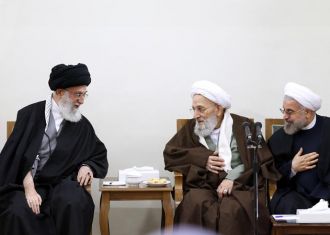
Iran Sup Leader and Experts

TEHRAN – Supreme Leader of the Islamic Revolution Ayatollah Seyyed Ali Khamenei says that threats of military action against Iran being made by U.S. officials illustrate the fact that the sanctions against Iran have been ineffective.

The Leader made the remarks during a meeting with a number of members of the Assembly of Experts in Tehran on Thursday. 

He also said the fact that there is a consensus among the heads of the three branches of government and other government officials on the implementation of the “resistance economy” plan is a promising sign which indicates that the country will be able to deal with the sanctions and the enemies’ plots through the implementation of the plan.

The Leader has recently outlined the general policies of the program to promote the “resistance economy”, which can lead the Iranian nation to victory in “the imposed economic war” with the West.

Under the program, the government must take action to expand the production and exportation of knowledge-based products, increase domestic production of strategic goods, and develop markets in neighboring countries.

It also encourages greater privatization and increased exports of electricity, gas, petrochemicals, and oil byproducts instead of crude oil and other raw materials.

Elsewhere in his remarks, the Leader highlighted the importance of the country’s independence and said that he is not opposed to relations with other countries, “but it must be specified that with which countries we should have relations and how the relations should be.”

He also criticized certain people for censuring the officials who put up resistance against the enemy for some problems facing the country and said, “the problems will not be resolved if we give in to the enemy.”

“The enemies of the Iranian nation are now among the most notorious (governments),” the Leader said, adding that the U.S. government is today regarded as a violent and criminal player on the international stage which violates human rights.

Prior to Ayatollah Khamenei’s address, Assembly of Experts Chairman Ayatollah Mohammad Reza Mahdavi-Kani delivered a speech and briefed the Leader on the meeting of the assembly which was held on Tuesday and Wednesday.

The wages of weakness

March 7, 2014

The wages of weakness, Washington Post, March  6, 2014

Vladimir Putin is a lucky man. And he’s got three more years of luck to come.

He takes Crimea, and President Obama says it’s not in Russia’s interest, not even strategically clever. Indeed, it’s a sign of weakness.

Really? Crimea belonged to Moscow for 200 years. Russia annexed it 20 years before Jefferson acquired Louisiana. Lost it in the humiliation of the 1990s. Putin got it back in about three days without firing a shot.

Now Russia looms over the rest of eastern and southern Ukraine. Putin can take that anytime he wants — if he wants. He has already destabilized the nationalist government in Kiev. Ukraine is now truncated and on the life support of U.S. and European money (much of which — cash for gas — will end up in Putin’s treasury anyway).

Obama says Putin is on the wrong side of history, and Secretary of State John Kerry says Putin’s is “really 19th-century behavior in the 21st century.”

This must mean that seeking national power, territory, dominion — the driving impulse of nations since Thucydides — is obsolete. As if a calendar change caused a revolution in human nature that transformed the international arena from a Hobbesian struggle for power into a gentleman’s club where violations of territorial integrity just don’t happen.

“That is not 21st-century, G-8, major-nation behavior,” says Kerry. Makes invasion sound like a breach of etiquette — like using the wrong fork at a Beacon Hill dinner party.

How to figure out Obama’s foreign policy? In his first U.N. speech, he says: “No one nation can or should try to dominate another nation.” On what planet? Followed by the assertion that “alignments of nations rooted in the cleavages of a long-gone Cold War” — like NATO? — “make no sense in an interconnected world.”

Putin’s more cynical advisers might have thought such adolescent universalism to be a ruse. But Obama coupled these amazing words with even more amazing actions.

(1) Upon coming into office, he initiated the famous “reset” to undo the “drift” in relations that had occurred during the George W. Bush years. But that drift was largely due to the freezing of relations Bush imposed after Russia’s invasion of Georgia. Obama undid that pushback and wiped the slate clean — demanding nothing in return.

(2) Canceled missile-defense agreementswith Poland and the Czech Republic. Without even consulting them. A huge concession to Putin’s threats — while again asking nothing in return. And sending a message that, while Eastern Europe may think it achieved post-Cold War independence, in reality it remains in play, subject to Russian influence and interests.

(3) In 2012, Obama assured Dmitry Medvedev that he would be even more flexible with Putin on missile defense as soon as he got past the election.

(4) The Syria debacle. Obama painted himself into a corner on chemical weapons — threatening to bomb and then backing down — and allowed Putin to rescue him with a promise to get rid of Syria’s stockpiles. Obama hailed this as a great win-win, when both knew — or did Obama really not know? — that he had just conferred priceless legitimacy on Bashar al-Assad and made Russia the major regional arbiter for the first time in 40 years.

(5) Obama keeps cutting defense spending. His latest budget will reduce it to 3 percent of GDP by 2016 and cut the army to pre-Pearl Harbor size — just as Russia is rebuilding, as Iran is going nuclear and as China announces yet another 12-plus percent increase in military spending.

Puzzling. There is no U.S. financial emergency, no budgetary collapse. Obama declares an end to austerity — for every government department except the military.

Can Putin be faulted for believing that if he bites off Crimea and threatens Kiev, Obama’s response will be minimal and his ability to lead the Europeans even less so?

Would Putin have lunged for Ukraine if he didn’t have such a clueless adversary? No one can say for sure. But it certainly made Putin’s decision easier.

Russia will get kicked out of the G-8 — if Obama can get Angela Merkel to go along. Big deal. Putin does care about financial sanctions, but the Europeans are already divided and squabbling among themselves.

Next weekend’s Crimean referendum will ask if it should be returned to Mother Russia. Can Putin refuse? He can already see the history textbooks: Catherine the Great took Crimea, Vlad (the Great?) won it back. Not bad for a 19th-century man.

Moscow secures Crimea poll with air-defense missile drill. US steps up military activity around Russia

March 7, 2014

Moscow secures Crimea poll with air-defense missile drill. US steps up military activity around Russia, DEBKAfile, March 7, 2014

Twelve US F-16 fighter bombers and 300 military personnel are to be transferred to Poland over the weekend and more US military exercises are planned in areas around the Russia starting Sunday.

Amid spiraling tensions between Moscow and the West over the fate of Crimea, Russia has mobilized its air and coastal defenses and more than 1,000 missile and tank units for a month-long drill in Kapustin Yar, around 450 km from the Ukraine border in the Astrakhan district. DEBKAfile’s military sources report that this facility is home to one of Russia’s biggest missile bases. The exercise covers the whole of March and early April, including the March 16 Crimean referendum on secession and its aftermath.

It will conclude with live-firing drills and the deployment of air defense systems in early April, when Moscow calculates they may be needed to thwart any Ukrainian or Western attempt to disrupt Crimea’s expected application to join the Russian Federation.

The referendum, put forward by two weeks to March 16, will ask roughly three million Crimean citizens for a straight “yes” or “no” on whether to remain part of Ukraine or secede to Russia. Since around 65 percent of the voters are ethnic Russians, the region’s future is not hard to predict.

The Russian parliament announced voting on a bill enabling annexation of Crimea to the Russian Federation at the request of a majority would take place on March 21.

President Barack Obama, in an hour-long phone call to President Vladimir Putin early Friday, March 7, declared the referendum was a violation of international law, echoing European Union leaders.

After imposing sanctions on individuals abetting Crimea’s breakaway from Ukraine, Obama urged the Russian leader to cancel the referendum and return his forces to the bases Russia holds on lease in Crimea.

Putin replied that the regime in Kiev and its decisions were “absolutely illegitimate.” He said he appreciated the importance of the Russian-American relationship to global security, and maintained that bilateral ties “should not be sacrificed for individual – albeit rather important – international issues.”

Col. Oleg Kochetkov of the Kapustin Yar district command described the new Russian deployment as “the largest-ever exercise held by air defense units of the Western Military District.” He added: “It is for the first time that all air defense units from the district, including coastal defenses of the Northern Fleet, have gathered in one place.”

Taking part in the exercise are S-300 long-range surface-to-air missiles, Buk-M1 medium-range missiles and Strela-10 short-range missiles.

DEBKAfile’s military sources report that Kapustin Yar is home to one of Russia’s biggest missile bases. From there, the army tested on March 3 its new anti-air missile system S-500, followed the next day by the test-launch of an RT-2PM Topol (NATO codenamed SS-25 Sickle) IBCM.

This flurry of Russian military momentum is partly in response to the military steps announced by the Pentagon in the last 48 hours:

Friday, March 7, the USS Truxtun guided-missile destroyer crossed the Bosporus into the Black Sea to join the fleets of NATO allies Rumania and Bulgaria in a naval exercise, the day after the Pentagon unveiled plans to put another six US F-15 fighters on an air patrol mission over the Baltic states of Estonia, Latvia and Lithuania.

Twelve US F-16 fighter bombers and 300 military personnel are to be transferred to Poland over the weekend and more US military exercises are planned in areas around the Russia starting Sunday.

Lawmaker: Obama Failing to Stop DoD Contractors From Dealing with Iran

March 7, 2014

Lawmaker: Obama Failing to Stop DoD Contractors From Dealing with Iran, Washington Free Beacon, March 7, 2014

(According to Congressman Doug Lamborn (D., Colo.), Defense Secretary “Hagel is putting too much faith in a sanctions regime that is already collapsing.” As it certainly appears to be doing. — DM)

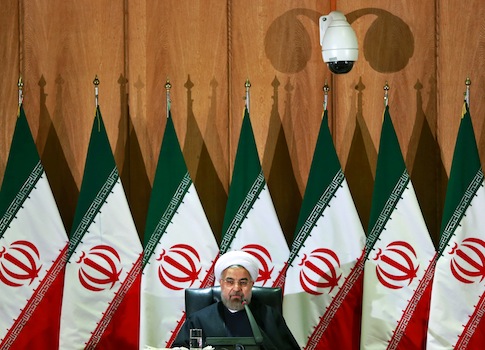
Hassan Rouhani

Administration aims to ‘bribe’ Tehran

Secretary of Defense Chuck Hagel sidestepped questions on Thursday about numerous Pentagon contractors who are currently seeking to begin business with Iran.

At least 13 major international companies have said in recent weeks that they aim to reenter the Iranian marketplace over the next several months. The companies have received Pentagon contracts totaling well over $107 billion, according to a Washington Free Beacon analysis that tracked defense contracts awarded since fiscal year 2009.

Lawmakers have expressed shock over the revelation that companies receiving billions in taxpayer funds would seek to do business with Iran and have demanded that these companies be forced to choose between  doing business with America or doing it with Iran.

When questioned about the matter during a congressional hearing on Thursday, Hagel avoided direct answers.

“Should companies that do business with the Department of Defense also be doing business with Iran?” asked Rep. Doug Lamborn (D., Colo.), a member of the House Armed Services Committee.

Hagel responded by saying that the United States has “sanctions in place … to address that. And companies would violate those sanctions if they were doing that kind of business with Iran.”

However, under the interim nuclear accord signed last year, companies have a temporary window to conduct certain types of business with Iran, giving it a chance to cash in on lucrative deals.

“One news report has indicated that companies doing business with the Department of Defense to the tune of $100 billion are looking at doing more business with Tehran now that the, sort of, floodgates have been opened,” Lamborn said. “And some people would disagree with that term, floodgates, since this recent deal with Iran. But that’s how some people out there in the business world are looking at it.”

Hagel said that “no floodgates have been opened.”

Asked after the hearing if he was satisfied with Hagel’s answers, Lamborn said that Hagel is putting too much faith in a sanctions regime that is already collapsing.

“He’s putting a lot of faith in the sanctions program that the Obama administration has in place,” Lamborn said. “Unfortunately, that program has been considerably weakened ever since the so-called agreement. I’m not convinced we’re really looking closely enough at how major companies in some cases might be wanting to play on both sides of the fence.”

Lamborn criticized the administration for not publicly addressing the issue and drawing a line for Pentagon contractors.

“I don’t see anybody being called out, and I don’t see any warnings being issued to any companies,” he said. “I just don’t see anything happening.”

This silence sets a dangerous precedent, Lamborn said.

“I’ve tried to call out some people by name and maybe bring them to an awareness that if they operate in an inconsistent way they’re going to have to have consequences,” he said.

Lamborn went on to note that some in the Obama administration believe that it is wise to get Tehran hooked on outside cash.

“There are some in the administration who have the belief they want Iran to start doing a lot of business and get hooked on the money,” he said. “I think that’s a huge gamble that hasn’t been proven. What has worked in the past to bring them to the table has been strong sanctions, not some kind of money transfusion that bribes people.”

Many of the companies said to be exploring business opportunities in Iran have had highly lucrative DoD contracts.

These companies include Boeing and General Electric—which have DoD contracts worth at least $87.9 and $12.5 billion respectively—as well as the Italian oil company Eni, Merck, Safran, Vitol, Bosch Rexroth, Sanofi Pasteur, and AVL.

Commentary: The West’s fiasco in Ukraine

March 7, 2014

Commentary: The West’s fiasco in Ukraine, Xinhua Net, Ming Jinwei, March 7, 2014

(Xinhua Net is sponsored by Xinhua News Agency as its online provider. Xinhua News Agency is

the state press agency of the People’s Republic of China. Xinhua is a ministry-level department subordinate to the State Council. Its president sits at the powerful Central Committee of the Communist Party of China, the highest authority within the Party.

Hence, it seems reasonable to assume that the following commentary is the position of the Communist Party of China. — DM)

“Western leaders were delusional when they believed they, with dented moral authority and shrinking financial coffers, could still take up such a grand task of nation-building. . . . The West itself also becomes a loser as the fiasco in Ukraine will surely erode its credibility.”

BEIJING, March 7 (Xinhua) — For a brief moment, Western leaders might have stopped to congratulate themselves for their “accomplishments” in Ukraine.

With their backing, Ukrainian opposition protesters successfully toppled the pro-Russian government, forcing out the president they loathe and dealing a humiliating blow to the Kremlin.

The West might have scored a major victory in this latest round of goepolitical fight. But things turned out otherwise.

Shortly afterwards, Russia struck back. Now, with Russian military personnel deployed in eastern Ukraine to protect Russia’s legitimate interests and pro-Russian regions clamoring for a secession from Kiev, Ukraine is teetering on the brink of total chaos and disintegration.

The West’s strategy for installing a so-called democratic and pro-Western Ukrainian government did not get anywhere at all. On the contrary, they have created a mess they do not have the capacity or wisdom to clean.

Their ill-fated plan was fundamentally flawed from the very beginning. First of all, they were destined to shoot their own feet when they, under the cliche pretense of supporting democracy, interfered in Ukrainian domestic affairs by engaging in biased mediation.

Second, they underestimated Russia’s will to protect its core interests in Ukraine. Russia may no longer be interested in competing for global preeminence with the West, but when it comes to cleaning a mess the West created in the country’s backyard, Russian leaders once again proved their credibility and shrewdness in planning and executing effective counter moves.

Last but not least, Western leaders were delusional when they believed they, with dented moral authority and shrinking financial coffers, could still take up such a grand task of nation-building.

Unfortunately, Ukraine and its people have become a big victim in this grueling process.

The Ukrainian people do not get the democracy or prosperity the West promises. Instead, all they can see in their beloved country now is political confusion and economic depression.

The West itself also becomes a loser as the fiasco in Ukraine will surely erode its credibility.

For the rest of the world, once again, people see another great country torn apart because of a clumsy and selfish West that boasts too many lofty ideals but always comes up short of practical solutions.

But the world does not need to be too pessimistic. The game in Ukraine is far from over. The international community still has the opportunity to salvage the country by working together.

Major powers should set their animosity aside and start working for a compromise. The Ukrainians should abandon their political infighting and work to restore law and order in their country as soon as possible.

After all, an independent, complete and stable Ukraine best serves the interests of all, including China.

Obama, anatomy of a failure

March 7, 2014

Obama, anatomy of a failure, Israel Hayom, Prof. Abraham Ben-Zvi, March 7, 2014

(President Obama has held office for just over five years. He appears to have learned little about foreign policy or the dangers of relying on the “good faith” of foreign adversaries. There is no apparent reason to assume that he will learn significantly more during the next three years. President Truman became wiser during his presidency, increasingly so after the “unexpected” North Korean invasion of South Korea in June of 1950 –for which we were grossly unprepared due in large part to defense cuts “to the bone and through the bone.” We are doing it again. — DM)

However the Ukraine crisis is resolved, it will no longer be possible to rehabilitate American credibility • Given this situation, how much stock should Israel put in promises made by Washington?
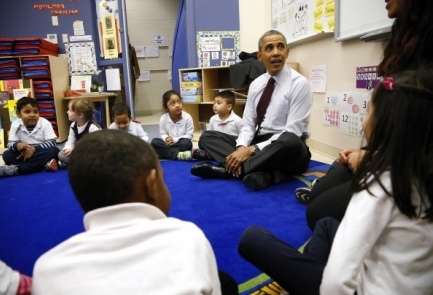
Obama with his advisersThe Obama administration refuses to recognize the violent, cruel, and belligerent nature of the international system | Photo credit: Reuters

On April 12, 1945, President Franklin Delano Roosevelt died. Eleven days later, on April 23, his successor, Harry S. Truman, welcomed Soviet Foreign Minister Vyacheslav Molotov to the White House. To Molotov’s astonishment, Truman bitterly assailed him over the USSR’s violation of the Yalta Agreement, which was signed two months earlier by Roosevelt, British Prime Minister Winston Churchill, and their totalitarian partner in victory Joseph Stalin.

According to the agreement, the Soviet Union committed itself to holding free, democratic elections in Poland (a country which Moscow essentially controlled through its puppet government in Warsaw). Molotov, who was shocked at the ferocity of Truman’s tirade, responded by saying that he had never been spoken to in such a manner.

The president’s blistering verbal attack failed to have any effect on Moscow’s aggressive, belligerent actions in Poland and the rest of eastern Europe. Nonetheless, it did illustrate the naivete demonstrated by a number of American leaders who mistakenly believed that the Russian bear — with its hostile aggression and its determination to exploit any opportunity to widen its sphere of influence and bolster its power — would honor basic norms of behavior and fairness and abide fully by agreements.

Indeed, one major hallmark of American diplomacy during the Cold War was the excessive reliance on written agreements. Truman’s protestations regarding Moscow’s violation of Yalta was akin to a legal dispute over breach of contract. The debate even descended to semantics, with Truman insisting on a “reorganization” as it pertains to the future structure of the Polish government.

In practice, despite the legal obligations supposedly taken by the Kremlin in upholding the independence and democratic future of Poland, what played the decisive factor was a confluence of the political interests of the USSR and not some signed document. Specifically, given its history of being invaded from the west, Stalin was determined to make sure that in the space separating the superpower which he kept in his iron grip and Germany would lie a docile, satellite Polish state that would seamlessly integrate with the new empire that he built after 1945.

After it became apparent that the American leadership’s initial thinking regarding the importance placed in the written word and signed documents was so disconnected from the cruel dynamic that was beginning to take shape in East-West relations, one would have been forgiven for expecting the American superpower’s leadership to commit itself to a process of divorcing itself from fantasy and delusions.

Going back in time

Here we are, seven decades after that tumultuous meeting between Truman and Molotov, we have Barack Obama’s America going back in time, straight to those distant days in which the U.S. made a hesitant, clumsy, error-filled transition from isolationist to reluctant leader of the free world, which was facing a challenge posed to it by the Stalinist USSR.

Not only has the 44th president learned nothing from Truman’s resounding failures in attempting to dissuade Stalin through legalese and court-styled appeals, but he has managed to bring upon himself more ridicule by going overboard in the same direction. Just two weeks ago, when the “Ukrainian crisis” was teeming, the U.S. president declared during a speech he delivered in Mexico that it was wrong to attribute the disagreements with Russian President Vladimir Putin on issues like Syria and Ukraine to a revival of “inter-power rivalry” similar to the one waged during the Cold War.

Even after Obama’s efforts to minimize the disagreements with the Kremlin led directly to the Russian invasion of the Crimean peninsula, the U.S. president has yet to come back to reality. Indeed, during his lengthy phone conversation with Putin, it sounded as if Obama was channeling Truman himself. In the phone call, Obama took on the role of jurist (or a professor of law at the University of Chicago, a position that is much more suited to him than his current occupation) who is calling to order someone who is guilty of breaching a contract.

A short synopsis of the conversation would lead one to the conclusion that the Russian leader was reprimanded for violating the Budapest memorandum of 1994, a document in which Moscow undertook to respect the sovereignty and territorial integrity of Ukraine. As if he were giving an introductory course in international law, Obama reiterated his well-reasoned argument that the occupation of the Crimean peninsula stands in contradiction to the memorandum and hence a violation of basic norms and principles that are supposed to guide the international community.

It’s hard to believe that such legal rhetoric had an effect on Putin since it was nothing more than a naïve application of American legal and business practices onto the rules of the game on the chaotic international stage. While these norms may be accepted codes of behavior within the United States, they are irrelevant when facing the cynical, shrewd, tough rival from Moscow (which just a few hours later would send thousands of Russian soldiers into the Crimean peninsula).

By the same token, it’s hard to believe that the nonchalant threats made by Obama and his indefatigable secretary of state, John Kerry, this past week regarding the price that Russia supposedly will pay for its aggression — including diplomatic and economic isolation that is the surcharge of Moscow’s blatant disregard for international law — hardly perturbed the Russian president.

On the contrary, particularly in regard to Kerry. Observers clearly recall Kerry’s blustery, dramatic appearances filled with theatrical pathos. The secretary took on the role of prophet of doom — a role played to perfection during the “chemical crisis” in Syria — by warning Bashar Assad of what was to come as a consequence of Damascus’ crimes. His performance was so convincing that Kerry deserves to be nominated for an Oscar. It seems that the more belligerent and threatening his statements, the less chance they will be translated into concrete action.

Indeed, while the president himself proved once again that his legal skills are above reproach in dusting off the forgotten Budapest memorandum, his secretary of state comes across as a marvelous orator whose passion-filled speeches on every available platform would make him a worthy star in Hollywood or on Broadway.

Unfortunately, this is American foreign policy, and not the theater of the absurd. In this vein, we are reminded of a famous phrase uttered by one of America’s greatest presidents, Theodore Roosevelt. Over a century ago, the president counseled that whenever dealing with rivals, it is best to speak softly but at the same time carry a big stick. The stick was to be used for deterrence and, if need be, to mete out punishment.

Judging by the present-day reality, Roosevelt’s statement has undergone a metamorphosis. Kerry, for one, continues with his fire-and-brimstone rhetoric, yet in his toolbox one would be hard-pressed to find even the smallest stick with which to provide credibility and substance to his apocalyptic threats.

In this regard, “all of Obama’s men” come across as completely disengaged from the international arena and its geo-strategic components. From a psychological aspect, it seems as if they have returned to the days of isolationism while refusing to recognize the violent, cruel, and belligerent nature of the international system.

Had they not taken the path of unilateral disengagement — or outright, hasty retreat from points of conflict and war zones — Obama and Kerry would have realized that flowery statements devoid of all meaningful content and empty promises lead to a dramatic erosion in credibility of the country that was supposed to be the guarantor of global stability and order.

The White House’s determination to completely abandon military force as a strategic option in favor of turning inward toward the continental U.S. has brought about a situation where it stands helpless where clearly defined red lines (as in the Syrian case) are crossed in such a blatant manner. Time and again, observers in Moscow and Beijing have become increasingly convinced they are seeing an eagle that has turned vegetarian and is in desperate need of rehabilitation.

The bitter irony of this situation is that if Uncle Sam does eventually awaken from his coma and decides to take determined action (with far-reaching economic measures) against Russian aggression, nobody will believe his threats (just like Hitler didn’t believe Britain would fulfill its promise to Poland in 1939 to wage war against Nazi Germany if Warsaw were to come under attack).

Indeed, just like President Jimmy Carter, who in 1977 prematurely declared an end to the Cold War and the rivalry with the Soviet Union only to be proved wrong two years later with the Soviet invasion of Afghanistan, this week Obama was left standing helpless as he watched his foreign policy go bankrupt.

There’s no need to rehash his failure on the Syrian front. The fact that Obama refrained from taking action even when conditions were ripe for it — and after the U.S. boastfully and ostentatiously declared before the world that it would indeed take military action — was the final indicator of the collapse of the president’s doctrine.

To make matters worse, by shying away from using (minimal) military force, Obama passed the baton and abdicated the leadership role in the crisis in favor of Putin. The Russian leader ostensibly jumped on the chance and midwifed the agreement that quickly bolstered his grip and prestige in the region and throughout the world.

As for Iran, here, too, it is clear that the superpower-in-decline is eagerly rushing toward a final-status agreement on the nuclear issue, irrespective of the price and the repercussions for stability and security in the Middle East.

As if that weren’t enough, in the last three years the Obama administration has abandoned its vegetarian policy of “leading from behind” when it comes to military campaigns involving allies (behind whom the Americans hide). From this standpoint, we have witnessed the end of the “Libyan option,” which entails limited, controlled military operations that are called upon when faced with regional challenges (obviously this option would not be considered in the Crimea or Ukraine).

All of these developments transpired against the backdrop of massive, steep cuts in the Pentagon’s budget which were announced last week. Although one can interpret this as a move intended to do away with excess bureaucracy and wasteful spending in favor of building a more versatile, flexible, hi-tech army, it is in fact a drastic reduction in American might. The U.S. military may soon be trimmed down to a fighting force that would comprise an incomprehensible 400,000 soldiers. This could bring the U.S. back to 1940.

As we all remember, 1940 was a time during which the U.S. was ensconced in its isolationist phase. This was just before it began to marshal its resources and capabilities toward preparing for the coming conflict with Germany, Italy, and Japan. The shrinking of its military is thus perceived as yet another manifestation of its decline and weakened position, a harbinger of yet another era of American non-interventionism.

Yes, the U.S. doesn’t have many tools to work with in Ukraine, which is right in the Russian bear’s backyard and well within its traditional sphere of influence. Still, the option of extending a generous financial aid package to Ukraine (in the spirit of the Truman Doctrine, which called for military aid to Greece and Turkey) would do well in signaling an American commitment to Ukraine’s future, particularly if it included other Western powers.

From this standpoint, it would be unwise to underestimate the package of loan guarantees totaling $1 billion, which was announced by Kerry upon his arrival in Kiev. Given the turmoil engulfing the country, the move does represent a legitimate gambit that indicates Washington’s desire to strengthen the Ukrainian government’s position as it tries to fend off the pressure coming from Moscow.

In any event, with Russia occupying the Crimean peninsula and the West unconvincingly rattling its sabers, the only concrete moves made by Washington thus far beside the loan guarantees, are the de-facto boycott of the G8 meeting due to be held in Sochi, and the thin set of military sanctions, including the freeze of all security cooperation with Russia (similar to what took place under President George W. Bush, who suspended cooperation with Russia after its invasion of South Ossetia in 2008).

What about us?

One must not ignore the Israeli angle in this story. In the past, loan and security guarantees were a major part of American policy because they helped formulate defense and diplomatic agreements between Israel and the Palestinian Authority and the Arab world.

On more than one occasion, the most glaring example being the 1975 Sinai interim agreement, which was achieved after a year of painstaking diplomacy by then-Secretary of State Henry Kissinger, the Americans have violated a few promises they made to the Israeli government. Nonetheless, Washington has managed to maintain its standing as an honest broker.

Today, given the fact that American credibility is in tatters in the neighborhoods of Damascus as well as in other points of friction, it would be wise to wonder whether Israel should put stock in promises made by Washington to compensate Israel for concessions that it will be asked to make.

However the Ukraine crisis is resolved, even if the regime in Kiev withstands Russian brutality it will no longer be possible to rehabilitate American credibility. The rumors of the impending death of the American era were, therefore, hardly premature.

Surviving Obama…

March 7, 2014

Column one: Surviving Obama | JPost | Israel News.

By CAROLINE B. GLICK

03/06/2014 23:00

Obama’s newfound courage to begin abandoning his pretense of supporting Israel presents Israel with a new challenge.

Obama and Netanyahu

Netanyahu and Obama shake hands at start of Oval Office meeting, March 3, 2013 Photo: REUTERS

Bloomberg columnist Jeffrey Goldberg minced few words in discussing the interview that US President Barack Obama gave him on the eve of Prime Minister Binyamin Netanyahu’s latest visit to Washington.

Speaking with journalist Charlie Rose, Goldberg equated Obama’s threat to stop supporting Israel in international forums to the talk of a mafia don. Obama told Goldberg that if Israel doesn’t cut a deal with the Palestinians soon, “our ability to manage the international fallout is going to be limited.” He added, “And that has consequences.”

That statement, Goldberg noted, was a “veiled threat” and “almost up there with, ‘Nice little Jewish state you’ve got there. Hate to see something happen to it.’” Goldberg saw the interview as Obama’s way of showing that he is beginning to abandon the pretense of supporting Israel, now that he no longer faces reelection. In Goldberg’s words, “It’s not that the gloves are coming off. It’s more that the mask of diplomatic language is coming off a little bit.”

Goldberg added that due to the fact that Obama “doesn’t have to run again for anything,” he doesn’t need to pretend feelings for Israel that he doesn’t have, by among other things, going to the AIPAC annual policy conference.

And indeed, Obama has achieved a comfort level with implementing anti-Israel policies. His threat to step aside and let Israel-haters have their way in places like the United Nations or in certain quarters of Europe is of a piece with several steps the he is already reportedly undertaking to harm Israel in various ways.

Before he was reelected in 2012, Obama felt it necessary to align his policies on Iran to the preferences of the US public. And as a consequence, although he voiced harsh criticism of congressional sanctions bills against Iran, he grudgingly signed them into law. (He then proceeded to use the sanctions he opposed but signed as proof that he supported Israel in speeches before Jewish audiences.) Now that he no longer has to concern himself with the wishes of the American public and its representatives in Congress, Obama has dropped the mask of opposition to Iran and forged ahead with a diplomatic process that all but ensures Iran will acquire nuclear weapons.

The same is apparently the case with joint US-Israeli missile defense programs. On Wednesday, it was reported that the administration has slashed funding of those programs by two-thirds for the 2015 fiscal year. Obama touted his previous willingness to fully fund those programs – manifested in his decision not to veto congressional appropriations, despite his stated desire to slash funding – as proof of his administration’s “unprecedented” security cooperation with Israel.

Then there are the low-level bureaucratic sanctions that Obama began enacting against Israel last year. These involve State Department activities that are not subject to easy congressional oversight.

For instance, last week it was reported that last year the State Department drastically decreased the number of Israeli tourist visa applications it approved. The rise in rejection rates has prevented Israel from participating in the visa waiver program.

Foreign Ministry officials told reporters they believe this is a deliberate, premeditated policy.

And this week we learned that last year the State Department rejected hundreds of visa requests from members of Israel’s security services.

Although White House spokesman Jay Carney was quick to claim that Israel’s interception of the Iranian missile ship en route to Gaza on Wednesday morning was the result of US-Israeli intelligence cooperation, the fact is that the US continues to undermine Israel’s covert operations in Iran. Earlier this week, CBS reported that the Obama administration has demanded that Israel stop its reported covert campaign to kill Iranian nuclear scientists in order to delay or block Iran’s nuclear progress.

Obama’s new willingness to threaten Israel and to take the actions he feels it is safe to take to downgrade Israel’s relations with the US will likely only grow after November’s midterm elections.

After the congressional elections, Obama will feel entirely free to attack the US’s closest ally in the Middle East.

So what can Israel do? How can Israel safeguard its interests at a time when the US president publicly trashes and threatens those interests and privately undermines them? Israel already did the most important thing in this regard when voters reelected Netanyahu to lead the government last year. During his trip to the US this week, Netanyahu made clear that he understands the challenge and is competent to handle it.

Since Netanyahu returned to the premiership in January 2009, he has implemented a policy of waiting Obama out. Over the past five years, the prime minister has only directly challenged Obama when he had no choice. And that has been the right course. Little good comes to Israel from open fights with the White House. Such fights should only be engaged when the consequences of having a fight are less bad than the consequences of not fighting.

In his speech at the AIPAC Conference on Tuesday, Netanyahu rebutted every position Obama has staked out on the Palestinians and Iran without ever mentioning Obama’s name. By doing so he energized Israel’s supporters while denying Obama the ability to claim that Netanyahu is unsupportive of his policies.

In other words, he humored the White House while staking out an independent Israeli policy for which he secured the support of Israel’s American backers.

But Netanyahu’s skill in maneuvering around Obama is not enough for Israel to safely weather his presidency. Israel needs an overall strategy for securing its interests.

Such a multi-pronged strategy begins with Iran.

Israel needs to directly attack Iran’s nuclear installations – by covert action as well as through overt military strikes, as required.

According to CBS, after Obama’s diplomatic capitulation to Iran became public, Netanyahu ordered Israel’s intelligence services to concentrate their efforts in Iran on exposing the fraudulence of Iran’s purported commitment to freezing its nuclear progress. But while this is important, exposing Iran’s duplicity is not nearly as important as incapacitating Iran’s nuclear sites.

With Obama now joining Secretary of State John Kerry in openly threatening to passively support a European trade war against Israel, it is imperative that Israel develop every economic opportunity it has to expand its markets. As Netanyahu made clear in his speech to AIPAC, Israel’s technological prowess has already made it a magnet for global investors. But these opportunities should be maximized through further economic liberalization.

In a conversation with Haaretz earlier this week, Texas Republican Sen. Ted Cruz noted that “President Obama has been the president most hostile to the nation of Israel in modern times.”

In a conversation with this writer on Tuesday, Cruz placed the blame for Obama’s success in implementing his anti-Israel policies on the Senate Democrats, led by Majority Leader Henry Reid.

In his words, “The challenge we are facing is that the number one protector of Obama’s foreign policy has been Harry Reid and the Senate Democrats.”

On the sidelines of the AIPAC conference, Cruz blasted the hypocrisy of Senate Democrats. “At the same time they block the Kirk-Menendez sanctions [bill against Iran] and blame Israel for the impasse in peace negotiations, they proclaim their support for Israel,” he said.

And Cruz is certainly correct.

There can be no doubt that Israel’s strongest supporters today are in the Republican Party.

But it is important to remember that most Democrats also support Israel. They are simply unable politically to withstand the pressures that Obama has brought to bear to force them to stand with him against Israel.

In his speech to AIPAC, Democratic Sen. Robert Menendez, who chairs the Senate Foreign Affairs Committee confessed that he was forced to stand down on Iran sanctions due to partisan pressure.

In his words, “When it comes to Iran, I have stood with you and have stood against so many in my own party.”

Menendez’s admission that he couldn’t withstand the pressures that Obama and Reid brought to bear against him indicates that among some Democrats, support for Israel remains strong, but that under Obama, Israel’s Democrat supporters are weak.

While deeply problematic, this is a problem with a limited shelf-life.

If Obama views the midterm elections as the final restraint on his ability to act against the will of the American public, his fellow Democrats likely view the elections as the last time Obama will serve as the head of their party during an election cycle. In the 2016 elections, the Democrat presidential nominee will set the tone for the party, not Obama. Moreover, as the full economic impacts of Obamacare, Obama’s signature domestic policy, become known after the midterm elections, Obama will be even more severely weakened. Consequently, his ability to pressure his Democrat colleagues to toe his line will be diminished.

Finally, given Obama’s obsessive focus on demanding that Israel surrender its land to the Palestinians, it is imperative that Israel develop a strategy for waiting Obama out on this issue.

Obama told Goldberg that Israel must surrender to the Palestinians forthwith, because it has no other option. In his words, “I have not yet heard… a persuasive vision of how Israel survives as a democracy and a Jewish state at peace with its neighbors in the absence of a peace deal with the Palestinians and a two-state solution.

As I explain in my book The Israeli Solution: A One-State Plan for Peace in the Middle East, which was released on Tuesday, Israel has a viable alternative.

It involves applying Israeli law to all of Judea and Samaria and integrating the Palestinians into Israeli society.

Israel would not be endangered demographically or democratically if it adopted this approach, and it would certainly be better off militarily.

Netanyahu has stated his support for establishing a Palestinian state. But he has made clear that he will only agree to a peace deal that protects Israel’s vital interests. While maintaining faith with that position, it would be prudent for him to discuss publicly and at length the fact while a negotiated peace is his preference, there is a fine alternative to a Palestinian terror state in Israel’s strategic and historic heartland.

If the Palestinians are uninterested in negotiating a viable agreement with Israel, then Israel will feel free to adopt an alternative course of applying its laws to Judea and Samaria.

At a minimum, such a move by Netanyahu would discredit and end Obama’s demographic threats, which are based on falsified Palestinian census data. It would place pressure on the Palestinians to show their hand – either embracing peace in a genuine manner, or demonstrating the basic falsity of their protestations of peaceful intentions. Either way, Israel would be better off.

Obama’s newfound courage to begin abandoning his pretense of supporting Israel presents Israel with a new challenge. But it is far from insurmountable. With the proper mix of policies, Israel can absorb Obama’s blows and even to blunt them, as Obama becomes an independent, unrestrained, and weak lame duck president.

Rocking the boat?

March 7, 2014

Israel Hayom | Rocking the boat?.

Ruthie Blum

On Wednesday, Israeli Navy commandos intercepted a commercial ship in the Red Sea between Eritrea and Sudan that was transporting weapons from Iran to terrorists in Gaza.

Because the commandos that boarded the vessel were wearing helmet cameras, there is real-time footage of the operation. And what the pictures reveal are dozens of Syrian-made long-range missiles, hundreds of pounds of payload and sacks of concrete with a “made in Iran” label in plain English.

According to sources in the Israeli defense establishment, this event is merely the tip of the iceberg. At its epicenter is the Quds Force of the Iranian Republican Guards, the unit in charge of “exporting the Islamic Revolution” worldwide. Key to the success of its goal is arming and financing terrorist networks bent on Israel’s annihilation.

Israeli intelligence has been closely monitoring the activities of Iran’s global reach and Middle East stronghold. Wednesday’s interception of the Klos C ship was one among many thwarted attempts by the ayatollah-led regime to transfer arms to Palestinian terror groups. One shudders to think of all the successful efforts emanating out of Tehran that Israel was unable to block.

It is this that Prime Minister Benjamin Netanyahu keeps trying to hit home with the American administration. His constant warning (reiterated during his speech on Tuesday at the American Israel Public Affairs Committee’s annual policy conference) that Iran has not become more moderate with President Hassan Rouhani at its helm — and that time is running out before it acquires nuclear weapons — sounds like a broken record.

But Netanyahu is forced to repeat himself, because U.S. President Barack Obama is neither listening nor cares.

This did not prevent Obama from taking credit for the Israeli commando raid on the Klos C, however. Indeed, as soon as news of the covert operation broke, White House spokesman Jay Carney said, “Our intelligence and military activities were closely coordinated with our Israeli counterparts, who ultimately chose to take the lead in interdicting this shipment of illicit arms.”

Lucky that Israel “chose to take the lead.” As enemies of the United States have learned since Obama took office, American threats are empty.

“We will continue to stand up to Iran’s support for destabilizing activities in the region in coordination with our partners and allies,” Carney continued. “These illicit acts are unacceptable to the international community and in gross violation of Iran’s Security Council obligations.”

One doesn’t know whether to laugh or cry at such atrophied muscle-flexing.

Let us not forget, after all, that while he was making these statements to the press in Washington, a new round of three-day negotiations between Iran and the P5+1 (the U.S., the U.K., Russia, China, France and Germany) had begun in Vienna. These talks are scheduled to end on Friday.

On Sunday, European Union foreign policy chief and nuclear negotiator Catherine Ashton is headed to Iran for a chummy visit. There she will undoubtedly meet with Foreign Minister Javad Zarif. He’s one Iranian whom she has gotten to know quite well, as he has participated in a number of farcical P5+1 summits, like the last one in February.

This is why Carney hurried to soften his “tough” words. Regardless of the Iranian weapons cache found on the Klos C, he said, “It’s entirely appropriate to continue to pursue the possibility of reaching a resolution on the nuclear program.”

This is as ludicrous as Tehran’s denial that it had anything to do with the intercepted arms shipment.

So preposterous is this, in fact, that while one Iranian military source was calling the accusations “baseless and false,” Iranian Defense Minister Brig. Gen. Hossein Dehghan held a ceremony that day to announce the addition of four new types of ballistic missiles to its arsenal — some with multiple warheads for more devastating effects.

“These missiles are able to hit and destroy enemy targets with precision, and they meet a variety of the armed forces’ needs,” he said. “The weapons have strengthened Iran’s deterrence power and military might.”

Oh, and in case anyone was wondering, Israel is in easy range of these missiles.

It is unlikely that Ashton will raise this particular issue over tea with Zarif during her Tehran trip. Nor will she want to rock the boat, so to speak, by asking him about his tweet on Thursday, which read: “An Iranian ship carrying arms for Gaza. Captured just in time for annual AIPAC anti Iran campaign. Amazing Coincidence! Or same failed lies.”

It’s enough to make even those of us with an iron stomach seasick.

Ruthie Blum is the author of “To Hell in a Handbasket: Carter, Obama, and the ‘Arab Spring.'”

Off Topic: Confronting Putin’s Invasion

March 7, 2014

Off Topic: Confronting Putin’s Invasion – The Weekly Standard.

It can—and must—be done.

Mar 17, 2014, Vol. 19, No. 26 • By ERIC EDELMAN

On the last day of February and first day of March, Russia’s mendacious foreign and defense ministers told their credulous U.S. counterparts that Russia had every intention of respecting Ukraine’s independence and territorial integrity. Of course, Foreign Minister Sergei Lavrov is virtually the poster child for Henry Wotton’s famous definition of a diplomat as someone sent abroad to lie for his country. Russian assurances to their U.S. counterparts during the war in Georgia in 2008 were equally deceitful. Lavrov’s duplicity during the Georgia war negotiations that year was so outrageous that French president Nicolas Sarkozy, according to witnesses, at one point grabbed him by the lapels and called him a liar to his face. 

Non-soft diplomacy: Russian special forces in Crimea

Non-soft diplomacy: Russian special forces in Crimea
Newscom

The crisis in Georgia was a serious matter but unfortunately came in the midst of an American presidential election and at the tail end of an administration that was both physically and psychologically exhausted after seven years of war. The serious but unsuccessful effort to impose costs on Russia was complicated by the fact that Georgia’s impetuous president, Misha Saakashvili, had ignored U.S. cautions, risen to the bait, and carelessly stepped into the trap set for him by Vladimir Putin. When Bush administration witnesses testified before the Senate Armed Services Committee in September 2008 (full disclosure: the author was one of the witnesses), some Democrats on the committee, notably including then New York senator Hillary Clinton, hinted darkly at a Bush administration conspiracy that had somehow orchestrated the war (implicitly to assist John McCain’s presidential election campaign), although her own experience appears to have soured her a bit on Putin.

After the Obama team took over, its members demonstrated minimal sympathy for the Georgians (who were facing their own internal political problems) since any close attention to Russia’s continued violations of the agreements that ended the war would detract from the new administration’s efforts to “reset” relations with Russia. Although Secretary of State John Kerry now has virtually denied there ever was a “reset” policy, it was aimed at securing Russian support for the president’s overriding nonproliferation objectives, particularly with regard to Iran, and at securing Russian support for the U.S. effort in Afghanistan, specifically the northern distribution route for supplying NATO forces (later, Russian support on Syria would be added to the list). The purchase price for this was scaling back U.S. missile defense efforts in Central Europe and a sweetheart deal in the New START Treaty, which required the United States to dismantle nuclear force structure while allowing Russia to build up its strategic nuclear forces to the agreed treaty levels while totally ignoring Russian theater nuclear weapons.

The administration’s failed efforts at reset are now obvious for all but the most deluded to see. Russia’s invasion of Ukraine presents the United States and its European allies with what is commonly conceded to be the biggest test of European security since the end of the wars of the Yugoslav succession in 1999. As was the case in Georgia, there will be a strong temptation to find a face-saving agreement that papers over Putin’s gains in order to trumpet the “success” of a negotiated, diplomatic outcome and allow the international community to return to its normal torpor. It can’t be said enough that any outcome that allows Putin to wrest either Crimea or other parts of Ukraine from Kiev’s control should not be acceptable. He should not be allowed to maintain the ill-gotten gains of his aggression. As Obama’s former NATO ambassador has said, “this isn’t just about Crimea.  This is about who is ultimately in control of Ukraine.”

Why does Ukraine matter so much?  

First, it matters because—despite Putin’s risible claims of anti-Russian violence in Crimea and eastern Ukraine (even Angela Merkel reportedly told President Obama that she thinks Putin is “in another world”)—this is military aggression against a neighboring independent state in the heart of Europe that violates the U.N. Charter and the Helsinki Final Act. Moreover, the pretext upon which it is based, protection of Russian national minorities in Ukraine, could also be used against NATO member states like Estonia, Latvia, and Lithuania, and under Article 5 of the NATO treaty, “an armed attack against one [member state] .  .  . shall be considered an attack against them all.” The future viability of the alliance is at stake here.

Second, if Putin can pull off a smash and grab operation against Crimea without being made to pay a serious and significant price, others will draw their own conclusions. Would the “international community” exact a price subsequently if China seized the Senkaku Islands or even Taiwan? Would Pyongyang or Tehran conclude that it might have more leeway for aggressive moves against its neighbors?

Third, there is a huge nonproliferation issue (allegedly the president’s highest national security priority) at stake. Ukraine, as one of the successor states to the former Soviet Union, found itself in 1991 with nuclear weapons on its territory to which it laid claim. It was one of the Clinton administration’s signal diplomatic achievements to have gotten Ukraine, Belarus, and Kazakhstan to agree to return the nuclear weapons on their respective territory to Russia, leaving one nuclear weapons state on the territory of the former USSR rather than four. In return, the United States, United Kingdom, and Russia all signed, along with Ukraine, the Budapest Memorandum, which accompanied Ukraine’s adherence to the Nuclear Nonproliferation Treaty. Inter alia, that document committed Russia to “respect the independence and sovereignty and the existing borders of Ukraine” and imposed on Russia an “obligation to refrain from the threat or use of force against the territorial integrity or political independence of Ukraine, and that none of their weapons will ever be used against Ukraine except in self-defense or otherwise in accordance with the Charter of the United Nations.” If left standing, Russian aggression will establish that security assurances offered by the nuclear weapons states to states that willingly give up their nuclear weapons or weapons programs mean precisely nothing.

What is to be done? Several commentators have suggested there are no military options and effective diplomacy and soft power are the order of the day. This trope of the mainstream media implicitly supports the Obama administration’s standard response to criticism—any alternative to the current policy would result in a “war” that would require U.S. “boots on the ground.” Such either/or thinking totally ignores a range of more forceful middle options that would, in this case, give the president more tools with which to manage the crisis.

The first order of business is clearly to reinforce Ukraine’s independence and territorial integrity. Dispatching Secretary Kerry to Kiev was a valuable first step, but it would have been better had he been accompanied by either Secretary of Defense Chuck Hagel or the chairman of the Joint Chiefs of Staff, General Martin Dempsey. Kerry needs to be followed by a long line of NATO and EU foreign ministers to consult, guide, and reassure the Ukrainian interim government. Shoring up the Ukrainian economy (in conjunction with the EU) is obviously the most immediate and important signal to be sent. It would be good, however, to dispatch a military needs assessment team to identify crucial shortfalls in the Ukrainian military and to lay the basis for urgent and longer-term military assistance programs on a bilateral U.S.-Ukraine basis. This should be done in coordination with (and as a stimulant to) a meeting of the NATO-Ukraine Commission as recently recommended by former Supreme Allied Commander in Europe James Stavridis. The commission could help share intelligence with the Ukrainians but also assist them with planning a more targeted NATO military assistance program.

A second necessary step is to strengthen NATO’s deterrent posture and ability to reassure allies. Reinforcing the NATO air policing mission in the Baltics is a good beginning, but this will also require a thorough reconsideration by the alliance of the self-abnegating undertakings it assumed at the time of the NATO-Russia Founding Act in 1997. The alliance should consider whether and how it wants to position ground combat forces on the territory of the former Warsaw Pact states that now are members of NATO. It should also reconsider the so-called three no’s—no intention, no plan, no reason to deploy nuclear weapons on the territory of the new NATO members. Bringing NATO military power closer to the borders of Russia would impose a real cost on the Russian military and might cause nationalists who support Putin’s current course to reconsider. All of this would need to be accompanied by a large increase in the defense budget, much like the one Jimmy Carter obtained after the Soviet invasion of Afghanistan. A jolt to the budget—at least to the levels proposed by Secretary Gates in 2011—would signal an end to the relative decline in U.S. military power over the past four years that, in Secretary Hagel’s words, has meant that “we are entering an era where American dominance on the seas, in the skies, and in space can no longer be taken for granted.” That would send a powerful and unwelcome message to those in both Moscow and Beijing who are betting on the end of the unipolar world.

Finally, we need to undercut some of the tools of economic and political influence that Russia has wielded so effectively in Ukraine and elsewhere. The administration’s sanctions targeting corrupt individuals who are complicit in Russian military action in Ukraine are all well and good, but they must hit the malefactors around the head kleptocrat—Vladimir Putin. Russia’s use of oil and gas to intimidate and sway can also be a target. It is time for the U.S. government to enable industry to export oil and natural gas and facilitate the infrastructure for doing so—by building a liquefied natural gas export terminal on the East Coast, for example, turning the United States effectively, as one former Bush administration official has suggested, into an “arsenal of energy.”

If all of this sounds a bit familiar, perhaps reminiscent of Ronald Reagan’s successful policies in the 1980s, it shouldn’t be a big surprise. During the third presidential debate in 2012, President Obama derided the courses of action recommended by Governor Mitt Romney by saying that “the 1980s are now calling to ask for their foreign policy back.” There are many words that the president will have to eat in light of the past week’s events. He ought to start with those.

Eric Edelman was undersecretary of defense for policy from 2005 to 2009.

The Iranian missile ship’s capture was Israel’s second swipe at al Qods chief Gen. Soleimani

March 7, 2014

The Iranian missile ship’s capture was Israel’s second swipe at al Qods chief Gen. Soleimani.

DEBKAfile Special Report March 7, 2014, 11:10 AM (IST)

Gen. Qassem Soleimani, Al Qods Brigades commander

Gen. Qassem Soleimani, Al Qods Brigades commander

The Israeli naval commandos’ seizure of the Iranian missile ship KLOS C Wednesday, March 6, was the second time in ten days that the IDF had poked a finger in the eye of Gen. Qassem Soleimani, head of the al Qods Brigades, the intelligence-cum-terrorist arm of Iran’s Revolutionary Guards Corps (IRGC). The first instance was the Israeli air strike on Feb. 24 against Hizballah’s arms convoys and missiles on the Lebanese-Syrian border.

In reference to the ship carrying dozens of Syrian-made 302mm rockets from Iran to the Gaza Strip, Israeli military intelligence chief Maj. Gen. Aviv Kochavi said Thursday, March 6, “We know who was behind this operation and who ran it from start to finish, the Revolutionary Guards and al Qods.”

Al Qods supreme commander is Gen. Soleimani. His agents and operatives are planted deeply across the Syrian war front and in Hizballah’s organization in Lebanon.

debkafile reports: Israel does not buy the distinction drawn by Iran’s leader Ayatollah Ali Khameini  for international consumption between the two arms of the Islamic regime: President Hassan Rouhani’s government for the respectable handling of diplomacy and foreign relations, and the IRGC, which is purportedly barred from nuclear negotiations and confined to running the regime’s military, subversive and terrorist operations in areas of conflict, such as Syria, Lebanon and Israel.

The IDF regards the two arms as artificial and representing the same regime which denies Israel the right to exist.

This week, Israel saw its chance to show that regime up as two-faced and expose its clandestine arm by a spectacle that played well in the United States and on the world stage.

The capture of the missile ship on the Red Sea shortly before it entered Port Sudan served that purpose.

It was also a chance to show Tehran that for Israeli intelligence, the clandestine agencies Iran had crafted over many years, were an open book and no match for its capabilities.

Gen. Soleimani has long been an object of study by Israel’s army chiefs and security agencies. In their estimation he will have his hands full in the short term with finding and plugging the hole in his organization which enabled hostile penetration. He is already taxed with the urgent task of putting a stop to the spate of suicide bombings plaguing the Syrian government and targeting Hizballah and Iranian institutions in Lebanon.

Therefore, in the short term,  Israeli intelligence experts believe the al Qods chief will not have time for revenge on Israel.

debkafile’s security sources beg to differ. Gen. Soleimani is reputedly a brilliant and cautious planner of undercover operations. He was quick to set up low-key yet ominous reprisals within days of Israel’s air strike over the Lebanese-Syrian border. They came as rocket fire and an attempt to rig a bomb on the Israeli border fence – both actions mounted from Syria although Hizballah was held responsible.

The Iranian general may therefore be expected to come up with some form of payback for the ship’s seizure.

Our sources discount the overblown claims that this unquestioned IDF success in capturing dozens of Syrian-made 302mm rockets carried by the ship saved four million Israelis from attack.

For two years, the IDF refrained from cutting short the incessant stream of mobile Grad rockets and other weapons systems flooding into the Gaza Strip from Libya via Egypt. Those weapons had already imparted to Hamas, Jihad Islami and the al Qaeda affiliates in Sinai the ability to strike Tel Aviv, Jerusalem and Rishon Lezion, an ability exhibited during Israel’s 2012 Gaza operation.

Two puzzling questions are raised by the Iranian missile ship episode suggesting that there was more to it than meets the eye.

The capture of a small merchant with a crew of 17 unarmed seamen scarcely warranted a naval commando force of the size employed, especially as it sailed without an Iranian naval escort; nor was there any sign of Iranian naval units based in Port Sudan coming to its rescue.

It is also strange that, in their comments on the operation, neither Defense Minister Moshe Ya’alon nor any Israeli general offered a word of thanks to Washington for its cooperation, after the White House spokesman Jay Carney described how the US military and intelligence had worked with Israel to track the missile ship and were even under orders to arrange its interception, should the Israeli Navy for some reason opt out.

Is this a sign that US cooperation was inconsequential – or even conjured up post factum?