Archive for March 6, 2014

US says ‘still appropriate’ to pursue nuclear deal despite Iran arms shipment

March 6, 2014

US says ‘still appropriate’ to pursue nuclear deal despite Iran arms shipment | JPost | Israel News.

By JPOST.COM STAFF

03/06/2014 09:34

White House spokesman says talks to continue, but US “will continue to stand up to Iran’s support for destabilizing activities in the region.”

The Klos-C

The Klos-C Photo: IDF SPOKESMAN’S OFFICE

It is entirely appropriate to continue to pursue the possibility of reaching a resolution on the nuclear program, White House Spokesman Jay Carney told reporters on Wednesday, despite confirmation that Israel had intercepted a ship containing weapons heading from Tehran to Gaza.

Carney said that talks will go on, but acknowledged that there were struggles within the US to accept Tehran’s stance on many issues.

“We continue to have enormous issues with Iran, its sponsorship of terrorist organizations, its bad behavior in the region that manifests itself in many ways. And we continue to take all the necessary steps to address those challenges,” he said.

“Even as we continue efforts to resolve our concerns over Iran’s nuclear program through diplomacy, we will continue to stand up to Iran’s support for destabilizing activities in the region, in coordination with our partners and allies, and made clear that these illicit actions are unacceptable to the international community and in gross violation of Iran’s UN Security Council obligations.”

The spokesman also echoed the State Department’s comments, confirming that after becoming aware of the suspected vessel, the White House directed the Department of Defense to monitor the vessel and was prepared to take necessary steps.

“This is part of the robust presence that the president has directed that we continue to maintain in and around the Gulf,” he said.

“Throughout this time, our intelligence and military activities were closely coordinated with our Israeli counterparts who ultimately chose to take the lead in interdicting the shipment of illicit arms.”


(The Klos-C, IDF Spokesperson)
US State Department spokeswoman Jen Psaki confirmed on Wednesday that “the Israeli government interdicted a shipment of illicit Iranian arms,” adding that the US was ready to act before Israel made its move.

“The White House directed the Department of Defense to monitor the vessel,” Psaki said, adding that the US prepared to take “unilateral steps” to stop the shipment. Israel volunteered to handle the ship itself, she added.

The transfer of arms would amount to a violation of UN Security Council resolutions, Psaki noted.

First US-Israeli intelligence collaboration in four years against an Iranian military target: Iranian missile ship

March 6, 2014

First US-Israeli intelligence collaboration in four years against an Iranian military target: Iranian missile ship, DEBKAfile, March 5, 2014

The White House spokesman said that Washington worked with Israeli through intelligence and military channels, and at the national security adviser level, as soon as it knew the shipment was on the move.
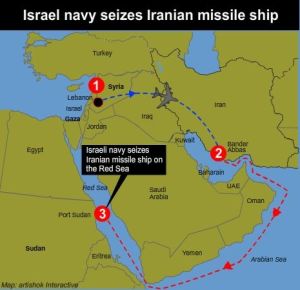
MiddleEastBoatENG_1

In an unusually frank disclosure, White House spokesman Jay Carney said Wednesday night, March 5, that US intelligence services and military had worked with Israel to track the Iranian Panama-flagged ship KLOS C, which was apprehended by Israeli naval commandos on the Red Sea earlier that day carrying missiles for Gaza via Sudan. The ship was boarded by the Israeli elite Shayetet 13 (Flotilla 13) and found to be carrying dozens of 302mm rockets made in Syria with a range of 150 km made in Syria. It is now on its way to Eilat.

The White House spokesman said that Washington worked with Israeli through intelligence and military channels, and at the national security adviser level, as soon as it knew the shipment was on the move. He said that President Barack Obama also directed the US military to work out contingencies in case it became necessary to intercept the vessel (thereby sanctioning military action).

“Our Israeli counterparts ultimately chose to take the lead in interdicting the shipment of illicit arms,” Jay Carney said.

DEBKAfile reports that this was the first time in four years that the US and Israel have collaborated in an operation against Iran – ever since the Stuxnet virus attack in 2010 on Iran’s nuclear facilities.

Until now, the Obama administration steadfastly refused to act against Iran for fear of jeopardizing the international diplomatic track for curbing its nuclear program.

The unusual frankness with which the Obama administration announced its coordination with Israel is both dramatic in itself and a road sign pointing the way to a radical change in its Iran policy. The US and Israel appear to be lining up – in their military policies as well – against the Iranian-Syrian-Hizballah bloc.

This radical turnabout was most probably the high point of the conversation between the US president and Prime Minister Binyamin Netanyahu at the White House Monday, March 3, after which Netanyahu raised comment by showering Obama with praise during his speech to the AIPAC conference in Washington the next day.

DEBKAfile’s US and Israeli intelligence sources report that both countries are braced for a swift and stinging response from Tehran to the capture of the missile ship and its condemnation by the White House. As Carney put it:  “We will continue to stand up to Iran’s support for destabilizing activities in the region in coordination with our partners and allies.These illicit acts are unacceptable to the international community and in gross violation of Iran’s Security Council obligations.”

Read DEBKAfile’s mearlier report on the interception and capture of the Iranian missile boat in Red Sea waters.

Israel’s elite Shayetet 13 (Flotilla 13) early Wednesday, March 5, boarded an Iranian Panama-registered cargo vessel KLOS C. Concealed in its hold under sacks of cement were dozens of 302mm rockets with a range of 150 kms, manufactured in Syria and destined by Iran for the Gaza Strip after being offloaded in Sudan.

The Israeli commandos seized the vessel in open sea on the maritime border of Sudan and Eritrea, 1500 south of Israel, and have set it on course for Eilat.

Sudan has been revealed by DEBKAfile’s military sources as having been transformed in the last two years into a major Iranian weapons manufacturing and logistic depot, which supplies Syria, HIzballah and Hamas. Port Sudan is also the hub for the smuggling of Iranian arms to various Middle East locations.

The IDF said the Iranian missile cargo was destined for the Palestinian Hamas which rules the Gaza Strip. If this is so, it would mean that Iran had gone back to arming Hamas with missiles and rockets after a two-year pause during which the Palestinian extremists were cold-shouldered by Tehran for their animosity to Syria’s Bashar Assad.

By the same token, it is hard to believe the Assad would consent to relay Syrian-made missiles to this antagonist. Some Middle East military sources believe the shipment as not destined for Palestinian terrorists for use against Israel, but rather for Muslim Brotherhood activists fighting the Egyptian army from their forward base in the Gaza Strip. They don’t rule out the possibility of Al Qaeda affiliates fighting in Sinai as being the address. Western intelligence has recorded instances of Iran entering into ad hoc operational collaboration with al Qaeda elements when it suits Tehran’s book.

The operation was carried out under an air umbrella by hundreds of naval commandos without casualties. It was directly commanded by the IDF Chief of Staff Lt. Gen. Benny Gantz from high command headquarters and the Navy Chief Maj. Gen Ram Rottberg from a floating command post at sea.

The rockets were flown from Syria to Iran, then loaded on a ship where they were concealed under sacks of cement inside containers. From the Iranian port of Bandar Abbas, the ship headed into the Red Sea bound for Sudan where it was intercepted by Israeli commandos.

The Iranian arms ship’s progress was tracked all the way.

In congratulating the forces which seized the shipment, Prime Minister Binyamin Netanyahu commented that this episode showed Iran’s true colors – in contrast to its diplomatic posture in nuclear negotiations with the West. Defense Minister Moshe Ya’alon said that Iran is again exposed as the biggest arms exporter in the world to terrorist organizations.

Iran’s Gaza Arms Shipment and Obama’s Middle East Diplomacy

March 6, 2014

Iran’s Gaza Arms Shipment and Obama’s Middle East Diplomacy, Commentary Magazine,   March 5, 2014

The decision by Iran to ship missiles from Syria to the Hamas-run strip raises serious questions about a number of Obama administration assumptions about both Iran and the conflict between Israel and the Palestinians.

The news that Israel has intercepted an Iranian shipment of arms headed for Gaza has been overshadowed, along with just about every other foreign policy story, by Russia’s aggression against Ukraine. But this is more than just a routine terror bulletin that will be noted, filed and then forgotten. The decision by Iran to ship missiles from Syria to the Hamas-run strip raises serious questions about a number of Obama administration assumptions about both Iran and the conflict between Israel and the Palestinians.

If, as now appears to be the case, Iran is back in the business of arming Hamas, then though does more than undermine the administration’s narrative about President Hassan Rouhani’s government being more moderate than his predecessors. It demonstrates that Iran is, as it always has been, up to its neck in the business of arming and funding international terrorism. That should make President Obama think twice about his belief that the regime can be trusted to abide by any nuclear accord. Just as important is the very real possibility that the captured arms were part of a rapprochement between Iran and its former close ally Hamas. If Iran is now seeking to strengthen the Islamist terrorist group’s ability to wage war on Israel, that could mean it is using the Gaza enclave as leverage against the possibility of an Israeli or Western attack on its nuclear facilities. But it is also possible that the attempt to create a Gaza arms buildup is aimed at reminding the Palestinian Authority that Hamas and other Islamist forces retain a veto over any peace deal with Israel. The seized arms are a signal to the U.S. and Israel not only of the essentially violent character of Iran but of its ability to create havoc throughout the region to serve its own interests.

Since 2011 Hamas and Iran have been at odds, as they have backed different sides in the Syrian civil war. In addition to pouring arms, money and some of its own forces into Damascus, Iran has deployed its Hezbollah terrorist proxies to back up the regime of Syrian dictator Bashar Assad. But Hamas sided with Islamist rebels and broke with Tehran over the dispute. But prior to that Hamas looked to Iran as its principal supplier of arms and cash during the second intifada fighting with Israel. Though Hamas is Sunni and Iran is Shi’ite, the two bonded over their mutual hatred for Israel and Jews.

Proof of the sophisticated nature of the arms pipeline between Tehran and Gaza came in 2002 when the Israeli Navy seized the Karine A, a ship that was loaded with Iranian missiles and various other types of military hardware intended for use by Hamas. Iran’s intentions were clear. They were prepared to back any force willing to fight Israel and to kill Jews in any manner possible.

The breakup of that alliance demonstrated Hamas’ belief that they no longer needed Iran’s assistance. But things have changed since the start of the Arab Spring when the Islamist group thought it could count on support from Egypt and Turkey to make up for the money and arms it got from Iran. The ouster of the Muslim Brotherhood government in Cairo and its replacement by a military regime that seems determined to shut down the smuggling tunnels into Gaza has placed Hamas under tremendous financial pressure. It has also been disappointed by Turkey whose Islamist government talked big about backing Hamas but now seems too preoccupied with its own domestic troubles to do much to prop up Gaza. That leaves Iran, which seems to have prevailed in Syria and is ready and willing to step back into its old role as Hamas’ funder and arms supplier as well as being the chief instigator of mayhem along Israel’s southern border.

Iran’s re-entry into the Israel-Palestinian conflict is just one more reason why Secretary of State John Kerry’s peace initiative is bound to fail. He and President Obama continue to act as if Palestinian Authority head Mahmoud Abbas now only is ready to make peace but has the ability to withstand pressure from Hamas and the rejectionists in his own Fatah to make a deal stick. This is clearly untrue. But now that Hamas has Iran in its corner again, Abbas must understand that any hopes that his rivals in Gaza will collapse are mere pipe dreams. Iran’s backing for Hamas not only makes Kerry’s peace talks look like a fool’s errand, their money and munitions may also be a down payment on the launch of a third intifada.

The standard refrain of Israel-bashers is that more violence will be the fault of the Jewish state’s alleged intransigence. But the real reason for another intifada may have more to do with Iran’s geo-strategic ambitions than West Bank settlements. With Syria and Lebanon still firmly in Tehran’s grasp, adding Hamas to the list of its allies gives the ayatollahs one more weapon to wield in its quest for regional hegemony. Stopping the already remote chances of peace between Israel and the Palestinians is one of their goals. But Iran also sees this as a chance to further complicate Western efforts to exert pressure on their nuclear program.

President Obama may believe he is embarked on a diplomatic quest with Iran that will result in a new détente that will lessen the chances of conflict and allow the United States to ease out of a strategic role in which it stands beside both Israel and moderate Arab states. But Iran has very different goals. The seizure of the arms shipment is a wake-up call for Washington. But it is an open question as to whether President Obama and Secretary Kerry are too besotted with their hopes for détente with Iran to listen to reason.


