(Sanctions relief will continue until negotiations end. By then, her “open for business” overtures will have attracted sufficient customers with ample money to continue to do as she pleases even should attempts be made to restore sanctions. It’s a bit late to be seeking IAEA access. –DM)
Zarif says regime hopes talks will succeed; US envoy tells IAEA that Iran must cooperate with probe for sanctions relief.
Iranian Foreign Minister Mohammad Javad Zarif (L) shakes hands with Japanese Prime Minister Shinzo Abe (R) at the start of talks at Abe’s official residence in Tokyo on March 5, 2014. (photo credit: AFP/ KIMIMASA MAYAMA)
TOKYO — Iran is pinning its hopes on the success of talks with the West about its nuclear program but has no plans to abandon a controversial reactor, its foreign minister said Wednesday
Mohammad Javad Zarif made the comments as he ended an official visit to Tokyo which included talks with his Japanese counterpart Fumio Kishida and Prime Minister Shinzo Abe.
“We have based all of our calculations on the success of these negotiations,” Zarif told reporters.
“I think that’s a better option, for the negotiations to succeed. It’s a better option for everybody.”
Under a November interim deal, Iran agreed to roll back or freeze some nuclear activities for six months in exchange for modest sanctions relief and a promise by Western powers not to impose new restrictions on its hard-hit economy.
The West and Israel have long suspected Iran is pursuing a nuclear weapons capability alongside its civilian program, something Tehran denies.
Also Wednesday, US envoy Joseph Macmanus told the International Atomic Energy Agency’s 35-nation board Wednesday that Tehran must also fully cooperate with the IAEA in its probe of the weapons allegations.
He said clearing up suspicions that Iran worked on nuclear arms “will be critical” to any final accord meant to give Tehran full final sanctions relief.
Zarif said Iran would not shutter the unfinished Arak heavy water reactor, a concern to the West because Tehran could extract weapons-grade plutonium from its spent fuel if it also builds a reprocessing facility.
This would give it a second route to a nuclear bomb.
On Tuesday, Israeli prime Minister Benjamin Netanyahu said Iran’s refusal to shutter Arak showed it was covertly pursuing nuclear weapons.
Zarif said Arak was crucial for peaceful scientific pursuits, and insisted that “we are not going to close it.”
“We believe the solution is at hand,” he told a joint press conference with Kishida. “I am sure if the other sides comes with the same posture we will have a satisfactory conclusion within a short period of time.”
He praised Japan’s expertise in the nuclear field and said more investment in Iran’s atomic sector could serve as “a mutual confidence-building operation.”
“Japan can also be on the ground in Iran and see for itself that Iran’s program is nothing but peaceful,” he added.
Japan has been reducing Iranian oil imports despite energy shortfalls in the wake of the tsunami and nuclear incident three years ago, which forced Tokyo to turn to pricey fossil-fuel options to plug the energy gap.
Kishida said he had promised Japan’s help in trying to broker a deal between Tehran and world powers.
“I told the foreign minister that Japan, along with the international community, will actively engage in the process towards the final agreement,” he told reporters.
“The comprehensive solution to Iran’s nuclear issue is extremely important, not only for the Middle East, but also for the peace and stability of the world.”
Life in a world of fantasy can often be pleasant for small children. For adults, it is far more dangerous.
On March 2nd, the Editorial Board of the often left-leaning Washington Post published an editorial titled President Obama’s foreign policy is based on fantasy. It was not written by a “right wing nut.” According to a sidebar,
Editorials represent the views of The Washington Post as an institution, as determined through debate among members of the editorial board. News reporters and editors never contribute to editorial board discussions, and editorial board members don’t have any role in news coverage. [Emphasis added.]
The editorial notes, among other things,
FOR FIVE YEARS, President Obama has led a foreign policy based more on how he thinks the world should operate than on reality. It was a world in which “the tide of war is receding” and the United States could, without much risk, radically reduce the size of its armed forces. Other leaders, in this vision, would behave rationally and in the interest of their people and the world. Invasions, brute force, great-power games and shifting alliances — these were things of the past. Secretary of State John F. Kerry displayed this mindset on ABC’s “This Week” Sunday when he said, of Russia’s invasion of neighboring Ukraine, “It’s a 19th century act in the 21st century.”
That’s only a sample, and the entire piece is well worth reading.
Writing at Israel Hayom, Clifford D. May presented a similar but perhaps stronger view. These passages are representiative, but Mr. May’s opinion piece is also well worth reading in its entirety:
As threats and crises multiply, what is U.S. President Barack Obama doing? Proposing to reduce the size and strength of America’s military to pre-2001 levels. Can anyone still regard the United States as a reliable ally? More consequentially, is the U.S. still seen as a formidable adversary?
Obama’s critics call him ambivalent and indecisive. Perhaps, but those are symptoms. The underlying malady: his conception of America’s role in the world. Late last week, responding to developments in Ukraine, the president said: “The United States will stand with the international community.”[Emphasis added.]
He advised Russia to be part of “the international community’s effort to support the stability and success of a united Ukraine going forward.” He said that would be “in the interest of … the international community.”
News bulletin: The “international community” is a figment of the imagination — right up there with Batman, Wonder Woman, Paul Bunyon and Babe the Blue Ox. It’s also the key that opens the door to a room filled with fashionable fictions. Among them: that there are “universal” values and principles, that the world’s most powerful political figures are, just like us, “rational actors” who seek peace, favor freedom, tolerance and democracy, and believe that diplomacy based on “confidence building” and reciprocal compromises leads to “conflict resolution” — an outcome they’d prefer to shedding blood and achieving victory.
Here is a video from PJ Media’s Trifecta gang on the recent Russian incursions in the Ukraine.
The world has always been a dangerous place and is becoming more so. The irrational belief of President Obama and His administration that the “international community” is a benign force for peace and actively supports what were once American human rights has contributed to the increased dangers.
President Barack Obama is a “low-IQ US president,” whose threat to launch a military offensive should nuclear talks fail is an oft-cited punchline in the Islamic Republic, particularly among children, an Iranian general said on Tuesday.
“The low-IQ US president and his country’s Secretary of State John Kerry speak of the effectiveness of ‘the US options on the table’ on Iran while this phrase is mocked at and has become a joke among the Iranian nation, especially the children,” General Masoud Jazayeri said, according to the semi-official Fars News Agency.
Jazayeri was responding to the US president’s interview in Bloomberg on Sunday, in which Obama maintained that the Iranian leadership should take his “all options on the table” stance — including the warning of a potential military strike — seriously.
. . . .
The Iranian news agency Tuesday published a political cartoon mocking the US president, calling it: “All Options on Table.” This Time for Russia.” In a jab at US non-intervention in Ukraine, the cartoon portrays Obama peering forlornly into an empty paint can with the label “Red Line” while Russian President Vladimir Putin walks away saying, “I think you used it all on Syria.”
Consider the P5+1 “deal.” Although President Obama claimed that Iran would receive only seven billion dollars in interim relief, she had by mid February already benefited from twenty billion dollars worth, and rising. Sanctions relief has become a farce.
Since the Obama administration relaxed sanctions on Iran, oil sales are up 25 percent, from 1.06 million barrels per day to 1.32 million, and the White House reportedly has no intention of preventing the rise in sales and consequent swelling of Revolutionary Guard bank accounts. And that’s not all. The leading economic indicators show an Iranian economy on the mend, thanks to the interim nuclear agreement struck in November. Inflation has decreased from 40 percent-plus to 20 percent and falling. The rial-to-dollar exchange rate is steadily recovering from the depths to which it had fallen in 2012. And where Iran’s GDP fell 3 percent in 2012, the IMF now projects modest increases for 2014 and 2015.
In short, with the sanctions regime eroding, Iran’s business climate has been transformed. What was once a foolish gamble is now a promising opportunity, and trade delegations are exploring investment options in Iran’s petrochemical and automobile industries. The White House’s early assessment that the regime was getting only $7 billion in sanctions relief was way off. The figure is far closer to those estimates of $20 billion that administration officials scoffed at. [Emphasis added.]
Iran’s non-peaceful development of nukes apparently is not even relevant to sanctions relief or to any other aspect of the P5+1 “deal.” Iran’s testing and development of nuclear warheads and devices with which to deliver them continues unabated. As I noted in substantial detail back in January in an article titled The Iran scam continues which I updated here, the “deal” imposes no limitations on Iranian military-related nuclear work.
Parchin is a key outstanding issue that the IAEA has placed at the heart of its concerns about Iran’s past and possibly on-going nuclear weapons work and other alleged military dimensions. Before the Parchin issue can be resolved satisfactorily, Iran will need to allow the IAEA to visit Parchin, provide other information and access to Iranians, and possibly permit visits to other sites. In sum, Iran will need to provide far more cooperation on this issue than it has done so far. If it does not, it risks not achieving a final deal with the P5+1 or receiving significant sanctions relief.
. . . .
what kind of comprehensive solution can be achieved by ignoring the central concern of the crisis– namely that Iran has misused its nuclear programs to seek nuclear weapons and may do so again? What is the value of a deal if Iran is not willing to admit to its past work on nuclear weapons and allow the IAEA to verify the correctness and completeness of its statements, along with gaining assurance that any such work has stopped? What confidence can be placed in the ability of the IAEA to verify any final deal, if Iran can successfully defy a legitimate IAEA verification request? The answer is simple: that agreement would not provide assurance that Iran is not building nuclear weapons. It would have an impaired verification regime. Iran would feel emboldened to resist future IAEA efforts aimed at ensuring the absence of undeclared nuclear activities and facilities, efforts that will inevitably require visits to military sites.
That hasn’t happened and apparently will not. To offer an analogy, suppose that someone whom the county sheriff reasonably thought, based on credible evidence, had stolen a horse denied it and said “trust me and don’t look in the barn.” Would a rational law enforcement official agree? Particularly if the suspected horse thief (like Iran) had lied about such things repeatedly before?
Sources familiar with the matter said the IAEA apparently had not gone ahead with writing the report and that there was no way of knowing what extra information might have been included in such a document, although one source said it could have added to worries about Iran.
According to the sources, the IAEA was believed to have dropped the idea of a new report, at least for the time being.
In 2011, the IAEA issued a landmark report with a trove of intelligence indicating past activity in Iran which could be relevant for developing nuclear weapons, some of which it said might still be continuing. Iran rejected the allegations as fabricated and baseless.
Since then, the UN watchdog has said it has obtained more information that “has further corroborated” its analysis in the 2011 document, but has not given details.
According to a recent Pentagon report, U.S. intelligence agencies have no way of determining whether Iran is progressing with her nuke program, if so how far she has got or even whether she has nuclear weapons.
A new report from the Pentagon warns that the US would be totally clueless if Iran were to obtain a nuclear weapon. The report reveals that America’s intelligence services are unable to detect when a nation has become nuclear armed.
Bret Stephens, a foreign affairs columnist for the Wall Street Journal, spoke about the report he recently analyzed while appearing on Fox News. There he noted the report exposes Vice President Joe Biden’s assurances, made in presidential debates with candidate Paul Ryan in 2012, as a lie.
“[Biden] said ‘for sure’ we would have ample warning before the Iranians decide to take their nuclear industrial capabilities and sprint toward a bomb,” Stephens noted. “This report tells us we probably wouldn’t have a clue.”
Innocent fantasy-based perceptions of the world held by small children — Santa Claus, the Tooth Fairy and the Easter Bunny, for example — are rarely dangerous for those whose parents attend faithfully to their safety and security. When those charged with ensuring the safety and security of the United States acceptfantasies, such as those firmly credited by the Obama Administration and others as reality, the world becomes a far more dangerous place for us all than it should be.
UPDATE:
An article at PJ Media titled The End of the ‘Wrong Side of History’ notes that President Obama referred to Russian leader Putin as being “on the wrong side of history” and observes,
The unspoken assumption behind all this, of course, is that being on the right side of history also means accepting the unmatched dominance of the U.S. in global affairs, and in turn the unchallengeable domination of the U.S. by people supporting the particular progressive world view of the president and his supporters.
That is, Obama and his supporters use the word “history” to refer to themselves. [Emphasis added.]
The problem with all this is that in the last five years, many players on the world stage have learned that if “history” and “Obama” are synonyms, being on the wrong side of Obama is a not particularly uncomfortable or worrying place to be. So the threat of it has rather less impact than the president might hope or assume. [Emphasis added.]
This is not a marginal point. Rather, it is the key factor defining the direction of strategic affairs globally, and in the Middle East in particular.
. . . .
In Iran, the regime has stage-managed the emergence of a supposed “moderate” president. The true powers in that country, Supreme Leader Ali Khamenei and the Revolutionary Guard Corps, have as a result obtained sanctions relief. This in turn is enabling them to continue to develop their missile program and uranium enrichment capacity undisturbed. They are also proceeding apace with their program of regional outreach, and are currently aligned with the dominant forces in Iraq, Syria and Lebanon. [Emphasis added.]
In deciding who are on the right and wrongs sides of history, much depends on who gets to write the history. The winners usually do, and fantasy-based policies are unlikely to produce a winner.
DEBKAfile Special Report March 5, 2014, 2:52 PM (IST)
M302 short-range 150km missiles
Israel’s elite Shayetet 13 (Flotilla 13) early Wednesday, March 5, boarded an Iranian Panama-registered cargo vessel KLOS C. Concealed in its hold under sacks of cement were dozens of 302mm rockets with a range of 150 kms, manufactured in Syria and destined by Iran for the Gaza Strip after being offloaded in Sudan.
The Israeli commandos seized the vessel in open sea on the maritime border of Sudan and Eritrea, 1500 south of Israel, and have set it on course for Eilat.
Sudan has been revealed by debkafile’s military sources as having been transformed in the last two years into a major Iranian weapons manufacturing and logistic depot, which supplies Syria, HIzballah and Hamas. Port Sudan is also the hub for the smuggling of Iranian arms to various Middle East locations.
The IDF said the Iranian missile cargo was destined for the Palestinian Hamas which rules the Gaza Strip. If this is so, it would mean that Iran had gone back to arming Hamas with missiles and rockets after a two-year pause during which the Palestinian extremists were cold-shouldered by Tehran for their animosity to Syria’s Bashar Assad.
By the same token, it is hard to believe the Assad would consent to relay Syrian-made missiles to this antagonist. Some Middle East military sources believe the shipment as not destined for Palestinian terrorists for use against Israel, but rather for Muslim Brotherhood activists fighting the Egyptian army from their forward base in the Gaza Strip. They don’t rule out the possibility of Al Qaeda affiliates fighting in Sinai as being the address. Western intelligence has recorded instances of Iran entering into ad hoc operational collaboration with al Qaeda elements when it suits Tehran’s book.
The operation was carried out under an air umbrella by hundreds of naval commandos without casualties. It was directly commanded by the IDF Chief of Staff Lt. Gen. Benny Gantz from high command headquarters and the Navy Chief Maj. Gen Ram Rottberg from a floating command post at sea.
The rockets were flown from Syria to Iran, then loaded on a ship where they were concealed under sacks of cement inside containers. From the Iranian port of Bandar Abbas, the ship headed into the Red Sea bound for Sudan where it was intercepted by Israeli commandos.
The Iranian arms ship’s progress was tracked all the way.
In congratulating the forces which seized the shipment, Prime Minister Binyamin Netanyahu commented that this episode showed Iran’s true colors – in contrast to its diplomatic posture in nuclear negotiations with the West. Defense Minister Moshe Ya’alon said that Iran is again exposed as the biggest arms exporter in the world to terrorist organizations.
News bulletin: The “international community” is a figment of the imagination — right up there with Batman, Wonder Woman, Paul Bunyon and Babe the Blue Ox. It’s also the key that opens the door to a room filled with fashionable fictions. Among them: that there are “universal” values and principles, that the world’s most powerful political figures are, just like us, “rational actors” who seek peace, favor freedom, tolerance and democracy, and believe that diplomacy based on “confidence building” and reciprocal compromises leads to “conflict resolution” — an outcome they’d prefer to shedding blood and achieving victory.
Count me among those — a dwindling minority, I’m afraid — who believe that politics should end at the water’s edge. No one, Republican or Democrat, ought to take pleasure at the spectacle of America’s foreign policies failing and the perception of America as a hobbled giant.
And that is, self-evidently, what we’re seeing: Russian boots are on the ground in Ukraine. North Korea is firing missiles. Iran’s negotiators are playing high-stakes poker, while the U.S.-led side doesn’t seem to know a flush from a straight. In Syria, Iran’s proxies confront al-Qaida forces (which the administration two years ago congratulated itself for having defeated) while the much ballyhooed agreement to remove chemical weapons has stalled. Hard-won gains in Iraq have been squandered. There’s a real possibility that the Taliban will reclaim Afghanistan once American troops depart. Venezuela is in turmoil. China is acting the bully in Asia.
As threats and crises multiply, what is U.S. President Barack Obama doing? Proposing to reduce the size and strength of America’s military to pre-2001 levels. Can anyone still regard the United States as a reliable ally? More consequentially, is the U.S. still seen as a formidable adversary?
Obama’s critics call him ambivalent and indecisive. Perhaps, but those are symptoms. The underlying malady: his conception of America’s role in the world. Late last week, responding to developments in Ukraine, the president said: “The United States will stand with the international community.”
He advised Russia to be part of “the international community’s effort to support the stability and success of a united Ukraine going forward.” He said that would be “in the interest of … the international community.”
News bulletin: The “international community” is a figment of the imagination — right up there with Batman, Wonder Woman, Paul Bunyon and Babe the Blue Ox. It’s also the key that opens the door to a room filled with fashionable fictions. Among them: that there are “universal” values and principles, that the world’s most powerful political figures are, just like us, “rational actors” who seek peace, favor freedom, tolerance and democracy, and believe that diplomacy based on “confidence building” and reciprocal compromises leads to “conflict resolution” — an outcome they’d prefer to shedding blood and achieving victory.
Russian President Vladimir Putin has given lip service to such warm-and-fuzzy ideas. In an op-ed published by The New York Times last September, he appealed for “mutual trust,” endorsed “shared success” and laid out the steps the “international community” should take to keep “hope alive.” He added: “We must stop using the language of force and return to the path of civilized diplomatic and political settlement.”
Is it not now — at long last — clear that Putin was just spinning us? North Korea’s Kim Jong Un, Iran’s Ali Khamenei, Syria’s Bashar Assad, China’s Xi Jinping, Saudi Arabia’s King Abdullah, Venezuela’s Nicolas Maduro, Cuba’s Raul Castro, and Turkey’s Recep Erdogan also are among those who sometimes talk like Berkeley professors but in truth practice raw, 19th century machtpolitik.
In theory, the idea of a “post-American” world — a global order featuring “shared leadership” and even “shared sovereignty” — sounds lovely. In practice, it can only mean global disorder — a Hobbesian state of nature in which the most rapacious and brutal regimes do whatever is necessary to establish their hegemony over whichever regions they covet. Expansion stops only when one hegemon bumps up against another — and both decide that a balance of power — or a balance of terror — is preferable to fighting it out, at least in the short term.
In his 2009 address to the U.N. General Assembly, Obama famously said: “No one nation can or should try to dominate another nation.” Had he said, “No one nation should try to dominate another nation” he would have sounded preachy and weak. But the assertion that no nation “can try” to dominate another is patently false. Combining the two phrases conveyed a rhetorical benefit at the time. In hindsight, however — and with Russia’s invasion of Ukraine on the front pages — the statement reveals a flawed foundation on which to build foreign policies.
Gaze over the international landscape: Do you see the prospect of a success anywhere? Or is it likely that the Obama administration’s goal at this point is simply to avoid additional visible failures?
That will require prolonging negotiations with Iran’s rulers (granting significant concessions while making believe that the Iranians are too); attempting to keep the Palestinian-Israel “peace process” alive (though no Palestinian leaders are currently prepared to make peace with the Jewish state); hoping against hope that Assad, Maduro and Kim fall (and that something better comes after them); and “pivoting” toward Asia, insisting that does not mean pivoting away from everywhere else (while still not providing meaningful support for Japan, the Philippines and other Asian allies).
Meanwhile, Obama continues to signal that he is “war-weary,” that he seeks to “end” wars (not necessarily on favorable terms) and, as noted, proposes to issue pink slips to America’s by-no-means-weary warriors. In so doing, he is violating one of history’s oldest and firmest rules: The stronger a nation appears, the less likely its strength will be tested. The corollary to that: Weakness is provocative.
No “international community” will respond to Putin’s aggression or any of the world’s other despot-caused disasters. But an alliance of free nations might begin to coalesce if we would acknowledge the fact that the UN has become a dictators’ club, and if we would accept that fact that there are responsibilities the U.S. must shoulder. Because if American leaders won’t lead, Putin, Khamenei and other tyrants are only too eager to rule. Let’s not pretend we don’t know that. And let’s not pretend we don’t know what that will mean over the years ahead.
Navy commandos board ship in early morning operation, encounter no resistance; vessel carried missiles with 200km range; Netanyahu: ‘This is the real Iran’
IDF soldiers inspect a missile found on board Klos-C in a commando operation Wednesday morning. The military says the ship was carrying an Iranian arms shipment headed for Gaza (Photo credit: IDF)
IDF special forces on Wednesday intercepted a ship in the Red Sea carrying an Iranian arms shipment headed for the Gaza Strip.
Israeli naval commandos from the elite Shayetet 13 unit boarded and took control of the “Klos-C” merchant ship, sailing under the Panama flag, at around 5 a.m. They encountered no resistance and there were no casualties reported on either side.
The army said soldiers carried out a preliminary inspection of the ship and found several dozen advanced Syrian M-302 missiles, with a range of up to 200 kilometers (125 miles) and a payload of up to 170 kilograms (375 pounds). The missiles were hidden in shipping containers also carrying sacks of concrete.
The incident took place 1,500 kilometers (930 miles) from Israel’s coast, in the Red Sea, off the Sudanese-Eritrean border. Israel had been tailing the ship for several days before the operation was launched.
The ship had a crew of 17, who were being interrogated by Israeli security forces. Defense Minister Moshe Ya’alon said crew members were apparently unaware of the ship’s secret cargo.
The vessel had reportedly set sail from Iran ten days ago and was set to reach Sudan tomorrow. From there, the weaponry would have been smuggled into Gaza.
The IDF said the ship was being towed to Eilat, a journey which would take several more days, where the ship’s cargo would be properly and extensively inspected.
IDF Chief of Staff Benny Gantz confers with Defense Minister Moshe Ya’alon at the Navy war room during Wednesday morning’s operation by naval commandos during which they captured a Iranian shipment of weapons on its way to Gaza (photo credit: Ariel Hermoni/ Ministry of Defense)
IDF Chief of Staff Lt. Gen. Benny Gantz personally oversaw the operation and Prime Minister Benjamin Netanyahu was briefed on its progress as he toured the US.
Netanyahu commended Gantz and Mossad Chief Tamir Pardo for their efficient work.
“I would like to congratulate the IDF, Israel’s intelligence apparatuses and of course the commanders and soldiers of the navy who carried out a flawless operation to capture a covert Iranian weapons ship,” Netanyahu said.
“As it conducts talks with [world] powers, as Iran smiles and utters pleasantries, the same Iran is sending lethal weapons to terror organizations…via an intricate network of clandestine global operations…in order to hurt innocent civilians,” he added.
“This is the real Iran and this country must not be allowed to have nuclear weapons,” he said. “We will continue to do whatever is necessary to protect Israeli citizens.”
WATCH: Prime Minister Benjamin Netanyahu on the capture of the Iranian shipment
Defense Minister Moshe Ya’alon said “It has once again become clear that Iran continues to be the greatest exporter of terror in the world, with the express purpose of destabilizing the Middle East.
“This Iranian attempt to transfer weapons to the Gaza Strip is additional evidence that Gaza is a terrorist entity under Iranian auspices preparing to strike deep into Israel,” he added.
The military said the operation originated several months ago, when IDF intelligence identified the transfer of Syrian M-302 rockets from Damascus to Tehran through Damascus International Airport. Intelligence officials found the move odd, as arms are usually transferred from Iran to Syria, not vice versa.
The shipment was then moved to Iran’s Bandar Abbas port and loaded onto the “Klos-C.” The ship initially sailed to the Iraqi port of Umm Qasr where it was loaded with containers carrying bags of cement, to help conceal the weaponry and blur its Iranian origin.
The route of the Iranian weapons shipment captured by the IDF on Wednesday, March 5 (Photo credit: IDF)
The ship then set sail to Port Sudan. From there the weapons would have been smuggled into the Gaza Strip through the Sinai Peninsula.
The military noted Wednesday that while the “Klos-C” was not the first Iranian arms shipment captured by Israel over the past few years, it stood out due to “the lethality and quality of its cargo.” While previous shipments had carried mortars, mid-range rockets and light-weapons ammunition, the latest captured cargo carried missiles with a much larger range and warheads of a much heavier payload.
Syrian M-302 missiles were used by Hezbollah during the Second Lebanon War to hit the Israeli cities of Haifa and Afula, the army said.
IDF Navy commander Maj. Gen. Ram Rothberg is seen on board the Klos-C as he inspects a cargo container carrying concealed Iranian weaponry, March 5, 2014 (Photo credit: IDF)
The military noted that Iran has made many attempts in the past to smuggle weaponry to Gaza.
In March 2011 navy commandos stopped civilian vessel “Victoria” as it headed from Syria to Egypt, and discovered 50 tons of Iranian weaponry on board. In January 2009 Cypriot merchant vessel “Monchegors” was found to contain a cache of Iranian weapons during an inspection by Cypriot authorities. Another ship boarded by IDF forces in November of that same year, the “Francop”, was carrying 500 tons of weaponry in 36 unmarked cargo crates. In 2002 the military captured the “Karine-A” as it carried 50 tons of weaponry from Iran to Gaza.
DEBKAfile Special Report March 5, 2014, 12:50 PM (IST)
Israel tanks on Golan
The Lebanese Hizballah is about to turn Israel’s northern borders into active warfronts. Early Wednesday, March 5, an Israeli patrol sighted a group planting a roadside bomb at the Syrian-Israeli border fence near Merom Hagolan, The patrol opened light arms, then tank, fire on the miscreants and reported hitting targets. Only five days ago, Hizballah launched two rockets against an IDF Golan outpost, causing no harm. The explosions resounded across the Golan and Upper Galilee, but it took the IDF spokesman several hours to confirm that an Israeli post was attacked from the Hermon range for the first time since the Syrian war broke out three years ago. The official first tried claiming the rockets were strays from the Syrian war.
Military sources, while attributing the bomb-planting bid to Hizballah, stressed that its operatives did not cross the border.
The road bomb attempt Wednesday was the second Hizballah attack on an Israeli military target since Israeli air strikes of Feb. 24, on a Hizballah arms convoy and missile batteries on the Lebanon-Syrian border, for which the Lebanese Shiite group vowed revenge.
Israeli military officials have been hemming and hawing about these incidents, debkafile reports, because they are under government orders to make sure that nothing major occurs to mar Prime Minister Binyamin Netanyahu’s visit to the United States. When he returns home at week’s end, he will decide how and when to respond to Hizballah’s provocations.
This delay has two drawbacks:
1. It gives Hizballah – and possibly Syria – free rein to do as they please for the next few days.
2. The delayed Israeli response may indeed egg them both on to continue – or even escalate – their military assaults with Iranian backing.
The diplomatic groundwork was laid for an escalation in a long interview President Bashar Assad’s communications adviser Bouthaina Shaaban gave Monday March 3 to the Lebanese Hizballah mouthpiece, the al-Mayadeen news network.
She accused Israeli military and intelligence of intervening in southern Syria, claiming its officers were overseeing the activity of three Syrian rebel militias, setting targets for them and advising them on assault tactics.
debkafile‘s military and intelligence sources say that Shaaban pointedly aired her charges over a Hizballah media outlet in order to build a case for Syrian and Hizballah reprisals across their borders with Israel. She was saying that if the IDF may operate inside Syria, Tthe Syrians and Hizballah are equally entitled to attack Israel – certainly on the divided Golan.
The Syrian official furthermore gave Israel due warning that the attacks from Syria and Lebanon would escalate with official approval from Damascus and Beirut. Our military sources add that neither would have launched even a low-key military campaign against Israel without sanction from Tehran.
Israel seized an Iranian ship carrying advanced weapons destined for Gaza on Tuesday night and towed it to Eilat port, the IDF said Wednesday. Elite troops from the Israel Navy’s Shayetet 13 unit boarded the ship in open waters on the maritime border of Sudan and Eritrea, some 1,500 km south of Israel.
The Klos C Iranian vessel was sailing under a Panamanian flag, making its way to Sudan from Iran carrying a cargo of advanced rockets capable of reaching distances of up to 200 km.
The ship was supposed to reach port in Sudan on Thursday, some 10 days after it left Iran. An initial inventory by Israel revealed a large supply of rockets, including the Iranian-made 302m, which hit Haifa during the 2006 Second Lebanon War.
The rockets originated in Syria, the IDF said, where Iran is known to store large arsenals. The rockets were flown from Syria to Iran, where they were loaded on the ship that then departed for Iraq where the arms concealed in boxes of cement.
From the Iraqi port of Umm Qasr it sailed into the Red Sea around the Port of Oman, bound for Sudan. The ship’s progress was closely tracked by the IDF as it sailed.
“There is clear evidence from the ship that these are rockets for which Iran is responsible,” a senior IDF source said Wednesday. “The rockets were … intended for terror groups in Gaza.”
The interception operation was conducted under the real-time supervision of IDF Chief of Staff Benny Gantz and Defense Minister Moshe Ya’alon, bith of whom were present at an IDF command center.
Arms transfer
Israel has long claimed that Iran is transferring arms to terror groups around the world, namely Hezbollah in Lebanon
and Hamas in the Gaza Strip, through Sudan and Yemen.
Last April, the Egyptian navy seized a vessel carrying a large arms shipment near the Sinai Peninsula’s southern coast. The Anatolia Turkish News Agency reported the ship is an Iranian fishing vessel named “Sawit 1,” and reported that 62,283 firearms were found in its cargo, including sniper-rifles, AK-47s, RPGs and large quantities of ammunition.
In 2009, the navy’s commando force stopped and boarded the Francop, a ship planning to dock in Syria containing massive amounts of Iranian arms indented for Hezbollah.
The most famous such operation was the interception of the Karin-A ship in the Red Sea in 2002. On board tons of munitions were captured en route from Iran to Gaza.
Earlier Wednesday Iran said its powerful Revolutionary Guard has acquired missiles with multiple warheads, a step that it says is a major boost of its defense capabilities.
The claim by Defense Minister Hossein Dehghan is the latest reported advance in Iran’s domestic missile production program.
He says Western sanctions have not stopped Iran from augmenting its ability to deter its enemies from attacking the Islamic Republic, a reference to Israel and the U.S.
His comments were posted on the Guard website, sepahnews.com, Wednesday.
Iran regularly announces breakthroughs in military technology that are impossible to independently verify. But the Pentagon released a rare public report in 2012 noting significant advances in Iranian missile technology, acknowledging that the Islamic Republic has improved the accuracy and firing capabilities.
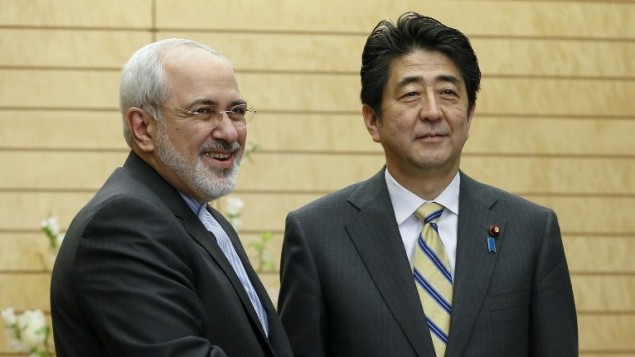 Iranian Foreign Minister Mohammad Javad Zarif (L) shakes hands with Japanese Prime Minister Shinzo Abe (R) at the start of talks at Abe’s official residence in Tokyo on March 5, 2014. (photo credit: AFP/ KIMIMASA MAYAMA)






 anneinpt
 artaxes
 danmillerinpanama
 davidking1530
 Peter Hofman
 Joseph Wouk
 Peter
Peter Louisiana Steve
 WarSclerotic
Recent Comments