Archive for March 4, 2014

Ukraine soldiers engage in test of wills with Russian troops

March 4, 2014

Ukraine soldiers engage in test of wills with Russian troops, Washington Post, March 4,2014

(What difference can personal honor and devotion to duty make now? — DM)
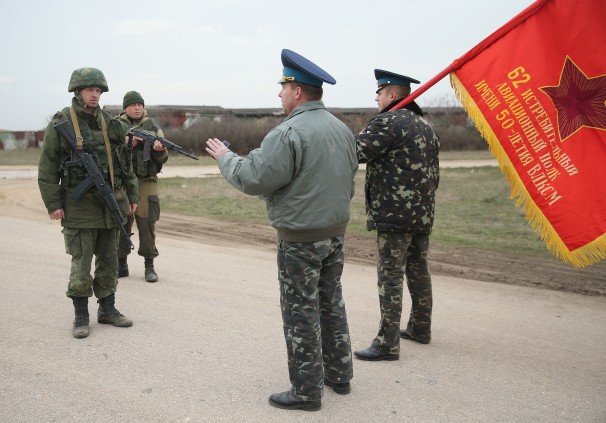
Ukranian vs RussianCol. Yuliy Mamchuk, center, commander of the Ukrainian military garrison at the Belbek airbase, and a colleague with the regimental flag confront troops under Russian command Tuesday. (Sean Gallup/Getty Images)

BELBEK, Ukraine — A tense and dangerous test of wills took place Tuesday on a rainy hilltop at a dilapidated Cold War-era airfield here, as Ukrainian soldiers confronted Russian troops and demanded to be allowed to return to their base.

Just a few hours after the 5 a.m. deadline reportedly issued by Russia’s Black Sea Fleet for Ukrainian troops in Crimea to switch their allegiance from the new government in Kiev to the pro-Russian leadership in Crimea, the first shots of the conflict were fired into the air here by a pro-Russia militiaman.

Russia denied imposing any such ultimatum.

No one was injured in the continuing impasse, but there were tense moments as the two sides faced off, and Ukrainian troops were forced to choose between their oath to Ukraine and their feelings of affinity with Russia.
1Ukranian russian standoff Video shows the dramatic moments of a tense standoff between Ukrainian soldiers and Russian forces who took control of an airbase in Crimea.

At the Belbek air base, the Ukrainians chose duty.

At the harbor in nearby Sevastopol, a trio of Ukrainian navy vessels spent the night before the ultimatum deadline trapped at a dock as Russian minesweepers and Russian navy tugboats passed back and forth across their bows, blocking their exit.

On Tuesday morning, the Russian rescue and salvage ship Epron cut close to the docks and blasted its klaxon.

Officers of the Ukraine command ship U510 Slavutych said that during the middle of the night, five Russian navy ships from the Black Sea Fleet harassed them, shining search lights at the vessels. The Ukrainian sailors mounted water hoses and mattresses, saying they would repel boarders. They vowed not to surrender their ship.

In addition to the blockade in Sevastopol harbor, Russian navy ships closed off the narrow Kerch Strait, which separates Ukraine’s Crimea Peninsula and Russia, Pavel Shishurin, deputy head of the Ukraine’s border guards, told Reuters news agency.

At the Belbek air base, as Russian snipers assumed flanking positions and aimed their rifles, a column of Ukrainian soldiers marched forward and tried to return to their jobs at the airfield Monday.

The Ukrainians had arrived unarmed.

The Russians were bristling with weapons.
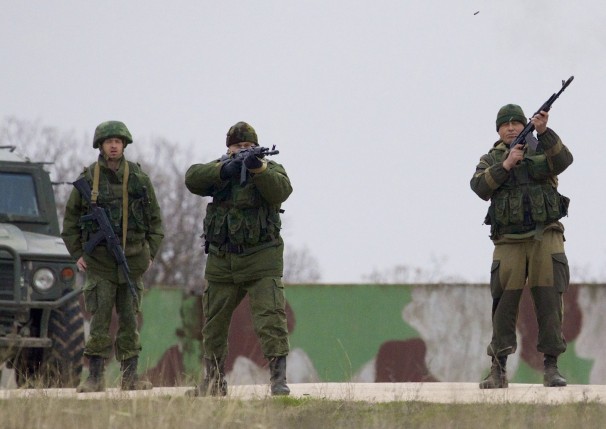
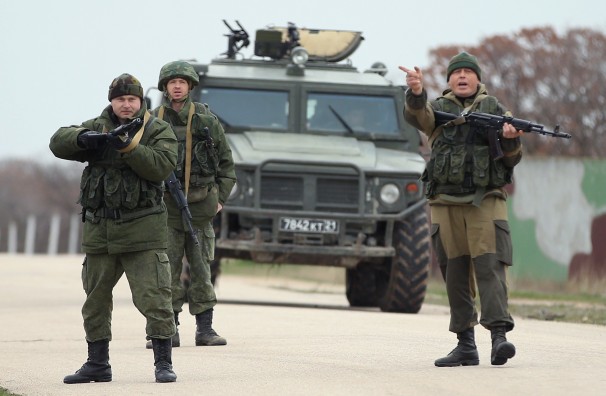
Russians with weapons in UkrainePro-Russia militiamen and a Russian soldier at Belbek airport Tuesday. (Ivan Sekretarev/AP)

Col. Yuliy Mamchuk, commander of Ukraine’s Sevastopol Aviation Unit, said the Russian troops appeared Thursday and took up positions surrounding the base. On Monday, as the purported deadline to surrender approached, the Russians entered the airfield and forced the Ukrainians out at gunpoint.

“The men felt very bad. They thought they had abandoned their post. We swore an oath to serve,” Mamchuk said.

The Ukrainians were also confused about Russia’s intentions, as the two militaries, especially here on the Crimean Peninsula, had worked closely in the past.

On Monay night, there were rousing, patriotic speeches in the Ukrainian barracks. “We decided we would return to work. Any man who did not want to come, he would not be branded a traitor or a coward,” Mamchuk said. “Every man came.”

The 200 Ukrainians marched back up the hill to tell the Russians they wanted to return to their jobs, to service the airplanes and guard the airfield and warehouse, which was filled with valuable aviation equipment and weaponry.

Their wives accompanied them, but when they saw the snipers, the troops sent the women back.

Mamchuk negotiated with a Russian officer who would identify himself only by the first name “Roman.” The Russians said they needed approval from their superiors to allow the Ukrainians to return to the base.

After no one came, Mamchuk was approached by a member of a civilian self-defense militia from Sevastopol. Mamchuk explained the situation again, though now he was negotiating not with a Russian officer but a Crimean bar owner from nearby Balaklava in mismatched fatigues and black sneakers, who only an hour earlier had been arguing with journalists at the front gate to the base.

He gave his name as Yuriy. Beside him stood another militiaman, his face covered by a black mask.

“I realize this looks like a comedy,” Yuriy said, but it was serious business. He said the people were afraid the Ukrainian airmen would put their planes in the sky and bomb Sevastopol.

Asked about Russian forces behind him, the soldiers still without markings or insignia, Yuriy said he didn’t know anything about them.

The Ukrainian colonel could make no progress. “They’re stalling,” he said. “They’re playing games.”
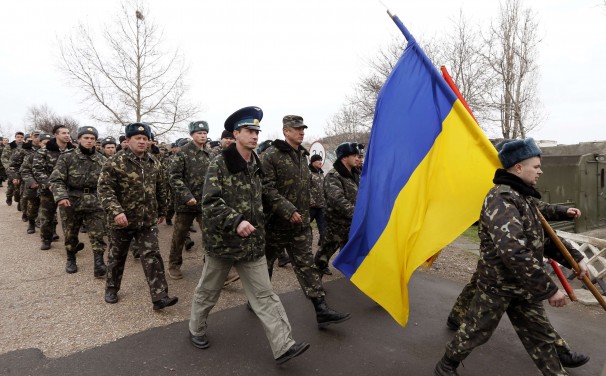
Ukranian troopsUkrainian servicemen march away from the Belbek airport Tuesday. (Vasily Fedosenko/Reuters)

He sent his men back down the hill to their barracks. Asked what would happen next, Mamchuk said: “I am feeling negative. There shouldn’t be this kind of escalation with the Russian troops.”

He said the Ukrainians had already sent their children out of Crimea, back to the Ukrainian mainland, after the servicemen and their families started receiving threatening phone calls and text messages.

Asked about the wives, Mamchuk said: “They’re stubborn. They won’t leave us.”
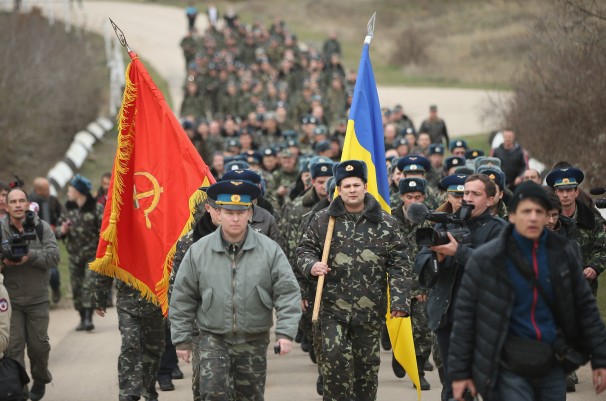
Ukranian colonel with unarmed troopsCol. Yuli Mamchor, left, commander of the Ukrainian military garrison at the Belbek airbase, leads his unarmed troops to retake the Belbek airfield from soldiers under Russian command in Crimea in Lubimovka, Ukraine. Sean Gallup /Getty Images.


Iranian general: Obama’s threats are ‘the joke of the year’

March 4, 2014

Iranian general: Obama’s threats are ‘the joke of the year’ | The Times of Israel.

Masoud Jazayeri says the ‘low-IQ’ president’s ‘all options are on the table’ remarks are a farce; warns against US strike

March 4, 2014, 9:34 pm

Iranian Brig. Gen Masoud Jazayeri (photo credit: image capture from YouTube video uploaded by NTDSpanish)

Iranian Brig. Gen Masoud Jazayeri (photo credit: image capture from YouTube video uploaded by NTDSpanish)

President Barack Obama is a “low-IQ US president,” whose threat to launch a military offensive should nuclear talks fail is an oft-cited punchline in the Islamic Republic, particularly among children, an Iranian general said on Tuesday.

“The low-IQ US president and his country’s Secretary of State John Kerry speak of the effectiveness of ‘the US options on the table’ on Iran while this phrase is mocked at and has become a joke among the Iranian nation, especially the children,” General Masoud Jazayeri said, according to the semi-official Fars News Agency.

Jazayeri was responding to the US president’s interview in Bloomberg on Sunday, in which Obama maintained that the Iranian leadership should take his “all options on the table” stance — including the warning of a potential military strike — seriously.

“We have a high degree of confidence that when they look at 35,000 US military personnel in the region that are engaged in constant training exercises under the direction of a president who already has shown himself willing to take military action in the past, that they should take my statements seriously,” the president told Bloomberg.

Jazayeri called Obama’s statements regarding the deployment of US troops “completely inexpert remarks far from the reality, and these statements can be used as the joke of the year.”

The Iranian news agency Tuesday published a political cartoon mocking the US president, calling it: “All Options on Table.” This Time for Russia.” In a jab at US non-intervention in Ukraine, the cartoon portrays Obama peering forlornly into an empty paint can with the label “Red Line” while Russian President Vladimir Putin walks away saying, “I think you used it all on Syria.” 

The Iranian general also issued a warning to Obama that should US forces make a move, “the region will be turned into a hell for them.”

Jazayeri is the second high-ranking official to castigate Obama since the interview was published Sunday. On Monday night, Foreign Ministry Spokeswoman Marziyeh Afkham panned Obama’s comments for undermining the diplomatic process.

“One part of the remarks made by the US president is in contradiction to the principles of the international law and against the spirit of diplomatic negotiations meant to prevent unconstructive slogans and resorting to threats,” Afkham said.

Under an interim deal clinched in November, Iran agreed to curb parts of its nuclear program for six months in exchange for limited sanctions relief. The agreement came into effect on January 20.

Negotiators from the P5+1 group of world powers — the United States, Britain, France, China and Russia plus Germany — are set to resume talks on a permanent accord with Iranian nuclear negotiators on March 17 in Vienna.

“The (nuclear) negotiations are going well … I’m hoping by the first deadline (July 20) we will reach an agreement,” Foreign Minister Mohammad Javad Zarif told reporters on the sidelines of an event in New Delhi on February 28.

However, he said that there were still disagreements between the sides, referencing a “problem in terms of both substance and approach.” He added that Iran would not get rid of its enrichment program.

“I can tell you that Iran’s nuclear program will remain intact. We will not close any program,” he said, according to Reuters.

Western nations and Israel have long suspected Iran of pursuing a nuclear weapons capability alongside its civilian program, charges denied by Tehran.

AFP and Times of Israel staff contributed to this report.

Russia says Iran is the only stable country in Mideast

March 4, 2014

Russia says Iran is the only stable country in Mideast, Tehran Times, March 4, 2014

(An interesting perception of stability and yet another reason to put little if any trust in Russia as a “stabilizing” influence on Iran. — DM)

TEHRAN – Russian Deputy Prime Minister Dmitry Rogozin said that the expansion of Moscow-Tehran relations is very important as Iran is the only stable country in the volatile Middle East region.

He made the remarks in a meeting with Iranian Ambassador to Moscow Mehdi Sanaei on Tuesday.

They exchanged some views on bilateral and multilateral cooperation between Iran and the Russian Federation.

Rogozin pointed to some important events in Ukraine and Afghanistan and said it is necessary to pay more attention to Western plots.

Sanaei, for his part, praised Rogozin’s positive view on bilateral relations and called for expansion of relations.

During the meeting, a report on Iran’s scientific advances and technical cooperation between the two countries was presented.

Iran, Russia Partnering to Launch Cyber Attacks

March 4, 2014

Iran, Russia Partnering to Launch Cyber Attacks, Washington Free Beacon, , March 4, 2014

(It’s probably because they want to get to know us better to develop closer and more trusting relationships. Right? — DM)

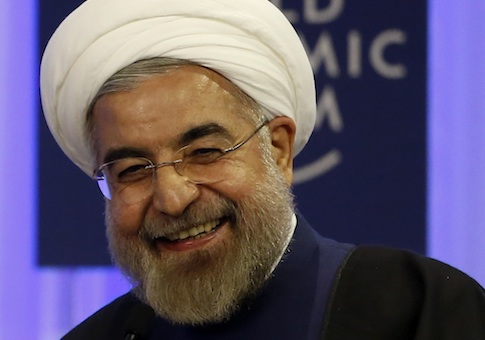
Iran's President Rouhani smiles during session of World Economic Forum in Davos

As Russia continues to take an aggressive stance towards the United States, its “assistance to Iran’s cyber program” will grow exponentially “as Iran continues to develop offensive and defensive capabilities,” Hoekstra said, noting that this “foreshadows an even darker future.”

Iran has boosted its cyber capabilities in a “surprisingly” short amount of time and possesses the ability to launch successful cyber attacks on American financial markets and its infrastructure, former Rep. Peter Hoekstra (R., Mich.) told a panel of lawmakers on Tuesday.

The Iranian regime’s emergence as a “world class” cyber threat likely has to do with its close ties to Russia, according to Hoekstra, who warned during a hearing on Iran’s global terror activities that the two countries will only boost coordination on the cyber front in the coming months.

“Iran and Russia will develop a much closer relationship,” said Hoekstra, who was on the House’s intelligence committee from 2001 to 2011. “Russia and Iran have so much to gain from more significant cooperation [and] the immediate impacts will be profound.”

As Russia continues to take an aggressive stance towards the United States, its “assistance to Iran’s cyber program” will grow exponentially “as Iran continues to develop offensive and defensive capabilities,” Hoekstra said, noting that this “foreshadows an even darker future.”

Iran’s cyber capabilities have become increasingly sophisticated, though the United States remains underprepared to respond to these threats, Hoekstra said.

“They’ve made a significant commitment to developing cyber capabilities and they’re doing it successfully,” he said. “In a very short period of time,” Iran has become “almost world class in the cyber area, nipping at the heels of the U.S.”

“The cyber threat is real, and it’s worrisome,” Hoekstra added.

Iran’s steady growth in the cyber arena has occurred under the nose of the U.S. intelligence community, Hoekstra said.

There have “always been concerns about how little we actually know about Iran,” he said.

The cyber buildup has occurred “in a very short period of time, and it’s surprising,” he said.

Concerns remain about “how quickly [Iran] did it and more importantly who helped them do it,” Hoekstra said. “The most likely candidate for that is the cooperation they have with Russia.”

With Iran and Russia combining their resources, a joint cyber attack on the United States could be devastating.

“You would see something that would cause economic disruption,” as well as an attack “potentially against our infrastructure,” Hoekstra said. “The scary thing is they have the capability to do that and we don’t necessarily have the means to defend it. If something like that occurred it would be very, very difficult to pinpoint who the perpetrators would be. It could be Iran, but it’s very difficult to track it back to Iran.”

Iran has turned to Russia and the cyber warfare front in a bid to even a potential battle against the United States and the West, according to Matthew McInnis, a resident fellow at the American Enterprise Institute.

“That asymmetry in the battle field they face is one of the reasons they strive to have the terror capabilities that they do, and having that ability to hit our homeland provides a retaliatory effect they don’t have with conventional weapons,” McInnis said. “It needs to be able to operate here and threaten the U.S. on our own territory.”

In addition to boosting its cyber abilities, Iran has sought to generate unrest across the Middle East to solidify its regional power.

The Iranian “regime foments bloodshed, promotes chaos, not just in the West Bank, and not just in Gaza, and not just in Iraq and Afghanistan, and not just in Lebanon,” said Rep. Ed Royce (R., Calif.).

“As their meddling increases, our allies, our partners in the region … bear the brunt of an emboldened Iran, and that’s why we need to keep the pressure on” via increased economic sanctions, Royce said.

Rep. Ileana Ros-Lehtinen (R., Fla.) warned the Obama administration against focusing only on Iran’s nuclear pursuits.

“While all of the focus of these negotiations has been on Iran’s nuclear program, what has gone largely ignored is just how dangerous the Iranian regime truly is. Iran is the world’s foremost state sponsor of terrorism and it seeks to harm the U.S. and our allies at every turn, yet the administration carries on as if Iran’s nuclear program exists in a vacuum—as if it is unrelated to Iran’s terror activities,” she said.

Off Topic: Palestinians say Netanyahu shut down talks with speech

March 4, 2014

Palestinians say Netanyahu shut down talks with speech, Times of Israel, March 4, 2014

(This “unexpected” event may displease President Obama.  — DM)

Fatah central committee member Nabil Shaath said Netanyahu’s repeated demand that the Palestinians recognize Israel as a Jewish state and his rejection of Palestinian demands on refugees and international peacekeepers were “totally rejected.”

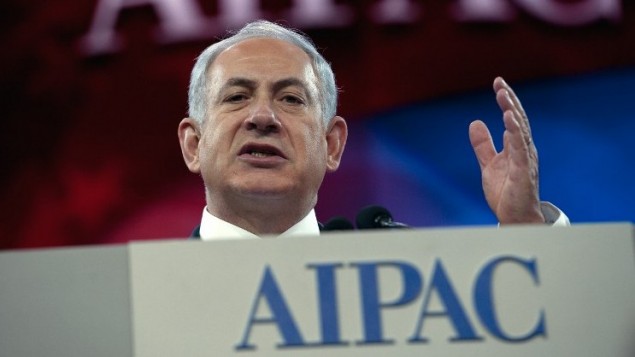
Netanyahu at AIPACPrime Minister Benjamin Netanyahu addresses the Israel Public Affairs Committee (AIPAC) policy conference in Washington on March 4, 2014 (photo credit: AFP/Nicholas KAMM

RAMALLAH – Israeli Prime Minister Benjamin Netanyahu’s speech to pro-Israel lobbyists in Washington on Tuesday amounted to “an official announcement of a unilateral end to negotiations,” a top Palestinian official told AFP.

Fatah central committee member Nabil Shaath said Netanyahu’s repeated demand that the Palestinians recognize Israel as a Jewish state and his rejection of Palestinian demands on refugees and international peacekeepers were “totally rejected.”

At AIPAC’s annual policy conference Tuesday, Netanyahu called on Palestinian Authority President Mahmoud Abbas to quit making excuses over the key Israeli demand. During the speech, Netanyahu also rejected the idea of international peacekeepers in the Jordan Valley, and made a case for upping pressure on Iran, saying any Iranian nuclear capability would be a threat to the whole world.

“It’s time for the Palestinians stop denying history,” Netanyahu told the supportive crowd. “Just as Israel is prepared to recognize a Palestinian state, the Palestinians must be prepared to recognize a Jewish state.”

Such a recognition would send a message to Palestinians, he said, “to abandon the possibility of flooding Israel with refugees or amputating parts of the Negev or Galilee.”

Israel and the Palestinians have been engaged in peace talks since August, and are expected to soon be presented with a US drafted “framework deal” that would guide the talks beyond their April end-date.

On Monday, Abbas told Meretz party leader MK Zahava Gal-on that he would only agree to extend talks if Israel freed more Palestinian prisoners than the 104 already agreed upon and froze settlement building.

Without getting personal, Netanyahu hits back at Obama

March 4, 2014

Without getting personal, Netanyahu hits back at Obama | The Times of Israel.

PM in AIPAC address argues extensively against White House thinking on Iran and Palestinians, while making just a single reference to the president

March 4, 2014, 7:22 pm

Prime Minister Benjamin Netanyahu addresses the Israel Public Affairs Committee (AIPAC) policy conference in Washington on March 4, 2014 (photo credit: AFP/Nicholas KAMM)

Prime Minister Benjamin Netanyahu addresses the Israel Public Affairs Committee (AIPAC) policy conference in Washington on March 4, 2014 (photo credit: AFP/Nicholas KAMM)

WASHINGTON — Publicly savaged by President Barack Obama for his settlement policies on Sunday, Prime Minister Benjamin Netanyahu on Tuesday opted for a firmly non-personal response in a warmly received address to the AIPAC conference here. He argued extensively for several positions directly at odds with those held by the president, but did so without the direct targeting that Obama had employed in his incendiary Bloomberg conversation published two days earlier.

Obama, in the lengthy interview with Jeffrey Goldberg that was released precisely as Netanyahu was flying in to meet with him, had chosen to assail the prime minister for overseeing “aggressive settlement construction,” indicated that Netanyahu’s positions on the Palestinian conflict were threatening Israel’s wellbeing, and warned that the US would find it increasingly difficult to defend Israel from the international consequences.

Netanyahu, having since joined the president in their latest public dialogue of the deaf at the White House on Monday, opted to tell AIPAC Tuesday morning that he had held “very good meetings” with Obama and other senior American leaders (the only time he named Obama in the speech), insisted that he was ready to conclude “a historic peace” with the Palestinians, and hailed the uniquely “precious alliance” between the United States and Israel.

He also chose to heap praise on Secretary of State John Kerry, who must have been deeply dismayed by the president’s decision to so openly question the policies of a prime minister he has spent months gradually trying to win over, cosset and reassure.

Kerry, who delivered a very long and passionately friendly address to the AIPAC conference on Monday evening, was hailed appreciatively by Netanyahu as “the secretary of state who never sleeps” and with whom he has been working “literally day and night” to advance the Palestinian peace effort.

Strikingly, the issue of settlement building — raised repeatedly by the president in his Sunday interview as the apparent key obstacle to real progress and the key threat to Israel’s future — received not a single mention in either Kerry’s address or Netanyahu’s.

Although Netanyahu eschewed direct confrontation with Obama, he argued emphatically against the president’s stances on both Iran and the Palestinians.

Where Obama promises to ensure that Iran will not obtain nuclear weapons, Netanyahu insisted that the challenge “is not just to prevent them from having the weapon, but to prevent them from having the capacity to make the weapon.”

Where Obama says he can envisage Iran retaining an enrichment capacity under a permanent accord on its nuclear program, Netanyahu said that to allow this would be “a grave error.” It would leave Iran as a threshold nuclear power, capable of breaking out to the bomb when the world’s attention was focused elsewhere, and would “open the floodgates” to nuclear proliferation. Seventeen countries worldwide have peaceful nuclear programs, Netanyahu said, without spinning centrifuges, heavy water reactors, subterranean nuclear facilities and missile research. Iran wants to keep all of those capacities, he said, because “Iran wants a military nuclear program.”

He stressed that Israel backs a diplomatic deal, provided it truly dismantles Iran’s military nuclear capabilities. But he warned, as he has from the same podium in past years, that the Jewish nation “will never be brought to the brink of extinction again” and that he would do “whatever I must do to defend the Jewish state of Israel.”

Turning to the Palestinian issue, Netanyahu set out an optimistic vision of thriving relations between Israel and parts of the Arab world — citing the potential of a combination “of Israeli innovation and Gulf entrepreneurship,” and declaring that Israel’s water expertise could better the lives of hundreds of millions — if only a deal could be done.

But whereas Obama had touted Palestinian Authority President Mahmoud Abbas as a leader demonstrably “committed to nonviolence and diplomatic efforts to resolve” the conflict, Netanyahu was far more skeptical. He received a standing ovation when he called on the Palestinians to “stop denying history” and urged Abbas to “recognize the Jewish state.” If Abbas would only tell his people of the Jewish nation’s sovereign rights, he could “finally make clear that you are truly prepared to end the conflict. No excuses. No delays. It’s time.”

And while Obama had openly wondered whether Israel wanted to “resign” itself “to what amounts to a permanent occupation of the West Bank,” and asserted that the US had developed a security plan to “deal with potential threats to Israel,” Netanyahu highlighted Israel’s ongoing security concerns in an “unraveling” Middle East. Israel simply could not afford to bet its security “on our fondest hopes.” It was, rather, Israel’s bitterly learned obligation to prepare for the worst. If a peace deal could be signed, it would certainly come under attack from extremists, and international forces could not be trusted to secure Israel because they “go home” when under repeated attack. Only “the brave soldiers” of the IDF could truly defend Israel, he said.

Netanyahu, who had looked tense and strained at the White House on Monday, was in his element at the Washington Convention Center. A couple of his jokes fell flat, and a couple of anticipated crowd-pleasers did not produce the anticipated applause. On one occasion he even asked the audience to applaud him.

But overall, as is customary, the reception for Netanyahu was markedly more enthusiastic than for any of the conference’s major speakers. His redefinition of the BDS (Boycott, Divestment, Sanctions) movement as “Bigotry, Dishonesty and Shame,” and his callout for Scarlett Johansson (who stood by SodaStream under BDS pressure), garnered particular enthusiasm.

Reading what Obama had said Sunday must have come as quite a shock for Netanyahu — not because the president’s views were unfamiliar to him, but because the president had chosen to air them, in public, as his guest was on the way to meet him. At AIPAC on Tuesday, Netanyahu set out his contrary positions with equal fervor, but did so without getting personal.

Obama the realist?

March 4, 2014

Israel Hayom | Obama the realist?.

Elliot Abrams

In the current issue of Politico, Fred Kaplan argues that U.S. President Barack Obama is the consummate realist in foreign policy. Politico asked me to comment, and my response, titled “Obama the Ideologue,” can be found here.

I argue there that Kaplan has it all wrong:

Obama emerges as an ideologue — not a realist. His policies have weakened America’s sway in the world, as our Arab and Israeli friends in the Middle East — and more, recently, the Russians — are all saying quite publicly. The “pivot to Asia” has no substance. Our military power is being deliberately reduced. While China and Russia seem to have growing influence, ours is diminishing. Relations between Obama and our closest allies (from Japan to Britain to Israel, for a few examples) are frosty at best. All this seems to be the goal of Obama policy, not an unexpected and unwanted byproduct. His is the early Jimmy Carter view (before the Soviets invaded Afghanistan), basically the George McGovern take on America’s role in the world: We’re a bully, we push people around and that’s got to stop. We need to “engage” and “reset” instead; we need to do less.

That’s not realism, and it can be called pursuit of our national interest only if you believe that having diminished power and influence is good for us — as Obama apparently does.

In The Weekly Standard today I discuss the President’s remarkable interview with Jeff Goldberg of Bloomberg. The full interview bears a close reading, for it reveals a lot about Mr. Obama’s view of himself and of foreign policy–and none of it is encouraging.

Here’s an excerpt:

When it comes to Iran, Obama shows an attitude that can only be described as solipsistic: What’s in his mind is reality. And any other reality is just plain silly. Here is the key exchange:

GOLDBERG: So just to be clear: You don’t believe the Iranian leadership now thinks that your “all options are on the table” threat as it relates to their nuclear program — you don’t think that they have stopped taking that seriously?

OBAMA: I know they take it seriously.

GOLDBERG: How do you know they take it seriously?

OBAMA: We have a high degree of confidence that when they look at 35,000 U.S. military personnel in the region that are engaged in constant training exercises under the direction of a president who already has shown himself willing to take military action in the past, that they should take my statements seriously. And the American people should as well, and the Israelis should as well, and the Saudis should as well…

GOLDBERG: So why are the Sunnis so nervous about you?

OBAMA: Well, I don’t think this is personal. I think that there are shifts that are taking place in the region that have caught a lot of them off guard. I think change is always scary.

It’s pretty obvious to all analysts that Iran does not fear an American military strike much these days, especially after Mr. Obama’s failure to act in Syria last summer. But Obama denies it, referring to himself in the third person as someone “who has shown himself willing to take military action.” Drones, sure; a quick raid as well. But in Libya and Syria, he showed himself extremely reluctant to take military action. Remember “leading from behind?” If he genuinely thinks he is viewed as a scary guy with his finger near the trigger, we all have a problem.

Goldberg pushes him, asking why (as is obvious) no one in the Gulf believes Obama. “I don’t think it is personal,” says the president; the problem is them, not him, and his analysis is therapeutic: Change is always scary, and they are having trouble catching up with it. But talk with Gulf Arabs and one finds quickly that it is in fact quite personal: They don’t trust Mr. Obama. They believe his handling of Iran and Syria and for that matter of Russia have made the world a more dangerous place.

The full text is here.

Who’s on another planet?

March 4, 2014

Israel Hayom | Who’s on another planet?.

Boaz Bismuth

From the moment Russia invaded Crimea, German Chancellor Angela Merkel hasn’t put the phone down for a second. She is calling Russian President Vladimir Putin, U.S. President Barack Obama, and she is of course calling her partners in the EU — she has 27 of these.

Merkel is on the lines trying to prevent a war in Ukraine, not because she simply feels like talking…

The New York Times reported on Monday that Merkel — during a phone conversation with Obama in which she updated him on her chat with Putin — said she believed the Russian president was out of touch with reality. Putin is “in another world,” she told Obama. While the paper did not reveal Obama’s reply despite the newspaper’s close ties to his administration, we can assume Obama did not exactly contradict her sentiments and perhaps even affirmed them.

Almost simultaneously, on Sunday U.S. Secretary of State John Kerry told ABC’s “This Week With George Stephanopoulos” that Russia’s invasion was “a 19th-century act in the 21st century.”

Kerry in essence told us that Putin is not only from another planet, he is also from another century — an alien. It is not surprising, therefore, that the West finds it hard to read his moves.

The tragedy in this story is that the West, our allies — they are the ones living in a fantasy land. Putin is living in the actual reality of our world, the same one where the leaders of China and Assad, Khamenei and Kim Jong Un also live. Everyone is on the same planet, and, believe it or not, even in the same century.

The leader of the free world, Obama, believes in a world where all is fine and dandy. Due to the status of his position, he is also dragging the Europeans along in this dream. Even the Europeans, who were indeed severely traumatized by World War II, have understood that sometimes there is no choice (Great Britain with the U.S. in the back seat in Libya, the French in Mali, Germany with NATO forces in Kosovo) and that there is such a thing as a “just war.”

The American president, however, truly believes that the age of wars is over, and that trusting in smiles is better than acknowledging the bombs. Generally speaking, he was elected to end wars (in Iraq and Afghanistan), not start new ones (in Syria). And we cannot, after all, forget that he has received the Nobel Peace Prize — a type of certification for living in la-la land. He even got a medal for it.

Obama of 2014 is very far from the person who won the election in November 2008. The “dream president” has become a president with a dream, and not a very realistic one. It’s too bad that the events in Egypt, Syria, Libya, China (provoking Japan) and Russia (the Crimea invasion) haven’t brought Obama back down to Earth. What a shame there is no ladder in Obama’s dream; otherwise he could climb down to us and see what is really going on down here, and not just in the Middle East.

The American press has also come to realize the president’s weakness on matters of foreign affairs. While The New York Times was revealing an important part of Merkel’s conversation with Obama, The Washington Post ran a highly critical piece headlined “Obama’s foreign policy is based on fantasy.” It’s as if the newspapers were working in coordination: The Post with an analysis of the story in The Times.

Off Topic: Is Europe’s gas supply threatened by the Ukraine crisis?

March 4, 2014

Off Topic: Is Europe’s gas supply threatened by the Ukraine crisis? – The Guardian.

(Shows you how utterly stupid Europe’s ruling elites are. Making Europe dependent on oil and gas from Arab despots and wannabe-tsars in Russia and reducing the exploitation of Europe’s own recources like coal as well as not using fracking for the sake of the global-warming-religion and the green radicals. Europe should end its dealings with these ‘champions of human rights’ and instead of its hypocritical boycott plans regarding Israel  Europe should start buying gas from the huge gas fields that were recently discovered in Israel.
THAT would hurt Putin more than any meaningless letters of protest. – Artaxes)

Russia supplies about 30% of Europe’s gas – should we be worried? John Henley reports


The Guardian,   Monday 3 March 2014 23.44 GMT

Ukraine pipeline

The Trans-Siberian Pipeline – one of Russia’s main natural gas export pipelines, in Ukraine. Photograph: Bloomberg

Last December, Ukraine‘s now-deposed, pro-Moscow president Viktor Yanukovych abandoned a trade deal with the European Union in favour of closer ties with Russia. One of the sweeteners in the $20bn support package that helped persuade him was a steep discount – around 30% – on the price that Russia’s gas giant, Gazprom, was then charging Ukraine for the natural gas on which it relies. This weekend, as relations between the two countries descended to an alarming new low, Moscow warned that the cut-price deal was unlikely to last much longer.

Gazprom, which controls nearly one-fifth of the world’s gas reserves and supplies more than half of the gas Ukraine uses each year, insisted the threatened price rise merely reflected cash-strapped Ukraine’s inability to meet its contractual obligations. The state-owned company said that Kiev owes it $1.55bn for gas supplied in 2013 and so far in 2014, and shows little evidence of paying up. But this is not the first time Russia has used gas exports to put pressure on its neighbour – and “gas wars” between the two countries tend to be felt far beyond their borders. Russia, after all, still supplies around 30% of Europe’s gas.

In late 2005, Gazprom said it planned to hike the price it charged Ukraine for natural gas from $50 per 1,000 cubic metres, to $230. The company, so important to Russia that it used to be a ministry and was once headed by the former president (and current prime minister) Dmitry Medvedev, said it simply wanted a fair market price; the move had nothing to do with Ukraine’s increasingly strong ties with the European Union and Nato. Kiev, unsurprisingly, said it would not pay, and on 1 January 2006 – the two countries having spectacularly failed to reach an agreement – Gazprom turned off the taps.

The impact was immediate – and not just in Ukraine. The country is crossed by a network of Soviet-era pipelines that carry Russian natural gas to many European Union member states and beyond; more than a quarter of the EU’s total gas needs were met by Russian gas, and some 80% of it came via Ukrainian pipelines. Austria, France, Germany, Hungary, Italy and Poland soon reported gas pressure in their own pipelines was down by as much as 30%.

While it was eventually resolved through a complex deal that saw Ukraine buying gas from Russia (at full price) and Turkmenistan (at cut price) via a Swiss-registered Gazprom subsidiary, the dispute gave the EU a fit of the jitters: a compelling demonstration, Brussels said, of the dangers of becoming overdependent on one source of supply. But three years later, the same row erupted again: Gazprom demanded a price hike to $400-plus from $250, Kiev flatly refused, and on New Year’s day 2009, Gazprom began pumping only enough gas to meet the needs of its customers beyond Ukraine.

Again, the consequences were marked. Inevitably, Russia accused Ukraine of siphoning off supplies meant for European customers to meet its own needs, and cut supplies completely. As sub-zero temperatures gripped the continent, several countries – particularly in south-eastern Europe, almost completely dependent on supplies from Ukraine – simply ran out of gas. Some closed schools and public buildings; Bulgaria shut down production in its main industrial plants; Slovakia declared a state of emergency. North-western Europe, which had built up stores of gas since 2006, was less affected – but wholesale gas prices soared, a shock that was declared “utterly unacceptable” by Brussels.

So last weekend’s news that Gazprom intends to start charging Ukraine around $400 per 1,000 cubic metres for its gas, as opposed to the $270-odd it has been paying since Yanukovych spurned Brussels for Moscow – sparking the demonstrations that led to his downfall – might seem alarming. Many industry experts, though, point out that the world has changed since 2009, and that there are any number of reasons why Moscow’s natural gas supplies may not prove quite the potent economic and diplomatic weapon they once were.

For starters, we are not now in early January but in March, considered the final month of the continental European heating season, when demand is likely to be highest. Moreover, this has been a particularly mild winter – the mildest since 2008 – and higher than normal temperatures are forecast to continue for several weeks yet, significantly reducing demand for gas and leaving prices at their lowest for two years. Energy market analysts at the French bank Société Générale said in a briefing note last month that European gas demand in 2013 was at its lowest level since 1999. In the UK, gas consumption is currently approaching a 12-year low.

Partly as a result of weaker demand, but also because since the first “gas war” of 2006, many European countries have made huge efforts to increase their gas storage capacity and stocks are high. Some countries, such as Bulgaria, Slovakia and Moldova, which lack large storage capacity and depend heavily on gas supplies via Ukraine, would certainly suffer from any disruption in supplies. But Gas Infrastructure Europe (GIE), which represents the gas infrastucture industry, estimated that in late February European gas storage was 10 percentage points higher than this time last year and about half full; the National Grid puts Britain’s stocks at about 25 percentage points above the average for the time of year.

“The conflict won’t have any impact at all” on prices, a Frankfurt-based analyst told Bloomberg News. “The gas price is currently influenced by temperatures and storage levels, and both don’t favour demand right now.” Prices of gas for delivery next month have risen around 10%, but that reflects insecurities in the market about a possible military confrontation between Russia and Ukraine rather than worries about fundamental shortages of supply were Gazprom to turn off the taps, the analyst told the agency.

Other, structural changes have lessened the potential impact on Europe of a disruption to Russian gas supplies through Ukraine. New Gazprom pipelines via Belarus and the Baltic Sea to Germany (Nord Stream) have cut the proportion of Gazprom’s Europe-bound exports that transit via Ukraine to around half the total, meaning only about 15% of Europe’s gas now relies on Ukraine’s pipelines. Gazprom is also planning a Black Sea pipeline (South Stream), expected in 2015, meaning its exports to Europe will bypass Ukraine completely. Ukraine itself has cut its domestic gas consumption by nearly 40% over the past few years, halving its imports from Russia in the process.

Moreover, a boom in sales of US shale gas means longstanding gas exporters such as Russia now have to fight for their share of the market. Europe is increasingly installing specialist terminals that will allow gas to be imported from countries such as Qatar in the form of liquefied natural gas – while Norway’s Statoil sold more gas to European countries in 2012 than Gazprom did. “Since the Russian supply cuts of 2006 and 2009, the tables have totally turned,” Anders åslund, an energy advisor to both the Russian and Ukrainian governments, told the Washington Post.

Gazprom has no wish to see sales to Europe disrupted. At its annual meeting with investors in London on Monday, company officials were optimistic about its prospects despite a 13% fall in its share price triggered by recent events in Ukraine. Indeed, they predicted Russia’s share of Europe’s total gas supply would actually increase in future as overall consumption – and Britain and Norway’s gas production – declines.

Europe accounts for around a third of Gazprom’s total gas sales, and around half of Russia’s total budget revenue comes from oil and gas. Moscow needs that source of revenue, and whatever Vladimir Putin’s geo-political ambitions, most energy analysts seem to agree he will think twice about jeopardising it. Short of an actual war, the consensus appears to be, Europe’s gas supplies are unlikely to be seriously threatened.

Putin: Not Russian – but local forces took control of Crimea. DEBKAfile: They are Russian special forces

March 4, 2014

Putin: Not Russian – but local forces took control of Crimea. DEBKAfile: They are Russian special forces, DEBKAfile, March 4, 2014

Putin’s insistence that the forces in control of Crimea are not Russian flies in the face of the evidence. Although the men’s uniforms are bare of unit insignias, their vehicles have identifying number plates.

Russian President Vladimir Putin, addressing reporters for the first time Tuesday, March 4, said that the forces which have taken control of the Crimean Peninsula are not Russian but self-defense locals in Russian uniforms which, he said, “anyone can buy.” DEBKAfile’s military sources challenge this statement. They have identified one unit as members of Russia’s Rapid Intervention Brigade 22, which is based in the southern Russian town of Rostov on-Don, along with air units. It was from Rostov that deposed Ukraine president Viktor Yanukovych broke his silence to the media on March 1, a week after he fled Kiev.

He has since dropped out of sight again.

Putin’s comments Tuesday were rambling and often self-contradictory.

He asserted that the acting president in Kiev has no power and that Yanukovych who was removed by an anti-constitutional coup d’etat is Ukraine’s only legitimate president. At the same time, the Russian president said: “I told him he had no chance of being reelected” – which did not prevent him from holding up Yanukovich’s letter asking him to send military forces to Ukraine to justify Russia’s military intervention.

Our sources identify the second Russian unit in Crimea as the 25th Regiment of Special Forces-Stavropol.

This Crimean town hit the headlines in January when a group of jihadists was captured there on its way to a suicide operation in Sochi in the run-up to the Olympic Winter Games.

The Russian president went on to say he is not concerned about war breaking out, because “there will not be fighting in Ukraine.” But then he said that if the violence spread to the eastern and southern regions, which are dominated by a Russian-speaking population, Russia reserved the right to use military forces to protect those citizens.

Putin’s insistence that the forces in control of Crimea are not Russian flies in the face of the evidence. Although the men’s uniforms are bare of unit insignias, their vehicles have identifying number plates.

Vladimir Putin also warned that Western sanctions would be counterproductive and “cause harm elsewhere.” “If they don’t want to come to Sochi, they will not come” he said with a shrug.

Shortly after his news conference, Secretary of State John Kerry landed in Kiev and drove off to his talks with interim government leaders without making any comments.