Archive for March 2, 2014

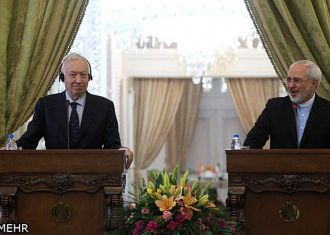
Spain says keen to expand ties with Iran

March 2, 2014

Spain says keen to expand ties with Iran, Tehran Times, March 2, 2014

(Iran’s “open for business” sign, posted when relief from sanctions began, continues to work as expected. Politics is often local economic, so the P5+1 negotiators must be pleased. — DM)

“We will make every effort to increase our relations with Tehran,” Garcia-Margallo [Spain’s Foreign Minister] said in a joint press conference with his Iranian counterpart Mohammad Javad Zarif. . . . Zarif said that Iran and Spain could work together toward a world free of violence and extremism.

Spain joins the rush

TEHRAN – The Spanish foreign minister who was visiting Tehran on Sunday said that Madrid is keen to increase relations with Iran, particularly in economic spheres.

Foreign Minister Jose Manuel Garcia-Margallo, who arrived in Tehran on Saturday for a planned four-day visit, cut short his trip to attend an emergency meeting of EU foreign ministers on Monday to discuss the situation in Ukraine.

“We will make every effort to increase our relations with Tehran,” Garcia-Margallo said in a joint press conference with his Iranian counterpart Mohammad Javad Zarif.

Commenting on the interim deal between Iran and the world powers on Tehran’s nuclear program, he expressed hope that the deal would be a comprehensive one and would not need to be extended.

In November 2013, Iran and the 5+1 group (the five permanent members of the UN Security Council plus Germany) reached an interim accord over Tehran’s nuclear program and agreed to work on a comprehensive solution over the next six months.

The chief Spanish diplomat praised Iran for its role in fighting the trafficking of illicit drugs and said that his country is ready to cooperate with the Islamic Republic on this issue.

The Iranian foreign minister also said that bilateral ties between the two countries have suffered a blow due to the Western sanctions against Iran. However, Zarif expressed hope that the two sides would make efforts to enhance their economic relations.

Zarif also said that as the Spanish diplomat had to cut short his trip to Iran, he would visit Tehran again in the near future to continue the talks.

Elsewhere in his remarks, Zarif said that Iran and Spain could work together toward a world free of violence and extremism.

Ukraine and Iran

March 2, 2014

Israel Hayom | Ukraine and Iran.

Elliot Abrams

Today’s news from Ukraine is grim. It’s increasingly clear that Russian President Vladimir Putin believes he has an opportunity to move in the Crimea, and perhaps to take eastern portions of Ukraine for Russia while destabilizing the new government in Kiev.

So far, the American reaction has been pathetically weak: a few words from Secretary of State John Kerry and President Barack Obama but no action. Not even diplomatic action like a U.N. Security Council session or a meeting of the NATO Council, or a Kerry visit to Kiev.

The administration’s inaction and Putin’s aggressive conduct may teach some lessons: that the Obama administration seeks above all to avoid confrontations, at whatever cost; that its efforts to engage dictators and repressive regimes appear always to end in grief; that friends and foes alike see us as increasingly disengaged and weak; that this appearance of weakness tempts enemies of the United States to act. The very week that Putin acts in Ukraine is the week when the Obama administration unveils its plan for the smallest U.S. Army since World War II.

Those who are wondering whether we need to pass sanctions legislation now and put more pressure on Iran should take all this into account. Like Putin, the ayatollahs likely see our failure to act in Syria (indeed our willingness to be “rescued” from action by Putin) as a sign that they can drive a hard bargain indeed with us over their nuclear weapons program, giving up nearly nothing and getting sanctions relief. And now they see us reacting (so far) to Russian aggression in Ukraine, sending troops across the border into the Crimea, with tut-tutting.

The administration’s argument against the proposed Iran sanctions legislation should be reconsidered in the light of today’s news. The Iranians across the negotiating table from us are following Ukraine closely, and judging our country’s willingness to resist when international law is violated — as Putin is violating it today and Iran has been violating it for years. This would be a very good time for Congress to pass the Menendez-Kirk legislation, promising more sanctions if Iran violates pledges it has made and moves toward a bomb. One lesson of events in Ukraine is that relying on the goodwill of repressive, anti-American regimes is foolish and dangerous. Another is that American strength and strength of will are weakened at the peril of the United States and its friends everywhere.

Off Topic: Ukraine PM warns country is ‘on brink of disaster’

March 2, 2014

Ukraine PM warns country is ‘on brink of disaster’ | The Times of Israel.

Newly appointed leader issues ‘red alert’ over Russian invasion; NATO chief calls on Kremlin to halt military activity

March 2, 2014, 2:21 pm

Ukraine's newly appointed Prime Minister Arseny Yatsenyuk (Photo credit: Sergei Supinsky/AFP)

Ukraine’s newly appointed Prime Minister Arseny Yatsenyuk (Photo credit: Sergei Supinsky/AFP)

Ukraine’s Prime Minister Arseniy Yatsenyuk warned Sunday that his crisis-hit country was on the “brink of disaster,” accusing Russia of declaring war in a bleak appeal to the international community.

“This is the red alert, this is not a threat, this is actually a declaration of war to my country,” he told reporters in English, a day after Russia’s parliament approved the deployment of troops to Ukraine.

“If President Putin wants to be the president who started a war between two neighboring and friendly countries, between Ukraine and Russia, he has reached his target within a few inches. We are on the brink of the disaster.”

US President Barack Obama has branded Russia’s parliament vote a “violation of Ukrainian sovereignty” and told his Russian counterpart Vladimir Putin in a phone call that Moscow’s reported deployment of troops outside bases that it leases from Ukraine in the Crimea peninsula had broken international law.

Yatsenyuk on Sunday appealed to the international community.

“We believe that our Western partners and the entire global community will support the territorial integrity and unity of Ukraine and will do everything they can in order to stop the military conflict provoked by the Russian Federation,” he said.

NATO chief Anders Fogh Rasmussen urged Russia on Sunday to stop its military activity and threats against Ukraine, saying Moscow’s action threatened “peace and security in Europe.”

“Russia must stop its military activity and its threats,” he said before opening crisis talks with NATO’s 28 ambassadors. “Today we will discuss the implications for European security.”

Off Topic: Kiev calls up troops as Crimea crisis threatens to spiral into war

March 2, 2014

Kiev calls up troops as Crimea crisis threatens to spiral into war | The Times of Israel.

Ukraine orders all reserves to report; convoy of Russian troops seen heading for Simferopol ; US calls on Moscow to withdraw its forces

March 2, 2014, 10:54 am Updated: March 2, 2014, 12:00 pm

Troops in unmarked uniforms stand guard in Balaklava on the outskirts of Sevastopol, Ukraine, Saturday, March 1, 2014. An emblem on one of the vehicles and their number plates identify them as belonging to the Russian military. (Photo credit: Andrew Lubimov/AP)

Troops in unmarked uniforms stand guard in Balaklava on the outskirts of Sevastopol, Ukraine, Saturday, March 1, 2014. An emblem on one of the vehicles and their number plates identify them as belonging to the Russian military. (Photo credit: Andrew Lubimov/AP)

SIMFEROPOL, Ukraine — Ukraine’s security chief ordered a full call-up of reserve troops Sunday morning, as Russian troops took control of the Crimea peninsula and the bloodless clash threatened to explode into fighting.

Andriy Parubiy told reporters that the council had ordered the defense ministry to “call on all those that armed forces need at the moment across Ukraine,” adding that the mobilization was to “ensure the security and territorial integrity of Ukraine”.

Earlier in the day, a convoy of hundreds of Russian troops were spotted heading toward the regional capital of Simferopol.

Russian troops took over the strategic Black Sea peninsula on Saturday without firing a shot and the new government in Kiev has been powerless to react.

On the road from Sevastopol, the Crimean port where Russia maintains a naval base, to Simferopol on Sunday morning, AP journalists saw 12 military trucks carrying troops, a Tiger vehicle armed with a machine gun and also two ambulances.

Ukraine’s acting president, Oleksandr Turchynov, announced late Saturday that he had ordered Ukraine’s armed forces to be at full readiness because of the threat of “potential aggression.” He also said he had ordered stepped-up security at nuclear power plants, airports and other strategic infrastructure.

On Crimea, however, Ukrainian troops have offered no resistance.

Russian military forces operating in Crimea were reported to have taken weapons from two Ukrainian military posts, according to a Ukrainian Defense Ministry sources cited by the Interfax news agency. The Russian troops were said to have urged military personnel at the posts to side with the “legitimate” leaders of the Crimean Peninsula.

The new government came to power last week following months of pro-democracy protests against the now-fugitive president, Viktor Yanukovych, and his decision to turn Ukraine toward Russia, its longtime patron, instead of the European Union.

Ukraine’s population of 46 million is divided in loyalties between Russia and Europe, with much of western Ukraine advocating closer ties with the EU, while eastern and southern regions look to Russia for support. Crimea, a semi-autonomous region that Russia gave to Ukraine in the 1950s, is mainly Russian-speaking.

The Russian move into the Crimean peninsula Saturday led to international calls for Moscow to pull back its troops.

On Saturday, Ukraine’s ambassador to the United Nations asked an emergency session of the Security Council “to do everything possible now” to stop Russia’s “aggression” as its troops took over the strategic Crimea region.

But action by the UN’s most powerful body appears unlikely. As a permanent member, Russia has veto power and can block the council from adopting any resolution criticizing or sanctioning Moscow.

UN Secretary-General Ban Ki-moon urged Russian President Vladimir Putin in a phone call to “urgently engage in direct dialogue with the authorities” in Kiev.

However, Putin threatened that if there is an escalation of violence against Russian speakers in eastern Ukraine and Crimea, Russia “will take necessary measures in [the] framework of international law,” Interfax reported.

Calling the situation in Ukraine “as dangerous as it is destabilizing,” US ambassador to the UN Samantha Power told the council, “It is time for the Russian military intervention in Ukraine to end.”

Power and other members of the council called for sending international monitors to Ukraine as soon as possible to observe the situation, and Power warned that “Russia’s provocative actions could easily push the situation beyond the breaking point.” She also mentioned work on an international mediation mission to send to Ukraine.

The Security Council met in emergency session for the second straight day on the rapidly developing events in Ukraine. It even met briefly in an open, televised session, despite objections from Russia, then resumed meeting behind closed doors.

Current council president, Luxembourg Ambassador Sylvie Lucas, said members stressed the importance of Ukraine’s territorial integrity and the need to lower tensions, in addition to the need for international monitors.

Russia’s UN ambassador, Vitaly Churkin, said the new government in Kiev needs to get away from “radicals” and warned that “such actions they’re taking could lead to very difficult developments, which the Russian Federation is trying to avoid.”

Churkin also accused the West of interfering in the recent Kiev demonstrations that turned violent amid tensions over the decision by Ukraine’s now-fugitive president, Viktor Yanukovych, to turn Ukraine toward Russia, its longtime patron, instead of the European Union.

Russia has given refuge to Yanukovych, who fled a week ago.

Churkin said Russia was intervening at the request of pro-Russian authorities in the semi-autonomous Crimea, which is largely Russian-speaking and home to Russia’s Black Sea navy fleet.

British Ambassador Mark Lyall Grant, who called for Saturday’s meeting, told reporters afterward that “there is no justification for Russia’s military activities in the last 48 hours.”

Deputy Secretary-General Jan Eliasson called the situation in Ukraine “very difficult and very dangerous” and said they were seeing “negative signs, serious signs, risks of escalation.”

Ukraine’s UN ambassador, Yuriy Sergeyev, asked the other four permanent Security Council members — the US, Britain, France and China — for help, adding that Russia had rejected Ukraine’s proposal to hold immediate bilateral consultations.

When asked later whether Ukraine is at war with Russia, Sergeyev said, “No. We are not at war. We are trying to avoid any clashes. We are being provoked.”

Ban, the UN chief, said earlier Saturday that he is “gravely concerned about the deterioration of the situation” in Ukraine and called for “full respect for and preservation of the independence, sovereignty and territorial integrity” of the country.

Ban later spoke by telephone with Putin, and a statement from Ban’s office said, “It is crucial to restore calm and proceed to an immediate de-escalation of the situation.”

“Cool heads must prevail, and dialogue must be the only tool in ending this crisis,” Ban said.

Ban planned to meet Sunday in Geneva with his special envoy Robert Serry, the Netherlands’ first ambassador to Ukraine.

Ban on Friday asked Serry to go to Crimea as part of a fact-finding mission. However, after consulting with authorities in the region, Serry decided that a visit was not possible.

Lyall Grant said his understanding was that Serry couldn’t go because airspace above Crimea has been closed. Eliasson called the decision “purely logistical.”

AFP contributed to this report
U.S. pushing Israel to stop assassinating Iranian nuclear scientists – CBS News

March 2, 2014

U.S. pushing Israel to stop assassinating Iranian nuclear scientists – CBS News.

President Obama and Israeli Prime Minister Benjamin Netanyahu hold a meeting in the Oval Office of the White House in Washington, Sept. 30, 2013. AFP/Getty Images

WASHINGTON — As Israel’s Prime Minister Benjamin Netanyahu flies to Washington – due to arrive on Sunday (March 2), to prepare for talks with President Barack Obama at the White House on Monday – it’s clear that there are several points of friction between Israel and the United States.

The two countries are allies, but their leaders often differ on the details of key issues: Israel’s peace talks with the Palestinians, America’s nuclear talks with Iran, how to approach political turmoil in Egypt, what might be done to limit Syria’s horrible civil war, and a broader issue of whether the Middle East sees President Obama as a powerful, influential leader.

Recently, as I sought to update a book I co-wrote about the history of Israel’s intelligence agencies, sources close to them revealed that they felt pressure from the Obama Administration – more than a hint – to stop carrying out assassinations inside Iran.

Although Israel has never acknowledged it, the country’s famed espionage agency – the Mossad – ran an assassination campaign for several years aimed at Iran’s top nuclear scientists. The purpose was to slow the progress made by Iran, which Israel feels certain is aimed at developing nuclear weapons; and to deter trained and educated Iranians from joining their country’s nuclear program.

At least five Iranian scientists were murdered, most of them by bombs planted on their cars as they drove to work in the morning. Remarkably, the Israeli assassins were never caught – obviously having long-established safe houses inside Iran – although several Iranians who may have helped the Mossad were arrested and executed.

In addition to strong signals from the Obama Administration that the U.S. did not want Israel to continue the assassinations, Mossad officials concluded that the campaign had gotten too dangerous. They did not want their best combatants – Israel’s term for its most talented and experienced spies – captured and hanged.

President Obama – much to the discomfort of Israeli officials – is pursuing negotiations with Iran. The United States is one of the P5+1 nations, continuing to talk with the Iranians about rolling back some of their nuclear potential.

Sources told us that Netanyahu has now ordered the Mossad to focus on hunting – inside Iran and elsewhere – for evidence that the Iranians are cheating on the commitments they made in their interim agreement with the P5+1 last November.

Prime Minister Netanyahu and President Obama will also discuss progress – said by all concerned to be limited, but not non-existent – in Israel’s talks with the Palestinian Authority which began last year. Secretary of State John Kerry has had many frustrations in his chosen role as mediator: not least, the harsh criticism of Kerry voiced by some members of Netanyahu’s coalition government who distrust the peace process and feel that giving up any of the West Bank would be needlessly dangerous for Israel.

Dan Raviv, Washington-based host of radio’s CBS News Weekend Roundup, is co-author of Spies Against Armageddon: Inside Israel’s Secret Wars, which has a new updated edition published on March 2.

Netanyahu to urge Obama to rule out Iranian enrichment

March 2, 2014

Netanyahu to urge Obama to rule out Iranian enrichment | The Times of Israel.

Ahead of White House meeting Monday, PM said ready to accept Kerry’s peace framework, much more worried about Iran

March 1, 2014, 4:38 pm

Prime Minister Benjamin Netanyahu meets with President Barack Obama in the White House in March 2012 (photo credit: Amos Ben Gershom/GPO/Flash90)

Prime Minister Benjamin Netanyahu meets with President Barack Obama in the White House in March 2012 (photo credit: Amos Ben Gershom/GPO/Flash90)

As he heads to the United States this weekend for a meeting Monday at the White House with US President Barack Obama, Prime Minister Benjamin Netanyahu is ready in principle to agree to Secretary of State John Kerry’s framework proposals for extending peace talks with the Palestinians, but is far less sanguine about the US-led international negotiations with Iran over its rogue nuclear program, The Times of Israel has learned.

On the understanding that Kerry’s framework proposals constitute a non-binding basis for extending the talks beyond the current April deadline, and with the provision that both sides can express their reservations over some of its clauses, the prime minister will not have to be pressured into endorsing the document, sources close to the prime minister said.

Netanyahu remains concerned about the US-drafted security proposals — which he believes do not constitute an adequate means for confronting terrorism in the West Bank, Israel’s Channel 10 News reported Friday — and opposes any formal legitimization of Palestinian claims to Jerusalem, the sources made clear, however. His office also said Thursday that Netanyahu “does not intend to evacuate any settlement or uproot a single Israeli” under a permanent accord, since he insists that settlers on the far side of a two-state border must be given the choice of evacuating or staying on in a Palestinian state — a stance first reported by The Times of Israel in January.

While Jerusalem anticipates that Obama, at their talks on Monday, will want to focus heavily on the Israeli-Palestinian peace process, Netanyahu is anxious to emphasize his concerns over the content of a permanent nuclear accord with Iran, which is currently being negotiated between Tehran and the P5+1 world powers. Primarily, Israel’s Channel 10 news reported Friday, Netanyahu is adamant that Iran must be denied any ongoing capacity to enrich uranium, since he fears that, as it improves its enrichment technology, it would be able to speed rapidly from low-level enriched uranium to nuclear weapons-grade enrichment levels. Obama, by contrast, has said he can envisage Iran maintaining the capacity to carry out low-level enrichment, under a highly intrusive inspection and supervision regime.

An Iranian worker at the Uranium Conversion Facility at Isfahan, 410 kilometers, south of Tehran. The conversion facility in Isfahan reprocesses uranium ore concentrate, known as yellowcake, into uranium hexaflouride gas. The gas is then taken to Natanz and fed into the centrifuges for enrichment. (photo credit: AP Photo/Vahid Salemi)

An Iranian worker at the Uranium Conversion Facility at Isfahan, 410 kilometers, south of Tehran. The conversion facility in Isfahan reprocesses uranium ore concentrate, known as yellowcake, into uranium hexaflouride gas. The gas is then taken to Natanz and fed into the centrifuges for enrichment. (photo credit: AP Photo/Vahid Salemi)

Netanyahu, who called the interim deal on Iran’s nuclear program, signed in Geneva in November and implemented in January, a “historic mistake,” is also concerned that the provisions of that deal did not prevent Iran from improving its enrichment centrifuges, and did not cover weaponization and missile development. If a permanent accord is to ensure that Iran never attain nuclear weapons, as the chief US negotiator Wendy Sherman said in Jerusalem last weekend, a permanent accord would have to cover those aspects, Netanyahu believes.

While the Israeli prime minister, who will address the annual AIPAC pro-Israel lobby’s annual Washington conference on Tuesday, is inclined to accept Kerry’s peace framework, Palestinian Authority President Mahmoud Abbas is expected to resist it when he meets with Obama on March 17. Abbas’s chief negotiator Saeb Erekat said on Thursday that there was “no point” in extending the negotiations past April.

Palestinian Authority President Mahmoud Abbas arrrives at the Elysee Palace in Paris on February 21, 2014. (photo credit: Alain Jocard/AFP)

Palestinian Authority President Mahmoud Abbas arrives at the Elysee Palace in Paris on February 21, 2014. (photo credit: Alain Jocard/AFP)

At the end of two days of talks with Kerry in Paris late last month, Abbas was reportedly left fuming over Kerry’s framework proposals. The US secretary reportedly suggested Abbas form a Palestinian capital in the neighborhood of Beit Hanina, not all of East Jerusalem, as the Palestinians have demanded. Kerry also suggested that Israel keep 10 settlement blocs as part of any territorial exchange, according to Al Quds, the most widely read Palestinian daily, on Wednesday. The Jordan Valley would not be part of a future Palestinian state, Palestinian sources told the paper, nor would there be an international force stationed there. And Kerry reportedly demanded that the Palestinians recognize Israel as the homeland of the Jewish people.

The report, which received no official confirmation, said Abbas exploded with rage over the US secretary’s proposals, and described them as “insanity.” The PA president threatened to “overturn tables” and to go back on the flexibility he had shown in order to facilitate the US-led peace efforts, according to Al Quds.

The paper suggested that Abbas’s subsequent invitation to meet Obama at the White House was a form of damage control on the part of the Americans.

A view of the Jordan Valley (photo credit: heatkernel)

A view of the Jordan Valley (photo credit: CC-BY heatkernel/Flickr/File)

The explosive nature of the meeting reported in the Palestinian daily, however, was far removed from the image projected by Abbas to the media in Paris, where he described American peace efforts as “extremely serious” and his talks with Kerry as ”constructive.”

Israel’s Channel 2 news reported last month that the PA has decided to reject Kerry’s proposals and instead launch a global diplomatic and legal assault on Israel. The PA, it said, was setting up teams to wage diplomatic war against Israel in “every conceivable” forum, including pushing for boycotts of Israel and seeking legal rulings against Israel via international courts in The Hague.

Unless Kerry significantly changed the formulation of his proposals, the report said, the Palestinians would reject his overtures, confident that much of the international community will consider them to be the injured party and hold Israel responsible for the failure of peace efforts. The Palestinians are furious that Kerry is offering them a state “with no borders, no capital, no [control over] border crossings… and without Jerusalem,” the TV report said, quoting Palestinian sources.


