Obama Warns Russia Against Military Action In Ukraine – YouTube.
–
Obama warns Russia over military actions in the southern Ukrainian peninsula that borders Russia.
–
Obama Warns Russia Against Military Action In Ukraine – YouTube.
–
Obama warns Russia over military actions in the southern Ukrainian peninsula that borders Russia.
–
Russia is uneasy at ” alarming information ” coming from ” friendly Venezuela ” and calls for no ” instigating actions and acts of violence.”

“The key is respect for the Constitution and the democratically elected authorities of Venezuela , led by President Nicolas Maduro ,” said the Russian Foreign Ministry in a statement .
Moscow urges to find the solution to the problems “through peaceful dialogue ,” stressing that ” meddling from the outside in the internal affairs of a sovereign state ” is something “unacceptable.”
“The smear campaign and incitement to violent antigovernment actions must stop,” said the Russian Foreign Ministry.The tension does not subside in Venezuela after holding two weeks of protests in favor and against the administration of President Maduro, taking the life of many demonstrators and Govt. supporters . On Monday the guild Venezuelan motorcyclists have staged a caravan in support of President Nicolas Maduro. Meanwhile, anti-government groups up barricades and burn garbage in protest .
Russia & China send aircraft carriers to the coast of VenezuelaThe Russian aircraft carrier ” Alexander Kuznetsov ” heads to the coast of Venezuela , in theory, for military exercises with the Bolivarian Navy.
Moreover, according to some sources , the Chinese aircraft carrier ” Shilang -07″ escorted by warships , also set to change its course towards Caribbean waters and engage the Russian aircraft , to- according to sources- support Venezuela from a possible U.S. military intervention .
Happy Birthday, MERKAVA ! – YouTube.
35 years ago, intent on becoming less reliant on foreign factories, the IDF rolled out the Merkava tank– now considered among the world’s best tanks.
The Merkava has ensured Israel’s military advantage through the years, and proves that not by strength of numbers, nor by quantity of money does Israel win its battles, but through intelligence, ingenuity and power of will.
–
Erekat Rejects Proposal to Extend Peace Talks, Israel National News, February 28, 2014
(Interpretation: If we had been dealing with the fair and reasonable P5+1 negotiators and had been given what we wanted like Iran, without having to make meaningful concessions, we would already have an acceptable deal. When trying to deal with Israelis, the peace process is futile. They refuse to bow to well informed world opinion and voluntarily abandon our land. We may have no choice but to drive them out.– DM)
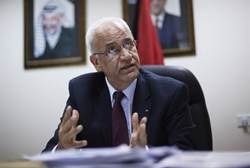 PA chief negotiator Saeb Erekat, Reuters
The Palestinian Authority’s (PA) chief negotiator on Thursday rejected U.S. moves to extend an April deadline for nine months of talks with Israel to culminate in a framework peace deal.
“There is no meaning to prolonging the negotiation, even for one more additional hour, if Israel, represented by its current government, continues to disregard international law,” Saeb Erekat told AFP.
“If there was a committed partner, we wouldn’t even have needed nine hours to reach that deal,” he added.
Erekat was responding to comments by U.S. Secretary of State John Kerry, who told reporters in Washington on Wednesday that more time would be needed and that he hoped first to agree a framework to guide further talks.
It was Kerry who coaxed the two sides back to the negotiating table in late July, after a three-year hiatus.
“Then we get into the final negotiations. I don’t think anybody would worry if there’s another nine months, or whatever it’s going to be… But that’s not defined yet,” he said.
The negotiations have shown little sign of progress, amid bitter recriminations with each side blaming the other for the stalemate.
Kerry insisted, however, that both parties were still “in the middle” of the talks.
“I laugh at people who say it’s not going anywhere. They don’t know because we’re not talking about where it’s at. They have no clue where our negotiations are and whether they could go anywhere,” he claimed.
Last week, Kerry met twice in Paris with PA Chairman Mahmoud Abbas, in what a U.S. official later described as “constructive” talks.
A PA official, however, said last Friday that ideas proposed by Kerry in Paris could not be accepted “as the basis for a framework accord… as they do not take into account the legitimate rights of the Palestinian people.”
Few details have been made public of Kerry’s proposed framework, though Thomas Friedman of the New York Times published some alleged details of the plan, which, he said, will call for a phased Israeli withdrawal from Judea and Samaria based on the 1949 lines, with “unprecedented” security arrangements in the strategic Jordan Valley.
The Israeli withdrawal will not include certain settlement blocs, but Israel will compensate the Arab side for this with Israeli territory.
On Thursday, the New York Times reported that President Barack Obamahas decided to take a more “active role” in the negotiations.
According to the report, during his meeting next week with Prime Minister Binyamin Netanyahu, Obama will make an “urgent appeal” to Netanyahu to accept Kerry’s plan.
Meanwhile, the PA-based Al-Quds newspaper reported on Wednesday that Abbas became very angry during his meeting with Kerry last week and threatened to end the negotiations with Israel.
According to the report, Abbas fumed when, during a meeting with Kerry in Paris, the top U.S. diplomat presented a new offer which, according to senior PA officials, adopted the Israeli positions for a peace agreement. The newspaper also reported that in order to appease Abbas and get him to continue the negotiations, the Americans invited him to a meeting at the White House with Obama.
Frameworks for disaster, Israel Hayom, Ruthie Blum, February 28, 2014
(Since the P5+1 negotiations with Iran have gone well from his perspective, President Obama wants to keep the Israeli – Palestinian “peace process” moving after the April 29th deadline. Surely, there must be more that Israel can yield.– DM)
Whenever Netanyahu impresses upon Obama the urgency of stopping Iran before it’s too late, the U.S. president responds by pressuring him into promises of appeasement [toward the Palestinians], if not concrete concessions.
Watching time run out at a dangerous pace, U.S. President Barack Obama has decided to take a more hands-on role in foreign policy. The impending peril he fears is not an Iranian atom bomb, however.
No, in spite of the Islamic Republic’s refusal to halt its nuclear program, Obama is as hopeful about the latest round of talks in Vienna as is European Union negotiator Catherine Ashton.
“We had three very productive days during which we have identified all the issues we need to address to reach a comprehensive and final agreement,” Ashton said last week.
This was music to White House ears. Now it could ignore Iran’s about-face following its signing of an interim agreement with the West in November. Indeed, before the ink had dried on the document, Iran was denouncing Obama’s interpretation of it.
Imagine the U.S. president’s relief, then, that he had not caved to pressure from Congress to step up sanctions against Tehran, and that a whole new series of talks — the first of which will take place on March 17 — was in the cards.
What, then, is causing the American president to grab the reins out of Secretary of State John Kerry’s hands with such urgency?
You guessed it — the fast approach of the April 29 deadline, set by the U.S., for a negotiated “two-state solution” between Israel and the Palestinian Authority.
Realizing that there is no chance of achieving such a goal within the next two months, Kerry came up with the next best thing: a “framework” for an agreement which would enable an extension of the deadline.
Ashton used that very word to describe the charade with Iran.
“We have set a timetable of meetings … with a framework to continue our deliberations,” she said.
The purpose of Kerry’s “framework,” too, is to perpetuate a process of “deliberations.”
This is all that is possible when dealing with a partner whose endgame does not bear any resemblance to one’s own. It is also what enables the harboring of illusions about making progress.
But even “frameworks” have to be agreed upon by negotiating partners, no matter how far apart their positions. The Iranians have consented to a new “framework” for talks, because this buys them more time to work on their nuclear program, with an ease on sanctions.
The Palestinians, on the other hand, have not done so. And why should they? They have suffered no consequences for their intransigence. On the contrary, so far, money from the U.S. and Europe keeps flowing into their coffers, and Israel has released many of the 104 Palestinian terrorists it committed to freeing as part of a goodwill gesture to jumpstart negotiations, with a fourth bunch about to be let out of prison at the end of March.
Nor has Kerry’s “framework” been met with anything but disdain on the part of Palestinian Authority President Mahmoud Abbas, who (according to a report in the Jerusalem-based Palestinian daily paper Al-Quds) called it “crazy.” Apparently, this was due to Kerry’s proposing, among other things, that the Beit Hanina neighborhood — rather than east Jerusalem as a whole — could become the capital of a future Palestinian state.
Meanwhile, Prime Minister Benjamin Netanyahu has been receptive to all State Department suggestions. Even those that are utterly untenable for Israel — such as a return to the 1967 borders — are open to discussion. Indeed, Netanyahu is taking serious flak within his own Likud party for the degree of open-mindedness with which he has been treating talks on the “core issues.”
According to White House Press Secretary Jay Carney, who gave a press conference on Thursday to explain why Obama is now directly entering the fray, these core issues are “borders, security, Jerusalem, refugees, mutual recognition, an end of conflict and an end of claims.”
The White House believes, he said, “that the framework will be a significant breakthrough, as it would represent a common picture on the outlines of the final status agreement.”
What Carney failed to address was what would happen in the event that Israel and the PA do not agree on such a “framework.” This, undoubtedly, will be the focus of Obama’s meeting with Netanyahu on Monday in Washington and subsequently with Abbas on March 17 (coincidentally the date of the next round of U.S. and EU talks with Tehran in Vienna.)
Netanyahu, on the other hand, has one thing on his agenda: preventing a nuclear Iran by any means necessary. It is a safe bet that this will be the highlight of his speech on Tuesday at the annual AIPAC conference. Unfortunately, though, Obama is more concerned about extending the deadline for Middle East “peace,” a euphemism for the establishment of a Palestinian state.
As an anonymous American official told The New York Times on Wednesday, “Now is a very timely opportunity for [Obama] to get involved. … The president wouldn’t want to run any risk that it was the lack of his involvement that would make the difference between success and failure.”
This is very bad news. Whenever Netanyahu impresses upon Obama the urgency of stopping Iran before it’s too late, the U.S. president responds by pressuring him into promises of appeasement, if not concrete concessions.
It is a framework for disaster.




 anneinpt
 artaxes
 danmillerinpanama
 davidking1530
 Peter Hofman
 Joseph Wouk
 Peter
Peter Louisiana Steve
 WarSclerotic
Recent Comments