Archive for January 2014

Bipartisan Task Force Calls for Support of Possible Israeli Military Strike on Iran

January 28, 2014

Bipartisan Task Force Calls for Support of Possible Israeli Military Strike on Iran | Washington Free Beacon.

Calls for strike as soon as July if no final nuclear agreement is reached
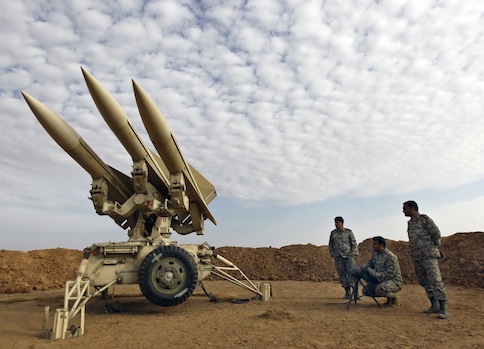
Iranian army members prepare missiles to be launched / AP

Iranian army members prepare missiles to be launched / AP

BY:
January 27, 2014 6:10 pm

A bipartisan task force led by Ambassadors Dennis Ross and Eric Edelman is calling on the Obama administration to support a possible Israeli military strike on Iran as soon as July if no acceptable final nuclear agreement is reached with Tehran by then.

The recommendation was included in a report released by the Jewish Institute for National Security Affairs’ (JINSA) Iran Task Force on Monday.

“The United States should move immediately to impose new sanctions and consider even tougher actions against Iran if no acceptable final agreement is in place 180 days after the [interim agreement’s] formal implementation on January 20,” the report says.

“At that time, the United States should do nothing that would impinge upon Israel’s ability to decide what actions it must take at that time, and indeed should support Israel if it takes military action.”

JINSA CEO Michael Makovsky said the task force was not calling for an Israeli strike on Iran, but for the United States to support one if Israel deemed it necessary after the 180-day window.

“It has been U.S. policy all along that we’d support Israel if it chose to attack,” said Makovsky at a panel discussion hosted by JINSA on Monday. “The reason why we focus on the Israeli government is because that is the last remaining stick right now.”

He said open-ended talks would undermine the only credible military threat against Iran, since Israel could be accused of thwarting diplomatic efforts if it attacked the nuclear program during drawn-out negotiations.

The task force’s report also criticized the interim nuclear deal reached by world leaders and Iran last year as “deeply flawed” and said it will “undermine the effort to prevent a nuclear Iran.”

Ross, a former top Middle East adviser to President Barack Obama, voiced a more favorable view of the deal during the panel discussion on Monday.

“I’m not one of those who thinks the agreement is that bad,” he said. “You do cap their program, and you do create inspections that are better than what we’ve had.”

He said the agreement clearly includes an acknowledgement that Iran can continue to enrich uranium, but added that he favored a limited enrichment approach because it showed the world that the deal was credible.

Steve Rademaker, a former State Department official under the Bush administration, disagreed with Ross and said the agreement removed the “bright line” between some enrichment and no enrichment.

He said the interim deal also concedes that any long-term agreement would not be permanent, and when it expires Iran would be subject to the same regulations as any other country with a civilian nuclear program.

“Iran is going to be treated just like Japan, just like Canada,” said Rademaker.

Bypassing sanctions and with help from Iran, Syria steps up missile production

January 28, 2014

Bypassing sanctions and with help from Iran, Syria steps up missile production | The Times of Israel.

Jane’s Defence Weekly says Assad regime is churning out rockets at pre-war rates, including ones slated for Hezbollah

January 28, 2014, 11:44 am

A screen capture from a video purporting to show the Syrian Army firing a Scud missile (image capture: YouTube)

A screen capture from a video purporting to show the Syrian Army firing a Scud missile (image capture: YouTube)

Syria is accelerating its production of missiles and rockets, effectively circumventing international sanctions imposed on it, according to the authoritative Jane’s Defence Weekly.

The magazine, which deals with military and security matters, presented evidence that the regime has upgraded its weapons capacity with the assistance of countries including Iran, North Korea and Belarus.

Jane’s reported that the Syria Scientific Studies and Research Center is responsible for the production of chemical weapons in Syria and oversees most of the regime’s missile projects. Yet according to the magazine, officials in the international community, including the UN, Russia and the United States, do not supervise the operations of the research center and have not imposed specific sanctions on it.

Jane’s added that although Syria has begun the process of destroying its chemical weapons arsenal, the SSRC still possesses the requisite knowledge to produce a host of warheads containing deadly chemical elements, including sarin, VX and Yperite.

The report reveals that the Assad regime has gone back to producing missiles and medium- to long-range rockets at a rate similar to that prior to the start of the country’s brutal civil war in March 2011. The two main reasons for the regime’s enhanced weapons production are an increased need for missiles in order to combat opposing rebel forces, and Hezbollah’s desire to acquire rockets and missiles stationed on Syrian soil.

Israel has hit Syrian missile facilities several times in the recent past, and has declared that it will not allow advanced weaponry to reach Hezbollah. The latest such reported Israeli air strike was on a missile warehouse in Latakia on Sunday night.

Jane’s report was published at the weekend — a particularity sensitive time, just as international factions convened in Switzerland for the “Geneva II” summit in an attempt to bring about a ceasefire between the Syrian regime and its opposition. So far, the conference has produced no notable achievements, except for an agreement to allow entry of humanitarian aid to Homs and to evacuate civilians from the area.

This image made from a video posted on Wednesday, September 18, 2013, shows Syrians in protective suits and gas masks conducting a drill on how to treat casualties of a chemical weapons attack, in Aleppo, Syria. (photo credit: AP)

This image made from a video posted on Wednesday, September 18, 2013, shows Syrians in protective suits and gas masks conducting a drill on how to treat casualties of a chemical weapons attack, in Aleppo, Syria. (photo credit: AP)

In surprising detail, Jane’s presented data on both chemical and conventional weapons production plants in Syria operated by the research center.

It said that chemical weapons production plants belonging to Institute 3000 have been closed down, and Branch 450, the production division of the institute, has been dismantled. But meanwhile, increased activity was observed at Institute 4000, which is responsible for the production of missiles and rockets. Some of its factories were moved to safer locations for fear that opposition forces would take control of them. Branch 340, responsible for missile research and development, which was previously located in Aleppo, as well as Branches 702 and 350, were all transferred to different locations.

The new rockets and missiles produced in SSRC facilities are considered more lethal in terms of their ability to inflict damage, though they are reported to be less accurate and have a more limited range.

Iran, Hezbollah, and the new missiles

One of the most interesting details presented by Jane’s relates to Project 702, an initiative that operates under Iranian supervision. The project has produced missiles intended for Hezbollah’s use, including an improved version of the Khaybar 1 missile, which has a range of about 100 km. Project 702 is now attempting to replace the liquid fuel currently used in missiles with solid fuel.

Members of a UN investigative team take samples near the site of an alleged chemical weapons attack, in Syria, August 28, 2013 (photo credit: AP/United Media Office of Arbeen)

Members of a UN investigative team take samples near the site of an alleged chemical weapons attack, in Syria, August 28, 2013 (photo credit: AP/United Media Office of Arbeen)

According to Jane’s, the SSRC bought weapons components from foreign countries through the use of shell companies or through intermediaries, both Syrians and foreigners living outside Syria. The intermediaries, Jane’s reported, purchased electronic parts and computers, among other things, from foreign countries, in exchange for funds provided to them by the research center. Jane’s added that when these efforts encountered obstacles, Syria would turn to its experienced allies which have been bypassing international sanctions for years, namely Iran and North Korea.

Besides these two infamous Syrian allies, the regime also concocted a deal with a company in Belarus specializing in the production and development of weapons. The company, Belvneshpromservice, negotiated with a Syrian shell company, a subsidiary of the SSRC, in order to establish an industrial unit to help produce more accurate M-600 and Scud D missiles. The Belorussian company declined to comment on the deal.

The SSRC is also working on a project with North Korea to help improve its Scud D missile capabilities. North Korean officials at the Tangun corporation have already begun researching and producing components for Scud D missiles which would make it difficult for enemy targets to calculate the missiles’ flight trajectory upon atmospheric entry, Jane’s reported, thus preventing or delaying interception by anti-missile systems, including those in Israel’s possession.

Turkey’s Erdogan to arrive in Iran, discuss Ankara-Tehran ties

January 28, 2014

Turkey’s Erdogan to arrive in Iran, discuss Ankara-Tehran ties | JPost | Israel News.

By JPOST.COM STAFF, REUTERS

01/28/2014 12:15

Iranian President Hassan Rouhani reportedly planning visit to Turkey in February.

Turkey's Prime Minister Tayyip Erdogan.

Turkey’s Prime Minister Tayyip Erdogan. Photo: REUTERS/Stringer

Turkish Prime Minister Recep Tayyip Erdogan was expected to arrive in Tehran on Tuesday for a two-day official visit to the Islamic Republic.

Erdogan was scheduled to meet with Iranian Supreme Leader Ayatollah Ali Khamenei and President Hassan Rouhani for the first time since the latter’s election in June.

The visit was slated to revolve around discussions over ties between Ankara and Tehran.

Rouhani in turn, was also planning a visit to Turkey in February, Istanbul-based Today’s Zaman cited Turkish Foreign Minister Ahmet Davutoglu as saying, adding that Zarif would return for an Iran-Azerbaijan-Turkey meeting.

“When Rouhani became the Iranian president, Turkey and Iran decided to communicate frequently, if possible every month, to discuss our mutual agendas and exchange views. I can say that we have accomplished this in the past five months,” said Davutoglu according to the report.

Moreover, he said that the two countries are planning to establish a High Level Cooperation Council mechanism before Erdogan visits Iran.

In addition, the countries are planning to increase trade, aiming for $30 billion in the next few years, with a further possibility for $50b. depending on legal issues, said Davutoglu.

Prof. Efraim Inbar, director of the Begin-Sadat Center for Strategic Studies, told The Jerusalem Post that “this is a continuation of an economic and political trend that is amplified by the nuclear agreement” reached between Iran and world powers in Geneva in November.

“Turkey needs Iranian energy and markets, while Iran needs Turkey to circumvent the sanctions,” said Inbar, adding that they both probably decided that Syria, where their interests collide, is a secondary issue.

“Turkey’s economic and political relationship with Iran continues to expand, even as the Turkish political elite’s ties to the Iranian underworld have mired the AKP government in scandal,” Jonathan Schanzer, vice president for research at the Foundation for Defense of Democracies, told the Post.

“Iranian gold traders have been at the center of this scandal, underscoring the dangers of working with Iran’s shadow economy,” he said.

Schanzer went on to point out that instead of scaling back relations, “it appears that the AKP is doubling down on Iran,” adding that “it is unclear why Turkey would stake out such a high-profile position at a time when Iran sanctions remain in place.”

Michael Rubin, a scholar at the American Enterprise Institute and a former Pentagon official told the Post, “Before the corruption scandal became public, Erdogan sought to have the best of both worlds: helping Iran evade sanctions for a profit, but was accepted in the White House as a pro-Western leader.

“With his dealings now blown open, it was decision- time, and he cast his lot with Iran.”

“It’s important to get inside his mind,” Rubin added, pointing out that “Erdogan believes his own conspiracy theories, is deeply anti-Semitic, seeks Israel’s eradication as a Jewish state, and is more inclined to see Iran rather than the West as an ideological ally because at least Iran doesn’t allow its few remaining Jews to control the newspapers, banks, and ‘interest-rate lobby.’”

Ariel Ben Solomon contributed to this report.

Poll: Most Americans think Obama not doing enough to stop Iran

January 28, 2014

Poll: Most Americans think Obama not doing enough to stop Iran | JPost | Israel News.

By LAHAV HARKOV

LAST UPDATED: 01/28/2014 15:16

World Zionist Organization poll of Americans shows nearly 60 percent advocate stronger sanctions on Iran; over half believe Obama could have done more to prevent development of nuclear weapons in the first place.

Obama

Most Americans think Obama not doing enough to stop Iran Photo: REUTERS

The American public overwhelmingly supports Israel in most issues, but opposes US President Barack Obama’s positions on related matters, according to a poll commissioned by the World Zionist Organization released Tuesday.

“President Obama and [US] Secretary of State [John] Kerry should heed these results. They should understand that the American people expect our government to support Israel; stop promoting a Palestinian state; stop condemning Jewish communities in Judea and Samaria and eastern Jerusalem as ‘illegitimate’; support Jerusalem as Israel’s undivided capital; stop funding the Palestinian Authority and impose stronger sanctions on Iran to persuade it to terminate its nuclear weapons program,” ZOA National President Morton A. Klein said.

Only 31 percent of Americans believe Obama is a close and reliable friend of Israel.

Most Americans – 51% – believe Obama has not done all he can to prevent Iran developing nuclear weapons, as opposed to a mere 28% who believe that he has.

In addition, 59% of Americans advocate the imposition of stronger sanctions on Iran to convince it to stop developing nuclear weapons, as opposed to a mere 17% who believe the US should weaken sanctions on Iran to convince it to stop developing nuclear weapons.

As for the conflict with the Palestinians, 59% of Americans believe a future Palestinian Arab state would be hostile to Israel and support terrorism.

By a ratio of over 3 to 1 (47% –– 14%), Americans believe that Jews have the right to settle in the West Bank, according to the poll.

An overwhelming majority of 72% Americans oppose Obama’s plan to give the Palestinian Authority $440 million, while only 15% believe that he should.

Over half – 55% – of Americans believe Jerusalem should remain the undivided capital of Israel, and 63% believe that the PA should recognize Israel as the sovereign state of the Jewish people.

“Pro-Israel organizations, both Jewish and non-Jewish, should cite these results to promote stronger support for Israel,” Klein stated.

The WZO poll was conducted by McLaughlin Associates, surveying 1000 Americans, consisting of Protestants (46%), Catholics (30%), Jews (3.6%), African Americans (13%), Hispanics (12%), Asians (3%) and Whites (70%). Politically, the respondents were 42% Democratic supporters and 41% Republican supporters.

“The results of this latest, very detailed and highly representative survey of American opinion show gratifyingly high, indeed, overwhelming levels of support for positions Israel takes, as opposed to the position the Obama Administration takes,” Klein said. “It also shows an understanding of the dangers Israel faces from a terror-sponsoring PA.”

“Large majorities of Americans clearly understand that a Palestinian state, if established, will not live in peace with Israel and will simply be another Mideast terrorist state,” he added.

Klein pointed out that the poll indicates that “only a small percentage [of Americans] believes in the racist, anti-Semitic Palestin

Obama vs. Harper: Who’s the real man of principle?

January 27, 2014

Obama vs. Harper: Who’s the real man of principle? – Opinion Israel News | Haaretz.

( And this is from the far-left Haaretz ! – JW )

While the American president hints at U.S. Jews’ dual loyalties and is disturbed by their activism, Canada’s PM confronts hostility to Israel for the bigotry it hides.

By | Jan. 27, 2014 | 3:49 PM

Stephen Harper and wife Laureen arrive in London on Tuesday, April 16, 2013

Prime Minister of Canada Stephen Harper and wife Laureen, April, 2013. Photo by AP

Years ago I wrote a column proposing that the leader of any country be permitted to run for president of the United States. The idea of the satire was that if the U.S. was to lead the world, foreigners ought to be able enter someone into the American fray. The Boston Globe illustrated the column with a cartoon of a perplexed, lunch-pail-toting factory worker walking past a line of politicians — Jimmy Carter, Leonid Brezhnev, Anwar Sadat, Menachem Begin — all wanting to shake his hand.

Well, why not Stephen Harper? He is the prime minister of Canada who just gave such a stirring address to the Knesset. Conrad Black, the ex-press baron who once owned the Jerusalem Post, is out with a column this week calling it one of the greatest speeches ever given by a Canadian leader. He ranks it with Sir John Macdonald’s defense of his conduct in the Pacific scandal in 1873 and Sir Wilfrid Laurier’s response to conscription in 1917.

The newsworthiness of Harper’s speech arises from the contrast with President Obama. The American leader is sending out word that he is “disturbed” by “Jewish activism in Congress” against his administration’s entente with Iran. Obama and Secretary of State Kerry, according to Israel Radio, are even blaming Prime Minister Netanyahu’s government for encouraging Jewish leaders to criticize the White House. We haven’t had this tone since President George H.W. Bush carped about being “one lonely little guy” beset by the Israel lobby.

Obama’s message hints at the kind of double-dual-loyalty libel that Harper confronted so bluntly in articulating the basis of the policies that have made him the most pro-Israel premier outside Jerusalem. He started with a paean to commercial and military cooperation, moved to the 250-year history of Jews in Canada and of the 350,000 Jews who are Canadians, and touched on the way the Holocaust put into sharp relief the logic of a Jewish homeland. “Canada supports Israel,” he said, “because it is right to do so.”

Then Harper acknowledged that Canada has made “terrible mistakes” in respect of the Jews, particularly “the refusal of our government in the 1930s to ease the plight of Jewish refugees.” But he said that “at the turning points of history,” Canada has “consistently chosen, often to our great cost, to stand with others who oppose injustice, and to confront the dark forces of the world.” He called it “a Canadian tradition to stand for what is principled and just, regardless of whether it is convenient or popular.”

Harper then declared that “support today for the Jewish State of Israel is more than a moral imperative.” He spoke of its “strategic importance” and declared it “a matter of our own long-term interests.” History, he argued, shows that those “who often begin by hating the Jew” eventually “end up hating anyone who is not them.” He spoke about “the new anti-Semitism” and the language that is used on campuses and in international fora to isolate the Jewish state. He called it “sickening” and said it “targets the Jewish people by targeting Israel and attempts to make the old bigotry acceptable for a new generation.”

At one point, Harper spoke of the “impossible calculus” with which Israelis live. “If you act to defend yourselves, you will suffer widespread condemnation, over and over again. But, should you fail to act, you alone will suffer the consequence of your inaction, and that consequence will be final, your destruction.”

Harper did not call on Israel to curtail its settlements — he didn’t mention them — or hector it about the peace process. This was startling given that, as Conrad Black pointed out, Canada has a foreign policy establishment as trans-configured against Israel as America’s own state department. Nor did Harper attack Obama’s demarche in respect of Iran. But he declared Canada’s intention to leave its own sanctions “fully in place” And “should the present agreement prove ephemeral” to renew the ones other nations are easing.

What is so striking about Harper’s speech is not the ardent expressions of friendship — all recent American presidents, including Obama, have done the same. Particularly George W. Bush, who, in the well of the Knesset, spoke of the “Chosen People” and called the Jewish state “the redemption of an ancient promise given to Abraham and Moses and David.” What is striking about Harper’s speech is the willingness to confront political correctness and call the hostility to Israel for what it is. It makes me think that if Harper were allowed to run for the president of America, he’d have a refreshing platform.

Seth Lipsky is editor of The New York Sun www.nysun.com. He was a foreign editor and a member of the editorial board of The Wall Street Journal, founding editor of The Forward and editor from 1990 to 2000.

The post-Khamenei era

January 27, 2014

The post-Khamenei era | JPost | Israel News.

By RAMIN PARHAM, SAEED GHASSEMINEJAD

01/26/2014 22:40

The West has considerable interests in how this era will be shaped in the Islamic Republic.

Iranian Supreme Leader Ayatollah Ali Khamenei

Iranian Supreme Leader Ayatollah Ali Khamenei Photo: REUTERS

A new Iran is emerging. New elites will arise. The battle has begun. Will the West be part of the problem or the solution? Will it be a merchant of the past, or a progressive actor of the future?

An ongoing tension

The Iranian Revolutionary Guards Corps is the fruit of Iran’s Islamic revolution. It was established by Ayatollah Ruhollah Khomeini, who called its members “his revolutionary children,” and they were to him what the Royal Army was to the Shah.

Khomeini’s “revolutionary children” over the past three decades have acquired immense power. The organization which was first established as an internal militia force to protect against a possible coup by the army gradually grew into what is known today as the IRGC: An army with a vast paramilitary branch, a well trained internal and extraterritorial intelligence apparatus and a vast military-industrial complex controlling the most important sectors of Iran’s economy.

Yet, the IRGC’s ambitions go even beyond its military and economic goals, with an intricate “soft power” infrastructure aimed at propagating the Islamic republic’s “messianic” message, born with the 1979 Revolution: “Revolutionary Islam.”

Since its inception, there has been ongoing tension between the IRGC and the clerics.

Although IRGC officers enthusiastically followed Ayatollah Khomeini, they have also persistently had a hard time coping with the clerics appointed by the supreme leader as his representatives within this “ideological army.” It is emblematic that this ongoing tension has consistently been tipped in favor of the “revolutionary children,” resulting in frequent changes of clerical appointees.

Who is Ali Khamenei?

After Khomeini’s death, a mid-ranking cleric lacking all due scholarly credentials rose to power: Sayyid Ali Khamenei.

Khamenei, who had, prior to the revolution, devoted his entire seminarian’s life to political activism against the Shah, began his own metamorphosis after the monarch’s overthrow. Before the revolution, he was better known within some intellectual circles, enjoying music and poetry, rather than in religious seminaries.

His interest in politics and history brought him to translate into Farsi a work of the renowned Muslim Brother Sayyid Qutb. After the revolution, his interests expanded to encompass military and intelligence issues.

Promoted Grand Ayatollah and Source of Emulation (Marja Taqlid) almost overnight, his outrageous rise was a direct insult to the traditional cleric establishment. The exponential growth of the IRGC coincides with his leadership. Illegitimate on scholarly grounds and non-charismatic, his rule could not be sustained, except on security pillars alone – provided by the IRGC. As the champion of messianic Islam, Khamenei is regarded by his zealots not only as the substitute of the Shia Messiah, but also as “Sayyid-e-Khurasani,” the prophetic character who prefigures and prepares the coming of the Savior.

In parallel, he has built an astronomic network of financial firepower and influence. Survivor of an assassination attempt shortly after the Revolution, the 74-year-old leader is currently in poor health. His death could lead to a huge redistribution of wealth and power among the Shia elites, already torn with infighting.

Post-Khamenei era; possible scenarios

How will the IRGC move in the post-Khamenei era? The options are threefold: First, that IRGC commanders stay neutral, not intervening in the process of selecting a new supreme leader, while safeguarding the stability of the regime in the transitional period. However, well aware of the possibility of being ousted by the new leadership and its entourage, high-ranking IRGC commanders, all indebted to Khamenei for their current positions, risk more than just their wealth and power.

The post-Khamenei era could well become for them a matter of life or death. Thus IRGC commanders have both the ability and the incentive to weigh in, with all their means, in the selection process of the new leader.

The second scenario is that IRGC commanders do intervene, installing their own pick for the supreme spot.

At the moment, the best option for them is Mojtaba Khamenei, son of the current leader. Symbolic as it might be, the ambitious heir has already started teaching his own seminars, known as “kharej,” interpreted as a sign of established religious credentials, a scholarly credit his own father did not have prior to his accession to leadership. However, it is no secret that Mojtaba’s most valuable credentials are his close ties with the IRGC and its related security apparatus.

Following in his father’s footsteps, Mojtaba Khamenei is personally involved in military programs and intelligence affairs. Also well known are the strong bonds between Mojtaba and Qasem Soleimani – the commander of the IRGC’s Qods Force and the most powerful operative in the Middle East according to Western sources.

The final scenario is that IRGC commanders stage a coup against the clerical establishment. After over 30 years of disastrous management of the country in all aspects, IRGC commanders are well aware of the profound unpopularity of the clerical establishment. It would thus not be unlikely for the IRGC to plan to present itself as the savior of both the country and the people from the catastrophic reign of corrupt and unpopular mullahs. This in turn may well guarantee the IRGC’s own power, at least in the short run. Such an ambitious move would, of course, face many obstacles, primarily within the IRGC itself, making it a possible yet perilous move.

The post-Khamenei internal battle has thus already begun in an emerging new Iran. The West has considerable interests in how this era will be shaped. The question is whether or not it has enough will and farsighted wisdom to abort shortsighted special interests. Realpolitik commands facilitating the emergence of a post-Islamist, open, plural and West-friendly Iranian society.

Dr. Ramin Parham is an Iranian writer and political analyst, author of L’histoire secrète de la révolution iranienne and Né à Ispahan. Parham is currently working on his third book on Iran-Israel relations.

Saeed Ghasseminejad is co-founder of Iranian Liberal Students and Graduates and a PhD candidate in finance at City University of New York.
The strategic achievements of the agreement with Iran

January 27, 2014

The strategic achievements of the agreement with Iran | JPost | Israel News.

By EPHRAIM ASCULAI

01/26/2014 22:52

Reaching an agreement with Iran was a brilliant move that served this purpose, and effectively neutralized any call for military action, specifically by Israel.

Bushehr nuclear Iranian

Iranian security official at Bushehr nuclear plant. Photo: REUTERS

The common wisdom is that the sanctions imposed on Iran were the main initiating reason for the Geneva talks between the P5+1 and Iran, talks that culminated with the November 23, 2013, Joint Plan of Action (JPA) and the subsequent “Technical Understandings” that went into effect on January 20, 2014.

There can be little doubt that the sanctions had a severe impact on Iran, but were they the main motive for the agreements? Looking into the situation in Iran and viewing the outcome of the discussions one can also suggest a different scenario, in which the strategic aims of both Iran and the US are not so far apart. In this scenario, the possible common ground dictated the advisability of the agreement, which will have a far-lasting effect, beyond its six-month term.

What are Iran’s strategic aims? Iran’s main priority, it is suggested, is to reach the capability to produce a nuclear weapon as quickly as possible, if and when the order to do so arrives from the leadership. The next order of priority is to avoid military conflict.

Iran is well aware that should it be found to be constructing even a primitive nuclear weapon, it would be susceptible to military attack, if not by the US, then by Israel, which has demonstrated its capability and willingness to carry out such an attack. The sanctions occupy only third place, since Iran has demonstrated that it can live with them. The ongoing Iranian “charm offensive” was the very effective tactic chosen to achieve these strategic aims.

What are the American strategic aims regarding the Iranian nuclear program? It appears, from extensive evidence, that the main US aim is to avoid conflict.

Reaching an agreement with Iran was a brilliant move that served this purpose, and effectively neutralized any call for military action, specifically by Israel. The relatively weak terms of this agreement were sufficient to convince many that the Iranians have effectively been stopped from advancing their program, while not forced to accede to conditions that would impede their ability to construct a nuclear weapon. This would hopefully come in the next stage – the final agreement, which many, including the US administration, doubt will ever be reached.

The next US aim was to prevent Iran from constructing a nuclear weapon. The US never claimed that preventing Iran from having the capability to produce a nuclear weapon was one of its strategic aims. Although Iran can already manufacture a nuclear weapon, it has no reason to do so at present, and by easing the sanctions Iran also partially achieved its third strategic aim. Iran also (inadvertently?) managed to deter the US administration from imposing more severe sanctions by threatening to enrich uranium to 60 percent – a very short step from military enrichment grade.

Thus, there is a convergence of interests between the US administration and Iran, and the terms of the JPA are not as important as the results of the agreement: reduction of tensions, postponing conflict and the easing of global economic concerns. However, although the exact terms of the agreement between Iran and the P5+1 have been kept confidential (why?) some loopholes are readily apparent. The main elements missing from the agreement are those dealing with what the IAEA called the “Possible Military Dimensions” of Iran’s nuclear program, meaning the work towards developing the nuclear explosive mechanism, and the prevention by Iran of the IAEA inspectors searching for undeclared nuclear and nuclear-related sites.

Iran can, regardless of the agreement, continue to develop anything it wants at undeclared sites, and as long as these activities remain concealed, all will be well. At present, no one really has an interest in enforcing these two missing factors, and the US is using a hard sales pitch to convince the world of the benefits of a very mediocre agreement.

On the practical side, Iranian Foreign Minister, Mohammad Javad Zarif was quite correct in stating, on January 23, that Iran had not agreed to dismantle anything. The only thing that can be remotely considered to be a rollback is the dilution of some of its 20% enriched uranium, and even this leaves a considerable amount in Iranian hands, which can then serve as a jump-start for enrichment to values beyond 20%. The Iranians will not accumulate much more 3.5% enriched uranium, but then, they have enough of it for several nuclear weapons, if further enriched.

The sanctions were never strong enough to force the hands of the Iranians. They do not hurt the pride and dignity of the Iranians, the weakest points in their armor. The Iranians can justifiably gloat, and the world can heave a sigh of relief, and the Middle East states, including Israel, can watch with wonder and anxiety, and try to assess how they will be able to live with a nuclear-capable Iran in their midst.

The author is a Senior Research Fellow at the Institute for National Security Studies (INSS) in Tel Aviv.

Analysis: Obama to confront a united Congress on Iran

January 27, 2014

Analysis: Obama to confront a united Congress on Iran | JPost | Israel News.

By MICHAEL WILNER

01/27/2014 21:36

Obama’s State of the Union address will focus mainly on domestic issues. But on foreign policy, the president will have to make his case on Iran to skeptical lawmakers.

US President Barack Obama at the White House

US President Barack Obama at the White House Photo: Reuters

WASHINGTON – Rarely does Congress find itself united on an issue, much less allied against the president. And yet on Tuesday night, amid a litany of domestic proposals that fall cleanly on party lines, US President Barack Obama will confront just that sort of bipartisanship against one of his policies: how to handle Iran.

Obama has been working the phones with members of the Senate for months now, calling privately on its leadership to pause work on a bill that would trigger new sanctions against the Islamic Republic should negotiations fail to reach a final-status agreement over its nuclear program.

That’s because key members of the upper chamber— including Senate Foreign Relations Committee chairman Robert Menendez (D-NJ) and his Republican counterparts— insist on an insurance policy that will apply pressure on Iran throughout the diplomatic process. Sanctions legislation from Congress has led Iran to the negotiating table, they say; by that logic, more sanctions will only encourage the process along and force the Iranians to capitulate further.

In November, an initial deal between Iran and world powers gave the parties six months to negotiate a comprehensive agreement. In the meantime, Iran agreed to halt its enrichment of uranium to high grades while the Obama administration agreed not to impose any new nuclear-related sanctions.

Reaching a comprehensive accord will be a difficult task that even the president and his allies agree is unlikely to succeed. The president himself has put the chances of success at less than 50 percent. But the US must demonstrate a good-faith diplomatic effort to its allies, the White House argues; and new sanctions from Congress would directly undermine that strategy, and the language of the interim deal, leaving the president only with the option of military force.

The president will enter the House chamber on Tuesday night and face 59 senators who have publicly endorsed the ‘trigger’ bill, along with 400 representatives who, over the summer, passed even harsher sanctions legislation aimed at cutting Iran’s remaining crude oil exports in half.

How Obama lays out his case against new legislation will be important to watch for several reasons. Most obviously, the president does not have an appetite for military conflict, and believes the public is on his side; and while the speech will be directed at Congress, the White House is well aware that this speech is his most significant policy platform of the year (members of Congress, as it turns out, are aware of that as well).

The president, therefore, might find it convenient to place on Congress the burden of such inevitable conflict should they pass a bill and undermine peace talks. While he’ll certainly seek to reassure them— expect to hear him reiterate that ‘no option is off the table’ in handling the crisis —  he may also try and threaten them with the specter of adverse consequences.

And yet Obama must also walk another fine line, away from redlines. Should he state, as the White House has implied, that the only option after the failure of diplomacy is war, then he obligates himself to conflict should talks fail in six months time.

That may be the lesson he learned from the Syrian chemical crisis in August: on matters of foreign policy, do not issue threats you are not prepared to uphold. In Tuesday’s speech, read between the redlines: listen carefully for what the president is truly prepared to do.

Next round of Iran nuclear talks set for New York

January 27, 2014

Next round of Iran nuclear talks set for New York | The Times of Israel.

Iran, world powers to convene next month to discuss long-term agreement over Tehran’s nuclear program

January 27, 2014, 8:49 pm

Illustrative photo of New York City (photo credit: CC BY-SA Dschwen, Wikimedia Commons)

Illustrative photo of New York City (photo credit: CC BY-SA Dschwen, Wikimedia Commons)

WASHINGTON — The next round of international nuclear negotiations with Iran is expected to be held in New York next month, according to officials involved in the planning.

The US and its negotiating partners — Britain, France, Germany, China and Russia — will be seeking a long-term agreement to halt Iran’s disputed nuclear program. The Islamic republic will be pressing for an end to international sanctions that have crippled the economy.

The opening rounds were held in Geneva. The parties agreed to a six-month deal that freezes key aspects of Iran’s nuclear program in exchange for easing some of the economic sanctions. That went into effect on January 20.

The officials insisted on anonymity because they weren’t authorized to identify themselves as confirming the location of the talks before a public announcement.

Copyright 2014 The Associated Press.

US warns Turkey against doing business with Iran

January 27, 2014

US warns Turkey against doing business with Iran | The Times of Israel.

Sanctions against Islamic Republic remain in force, top Treasury official says, though some restrictions lifted under nuke deal

January 27, 2014, 8:54 pm

David Cohen (photo credit: United States Government Work/Flickr/File)

David Cohen (photo credit: United States Government Work/Flickr/File)

ANKARA, Turkey — Companies should “hold off” doing business in Iran because many of the sanctions against the country are still in place despite an interim nuclear deal, the top US Treasury official warned Monday.

Speaking in Turkey, which is looking to expand business opportunities with its neighbor Iran, David Cohen, the US secretary for terrorism and financial intelligence, said a significant portion of sanctions against Iran remained, including in the banking, energy and shipping sanctions.

“Iran is not open for business,” Cohen said. “Businesses interested in engaging in Iran really should hold off. The day may come when Iran is open for business, but the day is not today.”

Last week, the United States and the European Union partially lifted economic sanctions on Iran after it unplugged banks of centrifuges involved in its most sensitive uranium enrichment work. The move was part of a deal aimed at easing concerns over Iran’s nuclear program.

Turkey has expressed hopes that the easing of sanctions against Iran will open business opportunities, especially in the energy sector. Turkish Prime Minister Recep Tayyip Erdogan travels to Iran on Tuesday.

Turkey imports gas and oil from Iran but the Turkish oil refiner, Tupras, was forced to reduce its Iranian oil purchases due to the sanctions.

“What we are working toward is the possibility of a long-term, comprehensive resolution with the Iranians in which they demonstrate that their nuclear program is exclusively for peaceful purposes,” Cohen said.

Cohen also said he expects Turkey’s state-run banking institution, Halkbank, to continue processing oil payments to Iran.

The bank’s head was arrested last month on bribery charges, along with two former Cabinet ministers’ sons, and police seized $4 million in cash in shoe boxes from the bank chief’s home.

Copyright 2014 The Associated Press.


