Archive for January 2014

Off Topic: Hamas, Islamic Jihad Gunmen Now in West Bank

January 30, 2014

(A challenge to Abbas, Israel and/or the U.S.? What about Iran, which has severed relations with Hamas and where Abbas is about to visit Rouhani ?  DM)

Hamas, Islamic Jihad Gunmen Now in West Bank Khaled Abu ToamehGatestone Institute

If anything, the rally that saw Hamas, Islamic Jihad and Fatah join forces in a rare show of power means that Abbas’s claim that he is fully in control of the situation in West Bank is baseless.

For the first time since 2007, Hamas and Islamic Jihad militiamen this week made a public appearance in the West Bank, raising fears that the two radical groups continue to maintain a military presence in areas controlled by Mahmoud Abbas’s Palestinian Authority.

Palestinians were surprised to see Hamas and Islamic Jihad militiamen in broad daylight in an area controlled by the Palestinian Authority.

The masked militiamen made their rare appearance in the Jenin refugee camp during a rally to commemorate Islamic Jihad member Nafi Sa’di, killed by the Israel Defense Forces last December.
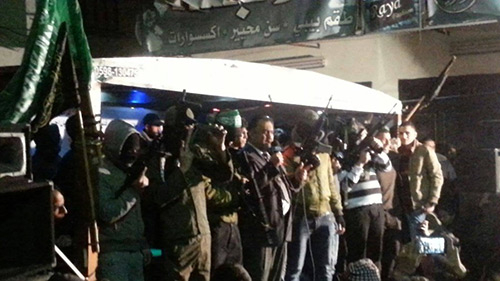
Hamas and Fatah
Gunman flank a speaker at the Jenin rally staged by Hamas and Islamic Jihad in December 2013.

The Palestinian Authority security forces, which are supposed to be in control of the refugee camp, did not intervene to stop or arrest the Hamas and Islamic Jihad gunmen, even as they fired into the air in honor of Sa’di.

Over the past few years, the US- and EU-backed Palestinian Authority [PA] security forces have been clamping down on Hamas and Islamic Jihad supporters in the West Bank. Hundreds of activists belonging to the two radical groups have been arrested as part of the crackdown.

But this time the PA decided not to take any action against the Hamas and Islamic Jihad gunmen despite the fact that their public appearance is seen as a challenge to Abbas’s authority.

One reason for this decision may be attributed to the possibility that the PA is afraid to confront Hamas and Islamic Jihad. The PA is already under attack from many Palestinians for conducting security coordination with Israel.

Last week, Hamas renewed its appeal to the Palestinian Authority leadership to halt all forms for security coordination with Israel.

statement published by Hamas urged Abbas to “immediately halt security coordination with the Zionist entity.”

Mahmoud Zahar, a top Hamas leader in the Gaza Strip, said that Abbas “was committing a big sin by opting to negotiate with Israel and prevent Palestinian resistance. Abbas’s survival depends on continued security coordination with the Zionist enemy. By preventing the resistance, Abbas is weakening himself politically because the resistance supports the political process.”

By allowing Hamas and Islamic Jihad militiamen to participate in a public rally in the West Bank, Abbas may also be seeking to send a message of warning to Israel and the US. This is a message that says that Palestinians have not abandoned the option of armed struggle against Israel as a way of achieving their goals.

Abbas may also be seeking to get more financial aid for the Palestinian Authority from the Americans and Europeans. The message he is sending to the American and European donors is that they need to give him more money and weapons, otherwise Hamas and Islamic Jihad would grow stronger and perhaps seize control of the West Bank.

A third message that Abbas seeks to send is one that is directed toward Hamas and Islamic Jihad. By allowing gunmen from the two groups to make a public appearance in the West Bank, Abbas is probably trying to appease the two groups and pave the way for “national reconciliation and unity.”

Even more surprising was the fact that Fatah gunmen loyal to Abbas took part in the rally at the Jenin camp alongside Hamas and Islamic Jihad.

The participation of Fatah gunmen in a Hamas and Islamic Jihad rally shows that the PA and Abbas continue to face a serious challenge from their own loyalists. Moreover, it shows that there is coordination between Abbas’s Fatah gunmen and Hamas and Islamic Jihad militiamen in the West Bank.

As senior Hamas representative Wasfi Kabaha declared at the rally, “We wanted to send a message to Israel that the Palestinian resistance continues to exist in the West Bank and is prepared for confrontation. We also wanted to affirm the need for national unity.”

If anything, the rally that saw Hamas, Islamic Jihad and Fatah join forces in a rare show of power means that Abbas’s claim that he is fully in control of the situation in the West Bank is baseless.

Yasser Arafat allowed Hamas to operate freely in the Gaza Strip until Hamas drove the Palestinian Authority out of the area. Abbas is now committing the same mistake and could lose the West Bank to Hamas and Islamic Jihad. The question is whether this will happen before or after the establishment of a Palestinian state.

Report: PA Chairman Abu Mazen will be invited to meet Rouhani in Tehran

January 30, 2014

Report: PA Chairman Abu Mazen will be invited to meet Rouhani in Tehran – jerusalemonline.

In the background of the Hamas movement supporting the rebels in Syria, Iran chose to severe ties with the Sunni terrorist organization and to find a new ally, the Fatah movement.

Jan 30, 2014, 10:54AM | Rachel Avraham
 
Best friends now? Rouhani and Abu Mazen
Best friends now? Rouhani and Abu Mazen. Photo Credit: AP
 
 As the United States focuses on efforts within the region to establish its influence based on peace negotiations between Israel and the Palestinian Authority, a new/old player in the region, Iran, is interested in strengthening its influence in the Middle East. 

 Since Tuesday, senior level Palestinian Authority official Jibril Rajoub is in Iran, on behalf of Palestinian Authority chairman Abu Mazen, where he will meet with a series of senior level Iranian officials.  By the means of Rajoub, Abu Mazen delivered a personal letter to Iran’s President Hassan Rouhani, which surveyed the internal Palestinian arena in regards to the negotiations existing with Israel under American auspices.

 Palestinian sources stated this morning in the Al Quds Al Arabi newspaper that Iran is even expected to invite Abu Mazen for an official visit in Tehran, as the strengthened relations between Tehran and the Palestinian Authority develop.  This visit is the result of intensive contacts arranged recently between the two sides in the framework of Iranian attempts to become involved with pressing regional issues.

Zarif and Rajoub met in Tehran
Zarif and Rajoub met in Tehran. Photo Credit: Channel 2

Iran severed relations with Hamas

 Another thing that brought about the warming of relations between Iran and the Palestinian Authority is Hamas distancing itself from the Hamas movement in Gaza, because of its support for the rebel movement in Syria.  Unlike Hamas, the Islamic Republic supports the Assad regime and is interested in him maintaining power.  Therefore, Iran stopped financially supporting Hamas and cut off all contact with the Sunni Islamist terrorist organization.  Therefore, representatives of Fatah and Iran were quick to establish new lines of communication between them.

 Sources in Tehran stated that Iranian Foreign Minister Mohammad Javad Zarif, who was the first to meet with Rajoub, stressed Iran’s readiness to support the Palestinian Authority and the Fatah movement.  Fatah and Iran announced the opening of a “new page,” to the great alarm of the State of Israel.  

Iran Is Not Our Friend

January 30, 2014

Iran Is Not Our Friend – The New Republic

BY LEON WIESELTIER

“On the foreign policy front . . . I find myselfwondering why we cannot regard another country, in this case Iran, 
as just that, as one more country which we would regard as neither friend nor foe, with whom we are prepared to deal on a day-to-day basis, neither idealizing it nor running it down, keeping to ourselves (here, of course, I am speaking about our government) our views about its domestic political institutions and practices, and interesting ourselves only in those aspects of its official behavior which touched our interests—maintaining in other words, a relationship with it of mutual respect and courtesy, but distant.” George Kennan wrote those words in his diary on March 8, 1998, after some thoughts on “the scandal of Mr. Clinton’s relationship to 
his Jewish girl intern.” Kennan died too soon. The day of his Iran policy has come.

This is the day of the extended hand, which Obama promised in his first inaugural address. The American government is no longer disgusted by the Iranian government, if ever it really was: in 2009, during the democratic rebellion in Iran, we certainly kept to ourselves, to use Kennan’s words, our views about its domestic political institutions and practices; or rather, 
we uttered hollow phrases of routine condemnation and moved on. But we are partners now, Washington and Tehran, and not only in the negotiations over 
the Iranian nuclear program. The administration hopes for an Iranian contribution also to a diplomatic solution to the Syrian excruciation. (There is no such solution. It is now a war to the death between secular tyranny and religious terrorism—the predictable, and often-predicted, consequence of leaving Syria alone.) There is wariness on both sides, of course; but generally there is a bizarre warmth between the governments, a climate of practicality and cordiality, as if a new page has been turned in a history of ugly relations, as if the ugliness of those relations were based only in illusion and misunderstanding. There is a new government in Tehran, isn’t there?

No, there isn’t. There is only a new president. Hassan Rouhani is an improvement over Mahmoud Ahmadinejad, since he is not a lunatic. He does not deny that the Holocaust happened, which for the Islamic 
Republic counts as a breakthrough in enlightenment. But it is important to remember, during this explosion of good feelings, that Iran is still the Islamic Republic, a theocratic tyranny ruled by 
a single man, a haughty cleric who subsumes the state beneath religion and his interpretation of it, and maintains his power by means of a fascistic military organization that brutalizes the population and plunders the economy—liberticide and prey, as a poet once wrote about another dictator. This same mullah-king supports the murderer in Damascus and the murderers in Lebanon and Gaza, and remorselessly pursues 
a foreign policy animated by anti-Americanism and anti-Semitism and intra-Muslim hatred. We may have extended our hand, but the Supreme Leader—the title itself is repugnant to decent modern ears—has not unclenched his fist. The smiles of his president and his foreign minister must not blind us to the scowl that is the true face of this cruel and criminal regime.

This does not mean that we must not negotiate with it. I appreciate the need for a diplomatic exploration of the Iranian nuclear challenge, though I prefer a deal that represents a strategic decision by Iran to renounce nuclear weaponry, not 
a strategic decision by Iran to find a cunning way out of the sanctions, and I resent the suggestion by the White House that anybody who is skeptical of its interim agreement is for war. Strenuous negotiations demand strenuous sanctions: the stronger our diplomatic position, the greater the likelihood that we will not resort to force. The thrill of diplomacy must not be allowed to obscure or to soften its purpose. Nor should it shrink our understanding of America’s role in the world. The abandonment of human rights as a primary and ardently pursued goal of American foreign policy—the Obama administration has returned American statecraft to its pre-Bosnia, pre-Rwanda days: we will have to be educated again by history, and by France—has been justified, in the case of Iran, by the urgency of the nuclear question. American support of democratization 
in Iran, it is said, would jeopardize the American effort to strike a deal on nuclearization. And so we must choose between a nuclear-free Iran and a tyranny-free Iran. But it is a false choice, designed to ratify the administration’s prior lack of appetite (and lack of nerve) for the promotion of freedom. We discovered the phoniness of the choice in our experience with the Soviet Union. You may still recall the twentieth century. Soviet missiles threatened the United States then infinitely more than Iranian centrifuges threaten us now, but arms control was not permitted to eclipse human rights in our policy toward the nuclear dictatorship. And even though we were prepared to offend, with our “moralism,” the interlocutors with the ICBMs, we did not fail—not at arms control nor, eventually, at human rights; and we learned that human rights, too, had vast strategic implications. A people is always more important than a government. 

Not long ago I was looking for a certain passage in Niebuhr, and I came upon his observation that “there are two ways of denying our responsibilities to our fellowmen”: “seeking to dominate them by our power” and “seeking to withdraw from our responsibilities to them.” It was not the passage I was seeking, and as I kept scouring the marked-up books I bumped into the great man’s call to “widen the conception of interest,” so that “the sense of justice must prevent prudence from becoming too prudential in defining interest.” This is the Niebuhr that our ostentatiously reflective president forgot, or never knew. He is withdrawn and we have withdrawn. We are leavers. We leave to pivot, but we do not pivot. We respect others too much to help them: how would contempt differ? Our friends doubt us, our enemies play us. We stand for too little and we stand for too few. The post-American world is here: behold it and weep.

Leon Wieseltier is the literary editor of The New Republic.

Austria aggressively moves to boost trade with Iran

January 30, 2014

Austria aggressively moves to boost trade with Iran | JPost | Israel News.

By BENJAMIN WEINTHAL

01/30/2014 01:56

Ambassador to Iran voices sharp criticism of Western sanctions targeting Islamic Republic’s nuclear program.

Iran's President Hassan Rouhani

Iran’s President Hassan Rouhani Photo: Reuters

Austria’s ambassador to Tehran, and the vice president of the country’s chamber of commerce, have expressed sharp criticism of tough sanctions targeting Iran’s nuclear program.

However, the Austrian Foreign Ministry rejected on Tuesday Iranian news reports claiming the Central European country was always critical of sanctions targeting the Islamic Republic.

According to a report by Iran’s state-controlled Fars News last month, Austria’s ambassador to Iran, Friedrich Stift, said his country never showed interest in pushing for sanctions.

A spokesman for the Foreign Ministry in Vienna told The Jerusalem Post during a telephone interview on Tuesday that “Austria has always supported sanctions and the ambassador represents this position.”

This “means support for the sanctions against the nuclear program, Iran’s regime, and human rights violations,” the spokesman added. But Stift is “unhappy when sanctions affect ordinary people in Iran.”

The spokesman cited the “freezing of [Iran] accounts” as one example of Austria’s support for the sanctions regime.

Austria-Iranian economic relations have traditionally been robust. Ali Naghi Khamoushi, a former head of Iran’s Chamber of Commerce, said, “Austria is for us the gateway to the European Union.”

Iran’s regime-controlled IRNA news agency reported on Wednesday that Stift praised the 150-year history of Tehran-Vienna ties, adding that Iran is a significant economic partner of Austria. “Stift is on Kish Island [in the Persian Gulf] to attend an international exhibition on tourism which would end its work on January 31,” IRNA reported.

Austrian oil and gas giant OMV sent a representative to a meeting in December with Iran’s oil minister in Vienna.

The purpose of the meeting was to discuss ways to revive investment in Iran’s oil fields.

Early last month, the Austrian Chamber of Commerce said representatives of 10 companies, and the chamber’s president, were slated to visit Iran.

Rail technology firms Plasser & Theurer and AVL, high-rise engineering firm Doka, engineering consultants ILF and cable car maker Doppelmayr were listed as participants, the Austrian daily Die Presse reported.

Austrian exports to Iran totaled $298 million in 2012, according to the Chamber of Commerce.

Richard Schenz, vice president of the Austrian Chamber of Commerce, told the Kurier daily earlier this month that “there is no reason to comply with US laws” regarding Iran sanctions.” Schenz was in Iran in December to boost Austrian- Iranian trade.

Iranian FM: More sanctions, more centrifuges

January 29, 2014

Iranian FM: More sanctions, more centrifuges – Trend

Iranian FM
29 January 2014, 10:32 (GMT+04:00)

“More sanctions would only result in more centrifuges,” Iran’s Foreign Minister Mohammad Javad Zarif said in reference to Iran’s steady progress in installing thousands of centrifuges for the enrichment of uranium over the past few years, despite the fact that the country has been under economic sanctions, Iran’s YJC news agency reported on Jan. 28 referring the Swiss Neue Zürcher Zeitung newspaper.

He also went on to say that the Geneva nuclear deal is a great success for his country.

“For one decade there was only one image in the West’s mind, that there is only one option, that is, zero enrichment, and that Iran’s uranium enrichment must be stopped,” he maintained.

Zarif further asserted “Although with delay, the US has now come to realize that it will not succeed in reaching such an objective. President Obama said that although he would have liked zero enrichment in Iran, he had not come to see it come true. President Rouhani put it in other words, saying ‘Americans had one understanding and now they must admit the truth, the truth of Iran’s uranium enrichment.'”

Rejecting reports about a secret agreement in 30 pages, the Iranian FM stated “There is the agreement that is being enacted. If the entire agreement does not lead to a positive outcome, it will not be the end of the world. That means that Americans think that more sanctions help the trend. Beside enraging the Iranian nation, the impact of the sanctions has more than anything been the fact that our enrichment facilities have carried on. Sanctions did not prevent the installation of 19 thousand centrifuges in Iran.”

Fatah official: PA hopes to renew ties with Iran

January 29, 2014

Fatah official: PA hopes to renew ties with Iran | The Times of Israel.

After meeting with Zarif, Jibril Rajoub says Palestinians ‘genuinely’ want to drive relations with Tehran forward

January 29, 2014, 9:59 pm

Fatah official Jibril Rajoub (photo credit: Nati Shohat/Flash90)

Fatah official Jibril Rajoub (photo credit: Nati Shohat/Flash90)

A day after he met with Iranian Foreign Minister Mohammad Javad Zarif in Tehran, Fatah Central Committee member Jibril Rajoub said Wednesday his movement was interesting in improving relations with the Islamic Republic.

Speaking in an interview with a Lebanese news outlet, Rajoub said the Palestinian Authority was”willing to consider a renewal of Palestinian-Iranian ties.”

“Our cards are shown and we are speaking frankly, we aren’t trying to cheat or manipulate anyone,” he told pan-Arab news network al-Mayadeen in an interview.

Rajoub met with Zarif Tuesday in a rare visit by a Palestinian Authority official to the Islamic Republic.

During the meeting, Zarif said Israel was using Iran’s “peaceful nuclear program as pretext to divert world public attention from their crimes in Palestine,” the semi-official Iranian news outlet Press TV reported.

Israel, along with Western countries, has long accused Iran of covertly pursuing nuclear weapons alongside its civilian program — charges denied by Tehran — and Jerusalem has criticized an interim nuclear deal reached between Iran and world powers in November.

Zarif reportedly told that Rajoub one of Iran’s motivations for advancing negotiations with the international community over its nuclear program has been to rob Israel of this “excuse.” He added that the Palestinians’ struggle was “a fundamental cause” for the Islamic Republic.

Rajoub, a senior member of Palestinian Authority President Mahmoud Abbas’s Fatah movement, said the group “will not stop the resistance until the establishment of an independent Palestinian government” in east Jerusalem. According to Press TV, he also told Zarif that Iran was a central player in the region and congratulated him on the interim nuclear deal.

While Rajoub’s only official capacity at the moment is as president of the Palestine Football Association, his visit was still a noteworthy occurrence in the relations between Iran and the PA, which over the past few years have mostly been tense.

Iran has traditionally held close ties with Hamas, a rival of the PA’s ruling Fatah party. And it has often sided with Hamas’s stance on the peace process, which rejects any negotiations with Israel, thus coming into conflict with the PA.

Iranian Foreign Minister Mohammad Javad Zarif speaks during a joint press conference with his Italian counterpart Emma Bonino in Tehran, Iran, Sunday, Dec. 22, 2013. (Photo credit: AP/Vahid Salemi)

Iranian Foreign Minister Mohammad Javad Zarif speaks during a joint press conference with his Italian counterpart Emma Bonino in Tehran, Iran, Sunday, Dec. 22, 2013. (Photo credit: AP/Vahid Salemi)

In 2010 then-Iranian president Mahmoud Ahmadinejad criticized the PA for resuming peace negotiations with Israel. PA spokesman Nabil Abu Rudaineh offered the following riposte: “The one who does not represent the Iranian people, who falsified election results, who oppressed the Iranian people and stole authority has no right to speak about Palestine, its president or its representatives.”

Still, in 2012 Abbas was invited by Ahmadinejad to visit Tehran, an offer that he initially accepted but upon which he ultimately did not follow through. The two did, however, meet in Cairo in February of 2013 on the sidelines of the Organization of Islamic Cooperation summit, and Abbas thanked the Iranian president for supporting the Palestinians’ November 2012 UN statehood bid.

Iran can now build and deliver nukes, US intel reports

January 29, 2014

Iran can now build and deliver nukes, US intel reports | The Times of Israel.

Tehran has capacity to break out to bomb if it wishes, intelligence chief James Clapper tells Senate, but would be detected if it tried to do so

January 29, 2014, 10:05 pm

Iran now has all the technical infrastructure to produce nuclear weapons should it make the political decision to do, Director of National Intelligence James Clapper wrote in a report to a Senate intelligence committee published Wednesday. However, he added, it could not break out to the bomb without being detected.

In the “US Intelligence Worldwide Threat Assessment,” delivered to the Senate Select Committee on Intelligence, Clapper reported that Tehran has made significant advances recently in its nuclear program to the point where it could produce and deliver nuclear bombs should it be so inclined.

“Tehran has made technical progress in a number of areas — including uranium enrichment, nuclear reactors, and ballistic missiles — from which it could draw if it decided to build missile-deliverable nuclear weapons,” Clapper wrote. “These technical advancements strengthen our assessment that Iran has the scientific, technical, and industrial capacity to eventually produce nuclear weapons. This makes the central issue its political will to do so.”

In the past year alone, the report states, Iran has enhanced its centrifuge designs, increased the number of centrifuges, and amassed a larger quantity of low-enriched uranium hexafluoride. These advancements have placed Iran in a better position to produce weapons-grade uranium.

“Despite this progress, we assess that Iran would not be able to divert safeguarded material and produce enough WGU [weapons grade uranium] for a weapon before such activity would be discovered,” he wrote.

Director of National Intelligence (DNI), James Clapper (photo credit: AP Photo/Susan Walsh, File)

Director of National Intelligence (DNI), James Clapper (photo credit: AP Photo/Susan Walsh, File)

He said the increased supervision and other “transparency” to which Iran has agreed under the new interim deal, reached with the world powers in Geneva in November and finalized last week, could offer earlier warning of a breakout to the bomb. Should Iran cooperate with the interim deal, halt enrichment, and “provide transparency,” then “This transparency would provide earlier warning of a breakout using these facilities.”

Clapper told the Senate committee that the interim deal will have an impact on Iran’s nuclear weapons program’s progress and “gets at the key thing we’re interested in and most concerned about,” namely, Iran’s 20 percent enriched uranium.

Iran had also worked hard to advance its program at the Arak heavy water facility, wrote Clapper. Its ballistic missiles, he noted, of which it has “the largest inventory in the Middle East,” are “inherently capable of delivering WMD.” And its space program gives it the means to develop longer-range missiles, including intercontinental ballistic missiles.

“We do not know if Iran will eventually decide to build nuclear weapons,” Clapper wrote. But he noted that Iran’s overarching “strategic goals” were leading it to pursue the capability to do so.

The national intelligence director reiterated that imposing additional sanctions against Iran would be “counterproductive” and would “jeopardize the [interim] agreement.” He advised that additional sanctions against the Islamic Republic should only be kept “in reserve.”

The report was released a day after Prime Minister Benjamin Netanyahu said that the interim nuclear agreement only set back the Islamic Republic’s nuclear program by six weeks.

“This agreement merely set Iran back six weeks — no more — according to our assessments, in relation to its previous position, so that the test, as to denying Iran the ability to manufacture nuclear weapons, has been and remains the permanent agreement, if such [a deal] can indeed be achieved,” Netanyahu said at a conference of the Institute for National Security Studies in Tel Aviv.

Last Wednesday, Foreign Minister Mohammad Javad Zarif accused the Obama administration of mischaracterizing the terms of an interim nuclear deal. “We did not agree to dismantle anything,” Zarif told CNN.

Zarif repeated that “we are not dismantling any centrifuges, we’re not dismantling any equipment, we’re simply not producing, not enriching [uranium] over 5%.”

The six-month deal freezes key aspects of Iran’s nuclear program, while allowing limited enrichment to continue, in exchange for some economic sanctions relief. It went into effect on January 20.

The next round of international nuclear negotiations with Iran is expected to be held in New York next month, according to officials involved in the planning.

Israel has threatened to attack Iran should it not back off from its alleged pursuit of a military nuclear capability.

On Tuesday, UN nuclear inspectors arrived in Tehran to visit Iran’s Gachin uranium mine for the first time in several years, Iran’s Atomic Energy Organization spokesman Behrouz Kamalvandi said. The visit was part of the framework of a separate deal between Iran and the International Atomic Energy Agency in November.

Times of Israel staff contributed to this report

IAF chief: Israel will destroy Hezbollah bases in Lebanon, even ones in residential areas

January 29, 2014

IAF chief: Israel will destroy Hezbollah bases in Lebanon, even ones in residential areas | JPost | Israel News.

By REUTERS

01/29/2014 21:14

Maj.-Gen. Amir Eshel says IDF’s military power is 15 times greater than what it had in last conflict with Hezbollah in 2006.

IAF chief Maj-Gen Amir Eshel

IAF chief Maj-Gen Amir Eshel Photo: IDF Spokeperson’s Office

Israel accused Lebanon’s Hezbollah guerrillas on Wednesday of putting “thousands” of bases in residential buildings and said it would destroy these in a future conflict, even at the cost of civilian lives.

The unusually explicit threat by air force chief Major-General Amir Eshel appeared to be part of an effort by Israeli officials to prepare world opinion for high civilian casualties in any new confrontation with Hezbollah in Lebanon.

Israel says Iran and Syria have supplied improved missiles to Hezbollah, which fought the technologically superior Israeli military to a standstill in a 2006 war in Lebanon.

“We will have to deal aggressively with thousands of Hezbollah bases which threaten the State of Israel and mainly our interior,” Eshel said in a speech, citing Beirut, the Bekaa Valley and southern Lebanon among the locations of the bases.

Other Israeli officials have alleged that Hezbollah uses Lebanese civilian homes as missile silos or gun nests. Eshel said the guerrillas sometimes had entire floors of residential buildings ready, under lock and key, to be used in combat.

“Above and below live civilians whom we have nothing against – a kind of human shield,” he told the Fisher Institute for Air and Space Strategic Studies, a think-tank near Tel Aviv.

“And that is where the war will be. That is where we will have to fight in order to stop it and win. Whoever stays in these bases will simply be hit and will risk their lives. And whoever goes out will live.”

Israeli Defense Minister Moshe Ya’alon said on Tuesday that Hezbollah now had around 100,000 missiles and rockets, or 30,000 more than figures given in official Israeli assessments in 2013.

Last year, Ya’alon showed UN Secretary-General Ban Ki-moon an Israeli map of alleged Hezbollah positions in southern Lebanese villages, apparently to demonstrate the risk of a high civilian death toll in any new war.

Hezbollah does not comment on its military capabilities but says these have been honed and expanded since the 2006 fighting, in which 1,200 people in Lebanon and 160 Israelis were killed. It says it needs its arms to defend Lebanon from Israeli attack.

Eshel said Israel’s military was “dozens” of times more powerful than Hezbollah and had more capabilities than in 2006.

“Our ability today to attack targets on a large scale and with high precision is about 15 times greater than what we did in the (2006) war,” he said, saying such intensity was required to keep the fighting short “because the more protracted the war, the more missiles we’ll be hit with here”.

Much of Hezbollah’s attention is now devoted to Syria, where its fighters have been helping President Bashar Assad battle an almost three-year-old insurgency.

While content to watch Hezbollah and the Islamist-led Syrian rebels fight each other, Israel worries that its Lebanese foes will obtain more advanced weaponry from Assad’s arsenal.

On at least three occasions last year, Israeli forces allegedly bombed suspected Hezbollah-bound arms convoys in Syria.

Asked whether Israel had done too little to intercept such transfers, Eshel said Israeli forces still had the upper hand.

“I don’t think this is a failure,” he said. “I think the State of Israel has extraordinary deterrence which should not be discredited – significant deterrence, bought in blood.”

ISIS: Interrim Deal not expected to seriously affect Iran’s Centrifuge R&D

January 29, 2014

The latest report from the Institute for Science and International Security (ISIS) concludes: The interim steps under the Joint Plan of Action are not expected to seriously affect Iran’s centrifuge research and development program.

By Charles Artaxes

In the latest ISIS report titled “Iran’s Centrifuge Research and Development Program” published on January 27, 2014 the Author David Albright concludes that the interrim deal (Joint Plan of Action) in its current form is not expected to seriously affect Iran’s centrifuge research and development program.

“The interim steps under the Joint Plan of Action are not expected to seriously affect Iran’s centrifuge research and development program. These steps may delay the final development of new centrifuges that have not yet used uranium hexafluoride at the Natanz Pilot Fuel Enrichment Plant. However, Iran can continue development of several existing types of advanced centrifuges there. More significant limitations on Iran’s centrifuge R&D combined with greater transparency of this program should be included in the final step of a comprehensive solution, given that Iran’s development of more advanced centrifuges would greatly ease its ability to conduct a secret breakout to nuclear weapons.”

But even more importantly, he points out that it seems that the only site under verified limitations is the Natanz enrichment plant.

“Verified limitations imposed by the interim steps on Iranian centrifuge R&D seem to be restricted to the Pilot Fuel Enrichment Plant at Natanz where uranium hexafluoride has been introduced into the centrifuges, which necessarily entails IAEA safeguards. Other sites involved in centrifuge R&D are not safeguarded under Iran’s comprehensive safeguards agreement and do not appear to be monitored in any way under the Joint Plan of Action. Activity at those facilities would likely not involve the secret use of uranium hexafluoride, since this act would be a violation of Iran’s safeguards agreement with the IAEA. However, this conclusion has not been confirmed by the IAEA and requires verification.”

It is not surprising that the number of centrifuge R&D sites is unknown.

“The number of Iranian facilities engaged in centrifuge R&D is not known. Moreover, the nature of the activities carried out at these sites is unclear. Nonetheless, these sites are likely conducting valuable R&D without the use of uranium hexafluoride, including design work, limited centrifuge manufacturing and assembly, and tests involving the spinning of rotors in air or under vacuum, often called mechanical testing. Mechanical testing is vital, and extensive mechanical testing would usually occur before a centrifuge would be brought to Natanz and tested with uranium hexafluoride. Afterwards, more mechanical testing of that centrifuge could also occur outside of Natanz.”

Worse and even more troubling is, that the sites which were involved in centrifuge R&D in the past are not under any IAEA safeguard and not subject to any kind of verification. He names explicitly three such sites.

“One of such unsafeguarded sites is Kalaye Electric, until 2003 Iran’s primary centrifuge R&D site and still an important part of its centrifuge research and development activities. Figure 1 shows commercial satellite imagery of the site in north Tehran.”

“One site that deserves further scrutiny is Farayand Technique, which is located in an industrial park in a valley near Esfahan. According to former senior U.N officials close to the IAEA, inspectors who visited this site during the 2003-2006 suspension suspected that the site could have been originally intended as a back-up to the Kalaye Electric facility or perhaps even as the pilot centrifuge plant. At the time, the site had two centrifuge test stands and a test pit, which would have been capable of mechanically testing centrifuges. Next to this facility was a large building under construction, which may have been intended to be the pilot centrifuge plant before the decision was made to establish it at Natanz. The Farayand building was far bigger than the building housing the pilot centrifuge plant at Natanz. In this case, Farayand Technique would have also served as a centrifuge assembly plant.”

“Another site deserving of scrutiny is Pars Trash, a subsidiary of Kalaye Electric located in Tehran that prior to 2004 was involved in centrifuge manufacturing and concealment activities aimed at defeating the IAEA’s efforts to uncover Iran’s centrifuge R&D program. This site received centrifuge manufacturing and development equipment from Kalaye Electric. It is located in Tehran among warehouses and light industrial buildings about a kilometer west of the Kalaye Electric facility. Prior to 2004, it manufactured centrifuge outer casings. Pars Trash was originally a small, private factory involved in making automobile parts. It went bankrupt and was bought by the Kalaye Electric Company, or its subsidiary, Farayand Technique. In February 2003, Pars Trash was involved in Iran’s concealment efforts. The facility stored centrifuge equipment that had been hastily moved from Kalaye Electric in an attempt to prevent its discovery by IAEA inspectors who were seeking access to that site. As in the case of Farayand, it is unclear whether this or possibly other sites have a current role in the production and testing of centrifuges, including advanced ones.”

All this shows us, if we didn’t know already, what a worthless piece of paper the interrim deal is.
Of course, its only worthless if the goal is to prevent Iran from becoming a nuclear power.
If the goal of the US goverment under Mr. Hope and Change is a different one, as I suspect, then it makes perfect sense.

Read the full report here.

Israel MoD Boss Blasts US Mideast Missteps

January 29, 2014

Israel MoD Boss Blasts US Mideast Missteps  —  Defense News

Warns of Iranian Hegemony as Washington Pivots From Region

Ya'alon
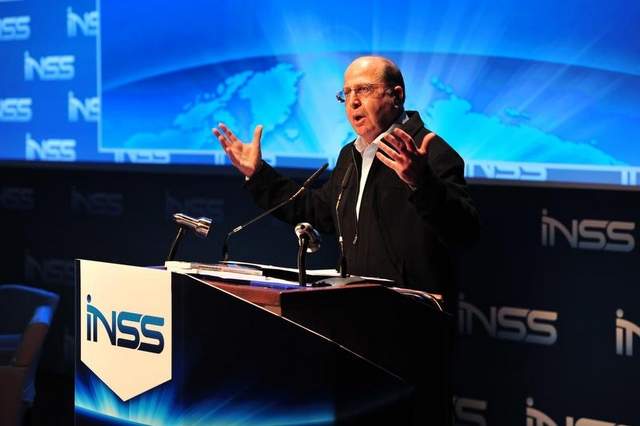
Israeli Defense Minister Moshe Ya’alon speaking Jan. 28 at Israel’s Institute for National Security Studies in Tel Aviv. (Israel Defense Ministry)

TEL AVIV — Two weeks after apologizing for a scathing attack on US Secretary of State John Kerry and the US-led Mideast peace drive, Israeli Defense Minister Moshe Ya’alon delivered a relatively temperate, yet no less critical assessment of US policy and its impact on the region.

In a Jan. 28 address kicking off an annual security conference here, Ya’alon assailed Washington for disengaging from conflict zones, relinquishing its role as global policemen and succumbing to an interim deal with Iran which he assailed as an “historic fumble.”

Unlike his tirade against Kerry, whom Ya’alon blasted as “inexplicably obsessed” with pursuing an Israeli-Palestinian peace deal unworthy of “the paper it was printed on,” the MoD boss offered a constructive assessment of a strategically shifting region.

Washington, said Ya’alon, will remain the world’s sole superpower, despite “the current situation, when the United States decides to disengage from conflict zones and is unenthusiastic about serving as the world’s policeman.”

While the US is challenged in the region by Russia and China, “there is no one that wants to step into the shoes of the United States.”

Russia is leading in the Syrian theater by default, Ya’alon told a gathering of Israel’s Institute for National Security Studies (INSS), due to Washington’s decision to “lower its profile.”

According to Ya’alon, a former head of military intelligence and Israel Defense Forces chief of staff, only two nations divide the world into territorial sectors of operational responsibility: the United States and Iran.

And while Washington has disengaged forces from Iraq and is drawing down from Afghanistan, Iran is rushing into those countries and elsewhere around the globe to fill the vacuum with terror and export a “messianic, apocalyptic” version of Islamic revolution, he said.

“The United States has its commands and Iran has its Corps. … It’s a regime that is now well received in the world despite the fact that it continues to spread its balance of terror in Afghanistan, Iraq, Syria, the Palestinian theater in Gaza, South America, Asia and Africa,” Ya’alon said.

On the US-led drive to reach a two-state peace deal, Ya’alon dismissed as “legend” claims that the Israeli-Palestinian conflict is a main source of Sunni-Shi’a wars and other troubles roiling the region.

“There is an argument between us and our friends about the [larger regional significance] of the Israeli-Palestinian conflict. But you can’t hang what’s happening in the Middle East on this conflict,” he insisted.

He also rejected arguments articulated by the US government, most world powers and many experts in Israel that failure to conclude a Palestinian peace deal deters Saudi Arabia and other moderate Sunni states from forging a united front against Iran.

“People in the Arab countries don’t raise the Palestinian issue; it’s only lip service for external consumption. What does the Palestinian issue have to do with the Iranian threat?”

In a televised interview presented Jan. 28 at the same INSS event, Palestine Authority President Mahmoud Abbas utterly dismissed Ya’alon’s assertions, insisting that 57 Arab and Islamic states — “from Mauritania to Indonesia” — would grant “full recognition” of Israel once a two-state deal was concluded.

“The opportunity for peace might not return,” Abbas told attorney, INSS fellow and former Israeli peace negotiator Gilead Sher.

But Ya’alon, a prominent, yet relatively pragmatic hawk in the right-of-center coalition government of Israeli Prime Minister Benjamin Netanyahu, said peace with the Palestinians “apparently won’t be realized in my generation.”

It is way too premature, he insisted, to consider US-crafted security arrangements when Palestinians are unwilling to accept Israel’s right to exist in the region as a sovereign homeland for the Jewish people.

“You can’t talk about security coming from unmanned aerial vehicles and sensors. As long as the Israeli flag does not appear on their map, and Palestine extends from Rosh Hanikra [bordering Lebanon in the north] to Eilat [at the Red Sea]…. As long as they are unwilling to declare an end of conflict and end of claims until the last Palestinian refugee is satisfied, what is there to discuss? This is the essence of the conflict.” ■