Archive for January 30, 2014

Off Topic: Hamas, Islamic Jihad Gunmen Now in West Bank

January 30, 2014

(A challenge to Abbas, Israel and/or the U.S.? What about Iran, which has severed relations with Hamas and where Abbas is about to visit Rouhani ?  DM)

Hamas, Islamic Jihad Gunmen Now in West Bank Khaled Abu ToamehGatestone Institute

If anything, the rally that saw Hamas, Islamic Jihad and Fatah join forces in a rare show of power means that Abbas’s claim that he is fully in control of the situation in West Bank is baseless.

For the first time since 2007, Hamas and Islamic Jihad militiamen this week made a public appearance in the West Bank, raising fears that the two radical groups continue to maintain a military presence in areas controlled by Mahmoud Abbas’s Palestinian Authority.

Palestinians were surprised to see Hamas and Islamic Jihad militiamen in broad daylight in an area controlled by the Palestinian Authority.

The masked militiamen made their rare appearance in the Jenin refugee camp during a rally to commemorate Islamic Jihad member Nafi Sa’di, killed by the Israel Defense Forces last December.
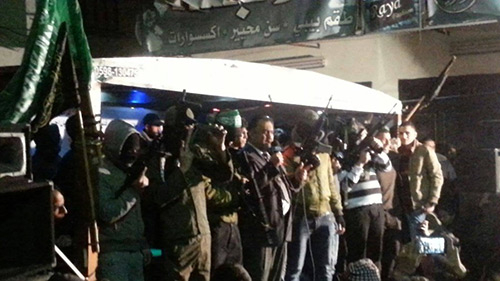
Hamas and Fatah
Gunman flank a speaker at the Jenin rally staged by Hamas and Islamic Jihad in December 2013.

The Palestinian Authority security forces, which are supposed to be in control of the refugee camp, did not intervene to stop or arrest the Hamas and Islamic Jihad gunmen, even as they fired into the air in honor of Sa’di.

Over the past few years, the US- and EU-backed Palestinian Authority [PA] security forces have been clamping down on Hamas and Islamic Jihad supporters in the West Bank. Hundreds of activists belonging to the two radical groups have been arrested as part of the crackdown.

But this time the PA decided not to take any action against the Hamas and Islamic Jihad gunmen despite the fact that their public appearance is seen as a challenge to Abbas’s authority.

One reason for this decision may be attributed to the possibility that the PA is afraid to confront Hamas and Islamic Jihad. The PA is already under attack from many Palestinians for conducting security coordination with Israel.

Last week, Hamas renewed its appeal to the Palestinian Authority leadership to halt all forms for security coordination with Israel.

statement published by Hamas urged Abbas to “immediately halt security coordination with the Zionist entity.”

Mahmoud Zahar, a top Hamas leader in the Gaza Strip, said that Abbas “was committing a big sin by opting to negotiate with Israel and prevent Palestinian resistance. Abbas’s survival depends on continued security coordination with the Zionist enemy. By preventing the resistance, Abbas is weakening himself politically because the resistance supports the political process.”

By allowing Hamas and Islamic Jihad militiamen to participate in a public rally in the West Bank, Abbas may also be seeking to send a message of warning to Israel and the US. This is a message that says that Palestinians have not abandoned the option of armed struggle against Israel as a way of achieving their goals.

Abbas may also be seeking to get more financial aid for the Palestinian Authority from the Americans and Europeans. The message he is sending to the American and European donors is that they need to give him more money and weapons, otherwise Hamas and Islamic Jihad would grow stronger and perhaps seize control of the West Bank.

A third message that Abbas seeks to send is one that is directed toward Hamas and Islamic Jihad. By allowing gunmen from the two groups to make a public appearance in the West Bank, Abbas is probably trying to appease the two groups and pave the way for “national reconciliation and unity.”

Even more surprising was the fact that Fatah gunmen loyal to Abbas took part in the rally at the Jenin camp alongside Hamas and Islamic Jihad.

The participation of Fatah gunmen in a Hamas and Islamic Jihad rally shows that the PA and Abbas continue to face a serious challenge from their own loyalists. Moreover, it shows that there is coordination between Abbas’s Fatah gunmen and Hamas and Islamic Jihad militiamen in the West Bank.

As senior Hamas representative Wasfi Kabaha declared at the rally, “We wanted to send a message to Israel that the Palestinian resistance continues to exist in the West Bank and is prepared for confrontation. We also wanted to affirm the need for national unity.”

If anything, the rally that saw Hamas, Islamic Jihad and Fatah join forces in a rare show of power means that Abbas’s claim that he is fully in control of the situation in the West Bank is baseless.

Yasser Arafat allowed Hamas to operate freely in the Gaza Strip until Hamas drove the Palestinian Authority out of the area. Abbas is now committing the same mistake and could lose the West Bank to Hamas and Islamic Jihad. The question is whether this will happen before or after the establishment of a Palestinian state.

Report: PA Chairman Abu Mazen will be invited to meet Rouhani in Tehran

January 30, 2014

Report: PA Chairman Abu Mazen will be invited to meet Rouhani in Tehran – jerusalemonline.

In the background of the Hamas movement supporting the rebels in Syria, Iran chose to severe ties with the Sunni terrorist organization and to find a new ally, the Fatah movement.

Jan 30, 2014, 10:54AM | Rachel Avraham
 
Best friends now? Rouhani and Abu Mazen
Best friends now? Rouhani and Abu Mazen. Photo Credit: AP
 
 As the United States focuses on efforts within the region to establish its influence based on peace negotiations between Israel and the Palestinian Authority, a new/old player in the region, Iran, is interested in strengthening its influence in the Middle East. 

 Since Tuesday, senior level Palestinian Authority official Jibril Rajoub is in Iran, on behalf of Palestinian Authority chairman Abu Mazen, where he will meet with a series of senior level Iranian officials.  By the means of Rajoub, Abu Mazen delivered a personal letter to Iran’s President Hassan Rouhani, which surveyed the internal Palestinian arena in regards to the negotiations existing with Israel under American auspices.

 Palestinian sources stated this morning in the Al Quds Al Arabi newspaper that Iran is even expected to invite Abu Mazen for an official visit in Tehran, as the strengthened relations between Tehran and the Palestinian Authority develop.  This visit is the result of intensive contacts arranged recently between the two sides in the framework of Iranian attempts to become involved with pressing regional issues.

Zarif and Rajoub met in Tehran
Zarif and Rajoub met in Tehran. Photo Credit: Channel 2

Iran severed relations with Hamas

 Another thing that brought about the warming of relations between Iran and the Palestinian Authority is Hamas distancing itself from the Hamas movement in Gaza, because of its support for the rebel movement in Syria.  Unlike Hamas, the Islamic Republic supports the Assad regime and is interested in him maintaining power.  Therefore, Iran stopped financially supporting Hamas and cut off all contact with the Sunni Islamist terrorist organization.  Therefore, representatives of Fatah and Iran were quick to establish new lines of communication between them.

 Sources in Tehran stated that Iranian Foreign Minister Mohammad Javad Zarif, who was the first to meet with Rajoub, stressed Iran’s readiness to support the Palestinian Authority and the Fatah movement.  Fatah and Iran announced the opening of a “new page,” to the great alarm of the State of Israel.  

Iran Is Not Our Friend

January 30, 2014

Iran Is Not Our Friend – The New Republic

BY LEON WIESELTIER

“On the foreign policy front . . . I find myselfwondering why we cannot regard another country, in this case Iran, 
as just that, as one more country which we would regard as neither friend nor foe, with whom we are prepared to deal on a day-to-day basis, neither idealizing it nor running it down, keeping to ourselves (here, of course, I am speaking about our government) our views about its domestic political institutions and practices, and interesting ourselves only in those aspects of its official behavior which touched our interests—maintaining in other words, a relationship with it of mutual respect and courtesy, but distant.” George Kennan wrote those words in his diary on March 8, 1998, after some thoughts on “the scandal of Mr. Clinton’s relationship to 
his Jewish girl intern.” Kennan died too soon. The day of his Iran policy has come.

This is the day of the extended hand, which Obama promised in his first inaugural address. The American government is no longer disgusted by the Iranian government, if ever it really was: in 2009, during the democratic rebellion in Iran, we certainly kept to ourselves, to use Kennan’s words, our views about its domestic political institutions and practices; or rather, 
we uttered hollow phrases of routine condemnation and moved on. But we are partners now, Washington and Tehran, and not only in the negotiations over 
the Iranian nuclear program. The administration hopes for an Iranian contribution also to a diplomatic solution to the Syrian excruciation. (There is no such solution. It is now a war to the death between secular tyranny and religious terrorism—the predictable, and often-predicted, consequence of leaving Syria alone.) There is wariness on both sides, of course; but generally there is a bizarre warmth between the governments, a climate of practicality and cordiality, as if a new page has been turned in a history of ugly relations, as if the ugliness of those relations were based only in illusion and misunderstanding. There is a new government in Tehran, isn’t there?

No, there isn’t. There is only a new president. Hassan Rouhani is an improvement over Mahmoud Ahmadinejad, since he is not a lunatic. He does not deny that the Holocaust happened, which for the Islamic 
Republic counts as a breakthrough in enlightenment. But it is important to remember, during this explosion of good feelings, that Iran is still the Islamic Republic, a theocratic tyranny ruled by 
a single man, a haughty cleric who subsumes the state beneath religion and his interpretation of it, and maintains his power by means of a fascistic military organization that brutalizes the population and plunders the economy—liberticide and prey, as a poet once wrote about another dictator. This same mullah-king supports the murderer in Damascus and the murderers in Lebanon and Gaza, and remorselessly pursues 
a foreign policy animated by anti-Americanism and anti-Semitism and intra-Muslim hatred. We may have extended our hand, but the Supreme Leader—the title itself is repugnant to decent modern ears—has not unclenched his fist. The smiles of his president and his foreign minister must not blind us to the scowl that is the true face of this cruel and criminal regime.

This does not mean that we must not negotiate with it. I appreciate the need for a diplomatic exploration of the Iranian nuclear challenge, though I prefer a deal that represents a strategic decision by Iran to renounce nuclear weaponry, not 
a strategic decision by Iran to find a cunning way out of the sanctions, and I resent the suggestion by the White House that anybody who is skeptical of its interim agreement is for war. Strenuous negotiations demand strenuous sanctions: the stronger our diplomatic position, the greater the likelihood that we will not resort to force. The thrill of diplomacy must not be allowed to obscure or to soften its purpose. Nor should it shrink our understanding of America’s role in the world. The abandonment of human rights as a primary and ardently pursued goal of American foreign policy—the Obama administration has returned American statecraft to its pre-Bosnia, pre-Rwanda days: we will have to be educated again by history, and by France—has been justified, in the case of Iran, by the urgency of the nuclear question. American support of democratization 
in Iran, it is said, would jeopardize the American effort to strike a deal on nuclearization. And so we must choose between a nuclear-free Iran and a tyranny-free Iran. But it is a false choice, designed to ratify the administration’s prior lack of appetite (and lack of nerve) for the promotion of freedom. We discovered the phoniness of the choice in our experience with the Soviet Union. You may still recall the twentieth century. Soviet missiles threatened the United States then infinitely more than Iranian centrifuges threaten us now, but arms control was not permitted to eclipse human rights in our policy toward the nuclear dictatorship. And even though we were prepared to offend, with our “moralism,” the interlocutors with the ICBMs, we did not fail—not at arms control nor, eventually, at human rights; and we learned that human rights, too, had vast strategic implications. A people is always more important than a government. 

Not long ago I was looking for a certain passage in Niebuhr, and I came upon his observation that “there are two ways of denying our responsibilities to our fellowmen”: “seeking to dominate them by our power” and “seeking to withdraw from our responsibilities to them.” It was not the passage I was seeking, and as I kept scouring the marked-up books I bumped into the great man’s call to “widen the conception of interest,” so that “the sense of justice must prevent prudence from becoming too prudential in defining interest.” This is the Niebuhr that our ostentatiously reflective president forgot, or never knew. He is withdrawn and we have withdrawn. We are leavers. We leave to pivot, but we do not pivot. We respect others too much to help them: how would contempt differ? Our friends doubt us, our enemies play us. We stand for too little and we stand for too few. The post-American world is here: behold it and weep.

Leon Wieseltier is the literary editor of The New Republic.

Austria aggressively moves to boost trade with Iran

January 30, 2014

Austria aggressively moves to boost trade with Iran | JPost | Israel News.

By BENJAMIN WEINTHAL

01/30/2014 01:56

Ambassador to Iran voices sharp criticism of Western sanctions targeting Islamic Republic’s nuclear program.

Iran's President Hassan Rouhani

Iran’s President Hassan Rouhani Photo: Reuters

Austria’s ambassador to Tehran, and the vice president of the country’s chamber of commerce, have expressed sharp criticism of tough sanctions targeting Iran’s nuclear program.

However, the Austrian Foreign Ministry rejected on Tuesday Iranian news reports claiming the Central European country was always critical of sanctions targeting the Islamic Republic.

According to a report by Iran’s state-controlled Fars News last month, Austria’s ambassador to Iran, Friedrich Stift, said his country never showed interest in pushing for sanctions.

A spokesman for the Foreign Ministry in Vienna told The Jerusalem Post during a telephone interview on Tuesday that “Austria has always supported sanctions and the ambassador represents this position.”

This “means support for the sanctions against the nuclear program, Iran’s regime, and human rights violations,” the spokesman added. But Stift is “unhappy when sanctions affect ordinary people in Iran.”

The spokesman cited the “freezing of [Iran] accounts” as one example of Austria’s support for the sanctions regime.

Austria-Iranian economic relations have traditionally been robust. Ali Naghi Khamoushi, a former head of Iran’s Chamber of Commerce, said, “Austria is for us the gateway to the European Union.”

Iran’s regime-controlled IRNA news agency reported on Wednesday that Stift praised the 150-year history of Tehran-Vienna ties, adding that Iran is a significant economic partner of Austria. “Stift is on Kish Island [in the Persian Gulf] to attend an international exhibition on tourism which would end its work on January 31,” IRNA reported.

Austrian oil and gas giant OMV sent a representative to a meeting in December with Iran’s oil minister in Vienna.

The purpose of the meeting was to discuss ways to revive investment in Iran’s oil fields.

Early last month, the Austrian Chamber of Commerce said representatives of 10 companies, and the chamber’s president, were slated to visit Iran.

Rail technology firms Plasser & Theurer and AVL, high-rise engineering firm Doka, engineering consultants ILF and cable car maker Doppelmayr were listed as participants, the Austrian daily Die Presse reported.

Austrian exports to Iran totaled $298 million in 2012, according to the Chamber of Commerce.

Richard Schenz, vice president of the Austrian Chamber of Commerce, told the Kurier daily earlier this month that “there is no reason to comply with US laws” regarding Iran sanctions.” Schenz was in Iran in December to boost Austrian- Iranian trade.


