Archive for January 30, 2014

Off Topic: How Kerry Put Netanyahu in a Bind

January 30, 2014

(Kerry is not alone. He has had lots of help and not only from the Israeli “far right.”  DM)

How Kerry Put Netanyahu in a Bind: Bloomberg News, Jeffrey Goldberg
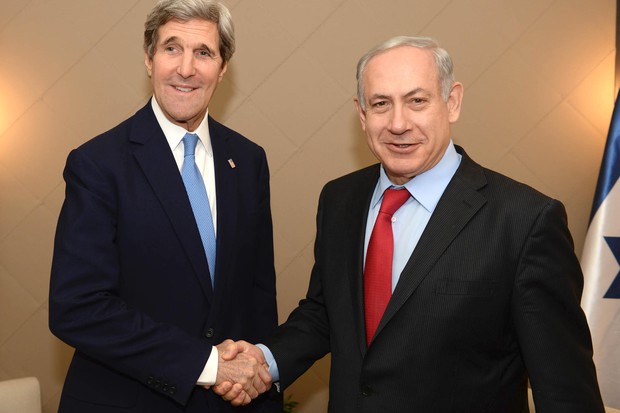
Kerry and NetanyahuPhotographer: Kobi Gideon/GPO via Getty Images
Netanyahu appears to be taking small rhetorical steps in Kerry’s direction.

U.S. Secretary of State John Kerry is obviously getting somewhere in his attempt to achieve a framework agreement between Israel and the Palestinian Authority, because all the right people — the far-right people — are going a little nuts.

At a security conference this week in Israel, Naftali Bennett, the leader of the Jewish Home party — reacting to an earlier suggestion made by the leader of his governing coalition, Prime Minister Benjamin Netanyahu, that Jewish settlers could conceivably find themselves living under Palestinian rule one day — asked, “Why should Jews live in Tel Aviv with Israeli sovereignty and in Eli and Hebron under Palestinian sovereignty? Open up the Book of Genesis and form an opinion. I demand that this idea be removed from the agenda.”

Bennett is referring to the passage in Genesis in which Abraham buys the Cave of Machpelah, in Hebron, as a burial site for his wife, Sarah. This passage marks the first purchase of land in Canaan by the patriarch of Judaism, and it is why Hebron is Judaism’s second holiest city. It is a painful idea for Jews to give up possession of Hebron to the Palestinians, who now make up most of its population.

I would point Bennett to another passage in Genesis, the one having to do with a very large flood, to help him understand why his audience of (mainly Jewish) security experts didn’t react with enthusiasm to his cri de coeur. I am not suggesting that God is planning on flooding Israel. Not at all. If God is thinking about unleashing floods in the Middle East, I’m sure Bashar al-Assad’s regime in Syria tops his current target list.

But a flood is coming to Israel nonetheless, and the country’s security establishment understands the nature of it. It’s a flood of condemnation, and it has two sources. The first is that Israel, as a Jewish state, is held to a higher standard by the hypocritical world that surrounds it. The second is the widespread perception that Israel, by continuing to build and expand settlements on the West Bank, is trying to block the creation of a Palestinian state.

Censure and international isolation pose acute national security threats to Israel. As the writer Ari Shavit says, the issue for Israel is not the quality of its F-15s. The Israeli military is the strongest in the region. The issue, Shavit argues, is that the world soon won’t allow those F-15s to take off. Isolation and condemnation will make it increasingly difficult for Israel to defend itself from the most serious threats. If Hamas chooses to launch waves of missiles at Israeli cities again, Israel may very well have to respond with force. But in the current international climate, Israel will find itself handcuffed by international condemnation as soon as Palestinians are killed — and keep in mind that Hamas is an expert at maximizing casualties on its own side, in order to create a trap for Israel.

Israel, of course, has tried in the past to create a Palestinian state on the West Bank. Former prime ministers Ehud Barak and Ehud Olmert both offered most of what Palestinian negotiators said they wanted, only to see Palestinian interlocutors walk away from negotiations. So I am not expecting miracles from Kerry or from this process. And remember — the Palestinian Authority is weak and corrupt, and does not even control Gaza, which must be a Palestinian state in order for any plan to succeed. But the framework agreement Kerry is trying to reach could set the stage for negotiations that might just result in unprecedented security guarantees for Israel and Palestinian recognition of Israel as a Jewish state, in exchange for a gradual Israeli withdrawal from most of the West Bank.

Kerry’s energetic efforts have placed Netanyahu in a terrific bind. On one side are right-wingers such as Bennett, who will bolt from the ruling coalition if Netanyahu goes down Kerry’s path. (One right-wing Israeli leader I spoke to this week argued that Kerry is not carving a path for Netanyahu, but building a plank for him to walk.) Pressing Netanyahu from the other side is a U.S. administration that appears ready to blame him for sinking negotiations, should they fail.

Netanyahu, unlike a set of government ministers to his right, including Bennett, understands that Israel’s addiction to West Bank settlements is undermining the legitimacy of his country, and endangering its role as a democratic haven for Jews. This is why he appears to be taking small rhetorical steps in Kerry’s direction — floating the idea that Jews on the West Bank could remain where they are under Palestinian rule (a proposal the Palestinians, so far, at least, reject) is one way he’s signaling to the Israeli public that unpopular decisions might be coming. Palestinian leader Mahmoud Abbas also seems to be bending under Kerry’s pressure, offering just this week a concession of his own: Israelis forces, he said, could remain in parts of the West Bank for as long as three years after an agreement is struck. Previously, Abbas had argued that all Israeli forces must depart as soon as a deal is made.

For Israelis, there are two ways to look at Kerry’s Herculean (and often Sisyphean) efforts to outline an agreement between extremely hesitant parties. The first way is Bennett’s: Much of the Israeli right sees Kerry as the enemy, trying to break the will of their prime minister in order to uproot settlers and create a Palestinian state that will become a source of endless violence. The second way is the one favored by Israelis of the center and the left: suspicion of grandiose American schemes but also a sober realization that someone needs to figure out a way to disentangle Israel from the lives of its Palestinian neighbors, and that that person may well be Kerry. The particular difficulty for Netanyahu is that he might have both of these understandings fighting it out in his head.

Sharansky: If Obama had backed Iran’s dissidents, Arab Spring might have looked different

January 30, 2014

Sharansky: If Obama had backed Iran’s dissidents, Arab Spring might have looked different | The Times of Israel.

Ex-Soviet Jewry icon, now Jewish Agency chief, slams the US president for his failure to support dissidents across the Middle East

January 30, 2014, 7:28 pm

In this Monday, June 15, 2009 file photo, hundreds of thousands of supporters of leading opposition presidential candidate Mir Hossein Mousavi, who claims there was voting fraud in Friday's election, turn out to protest the result of the election at a mass rally in Azadi (Freedom) square in Tehran, Iran. (photo credit: AP Photo/Ben Curtis, File)

In this Monday, June 15, 2009 file photo, hundreds of thousands of supporters of leading opposition presidential candidate Mir Hossein Mousavi, who claims there was voting fraud in Friday’s election, turn out to protest the result of the election at a mass rally in Azadi (Freedom) square in Tehran, Iran. (photo credit: AP Photo/Ben Curtis, File)

Natan Sharansky, the former Soviet dissident and Israeli politician who now heads the quasi-governmental Jewish Agency, assailed US President Barack Obama for failing to support anti-regime dissidents in the region.

Most importantly, he indicated, Obama’s decision not to encourage the would-be reformers confronting the ayatollahs’ regime in 2009 doomed those protests, which might otherwise have led to a revolution ousting the hardline Islamist regime.

The case of the thwarted revolution in Iran was “the saddest” instance of Obama’s misguided human rights stance, said Sharansky in a wide-ranging interview with The Times of Israel. “Everything starts from the fact that in 2009, when Iranians were ready for the revolution, when millions of double thinkers were going to cross this line,” said Sharansky, “they hear the message from the American president: Engagement with the government of Iran is more important than [its] replacement.”

The president’s stance, he said, “took all the energy out of this [movement]. And if it had succeeded then,” he added, “the whole Arab Spring could have been a very different story.”

President George W. Bush bestows the Presidential Medal of Freedom to Natan Sharansky, a former prisoner of the Soviet regime, during a ceremony in the East Room of the White House in Washington, Friday, Dec. 15, 2006 (photo credit: AP/Pablo Martinez Monsivais)

President George W. Bush bestows the Presidential Medal of Freedom to Natan Sharansky, a former prisoner of the Soviet regime, during a ceremony in the East Room of the White House in Washington, Friday, Dec. 15, 2006 (photo credit: AP/Pablo Martinez Monsivais)

More generally, Sharansky castigated Obama for failing to support dissidents across the region who were standing up against dictatorship. “With all that is happening in the Middle East,” he charged, “the president of the United States doesn’t take a position.”

Sharansky, who spent nine years in a Soviet gulag after seeking to immigrate to Israel before his release in 1986, said bitterly that “if American politicians had treated [Soviet dissident Andrei] Sakharov the way American leaders today are treating Egyptian dissidents, the Soviet Union might still exist.”

He said that while president Jimmy Carter had taken a highly principled stance in support of Sakharov, and George W. Bush “met with more than 100 democratic dissidents… and broke many taboos” on their behalf, Obama “simply stopped. You can’t tell me one important human rights activist [with whom Obama has met] when he was not already on the winning side.”

Sharansky said he’d had only one meeting with Obama, during the race for the Democratic presidential nomination, and that Obama made clear then that “it would be very important to him to continue this tradition where American presidents help dissidents.” But that changed after Obama assumed the presidency.

US President Obama delivering his famed Cairo Speech in 2009. The president highlighted the need for social progress in his first major address to the Muslim world. (photo credit: screen capture, YouTube)

US President Barack Obama speaks in Cairo on June 4, 2009. (photo credit: screen capture, YouTube)

Sharansky, the former head of a center-right political party and an ex-Israeli government minister, also said the current US-led effort to quickly broker an Israeli-Palestinian peace deal was doomed to failure, because a climate for peace had to be built bottom up. Palestinian Authority President Mahmoud Abbas was telling the truth when he said that Palestinian society is not ready to live with Jews in its midst, Sharansky said. “He’s right. He’s saying, Our society is not ready to accept this. He’s not saying, I’m anti-Semitic. But this, for me, is the barometer of readiness or not readiness to accept a peace treaty.”

The guiding human rights principle for the US in the Middle East and beyond, Sharansky said, must be to support processes for creating societies with free economies, political freedom, and bottom-up educational work. “Just consistently support steps towards civil society — in Egypt, in the West Bank, everywhere,” he urged. “Do that for a few years.”

Fatah official: Palestinians interested in Iranian role in conflict with Israel

January 30, 2014

Fatah official: Palestinians interested in Iranian role in conflict with Israel | JPost | Israel News.

By KHALED ABU TOAMEH

01/30/2014 21:35

After Tehran visit signaling rapprochement between Islamic Republic, PA leadership, Jibril Rajoub says Palestinians “entitled” to seek all channels to recruit regional action for cause.

Jibril Rajoub

Fatah official Jibril Rajoub. Photo: REUTERS

The Palestinians have an interest in an Iranian role in the region, Jibril Rajoub, a senior Fatah official, said Thursday.

He announced that Fatah has not abandoned the option of “armed resistance” if the peace talks with Israel fail.

“The year 2014 is the year of decision; we either go to a state or to a confrontation,” Rajoub said. “The confrontation would be on three fronts: launching and escalating resistance; boycotting and isolating Israel and halting all forms of normalization [with Israel] on the political, academic, trade and economic levels.”

He said that the option of resistance remains a strategic option for the Palestinians. “The option of armed resistance is also on the table,” Rajoub added.

Rajoub, who visited Tehran earlier this week, said an interview with Iran’s Al-Alam Tv station that he relayed a message from Palestinian Authority President Mahmoud Abbas to the Iranian leadership concerning the latest developments in the Palestinian arena.

Rajoub’s visit to Tehran is seen as a sign of rapprochement between Iran and the PA leadership.

Relations between the two sides have been strained over the past decade in wake of Iran’s support for Hamas and opposition to the peace process between the PA and Israel.

Relations between Iran and Hamas have deteriorated over the past three years following the Islamist movement’s refusal to side with Tehran’s ally, Syrian President Bashar Assad, against his enemies at home.

The London-based Al-Quds Al-Arabi daily reported Thursday that the Iranians were planning to invite Abbas to visit Tehran as part of efforts to boost bilateral relations.

“We are interested in creating and building bridges of communication with the Islamic Republic of Iran,” Rajoub, a former PA security commander, said in the interview. “This would have positive repercussions on the Palestinian cause, which is going through a decisive phase.”

He said that Abbas’s message to the Iranian leaders contained congratulations over Tehran’s “wisdom” in dealing with the Iranian nuclear program and international sanctions. The Palestinians, Rajoub said, consider the sanctions and embargo to be unjust.

Rajoub said that US “regression” in the face of Iran shows that the Americans have reached the conclusion that they can no longer view the world through an Israeli perspective and interest.

Rajoub pointed out that Fatah has had a long and historic relationship with Iran since the Islamic revolution that toppled the Shah.

He said that Iran could play a role in “managing the conflict in the region.”

Iran, he added, is part of the Arab and Islamic front in the Middle East.

Rajoub, who currently heads the Palestinian Football Association, said that the Palestinian leadership was now facing pressure regarding the peace talks with Israel.

“We are entitled to knock on all doors and seek all channels to recruit regional action in favor of our cause,” he said. “Our goal is to create elements of pressure on the international community.”

Rajoub said that the PA leadership was not ruling out the option of unilaterally declaring a Palestinian state. “We want to declare a state under occupation,” he said.

Referring to the Fatah-Hamas dispute, Rajoub said that the rapprochement with Iran was not at the expense of Hamas. “We are not establishing relations with Iran at the expense of Hamas,” he explained. “Hamas is part of the Islamic Arab social, political and national fabric in Palestine. We didn’t ask Iran to cut off its relations with Hamas.”

2014: Iran out, Global Jihad in

January 30, 2014

(That seems unlikely, but when surrounded by alligators it’s difficult to decide which to try to fend off first. DM)

2014: Iran out, Global Jihad in — Haaretz and | Jan. 30, 2014

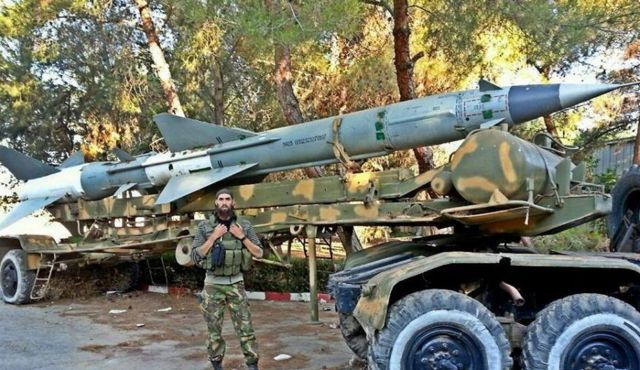
Rockets in SyriaA member of the Mujahideen militia in Syria, last month. Photo by AP

If one of Israel’s enemies had chosen to launch a surprise attack on the country this past Wednesday, the defense establishment might not have been completely prepared. In a rare situation, the four top officers in the Israel Defense Forces were busy giving long, comprehensive talks that day. A day earlier, the defense minister, Moshe Ya’alon, gave a detailed strategic address of his own. Maybe it’s a good thing that Syria and Hezbollah have other things to worry about just now.

The dense cluster of speeches was sheer coincidence. Senior IDF officers don’t usually give public lectures, still less media interviews. But this week, a number of conferences took place. The director of Military Intelligence, Maj. Gen. Aviv Kochavi, spoke at a conference organized by the Institute of National Security Studies at Tel Aviv University. The chief of staff, Lt. Gen. Benny Gantz, and his deputy, Maj. Gen. Gadi Eizenkot, addressed a conference at the Interdisciplinary Center in Herzliya; and the commander of the air force, Maj. Gen. Amir Eshel, was one of the speakers at a conference held by the Fisher Institute for Air and Space Strategic Studies.

The retired general Ya’alon, also speaking at INSS, and the four generals under him sounded quite coordinated. No glitches cropped up in the message conveyed by the defense establishment, despite the unusually complex strategic circumstances prevailing at this time. Here are some of the key points of the five speeches:

• Iran: “Our focal point in the period ahead and overall will be Iran,” Gantz said a year ago, at the last INSS conference. But this week, the chief of staff barely mentioned the Iranian nuclear project in his talk. Maj. Gen. Eshel identified a positive trend “when inspectors arrive in Iran and dismantle centrifuges.” DMI Kochavi was more circumspect: “The nuclear project is continuing, but it has been slowed. We now have to wait and see whether the [diplomatic] process will bring about something effective.”

Only the defense minister was somewhat more expansive – and pessimistic. The Geneva agreement of this past November, Ya’alon said, is “a historic missed opportunity.” The Iranians, he explained, are deceiving the international community. Their goal is to consolidate themselves at a starting point that will allow them to become a nuclear power when they wish. The “messianic regime” (not the first time the defense minister has used that word of late) in Tehran, Ya’alon said, is “the No. 1 threat to regional and world stability.”

An Israeli military threat against Iran is not in the cards now, one can conclude. Israel is in a waiting posture until the results of the Geneva agreement become clear.

• Global Jihad: The thousands of words that were devoted to Iran a year ago gave way this week to the new threat on Israel’s borders: Tens of thousands of terrorists from jihadist organizations that identify with the ideas of Al-Qaida are now present not only in Syria, but also in Lebanon and the Sinai Peninsula. Kochavi noted that some of the jihadist volunteers are from Europe, North America and Australia. Ya’alon said that the developing threat should be seen in the proper proportions: At this stage, the extremist groups are occupied mainly with trying to topple the Arab regimes. Implicit in his remarks was the notion that their hostility to Israel will be given concrete expression only at a later stage. The defense minister pointed out that Israel had twice exercised caution in its responses to Katyusha rocket fire from Lebanon, in order not to play into the hands of the Sunni jihadist organizations, which want to trigger a confrontation between Israel and Hezbollah.

• The upheaval in the Arab world: All the speakers described this development as presenting a mixture of threats and opportunities to Israel. “The IDF does not generate threats with the aim of enlarging its budget,” the air force commander emphasized. Kochavi observed that the Syrian army is at its lowest level of fitness since its founding, as a result of the prolonged civil war. Ya’alon painted a picture that is neither black nor white, “but diverse and colorful” – a clash between the radical Shi’ite axis and Sunni jihadist forces, with the ensuing concern of the more moderate Sunni states (Egypt, Jordan and some of the Gulf states) creating a positive confluence of interests with Israel.

Gantz remarked, “If I look at Syria in terms of what the future holds, and do a strategic heads or tails, it comes out negative in either case.” The victory of either side – whether President Bashar Assad or the extremist Sunni organizations now in the forefront of the opposition’s struggle – will not be good for Israel, the chief of staff said. However, Gantz did not go on to draw the logical conclusion from his analysis, namely that Israel therefore would probably like to see the fighting continue, despite the dangers it holds for regional stability.

• The rocket and missile threat: It turns out that this threat both increased and decreased during the past year. A year and two years ago, Kochavi referred to 200,000 rockets and missiles that were aimed at Israel. This year the news is a bit better: The number has fallen to 170,000. This is due primarily to the fact that the Syrian army has used tens of thousands of rockets in its war against the rebels. The bad news, though, is that the number of rockets in Hezbollah’s possession has grown to “more than 100,000” (Ya’alon), whereas the conventional estimate until recently had been 75,000.

Furthermore, the missiles have become “heavier and more accurate,” and, says Kochavi, Hezbollah has a larger missile arsenal than most countries. According to Eizenkot: “The enemy uses civilians [as human shields] to attack our civilians. The question is how to legitimize a move against him. Everyone is familiar with the international criticism sounded against us because of combat in built-up areas, but the enemy created that reality. We will have to defend our civilians.”

• The Palestinians: The ranking officers shied well away from this issue. Ya’alon was more open, in a forum that was problematic for him – the INSS this week put forward a proposal for a “coordinated unilateral” Israeli withdrawal from most of the West Bank if the initiative by U.S. Secretary of State Kerry fails. The defense minister said that the Palestinian Authority is not a responsible neighbor that Israel can trust. He went on to dwell on the education issue. As long as the Palestinian educational system continues to incite its students against Israel, he said, it could take many more decades to achieve peace. Recalling that he had originally supported the Oslo process, he stated that for him, “it is not land that is holy but human life that is holy.” On the other hand, he said, if the area that Israel vacates is then used to launch terrorist attacks against its civilians, as happened in the past, the risk will not be worthwhile.

• Cyberspace, technology and intelligence: Gantz believes that Israel needs to do a lot more in the cyber realm. “We must not wait with this story,” the chief of staff said, without elaborating. Kochavi revealed that there were dozens of attacks in the past year against computerized systems of Israel’s security branches, “most of them, happily, unsuccessful.” The realm of cyber warfare, he predicted, “will turn out to be a greater revolution than the discovery of gunpowder and the potential of air power in the last century… The same intelligence work that used to be done with 40 people is now done with four.” Eshel spoke about tremendous advances in the air force’s ability to strike at multiple targets simultaneously. That ability is 15 times as great as it was seven and a half years ago, in the Second Lebanon War, he said.

• The defense budget: As was to be expected, most of the speakers took the opportunity to respond to the recent attacks on the size of the defense budget and especially on the contribution of the members of the career army. “The assault on career personnel is irresponsible,” Eshel said. “They are not the problem the state faces. On the contrary.” Gantz complained about the cancellation of two IDF multiyear plans and about the delay in approving the alternative program – the third submitted by the IDF to the cabinet. “We will not be able to allow ourselves a hollow or wretched army,” he said. “An army that does not project might invites others to take it on.”

The last remark bore an outward thrust. Ya’alon, Eizenkot, Eshel and Kochavi all spoke about the importance of Israel’s neighbors perceiving its strength if it is to maintain deterrence. The fact that Israel is seen as militarily strong and as being determined to attack anyone who threatens it, contributes to the relative security quiet that has prevailed here in the recent past, despite the chaos in the surrounding Arab world. Most of Israel’s preemptive activity takes place far across the border and far from the attention of the public and the media, but is well understood by the organizations and states in the region.

But Gantz’s comment can also be read in the opposite direction: inwardly. Without intending to, apparently, the chief of staff voiced what can be interpreted as self-criticism. Gantz deserves high regard for the businesslike, collegial atmosphere he has introduced in the General Staff following the grim years of confrontation that prevailed during the tenures of Ehud Barak and Gabi Ashkenazi. But there is also a certain disadvantage to this approach from the army’s point of view. Even though the defense establishment finally prevented the significant budget cut planned by the Finance Ministry, the atmosphere in the IDF in connection with these developments has been rather sour in recent months.

Most officers are unable to come to terms with the apparent contradiction: Why does the army have to fire 5,000 career personnel (to be replaced by 1,000 younger career people), even as the treasury insists that the budget was not actually cut? And above all, how did it come about that in the public mind, it has suddenly become legitimate to attack career army personnel for being parasites who take early retirement at the expense of the public?

If no major wars break out in Gantz’s final year as chief of staff, which will start next month, it’s possible that these questions, along with the structural reforms in the IDF and his status in the eyes of the public will shape the memory of his term. But the impression of many officers is that the relatively easygoing personality traits shared by the current defense leadership – Ya’alon, Gantz, Eizenkot and the director general of the Defense Ministry, Dan Harel – are not exactly tailor-made for this particular campaign.

The world’s largest Israeli-flag mural completed in Eilat – YouTube

January 30, 2014

The world’s largest Israeli-flag mural completed in Eilat – YouTube.

It took the artist a month to draw the largest Israeli flag mural in the world (3600 square meters) in the southern city of Eilat.

It was painted on a concrete hangar in Eilat’s naval base.

Using a combination of light and shadow, the flag can be seen from the shores of the Gulf of Eilat and also from Eilat’s neighboring cities.

An inexpensive answer to Jordan’s 42 story high flagpole in Aqaba which had to cost them millions.

Oh, those clever Jews… Heh!

Artificial Intelligence « Commentary Magazine

January 30, 2014

Artificial Intelligence « Commentary Magazine.

I have one question for National Intelligence Director James Clapper and his predecessors.

As we all know, the infamous 2007 National Intelligence Estimate asserted with “high confidence” that Iran had halted its work on nuclear weapons development, and no subsequent NIE ever reversed that judgment.

Yet fast forward seven years, and the latest annual intelligence assessment asserts that “Tehran has made technical progress in a number of areas … from which it could draw if it decided to build missile-deliverable nuclear weapons,” and consequently, it now “has the scientific, technical, and industrial capacity to eventually produce nuclear weapons” should it so choose.

So here’s my question: If Iran stopped its weapons development effort seven years ago, how did it happen that since then, it has made precisely the kind of technical progress that now enables it to build a nuclear warhead whenever it chooses?

There are two plausible answers to this question. One, the work never really stopped, or resumed at some point in the last few years, and U.S. intelligence agencies simply missed it. That’s certainly possible; intelligence agencies aren’t omniscient, and it’s unrealistic to think they will never make mistakes. A more troubling possibility is that since intelligence rarely reaches the level of absolute certainty, the available information was misinterpreted due to political bias–a desire to avoid military action against Iran, and hence to avoid interpreting Iran’s behavior in a way that might necessitate such action.

But the answer offered by the Obama administration strains credulity: that Iran really did stop its weapons program and never resumed it, but somehow, mysteriously, nevertheless made major technical progress over the last seven years of precisely the kind that now enables it to build a nuclear warhead anytime it pleases. Even a two-year-old wouldn’t buy that.

The real problem, however, isn’t what this says about the past, but what it says about the future. After all, for years, opponents of attacking Iran’s nuclear program have argued that Tehran hasn’t yet decided to make a nuclear weapon, and if it ever does, the U.S. will know in enough time to stop it before it succeeds. Therefore, there’s no reason for either America or Israel to take military action now. Yet how can either Americans or Israelis have confidence that U.S. intelligence will detect a nuclear breakout in time if, for the past seven years, it has either missed all the signs that Iran was continuing to make “technical progress” toward weaponization, or deliberately ignored them out of a desire to avert military action–a desire that, judging by both words and deeds, remains the administration’s top priority?

The answer, of course, is that they can’t. And the lesson for Israel is clear: It cannot rely on U.S. promises to stop Iran from getting nukes, because these promises are based on the faulty assumption that U.S. intelligence will uncover a “smoking gun”–the kind of irrefutable proof that can’t be argued away–in enough time to take action. Hence the day is coming closer when Israel will have to make a fatal decision: attack Iran itself, or learn to live with a nuclear Iran.

Soldiers at Eilat Iron Dome battery shoot attacker

January 30, 2014

Soldiers at Eilat Iron Dome battery shoot attacker | The Times of Israel.

IDF troops report that an Israeli Arab man shouted ‘Allahu Akbar’ as he ran at them

January 30, 2014, 5:37 pm

An Iron Dome battery deployed near Eilat. (photo credit: Flash90)

An Iron Dome battery deployed near Eilat. (photo credit: Flash90)

IDF soldiers guarding an Iron Dome battery in the southern Israeli city of Eilat shot and injured an Israeli man who ran at them.

Soldiers at the site said the man, a resident of the Galilee Arab town of Majd al-Krum, shouted, “Allahu Akbar! I came to carry out an attack!” as he rushed toward their position, according to Army Radio. IDF forces reportedly called for the man to stop and opened fire when he refused to do so.

The man was lightly injured.

During his interrogation after the incident, the man confirmed he planned on carrying out an attack, but it was not clear if he was armed.

In August, the Eilat-based Iron Dome battery intercepted a Grad rocket from Sinai bound for Israel’s southernmost city, in the first successful interception since the battery’s July deployment.

The last-minute deployment was spurred by developments in Egypt, where the military continued its offensive against terrorist activities in the porous Sinai area.

Bombing Iran: Tough Tasks for Israeli Intelligence

January 30, 2014

Commentary: Bombing Iran: Tough Tasks for Israeli Intelligence | The National Interest.

January 30, 2014

Historically, Israel’s intelligence services have played a vital role—both direct and indirect—in making decisions of war and peace.

In 1954, Israeli intelligence persuaded then Defense Minister Pinhas Lavon to approve of an attempt to sabotage the Anglo-Egyptian agreement concerning British withdrawal from the Suez Canal. And there would have been no air strikes on the Iraqi nuclear reactor in 1981 and the Syrian reactor in 2007 if not for the information collected by Israel’s intelligence services.

Not only are the three current intelligence chiefs (Aviv Kochavi of military intelligence [Aman], Tamir Pardo of Mossad, and Yoram Cohen of Shin Bet) among the key individuals tasked with collecting and presenting information related to an Israeli military operation against Iran’s nuclear program, they are also part of the inner circle of advisors to Prime Minister Benjamin Netanyahu. Moreover, they would be responsible for assessing the civil and political consequences of attacking Iran’s nuclear facilities.

Although there are several forms of military operations that could be undertaken, with Israel’s capabilities and preparations in mind most analysts focus primarily on air strikes directed against Iran’s key nuclear sites. There are five main operational tasks related to destroying an underground facility: detecting the facility; characterizing the site’s features; planning the attack; neutralizing the site; and assessing the success of the operation.

A critical question for Israeli decision-makers and the intelligence apparatus is whether they have sufficient qualitative and accurate intelligence on the Iranian nuclear sites. There is no simple solution to locating and characterizing an underground facility.

Possible options include imagery intelligence (photographs from satellites), signature intelligence (detecting heat, sound, or vibration), signals intelligence (radio and radar signals), and the use of human intelligence (agents or informants). Usually, one source is not enough to characterize a facility and determine whether it is for leadership protection, weapons production, weapons storage, or something else.

In order to integrate all the methods in an efficient and cost-effective endeavor, one must first obtain the approximate location of a site. This is usually done with either human intelligence or satellites imagery. Israel has some tools to detect underground and excavated facilities.

The Ofeq series of reconnaissance satellites provides some photographic coverage of Iran. Furthermore, the Eros-B satellite provides it with a camera that improves the assessment capabilities regarding sites of interest. The satellites’ images can help answer questions regarding whether construction is taking place under the surface, what kind of materials are used in the construction process, and how deep the Iranians are digging.

However, given the large size of Iran, and Israel’s somewhat limited satellite assets, searching for clandestine facilities is a challenging task. Moreover, the hide-and-seek game played between Iran and Israeli intelligence allows for the use of deception, which further complicates the search. In order to reduce the risk of deception, intelligence needs to draw its information from multiple sources. Human intelligence would provide added value in this regard and may be the most effective mean to detect clandestine facilities.

To neutralize a site means either the physical destruction of the site or functional disruption. In the Iranian case, with its advance rebuilding expertise and experience, the difference between physical destruction and functional disruption may not be large in terms of the time it would take for the same level of activity can be restored. Given Iran’s expected ability to reestablish its nuclear program after absorbing an attack, an assessment of the time period for which it is halted will be necessary.

Intelligence will also need to assess the operational requirements to take out the sites. The uranium enrichment facility at Fordow, built into a mountain, would be particularly difficult to penetrate. Former Defense Minister Ehud Barak once called it “immune to standard bombs.” The enrichment facility in Natanz is also heavily fortified. The complex is underground, covered by layers of concrete and metal, and is protected by Russian-made surface-to-air missiles. Intelligence will need to assess the vulnerabilities of these sites and whether the IDF has the capability to take them out for a sufficient period of time.

If indeed a military operation using air strikes is chosen, Israeli intelligence will need to assess the responses of regional countries to the violation of their air space en route to Iranian targets. This assessment will affect the choice of route. There are three routes that have been highlighted: a northern route along the Syrian and Turkish border; a central route over Jordan and Iraq; and a southern route over Saudi Arabia.

Although some of these states may allow (or being unable to prevent) one Israeli operational breach of their air space, it is questionable whether they would accept continuous violations of their territorial sovereignty (if that would be necessary to halt the Iranian program). Israeli intelligence would therefore need to assess their responses, both politically and militarily, to breaches of their air space. The chance of hiding their destination if they are detected will be close to impossible since Israel does not enjoy strategic surprise.

One problem that intelligence will need to assess is the risk of early detection and the passing of this information to Iran. Given the enmity between Shi’ite Iran and some of the Sunni Arab states, it might be concluded that an Arab detection (excluding a Syrian or Iraqi detection) of Israeli planes will not be passed on to Iran. However, Iran would clearly have an incentive to establish the capacity to detect such an operation as early as possible. Thus, it cannot be ruled out that Iranian intelligence has sought to create an information link in those Arab states that are located along potential Israeli routes.

The success or failure of an actual operation also will need to be assessed. This will involve a damage assessment, noting the effect of the munitions deployed and whether additional attacks are necessary. This is usually done by visual intelligence methods, such as satellites. However, satellite sensors and cameras may not be sufficient to extract such information. Again, human intelligence will be the most reliable mean for acquiring such information.

Israel has two special forces units tasked with assisting in air strikes. One is responsible for laser target designation (Sayeret Shaldag/Unit 5101), and the other for real-time bomb damage assessment (Unit 5707). In order to utilize these units, they would need to infiltrate the target sites before an attack. The use of Unit 5101 would also limit problems associated with undertaking the operation in bad weather.

Intelligence will also need to assess the costs of a failed operation. This involves assessing the extent of the nuclear threat in the aftermath of the attack, whether Iran would use the excuse provided by the attack to break out for the bomb, the consequences of the erosion of Israel’s deterrence and credibility of military power, and the Iranian response.

It is clear that if the operation fails, then the fear that prevented Iran from breaking out no longer exists. Thus, a failed operation would risk having the adverse effect of accelerating the nuclear program. Other important questions that need to be considered are: “Can Iran rebuild the targeted sites or does it need to build new sites? Does it already have extra underground sites to be used if an attack should take place, thereby shortening the time it takes before it can continue its nuclear program? And can Iran’s capability to construct new sites be disturbed, for example by denying it the means it needs to do so?”

Related to a military operation,Israel’s intelligence service will need to continuously update the assessment of its timetable. In this regard, there are several relevant clocks: when Iran will have the first bomb or the fissile material sufficient to assemble a bomb; when Iran decides to break out for the bomb; when an attack will have the optimal capabilities to succeed; when Iran will have the optimal capabilities to defend itself; and the optimal time of launching an attack from the political viewpoint (for example, whether Israel should allow Western-imposed sanctions time to work or incur the political costs of launching an attack).

Iran may choose to break out for the bomb when it deems the strategic environment to be most favorable for such an action to successfully materialize. Will it choose to do it when it has acquired what it considers to be sufficient defensive capabilities to prevent a military operation from succeeding? Will it do it after it has dispersed, concealed and fortified its facilities in such a manner that it could quickly rebuild the nuclear program? Will it do it in the winter, when the rough weather conditions make a military operation more difficult? Will it do it when the Syrian civil war has calmed down and Hezbollah once again can focus on its role in Iran’s security concept as a deterrent against an Israeli attack? Israeli intelligence will need to assess when and under what circumstances such a moment might occur.

In the case that a military attack is chosen by the Israeli leadership, there might be a clash between the U.S. and Israel on the legitimacy of the operation and specifically about its timing. Israel, due to its somewhat limited operational and intelligence capabilities, considers the red line to be at the point when Iran has the capability to break out for a nuclear bomb.

In contrast, the U.S. considers the red line to be after Iran has in fact broken out for the bomb. The problem for Israel is that the time of the U.S. red line is considered to be too late for an effective Israeli military operation, leaving Iran’s nuclear program in the “zone of immunity” from an Israeli attack. Thus, Israel needs to assess whether the United States will, in fact, undertake the operation. Intelligence will also need to assess whether the U.S. has the capabilities to detect an Iranian breakout on short notice and whether it is politically feasible for the U.S. to undertake an operation at that time.

Israeli intelligence will also have to assess the impact of a confrontation with Iran on the threat perception of the Arab states. If Iranian ballistic missiles prove incapable of penetrating Israeli defense systems, then this lesson will significantly affect the security concepts of the Arab states that have acquired large quantities of missiles in part to achieve strategic parity with Israel. This would be particularly relevant to Syria and Egypt. The result could be that this lesson will increase the determination of Arab states to develop nuclear weapons.

Intelligence will need to assess the Iranians’ response. Specifically, this involves: determining whether they will launch ballistic missiles and, if so, the type and agents they will use; determining whether they would use fighter planes; determining whether they will use Hezbollah’s arsenal of rockets (and perhaps Palestinian groups); and determining whether they will carry out terror operations against Israeli and Jewish targets around the world.

With regards to the ballistic-missile threat, the main question would be whether these are armed with nonconventional or conventional warheads. Some of these missiles are allegedly hidden and protected in underground silos. It would be difficult for Israeli intelligence to identify these silos and preparations for an attack. With regard to the threat posed by Iranian fighter planes, intelligence will need to assess their capabilities to inflict damage and overcoming Israel’s air force and air defense systems.

With regard to proxy groups such as Hezbollah, intelligence will need to assess the threat they pose, their intentions and capabilities, and how to best deal with them. Specifically, this involves assessing whether the threat from Hezbollah could be dealt with by using air power only, or whether Israel would need to include a ground invasion of Lebanese territories south of the Litani River to prevent Hezbollah from fully using its arsenal of short-range rockets. Israeli intelligence will therefore have to collect information on the location of these missiles, Hezbollah positions, as well as other strategic targets. It needs to assess the implications of imposing a naval and air blockade to prevent weapon supplies from Iran. It will also need to collect information on weapon transportation routes between Lebanon and Syria. Specifically, it will need to locate advances weaponry in Syria and monitor any removal of such weapons over the Syrian-Lebanese border.

The threat posed to Israel and Jewish targets overseas would probably be more difficult to assess. This threat is likely to correlate with the defensive capabilities of the home front. In general, the less success of Iran’s retaliations on Israel’s home front, the more it would focus on attacking targets overseas. Israeli intelligence will therefore need to evaluate the vulnerability of Israeli and Jewish targets overseas, as well as increasing the monitoring of groups and individuals suspected of planning attacks.

Although it is debatable whether the current negotiations will lead Iran to scale back its nuclear program, even if it did, it is unlikely that the Iranian regime would publicize and broadcast such a decision. Saddam Hussein told U.S. investigators after his capture that although he did not have WMDs in the late 90s, he did not want to give weapon inspectors access to confirm this in order to not appear weak and reveal Iraq’s vulnerabilities to its main external threat, Iran. Intelligence will therefore have to, at all times, seek to answer whether disarmament is in fact taking place. The question, then, would be what nuclear disarmament look like. This may not be easy to determine. The task of intelligence will be to ensure that no secret nuclear facilities are operating and that no clandestine nuclear weapon program continues to run.

Lastly, since the Israeli-Iranian game is not played once but is continuous, Israel needs to prepare for how to respond to Iran’s initial response. Thus, even after an attack is conducted, Israeli intelligence will have to continue to assess Iranian intentions and capabilities, as well as Israel’s and others’ potential responses.

Thomas Saether is a Norwegian security analyst and a post-graduate from the MA program in security studies at Tel Aviv University.

Iran Could Have Enough Fuel for Four Bombs by July Under Administration’s Deal

January 30, 2014

PJ Media » Iran Could Have Enough Fuel for Four Bombs by July Under Administration’s Deal.

“Absent 100 percent cooperation” from Iran, Congress hears, Obama’s “‘verification’ equals bomb.”

Bridget Johnson

January 29, 2014 – 5:57 pm

“For the sake of our national security, we must give diplomacy a chance to succeed,” Obama said, getting not as much applause as he may have hoped from the joint session.

The morning before he took the dais, though, a congressional panel heard that Iran has fully retained its ability to build a nuclear bomb that could be cranked out in as little as two months under the terms of the much-touted P5+1 agreement.

Gregory Jones, senior researcher of the Nonproliferation Policy Education Center, told a joint hearing of the House Foreign Affairs subcommittees on the Middle East and North Africa and Terrorism, Nonproliferation and Trade that the Obama administration has engaged in “mischaracterization of the deal’s benefits and the denial of the deal’s great flaw.”

“President Obama has said that the deal has ‘cut off Iran’s most likely paths to a bomb,’” Jones said. “This is not true. Before the current nuclear deal, Iran could produce the highly enriched uranium — HEU — for a nuclear weapon in just six weeks. Over the next six months, the joint plan of action will increase this interval only slightly to eight weeks.”

“Iran will remain perilously close to a nuclear weapon. The joint plan of action allows Iran to continue to produce 3.5 percent enriched uranium which is the key starting material for any Iranian effort to produce HEU for weapons. Iran’s stockpile of this material will continue to grow during the course of this nuclear deal, though several White House statements, as well as Secretary Kerry, have incorrectly claimed otherwise.”

Jones warned that “as this stockpile of enriched uranium grows, the number of nuclear weapons that Iran can produce from it will grow as well.”

“Iran’s stockpile of 3.5 percent enriched uranium in the form of uranium hexafluoride is not supposed to grow. Iran is supposed convert the excess into an oxide form, but Iran can easily convert this material back into hexafluoride once it begins to produce nuclear weapons,” he added. “This fact is well known to U.S. technical experts, but their input was apparently either not sought or heeded.”

That means Iran could have enough uranium, once converted to weapons-grade material, for about four nuclear weapons by the time the interim agreement is up in July.

Mark Wallace, a former ambassador to the United Nations for UN Management and Reform during the George W. Bush administration, is now CEO of United Against Nuclear Iran. “Absent countries that fully and 100 percent cooperate, there is no such thing as verification that works,” he told the panel. “…Absent 100 percent cooperation, ‘verification’ equals bomb.”

The lawmakers on the panel who have seen the unfiltered version of the deal with Iran — which the administration won’t release to the American public because it says technical details need to be kept classified — remain convinced that the deal won’t stop Tehran from getting the bomb.

“First, if Iran has nuclear weapons Americans shouldn’t feel that they are safe, even if missile defense worked, because you can smuggle a nuclear weapon inside a bale of marijuana,” said Rep. Brad Sherman (D-Calif.). “Second, the best argument for this agreement remaining secret is it must contain wonderful pro-American provisions that hardliners in Iran are unaware of. Unfortunately — and I know the hardliners look to me for advice and information — we’ve seen it. It doesn’t.”

“No doubt President Obama will tout this deal as the ultimate achievement for diplomacy and peace while excoriating those of us who had the temerity to say, hey, wait a minute: I don’t trust the Iranian regime,” Rep. Ileana Ros-Lehtinen (R-Fla.) said of the agreement announced in November but not launched until Jan. 20.

“There is no mechanism that allows for adjudication of violations in this deal and that is very troublesome. Bottom line, as long as the infrastructure is in place for Iran to continue its nuclear program, the threat that it can create a nuclear weapon will always be all too real, and that where P5+1 momentarily failed in this interim agreement,” she continued.

And the public boasting from President Hassan Rouhani and Foreign Minister Javad Zarif that Iran “would not dismantle any part of its nuclear program under any circumstance… it has me fearing what the administration will accept in a final comprehensive agreement.”

Zarif told CNN today that Iran brushed off Obama’s address as fodder for “domestic consumption” but not representing the agreement accurately.

“It doesn’t matter how the Americans try to spin it for domestic consumption. When it comes to Iran, it does matter,” Zarif said. The Obama administration has likewise accused Iran of altering details of the agreement for public consumption.

“The Iranian stockpile is essentially useless for their domestic energy program. However, 19,000 centrifuges and 7 tons of enriched uranium are highly useful when a nation is trying to build a nuclear weapon,” said Rep. Ted Deutch (D-Fla.). “We can all agree that nuclear science is complicated, but it seems that even someone with only a cursory knowledge of nuclear technology understands the dangers posed by Iran’s nuclear enrichment activities.”

“How concerned should we be that continued R&D will simply allow Iran to install highly advanced centrifuges in six months, or in a year, or in five years?”

Foreign Affairs Committee Chairman Ed Royce (R-Calif.) said “all of us are a little stunned” by the agreement.

“I think we’re stunned that not only does Iran continue to enrich uranium, but they’re very, very vocal about the fact that they’re going to continue the research and development on faster and faster spinning of centrifuges,” Royce said. “And for them to be making this pronouncement in the middle of this interim agreement on how they’re reaching this capability to develop and spin these centrifuges at supersonic speeds, setting new records, implies a certain intent on undetectable nuclear breakout capability.”

“One of today’s witnesses has estimated that even if we were to force Iran to dismantle 80 percent of its 19,000 installed centrifuges — and of course they say they won’t dismantle one of them — even if we were to force it to close its entire enrichment facility at Fordow, even if we were to dismantle or convert its planned heavy water reactor to a light water reactor and agree to a multi-decade intrusive inspections regime, the fact is that Iran would still be six months away from nuclear breakout.”

Sherman stressed Congress members’ fear that the six-month interim agreement will go on for longer than the administration claims. “In November, the agreement was supposed to last six months but not until two months after it was signed. Eight months, it can be extended for another six months. We’re looking at 14 months. What happens during the 14 months?”

“Who will decide that Iran is just engaged in a delay program or that we’ve reached sufficient progress? I don’t think Congress should surrender this role because Congress has been right and three administrations have been wrong,” the California Democrat continued.

“Now we’re being asked, oh, just don’t do anything. Trust the president, he’ll do the right thing. The fact is that we’re told by the administration we can adopt new sanctions in a nanosecond should we decide that that is important. What he really means is — what the administration means is we can adopt new sanctions in a nanosecond if the administration agrees with them.”

Sherman said Congress is faced with dwindling options.

“We can act now and adopt sanctions that will go into effect in July but also schedule a vote in July where Congress could decide by joint resolution to suspend or prevent the sanctions from becoming effective, and we would do so if adequate progress is made,” he said. “We can have a compromise approach, right, and conference on the sanctions, and schedule a vote, affirmative vote, of both houses of Congress without delay, without filibuster, without obfuscation, without further division between the committees and the houses as to what the content would be and pass new legislation if warranted in July and soon enough to prevent any pocket veto since we go out in August.”

“The final approach is what I call the narcolepsy approach. Go to sleep until the administration decides to wake us up,” Sherman continued. “Then we’ll get around to thinking about something in July because we’ll notice that the six months — which is eight months — has passed. At that point you can be sure that this administration, like the prior two administrations, will be for delay, dilution and defeat, and we will be in session only a few weeks between the end of July and the end of the year.”

Resolve, he said, must be firm among lawmakers “that we’re not going to adopt the narcolepsy approach.”

Rep. Ted Poe (R-Texas) said as the agreement stands, Iran “gets to keep its yellowcake and eat it, too.”

“The U.N. has voted on five occasions, saying Iran has cheated in its nuclear capability and they should not be able to enrich at all. In one deal Iran just wiped away all of those U.N. resolutions,” Poe said. “When the United States negotiates a deal that makes the U.N. look tough, we got a problem. Just as bad, none of the changes agreed to are permanent and verification is difficult.”

“…The problem is that Arak reactor size and design is too big for a peaceful reactor. Experts say it more closely resembles a nuclear weapons facility. Well, no kidding. When asked if he thought that Arak could be used for peaceful purposes, former State Department nonproliferation official Robert Einhorn said, yes, it could. A 12-inch hunting knife could also be used to spread jam on your toast in the morning.”

Rep. Juan Vargas (D-Calif.) said he believes the deal is a “terrible mistake” that’s “naive” and “wrongheaded.”

“And I think it’s going to be very hard, I think, afterwards to try to put the genie back in the bottle, to get these sanctions going once again,” Vargas added. “And another thing that I’m very fearful of, I think the six months is going to turn into a year and then they’re going to ask for more time, and ‘aren’t we close’? And it’s going to continue to slide and to be more and more problematic.”

Wallace expressed frustration with those painting sanctions legislation as so detrimental to peace. “Remember what we’re talking about here. We’re saying, ‘We’re not going to do business with you. We’re going to close our pocketbook.’ We’re not invading them. We’re just simply saying, ‘We don’t like your policy, we’re going to close our pocketbook,’” he said.

“Somehow that’s being turned into war-mongering. Somehow that’s in debate. I don’t know about you all, but if somebody does something that I don’t like, I don’t want to do business with them. We shouldn’t do business with Iran. That’s what we’re debating here. Is that so controversial? We cannot allow partisanship to enter this debate and say that we’re somehow war-mongering because we don’t want to open our pocketbook.”

The ambassador implored lawmakers to each “go on the record with the president, the future president, as to what your red lines are.”

“That’s important that Congress speak with a unified voice,” Wallace said. “I beg you to do that.”

Rep. Randy Weber (R-Texas) later quipped, “Yeah, well since they saw us bomb Syria with President Obama’s red line, they know how serious we are.”

Bridget Johnson is a career journalist whose news articles and opinion columns have run in dozens of news outlets across the globe. Bridget first came to Washington to be online editor at The Hill, where she wrote The World from The Hill column on foreign policy. Previously she was an opinion writer and editorial board member at the Rocky Mountain News and nation/world news columnist at the Los Angeles Daily News. She has contributed to USA Today, The Wall Street Journal, National Review Online, Politico and more, and has myriad television and radio credits as a commentator. Bridget is Washington Editor for PJ Media.

Howard Dean Opposes Iran Nuclear Deal

January 30, 2014

Howard Dean Opposes Iran Nuclear Deal | Washington Free Beacon.

Says U.S. has not placed enough emphasis on human rights issues in talks
Howard Dean / AP

Howard Dean / AP

January 29, 2014 2:18 pm

Former Democratic presidential candidate Howard Dean spoke out against the Obama administration’s nuclear negotiations with Iran at a Capitol Hill briefing hosted by a controversial Iranian dissident group on Wednesday.

Dean said the United States has not placed enough emphasis on human rights issues in its talks with Iran and has failed to protect and resettle nearly 3,000 members of the Iranian opposition group Mujahideen-e Khalq (MEK) who are living at Camp Liberty in Iraq.

“We need to stand up to the mullahs,” said Dean. “These are not people we ought to be negotiating with.”

He added that if Tehran walked away from a deal due to pressure over human rights issues, then the regime is “most likely going to kill the negotiations as soon as they get out of the economic problems their sanctions are causing them.”

At least two MEK members were reportedly killed in a rocket attack on Camp Liberty last month. An Iranian-backed militia took credit, according to Reuters.

“We ought to sign no agreement until these 3,000 [Camp Liberty refugees] are safe,” said Dean.

The briefing was hosted by the Iranian-American Community of Arkansas, a member of the Organization of Iranian-American Communities, an MEK advocacy group.

MEK lobbying groups have a history of paying high-profile political leaders like Dean to speak at events. The MEK was listed as a terrorist group by the U.S. government until 2012.

Dean is one of the few progressive leaders to publicly criticize the deal. The White House has described opposition to the nuclear talks as “a march to war.”

President Barack Obama’s former national security adviser Gen. James Jones also spoke at the briefing and called on the administration to protect Camp Liberty from Iranian attacks, saying the Iranian government “doesn’t want [MEK] to leave Iraq because having them all in one place makes them very easy to target.”

Jones praised the Obama administration’s efforts on the Israel-Palestinian peace process, saying that it “remains at the epicenter of what needs to be resolved” in the Middle East.

The MEK was designated a terrorist group in 1997 for attacks it carried out against Iran that led to American deaths in the 1970s.

The group has had “noncombatant” status with the U.S. since 2004. It was delisted as a terrorist group in 2012 after a high-priced lobbying campaign.