Archive for January 23, 2014

Rouhani: If Israel attacks Iran, it will rue the day

January 23, 2014

Rouhani: If Israel attacks Iran, it will rue the day | JPost | Israel News.

By JPOST.COM STAFF

01/23/2014 20:55

While Iranian president tells CNN Tehran is not willing to destroy any centrifuges, US Secretary of State Kerry tells Al Arabiya that the US is willing to use the military option if Iran reneges on its deal with the West.

Rouhani

Iranian President Hassan Rouhani at the World Economic Forum (WEF) in Davos. Photo: REUTERS

Iranian President Hassan Rouhani warned Israel on Thursday of attacking his country’s nuclear facilities, saying Israel will “rue the day” if it does.

“Israel knows very well what the response would be. Israel knows well our regional capability,” he told CNN’s Fareed Zakaria. “When it comes to practice, the Israelis cannot do that. If they do such a crazy thing, our response will make them rue the day.”

On the ongoing nuclear talks with the West, Rouhani insisted Iran would not destroy any of its existing centrifuges.

“In the context of R&D and peaceful nuclear technology, we will not accept any limitations,” Rouhani said.

While Rouhani was displaying a tough front on CNN, US Secretary of State John Kerry told Al Arabiya Thursday that should Iran break its interim agreement with the West and continue enriching uranium, the US will consider using the military option.

“If they broke out, if they decided they were going to throw this agreement away and go start enrichment again, sure they can turn around, but guess what – if they do that, the military option that is available to the United States is ready and is prepared to do what it would have to do,” Kerry said.

“I don’t think that would last very long. I don’t think that’s a wise choice for Iran,” he added.

On the future of US-Iran relations, Kerry said that if accomplishments can be made on the nuclear issue, Washington would tackle more issues with Tehran, like its support of Hezbollah and its funding of terrorism in the Middle East.

“Iran is a state sponsor of terrorism. Iran is sponsoring Hezbollah right now. Hezbollah is engaged in the violence in Syria. We find that very objectionable. And there are other ways in which Iran has supported terror in the region. We don’t agree with that, nor do our friends,” he said.

“But you have to take it one step at a time. We are focused on the first step, which is the nuclear program. We are prepared to engage with Iran on the other issues,” he continued.

When asked if the United States will ask Iran to disarm Hezbollah, Kerry said “absolutely,” adding that the US believes Iran “should stop supporting Hezbollah completely and totally.”

Off Topic: Board declares NSA data sweep illegal, says program should be ended

January 23, 2014

Board declares NSA data sweep illegal, says program should be ended | Fox News.

January 17, 2013: President Barack Obama waves to the audience after he spoke about National Security Agency (NSA) surveillance, at the Justice Department in Washington. (AP/File)

An independent board tasked with reviewing National Security Agency surveillance called Thursday for the government to end its mass data collection program and “purge” its files, declaring the program illegal in a major challenge to President Obama.

The president did not go nearly as far when he called last week for ending government control of phone data collected from hundreds of millions of Americans. In its report, obtained by Fox News and scheduled for release Thursday afternoon, The Privacy and Civil Liberties Oversight Board (PCLOB) said the program ran afoul of the law on several fronts.

“The … bulk telephone records program lacks a viable legal foundation,” the board’s report said, adding that it raises “serious threats to privacy and civil liberties” and has “only limited value.”

“As a result, the Board recommends that the government end the program,” the panel wrote.

It remains to be seen whether Obama will accept all or part of the recommendations, but the findings could nevertheless be used as leverage in federal lawsuits against NSA spying.

The report concluded that the NSA collection raises “constitutional concerns” with regard to U.S. citizens’ rights of speech, association and privacy.

“The connections revealed by the extensive database of telephone records gathered under the program will necessarily include relationships established among individuals and groups for political, religious, and other expressive purposes,” it said. “Compelled disclosure to the government of information revealing these associations can have a chilling effect on the exercise of First Amendment rights.”

The panel added that the program “implicates constitutional concerns under the First and Fourth Amendments.”

The recommendations are sure to meet resistance in Washington. House Intelligence Committee Chairman Mike Rogers, R-Mich., who has been a staunch defender of the NSA, voiced dismay at the report’s findings.

“I am disappointed that three members of the Board decided to step well beyond their policy and oversight role and conducted a legal review of a program that has been thoroughly reviewed,” he said in a statement, noting that federal judges have found the program to be legal dozens of times.

The report also rejected claims that the program was necessary to cover up a gap in intelligence arising from a failure to detect Al Qaeda members in the United States prior to the Sept. 11, 2001 terror attacks. U.S. officials had claimed that the phone data collection program would have made clear that terrorist Khalid al-Mihdhar was calling a safehouse in Yemen from a San Diego address.

“The failure to identify Mihdhar’s presence in the United States stemmed primarily from a lack of information sharing among federal agencies, not of a lack of surveillance capabilities,” the report said. “This was a failure to connect the dots, not a failure to connect enough dots.”

The board’s recommendations go well beyond the reforms ordered by Obama in a major speech last Friday, in which he said that the phone records database would no longer be held by the NSA. Obama also tightened restrictions on gathering and accessing phone data, but did not recommend the program’s end.

The PCLOB recommendations also are more sweeping than reforms proposed by another panel of experts. That panel, the Review Group on Intelligence and Communications Technologies, advised Obama in December to restrict phone surveillance to limited court-ordered sweeps.

Along with its call for ending bulk phone surveillance, the oversight board report outlined 11 other recommendations on surveillance policy, calling for more government transparency and other reforms aimed at bolstering civil liberties and privacy protections. The board called for special attorneys to provide independent views in some proceedings before the secret spy court — as opposed to Obama’s plan for a panel of experts that would participate at times. The board also urged the administration to provide the public with clear explanations of the legal authority behind any surveillance affecting Americans.

Legal opinions and documents “describing the government’s legal analysis should be made public so there can be a free and open debate regarding the law’s scope,” the board said. Both the Bush and Obama administrations have been criticized by civil liberties advocates and by tech industry officials for failing to provide clear public explanations of the decision-making behind their surveillance policies.

While the oversight board found consensus in some of its recommendations for transparency, its members were sharply divided when it came to the surveillance programs and their judicial oversight.

Two members, former Bush administration Justice Department lawyers Rachel Brand and Elisebeth Collins Cook, defended the bulk phone sweeps and said they were too valuable to shut down.

“I am concerned about the detrimental effect this superfluous second-guessing can have on our national security agencies and their staff,” said Brand, who as a Justice lawyer defended USA Patriot Act legislation that provided the NSA with its authority to make the bulk phone collections.

But the oversight board’s three other members — executive director David Medine, former federal judge Patricia Wald and civil liberties advocate James Dempsey — held firm for broad changes.

“When the government collects all of a person’s telephone records, storing them for five years in a government database that is subjected to high-speed digital searching and analysis, the privacy implications go far beyond what can be revealed by the metadata of a single telephone call,” the majority wrote.

The oversight board was created at the urging of the independent commission on the 9/11 attacks as a key organizational reform needed to balance counterterrorism policy with civil liberties concerns. The board functioned fitfully for several years, often short on members because of Congress’ inaction. It finally won legislative approval last year for all five members and staff and took on its study of the NSA programs at the urging of Obama and congressional leaders.

The Associated Press contributed to this report.

Worthless chatter atop a powder keg

January 23, 2014

Israel Hayom | Worthless chatter atop a powder keg.

Dan Margalit

Were it not dealing with the killing of 130,000 civilians, a genocide of frightening proportions, and the exposure of terrible brutality by the Assad regime not been exposed — then perhaps this summit to discuss the future of Syria wouldn’t seem to be an especially unique diplomatic farce.

Representatives from across the globe are talking about a transfer of power and holding elections, and are discussing whether the accused is eligible to participate. In actuality, no one is putting any real stock in the worthless chatter that is supposed to extricate our neighbor to the north from this horrific crisis.

This summit was born in diplomatic sin — U.S. President Barack Obama’s belated focus on Assad’s wholesale use of chemical weapons against his people. There is a real achievement, though. Assad’s chemical weapons warehouses have been wiped clean, almost entirely if not entirely. The lack of a comprehensive diplomatic plan, however, and without the required determination to foster a political solution, this achievement, valuable as it may be, is not enough because it is merely one aspect of the equation.

The West’s dithering led to the disintegration of the Syrian opposition. The democratic countries left the sane elements in the opposition to erode. Now the rebellion is being led by al-Qaida, which again puts into question whether under the current conditions humanity should be interested in toppling Assad, who was and still is subservient to the Iranians.

Not to mention that America is not what it used to be. Obama, after all, is currently engaged in a love affair with Tehran, and one can only think that if it were up to the Americans, the Iranians would be allowed to participate in this summit. Only a Saudi Arabian veto and threats by the vestiges of the Syrian opposition to boycott the summit left the representatives for Iranian President Hassan Rouhani at home, or perhaps they flew with him to the World Economic Forum in Davos to ask high-tech leaders to invest billions in their country.

The summit in Geneva, which began Wednesday to discuss Syria’s future, is the unnecessary result of the international community’s empty diplomatic efforts to rid Syria of the Assad regime. Even the West’s willingness to initiate Assad’s downfall has waned. Instead there appears to be a sense of acceptance that the Middle East exists on a powder keg, which means an increasing threat to stability in Lebanon and to calm in Israel.

Only the staggering proportions of the ever-deepening human tragedy prevent this summit from being ridiculed as a joke.

‘World powers surrendered to Iran’

January 23, 2014

Israel Hayom | ‘World powers surrendered to Iran’.

Iranian President Hassan Rouhani last week tweeted a declaration of diplomatic victory: “In #Geneva agreement world powers surrendered to Iran’s national will.” In response, White House press secretary Jay Carney said not to worry: “It doesn’t matter what they say. It matters what they do.”

OK, so what are they doing? Abbas Araqchi, Iran’s chief negotiator, has provided the answer. “No facility will be closed; enrichment will continue, and qualitative nuclear research will be expanded,” he said. “All research into a new generation of centrifuges will continue.” Iran also is sending warships into the Atlantic Ocean for the first time in history — a not-so-subtle message, perhaps?

The Geneva agreement does slow Iran’s timeline for the development of nuclear weapons — by a month. Yes, that’s right: If Iran’s rulers faithfully comply with every commitment they have so far made, at the end of this six-month period, they will be about three months — instead of two months — away from breakout capacity.

In exchange, the U.S. and other “world powers” have given the revolutionary regime, long the world’s leading sponsor of terrorism, additional time — perhaps as much as a year — to continue developing nuclear warheads, triggers and ballistic missiles. Plus there is sanctions relief sufficient to remove the threat of an impending Iranian economic crisis. Iran’s economy already is recovering.

If such “doing,” in addition to “saying,” does not justify Rouhani’s claim of a “surrender” to Iran what would? Perhaps this: The same day Rouhani was using social media to announce Iran’s defeat of the West, Reuters was publishing photos of Iran’s foreign minister, Mohammad Javad Zarif, laying a wreath at the Beirut grave of Imad Mughniyeh.

History has cheated Mughniyah of the infamy he deserves. No self-proclaimed jihadist other than Osama bin Laden has murdered more Americans than he. A commander of Hezbollah, Iran’s Lebanon-based terrorist militia, Mughniyeh was the mastermind behind the attacks on the U.S. Embassy (63 people murdered) and Marines barracks (241 killed) in Beirut in 1983, as well as the truck bombing of a building housing French paratroopers (58 killed). He also was indicted for the 1985 hijacking of TWA flight 847, during which U.S. navy diver Robert Stetham was murdered.

Kidnapping was another of Mughniyeh’s specialties. William Buckley, the CIA station chief in Beirut, was abducted in 1984. For 15 months, he was brutally tortured before finally being murdered.

Through these and many other atrocities, according to former Deputy Secretary of State Department Richard Armitage, Hezbollah incurred a “blood debt” to America. But neither Republican nor Democratic administrations have ever made a serious effort to collect.

On February 13, 2008, Mughniyeh was assassinated. The following day, the Washington Institute’s Matthew Levitt and David Schencker wrote a paper describing him as a “brilliant military tactician” who served as Hezbollah’s “primary liaison to Iran’s security and intelligence services.”

Born in southern Lebanon in 1962, Mughniyeh “became a sniper in Yasser Arafat’s forces” at the age of 14. His “first major operation outside Lebanon was the March 1992 bombing of the Israeli embassy in Buenos Aires that killed twenty-nine people. Two years later, he directed the bombing of the Asociación Mutual Israelita Argentina in the same city, killing 85. Although Hezbollah carried out the attack, Argentinean court documents allege that Mughniyeh’s impetus came from a fatwa issued by Iran’s supreme leader, Ali Khamenei.”

Syrian President Bashar Assad, Iran’s loyal client, provided Mughniyeh with safe harbor — until it wasn’t. On Feb. 12, 2008, in a fashionable Damascus neighborhood, Mughniyeh attended a reception marking the 29th anniversary of the Iranian Revolution. He left the party around 10:30 p.m. and walked to his car. He didn’t notice that the headrest on the driver’s seat had been replaced. The new one contained an explosive. It detonated, killing him and no one else. Nearby buildings suffered only minor damage. It was a very professional hit. There is no proof that Israel was responsible.

The key point is this: Zarif’s homage to Mughniyeh, combined with Araqchi’s boast that Iran’s nuclear activities are continuing, combined with Rouhani’s announcement that America and other world powers have “surrendered” speaks volumes. It says that for the Iranian side, “Negotiations do not require concessions. Negotiations are a tool for us to receive concessions.” Actually, Iranian parliamentarian Ali Motahari said exactly that.

Many of the most influential members of “the foreign policy community” are convinced that such rhetoric is without significance — that it’s just for “domestic consumption.” Within Iran, they believe, a great debate is taking place between “hardliners” and “moderates.” They see Rouhani as the latter.

They don’t grasp that the Supreme Leader is called the Supreme Leader for a reason. During the popular upheaval that followed Iran’s fraudulent elections in 2009, tens of thousands protested in the streets, yelling “Death to the Dictator!” They knew what they were talking about — even if many in the West did not.

And so, despite abundant evidence to the contrary, the dominant narrative has become that the negotiations now underway offer “a once-in-a-generation opportunity to keep Iran from acquiring nuclear weapons.” Those of us who dissent from that view are denounced as “war mongers.”

Or, as news analyst-cum-humorist Jon Stewart told his millions of fans last week, “For the first time in decades,” the U.S. is on the verge of re-establishing “diplomatic relations with Iran and a means of ensuring that they would not have a nuclear weapon. Just so long as nobody comes in and figuratively throws eggs at the entire thing.”

Stewart went on to accuse Democrats and Republicans in Congress — at least 59 senators and a clear majority in the House — of doing exactly that by attempting to pass a bill that would put Iran’s rulers on notice that tough new sanctions will be imposed if they fail to make significant concessions over the next six months, if they refuse to dismantle their nuclear weapons programs in exchange for the sanctions relief the U.S. has already begun providing.

At this critical juncture, you might expect Iran’s rulers to do all they can to make this spin more credible, to at least give American leaders a face-saving way to “surrender.” Apparently, they see no need. They figure they can tell the truth about American retreat and do pretty much as they please on the nuclear portfolio. They are confident that American and other Western diplomats, politicians and pundits will continue to place their faith in the ability of international inspectors to stop a regime that has spent decades engaging in nuclear mendacity and the slaughter of Americans. No compelling evidence contradicts their thesis.

Clifford D. May is president of the Foundation for Defense of Democracies, a policy institute focusing on national security.

Israeli leaders pan Rouhani’s ‘deceptive’ speech

January 23, 2014

Israeli leaders pan Rouhani’s ‘deceptive’ speech | The Times of Israel.

Netanyahu urges world not to be fooled by Iranian president’s Davos speech, and to prevent Tehran from gaining nuclear weapons capability

January 23, 2014, 2:02 pm

Hassan Rouhani speaking at Davos Thursday. (photo credit: World Economic Forum)

Hassan Rouhani speaking at Davos Thursday. (photo credit: World Economic Forum)

Iranian President Hassan Rouhani’s attempts to foster better ties with the West are only a deception, Prime Minister Benjamin Netanyahu said Thursday, trying to put a damper on a seemingly moderate speech by the Iranian leader at the World Economic Forum earlier in the day.

Netanyahu, who is also at the summit in Davos, Switzerland, gave his own address on Thursday afternoon.

In an immediate response to Rouhani’s speech, Netanyahu said that the Iranian president was continuing “Iran’s deception show” and that the international community “must not be fooled and must prevent Iran from attaining the capability to produce nuclear weapons.”

“At a time when Rouhani talks about peace with the countries of the Middle East, he refuses – even today – to recognize the existence of the State of Israel, and his regime daily calls for the destruction of the State of Israel,” Netanyahu said. “At a time when Rouhani claims that Iran is not interested in a nuclear project for military purposes, Iran continues to strengthen its centrifuges and heavy water reactor, and to arm itself with intercontinental missiles, the sole purpose of which is for nuclear weapons.”

Rouhani, in his address, said Iran’s nuclear program was peaceful, denied any nuclear weapons goals, and said that his country was ready to engage in diplomatic relations with all countries it had officially recognized.

President Shimon Peres, who joined Netanyahu and the Israeli delegation in Davos, noted that Rouhani was more interesting for what he didn’t say than what he did.

“The most significant remarks were the ones he didn’t make – he didn’t express support for peace in the Middle East,” Peres said at a press conference. “He is the only leader I know who didn’t say clearly the time has come to make peace between Israel and the Arabs. He excluded the reference to peace and when he was asked if his vision included all countries he said it included only the ones that Iran will accept.”

Former ambassador to the US Michael Oren also rejected Rouhani’s claim that Iran was not seeking nuclear weapons.

“We are talking about a country that systematically lied [about its nuclear program] for years, even during negotiations,” Oren said in an interview with Israel Radio.

Oren also scoffed at Rouhani’s moderate posturing regarding regional conflicts, and in particular the Iranian leader’s claim that his country does not take aggressive military action.

“Everyone knows Iran is involved in international terror,” Oren said. “They are involved in every conflict in the region.”

However, Oren speculated that world leaders will not be taken in by Rouhani’s pacific rhetoric.

“They know that Iran is still a threat to the whole world, not just Israel,” he said.

Netanyahu: We can’t have a ‘Palestine’ run by Iran

January 23, 2014

Netanyahu: We can’t have a ‘Palestine’ run by Iran | The Times of Israel.

In economic forum address, PM says he wants to avoid a binational state, raises the alarm about Tehran’s true intentions

January 23, 2014, 4:32 pm

Prime Minister Benjamin Netanyahu gestures during a Q&A session at the World Economic Forum's annual meeting in Davos, Switzerland, Thursday, January 23, 2013 (screen capture)

Prime Minister Benjamin Netanyahu gestures during a Q&A session at the World Economic Forum’s annual meeting in Davos, Switzerland, Thursday, January 23, 2013 (screen capture)

Prime Minister Benjamin Netanyahu on Thursday laid out two major foreign policy challenges facing his administration — avoiding a binational state encompassing Israel and the Palestinians, and preventing a future Palestinian state from becoming an Iranian proxy.

“Half of Palestinian society is dominated by Iran’s proxy,” he said in an apparent reference to the Hamas regime in the Gaza Strip.

Netanyahu made the statements during an address at the World Economic Forum’s annual meeting in Davos, Switzerland.

During a question-and-answer session after his speech, the prime minister portrayed the Iranian nuclear program as a shared concern for both Israel and Arab states, along with the spread of Islamist movements.

“Central Arab governments are preoccupied with the Iranian nuclear weapons and the Muslim brotherhood,” he said. “The nations do not see Israel as an enemy but as a potential ally to combat these threats. They are not assured by the words spoke earlier by the president of Iran. They get it. We all wish there was a real change in Iran.”

Earlier in the day, Iranian President Hassan Rouhani appealed for improved relations with the world, telling the Davos forum that his country had never sought to develop a nuclear weapon.

But Netanyahu averred that only Iran’s words had changed, not its actions, and that the Islamic Republic remained aggressive and continued to develop materials for nuclear weapons, despite a deal with Western powers that curbs its enrichment activity.

Rouhani’s speech had “no connection to what’s going on on the ground,” he contended.

Netanyahu argued that peace with the Palestinians would be advanced if Iran truly changed its policies.

“There would be a great boom for peace…The removal of that threat [Iran] would help advance peace,” he said.

Hassan Rouhani speaking at Davos Thursday. (Screenshot: Davos World Economic Forum)

Hassan Rouhani speaking at Davos Thursday. (Screenshot: Davos World Economic Forum)

Netanyahu reiterated his long-held assertion that economic cooperation between Israel and the Palestinians would advance the peace process, and insisted he was ready for “real secure genuine peace.”.

“I hope [Mahmoud] Abbas is too,” he added, referring to the Palestinian Authority president.

“Investment in economic peace assists the development of political peace — especially with the Palestinians,” Netanyahu said. “We’ve had some cooperation between Israeli entrepreneurs and Palestinian entrepreneurs.”

Netanyahu also pushed back against recent European moves to punish Israel for its presence in the West Bank.

“If Europe is seen as pressuring Israel,” he said, “it hardens the Palestinian position.”

‘US perceives Israel as encouraging anti-Obama backlash among Jews’

January 23, 2014

‘US perceives Israel as encouraging anti-Obama backlash among Jews’ | JPost | Israel News.

( That Jews oppose WH policies on Iran is Israel’s fault?  More saboteurs ? – JW )

By JPOST.COM STAFF

01/23/2014 09:28

Israeli diplomats tell Israel Radio: Netanyahu government seen by Obama, Kerry as encouraging US Jewish leaders to criticize White House.

PM Netanyahu and US President Obama at a joint press conference in Jerusalem, March 20, 2013.

PM Netanyahu and US President Obama at a joint press conference in Jerusalem, March 20, 2013. Photo: REUTERS/Jason Reed

A US official close to President Barack Obama and Secretary of State John Kerry said both men are disturbed over what is being perceived in their inner circle as “Jewish activism in Congress” that they think is being encouraged by the Israeli government, Israel Radio reported on Thursday.

The official has informed Israeli government figures that the president and secretary of state are disappointed over repeated attacks made against them by leading members of the Jewish community in the US.

According to Israel Radio, Israeli diplomats and foreign officers have warned against this trend. According to officials based in foreign missions, the Israeli government is increasingly being viewed as fanning the flames among American Jews by encouraging them to promote the official government position while making no room for opposing viewpoints.

Earlier this month, Defense Minister Moshe Ya’alon apologized after it was reported that he called Kerry “obsessive” and “messianic.”

The daily tabloid Yedioth Ahronoth  quote Ya’alon as telling associates in private conversations that Kerry “should take his Nobel Prize and leave us alone.”

“Abu Mazen lives and dies by our sword,” Ya’alon is quoted as saying by Yedioth. “Once we leave Judea and Samaria, he is finished. In effect, during these past months, there haven’t been negotiations with the Palestinians, but with the Americans.”

“The only thing that can ‘save’ us is for John Kerry to win his Nobel Prize and leave us alone,” the defense minister reportedly said.

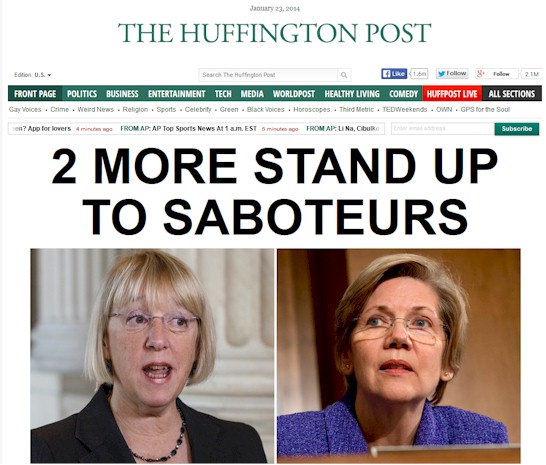
Huffpo vilifies supporters of sanctions

January 23, 2014

http://www.huffingtonpost.com/2014/01/22/iran-sanctions-bill-democrats_n_4646614.html

Pro-Israel (Jews) = Saboteurs.  Get it?  The new Leftist antisemitism. 

In Krauthammer’s words, “Wear your yellow star with pride!”  – JW

huff

Hey JosephWouk,

You have successfully closed your account with The Huffington Post. We’ll miss you!
If you want to sign up again later, you may do so here.
You can also reopen this account by following this link

You will no longer receive social notifications from The Huffington Post. You may reopen your account at any time.

Thanks,
The Huffington Post

McCain: Obama is Worse than Carter

January 23, 2014

McCain: Obama is Worse than Carter – News from America – News – Israel National News.

Senator McCain blasts Obama over Syria. “I thought Jimmy Carter was bad, but he pales in comparison to this president.”

By Elad Benari

First Publish: 1/23/2014, 4:44 AM

Senator John McCain (R., Ariz.) blasted President Barack Obama and his policy towards Syria on Tuesday, the Washington Free Beacon reports.

Speaking to Phoenix radio station KFYI, McCain compared Obama to former president Jimmy Carter, saying, “I thought Jimmy Carter was bad, but he pales in comparison to this president in my view.”

McCain also warned  that the rapidly deteriorating situation in Syria could pose a terror threat to the United States.

“It has turned into a tragedy of mammoth proportions, and if you don’t care about Syria, it’s becoming a regional conflict. It’s spread to Lebanon, it’s spread to Turkey, it’s spread to Jordan. It is spreading throughout the region and sooner or later, it will affect the United States of America,” he said.

McCain said Obama’s inaction in Syria and lack of support for moderate rebels could lead to an Al-Qaeda takeover of the country.

“We now have thousands of fighters of this — radical, extremist, Al-Qaeda affiliated people pouring in from all over the world into Syria, fighting against our guys, who are the good guys and also not doing much fighting against Bashar Assad,” he said, according to the Free Beacon.

McCain did not spare Secretary of State John Kerry from heavy criticism either, denouncing Kerry for negotiating with Russia while that country continues to prop up the Assad regime in Syria.

“I’m telling you, this guy [Assad] is a monster. The people who are giving him the weapons are the Russians, and our Secretary of State is buddy buddy and palsy-walsy with … his buddy Sergey [Lavrov] in places like Geneva and others,” he said.

McCain has long been a vocal opponent of Obama’s policy on Syria and has several times called on the president to take action in the civil war in Syria.

His latest criticism of the administration comes after he described Kerry as “a human wrecking ball” in the Middle East back in November.

“When the President of the United States says he’s going to launch a strike on another country, i.e. Syria, and the Secretary of State says, ‘Don’t worry, it’ll be unbelievably small’ – that is staggering, that’s mind-boggling,” McCain charged at the time.

He then proceeded to mock Kerry, “Don’t worry. We’re going to strike you but it’ll be unbelievably small? That’s sure ought to scare the heck out of them, wouldn’t it?”

Iran: We did not agree to dismantle anything

January 23, 2014

Iran: We did not agree to dismantle anything | The Times of Israel.

FM Mohammad Javad Zarif claims Washington has mischaracterized Tehran’s concessions in the interim nuclear agreement

January 23, 2014, 2:25 am

Iranian Foreign Minister Mohammad Javad Zarif smiles and laughs as he speaks to the media in Geneva, on Nov. 24, 2013, after the interim nuclear deal was concluded. (photo credit: AP/Carolyn Kaster/Pool)

Iranian Foreign Minister Mohammad Javad Zarif smiles and laughs as he speaks to the media in Geneva, on Nov. 24, 2013, after the interim nuclear deal was concluded. (photo credit: AP/Carolyn Kaster/Pool)

Iran’s foreign minister accused the US of mischaracterizing the terms of an interim nuclear deal that went into effect on Monday.

“We did not agree to dismantle anything,” Mohammad Javad Zarif told CNN in an interview on Wednesday, charging that the Obama administration had created a false impression in the language it used to describe the six-month agreement.

“The White House tries to portray it as basically a dismantling of Iran’s nuclear program,” he said, speaking from Davos, Switzerland, where he is attending the World Economic Forum. “If you find a single, a single word, that even closely resembles dismantling or could be defined as dismantling in the entire text, then I would take back my comment.”

Zarif repeated that “we are not dismantling any centrifuges, we’re not dismantling any equipment, we’re simply not producing, not enriching [uranium] over 5%.”

Both US and Iranian officials have tried to make the interim agreement palatable domestically. With the Iranians calling the nuclear deal a victory, and Obama officials saying that it essentially freeze’s the Islamic Republic’s nuclear program.

According to a White House fact sheet released in November, the interim deal mandates that Iran halt all uranium enrichment beyond 5% and “dismantle the technical connections required to enrich above 5%.”

In Washington, congressional aides who had been briefed by administration officials said Wednesday that negotiations over a final nuclear deal with Iran were expected to begin by mid-February.