Archive for November 2013

Geneva fallout: Iran becomes a nuclear power, followed by Saudis. Israel loses trust in Obama

November 8, 2013

Geneva fallout: Iran becomes a nuclear power, followed by Saudis. Israel loses trust in Obama.

DEBKAfile Exclusive Analysis November 8, 2013, 1:34 PM (IDT)
Falling-out between two allies over nuclear Iran

Falling-out between two allies over nuclear Iran

Israel’s most painful lesson from the two-day Geneva conference on Iran’s nuclear program is that the man who guaranteed to defend Israel’s security, President Barack Obama, is now marching hand in hand with Tehran towards a nuclear-armed Iran.


This is the reality behind the fuss and excitement surrounding the signing ceremony in Geneva Friday, Nov. 8, and the slick words gushing forth to put a convincing face on the interim deal put together between Iran and the Six Powers Thursday and Friday.
President Obama broke the news to NBC Thursday night: “There is a possibility of a phased agreement, the first part of which would stop Iran from further expanding its nuclear program. We are offering modest relief from the sanctions, but keeping the core sanctions in place, so that if it turned out during the course of the six months when we’re trying to resolve some bigger issues that they’re backing out of the deal or… not giving us assurances that they’re not developing a nuclear weapon, we can crank that dial back up,” the US president said.
Friday morning, when US Secretary of State John Kerry was heading for Geneva to join Iran’s Foreign Minister Javad Zarif for the final signing stage, it was still unclear what Iran is willing to concede.

This is because no one was ready to admit exactly what the agreed “freeze” applied to and how far it is from “dismantlement “

Iran had in fact already achieved all the makings of a nuclear bomb and was holding them in place ready for assembly. Uranium enrichment will furthermore continue although at a low grade.

At any moment, Tehran may decide to assemble those components and produce a bomb and has the capacity to do so before the US or Israel catch on to what is happening.

The accord to be signed Friday elevates Iran automatically to the rank of a nuclear power, which already holds Syria, Iraq and Lebanon under its sway. The radical alliance binding Iran’s Ayatollah Ali Khamenei, Syria’s Bashar Assad and Hizballah’s Hassan Nasrallah has triumphed. Israel fell down badly by trusting the Obama administration to break this axis up before it spreads more violence and havoc across the region.

Before setting off for Geneva, Secretary Kerry warned Israel that the breakdown of talks with the Palestinians would result in a third “intifada.”

But he made no reference to the Iranian nuclear intifada now looming over Israel and the entire Middle East.

Before coming to Jerusalem, the US Secretary visited Riyadh. But there was nothing much for him to discuss with King Abdullah and Foreign Minister Saud Al-Faisal, because both had accepted that there is no chance of turning the Obama administration from its chosen track which results in Iran enjoying the freedom to pursue a nuclear weapon amid progressively enhanced sanctions relief.
Some time ago, the Saudis took what they saw as appropriate preemptive action.

On Jan. 1, 2013, Crown Prince Salman, deputy premier and defense minister, traveled to Islamabad and commissioned Pakistan to build nuclear weapons for a multibillion fee. Those weapons were assembled in Pakistan and held ready for transfer to Saudi Arabia at a moment’s notice.
Last week, former Israeli Military Intelligence (AMAN) chief Amos Yadlin told a conference in Sweden that if Iran got the bomb, “the Saudis will not wait one month. They have already paid for the bomb and will go to Pakistan and bring back what they need.”

So the countdown to a nuclear Saudi Arabia begins with the signing of the “interim” Iranian nuclear deal in Geneva. Its first result will be the deployment of a Sunni Muslim Arab nuke versus a Shiite Iranian bomb. Israel’s reputed nuclear program remains in its decades-old holding position.
The burgeoning nuclear standoff will inject a further unstable element in the volatile Middle East.
Washington has not chosen that road out of stupidity or blindness as some dismayed Israeli officials are saying. The plan appears to be not only to present Israel with a nuclear challenge, but to put a damper on Russia’s strategic and military momentum in the region.

Even if this calculus proves correct it will take years for it to unfold.
Prime Minister Binyamin Netanyahu admitted he was stunned by the terms of the accord negotiated with Iran, calling it a “monumental, historic mistake” and “Iran’s deal of the century.”

Tehran has conceded nothing and receives limited sanctions relief, he said.

The interim agreement, said Netanyahu, buries the possibility of a peaceful final accord for dismantling Iran’s nuclear program once and for all. “Israel is not obliged by this agreement and will do everything it needs to do to defend itself and defend the security of its people,” he said.

His words carried two messages:

1. Israel has abandoned its trust in Barack Obama ever complying with his pledge to its security and will henceforth act on its own.
2. Israel’s only remaining course now is to exercise its military option against Iran’s nuclear capability – whether openly or covertly.

For five years, Binyamin Netanyahu has repeatedly warned the world that Israel was ready for military action to preempt a nuclear-armed Iran. Each successive repetition was received on a diminishing scale of credibility. His response to the Geneva accord is therefore anyone’s guess.

A deal — and then a war

November 8, 2013

A deal — and then a war « FresnoZionism.org — ציונות פרסנו.

Churchill

Churchill. Is his kind of leadership extinct in the West?

Benjamin Weinthal:

The Islamic Republic of Iran has laid a foundation to impose its will on the U.S. and continue its illicit nuclear-weapons program. The elements of a negotiated agreement outlined today in Geneva show the Obama administration engaging in concessionary bargaining with a rogue regime.

Abbas Araqchi, Iran’s deputy foreign minister, declared the U.S. and its partners “accepted the framework of Iran’s proposal,” the components of which entail sanctions relief in exchange for Iran’s suspension of some elements of its nuclear program.

There is no sign that Iran is willing to permanently stop its uranium enrichment, close its Arak and Fordo nuclear facilities, and ship its already 3.5 percent–enriched uranium outside of the country.

Moreover, there is no definitive method of verification to ensure that Iran’s clerical regime — a notoriously deceptive group — will comply with an agreement (Remember the North Korean debacle.)

In choosing to grant Iran concessions, the U.S. ignores that it has crucial economic leverage to dismantle Iran’s nuclear program. Bloomberg recently reported that “Iran’s economy will contract 1.5 percent this year after shrinking 1.9 percent in 2012,” while Trevor Houser, an economics expert, says, “Right now, Iran needs to sell its oil far more than the rest of the world needs to buy it.”

Israel’s PM Netanyahu responded to the news,

The proposal would allow Iran to retain the capabilities to make nuclear weapons. Israel totally opposes these proposals … I believe that adopting them is a mistake of historic proportions.

That is more or less the whole story. There will be more details, but it seems that the US, which could stop Iran from building nuclear weapons, has decided not to. Not only will it not make a credible military threat, it has folded even before exhausting the option of sanctions.

Saudi Arabia understands. It is now either on the verge of procuring nuclear capability from Pakistan, or has already done so.

This feels so … 1938. A vicious civil war chews up a country, which is serving as a proxy for the major combatants, who are arming themselves for the big show. The ‘responsible’ nations of the world try to defuse an aggressor’s violence by a policy of appeasement. Trita Parsi asks “Do we want a deal or a war?” but maybe we’ll make a deal and get a war anyway.

Netanyahu has been accused of ‘overreacting’, he’s been called ‘shrill’ and his demand that sanctions be increased rather than reduced until Iran actually dismantles its program is said to be ‘unreasonable’. He is “out of step,” say diplomats. I am sure they said the same about Czech President Edvard Beneš in 1938.

Netanyahu is quite rational, aware of the danger facing his country from the fanatically anti-Israel regime in Iran, whose officials have said over and over that they intend to destroy it. And now they are getting nuclear weapons. How is he supposed to sound?

Netanyahu is on a collision course with the US. The US will do practically anything to keep Israel from attacking Iran, and will punish her if she does. And Netanyahu sees that he simply will have no choice but to attack Iran.

Keep in mind that most of those, like Meir Dagan, that opposed an attack did so because they thought that the diplomatic option might work, not that Iran could be allowed to have the bomb. And diplomacy — tough sanctions — might have worked, if it were not for the cowardice, ignorance and stupidity of the Obama Administration.

But it is not going to be tried. There is going to be a deal. And then there is going to be a war.

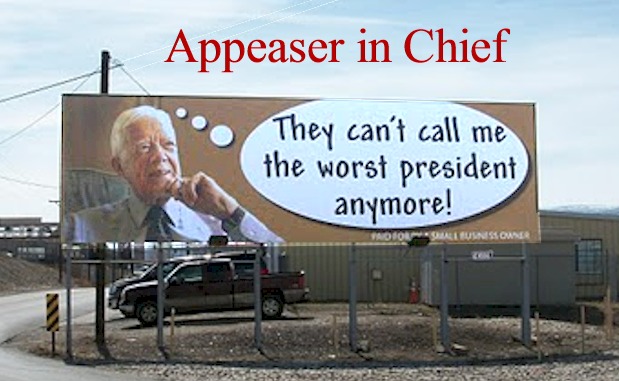
Appeaser in Chief

November 8, 2013

appeaser

Netanyahu: Israel rejects nuclear deal with Iran

November 8, 2013

Netanyahu: Israel rejects nuclear deal with Iran – Israel News, Ynetnews.

Tensions reach boiling point: PM briefly meets Kerry before latter heads to Geneva; says Israel ‘not obliged’ to agreement between Tehran world powers, adds ‘Iranians got everything and paid nothing

Reuters

Published: 11.08.13, 10:54 / Israel News

srael utterly rejects a mooted world powers deal with Iran aimed at ending a long-running row over its nuclear ambitions and will not be bound by such an accord, Prime Minister Benjamin Netanyahu said on Friday.

Speaking as headed into a meeting with US Secretary of State John Kerry, Netanyahu told reporters that Iran had got “the deal of the century”.

“Israel utterly rejects it and what I am saying is shared by many in the region, whether or not they express that publicly. Israel is not obliged by this agreement and Israel will do everything it needs to do to defend itself and the security of its people,” he said.


Israel has repeatedly warned that it might strike Iran if it did not halt its nuclear program, accusing Tehran of seeking to build atomic weapons. Iran says its various nuclear facilities are geared to civilian needs.

Netanyahu was meeting Kerry for the third time in barely 48 hours. The US secretary of state was due to fly immediately afterwards to Geneva where Iran and six world powers are holding negotiations.

The United States has said world powers will consider relaxing some economic sanctions against Iran if it takes verifiable steps to limit its nuclear program.

Israel has called for the sanctions to remain in place until Iran has dismantled its entire enrichment program.

Netanyahu: Iranians got everything (Photo: Shaul Golan, Yedioth Ahronoth)

 “I understand that the Iranians are walking around very satisfied in Geneva as well they should be because they got everything and paid nothing,” Netanyahu said.

“Everything they wanted, they wanted relief of sanctions after years of a grueling sanctions regime, they got that. They are paying nothing because they are not reducing in any way their nuclear enrichment capability,” he said.

An Israeli official declined to say what deal was brewing, or how Israel knew the details.

Netanyahu warns Kerry: Israel not bound by any deal between Iran and West

November 8, 2013

Netanyahu to Kerry: Israel not bound by any deal with Iran | The Times of Israel.

PM: Jerusalem ‘utterly rejects’ possible agreement with Tehran, warns Israel will do what it needs to defend itself

November 8, 2013, 7:57 am Updated: November 8, 2013, 11:00 am

Israel is not bound by any nuclear deal the West makes with Iran on its controversial nuclear program, Prime Minister Benjamin Netanyahu told US Secretary of State John Kerry Friday morning, at their third meeting in just 72 hours, ahead of Kerry’s trip to Geneva for continued nuclear talks with Iran in the framework of the P5+1 negotiations — a last-minute decision that suggests a deal could be imminent.

“I understand that the Iranians are walking around very satisfied in Geneva, as well they should be, because they got everything, and paid nothing. They wanted relief from sanctions after years of a grueling sanctions regime. They got that. They are paying nothing, because they are not reducing in any way their nuclear enrichment capability. So Iran got the deal of the century and the international community got a bad deal,” Netanyahu said.

“This is a very bad deal. Israel utterly rejects it and what I am saying is shared by many, many in the region, whether or not they express it publicly. Israel is not obliged by this agreement and Israel will do everything it needs to defend itself, to defend the security of its people,” affirmed Netanyahu.

Turning to seemingly address Kerry’s scathing critique Thursday night on Channel 2 of Israel’s West Bank policies, Netanyahu said: “I will never compromise on Israel’s security and our vital interests, not in the face of any international pressure. I think the pressure has to be put where it belongs, that is, on the Palestinians who refuse to budge. But I think in any case, no amount of pressure will make me or the government of Israel compromise on the basic security and national interests of the State of Israel. The people of Israel know this and they support it, as they should.”

Kerry and Netanyahu’s meeting was held at Ben-Gurion International Airport and was focused on a possible deal — of “limited” sanctions relief in response to an Iranian agreement to start scaling back nuclear activities — between world powers and Tehran, which Netanyahu labeled a historic mistake.

A senior State Department official said that Kerry had been open to the possibility of traveling to Geneva for the talks “if it would help narrow differences.”

The official said the European Union’s top diplomat, Catherine Ashton, asked Kerry to attend the latest round of discussions. The official called the negotiations “a complex process” and said Kerry was “committed to doing anything he can” to help.

According to the Telegraph, the Iranian deal’s four main points were that Iran would stop enriching uranium to 20 percent and convert its existing stockpile into harmless uranium oxide. Iran would be able to continue enrichment to 3.5% purity necessary for nuclear power plants — but would agree to limit the number of centrifuges running for this purpose. The inactive centrifuges would be able to remain intact. Iran would also agree not to activate its plutonium reactor at Arak, which could provide an alternative route to a nuclear weapon, during the six-month period in which Iran will limit uranium enrichment to 3.5%. Lastly, Iran would agree not to use the advanced IR-2 centrifuges, which enrich uranium three to five times faster than the older model.

In return, the British paper reported, the US “would ease economic sanctions, possibly by releasing some Iranian foreign exchange reserves currently held in frozen accounts” and ease “some restrictions on Iran’s petrochemical, motor and precious metals industries.”

On Thursday night, Netanyahu said the proposals “on the table in Geneva” would “ease the pressure on Iran in return for ‘concessions’ that aren’t concessions at all.” He said Israel completely opposes these proposals, which would leave Iran with a capacity to build nuclear weapons.

“I believe that adopting [these proposals] would be a mistake of historic proportions. They must be rejected outright,” he said at a conference of Israeli and Diaspora leaders in Jerusalem Thursday.

Later, during a meeting with a US Congress delegation, Netanyahu angrily called the offer being discussed in Geneva the “deal of the century” for Iran.

Sanctions had brought Iran to the brink of economic collapse, and the P5+1 countries have the opportunity to force Iran to completely dismantle its nuclear weapons program, the prime minister said. “Anything less than that” would reduce the likelihood of a peaceful solution to the crisis, he said, and Israel would always reserve the right to protect itself against any threat.

In an interview with Israel’s Channel 2 Thursday, Kerry stressed the negotiators in Geneva were requiring Iran to “provide a complete freeze over where they are today.” He argued that it was “better” to be talking to Iran, and seeking to “expand” the time it would take Iran to break out to the bomb, than not to be talking to Iran, and have it continuing to advance its nuclear program. “We have not taken away any of the sanctions yet,” he said. “We will not undo the major sanctions regime until we have absolute clarity,” he said.

If Iran did not “meet the standards” required by the international community, Kerry said, it knew “worse sanctions” were in prospect, and even, as the “clock ticks down… there may be no option but the military option. We hope to avoid that.”

On Thursday, the White House said world powers negotiating with Iran are pursuing an agreement that would offer some sanctions relief if Tehran halts and possibly reverses parts of its nuclear program.

White House spokesman Jay Carney said the first step would deal with Iran’s most advanced nuclear activities.

Carney said that, in exchange, the world powers would consider targeted and limited sanctions relief. He said the relief would be reversible, and sanctions could even be tightened, if Iran breaks its word.

The meeting between Kerry and Netanyahu Friday took place a day after the secretary of state launched an unusually bitter public attack on Israeli policies in the West Bank, during an interview with Israel’s Channel 2, warning that if current peace talks fail, Israel could see a Third Intifada and growing international isolation, and that calls for boycott, divestment and sanctions would increase.

“The alternative to getting back to the talks is the potential of chaos,” Kerry said during the interview. “I mean, does Israel want a Third Intifada?” he asked. “Israel says, ‘Oh, we feel safe today, we have the wall. We’re not in a day-to-day conflict,’” said Kerry. “I’ve got news for you. Today’s status quo will not be tomorrow’s…” Israel’s neighbors, he warned, will “begin to push in a different way.”

“If we do not resolve the issues between Palestinians and Israelis, if we do not find a way to find peace, there will be an increasing isolation of Israel, there will be an increasing campaign of delegitimization of Israel that’s been taking place on an international basis,” he went on.

Turning to settlements and Israel’s presence in the West Bank, he added: “If we do not resolve the question of settlements, and the question of who lives where and how and what rights they have; if we don’t end the presence of Israeli soldiers perpetually within the West Bank, then there will be an increasing feeling that if we cannot get peace with a leadership that is committed to nonviolence, you may wind up with a leadership that is committed to violence.”

Israel’s Channel 2 quoted an unnamed official in Jerusalem responding bitterly to the secretary’s remarks, saying Israel would not “succumb to fear tactics” by the secretary, and would not compromise on its vital security needs. The official also reportedly noted that Kerry’s comments would not “encourage” the Palestinians to compromise.

The Israeli official seemed to be angrily echoing Kerry’s own comments in connection with the Iranian nuclear program in late October, when he said that America “will not succumb to those fear tactics” — remarks interpreted by commentators as criticism of Israeli warnings about the dangers of talking to Tehran.

Iranian simulation: Missiles on Ben Gurion

November 8, 2013

Iranian simulation: Missiles on Ben Gurion – Israel News, Ynetnews.

While Geneva talks make progress towards agreement, Iranian state television broadcast simulated missile attack on Israel

Ynet

Published: 11.08.13, 10:15 / Israel News

An agreement between the United States and Iran over the latter’s nuclear program seems imminent, but the charm offensive in Geneva is not mirrored at home. In Tehran, the Iranian government sent a different message with a broadcast on state television of a simulated missile attack on Israel.  

The hour-long documentary program included segments about the capabilities of Iranian missiles and the possibility of their use in response to foreign threats. The program included a video simulation of a potential response by Iran to an Israeli strike on its nuclear facilities.

The video showed computer-animated launches of Iran’s long-range Sejjil ballistic missiles. The animations show Israel’s air defense systems intercepting a few missiles as others penetrate the protective layer and destroy different strategic targets across Israel.

Among the targets shown are the Azrieli Towers and the Kirya in Tel Aviv, the IDF base Tzfirin in central Israel, a generic missile launch site, Ben Gurion Airport, and the nuclear reactor at Dimona. The targets were circled on Google Maps, and the video finished with real pictures of casualties from the Second Lebanon War.

In 2012, Iran’s supreme leader Ayatollah Ali Khamenei threatened Israel with the destruction of Tel Aviv and Haifa – part of the usual rhetoric employed by the Islamic regime. “At times, the Zionist entity threatens a military attack, but they know that if they make the smallest mistake, the Islamic republic will obliterate Tel Aviv and Haifa.”

EMP Blackout Could Be Closer than You Think

November 8, 2013

EMP Blackout Could Be Closer than You Think – Op-Eds – Israel National News.

North Korea is prepared, probable target the USA. Iran is not far behind and has already told the world its intentions.

Ambassador R. James Woolsey is former Director of Central Intelligence and Co-Chair of the EMP Coalition; Dr. Peter Vincent Pry served on the Congressional EMP Commission, the House Armed Services Committee, and the CIA, and is author of the books Apocalypse Unknown and Electric Armageddon both available from CreateSpace.com and Amazon.com
 

Four days before Halloween, on Sunday morning, October 27, 2013, terrorists in Mexico’s Michoacan state blacked out the electric grid, leaving some 420,000 powerless and thirteen dead. That same Sunday night, National Geographic aired the docudrama American Blackout.  This fictionalized account of a cyber attack on the electric grid depicts some of the horrific consequences of a nationwide blackout in the USA lasting 10 days:

People get trapped in elevators and become virtual prisoners in their high-rise apartment buildings.  Gasoline is rationed to the military and hospitals, so the average American has no transportation–except for his legs.  Food and water become so scarce that there is a life and death struggle over a can of peaches.  Before day 10 of the blackout, when the lights come back on, society starts breaking down into anarchy as gangs and vigilante groups run wild.

National Geographic is to be applauded for American Blackout which is essentially a training film to educate the American people about the very real threat posed to their lives by a cyber attack on the electric grid.  If there is any fault or unrealism in the docudrama, it is that the blackout lasts only 10 days, and recovery is achieved so quickly.

While Mother Nature can also be a source of EMP disasters, this article deals with the possible threats posed by man. In real life, terrorists or rogue states would probably not limit their attack on the nation’s electric grid to computer viruses or hacking, as implied in the docudrama.  They would also use other more destructive means–that could cause a protracted national blackout lasting months or years.

Nuclear EMP–The Ultimate Cyber Threat

Electromagnetic Pulse (EMP) is a dimension of the cyber threat that is not usually considered a cyber threat in Western doctrine, but is in the playbooks for an Information Warfare Operation of Russia, China, North Korea, and Iran.  These potential adversaries in their military doctrines include as part of cyber warfare a wide spectrum of operations beyond computer viruses, including sabotage and kinetic attacks, up to and including nuclear EMP attack.

It is vitally important that we understand that a nuclear EMP attack is part of cyber and information warfare operations as conceived by our potential adversaries.  Our cyber doctrine must be designed to deter and defeat the cyber doctrines of our potential adversaries by anticipating how they plan to attack us–but our doctrine currently does not.

Our cyber and information warfare doctrines are dangerously blind to the likelihood that a potential adversary making an all-out information warfare campaign designed to cripple the U.S. electric grid and other critical infrastructures would include an EMP attack.

The assessment that nuclear EMP attack is included in the cyber and  information warfare doctrine of potential adversaries, and the effects of an EMP attack described here, are based on the work of the Congressional EMP Commission that analyzed this threat for nearly a decade (2001-2008).  The Congressional Strategic Posture Commission and several other major U.S. Government studies independently arrived at similar conclusions, and represent collectively a scientific and strategic consensus that nuclear EMP attack upon the United States is an existential threat.

Nuclear EMP Attack

A nuclear weapon detonated at high-altitude, above 30 kilometers, will generate an electromagnetic pulse that can be likened to a super-energetic radio wave, more powerful than lightning, that can destroy and disrupt electronics across a broad geographic area, from the line of sight from the high-altitude detonation to the horizon.

For example, a nuclear weapon detonated at an altitude of 30 kilometers would project an EMP field with a radius on the ground of about 600 kilometers, that could cover all the New England States, New York and Pennsylvania, damaging electronics across this entire region, including electronics on  aircraft flying across the region at the time of the EMP attack.  The EMP attack would blackout at least the regional electric grid, and probably the entire Eastern Grid that generates 70 percent of U.S. electricity, for a protracted period of weeks, months, possibly years.

The blackout and EMP damage beyond the electric grid in other systems would collapse all the other critical infrastructures–communications, transportation, banking and finance, food and water–that sustain modern civilization and the lives of millions.

Such an EMP attack, a nuclear detonation over the U.S. East Coast at an altitude of 30 kilometers, could be achieved by lofting the warhead with a meteorological balloon.

A more ambitious EMP attack could use a freighter to launch a medium-range missile from the Gulf of Mexico, to detonate a nuclear warhead over the geographic center of the United States at an altitude of 400-500 kilometers.  The EMP field would extend to a radius of  at least 2,200 kilometers on the ground, covering all of the contiguous 48 United States, causing a nationwide blackout and collapse of the critical infrastructures everywhere.

All of this would result from the high-altitude detonation of a single nuclear missile.

The Congressional EMP Commission warned that Iran appears to have practiced exactly this scenario.  Iran has demonstrated the capability to launch a ballistic missile from a vessel at sea.  Iran has also several times practiced and demonstrated the capability to detonate  a warhead on its medium-range Shahab III ballistic missile at the high-altitudes necessary for an EMP attack on the entire United States.  The Shahab III is a mobile missile, a characteristic that makes it more suitable for launching from the hold of a freighter.

Launching an EMP attack from a ship off the U.S. coast could enable the aggressor to remain anonymous and unidentified, and so  escape U.S. retaliation.

EMP In Cyber Warfare

The Congressional EMP Commission warned that Iran in military doctrinal writings explicitly describes making a nuclear EMP attack to eliminate the United States as an actor on the world stage as part of an Information Warfare Operation.  For example, various Iranian doctrinal writings on information and cyber warfare make the following assertions:

“Nuclear weapons…can be used to determine the outcome of a war…without inflicting serious human damage [by neutralizing] strategic and information networks.”

“Terrorist information warfare [includes]…using the technology of directed energy weapons (DEW) or electromagnetic pulse (EMP).”

“…today when you disable a country’s military high command through disruption of communications you will, in effect, disrupt all the affairs of that country….If the world’s industrial countries fail to devise effective ways to defend themselves against dangerous electronic assaults, then they will disintegrate within a few years.”

China’s premier military textbook on information warfare, written by China’s foremost expert on cyber and information warfare doctrine, makes unmistakably clear that China’s version of an all-out Information Warfare Operation includes both computer viruses and nuclear EMP attack.  According to People’s Liberation Army textbook World War, the Third World War–Total Information Warfare, written by Shen Weiguang, “Therefore, China should focus on measures to counter computer viruses, nuclear electromagnetic pulse…and quickly achieve breakthroughs in those technologies…”:

With their massive destructiveness, long-range nuclear weapons have combined with highly sophisticated information technology and information warfare under nuclear deterrence….Information war and traditional war have one thing in common, namely that the country which possesses the critical weapons such as atomic bombs will have “first strike” and “second strike retaliation” capabilities ….As soon as its computer networks come under attack and are destroyed, the country will slip into a state of paralysis and the lives of its people will ground to a halt. Therefore, China should focus on measures to counter computer viruses, nuclear electromagnetic pulse…and quickly achieve breakthroughs in those technologies in order to equip China without delay with equivalent deterrence that will enable it to stand up to the military powers in the information age and neutralize and check the deterrence of Western powers, including the United States.

Surprise EMP Attack

North Korea appears to be attempting to implement the information warfare doctrine described above by developing a long range missile capable of making a catastrophic nuclear EMP attack on the United States.  In December 2012, North Korea demonstrated the capability to launch a satellite on a polar orbit circling the Earth at an altitude of 500 kilometers.

An altitude of 500 kilometers would be ideal for making an EMP attack that places the field over the entire contiguous 48 United States, using an inaccurate satellite warhead for delivery, likely to miss its horizontal aimpoint over the geographic center of the U.S. by tens of kilometers.

North Korea appears to have borrowed from the Russians their idea for using a so-called Space Launch Vehicle to make a stealthy nuclear attack on the United States.  During the Cold War, Moscow developed a secret weapon called a Fractional Orbital Bombardment System (FOBS) that looked like a Space Launch Vehicle, but was designed to launch a nuclear warhead southward, away from the United States initially, but deliver the warhead like a satellite on a south polar orbit, so the nuclear attack comes at the U.S. from the south.

The United States has no Ballistic Missile Early Warning (BMEW) radars or missile interceptors facing south.  We might not even see the attack coming.

Miroslav Gyurosi in The Soviet Fractional Orbital Bombardment System describes Moscow’s development of the FOBS:

The Fractional Orbital Bombardment System (FOBS) as it was known in the West, was a Soviet innovation intended to exploit the limitations of U.S. BMEW radar coverage. The idea behind FOBS was that a large thermonuclear warhead would be inserted into a steeply inclined low altitude polar orbit, such that it would approach CONUS from any direction, but primarily from the southern hemisphere, and following a programmed braking maneuver, re-enter from a direction which was not covered by BMEW radars.

“The first warning the U.S. would have of such a strike in progress would be the EMP…,” writes Gyurosi.

The trajectory of North Korea’s satellite launch of December 12, 2012 looked very much like a Fractional Orbital Bombardment System for EMP attack.  The missile launched southward, away from the United States, sent the satellite over the south polar region, approaching the U.S. from the south, at the optimum altitude for EMP attack–although the test trajectory deliberately avoided flying over the United States initially.

In subsequent orbits the North Korean satellite did overfly the central U.S. at the optimum location for an EMP attack.

Super-EMP Attack

North Korea appears to have borrowed from Russia more than the FOBS.  In 2004, a delegation of Russian generals met with the Congressional EMP Commission to warn that design information for a Super-EMP nuclear warhead had leaked from Russia to North Korea, and that North Korea might be able to develop such a weapon “in a few years.”

A few years later, in 2006, North Korea conducted its first nuclear test, of a device having a very low yield, about 3 kilotons.  All three North Korean nuclear tests have had similarly low yields.  A Super-EMP warhead would have a low-yield, like the North Korean device, because it is not designed to create a big explosion, but to produce gamma rays, that generate the EMP effect.

According to several press reports, South Korean military intelligence concluded independently of the EMP Commission that Russian scientists are in North Korea helping develop a Super-EMP nuclear warhead.  In 2012, a military commentator for the People’s Republic of China stated that North Korea has Super-EMP nuclear warheads.

One design of a Super-EMP warhead would be a modified neutron bomb, more accurately an Enhanced Radiation Warhead (ERW) because it produces not only large amounts of neutrons but large amounts of gamma rays, that cause the EMP effect.  One U.S. ERW warhead (the W-82) weighed less than 50 kilograms.  North Korea’s so-called Space Launch Vehicle, which orbited a satellite weighing 100 kilograms, could deliver such a warhead against the U.S. mainland–or against any nation on Earth.

Iran has not yet tested a nuclear weapon, but may already have a FOBS delivery capability, as it has successfully launched several satellites on polar orbits, assisted by North Korean missile technology and North Korean technicians.

Iranian scientists were present at all three North Korean nuclear tests, according to press reports.

Defending America and the World

What is to be done about the Cyber and EMP threats?

There is no excuse for the United States to be vulnerable to EMP or to the worst case cyber scenarios as depicted in American Blackout.  The U.S. Department of Defense has understood for 50 years how to protect military systems from EMP.  Private vendors specializing in EMP protection are standing by with faraday cages, surge arrestors, blocking devices and other technology, ready to protect the national electric grid.

Technically, it is important to understand that surge arrestors and other hardware designed to protect against EMP can also protect against the worst-case cyber scenarios that, for example, envision computer viruses collapsing the national power grid.  For example, surge arrestors that protect Extra High Voltage transformers from EMP can also protect transformers from  damaging electrical surges caused by a computer virus that manipulates the grid Supervisory Control And Data Acquisition Systems (SCADAS).

Unfortunately, the electric power industry so far shows no inclination to invest in the technologies necessary to protect the national electric grid.  The congressional EMP Commission estimates that robust protection of the national electric grid could be achieved for a one-time investment of $2 billion–which is what the U.S. gives every year in foreign aid to Pakistan.  The U.S. Federal Energy Regulatory Commission (FERC) estimates that EMP protection of the national grid would increase the electric bill of the average rate payer by 20 cents annually.

Administratively, a coherent and effective answer will not likely arise from uncoordinated decisions made independently by the thousands of individual electric utilities and  industries at risk.  Because cyber preparedness should encompass EMP preparedness–and since EMP is an existential threat–it is imperative that Government play a supervisory and coordinating role to achieve protection against these threats swiftly:

–The President should sign the Executive Order provided to the White House by the Congressional EMP Commission directing that the national electric grid shall be protected against EMP;

–The Congress should pass the SHIELD Act, which has been stalled before the House Energy and Commerce Committee for three years.  SHIELD empowers the U.S. FERC with legal and financial authorities to protect the national grid from EMP;

–States should not wait for Washington, but should immediately launch their own legislative initiatives, as done already by the State of Maine, to protect that portion of the electric grid within their states.  States can “island” their grids, which will in no way impede their ability to receive or export electric power from or to other states, and thereby protect their people from an EMP catastrophe.

–Industry should start manufacturing Extra-High Voltage (EHV) transformers, SCADAS, and other critical technologies hardened against EMP.  Defense Department experience with hardening military systems has shown that, when systems are built with EMP protection as part of the original design, it only adds 1-3 percent to manufacturing cost.  As old EHV transformers are retired and other systems are replaced with new systems designed EMP hard, not only the United States, but the entire Free World would eventually become protected from an EMP catastrophe.

The Unfree World, Russia and China, have already hardened their grids against EMP. Israel may have done the same – and if it has not, there is no time to be lost.

Frustrated Kerry’s peace critique a heavy slap in Netanyahu’s face

November 8, 2013

Frustrated Kerry’s peace critique a heavy slap in Netanyahu’s face | The Times of Israel.

A patently bitter secretary of state asks why Israel keeps taking Palestinian land, and why the Israeli public doesn’t seem to care about it

November 7, 2013, 11:06 pm

Prime Minister Benjamin Netanyahu speaks during a meeting with US Secretary Of State John Kerry in Jerusalem, Wednesday, November 6, 2013 (photo credit: Miriam Alster/Flash90)

Prime Minister Benjamin Netanyahu speaks during a meeting with US Secretary Of State John Kerry in Jerusalem, Wednesday, November 6, 2013 (photo credit: Miriam Alster/Flash90)

On Wednesday, Prime Minister Benjamin Netanyahu told his old friend John Kerry in Jerusalem that he was concerned about the peace process, and asked the visiting US secretary of state to “steer [the Palestinians] back to a place where we could achieve the historical peace that we seek.” John Kerry quickly responded by lauding both sides’ “good faith,” and said he was “very confident” the negotiations would succeed.

But on Thursday, he loosened the diplomatic straitjacket, and we all got a much better look at what John Kerry really thinks about progress — and blame — in the new peace effort he worked so strenuously to revive a little over three months ago. He turned directly to the Israeli and Palestinian peoples and showed them rather more of his true colors. To the prime minister, it is safe to assume, they did not look particularly blue and white.

For the first time since he managed to restart the talks in July, Kerry dropped his statesman-like public impartiality, and clearly spoke from the heart — and what emerged were a series of accusations that amounted to a forceful slap in the face for Netanyahu. It was a rhetorical onslaught that the prime minister cannot have expected and one he will not quickly forget.

In an extremely unusual joint interview with Israel’s Channel 2 and the Palestinian Broadcasting Corporation, a very frustrated Kerry basically blamed the Israeli government for stealing the Palestinians’ land and the Israeli public for living in bubble that prevents them from caring much about it. If that wasn’t enough, he railed against the untenability of the Israel Defense Forces staying “perpetually” in the West Bank. In warning that a violent Palestinian leadership might supplant Mahmoud Abbas if there was not sufficient progress at the peace table, he appeared to come perilously close to empathizing with potential Palestinian aggression against Israel.

“If we do not resolve the issues between Palestinians and Israelis,” Kerry warned early in the interview, “if we do not find a way to find peace, there will be an increasing isolation of Israel [and an] increasing campaign of delegitimization of Israel.

“If we do not resolve the question of settlements,” he continued more dramatically, “and the question of who lives where and how and what rights they have; if we don’t end the presence of Israeli soldiers perpetually within the West Bank, then there will be an increasing feeling that if we cannot get peace with a leadership that is committed to non-violence, you may wind up with leadership that is committed to violence.”

He later elaborated, expressing apparently growing dismay over continued Israeli settlement expansion: “How, if you say you’re working for peace and you want peace, and a Palestine that is a whole Palestine that belongs to the people who live there, how can you say we’re planning to build in a place that will eventually be Palestine? So it sends a message that perhaps you’re not really serious.” That was a critique that will have resonated widely among those many Israelis, and critics from outside, who have long argued that Israel should limit any settlement building to areas it envisages seeking to retain in a permanent accord.

Kerry seemed to place the blame for the failure to make rapid and major progress in negotiations overwhelmingly on Israel, with no acknowledgement — in his statements as broadcast Thursday — of two intifadas, relentless anti-Israel incitement in the Palestinian territories, the Hamas takeover of Gaza and the constant rocket fire from the Strip. (It is important to note that Channel 2 aired only part of the full interview on Thursday. More is set to air Friday evening.)

In lamenting the IDF’s presence in the West Bank, Kerry positioned himself directly opposite Netanyahu, for whom an ongoing Israeli security presence in the Jordan Valley is a stated crucial condition for an agreement. Perhaps more surprisingly, he showed no evident concern over the danger of a Hamas takeover in the West Bank were the IDF to withdraw, disregarding a widely held concern — borne of the rapid ease with which Hamas swept Abbas’s forces aside in Gaza in 2007 — that the official Palestinian Authority forces alone would not be able to hold sway.

His comments, which indicated an assessment that Israelis are unrealistic about where the region is heading, seemed particularly bitter. “The alternative to getting back to the talks is the potential of chaos. I mean, does Israel want a third intifada?” Kerry asked rhetorically, before lashing out at ordinary Israelis. “I know there are people who have grown used to this,” he said referring to the current relatively peaceful stalemate. “And particularly in Israel. Israel says, ‘Oh we feel safe today. We have the wall, we’re not in a day-to-day conflict, we’re doing pretty well economically.’

“Well, I’ve got news for you,” he said, apparently addressing the Israeli public. “Today’s status quo will not be tomorrow’s or next year’s. Because if we don’t resolve this issue, the Arab world, the Palestinians, neighbors, others, are going to begin again to push in a different way.”

That line of thinking reflects much international conventional wisdom on the Israeli-Palestinian conflict — the assumption that Israel could attain peace with the Palestinians if only it wanted to, but that it just doesn’t want to enough. Many Israelis, Netanyahu most certainly among them, would counter that Israel cannot impose terms on a Palestinian leadership that, among numerous other problematic negotiating positions, still demands a “right of return” that would constitute suicide for the Jewish state. Many Israelis, their prime minister among them, too, would note that Israel is only too aware of how easily the relative calm could deteriorate, and thus are wary of relinquishing territory to a Palestinian leadership that, relatively moderate though it may be, might not be in a position to retain power and honor any accord amid sweeping regional instability.

For Netanyahu, watching Kerry’s from-the-heart interview must have topped what was already a pretty lousy day. In Geneva, the six world powers were inching toward a deal with the Iranians that the prime minister fears would leave Tehran with an enrichment capability even as the sanctions are eased — something Netanyahu considers a “historic error.”

Kerry weighed in on that, too, in the interview. Ultimately, if Iran doesn’t “meet the standards of the international community,” said the secretary unhappily, “there may be no option but the military option.” But, he quickly insisted, “we hope to avoid that.”

Just the sort of message Netanyahu has been urging the US not to deliver to Tehran.

‘Iran, world powers to announce initial deal as early as Friday’

November 8, 2013

‘Iran, world powers to announce initial deal as early as Friday’ | The Times of Israel.

According to a report in the Wall Street Journal, sides preparing ‘joint draft’ ahead of possible agreement

November 8, 2013, 10:21 am

P5+1 delegations meet for talks on Iran's nuclear program at in Geneva November 7, 2013. (Photo credit: State Department/Twitter)

P5+1 delegations meet for talks on Iran’s nuclear program at in Geneva November 7, 2013. (Photo credit: State Department/Twitter)

The P5+1 world powers and Iran are set to announce an initial deal on Iran’s controversial nuclear program as early as Friday, marking a breakthrough in the second round negotiations that have been talking place in Geneva.

According to a report in the Wall Street Journal,  the two sides were “jointly preparing a draft” ahead of the possible announcement.

US Secretary of State John Kerry was making his way to Geneva Friday to participate in the talks — a last-minute decision that further suggests a deal could be imminent.

On Thursday, the US delegation led by Undersecretary of State Wendy Sherman held bilateral talks with the Iranian delegation headed by Iranian Foreign Minister Mohammad Jazad Zarif on the sidelines of the P5+1 talks.

“It was a substantive and serious conversation,” said a US official who was in the meeting.

The deal could see international sanctions on Iran scaled back in exchange for Iran halting and possibly reversing parts of its nuclear program.

According to the Telegraph, the deal’s four main points were that Iran would stop enriching uranium to 20 percent and convert its existing stockpile into harmless uranium oxide. Iran would be able to continue enrichment to 3.5% purity necessary for nuclear power plants — but would agree to limit the number of centrifuges running for this purpose. The inactive centrifuges would be able to remain intact. Iran would also agree not to activate its plutonium reactor at Arak, which could provide an alternative route to a nuclear weapon, during the six-month period in which Iran will limit uranium enrichment to 3.5%. Lastly, Iran would agree not to use the advanced IR-2 centrifuges, which enrich uranium three to five times faster than the older model.

In return, the British paper reported, the US “would ease economic sanctions, possibly by releasing some Iranian foreign exchange reserves currently held in frozen accounts” and ease “some restrictions on Iran’s petrochemical, motor and precious metals industries.”

“One idea being explored to help Tehran in the short term,” the Wall Street Journal reported, “[was] to establish a financial mechanism to help Iran unfreeze as much as $50 billion in oil export revenue that Tehran has been blocked from repatriating from Asian and European banks.”

“The mechanism would amount to one-time relief from the banking and oil sanctions, leaving them broadly in place,” the report went on.

The last round of talks between the world powers and Tehran three weeks ago reached agreement on a framework of possible discussion points. The two sides kicked off Thursday’s round focused on getting to a “first step” — described by Western negotiators as an initial curb on uranium enrichment and other activities.

Though Tehran says it needs to do this work for peaceful purposes, the United States and its allies fear that Iran could turn it to use to arm warheads with fissile material.

Israeli Prime Minister Benjamin Netanyahu warned Thursday that the offer to Tehran would be a “mistake of historic proportions” and a “deal of the century” for Iran.

Sanctions had brought Iran to the brink of economic collapse, and the P5+1 countries have the opportunity to force Iran to completely dismantle its nuclear weapons program, the prime minister said. “Anything less than that” would reduce the likelihood of a peaceful solution to the crisis, he said, and Israel would always reserve to protect itself against any threat.

In an interview with Channel 2 Thursday night, Kerry defended the overtures to Tehran, stressing that the negotiators in Geneva were requiring Iran to “provide a complete freeze over where they are today.” He argued that it was “better” to be talking to Iran, and seeking to “expand” the time it would take Iran to break out to the bomb, than not to be talking to Iran, and have it continuing to advance its nuclear program. “We have not taken away any of the sanctions yet,” he said. “We will not undo the major sanctions regime until we have absolute clarity,” he said.

If Iran did not “meet the standards” required by the international community, Kerry said, it knew “worse sanctions” were in prospect, and even, as the “clock ticks down… there may be no option but the military option. We hope to avoid that.”

All diplomatic options had to be exhausted before a resort to force, he said.

US President Barack Obama made similar comments on NBC News Thursday night, saying an interim deal with Iran could provide “very modest relief” from international sanctions and that the bulk of them would remain in place.

“There is the possibility of a phased agreement in which the first phase would be us, you know, halting any advances on their nuclear program, rolling some potential back, and putting in place… some very modest relief, but keeping the sanctions architecture in place,” Obama said.

“We don’t have to trust them. What we have to do is to make sure that there is a good deal in place from the perspective of us verifying what they’re doing,” he added.

AP contributed to this report.

Kerry meets Netanyahu before heading to Geneva for Iran nuclear talks

November 8, 2013

Kerry meets Netanyahu before heading to Geneva for Iran nuclear talks | The Times of Israel.

After scathing remarks on Israel’s West Bank policies, secretary of state, PM discuss possible Tehran deal

November 8, 2013, 7:57 am

US Secretary of State John Kerry during his visit to Israel on November 6, 2013. (photo credit: Yonatan Sindel/Flash90)

US Secretary of State John Kerry during his visit to Israel on November 6, 2013. (photo credit: Yonatan Sindel/Flash90)

US Secretary of State John Kerry is meeting Prime Minister Benjamin Netanyahu for the third time in just 72 hours Friday morning as part of his Mideast tour, before heading to Geneva for continued nuclear talks with Iran in the framework of the P5+1 negotiations.

Kerry and Netanyahu’s meeting is being held at Ben-Gurion International Airport and is reportedly set to focus on a possible deal — of “limited” sanctions relief in response to an Iranian agreement to start scaling back nuclear activities — between world powers and Tehran, which Netanyahu labeled a historic mistake. US officials said Kerry will fly to Geneva on Friday to participate in the ongoing negotiations — a last-minute decision that suggests a deal could be imminent.

According to the Telegraph, the deal’s four main points were that Iran would stop enriching uranium to 20 percent and convert its existing stockpile into harmless uranium oxide. Iran would be able to continue enrichment to 3.5% purity necessary for nuclear power plants — but would agree to limit the number of centrifuges running for this purpose. The inactive centrifuges would be able to remain intact. Iran would also agree not to activate its plutonium reactor at Arak, which could provide an alternative route to a nuclear weapon, during the six-month period in which Iran will limit uranium enrichment to 3.5%. Lastly, Iran would agree not to use the advanced IR-2 centrifuges, which enrich uranium three to five times faster than the older model.

In return, the British paper reported, the US “would ease economic sanctions, possibly by releasing some Iranian foreign exchange reserves currently held in frozen accounts” and ease “some restrictions on Iran’s petrochemical, motor and precious metals industries.”

On Thursday night, Netanyahu said the proposals “on the table in Geneva” would “ease the pressure on Iran in return for ‘concessions’ that aren’t concessions at all.” He said Israel completely opposes these proposals, which would leave Iran with a capacity to build nuclear weapons.

“I believe that adopting [these proposals] would be a mistake of historic proportions. They must be rejected outright,” he said at a conference of Israeli and Diaspora leaders in Jerusalem Thursday.

Later, during a meeting with a US Congress delegation, Netanyahu angrily called the offer being discussed in Geneva the “deal of the century” for Iran.

Sanctions had brought Iran to the brink of economic collapse, and the P5+1 countries have the opportunity to force Iran to completely dismantle its nuclear weapons program, the prime minister said. “Anything less than that” would reduce the likelihood of a peaceful solution to the crisis, he said, and Israel would always reserve the right to protect itself against any threat.

In an interview with Israel’s Channel 2 Thursday, Kerry stressed the negotiators in Geneva were requiring Iran to “provide a complete freeze over where they are today.” He argued that it was “better” to be talking to Iran, and seeking to “expand” the time it would take Iran to break out to the bomb, than not to be talking to Iran, and have it continuing to advance its nuclear program. “We have not taken away any of the sanctions yet,” he said. “We will not undo the major sanctions regime until we have absolute clarity,” he said.

If Iran did not “meet the standards” required by the international community, Kerry said, it knew “worse sanctions” were in prospect, and even, as the “clock ticks down… there may be no option but the military option. We hope to avoid that.”

On Thursday, the White House said world powers negotiating with Iran are pursuing an agreement that would offer some sanctions relief if Tehran halts and possibly reverses parts of its nuclear program.

White House spokesman Jay Carney said the first step would deal with Iran’s most advanced nuclear activities.

Carney said that, in exchange, the world powers would consider targeted and limited sanctions relief. He said the relief would be reversible, and sanctions could even be tightened, if Iran breaks its word.

The meeting between Kerry and Netanyahu Friday takes place a day after the secretary of state launched an unusually bitter public attack on Israeli policies in the West Bank, during an interview with Israel’s Channel 2.

The visiting US secretary of state launched a scathing critique of Israel’s West Bank policies, warning that if current peace talks fail, Israel could see a Third Intifada and growing international isolation, and that calls for boycott, divestment and sanctions would increase.

“The alternative to getting back to the talks is the potential of chaos,” Kerry said during the interview. “I mean, does Israel want a Third Intifada?” he asked. “Israel says, ‘Oh, we feel safe today, we have the wall. We’re not in a day-to-day conflict,’” said Kerry. “I’ve got news for you. Today’s status quo will not be tomorrow’s…” Israel’s neighbors, he warned, will “begin to push in a different way.”

“If we do not resolve the issues between Palestinians and Israelis, if we do not find a way to find peace, there will be an increasing isolation of Israel, there will be an increasing campaign of delegitimization of Israel that’s been taking place on an international basis,” he went on.

Turning to settlements and Israel’s presence in the West Bank, he added: “If we do not resolve the question of settlements, and the question of who lives where and how and what rights they have; if we don’t end the presence of Israeli soldiers perpetually within the West Bank, then there will be an increasing feeling that if we cannot get peace with a leadership that is committed to nonviolence, you may wind up with leadership that is committed to violence.”

Israel’s Channel 2 quoted an unnamed official in Jerusalem responding bitterly to the secretary’s remarks, saying Israel would not “succumb to fear tactics” by the secretary, and would not compromise on its vital security needs. The official also reportedly noted that Kerry’s comments would not “encourage” the Palestinians to compromise.

The Israeli official seemed to be angrily echoing Kerry’s own comments in connection with the Iranian nuclear program in late October, when he said that America “will not succumb to those fear tactics” — remarks interpreted by commentators as criticism of Israeli warnings about the dangers of talking to Tehran.