Archive for November 14, 2013

Netanyahu prepares hero’s welcome for France’s Hollande

November 14, 2013

Netanyahu prepares hero’s welcome for France’s Hollande | The Times of Israel.
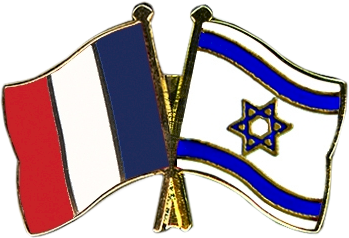
franc-israel

French president and foreign minister to arrive for high-profile visit focused on thwarting the Iranian nuclear threat

November 14, 2013, 8:11 pm

Prime Minister Benjamin Netanyahu meets with French President Francois Hollande in Paris, October 31, 2012 (photo credit: Avi Ohayon/Flash 90)

Prime Minister Benjamin Netanyahu meets with French President Francois Hollande in Paris, October 31, 2012 (photo credit: Avi Ohayon/Flash 90)

French President Francois Hollande is scheduled to arrive Sunday for a high-profile visit to Israel and the Palestinian territories, in the midst of ongoing deliberations over Iran’s nuclear program. Highlights of the trip include meetings with Prime Minister Benjamin Netanyahu, during which the upcoming second round of nuclear talks with Iran in Geneva will take center stage, and a speech in the Knesset.

Hollande, who will be accompanied by seven senior members of his government, can look forward to a hero’s welcome in Jerusalem, as Paris’s tough position on Iran prevented the global powers last week from signing an interim deal with Tehran that would have included limited sanctions relief in return for a partial freeze of the country’s nuclear program.

“The French president is a close friend of the State of Israel and I look forward to hosting him and his partner Valérie Trierweiler in Israel, especially at this time when the major powers, including France, are discussing ways to halt the Iranian nuclear program,” Netanyahu said Thursday.

“I am also pleased to host his team and French government ministers, including Foreign Minister Laurent Fabius, who is taking an active and important part in the talks currently being held by the major powers. Together we will work to advance and deepen bilateral strategic and economic relations,” the prime minister added.

Netanyahu and Hollande will sign a joint statement hailing “the continued growth of bilateral relations” and expressing “the determination to continue and deepen cooperation in many areas of strategic importance, and the strengthening of economic, scientific, educational and cultural ties between the two countries,” the Prime Minister’s Office announced.

“France defines the promotion of its political and economic status in the Middle East as a top objective of its national security policy,” Tsilla Hershco, an expert on Franco-Israeli relations at Bar-Ilan University’s Begin-Sadat Center for Strategic Studies, wrote in a new paper published Thursday.

“In media interviews, Fabius mentions French attentiveness to the concerns of Israel and other countries in the region regarding the Iranian threat. France maintains a constant strategic dialogue with Israel and appreciates Israeli professional assessments on Iran.”

Netanyahu and President Shimon Peres will greet the French dignitaries at Ben Gurion Airport at around 1 pm on Sunday. As in the visit of US President Barack Obama in March, the three leaders will hold a ceremony at the tarmac before heading for the capital.

In Jerusalem, Hollande will plant a tree in the garden of the President’s Residence and hold a first meeting with Peres.

The French president’s next stop will be Mt. Herzl, where he will lay a wreath at the grave of Theodor Herzl and place a stone on the grave of slain prime minister Yitzhak Rabin and his late wife Dalia.

Accompanied by Peres and Netanyahu, Hollande will visit the Yad Vashem Holocaust museum and lay a wreath in the Hall of Remembrance.

At around 6 pm, Hollande will arrive at the Prime Minister’s Office for a tête-à-tête with Netanyahu, which is scheduled to last for about an hour and a half. On the agenda: Iran, Iran and yet more Iran.

Netanyahu, who has been adamant in his opposition to the interim deal the international community is considering signing with Tehran, will try his utmost to convince Hollande to stand his ground during upcoming rounds of negotiations.

After their meeting, the two leaders will hold a joint press conference and then proceed to dine together.

Not far from the Prime Minister’s Residence, the French ministers, including Fabius and Finance Minister Pierre Moscovici, will have dinner with their Israeli counterparts at the King David Hotel.

On Monday morning, Hollande will meet with French clergymen in the Church of St. Anne, in Jerusalem’s Old City, which the Ottomans donated to France in 1856.

From there, Hollande and Fabius will continue to Ramallah for meetings with Palestinian Authority President Mahmoud Abbas.

The French president is also expected to lay a wreath at the grave of late Palestinian leader Yasser Arafat, who died in 2004 in a French hospital and whose remains were recently examined for traces of poisoning.

In the late afternoon, Hollande will address the Knesset plenum, which will convene for a special session in his honor. Netanyahu, Knesset Speaker Yuli Edelstein and opposition leader Shelly Yachimovich are also scheduled to speak.

Later on Tuesday, Holland will hold another meeting with Peres before attending a state dinner at the President’s Residence, in the company of the prime minister, Foreign Minister Avigdor Liberman and Finance Minister Yair Lapid.

On Tuesday morning, Hollande will lay stones on the graves of the victims of the March 2012 attack at a Jewish school in Toulouse — Rabbi Jonathan Sandler, 30, his two children Gavriel and Arieh, ages 5 and 4, and Miriam Monsonego, age 7.

From Jerusalem’s Har Hamenuchot cemetery, where the Sandlers are buried, the guests from Paris will drive to Tel Aviv for business-related events. Peres, Holland and Netanyahu will give speeches related to bilateral trade, economic cooperation and innovation.

Hollande will then meet with members of the French community in Israel at Tel Aviv University at an event which will mark the conclusion of his visit.

The visit of Hollande and Fabius in Israel comes at a crucial time. Just a few hours after they leave the country on Tuesday afternoon, the five permanent members of the United Nations Security Council and Germany — the so-called P5+1 — will gather in Geneva to negotiate a nuclear deal Israel staunchly rejects.

Last week, Iran and the six world powers came close to signing an interim agreement with Iran that would offer limited sanctions relief in exchange for halting uranium enrichment at 20 percent purity, while enrichment to the level of 3.5% would continue. But no agreement was signed, reportedly because of reservations raised by the French that were subsequently adopted by the other powers.

Fabius later said that “we want a deal…but not a sucker’s deal.”

According to France’s ambassador in Israel, Patrick Maisonnave, the world powers adopted the French position on a possible agreement with Tehran which demanded more significant concessions from the Iranians.

Speaking to Israeli reporters Wednesday in Tel Aviv, Maisonnave said the other five nations negotiating with Iran in Geneva had accepted Fabius’s position after he voiced his reservations.

All six nations agreed that Iran must not acquire nuclear weapons, but it was Paris that demanded more guarantees, Maisonnave said. France’s position was then adopted by the US and the other world powers.

Maisonnave said the P5+1 came close to an agreement the last round of talks in Geneva, but that Fabius felt that “France’s conditions were not met” in the draft that was presented to him, according to Ha’aretz.

The French ambassador reportedly said Paris demanded additional Iranian guarantees in three areas. Fabius was worried about the Iranians’ heavy water reactor in Arak, fearing it could produce plutonium, and so required guarantees which would prohibit Tehran from using it to advance their nuclear capabilities.

Secondly, Fabius argued that Tehran was continuously increasing its stockpile of enriched uranium and that guarantees should be sought in this area as well.

While France supports Iran’s right to use nuclear energy for peaceful purposes, the country does not need to operate uranium enrichment facilities, Ha’aretz quoted Maisonnave as saying.

Speaking to Israeli reporters, the ambassador said the question of Iran’s right to enrich uranium on its own soil was a major bone of contention among the P5+1 during the Geneva talks last week, requiring an additional round of negotiations.

“Based on Assurances they Got From Me”- Israel trust Obama? – YouTube

November 14, 2013

“Based on Assurances they Got From Me”- Israel trust Obama? – YouTube.

If you were Israel, what would you feel about Obama now?

Obama: Military strike could lead Iran to ‘pursue nukes more vigorously’

November 14, 2013

Obama: Military strike could lead Iran to ‘pursue nukes more vigorously’ | JPost | Israel News.

( Textbook “appeasement” reasoning. – JW )

By MICHAEL WILNER, JPOST.COM STAFF

11/14/2013 19:59

US president warns of cost of military conflict; US Secretary of State Kerry says imposing more sanctions on Tehran will indicate to the Iranians that Washington is not willing to negotiate in good faith.

US President Barack Obama said on Thursday that, no matter how powerful the American military, a strike against nuclear facilities in Iran could lead the Islamic Republic to “pursue even more vigorously nuclear weapons in the future.”

“No matter how good our military is, military options are always messy,” Obama said. “Any armed conflict has cost to it.”

At a press conference in the West Wing of the White House, Obama, speaking primarily about changes to his signature health care law, said that he hoped the US Congress would hold off on new sanctions against Iran as negotiations proceeded in Geneva – “if, in fact, we’re serious about trying to resolve this diplomatically.”

“Our policy is, Iran cannot have nuclear weapons, and I’m leaving all options on the table,” the president reiterated.

The new sanctions bill, being considered by the Senate Banking Committee, could see a markup this week – the last procedural motion before reaching the chamber floor for a vote.

“I know a little bit about sanctions, because we set them up,” Obama said, noting that his administration had “mobilized the entire international community” to enforce punishing financial restrictions on Iran since 2010.

“It has never been realistic that we would resolve the entire problem all at once,” he added.

Obama said he hopes that the deal being forged in Geneva – which will offer Iran modest sanctions relief “at the margins” of the core sanctions regime – will challenge Iran to commit to a final-status commitment without a fixed time period.

“What that gives us is the opportunity to test how serious are they,” he said, adding: “If it turns out six months from now that they’re not serious, we can crank those sanctions right back up.”

US Secretary of State John Kerry gave an interview to MSNBC on Thursday morning to help hammer in Obama’s message in favor of easing sanctions on Iran as part of the deal being worked on in Geneva.

Imposing additional sanctions on Iran would signal to Tehran that the United States is not willing to negotiate a peaceful resolution to the nuclear dispute, and drive hardliners in the country to push for obtaining of nuclear weapons, Kerry said.

Kerry and Vice President Joe Biden met with senators on Capitol Hill on Wednesday in an attempt to convince them to hold off on increasing sanctions on the Islamic Republic, arguing that such a move would be viewed by Iran as a bad faith step from the US.

“You have to do something in order to make it worthwhile for them to say, ‘Yes, we’re going to lock our program where it is today and actually roll it back,'” he said.

He stressed that 95 percent, the core of the sanctions regime, would remain in place, and only a “tiny portion” of sanctions would be eased.

“Iran was bringing in a $110-120 billion a year in income from its oil revenues, banking and so forth. That has been knocked down to $40-45 billion and that money is frozen in banks around the world. All we’re talking about doing is releasing a tiny portion of that,” he said.

He warned that failure to reach a deal would result in Tehran continuing its nuclear program, “and then we’re locked in a standoff for the next how-many number of years that becomes more dangerous for Israel and our other allies in the region, and may even push other countries to nuclearize and could result in the requirement that we’d have to – rather than have to negotiate a peaceful resolution of this – take military action in order to secure our goals.”

Kerry said that he has had several phone conversations with Prime Minister Binyamin Netanyahu on the issue over the past week, including one of Thursday.

“I respect completely [Netanyahu’s] deep concerns, as a prime minister should have about the existential nature of this threat to Israel,” he said, noting that the two countries agree about the goal of the talks – stopping Iran from obtaining nuclear weapons – but not on the way to achieve that goal.

“We believe that you need to take the first step and that you will not get Iran to simply surrender and believe you’re dealing in good faith if after two years of negotiating you don’t follow through with what’s on the table. But Mr. Netanyahu believes that you can increase the sanctions, put the pressure on even further, and that somehow this is going to force them to do what they haven’t been willing to do any time previously,” the secretary of state said.

Despite that, he stressed that there is no distance between Israel and the United States.

“I believe [this deal] is the best first step that will actually make Israel safer. It will extend the break out time. If we don’t get that first step, not only will that break out time shrink, but Iran may interpret the congressional reaction to increase sanctions as bad faith on our part and unwillingness to negotiate and may drive the hardliners even more to a commitment that they have to have the weapons,” he said.

Kerry and Obama’s comments came after Netanyahu on Wednesday warned the US and other Western nations that a “bad deal” with Iran on its nuclear program could lead to war. Netanyahu’s aides also challenged the US assertion that offers to provide Tehran relief from sanctions were “modest.”

The United States and five other major powers are set to resume negotiations with Iran on November 20, and one potential proposal could allow Iran to sell oil and gold and import some food and medicine in exchange for curbs on its nuclear program. Israel says the relief is too generous and would do little to stop Iran’s nuclear ambitions.

Reuters contributed to this report.

John Kerry on “Morning Joe” – Nov. 14, 2013 – YouTube

November 14, 2013

John Kerry on “Morning Joe” – Nov. 14, 2013 – YouTube.

PHASERS ON WEASEL !!

A completely incoherent attempt to justify the Obama Administration’s policy on Iran.

It’s no wonder he did so poorly on the hill…

– JW

Russian FM: Iran backed US nuclear proposal

November 14, 2013

Russian FM: Iran backed US nuclear proposal | The Times of Israel.

( More proof of Kerry’s ass-covering lies on the subject. – JW )

Sergey Lavrov says last-minute amendments prevented the signing of a deal

November 14, 2013, 5:11 pm

Russian Foreign Minister Sergey Lavrov speaks to the media in Moscow, Russia on Friday, Nov. 8, 2013 (photo credit: AP Photo/Alexander Zemlianichenko)

Russian Foreign Minister Sergey Lavrov speaks to the media in Moscow, Russia on Friday, Nov. 8, 2013 (photo credit: AP Photo/Alexander Zemlianichenko)

Russia’s foreign minister says Iran had accepted a US draft proposal on a nuclear deal, but last-minute amendments blocked an accord last week in Geneva.

Sergey Lavrov’s account fits with comments from Iran and world powers. But it offers additional insights into how Washington apparently led the negotiations seeking to ease Western concerns that Iran could one day produce nuclear weapons — a charge Iran denies.

Lavrov did not mention which country offered the 11th hour amendments. Others, however, say France raised concerns over issues such as a planned heavy water reactor that produces more byproduct plutonium.

Lavrov expressed hope Thursday that envoys will not abandon “agreements that already have been shaped” and strike a pact with Iran when talks resume next week.

Lavrov spoke during a high-level visit to Egypt.

Copyright 2013 The Associated Press

Erdan: What does Kerry Want Us to Wait For?

November 14, 2013

Erdan: What does Kerry Want Us to Wait For? – Middle East – News – Israel National News.

Minister responds to Kerry’s criticism: Should we cry out only when the sword is at our necks?

By Maayana Miskin

First Publish: 11/14/2013, 1:39 PM
Minister Gilad Erdan

Minister Gilad Erdan

Minister of Home Front Defense Gilad Erdan expressed surprise Thursday at United States Secretary of State John Kerry’s response to recent Israeli criticism of a proposed deal with Iran.

“I was shocked at Kerry’s statement asking why the Prime Minister had criticized the agreement being put together without waiting for it to be signed,” Erdan said, addressing a conference hosted by the Institute for National Security Studies.

“That’s an argument that I haven’t heard for many years,” he continued. “We’re talking about a state that wants to destroy Israel, and conditions that would allow it to carry out its plans.”

“What do they expect from the Israeli Prime Minister? That he not speak out when the knife is in [the attacker’s] hand – only when it is at our throats?” Erdan demanded.

Netanyahu’s criticism was helpful, he added. “It’s only thanks to the debate over the terms discussed in secret in Geneva that we may get better conditions,” he argued.

“Iranian Foreign Minister Zarif and his friends can’t keep the smiles off their faces as they walk around Geneva,” he added. “They themselves cannot believe how easily they managed to dispose of the sanctions.”

Erdan warned against agreeing to an unfavorable “temporary” agreement. “Make no mistake – the ‘interim’ agreement will be the permanent agreement,” he stated.

“Everyone who is involved needs to know that as soon as Iran becomes a country on the threshold of nuclear power, it will start an arms race in the Middle East, and uncertainty in the region will increase,” he warned.

Most Israelis distrust US on Iran, poll finds

November 14, 2013

Most Israelis distrust US on Iran, poll finds | The Times of Israel.

( My guess at this point is that most Americans feel the same way… – JW )

Clear majority says Netanyahu’s criticism of potential deal ‘justified’; left-wing Israelis share wariness of Obama administration

President Barack Obama talks with Prime Minister Benjamin Netanyahu while walking from the Oval Office to the South Lawn Drive of the White House, after their meeting May 20, 2011, in Washington, DC. (Photo credit: Avi Ohayon/Government Press Office/FLASH90)

President Barack Obama talks with Prime Minister Benjamin Netanyahu while walking from the Oval Office to the South Lawn Drive of the White House, after their meeting May 20, 2011, in Washington, DC. (photo credit: Avi Ohayon/Government Press Office/FLASH90)

A majority of Jewish Israelis believe that Israel cannot rely on the United States to ensure the security of the Jewish state during negotiations with Iran over its nuclear program, according to a poll published Thursday.

A full 55 percent of Israeli Jews felt that the US cannot be relied upon to safeguard Israel’s security during the Iranian talks, with 31% saying the Americans could be trusted on the issue and 14% stating that they did not have an opinion on the matter, according to the poll, which was commissioned by Israel Radio and conducted among a representative sample of Jewish Israeli adults by the Rafi Smith Institute.

A clear majority of both self-identified right-wing and left-wing respondents said the US could’t be relied upon when it came to Iran, a result that the institute described as “significant” and displayed the public’s general feeling that the Obama administration was “not pro-Israel.”

Forty-two percent of respondents said the US government was not giving Prime Minister Benjamin Netanyahu an “accurate and reliable picture” of the ongoing talks, 33% said they didn’t know if the US was presenting information about the talks accurately to the Israeli government, and 25% said Washington was giving a reliable picture of the discussions, the poll found.

Netanyahu’s public critiques of a potential deal with Iran, which made headlines over the weekend, were justified, according to 40% of the respondents, with another 22% saying the prime ministers response was justified but “excessive,” and 30% had “no opinion.” Only 9% said the response was “unjustified.”

Despite reported progress, the latest round of discussions between the P5+1 world powers — the US, UK, France, Russia, China and Germany — and Iran, conducted over the weekend in Geneva, ended without a deal after a proposed agreement was reportedly stymied over France’s objections to its terms. The sides are to meet again on November 20. Netanyahu’s criticism of the deal has been uncharacteristically acerbic, leading to a high-profile, ongoing dispute with US Secretary of State John Kerry. Kerry has also said it was Iran, not the P5+1 nations, that ultimately chose not to sign the deal in Geneva.

The six powers were considering a gradual rollback of sanctions that have crippled Iran’s economy. In exchange, they demanded initial curbs on Iran’s nuclear program, including a cap on uranium enrichment to a level that cannot be turned quickly to weapons use.

Israel has strongly opposed any deal that would leave Iran with the capability to quickly construct a nuclear weapon, leading Netanyahu and other officials to publicly come out against what they saw as a flawed potential agreement.

Times of Israel staff contributed to this report.

French ambassador: We set the tone for Geneva talks with Iran

November 14, 2013

Israel Hayom | French ambassador: We set the tone for Geneva talks with Iran.

French Ambassador to Israel Patrick Maisonnave: “The U.S. secretary of state took the French points and they became American points and later, the position of all those who participated.”

Shlomo Cesana and Yoni Hirsch
French Ambassador to Israel Patrick Maisonnave

|

Photo credit: Maya Baumel Berger

The US has its own set of interests

November 14, 2013

Israel Hayom | The US has its own set of interests.

Boaz Bismuth

“We, America, are not just hired lawyers negotiating a deal for Israel and the Sunni Gulf Arabs, which they alone get the final say on. We, America, have our own interests in not only seeing Iran’s nuclear weapons capability curtailed, but in ending the 34-year-old Iran-U.S. cold war, which has harmed our interests and those of our Israeli and Arab friends.”

By writing these frank words, New York Times columnist Thomas Friedman managed to embarrass former Israeli officials and various pundits in the Israeli media who have tried to drive home the notion that Iran’s nuclear program is a U.S. problem. “Let them handle this,” those well-informed opinion-makers told us. “We must not interfere.”

But the problem is that Friedman’s frankness complicates things. He claims in his column that the Obama administration’s interests are not necessarily identical to Israeli or Saudi interests. As America and Iran moved rapidly towards a deal in Geneva, the U.S. allies in the region were caught off guard.

Just look at France. French Foreign Minister Laurent Fabius told the press in Geneva last week that France would not accept a bad deal that would threaten Israel and the Gulf states. That is why the French negotiators torpedoed the deal, at least for the time being.

The French could not accept an agreement under which the heavy-water reactor in Arak continued to operate or a deal in that would let Iran enrich uranium to 20% purity. The French could not quite figure out why Iran would need to maintain the capacity to enrich uranium. As several countries have shown, you don’t need uranium enrichment if your goal is nuclear energy. French Ambassador to Tel-Aviv Patrick Maisonnave reiterated that stance on Wednesday.

During a visit to the United Arab Emirates this week, U.S. Secretary of State John Kerry said that at one point during the Geneva talks all six Western powers had agreed on a formula but Iran turned it down “at that particular moment.” Kerry said that although Western parties thought it was a fair deal, including the French, Iran killed it.

But Kerry was not being candid with us. He forgot to mention that even though there was no daylight between France and the U.S. on the need to prevent Iran from becoming a nuclear military power, France was insistent on getting more guarantees from Tehran.

“The U.S. secretary of state embraced the French position and it became the U.S. position and then the position of the six powers,” Maisonnave said.

On Sunday, in what can only be described as great timing, French President Francois Hollande will visit Israel. Considering the current state of the nuclear talks, the words of Thomas Jefferson, the third U.S. president, come to mind: “Every man has two countries — his own and France.”

French twist

November 14, 2013

Israel Hayom | French twist.

Clifford D. May

Well into last weekend, it looked as though Iran was going to win the latest round of negotiations — by a knockout, not on points.

U.S. Secretary of State John Kerry had flown to Geneva to sign a deal that would have stuffed tens of billions of dollars into the pockets of Iranian Supreme Leader Ali Khamenei, easing the economic pressure that had brought Iran to the negotiating table in the first place. The funds would have been turned over with no restrictions. Khamenei could have used them to further Iran’s illicit nuclear weapons program — the program that negotiations were meant to stop.

In exchange, Iran’s rulers would not have been required even to begin to dismantle their nuclear weapons programs. There would be no end to centrifuge manufacturing, no halt to the plutonium weapons track, no “intrusive” international inspections.

Then, at the eleventh hour, came an unexpected twist: French Foreign Minister Laurent Fabius announced that Paris could not go along with what he called — with admirably undiplomatic candor — a “sucker’s deal.”

Immediately and predictably, Fabius and the French came under fire. One “Western diplomat close to the negotiations” blasted the French demurral as “nothing more than an attempt by Fabius to insert himself into relevance late in the negotiations.” It’s worth noting that first, the Western diplomat did not address the substance of Fabius’ objections, and second, the Western diplomat did not have the courage to allow the his name to accompany his ad hominem attack.

Others accused the French of currying favor with the Saudis in an attempt to win lucrative contracts. In truth, the Saudis are concerned: They see clearly that a nuclear-armed Iran would pose an existential threat to them, to the Emiratis, the Qataris, the Kuwaitis, the Azerbaijanis and, of course, the Israelis.

The fact that France has some of the world’s foremost experts on both Iran and nuclear proliferation, combined with the possibility that the French, over the past century, have learned a thing or two about the dangers of appeasement, seems not to occur to those whose goal is to cut a deal with Iran — with the merits of that deal a secondary consideration.

Khamenei himself chimed in, tweeting that French officials were “hostile toward the Iranian nation.” Soon after that came what might be interpreted as a warning: “A wise man, particularly a wise politician, should never have the motivation to turn a neutral entity into an enemy.”

It is instructive to recall that a few days earlier Khamenei had, in effect, acknowledged that the deal being finalized would be a victory for Iran and a defeat for those on the other side of the table. He tweeted a photo of the Iranian delegation sitting at that table with this comment: “No one should consider our negotiating team as compromisers. These are the children of revolution.”

In other words, the Iranian side had not compromised — all the concessions were being offered by the U.S. and its European partners. And by refusing to give an inch, Khamenei’s negotiators were demonstrating their revolutionary credentials.

Americans have deluded themselves about the Iranian revolution from the start. I was working as a reporter in Iran in 1979 when, following the fall of Shah Mohammad Reza Pahlavi, the Ayatollah Ruhollah Khomeini began to construct what he called an Islamic republic. Most diplomats and journalists were all too eager to jump to the comforting conclusion that Khomeini was a moderate. More than that: William Sullivan, the U.S. ambassador in Tehran, called Khomeini a “Gandhi-like figure.” James Bill, an adviser to President Jimmy Carter, called the dour cleric a man of “impeccable integrity and honesty.” Andrew Young, Carter’s ambassador to the U.N., predicted that “Khomeini will eventually be hailed as a saint.”

Then, as now, abundant evidence contradicting such rosy assessments was willfully ignored. Among other things, Khomeini had always been implacably anti-American. “The U.S.A. is the foremost enemy of Islam,” he said in 1979. “It is a terrorist state by nature that has set fire to everything everywhere.”

Khomeini’s heirs — those “children of revolution” — have not mellowed. In 1995, Hasan Rouhani, now Iran’s president — invariably described in the major media as a moderate — said the “beautiful cry of ‘Death to America’ unites our nation.” Earlier this year, he doubled down: “Saying ‘Death to America’ is easy. We need to express ‘Death to America’ with action.” A few nuclear weapons could be helpful in that regard, don’t you think?

Rouhani is an experienced negotiator who, in a memoir published two years ago, explained that his strategy was to play off the U.S. against its European allies, to create “gaps in the Western front.” Skilled Iranian diplomats, he wrote, can prevent “consensus between America and other world powers — especially Europe, Russia, and China — over Iran.” That accomplished, it would be possible to “stand up against the conspiracies of America.”

The U.S. also has experienced negotiators, but their record is nothing to write home about. In particular, under Democratic and Republican administrations alike, American diplomats spent years talking with the despotic regime that rules North Korea in an effort to prevent it from becoming nuclear-armed. Over and over, concessions were made, aid was extended, agreements were signed, and progress was announced.

And then, in 2006, the North Koreans tested a nuclear weapon for the first time — demonstrating that they had not really compromised at all and were still very much children of their own anti-Western revolution. A second nuclear test was conducted in 2009. The U.S. strongly objected and vowed that North Korea would “pay a price for its actions.” But that was only bluster and bluff. On Feb. 12, North Korea conducted a third nuclear test. Pyongyang is today developing missiles capable of delivering its nuclear weapons to all those regarded as enemies.

Khamenei and Rouhani no doubt look at this history and say to each other: If the North Koreans can sit down with the Americans, play their very weak cards and walk away with the pot, surely we can do no worse. Khamenei and Rouhani were almost proved right — and they might still be. A new round of talks is scheduled to begin on Nov. 20. Between now and then, those favoring appeasement of Iran will almost certainly be negotiating with the French — in a more muscular fashion, I fear, than they have with Iran’s “children of revolution.”

Clifford D. May is president of the Foundation for Defense of Democracies, a policy institute focusing on national security.


