Archive for September 2013

Israel says will act if WMDs transferred to Hezbollah

September 12, 2013

Israel says will act if WMDs transferred to Hezbollah – Israel News, Ynetnews.

As global community tries to prevent Syria attack by negotiating surrender of country’s chemical arms, Israel says in favor of diplomatic solution, yet watches warily from side

Atilla Shmolfavi

Published: 09.12.13, 00:50 / Israel News

As the international community tries to reach an understanding regarding Syrian chemical disarmament, Israel closely monitors the actions of President Bashar Assad. Officials made clear Wednesday night that Israel has not withdrawn, and the red lines it set in reference to Assad have not changed. In other words, Jerusalem clarified, if the Syrian president tries to deliver chemical weapons, or weapons that tip the scales in favor of Hezbollah, Israel will act to prevent their transfer.

“Our red lines have not changed,” said an Israeli official. “Assad should understand already that he should not play around with us on this issue. Our policy has not changed, despite what is happening in the international arena. If something looks to us like an unusual step, it will be dealt with.” These words were spoken even as the international effort to reach an agreement went up a level – Wednesday night five members of the UN Security Council were expected to meet to further discuss solving the Syrian crisis.

Defense Minister Moshe Ya’alon hinted in speeches given in recent days that Israel has red lines, but declined to elaborate. Now, given the international community’s efforts to dismantle the non-conventional weapons Assad has collected, Jerusalem emphasized that Israel reserved the right to respond to any attempt to arm Hezbollah with weapons of the sort. According to foreign reports, the IDF carried out operations in Syria several times, hitting shipments of weapons that could have been transferred to the Lebanese terrorist organization and endanger Israel.

Jerusalem views events on the Syrian front with a discerning eye and cautious optimism, as it also does when considering the attitude of the US towards Iran. “We must see what happens in the end,” said an Israeli official, “but it is clear our stance is that a loaded gun must be placed on the table in the form of a real military threat, and this is the appropriate position to take. Once Assad and the Russians realized that the United States was serious, they led the diplomatic process. This policy holds true for Iran’s future as well.”

Even President Shimon Peres said that he believed the current diplomatic efforts to be a better option than a military attack, provided that they lead to the dismantling of chemical weapons Syria.

Meanwhile, Prime Minister Benjamin Netanyahu took a jab at US President Barack Obama in comments he made on Wednesday night, emphasizing his position that Israel cannot trust anyone on security issues.

To naval officers at a graduation ceremony in Haifa, Netanyahu said, “These days, perhaps more than ever, the main rule that guides me in my actions as prime minister and on which I am very particular, is: If I am not for myself, who will be? If we are not for ourselves, who will be? We are for ourselves.” Hours later, Ya’alon re-emphasized the same principle, during a ceremony at the Latrun Armored Corps Memorial, “In the fog that covers the Middle East, we must understand that we need to rely only on ourselves.”

The five member states – the US, France, Britain, Russia and China – were supposed to meet Wednesday to consider the French ultimatum draft resolution on Syria’s chemical weapons, but the meeting was canceled because Russia opposed the proposal.

US lawmakers said if diplomatic efforts to resolve the crisis in Syria according to the Russian program failed, the Senate vote on a military strike in Syria would take place next week.

US President Barack Obama canceled the Senate vote that was supposed to take place this week, in order to allow time to examine the Russian proposal to dismantle Syria’s chemical arms, without military action.

Iran’s nuclear strategy will be sailing full steam ahead, with Russia as facilitator

September 12, 2013

Iran’s nuclear strategy will be sailing full steam ahead, with Russia as facilitator | JPost | Israel News.

Iranian President Mahmoud Ahmadinejad attends the opening ceremony ahead of National Army Day.

Iranian President Mahmoud Ahmadinejad attends the opening ceremony ahead of National Army Day. Photo: REUTERS

Iran is probably rethinking its strategy.

The Islamic Republic observed how Syria, with Russia’s assistance, has wiggled out from what was to be limited US strikes not meant to topple the regime. Iran is famous for its diplomatic prowess – its ability to drag out negotiations with the West over its nuclear program – knowing exactly when to push on the peddle and when to ease up in its pursuit to the bomb.

So the ayatollah’s will take note at how effectively Syria was able to split the international community over the planned attack and how uneasy people in the West are to military interventions in the Middle East.

However, the threat of a unilateral attack by the US or Israel still hangs in the air, so Iran may try to proceed carefully as the charm offensive by newly elected President Hassan Rouhani gets into full gear.

Trita Parsi, the president of the National Iranian American Council told The Jerusalem Post that “Rouhani is already taking some credit for the Russian proposal at home, using it to show that his diplomacy pays greater dividends than Ahmadinejad’s theatrics.

“This can win him more maneuverability on the nuclear issue,” he said, adding that if the Syria situation calms down, it would likely “make Tehran feel strengthened.”

US Ambassador Joseph Macmanus said on Wednesday that Iran had further expanded its uranium enrichment capacity by continuing to install both advanced and first-generation centrifuges, calling these steps “concerning escalations of an already prohibited activity.”

Iran is also making further progress in the construction of a reactor, Arak, that can yield plutonium for bombs, including putting the reactor vessel in place and beginning to make fuel, Macmanus said. “All of these are troubling developments.”

Ray Takeyh, a senior fellow at the Council on Foreign Relations and a former senior advisor on Iran at the US State Department told the Post that he suspects that the way the Syrian issue is playing out is likely leaving “the Iranians feeling somewhat advantaged.”

“The international community’s reticence to use force and its referral of the matter to the cumbersome UN process offer them an opportunity to relax a bit,” he said.

Emily Landau, a senior research fellow and the director of the Arms Control and Regional Security Program at the INSS, stated to the Post that Iran is paying close attention to “how deep the divide is between the US and Russia” and how Europe essentially removed itself as a real player in this drama.

Even though there are differences between the Syrian issue – which is based on chemical weapons – and the Iranian nuclear file, “this is a kind of test case for the international community in facing serious noncompliance in the WMD realm,” she said.

Landau points out that there are positive and negative implications that may be drawn from the outcome of the Syrian situation. The good news is that Iran, Russia and Syria saw the US threat to use force as real despite some wavering by US President Barack Obama over the past weeks.

It was this threat, she noted, that caused Russia and Syria to come up with this alternate proposal thus demonstrating that the US is able to modify behavior of rogue regimes if it chooses to do so.

Furthermore, the success of the Russian proposal could result in “the US and Russia moving closer together meaning Iran cannot count on Russia and the US to be on opposite sides regarding its ongoing nuclear progress.”

“On the negative side, we have yet to see how this plays out, and what Obama does if the Russian proposal does not materialize into an effective plan,” she said.

If this is the case, then the ball will be back in Obama’s court and “the question of US action will again be at the forefront.”

Reuters contributed to this report.

Hinting at dismay with Obama, PM says Israel can rely only on itself

September 12, 2013

Hinting at dismay with Obama, PM says Israel can rely only on itself | The Times of Israel.

Citing Syria and Iran, Netanyahu says he is guided as Israel’s leader, more now than ever, by the saying, ‘If I am not for myself, who will be for me?’

September 11, 2013, 10:20 pm
Israeli Prime Minister Benjamin Netanyahu and Israeli president Shimon Peres attend a graduation course ceremony for IDF Naval officers at the navy training base in Haifa. September 11, 2013. (Photo credit: Kobi Gideon/GPO/FLASH90

Israeli Prime Minister Benjamin Netanyahu and Israeli president Shimon Peres attend a graduation course ceremony for IDF Naval officers at the navy training base in Haifa. September 11, 2013. (Photo credit: Kobi Gideon/GPO/FLASH90

In remarks whose content and timing implied criticism of President Barack Obama’s handling of the Syrian chemical weapons crisis, and a concern that Israel could not depend on the US to thwart Iran’s nuclear drive, Prime Minister Benjamin Netanyahu on Wednesday declared that nations that use weapons of mass destruction must pay a price, and said that his own actions as leader of the Jewish state revolved around the conviction that ultimately Israel had no one to rely on but itself when facing enemy threats.

Speaking at an Israeli Navy graduation ceremony, Netanyahu cited a 2,000-year-old saying by the Jewish sage Rabbi Hillel, “If I am not for myself, who will be for me?” And he said this rule “is more relevant than ever these days in guiding me, in my key actions as prime minister.” Its practical application, he said, “is that Israel will always be able to protect itself, and will protect itself, with its own forces, against all threats.”

Netanyahu and the Israeli leadership have been deeply worried that perceived hesitancy and weakness in the US, in responding to the alleged chemical weapons attack by the Assad regime that the US says killed 1,429 people in the outskirts of Damascus August 21, may be exploited by Iran to further advance its nuclear program.

Netanyahu made this concern explicit in his speech Wednesday, warning, “The message that is received in Syria will be clearly understood in Iran.”

Amid complex diplomacy to try to resolve the Syria crisis, the prime minister was adamant that “one has to be certain that the Syria regime is disarmed of its chemical weapons. The world needs to ensure that whosoever uses weapons of mass destruction pays a price.”

Netanyahu’s Defense Minister Moshe Ya’alon echoed his theme, stating that, “At the end of the day, we have rely on ourselves, on our forces, on our deterrent capacity.”

At the same event, President Shimon Peres stressed that the Syrian regime could not be trusted. But in sharp contrast to Netanyahu, Peres clearly threw his weight behind Obama-backed, Russia-initiated diplomacy, saying any agreement reached by the US and Russia would ensure the safe disposal of Syria’s WMDs.

“I know both President Obama and President Putin, and I am convinced that if an agreement is reached it will be reliable, explicit and significant,” the president said.

Israel’s Channel 2 news said that, behind the scenes, Jerusalem believed that if diplomacy failed to definitively resolve the crisis surrounding Assad’s chemical weapons, and yet Obama did not resort to military action, Iran would be greatly emboldened.

Another TV News report, on rival Channel 10, said Netanyahu in private had indicated his concern that the Iranians perceive weakness from the US in facing Bashar Assad’s Syria, a far less potent regime than their own. The TV report said Netanyahu was also unhappy that Obama had reached out to Israel and to pro-Israel activists for help in swaying Congress behind military action, only to back away from that course. And finally, it said, Netanyahu was wary that destroying Assad’s chemical stockpiles was a lengthy, complex process, and there was insufficient clarity about how it was to be handled.

Last week, Giora Eiland, a former head of Israel’s National Security Council, said a plan by Netanyahu to attack Iran in 2012 was canceled due to US objections.

Arab affairs analyst Ehud Yaari noted Wednesday that seven years after Libya agreed to relinquish its chemical weapons stockpiles — which were far smaller than the 1,000 tons he said Assad’s regime held — only 40% of that weaponry had been destroyed.

The process in Syria, said Yaari, would take many years, would require immediate supervision of existing stockpiles by large deployments if forces, the speedy signing and ratification by Syria of the treaty against production and proliferation of chemical weapons, and then the construction of sophisticated facilities to destroy the weaponry.

What Putin Has to Say to Americans About Syria – NYTimes.com

September 12, 2013

What Putin Has to Say to Americans About Syria – NYTimes.com.

MOSCOW — RECENT events surrounding Syria have prompted me to speak directly to the American people and their political leaders. It is important to do so at a time of insufficient communication between our societies.

Relations between us have passed through different stages. We stood against each other during the cold war. But we were also allies once, and defeated the Nazis together. The universal international organization — the United Nations — was then established to prevent such devastation from ever happening again.

The United Nations’ founders understood that decisions affecting war and peace should happen only by consensus, and with America’s consent the veto by Security Council permanent members was enshrined in the United Nations Charter. The profound wisdom of this has underpinned the stability of international relations for decades.

No one wants the United Nations to suffer the fate of the League of Nations, which collapsed because it lacked real leverage. This is possible if influential countries bypass the United Nations and take military action without Security Council authorization.

The potential strike by the United States against Syria, despite strong opposition from many countries and major political and religious leaders, including the pope, will result in more innocent victims and escalation, potentially spreading the conflict far beyond Syria’s borders. A strike would increase violence and unleash a new wave of terrorism. It could undermine multilateral efforts to resolve the Iranian nuclear problem and the Israeli-Palestinian conflict and further destabilize the Middle East and North Africa. It could throw the entire system of international law and order out of balance.

Syria is not witnessing a battle for democracy, but an armed conflict between government and opposition in a multireligious country. There are few champions of democracy in Syria. But there are more than enough Qaeda fighters and extremists of all stripes battling the government. The United States State Department has designated Al Nusra Front and the Islamic State of Iraq and the Levant, fighting with the opposition, as terrorist organizations. This internal conflict, fueled by foreign weapons supplied to the opposition, is one of the bloodiest in the world.

Mercenaries from Arab countries fighting there, and hundreds of militants from Western countries and even Russia, are an issue of our deep concern. Might they not return to our countries with experience acquired in Syria? After all, after fighting in Libya, extremists moved on to Mali. This threatens us all.

From the outset, Russia has advocated peaceful dialogue enabling Syrians to develop a compromise plan for their own future. We are not protecting the Syrian government, but international law. We need to use the United Nations Security Council and believe that preserving law and order in today’s complex and turbulent world is one of the few ways to keep international relations from sliding into chaos. The law is still the law, and we must follow it whether we like it or not. Under current international law, force is permitted only in self-defense or by the decision of the Security Council. Anything else is unacceptable under the United Nations Charter and would constitute an act of aggression.

No one doubts that poison gas was used in Syria. But there is every reason to believe it was used not by the Syrian Army, but by opposition forces, to provoke intervention by their powerful foreign patrons, who would be siding with the fundamentalists. Reports that militants are preparing another attack — this time against Israel — cannot be ignored.

It is alarming that military intervention in internal conflicts in foreign countries has become commonplace for the United States. Is it in America’s long-term interest? I doubt it. Millions around the world increasingly see America not as a model of democracy but as relying solely on brute force, cobbling coalitions together under the slogan “you’re either with us or against us.”

But force has proved ineffective and pointless. Afghanistan is reeling, and no one can say what will happen after international forces withdraw. Libya is divided into tribes and clans. In Iraq the civil war continues, with dozens killed each day. In the United States, many draw an analogy between Iraq and Syria, and ask why their government would want to repeat recent mistakes.

No matter how targeted the strikes or how sophisticated the weapons, civilian casualties are inevitable, including the elderly and children, whom the strikes are meant to protect.

The world reacts by asking: if you cannot count on international law, then you must find other ways to ensure your security. Thus a growing number of countries seek to acquire weapons of mass destruction. This is logical: if you have the bomb, no one will touch you. We are left with talk of the need to strengthen nonproliferation, when in reality this is being eroded.

We must stop using the language of force and return to the path of civilized diplomatic and political settlement.

A new opportunity to avoid military action has emerged in the past few days. The United States, Russia and all members of the international community must take advantage of the Syrian government’s willingness to place its chemical arsenal under international control for subsequent destruction. Judging by the statements of President Obama, the United States sees this as an alternative to military action.

I welcome the president’s interest in continuing the dialogue with Russia on Syria. We must work together to keep this hope alive, as we agreed to at the Group of 8 meeting in Lough Erne in Northern Ireland in June, and steer the discussion back toward negotiations.

If we can avoid force against Syria, this will improve the atmosphere in international affairs and strengthen mutual trust. It will be our shared success and open the door to cooperation on other critical issues.

My working and personal relationship with President Obama is marked by growing trust. I appreciate this. I carefully studied his address to the nation on Tuesday. And I would rather disagree with a case he made on American exceptionalism, stating that the United States’ policy is “what makes America different. It’s what makes us exceptional.” It is extremely dangerous to encourage people to see themselves as exceptional, whatever the motivation. There are big countries and small countries, rich and poor, those with long democratic traditions and those still finding their way to democracy. Their policies differ, too. We are all different, but when we ask for the Lord’s blessings, we must not forget that God created us equal.

9/11 reflections: 2001, 2012, and 2013

September 11, 2013

9/11 reflections: 2001, 2012, and 2013 – Israel Opinion, Ynetnews.

( Novelist Noah Beck sums up the catastrophe that Obama has brought to US democracy better than anything else I have read.  – JW )

Op-ed: Recent scandals undermined public’s trust that US government conducts itself fairly, transparently and constitutionally

Noah Beck

Published: 09.11.13, 18:00 / Israel Opinion

In the 16-month period following Osama bin Laden’s assassination (on 5/1/2011), national confidence increased in a way that was almost reminiscent of the pre-9/11 days. The economy was gradually coming back from the Great Recession (much as the pre-9/11 economy was recovering from the “Dot-Com Crash”) and — more importantly — there was a sense that the worst national security fears of the US were behind us.

The brave US special forces who killed bin Laden brought a much needed sense of justice and closure regarding the mastermind behind the worst terrorist attack in US history, and for many months President Obama was able to spin the symbolic victory into far more than what it was.

But on the eleventh anniversary of 9/11, the attacks on the US embassy in Benghazi claimed four American lives and shattered the false sense of security that had begun to creep back into the American psyche. Within a year of that attack, the Boston Marathon bombings killed three people and injured an estimated 264 people (last April), and the US was forced to close over 20 embassies around the world because of terrorist threats (last month).

Making matters worse, the Obama administration misled the American public about 9/11/12 to preserve a presidential national security narrative that was critical to Obama’s reelection about two months later. As the Washington Times recently reported, “As President Obama ran to election victory last fall with claims that al-Qaeda was ‘decimated’ and ‘on the run,’ his intelligence team was privately offering a different assessment that the terrorist movement was shifting resources and capabilities to emerging spinoff groups in Africa that posed fresh threats to American security.”

Obama’s renewed lease on power was promptly followed by a series of scandals that have yet to be fully understood or addressed: Benghazi-gate, Associated Press-gate, IRS-gate, and most recently NSA-gate. All of these have undermined the public’s trust that the US government conducts itself fairly, transparently, and constitutionally.

Rather than address these issues honestly, Obama initially stonewalled and then dismissed everything with the label “phony scandals” — as if that could persuade anyone that nothing improper ever happened. As bad as each of the various scandals might have been in isolation, they are collectively far more ruinous because each one independently suggests the same thing: an administration that has breached the public trust, violated constitutional values, and abused its power – particularly when that power might have been checked by the will of the people at elections. And instead of reassuring the public, when each scandal broke, that his top priority was to investigate and address each issue, Obama looked like any other politician clinging to power however he can, volunteering nothing until compelled to do so.

And so the public was left to draw the inevitable conclusions: that the Obama administration was so determined to win reelection that it whitewashed the September 11 attacks in Benghazi, used the IRS to weaken political opponents, and penalized the Associated Press for issuing a May 7, 2012 report that undermined Obama’s we-beat-terrorism election campaign narrative.

Much is still unknown about the latest breach of trust with the American public — the National Security Agency’s domestic spying program. But the Guardian recently reported that the NSA worked with US tech giants to defeat whatever privacy and encryption technologies Americans thought were in place to ensure that “their communications, online banking and medical records would be indecipherable to criminals or governments.” As if to grant the NSA’s greatest wish, Apple’s new iPhones feature a biometric fingerprint scan that replaces password-based security (and Apple competitors will undoubtedly start offering the same feature), so potentially hundreds of millions of people will soon be giving their fingerprints to the US government.

Still not bothered? The New York Times just reported that the US government also “uses border crossings to seize and examine travelers’ electronic devices instead of obtaining a search warrant to gain access to the data.”

The biggest loser from so much abuse of power and deception is the American electorate. Voters wanted to believe that Obama was somehow different: more grounded, more ethical, more committed to some lofty ideal that had eluded prior politicians. The audacity of disappointment involves cultivating a cult of personality with soaring oratory and then letting down all of those faithful voters with politics as usual.

And now, the alarming reality of post-9/11/13 is arguably more unsettling than that of post-9/11/1. Twelve years ago, the main concern was al-Qaeda in Afghanistan and Pakistan. Now that threat has metastasized and — partly thanks to Obama’s feckless Mideast and Africa strategy — has proliferated to many more places, including Yemen, Libya, Lebanon, Iraq, the Egyptian Sinai, and Syria. More importantly, Obama’s policies have eroded US deterrence and emboldened some of the world’s most dangerous regimes — which can cause far more harm than non-state actors can.

Twelve years after 9/11, the US president has misled the public about its security, abused power in ways that are still not fully understood, and failed to provide strategic leadership in a world that gets more dangerous by the day. Iranian nukes are around the corner, Syria could explode in countless different ways, and Obama seems ill-prepared to handle any of this. But Russia, China, Iran and North Korea are watching opportunistically for the next US misstep, and the consequences could extend well beyond Obama’s second term.

How many more 9/11 anniversaries are needed before Americans can once again trust their government and feel truly safe from security threats?

Noah Beck is the author of The Last Israelis, an apocalyptic novel about Iranian nukes and other geopolitical issues in the Middle East.

Russia says no plans to transfer S-300 missiles to Iran

September 11, 2013

Russia says no plans to transfer S-300 missiles to Iran – Israel News, Ynetnews.

Putin spokesman denies report saying president decided to supply Tehran with five advanced air defense batteries for $800M

Polina Garaev

Published: 09.11.13, 20:28 / Israel News
 

The spokesperson for Russian President Vladimir Putin said ‘no’ when asked by reporters if Putin had instructed to go ahead with a deal to transfer S-300 missiles to Iran, Russian news agency RIA Novosti reported Wednesday.

Russian newspaper Kommersant reported earlier in the day that Russia will offer Iran a new supply of S-300 missiles and assistance in the construction of an additional nuclear reactor in Bushehr.

The alleged proposal was made three years after a previous agreement under which Russia was expected to transfer five S-300 batteries to Iran was canceled.

According to a source within the Kremlin, Putin decided to grant an Iranian request to supply the Islamic Republic with the high-end S-300 air defense system with a deal estimated at $800 million which will also include coordinating the construction of an additional nuclear reactor in Bushehr.


S-300 air defense system (Photo: AFP)

According to the report, Putin has instructed his staff to prepare the agreements so as to discuss them with Iranian President Hassan Rohani during the two leaders’ scheduled meeting on Friday during the Shanghai Cooperation Organization held in Kyrgyzstan.

In 2007, an S-300 deal was signed between the two countries. Three years later the UN Security Council sanctioned Iran, and as a result the deal’s completion was halted. In the past, Israel and Western powers had expressed concern over the deal, partly fearing it would pose a threat to any aerial attack on Iran’s disputed nuclear facilities.

According to Wednesday’s report, the arms deal is conditioned on Iran’s withdrawal of a $4 billion damages suit filed against Russia with the International Court of Arbitration in Geneva after Moscow backed out of the 2007 deal. At the time, Russia offered the Islamic Republic an alternative system instead of the S-300, but the Iranians refused.

Netanyahu: Iran ‘watching closely’ to see if world dismantles Syrian chemical weapons

September 11, 2013

Netanyahu: Iran ‘watching closely’ to see if world dismantles Syrian chemical weapons | JPost | Israel News.

Speaking at a naval ceremony in the north, prime minister affirms comments made by US President Obama regarding Israel’s ability to “defend itself with overwhelming force” against any threat.

Israel's Prime Minister Benjamin Netanyahu gestures during his speech

Israel’s Prime Minister Benjamin Netanyahu gestures during his speech Photo: Reuters

The Russian-brokered proposal to dismantle Syria of its chemical weapons is an acceptable option if it is fully implemented, Prime Minister Binyamin Netanyahu indicated Wednesday in his first comments on the situation in the north.

Speaking at a naval ceremony in the north, Netanyahu said that dozens and sometimes hundreds of innocent people were being killed on a daily basis just across Israel’s border.

“Some of them were murdered by chemical weapons,” he said. “That is a horrible crime, a crime against humanity. Now what needs to be ensured is that the Syrian regime’s chemical weapons will be dismantled and the world will ensure that anyone who uses weapons of mass destruction will pay a price.

“The message Syria receives will resonate very strongly in Iran,” he stressed.

Netanyahu repeated what he has said in the past regarding the Syrian crisis, that he was being guided by Hillel’s ancient adage: “If I am not for me, who will be?”

He said the practical translation of that adage these days is the Israel will always be able to defend itself, by itself, against any threat.

Netanyahu cited comments US President Barack Obama made regarding Israel’s ability to “defend itself with overwhelming force” during his speech on Syria Tuesday. “That is correct,” Netanyahu affirmed, “and that is the foundation of our security.”

Kadidsh – קדיש

September 11, 2013

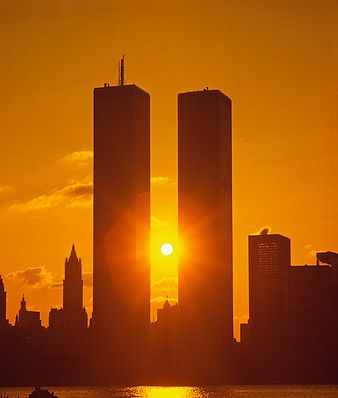
NYC, NY, Sunrise Between Twin Towers, World Trade Center, designed by Minoru Yamasaki, International Style II


________________________________________________________________________________

Magnified and sanctified be G-d’s great name in the world which He created according to His will. May he establish His kingdom during our lifetime and during the lifetime of Israel. Let us say, Amen.May G-d’s great name be blessed forever and ever.

Blessed, glorified, honored and extolled, adored and acclaimed be the name of the Holy One, though G-d is beyond all praises and songs of adoration which can be uttered. Let us say, Amen.

May there be peace and life for all of us and for all Israel. Let us say, Amen.

Let He who makes peace in the heavens, grant peace to all of us and to all Israel. Let us say, Amen.

Paul Simon at Ground Zero- Sounds of Silence – Hebrew Subtitles

Peres says he trusts Obama, Putin to reach Syria deal

September 11, 2013

Peres says he trusts Obama, Putin to reach Syria deal | The Times of Israel.

President believes that if Assad shows any dishonesty in chemical weapons agreement, US will strike his regime

September 11, 2013, 6:53 pm
Shimon Peres at the graduation ceremony Wednesday. (photo credit: President's Residence)

Shimon Peres at the graduation ceremony Wednesday. (photo credit: President’s Residence)

Two days after casting doubt on a Russian-brokered deal that would see Damascus give up its chemical weapons, President Shimon Peres threw his weight behind the proposal, saying any agreement reached by the US and Russia would ensure the safe disposal of Syria’s WMDs.

“I know both [US] President [Barack] Obama and [Russian] President [Vladimir] Putin, and I am convinced that if an agreement is reached it will be reliable, explicit and significant,” the president said at an Israeli Navy graduation ceremony.

Responding to Obama’s speech on Syria the night before in which the president said Washington was pursuing a diplomatic agreement which would ensure the destruction of Assad’s chemical weapons stockpiles, Peres said the US “is showing its moral and democratic weight and the strength of its military by attempting to bring an immediate end to the use of chemical weapons and to its ultimate destruction.”

“The murder of innocents, including women and children, is a crime which cannot be ignored,” Peres said, but noted that “it wasn’t the anger over the images of dead children that affected Assad but the military threat which forced him to respond to the initiative to remove and disarm his chemical weapons.”

On Monday, shortly after Russian Foreign Minister Sergey Lavrov pitched the proposal to have Assad hand his chemical weapons over to international actors for eradication, Peres cautioned against putting too much stock in the deal, saying “the Syrians are not trustworthy,” and that their acceptance of the Russian proposal meant very little.

Peres Wednesday again voiced skepticism of Assad’s trustworthiness, but assured the audience that he had faith in Putin and Obama’s ability to reach a suitable agreement which “must ensure that Assad has no chemical weapons.”

Earlier in the day the elder statesman said that if Assad proved to be honest, he would avoid American military action, but “if there’ll be a crack in Syria’s integrity I have no doubt that the US will act militarily.”

Prime Minister Benjamin Netanyahu also weighed in Wednesday on the issue of Syria’s alleged chemical weapons use, reiterating Obama’s remark the night before that Assad’s act was a “crime against humanity.”

“The world needs to ensure that whosoever uses WMDs pays a price for it,” Netanyahu said in a statement. “The message received in Syria will be well understood in Iran.”

Netanyahu added that Obama’s statement that Israel can defend itself “with overwhelming force” is correct, and is “the basis of our security.”

On Tuesday evening, Obama asked Congress to delay voting on using force against Syria in order to try and pursue a diplomatic solution to the crisis. The American president added Tuesday that should diplomacy fail the US military would “be ready to respond” against the Syrian government.

The Russian proposal, which Damascus agreed to on Tuesday, would put the country’s chemical weapons under international supervision. The regime is accused of using sarin gas to kill over a thousand people outside Damascus on August 21.

The Syrian civil war, which has raged for over two years, has claimed over 100,000 lives, according to the United Nations.

Syrian rebels: Russian initiative ‘dirty deal’, only good for Israel

September 11, 2013

Syrian rebels: Russian initiative ‘dirty deal’, only good for Israel – Israel News, Ynetnews.

Opposition laments positive attitude toward Russian compromise, urges US to revert back to attack plans. ‘Neutralizing Assad’s chemical weapons serves Israel, not the Syrian people,’ rebel commander says

Roi Kais

Published: 09.11.13, 14:58 / Israel News

Syria’s opposition and rebel forces are fuming over US President Barack Obama and the West’s handling of the Syrian crisis, specifically the latest developments regarding the US attack on Syria.

Qassim Saad al-Din, a spokesman for the Syrian opposition military command, told the London-based paper Asharq Al-Awsat that the Russian compromise with the US regarding Syria’s chemical arms was reached “at the expense of the blood of the Syrian people.”

According to al-Din, “the only thing the West is interested in is protecting Israel and disarming the arms threatening it. The 100,000 killed in Syria do not top their priorities.”

Syrian rebels in Aleppo (Photo: Reuters)

Head of the Military Revolutionary Command in Aleppo, Abed al Jabar al Akhidi, said that “the international ploy to cancel the attack on Syria in return for the neutralization of chemical weapons is a dirty deal between Russia, Assad’s regime and the West.”

In an interview with Al Arabiya, al Akhidi said that “what is happening here is an attempt to help Obama save face after he climbed up onto a tree and the Russians pulled out his ladder.

“Neutralizing Assad’s chemical weapons serves Israel, not the Syrian people, because the international community’s attempt to disarm Assad from his chemical arms stems from the public outcry and not from the killing.”

Immediately following the publication of the Russian proposal, General Salim Idris, head of the Free Syrian Army, dismissively responded to the initiative, saying: “The (Syrian) regime has a massive arsenal, the size and location of which is unknown.” According to him, Assad should not be trusted and Syria responded positively only in a bid to postpone the American strike and “buy time.” He further urged the Americans not fall for the regime’s “deceit” and return to their attack plans.
"המערב מבטיח ומבטיח, עכשיו זו בדיחה". סלים אידריס (צילום: AFP)

‘Western promises are a joke’. Salim Idris (Photo: AFP)

After the British parliament decided against an attack, Idris said the decision would “leave us alone to be killed” by President Bashar Assad, and pave the way for al-Qaeda to dominate the rebel ranks. “What are our friends in the West waiting for?” Idris asked. “For Iran and Hezbollah to kill all the Syrian people?” “The West promises and promises. This is a joke now,” he concluded.

Unarmed Syrian opposition forces also expressed discontent from the favorable light in which the Russian compromise was greeted.

Ahmed Ramdan, a Syrian opposition member, expressed apprehension regarding the initiative, claiming he feared that it might be mistakenly understood by Assad as a green light to continue to conduct massacres against the Syrian people after he disarms from chemical weapons.

Nonetheless, he noted that he hoped the Syrian regime’s positive response to the initiative could signal the first step towards Assad’s unconditional surrender of power.