Archive for September 11, 2013

9/11 reflections: 2001, 2012, and 2013

September 11, 2013

9/11 reflections: 2001, 2012, and 2013 – Israel Opinion, Ynetnews.

( Novelist Noah Beck sums up the catastrophe that Obama has brought to US democracy better than anything else I have read.  – JW )

Op-ed: Recent scandals undermined public’s trust that US government conducts itself fairly, transparently and constitutionally

Noah Beck

Published: 09.11.13, 18:00 / Israel Opinion

In the 16-month period following Osama bin Laden’s assassination (on 5/1/2011), national confidence increased in a way that was almost reminiscent of the pre-9/11 days. The economy was gradually coming back from the Great Recession (much as the pre-9/11 economy was recovering from the “Dot-Com Crash”) and — more importantly — there was a sense that the worst national security fears of the US were behind us.

The brave US special forces who killed bin Laden brought a much needed sense of justice and closure regarding the mastermind behind the worst terrorist attack in US history, and for many months President Obama was able to spin the symbolic victory into far more than what it was.

But on the eleventh anniversary of 9/11, the attacks on the US embassy in Benghazi claimed four American lives and shattered the false sense of security that had begun to creep back into the American psyche. Within a year of that attack, the Boston Marathon bombings killed three people and injured an estimated 264 people (last April), and the US was forced to close over 20 embassies around the world because of terrorist threats (last month).

Making matters worse, the Obama administration misled the American public about 9/11/12 to preserve a presidential national security narrative that was critical to Obama’s reelection about two months later. As the Washington Times recently reported, “As President Obama ran to election victory last fall with claims that al-Qaeda was ‘decimated’ and ‘on the run,’ his intelligence team was privately offering a different assessment that the terrorist movement was shifting resources and capabilities to emerging spinoff groups in Africa that posed fresh threats to American security.”

Obama’s renewed lease on power was promptly followed by a series of scandals that have yet to be fully understood or addressed: Benghazi-gate, Associated Press-gate, IRS-gate, and most recently NSA-gate. All of these have undermined the public’s trust that the US government conducts itself fairly, transparently, and constitutionally.

Rather than address these issues honestly, Obama initially stonewalled and then dismissed everything with the label “phony scandals” — as if that could persuade anyone that nothing improper ever happened. As bad as each of the various scandals might have been in isolation, they are collectively far more ruinous because each one independently suggests the same thing: an administration that has breached the public trust, violated constitutional values, and abused its power – particularly when that power might have been checked by the will of the people at elections. And instead of reassuring the public, when each scandal broke, that his top priority was to investigate and address each issue, Obama looked like any other politician clinging to power however he can, volunteering nothing until compelled to do so.

And so the public was left to draw the inevitable conclusions: that the Obama administration was so determined to win reelection that it whitewashed the September 11 attacks in Benghazi, used the IRS to weaken political opponents, and penalized the Associated Press for issuing a May 7, 2012 report that undermined Obama’s we-beat-terrorism election campaign narrative.

Much is still unknown about the latest breach of trust with the American public — the National Security Agency’s domestic spying program. But the Guardian recently reported that the NSA worked with US tech giants to defeat whatever privacy and encryption technologies Americans thought were in place to ensure that “their communications, online banking and medical records would be indecipherable to criminals or governments.” As if to grant the NSA’s greatest wish, Apple’s new iPhones feature a biometric fingerprint scan that replaces password-based security (and Apple competitors will undoubtedly start offering the same feature), so potentially hundreds of millions of people will soon be giving their fingerprints to the US government.

Still not bothered? The New York Times just reported that the US government also “uses border crossings to seize and examine travelers’ electronic devices instead of obtaining a search warrant to gain access to the data.”

The biggest loser from so much abuse of power and deception is the American electorate. Voters wanted to believe that Obama was somehow different: more grounded, more ethical, more committed to some lofty ideal that had eluded prior politicians. The audacity of disappointment involves cultivating a cult of personality with soaring oratory and then letting down all of those faithful voters with politics as usual.

And now, the alarming reality of post-9/11/13 is arguably more unsettling than that of post-9/11/1. Twelve years ago, the main concern was al-Qaeda in Afghanistan and Pakistan. Now that threat has metastasized and — partly thanks to Obama’s feckless Mideast and Africa strategy — has proliferated to many more places, including Yemen, Libya, Lebanon, Iraq, the Egyptian Sinai, and Syria. More importantly, Obama’s policies have eroded US deterrence and emboldened some of the world’s most dangerous regimes — which can cause far more harm than non-state actors can.

Twelve years after 9/11, the US president has misled the public about its security, abused power in ways that are still not fully understood, and failed to provide strategic leadership in a world that gets more dangerous by the day. Iranian nukes are around the corner, Syria could explode in countless different ways, and Obama seems ill-prepared to handle any of this. But Russia, China, Iran and North Korea are watching opportunistically for the next US misstep, and the consequences could extend well beyond Obama’s second term.

How many more 9/11 anniversaries are needed before Americans can once again trust their government and feel truly safe from security threats?

Noah Beck is the author of The Last Israelis, an apocalyptic novel about Iranian nukes and other geopolitical issues in the Middle East.

Russia says no plans to transfer S-300 missiles to Iran

September 11, 2013

Russia says no plans to transfer S-300 missiles to Iran – Israel News, Ynetnews.

Putin spokesman denies report saying president decided to supply Tehran with five advanced air defense batteries for $800M

Polina Garaev

Published: 09.11.13, 20:28 / Israel News
 

The spokesperson for Russian President Vladimir Putin said ‘no’ when asked by reporters if Putin had instructed to go ahead with a deal to transfer S-300 missiles to Iran, Russian news agency RIA Novosti reported Wednesday.

Russian newspaper Kommersant reported earlier in the day that Russia will offer Iran a new supply of S-300 missiles and assistance in the construction of an additional nuclear reactor in Bushehr.

The alleged proposal was made three years after a previous agreement under which Russia was expected to transfer five S-300 batteries to Iran was canceled.

According to a source within the Kremlin, Putin decided to grant an Iranian request to supply the Islamic Republic with the high-end S-300 air defense system with a deal estimated at $800 million which will also include coordinating the construction of an additional nuclear reactor in Bushehr.


S-300 air defense system (Photo: AFP)

According to the report, Putin has instructed his staff to prepare the agreements so as to discuss them with Iranian President Hassan Rohani during the two leaders’ scheduled meeting on Friday during the Shanghai Cooperation Organization held in Kyrgyzstan.

In 2007, an S-300 deal was signed between the two countries. Three years later the UN Security Council sanctioned Iran, and as a result the deal’s completion was halted. In the past, Israel and Western powers had expressed concern over the deal, partly fearing it would pose a threat to any aerial attack on Iran’s disputed nuclear facilities.

According to Wednesday’s report, the arms deal is conditioned on Iran’s withdrawal of a $4 billion damages suit filed against Russia with the International Court of Arbitration in Geneva after Moscow backed out of the 2007 deal. At the time, Russia offered the Islamic Republic an alternative system instead of the S-300, but the Iranians refused.

Netanyahu: Iran ‘watching closely’ to see if world dismantles Syrian chemical weapons

September 11, 2013

Netanyahu: Iran ‘watching closely’ to see if world dismantles Syrian chemical weapons | JPost | Israel News.

Speaking at a naval ceremony in the north, prime minister affirms comments made by US President Obama regarding Israel’s ability to “defend itself with overwhelming force” against any threat.

Israel's Prime Minister Benjamin Netanyahu gestures during his speech

Israel’s Prime Minister Benjamin Netanyahu gestures during his speech Photo: Reuters

The Russian-brokered proposal to dismantle Syria of its chemical weapons is an acceptable option if it is fully implemented, Prime Minister Binyamin Netanyahu indicated Wednesday in his first comments on the situation in the north.

Speaking at a naval ceremony in the north, Netanyahu said that dozens and sometimes hundreds of innocent people were being killed on a daily basis just across Israel’s border.

“Some of them were murdered by chemical weapons,” he said. “That is a horrible crime, a crime against humanity. Now what needs to be ensured is that the Syrian regime’s chemical weapons will be dismantled and the world will ensure that anyone who uses weapons of mass destruction will pay a price.

“The message Syria receives will resonate very strongly in Iran,” he stressed.

Netanyahu repeated what he has said in the past regarding the Syrian crisis, that he was being guided by Hillel’s ancient adage: “If I am not for me, who will be?”

He said the practical translation of that adage these days is the Israel will always be able to defend itself, by itself, against any threat.

Netanyahu cited comments US President Barack Obama made regarding Israel’s ability to “defend itself with overwhelming force” during his speech on Syria Tuesday. “That is correct,” Netanyahu affirmed, “and that is the foundation of our security.”

Kadidsh – קדיש

September 11, 2013

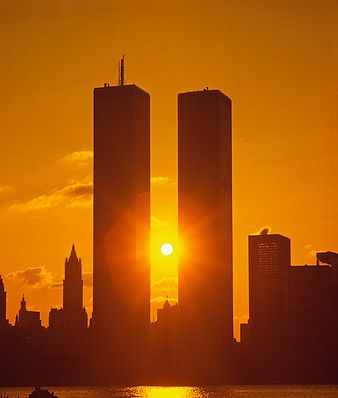
NYC, NY, Sunrise Between Twin Towers, World Trade Center, designed by Minoru Yamasaki, International Style II


________________________________________________________________________________

Magnified and sanctified be G-d’s great name in the world which He created according to His will. May he establish His kingdom during our lifetime and during the lifetime of Israel. Let us say, Amen.May G-d’s great name be blessed forever and ever.

Blessed, glorified, honored and extolled, adored and acclaimed be the name of the Holy One, though G-d is beyond all praises and songs of adoration which can be uttered. Let us say, Amen.

May there be peace and life for all of us and for all Israel. Let us say, Amen.

Let He who makes peace in the heavens, grant peace to all of us and to all Israel. Let us say, Amen.

Paul Simon at Ground Zero- Sounds of Silence – Hebrew Subtitles

Peres says he trusts Obama, Putin to reach Syria deal

September 11, 2013

Peres says he trusts Obama, Putin to reach Syria deal | The Times of Israel.

President believes that if Assad shows any dishonesty in chemical weapons agreement, US will strike his regime

September 11, 2013, 6:53 pm
Shimon Peres at the graduation ceremony Wednesday. (photo credit: President's Residence)

Shimon Peres at the graduation ceremony Wednesday. (photo credit: President’s Residence)

Two days after casting doubt on a Russian-brokered deal that would see Damascus give up its chemical weapons, President Shimon Peres threw his weight behind the proposal, saying any agreement reached by the US and Russia would ensure the safe disposal of Syria’s WMDs.

“I know both [US] President [Barack] Obama and [Russian] President [Vladimir] Putin, and I am convinced that if an agreement is reached it will be reliable, explicit and significant,” the president said at an Israeli Navy graduation ceremony.

Responding to Obama’s speech on Syria the night before in which the president said Washington was pursuing a diplomatic agreement which would ensure the destruction of Assad’s chemical weapons stockpiles, Peres said the US “is showing its moral and democratic weight and the strength of its military by attempting to bring an immediate end to the use of chemical weapons and to its ultimate destruction.”

“The murder of innocents, including women and children, is a crime which cannot be ignored,” Peres said, but noted that “it wasn’t the anger over the images of dead children that affected Assad but the military threat which forced him to respond to the initiative to remove and disarm his chemical weapons.”

On Monday, shortly after Russian Foreign Minister Sergey Lavrov pitched the proposal to have Assad hand his chemical weapons over to international actors for eradication, Peres cautioned against putting too much stock in the deal, saying “the Syrians are not trustworthy,” and that their acceptance of the Russian proposal meant very little.

Peres Wednesday again voiced skepticism of Assad’s trustworthiness, but assured the audience that he had faith in Putin and Obama’s ability to reach a suitable agreement which “must ensure that Assad has no chemical weapons.”

Earlier in the day the elder statesman said that if Assad proved to be honest, he would avoid American military action, but “if there’ll be a crack in Syria’s integrity I have no doubt that the US will act militarily.”

Prime Minister Benjamin Netanyahu also weighed in Wednesday on the issue of Syria’s alleged chemical weapons use, reiterating Obama’s remark the night before that Assad’s act was a “crime against humanity.”

“The world needs to ensure that whosoever uses WMDs pays a price for it,” Netanyahu said in a statement. “The message received in Syria will be well understood in Iran.”

Netanyahu added that Obama’s statement that Israel can defend itself “with overwhelming force” is correct, and is “the basis of our security.”

On Tuesday evening, Obama asked Congress to delay voting on using force against Syria in order to try and pursue a diplomatic solution to the crisis. The American president added Tuesday that should diplomacy fail the US military would “be ready to respond” against the Syrian government.

The Russian proposal, which Damascus agreed to on Tuesday, would put the country’s chemical weapons under international supervision. The regime is accused of using sarin gas to kill over a thousand people outside Damascus on August 21.

The Syrian civil war, which has raged for over two years, has claimed over 100,000 lives, according to the United Nations.

Syrian rebels: Russian initiative ‘dirty deal’, only good for Israel

September 11, 2013

Syrian rebels: Russian initiative ‘dirty deal’, only good for Israel – Israel News, Ynetnews.

Opposition laments positive attitude toward Russian compromise, urges US to revert back to attack plans. ‘Neutralizing Assad’s chemical weapons serves Israel, not the Syrian people,’ rebel commander says

Roi Kais

Published: 09.11.13, 14:58 / Israel News

Syria’s opposition and rebel forces are fuming over US President Barack Obama and the West’s handling of the Syrian crisis, specifically the latest developments regarding the US attack on Syria.

Qassim Saad al-Din, a spokesman for the Syrian opposition military command, told the London-based paper Asharq Al-Awsat that the Russian compromise with the US regarding Syria’s chemical arms was reached “at the expense of the blood of the Syrian people.”

According to al-Din, “the only thing the West is interested in is protecting Israel and disarming the arms threatening it. The 100,000 killed in Syria do not top their priorities.”

Syrian rebels in Aleppo (Photo: Reuters)

Head of the Military Revolutionary Command in Aleppo, Abed al Jabar al Akhidi, said that “the international ploy to cancel the attack on Syria in return for the neutralization of chemical weapons is a dirty deal between Russia, Assad’s regime and the West.”

In an interview with Al Arabiya, al Akhidi said that “what is happening here is an attempt to help Obama save face after he climbed up onto a tree and the Russians pulled out his ladder.

“Neutralizing Assad’s chemical weapons serves Israel, not the Syrian people, because the international community’s attempt to disarm Assad from his chemical arms stems from the public outcry and not from the killing.”

Immediately following the publication of the Russian proposal, General Salim Idris, head of the Free Syrian Army, dismissively responded to the initiative, saying: “The (Syrian) regime has a massive arsenal, the size and location of which is unknown.” According to him, Assad should not be trusted and Syria responded positively only in a bid to postpone the American strike and “buy time.” He further urged the Americans not fall for the regime’s “deceit” and return to their attack plans.
"המערב מבטיח ומבטיח, עכשיו זו בדיחה". סלים אידריס (צילום: AFP)

‘Western promises are a joke’. Salim Idris (Photo: AFP)

After the British parliament decided against an attack, Idris said the decision would “leave us alone to be killed” by President Bashar Assad, and pave the way for al-Qaeda to dominate the rebel ranks. “What are our friends in the West waiting for?” Idris asked. “For Iran and Hezbollah to kill all the Syrian people?” “The West promises and promises. This is a joke now,” he concluded.

Unarmed Syrian opposition forces also expressed discontent from the favorable light in which the Russian compromise was greeted.

Ahmed Ramdan, a Syrian opposition member, expressed apprehension regarding the initiative, claiming he feared that it might be mistakenly understood by Assad as a green light to continue to conduct massacres against the Syrian people after he disarms from chemical weapons.

Nonetheless, he noted that he hoped the Syrian regime’s positive response to the initiative could signal the first step towards Assad’s unconditional surrender of power.

Between the sublime and the ridiculous

September 11, 2013

Israel Hayom | Between the sublime and the ridiculous.

Boaz Bismuth

There will, of course, be some who see a spark of genius, or perhaps even more than that, in U.S. President Barack Obama’s management of the crisis in Syria.

They will tell us that Obama, by issuing a credible military threat against Syria, put a serious scare into Syrian President Bashar Assad for the first time since the start of the uprising in Syria. Assad was so frightened of being bombed, they will say, that he agreed unconditionally to give up his chemical weapons without even a single shot being fired, obeying the order of the responsible adult, Mother Russia, which probably received a tip to act in this manner from Obama during the G-20 summit in Saint Petersburg last week. And what about Iran? They will explain to us that Iran is now shaking in its boots in the face of America’s aggressiveness and might even join its little sister Syria in dismantling prohibited weapons programs.

I wish these people were right. But in reality, the crisis in Syria, even before the most recent developments, has been a reminder to us of Napoleon Bonaparte’s phrase: “There is only one step from the sublime to the ridiculous.”

On Tuesday night, Obama delivered a highly significant speech to his nation. Everyone in Washington had been waiting for the speech, in which it was expected that Obama would seek the backing of Congress and the American public for military action in Syria. But in the lead-up to the speech, Obama vacillated, Russia took the lead and Congress chose to delay a decision on the matter. Assad, who, perhaps ironically, celebrates his 48th birthday on Sep. 11, may live for 120 years in his country.

Russian President Vladimir Putin’s proposal for Syria to give up its chemical weapons reduced the importance of Obama’s speech. Meanwhile, the center of attention has shifted to the U.N. Security Council, Moscow, Europe and even Tehran. Washington is lucky just to remain in the picture.

As things stand now, the big winner, other than Putin, is Assad. First, no one now expects that he will in fact be punished for his use of chemical weapons against his citizens. And second, even if Assad says he is willing to hand over his chemical weapons, the situation is complex and problematic. How will Assad’s huge stores of chemical weapons be destroyed? Does anyone really trust Assad to facilitate the work of inspectors? And speaking of inspectors, how will they be able to conduct their work in the midst of the bloody civil war that is raging in Syria?

France, which supports military action against Assad, has turned to the U.N. Security Council with a binding resolution that includes three conditions: that Syria’s dismantlement of chemical weapons be quick and thorough, and, most importantly, obligatory. Russia opposes this resolution. A U.N. Security Council discussion on the resolution that was scheduled for Tuesday was canceled due to disagreements between superpowers. The Americans and Russians are now just talking and talking. And this is just the beginning.

We have to admit that the Syrian matter has left an unpleasant taste in our mouths. Obama, the commander-in-chief of the U.S. armed forces, is the leader of the free world. He is supposed to provide “the sublime”: security, peace, justice and freedom. But right now, Niccolo Machiavelli — otherwise known as Vladimir Putin (whose proposal won global praise and support from leaders who feed on public opinion polls) — is in charge. Putin’s proposal is perceived as simple and logical, but it is in fact complicated and may drag out over years in a country with the largest chemical weapons stockpiles in the world.

In any case, this whole story is rife with surprises. Suddenly, the isolated U.S. government found a “vital” reason for attacking Syria: concerns in Israel, where, as U.S. Secretary of State John Kerry explained, there has been an increase in demand for gas masks. Kerry also mentioned, justly we must admit, fears about Iran.

So perhaps it is not a good time to remind our American friends that chemical weapons are extremely deadly and Assad has only shown signs of willingness to part from them after he had already used them. Here in Israel, we do not want Iran to agree to give up nuclear weapons after having already used them once — on us.

I hope that Obama will ultimately provide us with the “sublime.” This is important for him, and equally important for us. Woe be to the Middle East if Obama ends up on the “ridiculous” side again. We certainly will not be laughing.

Report: Russia to supply S-300 anti-aircraft missiles to Iran

September 11, 2013

Report: Russia to supply S-300 anti-aircraft missiles to Iran | JPost | Israel News.

According to Russian daily Kommersant, Moscow has also agreed to build another nuclear reactor in Bushehr; Iran to pay $800 million for missile batteries.

Russian S-300 anti-aircraft missile system

Russian S-300 anti-aircraft missile system Photo: Reuters

Russian President Vladimir Putin has approved the transfer of S-300 anti-aircraft missiles to Iran, according to the prestigious Russian daily newspaper Kommersant.

The newspaper reported on Wednesday that the Russian government will revive the transfer three years after it canceled the original transaction.

According to Kommersant, the Kremlin agreed to Tehran’s request to complete the transaction, which will net the Russian treasury $800 million.

In addition to the missile deal, Russia has also agreed to construct another nuclear reactor in Bushehr. According to the Kommersant report, the two sides are expected to finalize the details of the deal this coming Friday, when Putin is expected to meet his Iranian counterpart, Hassan Rouhani, in the central Asian republic of Kyrgyzstan.

Kommersant reported on Wednesday that the Russians intend on supplying Iran with a less advanced version of the S-300 than originally thought.

The Russian-manufactured anti-aircraft batteries have been a source of concern to Israeli officials who fear that their enemies’ possession of them could have adverse strategic consequences.

Last month, Russia suspended the delivery of S-300 missile systems to Syria. Russian newspaper Kommersant reported the shipping of the S-300 missile systems that were expected to be delivered by July 2014. The newspaper reported that the shipments were delayed until 2015-2016 because Damascus failed to provide payment for them.

Israeli official believe that the missiles, which have a 200-kilometer range, would have the capacity to hit planes in northern Israel. It would create a no-fly zone that would make it impossible for the Israeli air force to operate along the Syrian and Lebanese border.

Putin told Russia’s First Channel that some components of the S-300 systems were delivered to Syria, but that the rest would be delayed until Syrian President Bashar Assad’s regime pays for them.

Additionally, a shipment of twelve MiG-29M/M2 jets ordered in 2007, six of which were due to be delivered to Syria by the end of the year, will not be supplied before 2016-2017 because Damascus has only paid Moscow 30 percent of the agreed sum for the jets.

In May, Israel and the US asked Russia not to deliver the weapons system to Syria, but Russia said the missiles are defensive and needed by Assad in his battle against rebel groups.

Obama-Putin deal didn’t stop at chemical Syria: US eases sanctions on nuclear Iran

September 11, 2013

Obama-Putin deal didn’t stop at chemical Syria: US eases sanctions on nuclear Iran.

DEBKAfile Exclusive Report September 11, 2013, 11:59 AM (IDT)
Iranian President Hassan Rouhani

Iranian President Hassan Rouhani

Iran, and not just Russia and Syria, is taking advantage of President Barack Obama’s decision to refrain from military force against Syria to collect a shower of diplomatic and political dividends.

The new Iranian president Hassan Rouhani announced Tuesday that the coming meeting of the General Assembly opening in New York later this month “may prove the perfect setting to reignite talks about the nation’s nuclear program.“ The US Treasury Department accordingly lifted a string of sanctions restricting humanitarian and athletic exchanges between US and Iranian NGOs and environmental projects, as a counter-gesture of good will.
Washington was not put off when that comment proved to be an exercise in image-burnishing for the benefit of the West. That same day, the Iranian president declared his country would not give up “one iota of its nuclear capabilities.”

debkafile’s Iranian sources disclose that the posturing on all sides provided the façade for the secret exchange of messages between Washington, Tehran, Moscow and Damascus. They focused first on a Russian pledge to bring Assad’s chemical arsenal under international control and destroyed. This was followed by Tehran consenting to engage in direct dialogue with Washington when the next UN General Assembly session opens in New York on September 23.
Rouhani, who has consistently refused to enter into direct talks with Washington on his government’s nuclear program, said Friday, Sept. 6: “Initial steps in the future of nuclear talks may be taken in New York and then these talks will be pursued by the Group 5 + 1.”

debkafile: For President Obama, the two issues – the disposal of Syria’s chemical weapons and resolution of the nuclear controversy with Iran – were closely interwoven in his quiet exchanges with Vladimir Putin, which emphasized the diplomatic, non-military route.
The Russian leader appears to have assured Obama that an agreed formula for defusing the Syrian chemical weapons issue without military force would provide the key to progress in nuclear talks with Iran.
Our Iranian sources report that Tehran was in on all stages of the discreet Obama-Putin discussions on Syria: High-ranking Iranian officials were present in Damascus and Moscow throughout, and points of agreement were brought to Tehran for approval.
Full details of how this four-handed game was conducted and details of the deals struck between the US, Russia and Iran, will be revealed for the first time in the next issue of DEBKA Weekly out Friday, Sept. 13.

Terror States

September 11, 2013

Terror States.

A crucial factor of US decision to strike Syria should consider the phenomenon of establishment of a new, Threatening entity in the international environment terror states which sooner or later will pose a foremost existential threat to the free world. A counter Syria Campaign may strengthen this phenomenon and its threats
EMERGENCY services are responding to a simulated terrorist attack - flicker/West Midlands Police
EMERGENCY services are responding to a simulated terrorist attack – flicker/West Midlands Police

The History of the last three Centuries has defined only one type of actors in the international environment – sovereign states with identified and recognized borders, compliant with international law and covenants, and responsible to their deeds. During the last 50 years was developed another type of actors, i.e. Guerilla and terror organizations that lack basic attributes of state and comprised some amorphous characteristics that enable them to strengthen in the modern world order, and at the same time they try to abolish it.

At the beginning of the 21st Century, a new entity in the international environment has been evolving. That entity encompasses terror groups or organizations that govern a state. Consequently, the aggressive and cruel characteristics of terror organizations unite with the qualities of sovereign state enjoy protection of the international law and at the same time ignore it in seeking their goals, regarding internal struggles and outside conflicts. Afghanistan under the Taliban control had been the first model of Terror State.

Its temporary success enabled other terror organizations to adapt that concept to other regions. But dealing with theoretical issues has little to contribute to cope with a most dangerous challenge of the Free World; i.e., Terror States. The Middle East encounters clouds of threats of a revolution that may evolve several terror nations which will be able to conquer most of the Arab nations. Some of them hold the keys for a considerable share of the world’s energy reserves.

Syria, after a plausible fall of President Assad’s regime, assumed to be the first candidate for a terror states’ alliance. Egypt, if free election will be occurred, supported by illogical and mistaken US pressure, and victory of the Muslim Brothers, will be the second one. The fragile regime Kingdome of Jordan will plausibly fall soon after. Yemen and the Emirates will not sustain the pressure of terrorism; and it is redundant to mention other candidate nations.

A few years from now an evil nation as Iran will be considered as a relatively moderate one comparing to the terror states. The new entity of the international environment – Terror states are believed to be the worst threat against the values and freedom of the free world, which protects itself by international law and international covenants` While terror states will try to harm and even destroy democracies ignoring any law and moral principles.

In order to prevent that reinforcement of the international terrorism, this process must be cut off at its first stage. The US president, despite his admirable moral concept, has to realize the consequences of initiation of a campaign against Assad’s regime – the first falling block of the shaken wall of Middle Eastern South-Eastern states, The US ability to prevent the fall of other countries to the evil hands of the international terrorism will be degraded significantly.

The United States of America should determine its next step for the long run rather than attack Syria as a result of short-run mistaken considerations.


