Archive for July 2013

Russia worried by lack of progress in Iran nuclear talks

July 4, 2013
By REUTERS
07/04/2013 15:31
MOSCOW- Russia is worried by a lack of progress on organising new talks between Iran and six world powers on Tehran’s nuclear programme, a senior Russian diplomat said on Thursday, despite the victory of a relative moderate in Iran’s presidential election.Deputy Foreign Minister Sergei Ryabkov made clear that a diplomatic push to arrange a new round of talks, launched after Hassan Rouhani won the June 14 election, had produced no breakthrough.

“There is no agreement now on when and where the next round will be. That worries us,” Ryabkov told Interfax news agency.

“After the election of the Iranian president, we stepped up work in preparation for a new round of talks but so far the work is not being done transparently.”

.

Envoy says Israel ‘far from’ strike on Iran | Israel | Jewish Journal

July 4, 2013

Envoy says Israel ‘far from’ strike on Iran | Israel | Jewish Journal.

In an interview aired Sunday on CNN, Michael Oren told host Fareed Zakaria that Israel supports President Obama’s efforts at outreach to Iran.

Asked about reports that Israel was planning to curb the Islamic Republic’s ability to obtain nuclear weapons by attacking its nuclear facilities, Oren said,  “I don’t think it’s true. I think that we are far from even contemplating such things right now.”

After Zakaria accused Oren of not being forthcoming about an imminent attack, and pointing out that Israel has been “deeply uncomfortable and nervous” about engagement with Iran, the ambassador replied that “We were, but we were greatly comforted during the prime minister’s visit here in May, when the president told him, assured him, that there would be a serious reassessment of the policy before the end of the year. We are further reassured now that the end-of-the-year deadline has been moved up to September.”

Oren added that the U.S. “willingness to consider formulating a package of serious sanctions against Iran even now in advance of the reassessment” also was reassuring.

America chooses to win wars without bloodshed – English pravda.ru

July 4, 2013

America chooses to win wars without bloodshed – English pravda.ru.

04.07.2013 10:59

America chooses to win wars without bloodshed. 50504.jpeg

There are different methods of fighting a war. In today’s world, there is no need to grab a gun and kill the enemy. A war can be won without bloodshed, with the help of information attacks. The Americans have been particularly successful in this regard, take the Internet “Arab Spring” for example. The United States is using the same methods against Iran. Will they bring success?

A number of satellite television systems operated by European companies stopped broadcasting the Iranian channels. This was done under the pressure of sanctions by the United States.

In particular, the broadcasts of the Iranian channel Press TV via European satellite systems, Intelsat, Eutelsat, Hotbird and the Australian Optus have been suspended. Spanish-language Hispan TV, news channel al-Alam and entertainment iFilm are not broadcast either.

On June 19th of this year, Intelsat company gave Iran Broadcasting Service a notification stating that due to the introduction of new U.S. sanctions against Tehran the company would be no longer providing the services starting July 1, 2013. Press TV broadcast was previously blocked in Germany, the UK, France and Spain.

Jose Manuel Toscano, General Director of the International Telecommunications Satellite Organization, in turn, urged the U.S. and Intelsat to not turn off the Iranian channels and start negotiations on the renewal of broadcasting.

This is how the Americans want to force the Iranian authorities to be more loyal to their regime. They say that in a war all means are great, so every means is used, including information warfare.

In the context of learning new techniques, forms and methods of information wars the development of the situation around Iran’s nuclear program is particularly interesting.  

The United States and its allies have repeatedly practiced the scenarios of information and psychological operations aimed at discrediting the political authorities of the countries they were not favoring. Previous armed conflicts and the “Arab Spring” have common traits because they use classic schemes. As a rule, the main objectives of this policy are:

1. Ensuring global domination and consolidation of positions in a favorable, primarily based on the availability of resources, region of the planet;

2. Raising the rating of specific political forces and certain leaders on the eve of important electoral campaigns;

3. Justification of the need to increase military spending, as well as the development of the military-industrial complex;

4. Testing of the new and utilization of the old types of weapons.

As a rule, measures of informational influence are accompanied and enhanced by economic sanctions, staged civil disobedience, mass protests, special acts of sabotage in the enemy territory, and demonstration of readiness to conduct military operations (various military exercises, as well as concealed concentration of weapons and troops).

The information war of the U.S. against Iran is carried out according to this scenario, but it has its own peculiarities. The emphasis is on the components in which the opponents of the Islamic state still have significant advantage. This is the cyber sphere, as well as special and psychological operations.

Thus, Iran’s information systems related to the nuclear program are constantly subject to highly effective virus attacks. For the first time a virus called Stuxnet was used in June of 2010. Its main task was the disruption of the Bushehr nuclear power plant as well as uranium enrichment plants. At a munitions factory in Natanz there were serious technical problems that affected the work of gas centrifuges. This led to the fact that Tehran’s nuclear programs were suspended for some time.

The second penetration occurred in April of 2011, when a virus called Stars was used, directed against the Iranian government agencies. Later, a third attack was carried out with the use of Duqu virus designed to steal confidential information.
It should be noted that the U.S. authorities take into account the fact that today Iran’s media community is rapidly evolving. The activities of the regional media, particularly electronic ones, are not left without attention. During various interviews, briefings, and other information campaigns the resources of BBC are fully utilized (primarily, BBC Persian), as well as “Voice of America”. Of great importance are social networks like Facebook, Twitter, and YouTube.

In particular, the BBC Persian TV channel has a million-strong audience in Iran, and online resource BBC Persian is a very popular information resource in the Middle East.

In addition, in December of 2011, the U.S. opened its own so-called “virtual embassy in Iran.” Certain websites offer information on U.S. policy towards Iran, the advantages of studying in the U.S., as well as provide an opportunity to get a U.S. visa. The resource did not last long and was blocked by the Iranian authorities. Iran’s leaders periodically block access for their citizens to various “pro-American” internet sites and satellite television channel BBC Persian.

As part of “demonizing” the current leadership of Iran, the United States and Israel keep accusing Tehran of supporting terrorist organizations and carrying out terrorist attacks against the U.S., Israel and their allies.

It should also be noted that by opposing the will of Iran to implement its national nuclear program, the U.S. government and Israel ignore the fact that it was Washington that gave the country nuclear technology. In 1967, the United States gave Iran a nuclear reactor of five megawatts set up by Israeli experts.
The U.S. has been methodically forming a negative image of Iran for the international community saying that this country represents a threat. U.S. special agents constantly disseminate scary information about the Iranian leadership.

In addition, the U.S. and Israel periodically carry out planned activities for misinformation of the population through the “leaks” from their governments about the readiness of the United States and Israel to take military action against Iran. Reputable Western publications regularly publish materials about this possible scenario. It must be acknowledged that these articles have the desired effect.

To date, the majority of the citizens of nearly every country form their own view of the events only on the basis of the information received from the media. Major news portals on the Internet are also of great importance. If we consider that in most cases they are controlled by the U.S. secret services, one can imagine the view formed by the ordinary citizens.

Among the main responses to the information influence from Iran is the demonstration of readiness to meet any possible military attacks, as well as the possibility of applying adequate strikes against the U.S. and its allies in the region, primarily Israel. Iranian spiritual leader Ayatollah Khamenei has repeatedly said that Iran’s armed forces have all the necessary means to repel possible attacks and perform a retaliatory “preemptive strike” against the enemy.

The country’s leadership is constantly filtering information flow by blocking the resources involved in brainwashing ordinary people. The Iranian authorities also attach great importance to developing relations in different directions with their longtime allies in the international arena that in fact are the opponents and antagonists of the United States. These are Russia, China, Venezuela, Ecuador, Syria, Afghanistan and other countries.

This helps the Iranian leadership to withstand such a serious economic and information pressure from the United States.

Sergei Vasilenkov

Pravda.Ru 

Read the original in Russian

Дмитрий Судаков

Syria’s Assad declares fall of ‘political Islam’

July 4, 2013

Syria’s Assad declares fall of ‘political Islam’ – Israel News, Ynetnews.

In special interview, Syrian president battling civil war says ouster of Egyptian President Morsi ‘is fall of political Islam’. ‘You can’t fool all the people all the time, he adds

AFP

Published: 07.04.13, 12:13 / Israel News
 

Syrian President Bashar Assad said the massive protests against his Islamist Egyptian counterpart brought the fall of “political Islam,” in statements posted on Wednesday on his official Facebook page.

“What is happening in Egypt is the fall of what is known as political Islam,” Assad said in an interview with Syrian state newspaper Ath-Thawra, excerpts of which were posted on the Internet.

“Anywhere in the world, whoever uses religion for political aims, or to benefit some and not others, will fall,” Assad said.

“You can’t fool all the people all the time, let alone the Egyptian people who have a civilization that is thousands of years old, and who espouse clear, Arab nationalist thought,” he added.
פורצים למטה האחים המוסלמים במצרים (צילום: EPA)

Activists breaking into Muslim Brotherhood Cairo HQ (Photo: EPA)

“After a whole year, reality has become clear to the Egyptian people. The Muslim Brotherhood‘s performance has helped them see the lies the (movement) used at the start of the popular revolution in Egypt.”

The full, pre-recorded interview is due to be published on Thursday, a day after massive street protests in Egypt ended with the ouster of the Brotherhood’s Mohamed Morsi.

There is long-standing animosity between the Damascus regime and the Muslim Brotherhood, and membership in the group has been punishable by death in Syria since the 1980s.

The Syrian branch of the Brotherhood today plays a key role in the exiled opposition National Coalition, which is recognized by more than 100 states and organizations as legitimate representative of the Syrian people.

Syria’s conflict broke out after Assad’s regime unleashed a brutal crackdown on a popular movement for regime change that broke out in March 2011.

More than 100,000 people have been killed in Syria’s war, says the Syrian Observatory for Human Rights.

Saudis, Gulf emirates actively aided Egypt’s military coup, settling score for Mubarak ouster

July 4, 2013

Saudis, Gulf emirates actively aided Egypt’s military coup, settling score for Mubarak ouster.

DEBKAfile Exclusive Report July 4, 2013, 10:33 AM (IDT)
Egyptians celebrating military overthrow of Morsi government

Egyptians celebrating military overthrow of Morsi government

The lightening coup which Wednesday, July 3, overthrew President Mohamed Morsi put in reverse gear for the first time the Obama administration’s policy of sponsoring the Muslim Brotherhood movement as a moderate force for Arab rule and partner in its Middle East policies. debkafile reveals that the Egyptian military could not have managed their clockwork coup without the aid of Saudi and Dubai intelligence and funding.
Saudi Arabia and the UAE threw their weight and purses behind Egypt’s generals aiming to put their first big spoke in the US-sponsored Arab Revolt (or Spring), after they failed to hold the tide back in Libya, Egypt and thus far Syria.

The coup leader, Defense Minister and army chief Gen. Abdel Fattah El-Sisi, had two more Saudi-Gulf commitments in his pocket, say debkafile‘s Middle East sources:

1. Should the Obama administration cut off the annual US aid allocation of $1.3 billion, Saudi Arabia and the UAE would make up the military budget’s shortfall;

2. The Saudis, UAE and other Gulf nations, such as Bahrain and Kuwait, would immediately start pumping out substantial funds to keep the Egyptian economy running. The Egyptian masses would be shown that in a properly managed economy, they could be guaranteed a minimal standard of living and need not go hungry as many did under Muslim Brotherhood rule.

According to our sources, the Saudis and the UAE pledged to match the funds Qatar transferred to the Muslim Brotherhood’s coffers in Cairo in the past year, amounting to the vast sum of $13 billion.

This explains President Barack Obama’s caution Thursday morning, July 4, in his expression of deep concern over the ousting of the Egyptian president and the suspension of its constitution. He urged the military to restore government to civilian hands – without accusing them outright of a coup d’etat – and to “avoid arresting President Moris and his supporters.”

The US president refrained from cutting off aid to Egypt, now under military rule, only ordering his administration “to assess what the military’s actions meant for US foreign aid to Egypt.”

Thursday morning, Washington ordered US diplomats and their families to leave Cairo at once, leaving just a skeleton staff at the embassy for emergencies. debkafile: This step is only one symptom of the broad gulf developing between the Obama administration and Egypt’s post-coup administration headed by Defense Minister and coup leader Gen. El-Sisi

By means of the successful military putsch in Cairo, Saudi King Abdullah had his revenge for the toppling of his friend Hosni Mubarak in February 2011, for which he has never forgiven President Obama whom he held responsible.
The Saudi-Gulf intervention in Egypt’s change of government also ushers in a new stage of the Arab Revolt for the Middle East. For the first time, a group of traditionally pro-US conservative Arab governments has struck out on its own to fill the leadership vacuum left by the Obama administration’s unwillingness to pursue direct initiatives in the savage Syrian civil war or forcibly preempt Iran’s drive for a nuclear bomb.

The removal of Muslim Brotherhood rule in Egypt has far-reaching ramifications for Israel. In the immediate term, it gives Israel some security relief – especially, easing the dangers posed from Sinai to its southern regions. The radical Palestinian Hamas, the Muslim Brotherhood offshoot which rules the Gaza Strip, has suffered the most damaging political and military setback in its history with the loss of its parent and patron in Cairo.

The big question facing Egypt’s still uncertain future is: Will Riyadh and the UAE follow through on their backing for Gen. Fattah El-Sisi, the most powerful man in Egypt today, and release the promised funds for rehabilitating the Egyptian economy?

’32 die in violent clashes in Egypt following Morsi overthrow’

July 4, 2013

’32 die in violent clashes in Egypt following Morsi overthrow’ | JPost | Israel News.

By REUTERS
LAST UPDATED: 07/04/2013 10:20
Dozens injured as supporters, opponents of ousted Egyptian president clash after army announces his removal; Egyptian police issue arrest warrant for 300 Muslim Brotherhood members; Morsi reportedly held at military facility.

ALEXANDRIA, Egypt – At least 32 people were killed when opponents and supporters of Egypt’s deposed president, Mohamed Morsi, clashed after the army announced his removal on Wednesday, Egyptian television station Nile TV reported on Thursday.

Eight of those reported dead were in the northern city of Marsa Matrouh. Al-Anani Hamouda, a senior provincial security official, said two members of security forces were among those killed in the clashes.

Three people were killed and at least 50 wounded in the Mediterranean city of Alexandria, state news agency MENA reported. Gunfire broke out as rocks and bricks flew during the fighting, witnesses said.

One of the city’s dead was a woman stabbed in the stomach, MENA said. The other two were men hit by birdshot.

“We are dealing with the situation… We have called for security reinforcements in the area,” said senior police officer Sherif Abdelhamid.

Three people were also killed in the southern Egyptian city of Minya, including two police, MENA said. It said 14 people were wounded.

Dozens more were wounded in Fayoum, south of Cairo, where unidentified assailants broke into the local offices of the Freedom and Justice Party, the Brotherhood’s political wing, MENA said.

The attackers looted the headquarters and set them on fire, it said.

Meanwhile, the Egyptian police issued an arrest warrant for 300 members of the Muslim Brotherhood, Egyptian paper Al Ahram reported on Thursday morning.

Morsi himself is reportedly detained in the Presidential Republican Guards Club, a military facility, with his top aides, AFP cited a senior Muslim Brotherhood member as saying.

JPost.com staff contributed to this report.

At least 9 killed in clashes following Morsi’s ouster

July 4, 2013

At least 9 killed in clashes following Morsi’s ouster | The Times of Israel.

Deposed Egyptian president placed under house arrest; troops surround Islamist rallies, where Muslim Brotherhood supporters vow to fight to the end

July 4, 2013, 6:38 am Egyptian soldiers are seen deployed near Cairo University, where thousands of Muslim Brotherhood's supporters have gathered to support Mohammed Morsi in Cairo Wednesday, July 3 (photo credit: AP/Manu Brabo)

Egyptian soldiers are seen deployed near Cairo University, where thousands of Muslim Brotherhood’s supporters have gathered to support Mohammed Morsi in Cairo Wednesday, July 3 (photo credit: AP/Manu Brabo)

CAIRO (AP) — Egypt’s first democratically elected president was overthrown by the military Wednesday, ousted after just one year in office by the same kind of Arab Spring uprising that brought the Islamist leader to power.

The armed forces announced they would install a temporary civilian government to replace Islamist President Mohammed Morsi, who denounced the action as a “full coup” by the generals. They also suspended the Islamist-drafted constitution and called for new elections.

Millions of anti-Morsi protesters around the country erupted in celebrations after the televised announcement by the army chief. Fireworks burst over crowds in Cairo’s Tahrir Square, where men and women danced, shouting, “God is great” and “Long live Egypt.”

Fearing a violent reaction by Morsi’s Islamist supporters, troops and armored vehicles deployed in the streets of Cairo and elsewhere, surrounding Islamist rallies. Clashes erupted in several provincial cities when Islamists opened fire on police, with at least nine people killed, security officials said.

Egyptian police special forces stand guard beside an armored vehicle, protecting a bridge between Tahrir Square and Cairo University, where Muslim Brotherhood supporters have gathered, in Giza, Egypt, Wednesday, July 3 (photo credit: AP/ Manu Brabo)

Egyptian police special forces stand guard beside an armored vehicle, protecting a bridge between Tahrir Square and Cairo University, where Muslim Brotherhood supporters have gathered, in Giza, Egypt, Wednesday, July 3 (photo credit: AP/ Manu Brabo)

Gehad el-Haddad, a spokesman for the Muslim Brotherhood party, said Morsi was under house arrest at a Presidential Guard facility where he had been residing, and 12 presidential aides also were under house arrest.

The army took control of state media and blacked out TV stations operated by the Muslim Brotherhood. The head of the Brotherhood’s political wing was arrested.

The ouster of Morsi throws Egypt on an uncertain course, with a danger of further confrontation. It came after four days of mass demonstrations even larger than those of the 2011 Arab Spring that toppled longtime autocrat Hosni Mubarak.

Egyptians were angered that Morsi was giving too much power to his Muslim Brotherhood and other Islamists and had failed to tackle the country’s mounting economic woes.

Beyond the fears over violence, some protesters are concerned whether an army-installed administration can lead to real democracy.

Egyptians wave national flags as fireworks light the sky over Tahrir Square, where hundreds thousands opponents of Egypt's Islamist President Mohammed Morsi celebrate in Cairo, Egypt, Wednesday, July 3, (photo credit: AP/Amr Nabil)

Egyptians wave national flags as fireworks light the sky over Tahrir Square, where hundreds thousands opponents of Egypt’s Islamist President Mohammed Morsi celebrate in Cairo, Egypt, Wednesday, July 3, (photo credit: AP/Amr Nabil)

President Barack Obama urged the military to hand back control to a democratic, civilian government as soon as possible but stopped short of calling it a coup d’etat.

He said he was “deeply concerned” by the military’s move to topple Morsi’s government and suspend Egypt’s constitution. He said he was ordering the U.S. government to assess what the military’s actions meant for U.S. foreign aid to Egypt — $1.5 billion a year in military and economic assistance.

The U.S. wasn’t taking sides in the conflict, committing itself only to democracy and respect for the rule of law, Obama said.

On Monday, army chief Gen. Abdel-Fattah al-Sisi had given Morsi an ultimatum to find a solution to meet the demands of anti-government demonstrators in 48 hours, but the 62-year-old former engineer defiantly insisted on his legitimacy from an election he won with 51.7 percent of the vote in June 2012.

Any deal was a near impossibility, however, making it inevitable the military would move.

As the deadline approached, al-Sisi met with pro-reform leader Mohammed ElBaradei, top Muslim cleric Sheik Ahmed el-Tayeb and Coptic Pope Tawadros II, as well as opposition activists and some members of the ultraconservative Salafi movements. The consultations apparently were aimed at bringing as wide a consensus as possible behind the army’s moves.

The Brotherhood boycotted the session, according to its political arm the Freedom and Justice Party.

In a last-minute statement before the deadline, Morsi again rejected the military’s intervention, saying abiding by his electoral legitimacy was the only way to prevent violence. He criticized the military for “taking only one side.”

“One mistake that cannot be accepted, and I say this as president of all Egyptians, is to take sides,” he said in the statement issued by his office. “Justice dictates that the voice of the masses from all squares should be heard,” he said, repeating his offer to hold dialogue with his opponents.

“For the sake of Egypt and for historical accuracy, let’s call what is happening by its real name: Military coup,” Morsi’s top foreign policy adviser Essam al-Haddad wrote on his Facebook page.

After the deadline expired, el-Sissi went on state TV and said the chief justice of the Supreme Constitutional Court, Adli Mansour, would step in as interim president until new elections are held. Mansour was appointed to the court by Mubarak but elevated to the chief justice post by Morsi and will be sworn in Thursday by judges of his court.

Flanked by Muslim and Christian clerics as well as ElBaradei and two opposition activists, al-Sisi said a government of technocrats would be formed with “full powers” to run the country.

He promised “not to exclude anyone or any movement” from further steps. But he did not define the length of the transition period or when presidential elections would be held. He also did not mention any role for the military.

Al-Sisi speaking on state televison. (Screenshot: Egypt State Television/ AP)

Al-Sisi speaking on state televison. (Screenshot: Egypt State Television/ AP)

The constitution, drafted by Morsi’s Islamist allies, was “temporarily suspended,” and a panel of experts and representatives of all political movements will consider amendments, al-Sisi said. He did not say whether a referendum would be held to ratify the changes, as customary.

ElBaradei, a Nobel Peace Prize laureate and the former head of the U.N. nuclear watchdog agency, said he hoped the military plan “is the beginning of a new launch for the Jan. 25 revolution when people offered their dearest to restore their freedom, dignity and social justice for every Egyptian.”

Also appearing with al-Sisi was Mahmoud Badr, one of two representatives of Tamarod, or Rebel — the youth opposition movement that engineered the latest wave of protests. He urged protesters “to stay in the squares to protect what we have won.”

After the speech, fireworks burst over crowds dancing and waving flags in Cairo’s Tahrir Square, epicenter of the 2011 uprising. Now it was one of multiple centers of a stunning four-day anti-Morsi revolt that brought out the biggest anti-government rallies Egypt has seen.

“Don’t ask me if I am happy. Just look around you at all those people, young and old. They are all happy,” said 25-year-old Mohammed Nageh, shouting to be heard in Tahrir. “For the first time, people have really won their liberty.”

Egyptians celebrate at a tea house at Defense Minister Gen. Abdel-Fattah el-Sissi's announcement in Cairo's Zamalek district Wednesday, July 3 (photo credit: AP/Hiro Komae)

Egyptians celebrate at a tea house at Defense Minister Gen. Abdel-Fattah el-Sissi’s announcement in Cairo’s Zamalek district Wednesday, July 3 (photo credit: AP/Hiro Komae)

A statement from Morsi’s office’s Twitter account quoted Morsi as saying the military’s measures “represent a full coup categorically rejected by all the free men of our nation.”

The army insisted it is not carrying out a coup, but acting on the will of the people to clear the way for a new leadership. al-Sisi warned that the armed forces, police will deal “decisively” with violence.

Some of Morsi’s Islamist backers, tens of thousands of whom took to the streets in recent days, have vowed to fight to the end, although he urged everyone “to adhere to peacefulness and avoid shedding blood of fellow countrymen.”

“Down with the rule of the military!” some of them chanted after al-Sisi’s speech, reviving a chant used by leftist revolutionaries during the nearly 17 months of direct military rule that followed Mubarak’s removal.

The army deployed troops, commandos and armored vehicles around the country. In Cairo, they were stationed on bridges over the Nile and at major intersections. They also surrounded rallies being held by Morsi’s supporters — an apparent move to contain them.

After the military’s 9:20 p.m. announcement, the Brotherhood’s TV station went black. Islamist TV networks that have been accused of inciting violence also went off the air and some of their prominent anchors have been arrested, according to security officials speaking on condition of anonymity because they were not authorized to speak to the media.

Security forces stormed the studio of Al-Jazeera Misr Mubasher and detained the staffers. The station, a branch of Qatari-run Al-Jazeera TV, has maintained a generally pro-Morsi line.

Travel bans were imposed on Morsi and top figures from the Muslim Brotherhood including its chief Mohammed Badie and his powerful deputy Khairat el-Shater. Officials said security forces had surrounded Badie inside a tourist compound where he had been staying in the Mediterranean coastal city of Marsa Matrouh, near the Libyan border.

A security official said Saad el-Katatni, the head of the Freedom and Justice Party, and Rashad Bayoumi, one of two deputies of the Brotherhood’s top leader, were arrested early Thursday. The official spoke on condition of anonymity because he was not authorized to talk to the press.

El-Haddad, the Brotherhood party’s spokesman, said a list has been drawn up of hundreds of Brotherhood members believed wanted for arrest, including himself.

“We don’t know the details. The army is not giving details,” he told The Associated Press. “It is a full-fledged coup and it is turning into a bloody one too. They are arresting everybody.”

Police shot dead six Islamists who opened fire on Marsa Matrouh’s police headquarters as they drove past. Morsi supporters tried to storm a police station in the southern city of Minya, but where battled back by police, killing three, while other Islamists destroyed cars and shops and threw stones at a church in the nearby city of Deir Mawas, while police fired tear gas at them. Police and armed Morsi supporters also battled in the southern city of Assiut, another Islamist stronghold.

Nearly 50 people have been killed in clashes between Morsi supporters and opponents since Sunday.

Morsi took office vowing to move beyond his roots in the Muslim Brotherhood, but his presidency threw the country into deep polarization. Those who took to the streets this week say he lost his electoral legitimacy because he tried to give the Brotherhood and Islamist allies a monopoly on power, pushed through a constitution largely written by his allies and mismanaged the country’s multiple crises.

Egypt's new President Mohammed Morsi waves to supporters after giving a speech at Tahrir Square in Cairo on Friday, June 29. Morsi opened his jacket to show he was not wearing a bullet-proof vest. (photo credit: Khalil Hamra/AP)

Egypt’s then newly elected President Mohammed Morsi waves to supporters after giving a speech at Tahrir Square in Cairo on Friday, June 29. Morsi opened his jacket to show he was not wearing a bullet-proof vest. (photo credit: Khalil Hamra/AP)

“Now we want a president who would really be the president of all Egyptians and will work for the country,” according to Said Shahin, a 19-year-old protester in Tahrir. He fell to the ground to pray as soon as al-Sisi spoke.

Badr, the Tamarod movement spokesman, praised the crowds in the streets saying, they succeeded in “putting your revolution back on track.”

“Let’s start a new page, a new page based on participation,” he wrote on his Twitter account. “Our hand is extended to all.”

Morsi and his allies say the opposition never accepted their appeals for dialogue — seen by opponents as empty gestures — and that Mubarak loyalists throughout the government sabotaged their attempts to bring change.

Rizk Gamil, a 44-year-old driver, brought his wife to Tahrir to celebrate after el-Sissi announcement. “Today is a day of joy. Today is the day we liberated Egypt from Brotherhood occupation,” he said.

A major question now is whether the Brotherhood and other Islamists will push back against the new, military-installed system or can be drawn into it.

Copyright 2013 The Associated Press.

Consider the dichotomy: Obama 2011: Mubarak Must Go; Obama Today: ‘It’s not our job to choose who Egypt’s leaders are’.

July 3, 2013

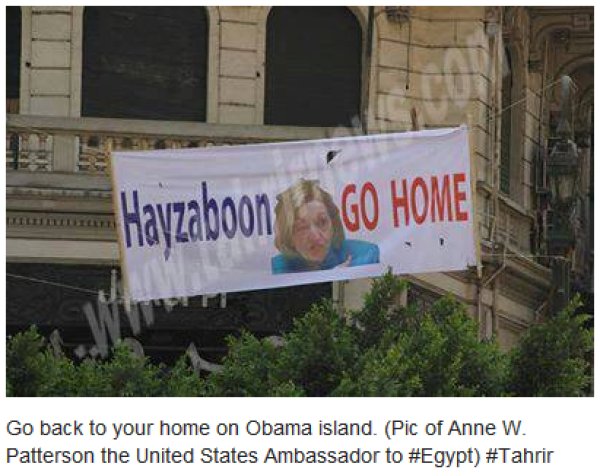
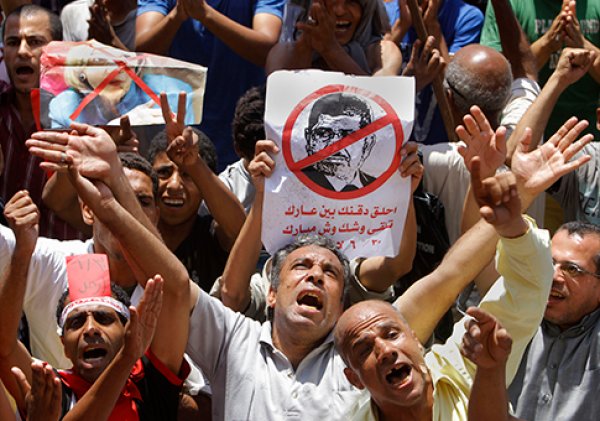
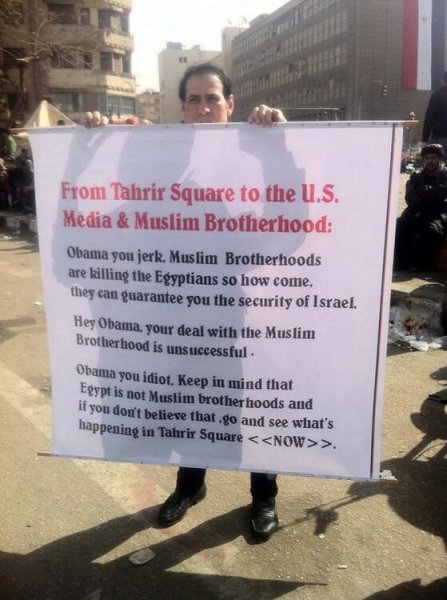
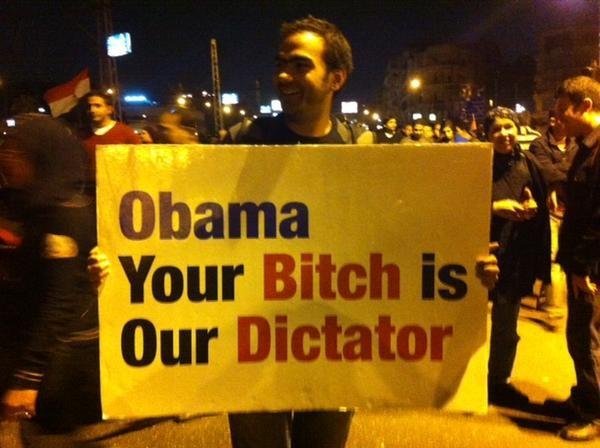
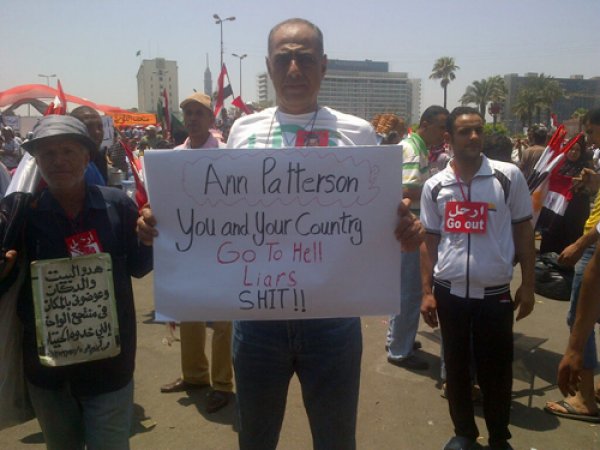
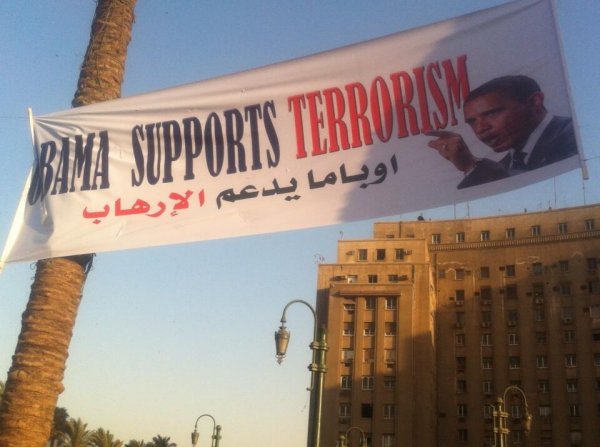
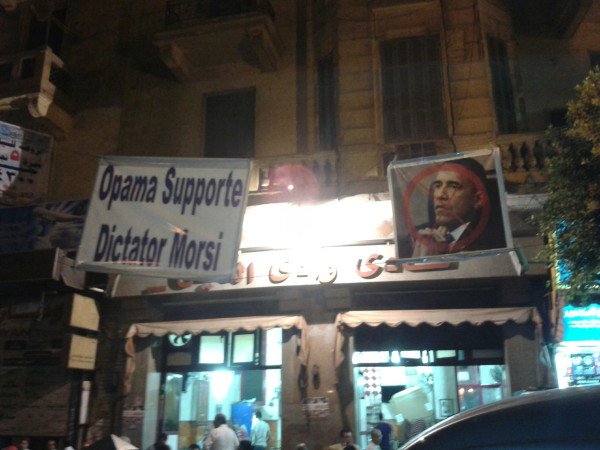
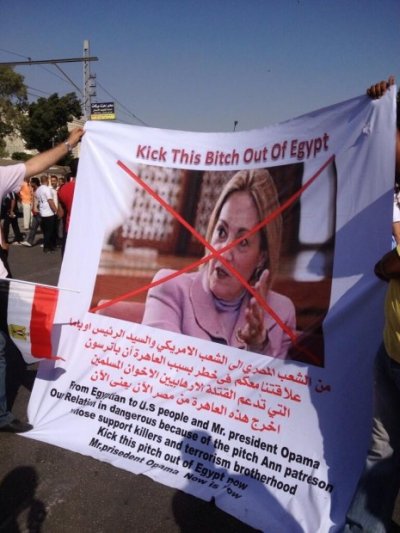
Doug Ross @ Journal: 15 Photos From the Tahrir Square Protests You’ll Never See In Legacy Media. #Egypt #Morsi #Obama.

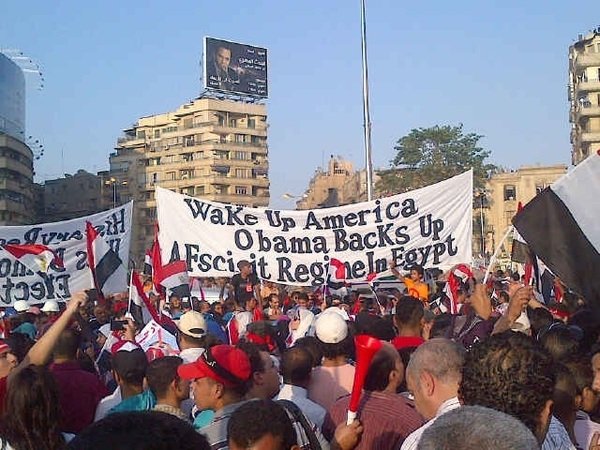
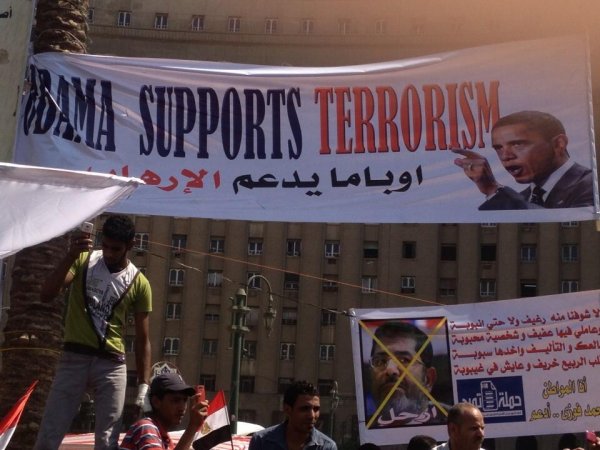
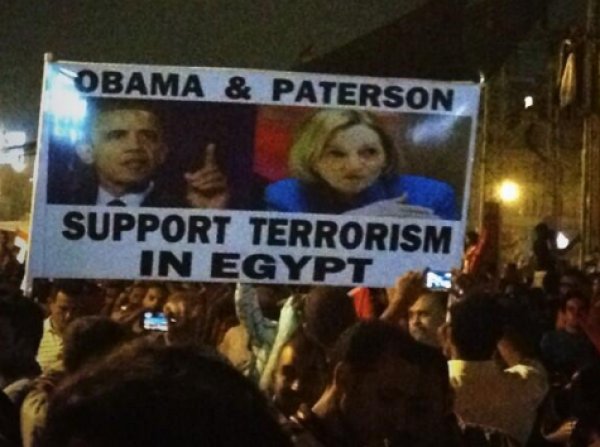
Curiously, a massive wave of anti-Obama sentiment in Egypt has been utterly ignored by vintage media, even though the protests may be the largest in all of human history.

Egypt: Beyond The Barricades

July 3, 2013

Egypt: Beyond The Barricades – YouTube.

Once again, the brave people of Egypt have risen to throw off a corrupt and totalitarian government. 

Once again, I wish them God’s speed.

I made this video 2 years ago to salute them.  It is just as relevant now as it was then.

JW

Report: Egyptian army getting ready to take over

July 3, 2013

Report: Egyptian army getting ready to take over – Israel News, Ynetnews.

Al-Ahram newspaper says military placed Muslim Brotherhood officials under house arrest, ‘guarding’ movement’s funds. Brotherhood official: Freedom more valuable than life

Roi Kais, Reuters

Published: 07.03.13, 11:40 / Israel News

Egypt’s flagship state newspaper Al-Ahram reported Wednesday that the Egyptian army is taking a number of steps that signal it is getting ready to take the reigns when a deadline set by the army for resolving the country’s political crisis expires.

According to the report, the army has placed heavy security on national institutions and weapons depots, placed a number of Muslim Brotherhood officials under house arrest and has the movement’s funds “under inspection.”

“The army has started to hermetically secure sites across Egypt in coordination with security forces and all active elements within the Muslim Brotherhood are under control,” the paper said. Brotherhood officials denied the report.

Al-Ahram said it expected President Mohamed Morsi would either step down or be removed from office when the deadline expires.

But a military source denied reports in several local newspapers on details of the road map, describing them as “nothing but predictions”. The source expected the next step would be to call political, social and economic figures to talks on the road map.

Al-Ahram said an army road map for the future would set up a three-member presidential council to be chaired by the head of the Supreme Constitutional Court.

“Al-Ahram learnt that with the end of the 48-hour period set by the armed forces … it is expected in the hours that follow it, one of two things: either Mursi announces his resignation himself, or the declaration of his removal through the road map for the future set out by the armed forces,” it said.

Al-Ahram said the road map would set up a neutral transitional government to be headed by a military leader. The transitional period would last nine to 12 months in which a new constitution would be drafted to set out a path to presidential elections.

A senior member of the Muslim Brotherhood’s political party warned on that the Egyptian people would not stay calm in the face of a “military rebellion” and said freedom was more valuable than life.

Essam el-Erian, deputy leader of the Brotherhood’s Freedom and Justice Party, said anyone wagering that the people would stay calm in the face of military revolt would lose their bet.