Archive for July 8, 2013

Snowden: US and Israel did create Stuxnet attack code

July 8, 2013

Snowden: US and Israel did create Stuxnet attack code • The Register.

UK is ‘radioactive’ and ‘Queen’s selfies to the pool boy’ slurped

“The NSA and Israel cowrote it,” he told Der Spiegel in an email interview conducted before he publicly outed himself as the NSA mole. Snowden is currently in Russia and a “free man” according to Vladimir Putin – as long as there are no further NSA leaks.

The Stuxnet code, which has been deployed since 2005, is thought to be the first malware aimed specifically at damaging specific physical infrastructure*, and was inserted into the computer networks of the Iranian nuclear fuel factory in Natanz shortly after it opened.

Early variants attempted to contaminate uranium supplies by interfering with the flow of gas to the fuel being processed, potentially causing explosive results in the processing factory. Later a more advanced variant attacked the centrifuges themselves, burning out motors by rapidly starting and stopping the units and contaminating fuel production, although it may actually have encouraged the Iranians.

Last year an unnamed US official said that Stuxnet was part of a program called Operation Olympic Games, started under President Bush and continued under the current administration, aimed at slowing down the Iranian nuclear effort without having to resort to risky airstrikes. General James Cartwright, a former vice-chairman of the Joint Chiefs of Staff, is currently under investigation by the US government for allegedly leaking details of Operation Olympic Games.

Don’t trust Europe or multinationals

Such international efforts are coordinated by the NSA’s Foreign Affairs Directorate (FAD), Snowden said.

The FAD has full cooperation with its so-called “Five Eye partners,” in the UK, Australia, New Zealand, and Canada, and these agencies are even better or worse (depending on your viewpoint) at collecting data. Typically, these countries practice “full take,” Snowden said, scooping every bit of data and storing it for later perusal.

“As a general rule, so long as you have any choice at all, you should never route through or peer with the UK under any circumstances,” he said. “Their fibers are radioactive, and even the Queen’s selfies to the pool boy get logged.”

Other European countries also work closely with the NSA, he said, describing the organization as “in bed together with the Germans.” Other countries don’t ask where the NSA’s data comes from, and the US returns that favor, to give politicians plausible deniability in the event of source disclosure, he explained.

Multinational companies also play the game, Snowden said, and cooperate with the NSA to enable the slurping of their customer’s data, although a few (unnamed) firms don’t submit their data to NSA inspection. “The NSA considers the identities of telecom collaborators to be the jewels in their crown of omniscience,” he said

“As a general rule, US-based multinationals should not be trusted until they prove otherwise,” he said. “This is sad, because they have the capability to provide the best and most trusted services in the world if they actually desire to do so.”

*Bootnote

There are unconfirmed reports that the CIA was using dodgy software as far back as the 1980s to cause problems with its then–enemy number one, the Soviet Union.

According to National Security Council staffer Thomas Reed, the CIA got wind that the Soviets were trying to steal industrial-control software for a new gas pipeline from a Canadian supplier. He claims the CIA installed a trojan into the Canadian firm’s software and allowed it to be purloined by the KGB.

“The pipeline software that was to run the pumps, turbines and valves was programmed to go haywire, to reset pump speeds and valve settings to produce pressures far beyond those acceptable to the pipeline joints and welds,” he said. “The result was the most monumental non-nuclear explosion and fire ever seen from space.”

The report has never been officially confirmed, although the CIA has said that it introduced numerous dodgy technologies to the Soviets, including “flawed turbines were installed on a gas pipeline.”

Israelis cautiously optimistic over Morsi ouster

July 8, 2013

Israelis cautiously optimistic over Morsi ouster | The Times of Israel.

Not having the Muslim Brotherhood in charge in Egypt brings hope — but an unstable neighbor carries many risks, analysts say

July 8, 2013, 8:25 pm Hundreds of thousands of anti-Morsi protesters hold demonstrations at Cairo's Tahrir Square, on Tuesday, July 2. (photo credit: screen capture/Channel 10 news)

Hundreds of thousands of anti-Morsi protesters hold demonstrations at Cairo’s Tahrir Square, on Tuesday, July 2. (photo credit: screen capture/Channel 10 news)

TEL AVIV (JTA) — For the second time in less than three years, Egypt is erupting in chaos, with a popular protest movement leading to a swift change in the country’s leadership.

For Israelis, the Egyptian military’s removal of Mohammed Morsi from the presidency last week is a cause for optimism.

An Islamist and a leading figure in the Muslim Brotherhood, Morsi’s brief tenure saw a further estrangement between Israel and Egypt. The Brotherhood advocates Israel’s destruction and supports Hamas, the terrorist group that governs in Gaza. And while Morsi upheld the 1979 peace treaty with Israel during his year in office, his refusal of contact with Israel and his warm relations with other Islamist governments portended future tension between the countries.

With Morsi gone and the Egyptian military reasserting itself, Israel can breathe a little easier. Israel has enjoyed close cooperation with the Egyptian army in recent decades, born of their shared interest in combating terrorist groups and maintaining stability.

“To get rid of the Muslim Brotherhood is great for Egypt and for the region,” said Zvi Mazel, Israel’s ambassador to Egypt in the late 1990s. “It’s the best thing that has happened this year. One of their central goals is to destroy Israel.”

The takeover also poses risks for Israel.

A weak and unstable Egypt will be less able to maintain calm in the Sinai Desert, act as an anchor of stability in the Arab world or step in as a mediator between Israel and its enemies. And while dealing with a country led by secular pragmatists is obviously preferable to one led by Islamists, the 2011 Egyptian uprising showed that a government inclined positively toward Israel may only be possible amid significant repression at home.

Israel thus far has stayed silent in response to the unrest in Egypt’s capital, neither praising nor condemning the military’s actions, nor reaching out publicly to the new government in formation.

In an interview last week with the Italian newspaper La Corriere Della Sera, Israeli Prime Minister Benjamin Netanyahu said only that Israel is watching events in Egypt very carefully. Netanyahu also made only passing reference to Egypt in his weekly speech to the Cabinet on Sunday.

The Israel Defense Forces also have reacted calmly. Troop activity on Israel’s southern border has not increased meaningfully, despite a rocket exploding last week near the resort town of Eilat and the bombing of an Egyptian gas pipeline to Jordan. Last week, Israel allowed Egypt to move troops into the Sinai — a move prohibited by their peace treaty — as an added security measure.

Despite ongoing close coordination between the Israeli and Egyptian militaries, the Sinai has been a hotspot of terrorist activity since Mubarak’s ouster, a situation that could get worse with Egypt’s top brass focused on containing the unrest in Cairo, which already has claimed dozens of lives. In addition to the pipeline bombing, an Egyptian soldier was killed there on Sunday.

Morsi’s fall also has weakened Hamas, which enjoyed a small uptick in prestige during his administration. In October, the emir of Qatar became the first head of state to visit Gaza. The following month, Morsi’s mediation of the conflict between Hamas and Israel led to a slight easing of Israel’s Gaza blockade.

Now, Hamas again is on the ropes. Its parent organization has been removed from leadership after only a year and it has lost some financial support from Iran for choosing to back the rebels fighting Syrian President Bashar Assad, an Iranian ally. If the Egyptian military clamps down on weapons transfers in the Sinai and underground tunnels to Gaza, it could stanch Hamas’s supply chain.

For now, Israeli officials are reacting with a poker face. But if the Brotherhood’s fall portends a decline in Islamist fortunes across the region, Israelis will likely smile and collectively exhale.

“The interests of the [Egyptian] government are pragmatic — to work in Sinai against terror and to revive the Egyptian economy,” Mazel said. “They may even cooperate with us more economically. It was a cold peace. We’ll see what happens now.”

Gaza terrorists infiltrate Sinai

July 8, 2013

Gaza terrorists infiltrate Sinai – Israel News, Ynetnews.

Dozens of terrorists affiliated with Muslim Brotherhood head to Sinai, take part in assaults on Egyptian army posts. Egypt authorities scramble to seal off smuggling tunnels

Roi Kais

Published: 07.08.13, 16:29 / Israel News
Dozens of members of terrorist groups affiliated with the Muslim Brotherhood have left the Gaza Strip headed to the Sinai Peninsula to fight the Egyptian army, Ynet has learned. The terrorists are taking part in the Muslim Brotherhood’s struggle against the ouster of President Mohamed Morsi. They had been taken part in battles in El-Arish over the weekend and attacked several Egyptian army posts.
The Egyptian army has accelerated efforts to seal smuggling tunnels connecting Gaza and Sinai with 50 tunnels already closed. Nevertheless, a large portion of the tunnels remains active. Last Saturday, a senior Egyptian official held the Islamic Jihad and members of Hamas accountable for inflaming the situation in Sinai.

The official told the London-based Al-Hayat newspaper that Egyptian authorities have observed the entry of 150 Izz al-Din al-Qassam operatives into Sinai via the tunnels. “They were wearing uniforms associated with the military police before joining Jihadists in Sinai,” he said.

The official added that the army suspects that Palestinians took part in assaults on army posts last Friday.

Cairo violence (Photo: Getty Imagebank)

In addition, Egyptian security sources told the Al-Masry Al-Youm newspaper that Muslim Brotherhood officials are overseeing terrorist activity against army and police forces in Sinai and coordinating these efforts with commanders in Hamas’ military wing.

At least 42 people were killed on Monday when Islamist demonstrators enraged by the military overthrow of Morsi said the army opened fire during morning prayers at the Cairo barracks where he is being held.

But the military said “a terrorist group” tried to storm the Republican Guard compound and one army officer had been killed and 40 wounded. Soldiers returned fire when they were attacked by armed assailants, a military source said.

Syria: Latakia attack carried out by al-Qaida terrorists

July 8, 2013

Israel Hayom | Syria: Latakia attack carried out by al-Qaida terrorists.

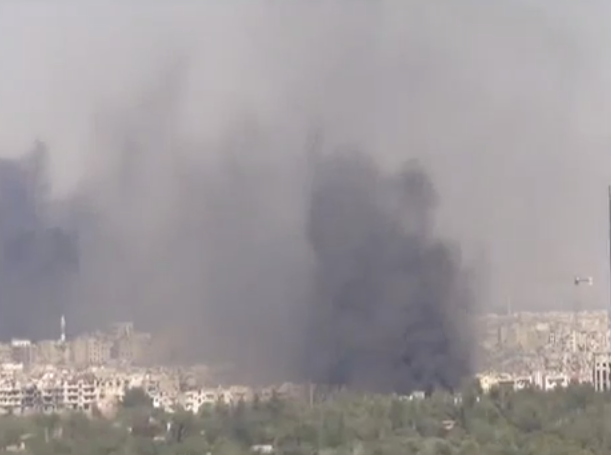
Arab media outlets report 10 to 20 Syrian soldiers killed in explosion in coastal Syrian city • Early reports conflict: Some say the attack was carried out by foreign aircraft, while others say it was by missiles fired from boats.

Daniel Siryoti
Syrian rebels with a rocket launcher [Illustrative]

|

Photo credit: AP

Hezbollah asks Iran to send more fighters to Syria

July 8, 2013

Israel Hayom | Hezbollah asks Iran to send more fighters to Syria.

Mounting casualties among Hezbollah fighters in the fighting in Syria has led some Lebanese supporters of the organization to petition its leaders to scale back its involvement in the Syrian conflict, a Saudi paper has reported.

Israel Hayom Staff
The war in Syria is taking a toll on Hezbollah

|

Photo credit: Reuters [archive]

In Egypt, US stuck in time warp

July 8, 2013

Israel Hayom | In Egypt, US stuck in time warp.

As if one needed further evidence that U.S. conduct in the international arena exudes weakness and indecision, the events in Egypt have shown that President Barack Obama’s strategy of “leading from behind” is nothing but a cover for a spineless policy with minimal consistency. The U.S. is being dragged by events, rather than trying to influence them.

Not only did Washington belatedly realize that Mohammed Morsi’s regime had lost legitimacy in the eyes of broad sections of the Egyptian populace, but U.S. officials have also reacted with almost complete indifference to the dramatic violence taking place in Cairo over the past week. Of course, any crisis that intrudes on summer golf or yacht outings is an uninvited guest. So one can understand why Obama and U.S. Secretary of State John Kerry treated the crisis in Egypt this past weekend as if it was a momentary nuisance that could be struck from the agenda in one breath.

This is not the first time that dramatic events in the Middle East have come to life during hot summer days and U.S. government officials have had to put their sacred vacation plans on hold. In July 1990, then-Iraqi President Saddam Hussein summoned then-U.S. Ambassador to Iraq April Glaspie and essentially gave her advanced warning of his plan to invade Kuwait. Glaspie wasn’t able to receive instructions from her superiors in Washington — then-Defense Secretary Dick Cheney was inaccessible as he was on a hunting trip in the Rocky Mountains — and in effect gave Hussein a green light to invade Kuwait without fear of an American military response. The rest is history.

A broad look gives the impression that the Obama administration hasn’t learned the necessary lessons from the failures of its predecessors in dealing with the revolutionary dynamics of the Middle East in general and Egypt more specifically. For instance, 50 years ago, then-President John F. Kennedy truly believed it was possible to guide Gamal Abdel Nasser’s revolutionary regime along a path of modernization, pluralism and moderation via the carrot of generous economic aid (which Kennedy granted to Egypt on a multiyear basis).

Despite the incentives, temptations and gestures showered on Nasser’s head by Kennedy, this policy of placation did not have the desired effect. Less than two years after Kennedy entered the White House and instituted the “positive sanctions” policy toward Egypt, all of Kennedy’s hopes in Nasser sank in the deserts of Yemen. Not only did Nasser rush to intervene on the Republican side in the inter-tribal war that broke out in Yemen in 1962, but Egypt also used chemical weapons there. The civil war in Yemen brought an early end to the honeymoon between Washington and Cairo.

Now, it appears that another liberal president, Obama, is stuck in a time warp. While there were already signs of the dictatorial and intolerant characteristics of the Muslim Brotherhood regime in Egypt last year, the White House didn’t produce a stick to accompany the carrot of economic aid (around $1.3 billion annually). There weren’t even any stipulations or warnings. Like Nasser in the Kennedy era, Morsi won generous credit and unconditional political support from Washington, despite the obvious oppressive and authoritarian nature of his regime.

Obama’s undoing was his prolonged clinging to the concept that elections with democratic characteristics absolutely guarantee that societies will be democratic and pluralistic. He disabused himself of that illusion much too late. Hopefully, Uncle Sam will now wake up from the world of illusions and finally recognize the large gap between the Western democratic model and the nature of existence in the Middle East.

Winning: Threats To Israeli Aircraft Over Iran

July 8, 2013

Winning: Threats To Israeli Aircraft Over Iran.

( Don’t miss reading this… – JW )

July 8, 2013: Iranian military leaders were relieved at the recent election of the “moderate” Hassan Rowhani to replace Mahmoud Ahmadinejad as president. Rowhani is known to be a superb negotiator and someone you can reason with. Ahmadinejad was neither of those things and his constant and hysterical threats to Israel made war with Israel an ever increasing possibility. This was made worse by the growing threat of Iran developing nuclear weapons. Ahmadinejad also liked to boast of how well prepared Iran was to kick Israeli ass if it ever came to a fight. Iranian military leaders cringed at this, because they knew that the military power Ahmadinejad was boasting of was largely an illusion. The constant stream of boastful press releases put out by the Iranian military were for building domestic morale, not to describe any real improvements in Iranian military capabilities. The Israeli’s knew this, as did Ahmadinejad (well, he was told) but the numerous threats against Israel caused the Israelis to threaten right back. The problem was that Israel was much more capable to attacking Iran than Iran was in defending itself.

While Israel has a huge stockpile of fuel, ammo and other supplies for wartime (about 30 days’ worth), Iran has very little. While Iran pumps a lot of oil, it doesn’t have the refineries to produce much aircraft grade fuel. Iran has few smart bombs, missiles and well, not much of anything compared to Israel.

Israel can put over 500 aircraft (mostly F-15s and F-16s) a day (as in sorties) over Iran. That’s in addition to more than twice as many for any short range threat. Israel has over 25,000 smart bombs and missiles (not counting smaller missiles like Hellfire). Within a few days this Israeli air power could destroy what little Iran has in the way of major weapons systems (armored vehicles, aircraft, warships and weapons research and manufacturing facilities). Worse, the earlier claims of Iranian military strength would not only be exposed as false but greatly diminished from what they actually were before the Israelis came by. Iranian military leaders did not want this to happen, although the senior clerics of the religious dictatorship that rules Iran saw a positive angle to an Israeli attack; it would rally all Iranians behind the generally disliked government.

The Iranian problem is that three decades of sanctions has made it impossible to replace obsolete and worn out gear or even maintain the elderly systems they have to rely on. Thus the best defenses (anti-aircraft missiles and jet fighters) against an Israeli attack are largely absent. What is available is ancient and probably ineffective against Israeli SEAD (Suppression of Enemy Air Defenses) capabilities.

For example, Iran has been having increasing problems keeping its 1970s era F-5s flying. The ones that are still flying tend to crash a lot, or not be available for use because of maintenance problems (including spare parts shortages.  Spare parts for all U.S. aircraft Iran still uses have been hard to come by. Iran has managed, sort of. Nevertheless, the Iranian Air Force is largely a fraud. It has lots of aircraft that, for the most part, sit there, but can’t fly, because of age and lack of replacement parts. Those that can fly would likely provide target practice for Israeli fighters.

The Iranian Air Force is still recovering from the effects of the 1979 revolution (which led to an embargo on spare parts and new aircraft). Despite that, many Iranian warplanes remain flyable, but only for short periods. The main reason for even that is an extensive smuggling operation that obtains spare parts. Two of their aircraft, the U.S. F-4D and F-5E Tiger, were widely used around the world. Somewhere, someone had parts for these planes that Iran could buy. There are still about 40 of each in service, with less than half of them flyable at any time.

This was less the case with Iran’s most expensive warplane, the U.S. F-14 Tomcat. Iran was the only export customer of this aircraft. Some F-14s have been kept flyable, despite the rumored sabotage of Iran’s AIM-54 Phoenix missiles by U.S. technicians as they were leaving. To demonstrate this, they sent 25 F-14s on a fly-over of Tehran in 1985. Today, Iran has about 20 F-14s, with less than half of them flyable.

Iran has sought to buy new foreign aircraft. In the 1990s, with the end of the Cold War, and the collapse of the Soviet Union, they sought to buy from Russia. Despite the low prices, a combination of Western pressure (to not sell) and lack of Iranian money for high-ticket items, not that many aircraft were obtained. One unforeseen opportunity was the 1991 Gulf War. Many Iraqi aircraft (most of them Russian-built) fled to Iran to avoid American attack. The Iranians never returned them. Iran ended up with up to 60 MiG-29s. There were also 18 Su-24s, a force that was expanded by more purchases from Russia. Black market spare parts have been available, but the MiG-29 is a notoriously difficult aircraft to maintain, even when you have all the parts you need.

Iran currently has about two hundred fighters and fighter bombers, but only about half can be put into action and then usually for only one sortie a day. The chronic shortage of spare parts, limits the number of hours the aircraft can be flown. This means pilots lack good flying skills. The poor maintenance and untrained pilots leads to more accidents.

Iran is similarly ill-prepared when it comes to ground based anti-aircraft defense. Iran has managed to keep operational some of the American Hawk anti-aircraft missile systems it bought in the 1970s. But these are not very capable these days and the Israelis know all about Hawk. Iran has had limited success in buying new systems from Russia and China and, in general, is as ill-prepared as it is in the air to oppose an Israeli attack.

Muslim Brotherhood calls for uprising against Egyptian army after dozens killed

July 8, 2013

By REUTERS

07/08/2013 11:22

Morsi supporters carry body of man killed by violence outside the Republican Guard headquarters Photo: REUTERS

Islamist group claims it was fired upon while staging sit-in outside barracks where Morsi being held; State TV reports 42 killed; Egyptian military: “Terrorist group” tried to storm Republican Guard facility.

CAIRO – The Muslim Brotherhood called on Egyptians to rise up against those who “want to steal” the revolution, a statement by its political wing said on Monday, after Egyptian state television said 42 people were killed in shooting outside the Cairo headquarters of the Republican Guard.

The Brotherhood’s official spokesman, Gehad El-Haddad said shooting broke out in the early morning while Islamists were praying and staging a peaceful sit-in outside the Republican Guard barracks where Morsi is believed to be held.

Morsi supporters carry body of man killed by violence outside the Republican Guard headquarters Photo: REUTERS

The military claimed “a terrorist group” tried to storm the Republican Guard compound and one army officer had been killed and 40 wounded. Soldiers returned fire when they were attacked by armed assailants, a military source said.

The bloodshed deepened Egypt’s political crisis, escalating the struggle between the army, which overthrew Morsi last Wednesday after mass demonstrations demanding his resignation, and the Brotherhood, which has denounced what it called a coup.

A statement on the Brotherhood’s Facebook page following the shooting said, “(The Freedom and Justice Party) calls on the great Egyptian people to rise up against those who want to steal their revolution with tanks and armored vehicles, even over the dead bodies of the people,”

Following the shooting, the ultra-conservative Islamist Nour party, which initially supported the military intervention, said it was withdrawing from stalled negotiations to form an interim government for the transition to fresh elections.

Al Jazeera’s Egypt news channel broadcast footage of what appeared to be five men killed in the violence, and medics applying cardiopulmonary resuscitation to an unconscious man at a makeshift clinic at a nearby pro-Morsi sit-in.

A Reuters television producer at the scene saw first aid helpers attempting mouth-to-mouth resuscitation on a dying man. Wounded people were being ferried to the field hospital on motorbikes, given first aid treatment and taken away in ambulances.

The military overthrew Morsi on Wednesday after mass nationwide demonstrations led by youth activists demanding his resignation. The Brotherhood denounced the intervention as a coup and vowed peaceful resistance.

ROADBLOCKS

Military vehicles sealed off traffic in a wide area around the Rabaa Adawia mosque where Morsi supporters led by senior Brotherhood leaders have been staging protests since his ouster.

The army also closed two of the main bridges across the Nile River with armored vehicles, witnesses said.

Talks on forming a new government were already in trouble before Monday’s shooting, after the Nour party rejected two liberal-minded candidates for prime minister proposed by interim head of state Adli Mansour.

Nour, Egypt’s second biggest Islamist party, which is vital to give the new authorities a veneer of Islamist backing, said it had withdrawn from the negotiations in protest at what it called the “massacre at the Republican Guard (compound)”.

“We’ve announced our withdrawal from all tracks of negotiations as a first response,” party spokesman Nader Bakar said on Facebook.

via Muslim Brotherhood calls for uprising against Egyptian army after dozens killed | JPost | Israel News.

Muslim Brotherhood: 34 shot dead in Cairo: Egyptian army set to defend oil pipeline and Suez shipping

July 8, 2013

Muslim Brotherhood: 34 shot dead in Cairo: Egyptian army set to defend oil pipeline and Suez shipping.

DEBKAfile Exclusive Report July 8, 2013, 10:05 AM (IDT)
Route of the Sumed oil pipeline

Route of the Sumed oil pipeline

Egyptian soldiers opened fire early Monday, July 8, on Muslim Brotherhood supporters at the Republican Guards Club in Cairo where deposed president Mohamed Morsi is held. The Brotherhood reported 34 dead and 300 wounded.  The army said the soldiers opened fire when “armed terrorists” tried to storm the compound. Egyptian media reported that the army and police forces opened fire after a group of demonstrators tried to climb the walls of the club. According to eyewitnesses, the army raided a quiet sit-in outside the Presidential Guards Club.

While events in Cairo following the Egyptian military takeover of power are the focus of media coverage, debkafile’s military sources report that the army is quietly reorganizing to secure the country’s primary assets – Suez Canal traffic, the oil facilities in the town of Suez and the Sumed oil pipeline – all extremely sensitive targets.

According to intelligence reaching the military, a radical Islamist force – made up of a clandestine Muslim Brotherhood raider unit called El Giza Al Sidi, Sinai Bedouin Salafists linked to al Qaeda and the Palestinian Hamas – are conspiring to activate commando and missile units for sabotaging Suez shipping and the flow of oil from the Persian Gulf to the Mediterranean.

Hitting one ship transiting the canal or a single explosion at the pipeline would suffice to send world oil prices and insurance costs sky high.
This armed Islamist coalition also plans a major campaign of terror against Israel.
These concerns were underscored Sunday, July 7, when armed Salafists using at least 10 explosive devices blew up the Egyptian gas pipeline to Jordan rat a point south of El Arish in northern Sinai. The flow was brought to a halt.

That night, the Israeli Counter-Terror Bureau strongly urged Israelis to avoid traveling to Sinai and travelers already there to leave at once amid a rising danger of attack and abduction.
The Egyptian military has been warned that the El Giza Al Sidi raiders have been directed by their Muslim Brotherhood masters to attack the Sumed oil pipeline, which starts at Ain Sukhna on the Gulf of Suez, runs 320 kilometers through the Western desert and ends at Sidi Kerir on the Mediterranean coast south of Alexandria.
This attack would not just target the Egyptian EGPC, but also lash out at its Saudi and UAE co-owners, whom the Brotherhood accuses of abetting the military coup ousting them from power: the Saudi Aramco, and the International Petroleum Investment Co. of Abu Dhabi.

The fighting between Egyptian military and armed Islamists in Sinai went into its third day Monday with the eruption of a fierce battle close to the Israeli border not far from the Israeli Red Sea resort and port-town of Eilat. The sounds of gunfire and explosions reached the Ovda Israeli Air Force base 40 kilometers north of the town. As a precaution, the Israeli army closed to civilian traffic the section of Route 12 from northern Israel to Eilat which runs close to the Sinai border.
Armed Salafists tearing around in minivans continued to attack Egyptian army and police positions and checkpoints at El Arish and Sheikh Zweid, firing the heavy machine guns and missile launchers mounted on their vehicles. Some used Grads.  An Egyptian soldier and a policeman were killed Sunday.

debkafile’s military sources report that the Egyptian army has taken down some of its Sinai checkpoints and is relocating a smaller number on main intersections and manning them with larger contingents.

Israel Matzav: Hmmm: Mysterious explosions near Syrian arms depot holding Russian S-300 parts in Latakia

July 8, 2013

Israel Matzav: Hmmm: Mysterious explosions near Syrian arms depot holding Russian S-300 parts in Latakia.

A mysterious explosion destroyed a weapons plant belonging to Bashar al-Assad near Latakia, Syria on Friday night.

Arab media outlets reported mysterious explosions at a military facility near the Syrian coastal city of Latakia overnight Friday. BBC Arabic reported powerful explosions at a Syrian military arms depots near the Latakia port that sent shock waves several kilometers from the source.

Syrian Observatory for Human Rights Chairman Rami Abdel Rahman said intense explosions shook the entire region, where the Syrian regime has a large army base and multiple arms caches. The explosions occurred possibly after they were targeted with rockets, the Syrian Observatory for Human Rights said.

Witnesses reported that at least 10 Syrian troops were killed following the explosions. Reports attributed the explosions to an attack aimed at government arms cashes near the village of Asamiya, 20 kilometers (12 miles) northeast of Latakia.

Abdel Rahman said there were indications that the blasts were caused by rocket fire targeting the depots, but that there was uncertainty over who was behind the attack.

Israel’s Defense Ministry said it was “studying the reports.”

Lebanese terrorist group Hezbollah’s Al-Manar TV network reported the attack and quoted a Syrian defense official saying it was carried out by rebels based in northern Latakia.

No one else knows who was behind the explosions. But Dickie ‘tikkun olam’ Silverstein is sure it’s da Joooz. You see Latakia is near Tartus, the Russian naval base on the Syrian coast, and….

Though the Free Syrian Army took immediate credit for the attack, it was not the responsible party.  A confidential Israeli source informs me that Israeli forces attacked the site.  The target were components of Russia’s SA-300 anti-aircraft missile system which had been shipped by Russia to Tartus and stored in Latakia.

Israel and exerted tremendous pressure on Vladimir Putin to cancel its contract to supply the missile batteries to Syria, since once they were operational they would render Israeli aircraft more vulnerable to attack.  Israel, of course, will countenance no front-line state having even defensive weapons which give it superiority over Israeli weapons systems.  In response to Israeli entreaties, Russia’s leader refused to budge and recommitted to providing the weapons to Assad.  Apparently, he’d begun to follow through on his promise with these first shipments.

Dickie may not be able to put together a coherent English sentence, but for once I hope he’s right. It’s high time for at least one country in the free world not to back down in the face of Russia’s meddling and support for terrorism. I’m glad it’s my country.

There’s another interesting piece of speculation about how the attack might have been carried out here.