Curiously, a massive wave of anti-Obama sentiment in Egypt has been utterly ignored by vintage media, even though the protests may be the largest in all of human history.
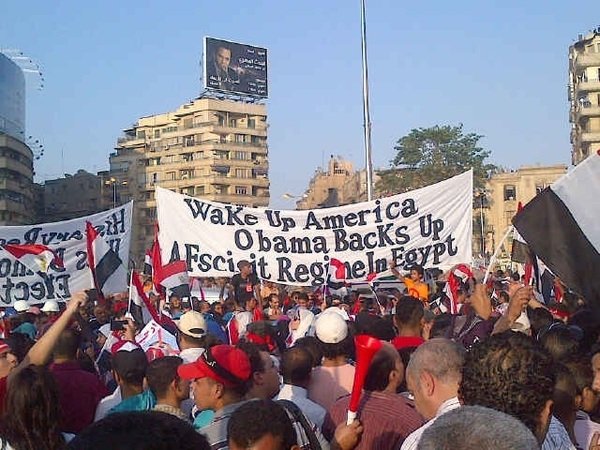
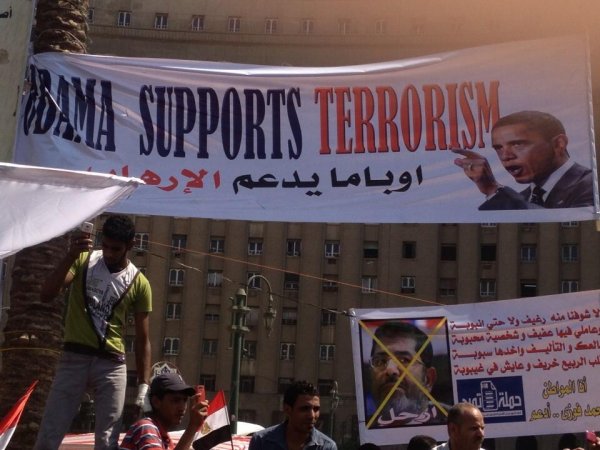

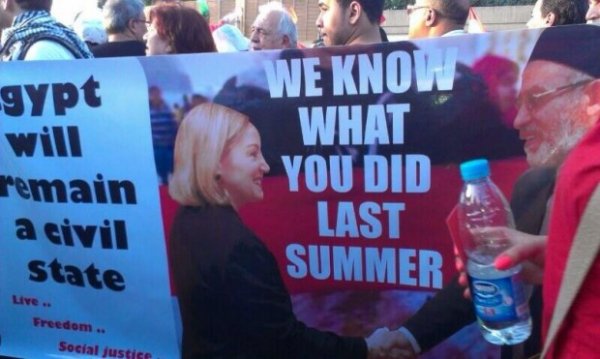
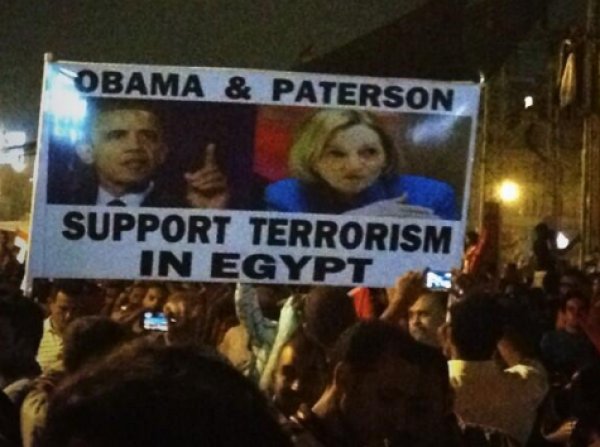
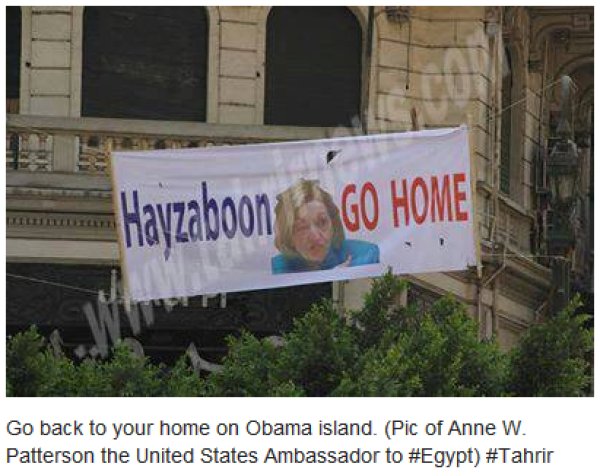
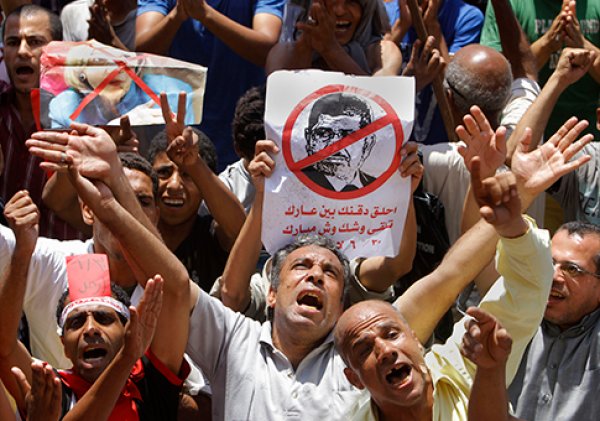
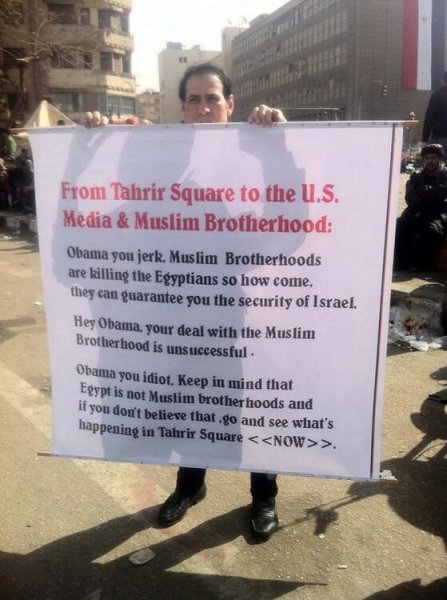
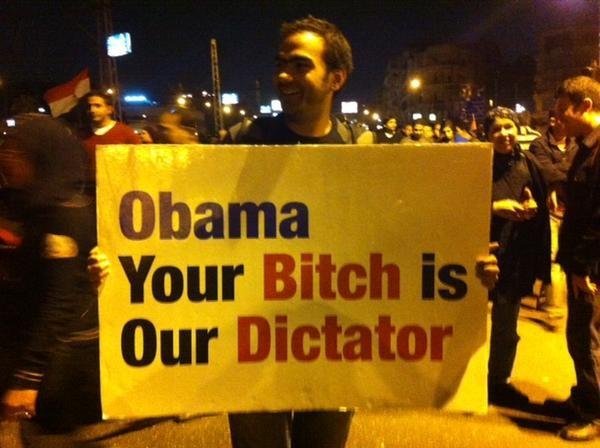
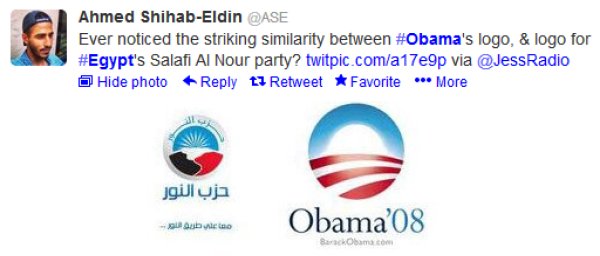
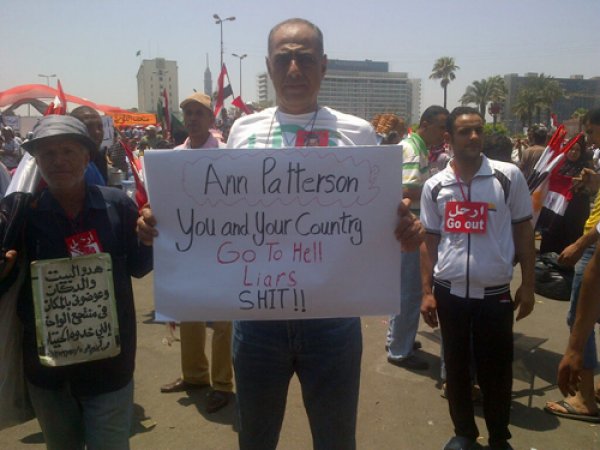
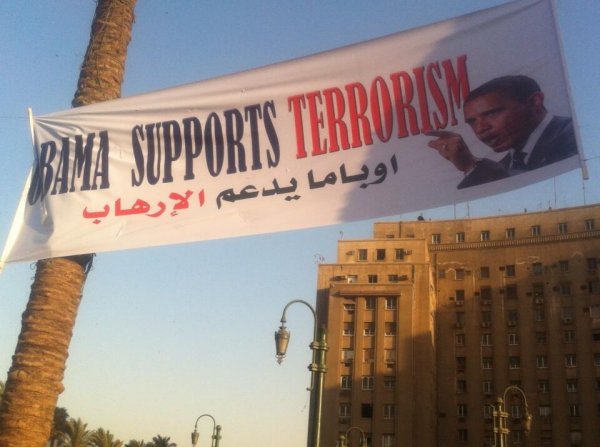
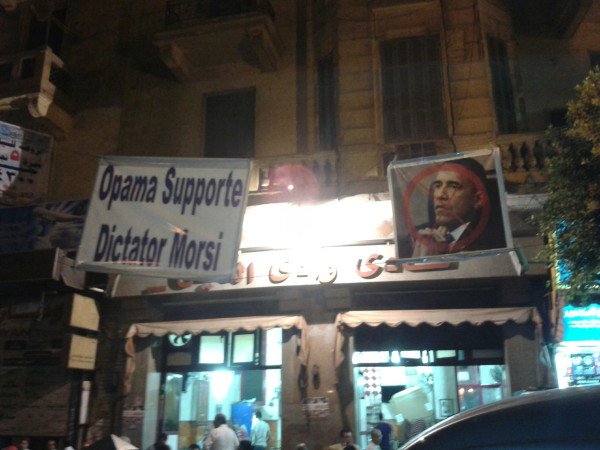
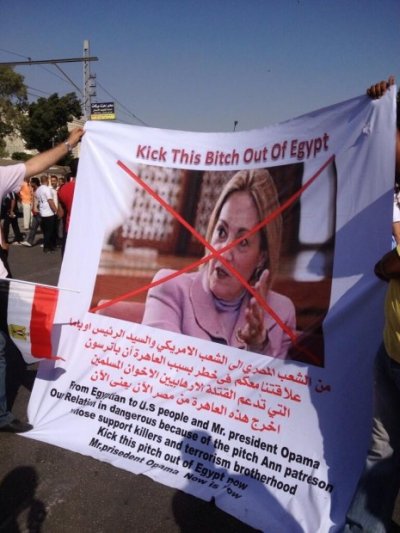
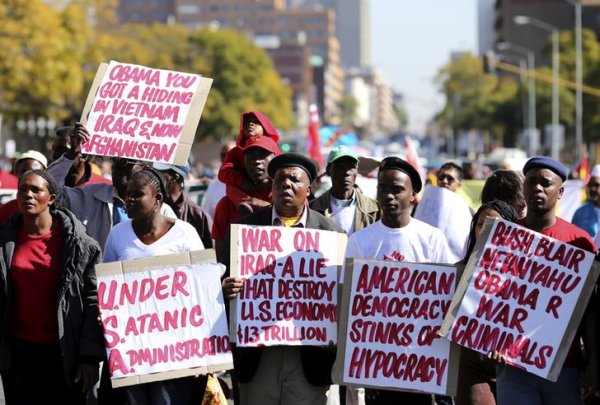
Curiously, a massive wave of anti-Obama sentiment in Egypt has been utterly ignored by vintage media, even though the protests may be the largest in all of human history.
Egypt: Beyond The Barricades – YouTube.
Once again, the brave people of Egypt have risen to throw off a corrupt and totalitarian government.
Once again, I wish them God’s speed.
I made this video 2 years ago to salute them. It is just as relevant now as it was then.
JW
Report: Egyptian army getting ready to take over – Israel News, Ynetnews.
Al-Ahram newspaper says military placed Muslim Brotherhood officials under house arrest, ‘guarding’ movement’s funds. Brotherhood official: Freedom more valuable than life
Roi Kais, Reuters
|
Egypt’s flagship state newspaper Al-Ahram reported Wednesday that the Egyptian army is taking a number of steps that signal it is getting ready to take the reigns when a deadline set by the army for resolving the country’s political crisis expires.
According to the report, the army has placed heavy security on national institutions and weapons depots, placed a number of Muslim Brotherhood officials under house arrest and has the movement’s funds “under inspection.”
“The army has started to hermetically secure sites across Egypt in coordination with security forces and all active elements within the Muslim Brotherhood are under control,” the paper said. Brotherhood officials denied the report.
Al-Ahram said it expected President Mohamed Morsi would either step down or be removed from office when the deadline expires.
But a military source denied reports in several local newspapers on details of the road map, describing them as “nothing but predictions”. The source expected the next step would be to call political, social and economic figures to talks on the road map.
Al-Ahram said an army road map for the future would set up a three-member presidential council to be chaired by the head of the Supreme Constitutional Court.
“Al-Ahram learnt that with the end of the 48-hour period set by the armed forces … it is expected in the hours that follow it, one of two things: either Mursi announces his resignation himself, or the declaration of his removal through the road map for the future set out by the armed forces,” it said.
Al-Ahram said the road map would set up a neutral transitional government to be headed by a military leader. The transitional period would last nine to 12 months in which a new constitution would be drafted to set out a path to presidential elections.
A senior member of the Muslim Brotherhood’s political party warned on that the Egyptian people would not stay calm in the face of a “military rebellion” and said freedom was more valuable than life.
Essam el-Erian, deputy leader of the Brotherhood’s Freedom and Justice Party, said anyone wagering that the people would stay calm in the face of military revolt would lose their bet.
Israel nervously watches Egyptian turmoil | The Times of Israel.
Officials fear Morsi’s downfall could pose a threat to regional stability, enabling terrorists to launch attacks

AP — Israeli officials are warily watching the mass protests in neighboring Egypt, fearing a collapse of the Islamist government could threaten the historic peace treaty between the two nations.
While Israeli leaders have been careful not to take sides in Egyptian President Mohammed Morsi’s struggle with protesters, many fear extremist Islamic groups could take advantage of chaos to launch attacks from either Egypt or the Gaza Strip.
It is an ironic turn of events. The election of Morsi, a member of the anti-Israel Muslim Brotherhood, last year raised fears among Israeli leaders that Egypt would move to cancel the 1979 peace accord. Morsi’s predecessor, Hosni Mubarak, carefully honored the peace deal and maintained close coordination with the Israeli military.
“Like everybody, we are watching very carefully what’s happening in Egypt,” Israeli Prime Minister Benjamin Netanyahu told the Italian newspaper Corriere Della Sera. “Remember that for 30 years now we have had an anchor of peace and stability in the Middle East, and that was the Egyptian-Israeli peace treaty. We hope that peace will be kept.”
Morsi has been cool to Israel, but he has also shown himself to be surprisingly pragmatic. He has allowed military cooperation to continue and at times served as a moderating influence.
Egypt last year brokered a cease fire between Israel and Hamas militants in the Gaza Strip that ended eight days of rocket fire and airstrikes. More recently, the Egyptian military has cracked down on arms smuggling into the Hamas-ruled Gaza Strip.
The peace accord has allowed Israel’s military to refocus its resources on volatile fronts with Lebanon, Syria and the Palestinians.
Israeli officials say security cooperation between the two armed forces is stronger than ever, due to the common threat posed by extremist Islamic groups. Jihadis have gained strength in Egypt’s Sinai desert, and Palestinian militants in neighboring Gaza have moved between the two areas through illicit tunnels under the border.
Israeli military officials said Tuesday that Egypt has moved forces into the volatile border area near Gaza to help contain militant threats. It said the deployment was coordinated with Israel, as required by the peace treaty.
“The Egyptian military activity in Sinai is coordinated with Israeli security elements and authorized at the most senior levels in Israel, in order to contend with security threats in Sinai that pose a threat to both Israel and Egypt,” the military said in a statement.
An Egyptian security official in the border area confirmed that about 50 tanks were deployed in the area overnight. He spoke on condition of anonymity because he was not authorized to talk to reporters.
Sami Abu Jazzar, a Gaza resident, said he could see Egyptian jeeps and armored vehicles across the border.
Israeli military officials say there have been no extraordinary troop movements on the Israeli side, but they are monitoring the situation. Besides the possibility that Islamic extremists might try to use the turmoil in Egypt to carry out attacks, there are also concerns that arms smuggling into Gaza could pick up.
The officials spoke on condition of anonymity because they were discussing a confidential security assessment.
Eli Shaked, a former ambassador to Egypt, said Israel can ill afford a new crisis at a time of instability across the region.
Israel has been concerned that it could be dragged into the civil war in neighboring Syria to the north. It is also watching the spillover of the Syrian conflict in Lebanon, where Hezbollah guerrillas have rallied behind Syrian President Bashar Assad, and Jordan, which is grappling with an influx of hundreds of thousands of Syrian refugees.
“Instability is bad for Israel. Instability is bad for the Middle East,” he said.
Shaked said that despite Morsi’s outward hostility toward Israel, he has respected the value of maintaining ties with Israel.
“Even with the extremists in power, they have shown they understand the value, or the interests of Egypt,” he said. “Who is going to replace Morsi in case he is getting out? Is it going to be a personality who is going to unify the Egyptian people, and bring back stability? This is the huge enigma, the question mark.”
Elie Podeh, a Hebrew University expert on Egypt, said Israel would want to preserve its ties with the Egyptian military regardless of who leads the country.
“What’s best for Israel is to wait and see, not to interfere and not to support one side or the other, and let the Egyptian people determine what’s best,” he said.
Copyright 2013 The Associated Press.
37 Years after Operation Entebbe.

On the week marking 37 years since Operation Entebbe, the IDF operation to rescue 105 hostages seized by terrorists on a flight in 1976 and brought to the Entebbe airport in Uganda, the Israeli company Trilogical Technologies has won a project for integrating and implementing a C2 system at the same airport.
The project, which is expected to start in the coming week, will encompass the manpower, vehicle and equipment departments serving the field’s ground services. The project was ordered by ENHAS, which operates 70% of the ground services at the Entebbe airport. In its framework, Trilogical’s software and hardware products will be integrated as part of a comprehensive solution for total control of the management of existing resources at the airport and carrying out missions in its airspace.
In the framework of the project, computer systems will be installed for the first time in the airfield’s operation, luggage, loading and unloading departments, as well as in the passenger, maintenance and cleaning departments. In addition, computer systems will be provided to the managers and operators, and a control system will be installed for control and warning in the event of operational or security irregularities.
Erez Lorber, Trilogical CEO, said that “We are pleased for the opportunity given to the company to carry out an extensive project in Uganda. There is a great deal of symbolism in the date when we are beginning the project.”

The grassroots opposition movement, which drew millions of Egyptians to protest against President Mohammed Mursi this week, has called on his military guard to arrest him.
The ‘Tamarod’ or Rebel movement on Wednesday dismissed a televised address made by Mursi earlier in the day, in which he made claims to legitimacy.
The movement said in a statement: “The only response to Mursi’s speech is to protest on the streets in our millions, starting on Wednesday, so that he and his group hear the voice of the great Egyptian people.
“Not only are we calling for his departure but we call for him and his group to be sent for trial. We call on the Republican Guard to arrest Mohammed Mursi and send him for trial immediately.”
On Monday, the group set a deadline for Mursi to cede power.
The group gave Mursi until 5:00 p.m. on Tuesday to quit, threatening escalated protests if he doesn’t.
“(Mursi) has until 5:00 p.m. on Tuesday, July 2 to leave power. He must do this in order for Egyptian state institutions to prepare for early presidential elections,” the movement said in its first official statement published on its website.
But this move was overshadowed by a deadline set by the army, in which the armed forces gave an ultimatum for him to share power with the opposition by Wednesday afternoon or face a solution imposed by the military.
(With Reuters)
Remember, remember, the third of July | The Times of Israel.
Egypt’s Muslim Brotherhood was the spearhead of a series of Islamist victories in the ‘Arab Spring.’ As of Wednesday, that’s over

The third of July 2013 will likely go down as one of the most significant days in the period of Middle East history known as the “Arab Spring.” A dramatic day not just for Egypt, but for Islamist movements all over the region.
Roughly two and a half years after Islamist parties conquered one Arab state parliament after another, Egypt’s Muslim Brotherhood — the most dominant representative of the ideological stream — is having to acknowledge the limits of power. The movement’s continued rule in Egypt now depends on the good will of the very institution it has despised for decades: the military and security establishment.
If President Mohammed Morsi, a Muslim Brotherhood man, decides to respond to the army’s Wednesday ultimatum and consent to call new elections as the opposition demands, there will be repercussions for the standing of Sunni movements in Tunisia, Gaza and even Syria.
Even if he doesn’t capitulate to the pressure, and opts to remain in office, he will be a weak president, bereft of real authorities or freedom to act, and he will eventually have to give up his seat.
As of Tuesday night, Morsi does not seem willing to give an inch. His speech was clear; he intends to stay in power and will not surrender. But by Wednesday afternoon, many things may change.
Either way, the Muslim Brotherhood’s success story from a year ago, transformed into today’s resounding failure, will likely mark the path of sister movements across the Middle East.
Neither of the two July 3 options open to Morsi and the Muslim Brotherhood’s leadership are favorable. But in light of the millions of people flooding Egypt’s cities for the third day in a row Tuesday demanding his ouster, the US’s call on Morsi to declare early elections, and the wave of resignations amongst his own officials, calling for new presidential elections appears to be the lesser evil.
If Morsi accepts the will of the demonstrators and the military now, there is still a plausible chance that the president or another Muslim Brotherhood candidate can prevail. The movement’s leadership is aware of this, and so there have been voices calling on Morsi to give in to the public’s demands. The secular opposition, it is worth noting, has yet to agree on a single candidate to represent it.
Meanwhile, the army has continued pretending to play the role of impartial broker between the Brotherhood and the opposition. The army’s High Command issued a statement forbidding soldiers to participate in protests while in uniform and Defense Minister Abdel Fattah al-Sisi met with Morsi. All very dignified and professional. However, simultaneously, a senior army official leaked to Reuters details of the “Road Map” that al-Sisi planned to present Morsi if the president proves unable to find a solution to the crisis by Wednesday afternoon.
In essence the military’s plan is for Morsi to accept the opposition’s demands in their entirety: the dissolving of parliament, freezing the passage of the new constitution, establishing an interim government to be headed by Supreme Constitutional Court chairman Adly Mansour (Morsi’s rival), and calling presidential elections.
The leak may have been partly a test balloon, meant to push Morsi and the brotherhood deeper into the corner, but it’s safe to assume that the “Road Map” the army will present on Wednesday will not be much different.
The army’s ultimatum expires on Wednesday afternoon. Al-Sisi and his men hope Morsi will agree to early elections before then. Even if the president refuses to do so, the chances that the army will order its forces to take over government installations are very low, at least for now.
The army is, however, expected to give a “green light” for protesters to take action against Morsi and the Muslim Brotherhood. And it is doubtful that the security forces watching over Morsi in his safehouse will continue to do so loyally if he refuses to do what the military expects of him — essentially, to obey orders. If such a scenario unfolds, the protests we have seen so far, which have already led to the death of seven people and the injuring of 144 others, may become more violent.
Morsi, army ready for showdown in ‘final hours’ | JPost | Israel News.
CAIRO – Egypt’s army commander and Islamist President Mohamed Morsi each pledged his life to defy the other as the hour approached on Wednesday that will trigger a military takeover that was prompted by mass demonstrations.
The military chiefs issued a call to battle in a statement headlined “The Final Hours”. They said they were willing to shed blood against “terrorists and fools” after Morsi refused to give up his elected office. Morsi said, “The price … is my life.”
As a mass of revelers on Cairo’s Tahrir Square feted the army for saving the revolutionary democracy won there two years ago, supporters of the president’s Muslim Brotherhood denounced a “military coup”. Some clashed with security forces at Cairo University, where 16 people died and about 200 were wounded.
Military sources told Reuters the army had drafted a plan to sideline Morsi and suspend the constitution after a 5 p.m. (1500 GMT) deadline passes. Coordinated with political leaders, an interim council would rule pending new elections. The sources would not say what was planned for an uncooperative president.
Facing the expiry of a 48-hour ultimatum set by the head of the armed forces that he should agree a power-sharing deal with his rivals, Morsi broadcast a defiant, if somewhat rambling, address to the nation to defend his “legitimacy” – a word he used repeatedly in the course of 45 minutes.
Liberal opposition leaders, who have vowed not to negotiate with Morsi since the ultimatum was issued, immediately denounced his refusal to go as a declaration of “civil war”. The youth movement that organized the mass protests urged the Republican Guard to arrest Morsi immediately and present him for trial.
Three hours after his midnight television appearance, the military high command responded with a post on its Facebook page. The post said they, too, were willing to lay down their lives to defend their position – one which they described as defending the Egyptian people from “terrorists, radicals and fools”.
A military source said the message came from General Abdel Fattah al-Sisi, the armed forces commander appointed by Morsi last year, who issued the ultimatum to politicians on Monday.
It was posted on the official Facebook page of the Supreme Council of the Armed Forces, or SCAF. It entered history books as Egypt’s ruling institution after the army pushed aside Hosni Mubarak in the Arab Spring uprising of early 2011.
“It is an honor for us to die rather than that anyone should terrorise or threaten the Egyptian people,” it said. “We swear to God, we will sacrifice even our blood for Egypt and its people to defend them against any terrorist, radical or fool.
“Long live Egypt and its people.”
PROTESTS
The army has taken its cue from the millions who rallied on Sunday to call for Morsi’s resignation as he completed a year in office. It appears to have only enhanced the high regard in which the military is held by most Egyptians by its action.
But as well as listening to the voice of protesters, the army also appears to have had its own concerns about the way Morsi was leading the country – notably about his alliances with more radical Islamist groups and recent association with sectarian calls to holy war in Syria.
The opposition say offers by Morsi to include them have been made in bad faith by a leader beholden to a religious movement intent on entrenching its power and Islamic ideas forever. The Brotherhood calls them bad losers who do not grasp democracy.
Sisi, a 2006 graduate of the US Army War College, has insisted he is not seeking power in the long term. Many believe the armed forces – with their extensive economic interests and generous funding – when they say they have no political ambition.
The United States has urged compromise. It has funded the army for decades, since long before the fall of Mubarak in 2011, as a key part of helping secure Washington’s ally Israel. Morsi aides have said they believe a coup would need US support.
Washington has also defended the legitimacy of Morsi’s election to lead the biggest Arab nation, as part of a strategy of promoting democracy in the Middle East since the Arab Spring.
President Barack Obama told Morsi by telephone that talks with opponents were needed. Morsi said on Twitter that he would not be “dictated to internally or internationally”.
A senior European diplomat said world powers would have no choice but to condemn the military removal of an elected head of state, even if the generals have support on the streets.
In his television address, Morsi warned that any deviation from the democratic order approved in a series of votes last year would lead Egypt down a dangerous path.
It was unclear who fired at whom or who started the violence at Cairo University. Muslim Brotherhood supporters angrily held up rifle and shotgun cartridges after scenes of mayhem, shrouded in teargas. State television quoted a health ministry official as saying 16 people died and about 200 were hurt.
That made it by some way the bloodiest incident in several weeks of street fighting. Eight people were killed the previous day during a siege of the Brotherhood’s national headquarters and the movement has said it is under attack from hired “thugs” left over from the days of Mubarak’s secret police.
MURSI DEFIANT
“The price of preserving legitimacy is my life,” Morsi said in an impassioned, repetitive address to the camera. “Legitimacy is the only guarantee to preserve the country.”
In a warning aimed as much at his own militant supporters as at the army, he said: “We do not declare jihad (holy war) against each other. We only wage jihad on our enemies.”
Urging Egyptians not to heed the siren calls of what he called remnants of the former authoritarian government, the “deep state” and the corrupt, he said: “Don’t be fooled. Don’t fall into the trap. Don’t let them steal your revolution.”
Condemning a coup against their first freely elected leader, tens of thousands of Muslim Brotherhood supporters took to the streets, clashing with opponents in several towns.
But they were dwarfed by anti-government protesters who turned out in the hundreds of thousands across the nation.
“Morsi – Game Over – Out”, proclaimed a laser display beamed over Tahrir Square, where people danced with joy, recalling the euphoria and the slogans that greeted the overthrow of Hosni Mubarak. The light show counted the hours to 5 p.m.
Despite his fighting talk, time appears to have all but run out for Morsi. Ministers have resigned and aides abandoned him.
Military sources told Reuters that, assuming the politicians fail to end a year of deadlock before the deadline, the generals have their own draft program ready – although it could be fine-tuned in consultation with willing political parties.
Under the road map, the military would install an interim council, composed mainly of civilians from different political groups and experienced technocrats, to run the country until an amended constitution was drafted within months.
That would be followed by a new presidential election, but parliamentary polls would be delayed until strict conditions for selecting candidates were in force, the sources said.
They would not say how the military intended to deal with Morsi if he refused to go quietly. Some of his Islamist supporters have vowed to defend what they see as the legitimate, democratic order, even if it means dying as martyrs. Some have a history of armed struggle against the state.
TROOPS
Troops intervened to break up factional clashes in the city of Alexandria. They were also out on the streets of Suez and Port Said, at either end of the Suez Canal. The waterway is vital to world trade and to Egypt’s struggling economy.
Beyond it, the Sinai peninsula has seen militant groups thrive since Mubarak fell, worrying neighboring Israel.
The Brotherhood’s political wing called for mass counter- demonstrations to “defend constitutional legitimacy and express their refusal of any coup”, raising fears of violence. But the biggest pro-Mursi rally in a Cairo suburb appeared to attract around 100,000 supporters, Reuters journalists said.
Senior Brotherhood leader Mohamed El-Beltagy told the crowd: “We give our lives in sacrifice for this great legitimacy. … We swear by almighty God to protect the will of these people and to not let it go, even if in doing this we sacrifice our souls.”
But the Brotherhood long avoided direct confrontation with the security forces despite its oppression under Mubarak.
For many Egyptians, fixing the economy is key. Unrest since Mubarak fell has decimated tourism and investment and state finances are in poor shape, drained by extensive subsidies for food and fuel and struggling to provide regular supplies.
The Cairo bourse, reopening after a holiday, shot up nearly 5 percent after the army’s move.
This week has made Sisi a household name in Egypt, but he remains a man of some mystique. Steve Gerras, a retired colonel in the US Army who was Sisi’s faculty adviser at the Army War College, described him to Reuters as a serious student.
Calling him “pious, kind, thoughtful”, the behavioral science professor said: “He was a serious guy. He is not a guy who would go to a stand-up comedy show. But at the same time … his eyes were always very warm. His tone was very warm.
“He was passionate about the future of Egypt.”




 anneinpt
 artaxes
 danmillerinpanama
 davidking1530
 Peter Hofman
 Joseph Wouk
 Peter
Peter Louisiana Steve
 WarSclerotic
Recent Comments