Nick Turse: Nuclear Terror in the Middle East.
( Now the left seeks to equate Iran’s possession of nuclear weapons to Israel’s. Why not to to the United States’ ? Self deluding, self destructive “cultural relativism” at its worst. – JW )
Huffington Post
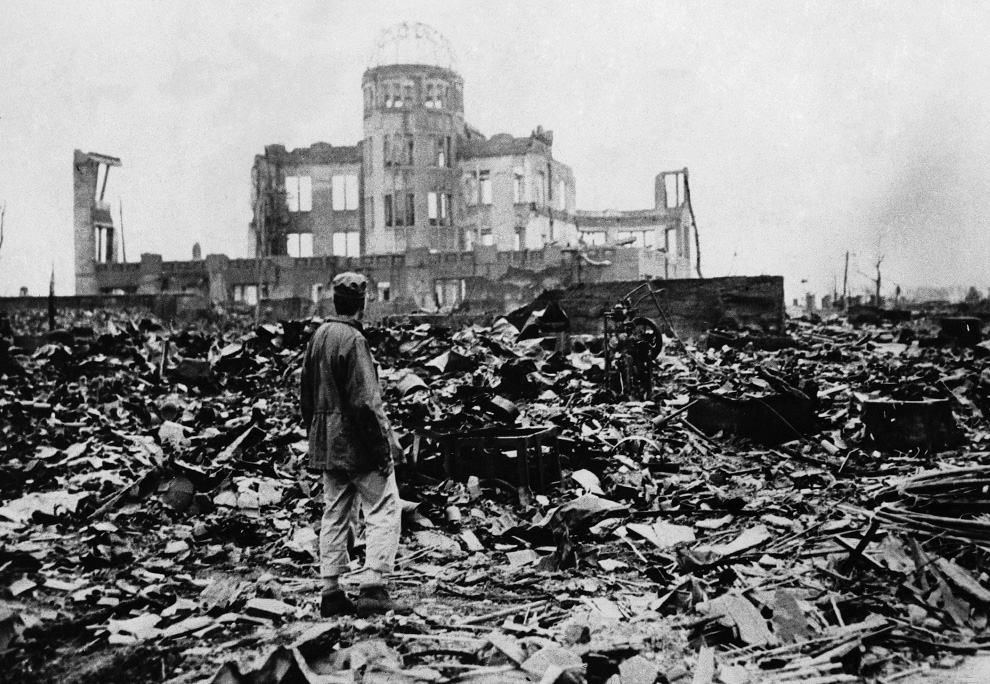
In those first minutes, they’ll be stunned. Eyes fixed in a thousand-yard stare, nerve endings numbed. They’ll just stand there. Soon, you’ll notice that they are holding their arms out at a 45-degree angle. Your eyes will be drawn to their hands and you’ll think you mind is playing tricks. But it won’t be. Their fingers will start to resemble stalactites, seeming to melt toward the ground. And it won’t be long until the screaming begins. Shrieking. Moaning. Tens of thousands of victims at once. They’ll be standing amid a sea of shattered concrete and glass, a wasteland punctuated by the shells of buildings, orphaned walls, stairways leading nowhere.
This could be Tehran, or what’s left of it, just after an Israeli nuclear strike.
Iranian cities — owing to geography, climate, building construction, and population densities — are particularly vulnerable to nuclear attack, according to a new study, “Nuclear War Between Israel and Iran: Lethality Beyond the Pale,” published in the journal Conflict & Health by researchers from the University of Georgia and Harvard University. It is the first publicly released scientific assessment of what a nuclear attack in the Middle East might actually mean for people in the region.
Its scenarios are staggering. An Israeli attack on the Iranian capital of Tehran using five 500-kiloton weapons would, the study estimates, kill seven million people — 86% of the population — and leave close to 800,000 wounded. A strike with five 250-kiloton weapons would kill an estimated 5.6 million and injure 1.6 million, according to predictions made using an advanced software package designed to calculate mass casualties from a nuclear detonation.
Estimates of the civilian toll in other Iranian cities are even more horrendous. A nuclear assault on the city of Arak, the site of a heavy water plant central to Iran’s nuclear program, would potentially kill 93% of its 424,000 residents. Three 100-kiloton nuclear weapons hitting the Persian Gulf port of Bandar Abbas would slaughter an estimated 94% of its 468,000 citizens, leaving just 1% of the population uninjured. A multi-weapon strike on Kermanshah, a Kurdish city with a population of 752,000, would result in an almost unfathomable 99.9% casualty rate.
Cham Dallas, the director of the Institute for Health Management and Mass Destruction Defense at the University of Georgia and lead author of the study, says that the projections are the most catastrophic he’s seen in more than 30 years analyzing weapons of mass destruction and their potential effects. “The fatality rates are the highest of any nuke simulation I’ve ever done,” he told me by phone from the nuclear disaster zone in Fukushima, Japan, where he was doing research. “It’s the perfect storm for high fatality rates.”
Israel has never confirmed or denied possessing nuclear weapons, but is widely known to have up to several hundred nuclear warheads in its arsenal. Iran has no nuclear weapons and its leaders claim that its nuclear program is for peaceful civilian purposes only. Published reports suggest that American intelligence agencies and Israel’s intelligence service are in agreement: Iran suspended its nuclear weapons development program in 2003.
Dallas and his colleagues nonetheless ran simulations for potential Iranian nuclear strikes on the Israeli cities of Beer Sheva, Haifa, and Tel Aviv using much smaller 15-kiloton weapons, similar in strength to those dropped by the United States on the Japanese cities of Hiroshima and Nagasaki in August 1945. Their analyses suggest that, in Beer Shiva, half of the population of 209,000 would be killed and one-sixth injured. Haifa would see similar casualty ratios, including 40,000 trauma victims. A strike on Tel Aviv with two 15-kiloton weapons would potentially slaughter 17% of the population — nearly 230,000 people. Close to 150,000 residents would likely be injured.
These forecasts, like those for Iranian cities, are difficult even for experts to assess. “Obviously, accurate predictions of casualty and fatality estimates are next to impossible to obtain,” says Dr. Glen Reeves, a longtime consultant on the medical effects of radiation for the Defense Department’s Defense Threat Reduction Agency, who was not involved in the research. “I think their estimates are probably high but not impossibly so.”
According to Paul Carroll of the Ploughshares Fund, a San Francisco-based foundation that advocates for nuclear disarmament, “the results would be catastrophic” if major Iranian cities were attacked with modern nuclear weapons. “I don’t see 75% [fatality rates as] being out of the question,” says Carroll, after factoring in the longer-term effects of radiation sickness, burns, and a devastated medical infrastructure.
According to Dallas and his colleagues, the marked disparity between estimated fatalities in Israel and Iran can be explained by a number of factors. As a start, Israel is presumed to have extremely powerful nuclear weapons and sophisticated delivery capabilities including long-range Jericho missiles, land-based cruise missiles, submarine-launched missiles, and advanced aircraft with precision targeting technology.
The nature of Iranian cities also makes them exceptionally vulnerable to nuclear attack, according to the Conflict & Health study. Tehran, for instance, is home to 50% of Iran’s industry, 30% of its public sector workers, and 50 colleges and universities. As a result, 12 million people live in or near the capital, most of them clustered in its core. Like most Iranian cities, Tehran has little urban sprawl, meaning residents tend to live and work in areas that would be subject to maximum devastation and would suffer high percentages of fatalities due to trauma as well as thermal burns caused by the flash of heat from an explosion.
Iran’s topography, specifically mountains around cities, would obstruct the dissipation of the blast and heat from a nuclear explosion, intensifying the effects. Climatic conditions, especially high concentrations of airborne dust, would likely exacerbate thermal and radiation casualties as well as wound infections.
Nuclear Horror: Then and Now
The first nuclear attack on a civilian population center, the U.S. strike on Hiroshima, left that city “uniformly and extensively devastated,” according to a study carried out in the wake of the attacks by the U.S. Strategic Bombing Survey. “Practically the entire densely or moderately built-up portion of the city was leveled by blast and swept by fire… The surprise, the collapse of many buildings, and the conflagration contributed to an unprecedented casualty rate.” At the time, local health authorities reported that 60% of immediate deaths were due to flash or flame burns and medical investigators estimated that 15%-20% of the deaths were caused by radiation.
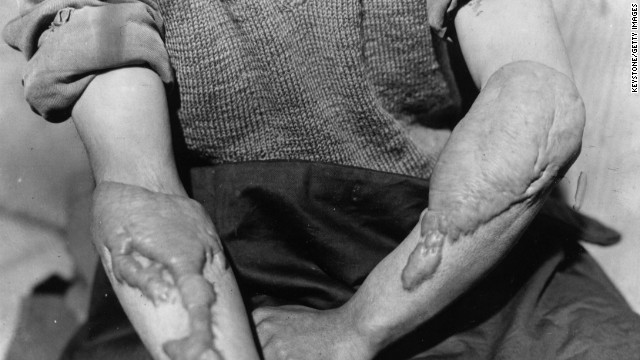
Witnesses “stated that people who were in the open directly under the explosion of the bomb were so severely burned that the skin was charred dark brown or black and that they died within a few minutes or hours,” according to the 1946 report. “Among the survivors, the burned areas of the skin showed evidence of burns almost immediately after the explosion. At first there was marked redness, and other evidence of thermal burns appeared within the next few minutes or hours.”
Many victims kept their arms outstretched because it was too painful to allow them to hang at their sides and rub against their bodies. One survivor recalled seeing victims “with both arms so severely burned that all the skin was hanging from their arms down to their nails, and others having faces swollen like bread, losing their eyesight. It was like ghosts walking in procession… Some jumped into a river because of their serious burns. The river was filled with the wounded and blood.”
The number of fatalities at Hiroshima has been estimated at 140,000. A nuclear attack on Nagasaki three days later is thought to have killed 70,000. Today, according to Dallas, 15-kiloton nuclear weapons of the type used on Japan are referred to by experts as “firecracker nukes” due to their relative weakness.
In addition to killing more than 5.5 million people, a strike on Tehran involving five 250-kiloton weapons — each of them 16 times more powerful than the bomb dropped on Hiroshima — would result in an estimated 803,000 third-degree burn victims, with close to 300,000 others suffering second degree burns, and 750,000 to 880,000 people severely exposed to radiation. “Those people with thermal burns over most of their bodies we can’t help,” says Dallas. “Most of these people are not going to survive… there is no saving them. They’ll be in intense agony.” As you move out further from the site of the blast, he says, “it actually gets worse. As the damage decreases, the pain increases, because you’re not numb.”
In a best case scenario, there would be 1,000 critically injured victims for every surviving doctor but “it will probably be worse,” according to Dallas. Whatever remains of Tehran’s healthcare system will be inundated with an estimated 1.5 million trauma sufferers. In a feat of understatement, the researchers report that survivors “presenting with combined injuries including either thermal burns or radiation poisoning are unlikely to have favorable outcomes.”
Iranian government officials did not respond to a request for information about how Tehran would cope in the event of a nuclear attack. When asked if the U.S. military could provide humanitarian aid to Iran after such a strike, a spokesman for Central Command, whose area of responsibility includes the Middle East, was circumspect. “U.S. Central Command plans for a wide range of contingencies to be prepared to provide options to the Secretary of Defense and the President,” he told this reporter. But Frederick Burkle, a senior fellow at the Harvard Humanitarian Initiative and Harvard University’s School of Public Health, as well as a coauthor of the just-published article, is emphatic that the U.S. military could not cope with the scale of the problem. “I must also say that no country or international body is prepared to offer the assistance that would be needed,” he told me.
Dallas and his team spent five years working on their study. Their predictions were generated using a declassified version of a software package developed for the Defense Department’s Defense Threat Reduction Agency, as well as other complementary software applications. According to Glen Reeves, the software used fails to account for many of the vagaries and irregularities of an urban environment. These, he says, would mitigate some of the harmful effects. Examples would be buildings or cars providing protection from flash burns. He notes, however, that built-up areas can also exacerbate the number of deaths and injuries. Blast effects far weaker than what would be necessary to injure the lungs can, for instance, topple a house. “Your office building can collapse… before your eardrums pop!” notes Reeves.
The new study provides the only available scientific predictions to date about what a nuclear attack in the Middle East might actually mean. Dallas, who was previously the director of the Center for Mass Destruction Defense at the Centers for Disease Control and Prevention, is quick to point out that the study received no U.S. government funding or oversight. “No one wanted this research to happen,” he adds.
Rattling Sabers and Nuclear Denial
Frederick Burkle points out that, today, discussions about nuclear weapons in the Middle East almost exclusively center on whether or not Iran will produce an atomic bomb instead of “focusing on ensuring that there are options for them to embrace an alternate sense of security.” He warns that the repercussions may be grave. “The longer this goes on the more we empower that singular thinking both within Iran and Israel.”
Even if Iran were someday to build several small nuclear weapons, their utility would be limited. After all, analysts note that Israel would be capable of launching a post-attack response which would simply devastate Iran. Right now, Israel is the only nuclear-armed state in the Middle East. Yet a preemptive Israeli nuclear strike against Iran also seems an unlikely prospect to most experts.
“Currently, there is little chance of a true nuclear war between the two nations,” according to Paul Carroll of the Ploughshares Fund. Israel, he points out, would be unlikely to use nuclear weapons unless its very survival were at stake. “However, Israel’s rhetoric about red lines and the threat of a nuclear Iran are something we need to worry about,” he told me recently by email. “A military strike to defeat Iran’s nuclear capacity would A) not work B) ensure that Iran WOULD then pursue a bomb (something they have not clearly decided to do yet) and C) risk a regional war.”
Cham Dallas sees the threat in even starker terms. “The Iranians and the Israelis are both committed to conflict,” he told me. He isn’t alone in voicing concern. “What will we do if Israel threatens Tehran with nuclear obliteration?… A nuclear battle in the Middle East, one-sided or not, would be the most destabilizing military event since Pearl Harbor,” wrote Pulitzer Prize-winning national security reporter Tim Weiner in a recent op-ed for Bloomberg News. “Our military commanders know a thousand ways in which a war could start between Israel and Iran… No one has ever fought a nuclear war, however. No one knows how to end one.”
The Middle East is hardly the only site of potential nuclear catastrophe. Today, according to the Ploughshares Fund, there are an estimated 17,300 nuclear weapons in the world. Russia reportedly has the most with 8,500; North Korea, the fewest with less than 10. Donald Cook, the administrator for defense programs at the U.S. National Nuclear Security Administration, recently confirmed that the United States possesses around 4,700 nuclear warheads. Other nuclear powers include rivals India and Pakistan, which stood on the brink of nuclear war in 2002. (Just this year, Indian government officials warned residents of Kashmir, the divided territory claimed by both nations, to prepare for a possible nuclear war.) Recently, India and nuclear-armed neighbor China, which went to war with each other in the 1960s, again found themselves on the verge of a crisis due to a border dispute in a remote area of the Himalayas.
In a world awash in nuclear weapons, saber-rattling, brinkmanship, erratic behavior, miscalculations, technological errors, or errors in judgment could lead to a nuclear detonation and suffering on an almost unimaginable scale, perhaps nowhere more so than in Iran. “Not only would the immediate impacts be devastating, but the lingering effects and our ability to deal with them would be far more difficult than a 9/11 or earthquake/tsunami event,” notes Paul Carroll. Radiation could turn areas of a country into no-go zones; healthcare infrastructure would be crippled or totally destroyed; and depending on climatic conditions and the prevailing winds, whole regions might have their agriculture poisoned. “One large bomb could do this, let alone a handful, say, in a South Asian conflict,” he told me.
“I do believe that the longer we have these weapons and the more there are, the greater the chances that we will experience either an intentional attack (state-based or terrorist) or an accident,” Carroll wrote in his email. “In many ways, we’ve been lucky since 1945. There have been some very close calls. But our luck won’t hold forever.”
Cham Dallas says there is an urgent need to grapple with the prospect of nuclear attacks, not later, but now. “There are going to be other big public health issues in the twenty-first century, but in the first third, this is it. It’s a freight train coming down the tracks,” he told me. “People don’t want to face this. They’re in denial.”
Nick Turse is the managing editor of TomDispatch.com and a fellow at the Nation Institute. An award-winning journalist, his work has appeared in the Los Angeles Times, the Nation, and regularly at TomDispatch. He is the author most recently of the New York Times bestseller Kill Anything that Moves: The Real American War in Vietnam (The American Empire Project, Metropolitan Books). You can catch his conversation with Bill Moyers about that book by clicking here. His website is NickTurse.com. You can follow him on Tumblr and on Facebook.






 anneinpt
 artaxes
 danmillerinpanama
 davidking1530
 Peter Hofman
 Joseph Wouk
 Peter
Peter Louisiana Steve
 WarSclerotic
Recent Comments