Archive for April 28, 2013

Syrian army ordered to use chemical weapons, defected general tells Al Arabiya

April 28, 2013

Syrian army ordered to use chemical weapons, defected general tells Al Arabiya – Alarabiya.net English | Front Page.

Sunday, 28 April 2013


A former army general from the chemical weapons branch, Zahir al-Sakit, said he was instructed to use chemical weapons. (Al Arabiya)


Al Arabiya –


The Syrian government ordered the use chemical weapons against the Free Syrian Army (FSA) during select battles with Syrian regime forces, a defected general told Al Arabiya late Saturday.


A former army general from the chemical weapons branch, Zahir al-Sakit, said he was instructed to use chemical weapons during a regime battle with the FSA in the southwestern area of Hauran.


But instead, Sakit disobeyed the orders and swapped the chemicals with disinfectant water he called “Javel water.”

“I was given orders to execute the use of poisonous chemicals in caves and tunnels that are used by the Free Syrian Army, but I mixed all chemicals with water and used Javel water instead,” Sakit said.

According to Sakit, prior to his defection, no chemical weapons were used on his watch in battles against the FSA.


“I assure you that I ordered all chemical weapons to be buried and I can point out the exact locations of those chemicals,” Sakit added.


The U.S. and Britain have previously accused the Syrian government of using chemical weapons in Damascus after results of the smuggled soil samples showed presence of chemicals that were used in the capital’s suburbs.


U.S. President Barack Obama on Friday warned Syria that using chemical weapons would be a “game changer,” after the U.S., Israel and Britain all cited signs that the regime attacked with the deadly agent sarin.


United Nations chief Ban Ki-Moon has called on Syria to approve a U.N. mission of inspectors to probe the alleged use of chemical weapons in the spiraling two-year conflict.


Meanwhile, Russia’s deputy foreign minister Mikhail Bogdanov said on Saturday that claims chemical weapons have been used in Syria should not become a pretext for a foreign military intervention.

“If there is serious evidence of the use of chemical weapons in Syria, it should be presented immediately and not concealed,” said Bogdanov, who is Russian President Vladmir Putin’s Middle East envoy, during a visit to Beirut.

US Patriots relocate from Gulf to Jordan. Israel and Turkey pool Syria intelligence

April 28, 2013

US Patriots relocate from Gulf to Jordan. Israel and Turkey pool Syria intelligence.

DEBKAfile Exclusive Report April 28, 2013, 9:45 AM (GMT+02:00)


US Patriots moved to Jordan-Syrian border

US Patriots moved to Jordan-Syrian border
Israel and Turkey agreed last week to start pooling their incoming intelligence on the Syrian civil war, debkafile’s intelligence sources report exclusively. Exchanges will take place at the highest level between Mossad Director Tamir Pardo and Hakan Fidan, head of Turkey’s MIT.


The United States will also provide additional security for Syria’s southern neighbor by the relocation of US Patriot missile interceptors from West Saudi Arabia and Kuwait to northern Jordan opposite the Syrian border.


US Patriots were deployed on the Turkish-Syrian border last year.


The new Patriot deployment indicates that the Obama administration is now treating the peril to its allies from Syria as greater than the Iranian menace.
Things are also on the move in the Turkish-Israeli arena.
Advantage was taken of the Israeli delegation’s visit to Istanbul Monday, April 22, for negotiations on the amount of compensation to be paid out to the families of the nine Turks who died in a clash of arms with Israeli naval commandoes in May 2010, when their ship, the Mavi Marmara, was stopped from completing its mission to break Israel’s blockade of the Gaza Strip.
As first reported by the last DEBKA-Net-Weekly, the negotiating session was brief. Criteria for determining the amounts of the payouts were settled in less than an hour. A joint Israeli-Turkish group is to calculate the sums and refer their estimates back to the delegations for approval.


The two delegations then got down to the brass tacks of the most pressing issues of interest to them both.


A day earlier, US Secretary of State John Kerry had urged Turkey to hurry up and restore its relations with Israel because of the urgent security interests they shared with one another and the United States in the Middle East:


The turbulence in Syria and Iran’s drive for a nuclear bomb posed extreme perils to all three nations.
The delegations responded by launching into an intense discussion of ways to further their military and intelligence cooperation for the common benefit.


One immediate decision was for Turkey and Israel to set up a joint mechanism for sharing intelligence on the Syrian conflict.


Turkey and Israel are reputed to have the best Syrian intelligence in the business, but their methods of gathering information, its content and their sources vary.


The Turks use Syrian rebels and Lebanese informants operating in Syria. They don’t command the electronic resources which Israel possesses. The two agencies also maintain contact with different rebel militias.
It was quickly recognized that both agencies have much to gain from a arrangement for sharing their input without further delay.

Israel Will Strike Iran ‘s Subterranean Nuclear Sites

April 28, 2013

Israel Will Strike Iran ‘s Subterranean Nuclear Sites – Op-Eds – Israel National News.

Published: Friday, April 26, 2013 11:50 AM
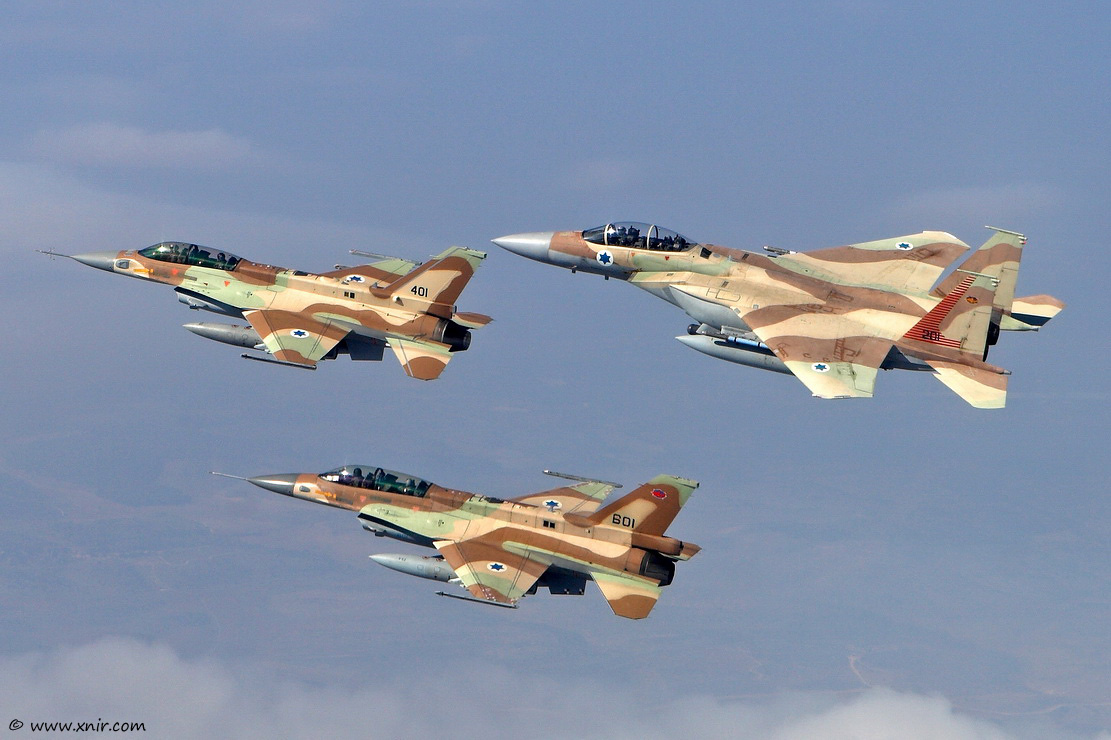
F-16 Israel

An Israeli strike on Iran’s sites is inevitable. However, timing and opportunity do matter. A careful analysis of both.

Israel is facing an existential threat far greater than anyone could have ever imagined and difficult to ignore. On the contrary, it would even be foolish to assume that Israelis and Jews living overseas are safer – when Iran becomes a nuclear capable state.

An overwhelming majority of Israelis believe that the Iranian nuclear threat constitutes an existential threat to the State of Israel; and the price Israel would have to pay for living under the shadow of Iran’s nuclear warheads is higher than the price it would pay for attacking Iran’s nuclear capability.

Israel’s cruel dilemma is an open ended question of bombing or not bombing Iran. A critical decision to risk indeterminate war with Iran will be a momentous challenge for Israel- and yet, it will have a durable impact towards the preservation of geopolitical-strategic balance of power in the restive Middle East.

In any military conflict, however, timing and opportunity do matter.

Indeed, an inevitable Israeli airstrike against Iran’s subterranean nuclear facilities may be a very complex operation- but Israel’s high tech military advantage could level the playing field and determine once and for all, the fate of its enemies, who would reel in disbelief.

Consequently, plausible deniability and nuclear ambiguity have served Israel’s decisive deterrence so far against Iran and its proxies: Hizbullah in Lebanon, Syria, Hamas and Palestinian Islamic Jihad in Gaza.

It is interesting to note that Israel’s first layer of defense, the Iron Dome, has successfully intercepted short-range rockets from Gaza during Operation Pillar of Defense, but the David Sling and Arrow, specifically designed with Iran’s Shahab missiles in mind, has never been tested in real-life combat.

In general, an Israeli Air Force (IAF) strike on Iran’s underground nuclear facilities from Natanz to Fordow, in particular, might require the most lethal combination of sophisticated precision-guided bunker-buster weapons (GBU-27 and GBU-28) that can only be carried on B-2 Spirit stealth bombers.

In large measure, Israel already possesses these weapons, built either on their own or sold to it by the U.S. But, it is unclear how Israel would deliver the GBUs maximum payload short of B-2s.

Furthermore, Israel’s possession of Jericho III intercontinental ballistic missiles (ICBM), that can reach New York and Tokyo, are capable of striking Iran’s above-ground targets. The high speed of the ICBM makes it practically invincible for interception and will free up IDF aircrafts to focus on hard targets.

In absolute terms, Israel could use tactical nukes- but the IDF might opt to use the much vaunted precision guided GBU-31s which have the same warhead as Israel’s existing GBU-28s (the BLU-122 warhead)- to augment the IAF’s existing capabilities.

Of course, it is not surprising, or beyond the realm of impossibilities, that Israel might deploy a simultaneous, knockout combination of cyber offensive weapons and electromagnetic pulse (EMP) attacks.

In the event Russia might have surreptitiously supplied Iran with the SA-12 or S-300 air defense systems, the attrition rate of an Israeli air strike could be significant.

But now, a respected Washington think tank (CSIS) has said that low-radioactive yield “tactical” nuclear warheads would be one way for the Israelis to destroy Iranian uranium enrichment plants in remote, dug-in fortifications.

Given the difficulty its jets would face in reaching Iran for anything more than a one-off sortie – ballistic missiles or submarine-launched cruise missiles could serve for Israeli tactical nuclear strikes without interference from Iranian air defenses.

“Preemptive nuclear strikes are foreign to the national doctrine”:

Israeli leaders do not comment on this capability other than to underscore its deterrent role. A veteran Israeli defense official, speaking on condition of anonymity, said preemptive nuclear strikes were foreign to the national doctrine: “Such weapons exist so as not to be used.”

Neither the public nor the media ought to deal with the operational issues that are connected to a military action. Having said that, the mainstream media is actually rife with speculation about the United States — which, like Israel, has not ruled out military force to deny Iran atomic arms, and could itself resort to tactical nuclear strikes.

We are not bluffing,” has become the familiar refrain from both countries specifically as a warning to Iran. Under no circumstances will Israel agree to a nuclear-armed Iran.

Unfortunately, the U.S.-Iran secret nuclear deal to recognize Iran as a “threshold-power”, as long as it does not manufacture atomic weapons is inherently a flawed logic.

As a result of a possible military dimension to Iran’s nuclear program, Iran has forfeited its right to unrestricted access to civil nuclear technology. Moreover, nuclear weapons have become a symbol of Iran’s national pride and therefore, there is no ironclad guarantee that Iran will not pursue nuclear weapons.

The possibility that there is still time for diplomatic sanctions to succeed is just a morbid dream and an illusion of the imprudent Obama administration.

Let us make this categorically clear to Iran:

The U.S. and Israel share a united front against Iran, and the U.S. commitment to defending its longtime ally in the Middle East remains unbreakable. For the most part, the U.S. has a 60-year commitment to Israeli security, and if Israel’s population centers were hit, the U.S. could feel obligated to come to Israel’s defense.

The importance of the recent most complex and carefully orchestrated $10 billion arms deal to maintain Israel’s military edge cannot be overemphasized – a clear signal that Iran could face a military strike unless it abandoned its suspect nuclear program.

Although Iran’s genocidal rhetoric is unmistakably clear, Israel senses bluffing in Iran’s threats of retaliation.

Come to think about it- a fanatical radical Islamist theocracy bent on taking over the world for Islam, and “wiping Israel off the map”, by itself deserves to be sent back to the Stone Age.

Now the moment of truth has come to a close: Iran has enough enriched uranium to build five atomic bombs and probably is in possession of at least one primitive nuclear device—a “dirty bomb.”

What’s really interesting here is Washington’s response to U.S. intelligence indicating that the “red line”- Syria’s use of chemical weapons (sarin) and the transfer of its stockpiles to a terrorist group under the guidance of Iran’s Islamic Revolutionary Guards Al-Quds – has been passed is very troublesome.

In light of these developments, Iran’s direct involvement in all the conflicts in Syria and the botched terrorist attacks in different parts in the world are a ruse designed to divert attention from its illicit nuclear program.

Finally, there is no question that under the Obama White House’s incompetent foreign policy, Iran has become the greatest purveyor of global terrorism and now is a de facto nuclear state, which via proxies has violated every convention of warfare- is a “casus belli” for Israeli military action.

The bottom line here is quite simple: in a few years, Israel’s existence would be worthless, if it didn’t make a historic decision to confront Iran’s atomic ambitions. The truth, however cruel, is also revealing: Israel must always adopt the war footing required to prevail over the unimaginable perils and catastrophic consequences of a nuclear Iran.

Born in Manila, American by choice, the author is a former clinical research-physician-general surgeon for Saudi Arabian, Philippine and American healthcare systems and currently an American freelance writer as well as op-ed contributor.

IDF received unspecific intelligence warnings ahead of Eilat rocket attack

April 28, 2013

IDF received unspecific intelligence warnings ahead of Eilat rocket attack – Diplomacy & Defense – Israel News | Haaretz Daily Newspaper.

The Iron Dome battery did not intercept the rockets likely due to Eilat’s complex geography – a relatively small strip of coast between Egypt and Jordan.

By | Apr.17, 2013 | 6:24 PM 

One of the rockets fired at Eilat

One of the rockets fired at Eilat. Photo by Eilat Police

The defense establishment had received unspecific intelligence warnings before the rocket attack on Eilat from the Sinai desert on Wednesday morning.

Assessing the situation earlier this month, the army decided to place an Iron Dome anti-missile battery in the area – the fifth deployed in Israel. (This was the system deployed on a limited basis to defend the Tel Aviv area during Operation Pillar of Defense in Gaza last November.)

Deployment of the Iron Dome battery in Eilat made it possible to sound the alarm system in the city Wednesday morning. The old radar systems that were stationed in the city didn’t have the relevant capabilities.

On Wednesday, however, the battery was not triggered to intercept the rockets, which fortunately caused only light property damage. The army has not volunteered explanations on why the system didn’t operate when the rocket fire was detected.

We can assume however it has to do with Eilat’s complex geography – a relatively small strip of coast between Egypt and Jordan. It is a densely built-up area.

The IDF will have to examine the precise circumstances of the rocket fire and the response, but it must also take into account that under these conditions Iron Dome’s interception rate could be different from what we’re used to.

In recent weeks Israeli political and security sources have made positive statements about the cooperation with Egypt’s intelligence and army. Although these Egyptians are subordinated to a government controlled by the Muslim Brotherhood, the improved contacts stem mainly from Egypt’s stepped-up efforts to prevent weapons smuggling from Sinai into Gaza and Cairo’s pressure on the Hamas regime in Gaza to halt rocket fire from Gaza into the Negev.

But the Egyptian security forces’ functioning is limited, especially concerning their control over extremist Islamic factions in Sinai. Therefore Wednesday’s rocket fire, at least the sixth such incident in the past three years, shouldn’t come as a surprise. A Salafi organization claimed responsibility, saying the attack came in response to the killing of two young Palestinians near the West Bank town of Tul Karm less than two weeks earlier. Whether it was the work of this faction or another small group, it’s hard to believe that the Egyptians will deal with them firmly or be able to assure Israel that Wednesday’s rocket fire won’t repeat.

Before the incident in Eilat, IDF Chief of Staff Benny Gantz made statements for Independence Day expressing concerns about the situation in Syria. He warned that the calm in the Golan Heights for nearly 40 years since the end of the Yom Kippur War was now over. Gantz’s warning was perhaps also based on an intelligence assessment.

The situation on the Syrian and Egyptian borders is similar. Neither regime has effective control over the border area. The vacuum is filled by Islamic extremists inspired by Al Qaida. They seek to attack Israel, even though in the Syrian case, the fight against Israel still has a relatively low priority compared to the main goal of deposing the Assad regime.

In addition to a certain lack of intelligence, Israel’s problem is a lack of capacity to achieve deterrence against those extremist organizations. These factions don’t have assets they would fear losing. When Syrian soldiers fire at Israel, whether by mistake or not, it’s still possible to try to deter the Assad regime by hitting army positions.

Wednesday’s incident is also a sign of the current instability. Old concepts of deterrence, warnings and a balance of interests aren’t as valid as they have been for many years.

Boston bomber’s mother urged him to join Palestinians

April 28, 2013

Boston bomber’s mother urged him to join Palestinians – Israel News, Ynetnews.

Phone calls between Tamerlan Tsarnaev and his mother tapped by Russian authorities reveal discussions of jihad in 2011

Associated Press

Published: 04.28.13, 08:22 / Israel News

Russian authorities secretly recorded a telephone conversation in 2011 in which one of the Boston bombing suspects vaguely discussed jihad with his mother, officials said Saturday, days after the US government finally received details about the call.

In another conversation, the mother of now-dead bombing suspect Tamerlan Tsarnaev was recorded talking to someone in southern Russia who is under FBI investigation in an unrelated case, officials said.

The conversations are significant because, had they been revealed earlier, they might have been enough evidence for the FBI to initiate a more thorough investigation of the Tsarnaev family.
הפיגוע בבוסטון (צילום: רויטרס)

Boston Marathon bombing (Photo: Reuters)

As it was, Russian authorities told the FBI only that they had concerns that Tamerlan and his mother were religious extremists.

With no additional information, the FBI conducted a limited inquiry and closed the case in June 2011.

Two years later, authorities say Tamerlan and his brother, Dzhohkar, detonated two homemade bombs near the finish line of the Boston Marathon, killing three and injuring more than 260. Tamerlan was killed in a police shootout and Dzhohkar is under arrest.

In the past week, Russian authorities turned over to the United States information it had on 26-year-old Tamerlan and his mother, Zubeidat Tsarnaeva.

The Tsarnaevs are ethnic Chechens who emigrated from southern Russia to the Boston area over the past 11 years.

Even had the FBI received the information from the Russian wiretaps earlier, it’s not clear that the government could have prevented the attack.

In early 2011, the Russian FSB internal security service intercepted a conversation between Tamerlan and his mother vaguely discussing jihad, according to US officials who spoke on condition of anonymity because they were not authorized to discuss the investigation with reporters.

The two discussed the possibility of Tamerlan going to ‘Palestine,’ but he told his mother he didn’t speak the language there, according to the officials, who reviewed the information Russia shared with the US.

It was not immediately clear why Russian authorities didn’t share more information at the time. It is not unusual for countries, including the US, to be cagey with foreign authorities about what intelligence is being collected.

Jim Treacy, the FBI’s legal attache in Moscow between 2007 and 2009, said the Russians long asked for US assistance regarding Chechen activity in the United States that might be related to terrorism.

“On any given day, you can get some very good cooperation,” Treacy said. “The next you might find yourself totally shut out.”

Zubeidat Tsarnaeva has denied that she or her sons were involved in terrorism. She has said she believed her sons have been framed by US authorities.

But Ruslan Tsarni, an uncle of the Tsarnaev brothers and Zubeidat’s former brother-in-law, said Saturday he believes the mother had a “big-time influence” as her older son increasingly embraced his Muslim faith and decided to quit boxing and school.

After receiving the narrow tip from Russia in March 2011, the FBI opened a preliminary investigation into Tamerlan and his mother. But the scope was extremely limited under the FBI’s internal procedures.

After a few months, they found no evidence Tamerlan or his mother were involved in terrorism.

The FBI asked Russia for more information. After hearing nothing, it closed the case in June 2011.

In the fall of 2011, the FSB contacted the CIA with the same information. Again the FBI asked Russia for more details and never heard back.

At that time, however, the CIA asked that Tamerlan’s and his mother’s name be entered into a massive US terrorism database.


Face Islam for what it really is – ‘The Religion of the Sword.’

April 28, 2013

Face Islam for what it really is – ‘The Religion of the Sword.’ | Jerusalem Post – Blogs.

Earl Cox

The ugly head of Muslim terrorism has risen again and this time with the recent bombing at the Boston Marathon. At least three people were killed and more than 150 maimed or wounded in that horrifying, inhumane bomb attack. You have to wonder how anyone could be so evil minded to plan and carry out such a devastating act. But that’s Islam. That’s all part of Islamic teaching and action.

Then, can you believe it? Catholic Bishop O’Malley tells the crowd at a hastily arranged interfaith service in Boston that Islam is not to be blamed for the Marathon massacre. He repeats the politically correct lie that Islam is really a peaceful religion. We can’t forget how then President George W. Bush made the same erroneous assessment about Islam following the devastating attacks on the Twin Towers in New York, the Pentagon in Washington DC, and the crash in Pennsylvania which resulted in the deaths of more than 3,000 innocent Americans. How many scores of times do the Muslims have to terrorize and kill before these peace mongers believe the actual, horrifying truth?

To look at Islamic terrorism worldwide you have to start, of course, with Israel. On the very day that Israel declared its existence as a restored Jewish nation, five Arab Muslim national armies immediately set out to annihilate the new nation in its infancy but the God of Israel prevented them from succeeding. Five more times in the following years, those neighboring Muslims tried to wipe Israel out of existence, and God miraculously preserved Israel every time.

So then the Muslims switched to terrorism, sending suicide (a more precise term would be ‘homicide’) martyrs into Israel to blow themselves up in crowded buses and restaurants where scores of Jewish people could be killed and maimed at one time. And we should not forget that Muslim Iran keeps threatening “to wipe Israel off the face of the map,” particularly with the nuclear bombs they are developing.

A report written recently by Robert Shortt of Great Britain states that “if something is not done soon to stem the Muslim persecution in the Middle East, Christianity may disappear from the region entirely.” Shortt reports that in Iraq the Muslims have forced the number of Christians in the country to drop from 1.4 million in 1990 to fewer than 200,000 today. In Iran Muslims have routinely falsely accused Christians of blaspheming the Islamic prophet Mohammed, and they have imprisoned and tortured numerous Christian and/or driven them out of the country. Shortt’s report adds that in Egypt the Coptic Christians have faced increasing persecution since Mohammed Morsi took over as president and instituted Sharia law. Muslim leaders in Egypt are now unrelenting in their threatening and persecuting of Coptic Christians with genocide.

And don’t forget the murderous Muslim activity in Nigeria and Sudan in Africa. In northern Nigeria more than 60,000 people have died from Muslim violence, mostly Christians. Some 300 Christian churches have been burned and more than 100 Christian pastors have been put to death. In southern Sudan the same murderous activity has been taking place. Hundreds of Christian churches have been destroyed and thousands of innocent Christians have been killed but there’s more. Remember the relatively recent unprovoked Muslim terrorist bombings of a Madrid passenger train and of a London subway station. Again, dozens of innocent people were killed and hundreds were injured.

It’s hard for me as a Christian to conceive that any people group can be so evil minded as to kill and injure innocent people all around the world yet this is exactly what the terrorists, who happen to be Muslims, are doing.  We Christians are taught to be kind to others, even to our enemies. Conversely, Muslims are taught to hate and to kill others for no reason other then they are not Muslims. The Islamic holy book, the Koran, labels all non-Muslims as “infidels,” and it primarily specifies Jews and Christians. Everyone understands that the two primary targets of Islamic terrorism today are Israel and the United States. Muslims call the U.S. “the Great Satan” and Israel “the Little Satan.” But their full intent, according to their Koran, is to conquer and to control the entire world. They are supposed to do it by “jihad,” or holy warfare. And that’s why Islam is really (and rightly) characterized as “the religion of the sword.”

It is time that Israeli and U.S. government and religious leaders stand up and face Islam for what it really is. Since it authorizes the killing of all Jews and Christians, and since it authorizes the annihilation of Israel and the conquering of the U.S. nation, it is not just a religion, it is also a traitorous and treasonous militant ideology.  Civilized nations need to enact and enforce laws to prevent Islam from infecting our tolerant countries since it wars against our traditional freedoms and against our countries’ existence. Islam must be recognized for what it is not…it is not a peaceful religion.

Are there rules in these games?

April 28, 2013

Are there rules in these games? | Jerusalem Post – Blogs.

Ira Sharansky

Barack Obama has said that Syrian use of chemical weapons is a “game changer.” 

 According to the lead paragraphs in a New York Times article, the President said

“he would respond “prudently” and “deliberately” to evidence that Syria had used chemical weapons, tamping down any expectations that he would take swift action after an American intelligence assessment that the Syrian government had used the chemical agent sarin on a small scale in the nation’s civil war. . . . he was seeking further proof of culpability for chemical weapons attacks. It is a laborious process that analysts say may never produce a definitive judgment. But Mr. Obama is also trying to preserve his credibility”

For Israelis, the bigger issue is Iran. Its leaders seem intent on creating a nuclear weapon, and they have said time and again that Israel has no place in their world. We worry about an unstable Syria, perhaps being taken over by Muslim fanatics, with a sizable arsenal that might fall into the hands of Hezbollah fanatics. However, those concerns are more manageable than what may come out of Iran.

It is not in Israel’s interests that the United States take forceful action in Syria that may lessen its will or capacity to act against the greater threat of Iran.
Would Prime Minister Netanyahu act now against Iran, while the White House is pondering Syria?
Netanyahu would thereby preserve his reputation, staked on doing what was necessary to prevent Iran from acquiring nuclear weapons. He would also turn US attention to Israel’s greater problem, and might force the US to act in concert with Israel.
The costs would not be light, and the benefits doubtful. Most likely there would be Iranian and maybe Hezbollah missile attacks against Israeli cities. An Israeli attack might do no more than delay Iran’s nuclear program, and serve to enrage the Iranians sufficiently to overcome their internal debates and set them on a firmer course to destroy Israel. It may not induce American or European cooperation, and even lead those governments to question Netanyahyu’s wisdom or condemn Israeli acts that disturb their own independence of action.
An Israeli attack might be good for Netanyahu’s self image, his short range support within Israel, and–if it succeeds in destroying enough of Iran’s nuclear infrastructure and dissuading its leadership from trying again–assure him a decent page in history.
What is most likely is that both Netanyahu and Obama will be pondering their options.
It is also possible that neither will act. Not Obama now or later against Syria or Iran, and not Netanyahu against Iran. Both can find the verbiage to wiggle out of previous commitments, rest with renewed condemnations of both Syria and Iran, and their threats of retaliation against Iran if it dares use nuclear weapons.
Already in the air is the US finding that there has been a “small scale” use of chemical weapons. Not enough to justify US action. A few dozen deaths due to chemicals may not weigh much against what may be 100,000 deaths due to conventional weapons.
While not acting in a big way, both the United States and Israel may continue what they already appear to be doing, i.e., low profile operations to frustrate any transfer of Syrian weapons to Hezbollah, and to delay Iran’s nuclear ambitions.
The rules of this game prioritize a calculation of costs and benefits, and a recognition that no decision is likely to solve the problems associated with Syria or Iran once and for all times. Coping, or problem management is the theme, like much else in politics.
Don’t make things worse is an important caveat.
North Korea is part of the story.
The United States and other powers dithered through North Korea’s development and testing of its nuclear capacity, with possibilities of its learning and teaching along with Pakistan and Iran. Now the North Korean regime qualifies for the category of untouchable, given what it can do to others.
There is another small country that benefits from the same status, even though it has wrapped its nuclear capacities in a porous blanket of ambiguity.
If the US goes into Syria with force, the scenario is likely to repeat what has happened in Iraq and Afghanistan, with high costs in American lives and resources without an outcome that will be anything like a stable and enlightened Syria likely to cooperate with American interests.
Based upon the success of MAD (mutual assured destruction) in the cases of the US and the USSR, India and Pakistan, Israeli leaders can find ample reason to desist rather than act forcefully. The Israeli Air Force, along with land-based missiles and those in submarines, provide the means to make a second strike against Iran, and deter the Iranians from a first strike against Israel.
Holding back from attacking Syria or Iran might be viewed as anti-heroic in both the US and Israel, and lose their leaders the support of their more adventurous constituents.
An item headlined in a prominent Israeli news site begins, “50 shades of red: the blurred lines of Obama. The American president proclaimed clear limits to Iran and Syria, but the lines continue to move. Americans look for Chechnya on the map, and lose the solution of two countries.”
The two countries at issue here may be Russia and Chechnya, with their implications for Israel and Palestine. The article continues with ridicule against American claims of “not bluffing.”
The red on the faces of national leaders may be easier to explain than other damage. Bibi’s flexibility would lessen the prospect of missiles dropping on its people from distant Iran and closer Hezbollah, and Obama’s might lessen the incentives of Muslims to try another 9-11 or Boston Marathon.
The perpetrators of the Boston Marathon now appear to have been acting alone, outside the orbit of organized Islamic extremists.
This puts the US in a situation like that of Israel, having to deal with enraged individuals or very small groups. Such attacks may not be a reasoned response to any obvious action, and are difficult to uncover in advance. The Palestinian shooting at cars thought to be driven by Jews, or taking a kitchen knife and attacking the first person who looks to be a Jew met on the street, resembles that major at Fort Hood and two Chechen brothers in Boston.
The next target may be the Sharkanskys taking their evening stroll in French Hill, or a school yard in any American city.
Historians will debate when this Crusade, or war between civilizations began. Among the options are 9-11, the wars of 1948 or 1967, the 1993 attack on the World Trade Center, or the Gulf War of 1991.
Readers looking for certainty at low risk should consider another pursuit. Perhaps growing roses, shopping for wine, or discovering the ultimate spaghetti sauce.

Analysis: No good military options for US in Syria

April 28, 2013

Analysis: No good military options for US in Syria | JPost | Israel News.

By REUTERS
04/28/2013 05:46
“Obama has so far opposed limited steps, like arming anti-government rebels; pressure to deepen US involvement in Syria has grown”.

US President Barack Obama in a video message to the Syrian people, January 29, 2013.

US President Barack Obama in a video message to the Syrian people, January 29, 2013. Photo: YouTube Screenshot

WASHINGTON – Despite President Barack Obama’s pledge that Syria’s use of chemical weapons is a “game changer” for the United States, he is unlikely to turn to military options quickly and would want allies joining him in any intervention.

Possible military choices range from limited one-off missile strikes from ships – one of the less complicated scenarios – to bolder operations like carving out no-fly safe zones.

One of the most politically unpalatable possibilities envisions sending tens of thousands of US forces to help secure Syrian chemical weapons.

Obama has so far opposed limited steps, like arming anti-government rebels, but pressure to deepen US involvement in Syria’s civil war has grown since Thursday’s White House announcement that President Bashar Assad likely used chemical weapons.

After fighting wars in Afghanistan and Iraq, the Pentagon is wary of US involvement in Syria. The president’s top uniformed military adviser, General Martin Dempsey, said last month he could not see a US military option with an “understandable outcome” there.

“There’s a lot of analysis to be done before reaching any major decisions that would push US policy more in the direction of military options,” a senior US official told Reuters.

That caution is understandable, given the experience of Iraq where the United States went to war based on bad intelligence about weapons of mass destruction. The Pentagon has made repeated warnings of the enormous risks and limitations of using American military might in Syria’s civil war.

STRIKES, NO-FLY ZONE

One form of military intervention that could to some extent limit U.S. and allied involvement in Syria’s war would be one-off strikes on pro-Assad forces or infrastructure tied to chemical weapons use. Given Syria’s air defenses, planners may choose to fire missiles from ships at sea.

“The most proportional response (to limited chemical weapons use) would be a strike on the units responsible, whether artillery or airfields,” said Jeffrey White, a former senior official at the Pentagon’s Defense Intelligence Agency and a Middle East expert who is now a defense fellow at the Washington Institute For Near East Policy.

“It would demonstrate to Assad that there is a cost to using these weapons – the problem so far is that there’s been no cost to the regime from their actions.”

It is not clear how the Syrian government would respond and if it would try to retaliate militarily against the US forces in the region. US military involvement would also upset Russia which has a naval facility on Syria’s Mediterranean coast.

Another option that the Pentagon has examined involves the creation, ostensibly in support of Turkey and Jordan, of humanitarian safe areas that would also be no-fly zones off limits to the Syrian air force – an option favored by lawmakers including Senator John McCain of Arizona.

This would involve taking down Syrian air defenses and destroying Syrian artillery from a certain distance beyond those zones, to protect them from incoming fire.

Advocates, including in Congress, say a safe zone inside Syria along the Turkish border, for example, would give needed space for rebels and allow the West to increase support for those anti-Assad forces it can vet.

Still, as officials, including Defense Secretary Chuck Hagel, have warned, once established, a safe zone would tie the United States more closely to Syria’s messy conflict. Assad would almost certainly react.

“Once you set up a military no-fly zone or safe zone, you’re on a slippery slope, mission creep and before you know it, you have boots on the ground,” said Bruce Riedel, a former CIA analyst and Middle East expert at the Brookings Institution.

“Or you end up like Libya where you don’t really have a control mechanism for the end-game, should you end up with chaos.”

The US military has also completed planning for going into Syria and securing its chemical weapons under different scenarios, including one in which Assad falls from power and his forces disintegrate, leaving weapons sites vulnerable to pillaging.

The US fears anti-Assad Islamist rebels affiliated to al Qaeda could grab the chemical weapons but a U.S. intervention into Syria to get the arms would require tens of thousands of American troops.

Asked if he was confident the US military could secure Syria’s chemical weapons stock, Dempsey told Congress: “Not as I sit here today simply because they have been moving it and the number of sites is quite numerous.”

IS THERE A WILLING COALITION?

Obama said on Friday that he would seek to mobilize the international community around Syria, as he attempts to determine whether pro-Assad forces used chemical weapons.

British and French officials have long made it clear their countries might be willing to join in any US-led action under the right circumstances.

But Hagel warned last week that “no international or regional consensus on supporting armed intervention now exists.” Once a fervent advocate of foreign intervention in Syria, Turkey has grown frustrated with the fractured opposition to Assad and with international disunity.

NATO chief Anders Fogh Rasmussen has ruled out Western military intervention and US Admiral James Stavridis, NATO’s supreme allied commander, cautioned last month that the alliance would need agreement in the region and among NATO members as well as a UN Security Council resolution – something that looks unlikely given probable opposition from Russia and China.

The Pentagon has focused over the past year on synchronizing defense planning on Syria, including with Britain, France and Canada.

It is also enhancing its military presence in Jordan by ordering some 200 Army planners into Jordan to focus on Syria scenarios. That would be a better group to coordinate any military or humanitarian action than the ad-hoc U.S. military team previously in Jordan.

Obama met Jordan’s King Abdullah at the White House on Friday and Hagel traveled to Jordan this week, as well as to Israel, Saudi Arabia, Egypt and the United Arab Emirates.

“It seems increasingly clear that the Obama administration is feeling pressure to act,” said Mona Yacoubian, a former State Department official and now a Syria expert at the Stimson Center in Washington.

“But they will likely seek two things: conclusive evidence and multilateral support/participation in whatever action (they) choose, which I think would be limited, targeted air strike.”

Evidence of sarin use puts US intel at crossroads

April 28, 2013

Evidence of sarin use puts US intel at crossroads | JPost | Israel News.

US requests UN investigation based on ‘credible’ proof; Oren: Israel ‘not pressuring’ Washington to intervene militarily.

Satellite view of suspect sites in Syria [file]

Satellite view of suspect sites in Syria [file] Photo: Reuters / Handout


NEW YORK – Ever since the White House unveiled a series of findings on Thursday that chemical weapons have been used in Syria’s civil war on at least two occasions, Western officials have been acknowledging that suspicions of their use took root in December.

After claims first surfaced of a chemical attack on December 23 in Homs, one source described a strongly worded exchange between Assad regime officials and Russian diplomats, with the latter persuaded by Western powers that such an attack would broach a red line that, if crossed, would preclude even Russia from stopping an escalation of American involvement.

Western officials believed in January that Syrian President Bashar Assad “got the message” after feeling sincere international pressure, Ron Prosor, Israel’s ambassador to the UN, said at the time.

But that diplomatic success proved short-lived, as reports surfaced less than two months later of additional small-scale chemical attacks.

The Jerusalem Post has learned that, in support of written pleas sent by Britain and France to UN Secretary-General Ban Ki- moon, US Ambassador to the UN Susan Rice met in private with Ban to issue a formal request from the Obama administration for an investigation into the use of chemical weapons in Syria, based on “credible evidence” acquired by US intelligence agencies.

That meeting took place on March 20. The secretary-general announced an investigation the following morning.

One former White House official said the intelligence roll-out reminded him of the nerves exhibited by the CIA in 2007, when concerned Israelis approached the Bush administration to discuss how to address a suspected nuclear facility under construction in eastern Syria.

“All the intelligence agencies agreed that this was a nuclear reactor, but they couldn’t definitively prove it was part of a larger nuclear program,” the official said.

Ever since Iraq, spooked US officials have qualified their intelligence assessments submitted to the Oval Office in tiers of certainty: low, medium or high confidence. How information earns higher confidence has become a matter of politics within the intelligence community.

“They have one out: They can hope the amount of attention given to this [intelligence report] is sufficient to deter Assad from doing it again,” said Elliott Abrams, a former senior diplomat in the Reagan and George W. Bush administrations.

“The question is: Is it really an intel problem, or is the administration trying to hide or politicize the intel?”

On a conference call with reporters after the announcement, one White House official said the president sought to prove the “chain of custody” of the chemicals used – not just the fact that they were indeed released, but who released them, who made them and where they had come from.

But without unfettered access to Syrian stockpiles as a point of reference, that chain of custody is impossible for investigators to prove, said Ray Zilinskas, director of the Biological Weapons Nonproliferation Program at Middlebury College’s Monterey Institute of International Studies in California.

“The rebels don’t have the capabilities themselves to produce complex chemicals such as sarin,” which is what was found by the Americans, Zilinskas said. “But they do have the ability to acquire organophosphorus pesticides, which produces a lot of similar symptoms,” including miosis (excessive constriction of the pupils) and foaming at the mouth.

Matthew Meselson, co-director of the Harvard Sussex Program on Chemical and Biological Weapons, agreed. He also noted that sarin has a shelf life of less than two years – unless very purely made – implying that the sarin used in the attacks was likely mixed by the Assad government after the civil war started in March 2011.

To test for sarin, intelligence agencies would have to acquire either soil samples or samples of tissue, blood, urine or hair from humans or animals present during the chemical release. While the effects of less potent gases such as mustard would linger, sarin’s volatility makes it difficult to detect more than 10 days after an attack.

Western intelligence officials therefore fear that an extensive, detailed report of findings would reveal their hand to the Assad government, possibly compromising agents or allies on the ground who were able to acquire evidence quickly.

Speaking to the Post , Ambassador to Washington Michael Oren said intelligence work on Syria’s chemical weapons between Israel and the US – and in coordination with other Middle Eastern powers – is “intimate,” but that Israel’s strategic “red line” is different than the one oft-repeated by the American president since last August.

“Prime Minister [Binyamin] Netanyahu has stated that Israel’s red line is any attempt by Syria to transfer chemical or other game-changing weapons to Hezbollah,” Oren said. “That is our red line, and we stand by it.

“We are not pressuring, urging or even suggesting that the United States should take military action in Syria,” the ambassador continued. “All we have stated is that if a decision were to be made to provide weapons to rebels, those who receive them should be closely vetted.”

Two days before the White House acknowledgment, and two days after meeting with US Secretary of Defense Chuck Hagel in Tel Aviv, Defense Minister Moshe Ya’alon openly cited instances of chemical weapons use in Syria.

Hagel told journalists the announcement caught him by surprise and that the US was still searching for hard proof in “real intelligence.”

“If the Israelis are going to force the president’s hand, they don’t want to waste it on this,” said Daniel Byman, director of research at the Saban Center for Middle East Policy at the Brookings Institution. “But certainly, the Israelis put this back on the agenda.

“It’s rare that you get the perfect intelligence,” Byman added, “or the smoking gun that you need, as we saw painfully in Iraq.”

Facing pressure from both sides of the aisle in Congress to match his words with deeds, US President Barack Obama reiterated his stance on Friday after meeting with King Abdullah II of Jordan: Chemical weapons were a “game changer,” and the US would have to respond – in one way or another.

Foreign affairs experts, ranking congressmen and Senate Intelligence Committee members have all agreed: strategically, the administration has given itself little choice.

“It’s not reasonable to seek perfect certainty – that becomes an excuse for inaction.

And that worries me not about Syria, but about Iran,” Abrams said. “If we do nothing, the Iranians are going to draw the conclusion that this language means nothing.”

IAF Strikes Terror Targets in Gaza

April 28, 2013

IAF Strikes Terror Targets in Gaza – Defense/Security – News – Israel National News.

IAF aircraft strike a terror facility and a weapons storage site in southern Gaza.


By Arutz Sheva Staff

First Publish: 4/28/2013, 4:37 AM / Last Update: 4/28/2013, 5:10 AM
IAF air strike in Gaza

IAF air strike in Gaza
Flash 90


IAF aircraft struck a terror facility and a weapons storage site in southern Gaza on Saturday night.


The IDF Spokesperson’s Unit said in a statement that direct hits at the targets were identified. All Israeli aircraft returned to their bases safely.


The attack came in response to the recent escalation in rocket attacks from Gaza at southern Israel, said the statement, which stressed that the IDF will not tolerate any attempt to harm Israeli citizens and IDF soldiers and the IDF does not intend to allow a return to the reality that existed before Operation Pillar of Defense.


Earlier on Saturady, as Israelis celebrated Lag Ba’Omer around the bonfires, Gaza-based terrorists fired a rocket at southern Israel.


The rocket exploded in the Sdot Negev Regional Council. No physical injuries or damages were reported. Children who were celebrating Lag Ba’Omer were instructed to return to their homes.


The latest attack comes exactly one week after a rocket fired by Gaza terrorists exploded in an open area in the Eshkol Regional Council, causing no physical injuries or damages.


Two days before that, two rockets were fired at the Eshkol Region from Gaza. They exploded in open areas as well.


The head of the Eshkol Regional Council, Haim Yellin, told Arutz Sheva last week that it is time that Israel follow up on its words with actions and act to stop the rocket attacks from Gaza.


“Terrorism without a response is not viable, both inwardly and outwardly,” Yellin said. We may say that there’s no reason to strike back over a small shell which explodes in an open area, but this small shell will eventually explode on Tel Aviv,” he warned, adding that the Israeli restraint encourages Hamas terrorists to expand the range of the rockets until they reach Tel Aviv.