Archive for March 10, 2013

Haniyeh: Obama Israel Trip a ‘Trap’ for Hamas, PA – Middle East – News – Israel National News

March 10, 2013

Haniyeh: Obama Israel Trip a ‘Trap’ for Hamas, PAHamas has charged that the upcoming visit to Israel by President Obama was a “trap” aimed at undermining the Arab population.AAFont SizeBy Rachel HirshfeldFirst Publish: 3/10/2013, 12:55 PMHamas leader Ismail HaniyehHamas leader Ismail HaniyehFlash 90Hamas leader Ismael Haniyeh charged on Friday that the upcoming visit to Israel by President Barack Obama was a “trap” aimed at undermining the Arab population.”We are convinced that Obama’s visit will not produce the necessary breakthrough for our people,” Haniyeh said at a sermon during weekly Muslim prayers in the Gaza Strip’s Al-Omari mosque, according to the AFP news agency.He urged rival Palestinian Authority Chairman Mahmud Abbas, who is due to meet Obama at his Ramallah headquarters, not to be deluded by the visit or sacrifice efforts to seal Palestinian reconciliation.PA Chairman Abbas should “not fall into the trap of Obama’s visit to the region and shut the door to reconciliation,” said Haniyeh.Obama’s visit “will focus on regional developments and will only address our cause in a way to undermine Palestinian national reconciliation efforts and to relaunch the absurd so-called negotiations” with Israel, he said, according to AFP.Obama is due in Israel at the end of this month in his first visit to the Jewish State since his inauguration in 2008.On Thursday the president met American Jewish community leaders at the White House and signaled that there would be no monumental US-brokered peace initiative on the table when he arrives in the region.While rumors have been circulating regarding whether Obama would use his trip to forge a peace deal between Israel and the Palestinians, following a failed initiative in his first term, the president said that he was not aiming to resolve any specific policy issue in Israel, an American official told the news agency.Obama did however say during the meeting that he would outline a “framework” that could evolve into a more concrete US diplomatic effort in the following year.”The President reiterated America’s unshakeable support for Israel and thanked the leaders for role they play in strengthening ties between the two nations,” the US official said, adding that the trip would be “an opportunity to consult with the Israeli government about a broad range of issues — including Iran, Syria, the situation in the region, and the peace process.”

via Haniyeh: Obama Israel Trip a ‘Trap’ for Hamas, PA – Middle East – News – Israel National News.

Iran Sanctions to Be Eased If Enrichment Is Limited: ISNA – Bloomberg

March 10, 2013

Iran Sanctions to Be Eased If Enrichment Is Limited: ISNA

By Ladane Nasseri & Yeganeh Salehi – Mar 10, 2013 10:35 AM GMT

World powers have offered to ease economic sanctions on Iran if it limits the enriched uranium at its disposal within six months, state-run Iranian Students News Agency reported, citing an unidentified Iranian diplomat.

In a proposal presented at nuclear talks last month, international negotiators asked Iran to stop producing uranium enriched to 20 percent if it has enough to fuel the Tehran research reactor, said the official, who is knowledgeable about the content of the talks, according to ISNA’s report today.

If Tehran complies with the negotiators’ demands, world powers initially would lift sanctions on gold, precious metals and petrochemicals, the diplomat was cited as telling ISNA. Banking sanctions would be eased later, and bans on repairing airplanes and supplying spare aircraft parts would be lifted, the diplomat was cited as saying.

Iran is struggling under international sanctions that have hurt growth and contributed to an inflation rate nearing 30 percent. World powers imposed the sanctions amid concern that uranium enriched to 20 percent could be turned into weapons grade within months.

If the stockpile of 20 percent enriched uranium exceeds the reactor’s needs, Iran would ship the surplus to a third country, under the International Atomic Energy Agency’s supervision, the diplomat was cited as telling ISNA. The excess material would stay there for six months while Iran and the agency worked to reach an agreement, the official said.

Metal Plates

Iran would be able to keep surplus medium-enriched uranium if it transformed the material into metal plates, the diplomat was cited as saying. Turning the uranium into metal renders it more difficult to further enrich into weapons-grade material.

Earlier this month, Iran’s Foreign Minister Ali Akbar Salehi told Austria’s Wiener Zeitung newspaper that his country wanted to reduce its stockpile of 20 percent enriched uranium.

Iran, a signatory to the nuclear Non-Proliferation Treaty, says its nuclear program is purely civilian and intended for producing electricity and for medical research. The U.S. and its allies say Iran’s nuclear program may have a military intent. The Tehran research reactor produces medical isotopes for cancer treatment and operates using metal plates constructed with 20 percent-enriched uranium.

Iranian officials concluded two days of talks with China, Germany, France, Russia, the U.K. and U.S. on Feb. 27. No diplomatic breakthrough was announced and the details of the international proposal were not released. The two sides said the talks were on the right track and agreed to a technical meeting next week and another round of political talks on April 5-6 in Almaty, Kazakhstan.

via Iran Sanctions to Be Eased If Enrichment Is Limited: ISNA – Bloomberg.

Iran slams West for not making nuke concessions | JPost | Israel News

March 10, 2013

Iran slams West for not making nuke concessions

By REUTERS

03/07/2013 15:41

Tweet

Select Language​▼

Islamic Republic’s supreme leader Khamenei accuses West of using the nuclear issue as pretext to impose sanctions.

Iran’s supreme leader Ayatollah Ali Khamenei

Iran’s supreme leader Ayatollah Ali Khamenei Photo: Ho New / Reuters

DUBAI – Iran’s supreme leader criticized Western powers on Thursday for not offering concessions in talks last week, saying the West was using the nuclear issue as a pretext to impose sanctions and harm the Islamic Republic.

It was Ayatollah Ali Khamenei’s first reaction to what Iranian officials described as “positive” nuclear talks in Almaty, Kazakhstan, during which the P5+1 group of nations offered modest sanctions relief in return for Iran curbing higher grade uranium enrichment.

Related:

Barak hints the US would join Israel in Iran strike

US House bill would back Israel strike on Iran

“Western nations did not accomplish anything that can be construed as a concession, and instead they admitted Iran’s rights only to a degree,” Khamenei said in an address reported on his official website.

“To assess their integrity, we must wait until the next round of talks,” he added.

Khamenei said the West was using Iran’s nuclear program as a “pretext” to impose sanctions and pressure Iranians to “confront the system.”

After the talks ended last Wednesday, Iran’s chief nuclear negotiator Saeed Jalili said the P5+1 – United States, China, France, Russia, Britain and Germany – had tried to “get closer to our viewpoint” and said he believed the meeting could be “a turning point.”

Click here for full Jpost coverage of the Iranian threat

Western officials said the offer presented by the six powers included easing a ban on trade in gold and other precious metals, and a relaxation of an embargo on Iranian petrochemical products. They gave no further details.

In exchange, a senior US official said that Iran would, among other things, have to suspend uranium enrichment to a fissile concentration of 20 percent at its Fordow underground facility and “constrain the ability to quickly resume operations there.”

Iran maintains it has the right to enrich uranium, both for nuclear power plants and for making medical isotopes which requires fuel enriched to a fissile purity of 20 percent.

But the US and its allies are concerned that 20-percent purity is a major step towards producing weapons-grade uranium and that Tehran is covertly developing weapons capability, accusations Iran denies.

via Iran slams West for not making nuke concessions | JPost | Israel News.

Iran warns West on reviewing nuclear approach – Trend.Az

March 10, 2013

Iran warns West on reviewing nuclear approach

inShare

Iran warns West on reviewing nuclear approach

10 March 2013, 12:24 (GMT+04:00)


Azerbaijan, Baku, March 10 / Trend, D.Khatinoglu/

Iran’s Parliament Speaker Ali Larijani criticized Yukia Amano’s statement about immediate need to investigation of Parchin, saying this sort of statements may lead Iran to review its cooperative approach in nuclear negotiations.

“After nuclear talks between Iran and P5+1 some statements came from IAEA and others does not have positive result, but a kind of making obstacles en rout of constructive negotiations”, he said.

Larijani added that Iran is ready to cooperate with IAEA in framework of NPT and has announced that its nuclear activities are completely peaceful.

Iran may review in its positive approach in nuclear talks if the West continues to miss-treatment.

Iran and P5+1 held nuclear talks in Kazakhstan On Feb. 13.

The head of the UN atomic agency Yukia Amano called Iran to allow immediate access to the Parchin military base where it suspects nuclear weapons research took place on March 4. Iran has rejected allowance Parchin to be inspected since 2011 saying this base is military, not nuclear facility.

The second round of nuclear talks between Iran and P5+1 is scheduled to be held in Kazakhstan.

Before that, the sides agreed to hold expert level talks in Istanbul on 17-18 March.

via Iran warns West on reviewing nuclear approach – Trend.Az.

Woodward Blasts Obama on Iran Move | Consortiumnews

March 10, 2013

Woodward Blasts Obama on Iran Move | Consortiumnews.

Woodward Blasts Obama on Iran Move

March 9, 2013

In recent decades, Watergate reporter Bob Woodward has blundered in fawning books on Federal Reserve Chairman Alan Greenspan and President George W. Bush – and now finds a threat in a routine exchange with a White House official. But overlooked is his war-mongering, says William Boardman.


By William Boardman

When a veteran Navy intelligence analyst gets his knickers in a loud public twist over the number of U.S. nuclear-strike capable aircraft carriers in the Persian Gulf, one might first enjoy the spectacle – but then wonder: why such carryings-on to raise the military threat against Iran?

When the veteran Navy intelligence analyst turns out to be Bob Woodward, who has a national audience from his platform at the Washington Post, serious observers might well wonder what the motive for this misleading war-mongering might be (beyond fitting with the apparent editorial policy at the Post).

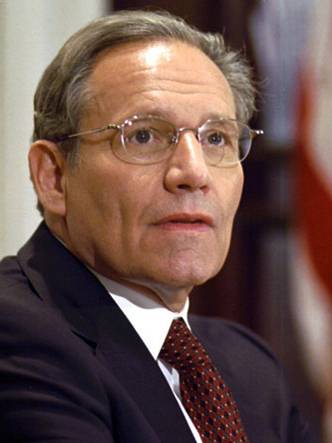
Bob Woodward of the Washington Post. (Photo credit: Jim Wallace, Smithsonian Institution)

But overt war-mongering quickly became a non-issue for most of what passes for the American journalistic intelligentsia, as twitter-heads of all persuasions were promptly distracted by the shiny objects of alleged and imaginary “threats” from the White House (gasp!). Finding the “threat” hidden in an apology failed to stop much of the mainstream media from seeing a danger to a free press.

The actual news behind this empty-headed media kabuki about fake “intimidation” of the press was actually reported (and largely ignored) on Feb. 6, when NBC  ran with this false headline: “Navy to pull aircraft carrier from Persian Gulf over budget worries.”

The text quickly revealed that the Navy wasn’t pulling an aircraft carrier from the Persian Gulf; it was simply NOT sending a second aircraft carrier to the Persian Gulf, under a two-carrier policy ordered by Defense Secretary Robert Gates in 2010. The change in policy raises interesting questions about the U.S. role in the region, but the NBC story ignores that aspect while going on at length about what appears to be a Navy cover story: budget cuts make the deployment too expensive.

Woodward Worries

Not content with Pentagon assurances that the U.S, would “maintain a robust presence” in the Persian Gulf region, the Post’s Woodward had a delayed but volcanic reaction to the U.S. reducing its ability to obliterate the region to a mere three or four times over. He called the decision not to deploy the second carrier “madness.”

On the MSNBC show ”Morning Joe,”  on Feb. 27, Woodward accused President Obama of exhibiting “a kind of madness I haven’t seen in a long time” for having only one aircraft carrier in the Persian Gulf. Since the two-carrier policy dates from 2010, Woodward implies he hasn’t seen that kind of madness for almost three years, although he doesn’t say that.

In the context of discussing the sequester, what he says very calmly is: “President Obama came out and acknowledged that we are not sending the aircraft carrier Truman to the Persian Gulf because of this budget agreement….

“Can you imagine Ronald Reagan sitting there and saying, ‘Oh, by the way, I can’t do this because of some budget document? Or George W. Bush saying, ‘You know, I’m not going to invade Iraq because I can’t get the aircraft carriers I need?’  Or even Bill Clinton saying, ‘You know, I’m not going to attack Saddam Hussein’s intelligence headquarters,’ … because of some budget document?

“Under the Constitution, the President is commander-in-chief and employs the force. And so we now have the President going out because of this piece of paper and this agreement. ‘I can’t do what I need to do to protect the country.’  That’s a kind of madness that I haven’t seen in a long time.”

Now THAT’s a kind of madness. Unfortunately it’s a familiar kind of madness seen all too often in the U.S. government and the U.S. news media. “Protect the country” from what? Fulminating about Iraq? Saddam Hussein? Secret war in Nicaragua, perhaps? Is there a pattern here?

No wonder Joe Scarborough immediately changed the subject. But if Woodward’s outburst isn’t war-mongering against Iran, what is it? Early senility is a possibility, I suppose, or early morning wobbliness. Not likely, not from Woodward, not from a master of hidden agendas hiding other agendas.

If it matters, why wasn’t Woodward on the case when the Navy announced the non-deployment decision three weeks earlier? Why did he wait till President Obama referred to it in a speech in Norfolk, Virginia, on Feb. 26, when he said, “The threat of these cuts has forced the Navy to cancel the deployment [of the aircraft carrier].”

Is anybody telling the truth here? Doesn’t look like it. Is anyone taking the aircraft carrier decision back to its essentials? Apparently not.

The first question is: why does the United States need any aircraft carriers in the Persian Gulf? To spare more distraction, let’s concede that a credible argument can be made for the projection of American power everywhere we want to stick it.

The next question, then, is: why does the United States need TWO aircraft carriers in the Persian Gulf, where the last time any Persian Gulf country was attacked was when the U.S. attacked Iraq. There was serious violence in Bahrain more recently, but that was the government attacking its own people and Bahrain is a U.S. ally, home to a U.S. Navy base, so Washington was unconcerned.

So what is this two-aircraft-carriers-in-the-Persian-Gulf business all about? The last time the U.S. deployed a second aircraft carrier to the Persian Gulf was in April 2012, when CBS News very helpfully reported:

“(CBS/AP) DUBAI, United Arab Emirates – The U.S. Navy said Monday it has deployed a second aircraft carrier to the Persian Gulf region amid rising tensions with Iran over its nuclear program. The deployment of the nuclear-powered USS Enterprise along [with] the Abraham Lincoln carrier strike group marks only the fourth time in the past decade that the Navy has had two aircraft carriers operating at the same time in the Persian Gulf and the Arabian Sea, said Cmdr. Amy Derrick-Frost of the Bahrain-based 5th Fleet.

“The two carriers will support the American military operations in Afghanistan and anti-piracy efforts off Somalia’s coast and in the Gulf of Aden, said Derrick-Frost. The warships also patrol the Gulf’s strategic oil routes that Iran has threatened to shut down in retaliation for economic sanctions.”

The 2012 deployment came just before scheduled talks with Iran about nuclear issues. The current non-deployment came just before scheduled seven-nation talks with Iran about nuclear issues. By not sending the second carrier, is the Obama administration signaling a more peaceful message to Iran?

No wonder Woodward is losing it.

William Boardman lives in Vermont, where he has produced political satire for public radio and served as a lay judge. [A version of this article was originally published at Reader Supported News.]
Iran to Test Fire 3 New Missiles | Defense | RIA Novosti

March 10, 2013


Iran to Test Fire 3 New Missiles

Russian S-300 air defense missile system (archive)

Russian S-300 air defense missile system (archive)

© RIA Novosti. Yury Shipilov

19:44 09/03/2013


Iran’s nuclear program: civilian purposes or nuclear weapons?

MOSCOW, March 9 (RIA Novosti) – Iran’s army will test-fire three new types of missiles during an upcoming military drill, a top military commander said on Saturday.

The missiles, which have undergone lab tests, will be test-fired by the end of the current Persian calendar year (ending on March 20, 2013), Ground Forces deputy chief Gen. Kiomars Heidari was quoted by Press TV as saying.

During the exercise, which will take place in central Iran, missile units “will be used in massive combat and operational tactics,” he said.

Heidari did not provide any specifications for the new missiles.

On February 10, Iran successfully tested the Fakour air-to-air missile and on December 31, 2012 the Ra’d (Thunder)surface-to-air missile, the agency said.

In July, Iran’s Defense Minister Ahmad Vahidi announced progress in the development and manufacture of an indigenous version of the advanced Russian S-300 air defense missile system.

Iranian military officials said the missile system, called Bavar (Belief) 373, is even more powerful and more advanced than the Russian S-300.

The $800-million contract to supply Iran with the missile system was signed in late 2007. Russia was to deliver five S-300PMU-1 battalions to Tehran. However, on September 22, 2010, Russian President Dmitry Medvedev signed a decree terminating the contract in line with UN Security Council Resolution 1929, which bans supply to Iran of conventional weapons including missiles and missile systems, tanks, attack helicopters, warplanes and ships.

via Iran to Test Fire 3 New Missiles | Defense | RIA Novosti.

Report: Sinai terror group launches rocket during training – Israel News, Ynetnews

March 10, 2013

Breaking NewsGet Breaking News AlertsRed email Report: Sinai terror group launches rocket during trainingPublished: 03.10.13, 12:21 / Israel News The Palestinian news agency Maan reported that according to an Egyptian military source a Sinai Peninsula based terror group launched a rocket with a range of 45 km during training.The source added that the rocket was launched from central Sinai and fell in a desert area near the Suez district. Roi Kais

via Report: Sinai terror group launches rocket during training – Israel News, Ynetnews.

IDF on High Alert on Israel’s Syrian Border

March 10, 2013

IDF on High Alert on Israel’s Syrian Border – Defense/Security – News – Israel National News.

IDF forces are on high alert in the Golan Heights as opposition forces begin to aim at a new target: Israel.

By Chana Ya’ar

First Publish: 3/10/2013, 9:50 AM


Peres on Israel's northern border

Peres on Israel’s northern border
Israel news photo: Flash 90

IDF forces are on high alert in the Golan Heights, carefully scrutinizing the border with Syria, as opposition forces begin to consider a new target: Israel.

Syrian rebels have penetrated the demilitarized zone (DMZ) separating Syria from Israel. The status of the area respected by both Israel and Syria since the end of the Yom Kippur War, though both are technically still at war, is apparently respected no longer.

In a video posted Saturday on the Internet by Syrian opposition forces, the rebels are seen in the Syrian side of the Golan Heights DMZ, firing guns right next to a U.N. sign specifically stating the area is a demilitarized zone. Another, similar video shows the rebel forces traveling in a vehicle within the DMZ, with a spokesperson saying, “We are now in front of the occupied Golan, the blessed land sold by [former President] Hafez Assad. “For 40 years, not a single gunshot has been fired on this land. For 40 years not a single gunshot has been fired towards Israel,” the rebel spokesman added. 

Last week’s kidnapping of 21 United Nations Filipino peacekeeping soldiers within the DMZ by a group of 30 rebels made it clear that era is over.  Member nations are more skittish about allowing their troops, who carry light arms only, to remain in what is now clearly a danger zone.

Meanwhile Israeli troops are providing security for military engineers and private contractors who are rushing to complete Israel’s new northern border security fence. New alarm systems armed with a special fiber that activates at the slightest touch are being added to the fence.

Additional troops have been sent to back up the Golani Brigade, select special forces, the Oketz combat canine unit, and artillery forces already on the Heights who are constantly patrolling the area.

The barrier fence is being installed as an extra layer of security in the chaos that is expected to follow the probable fall of Syrian President Bashar al-Assad.

Syrian rebel forces – many of whom are hostile to Israel – are advancing towards the Golan Heights, military sources have said, and are threatening to retake the region from Israel.

The rebel forces are comprised of two factions.

One is the Free Syrian Army (FSA), represents the Western-backed mainstream Syrian National Council (SNC), which is supported by the United States, the UK and France.

The second, a radical jihadist group, is the 13-member Islamic Front for the Liberation of Syria. Many of its members are terrorist organizations, a number of which are linked to Al Qaeda and global jihad. They are dedicated to installing a government led by Shari’a (Islamic law), in much the same style as Iran and Saudi Arabia.

Neither is a friend of the Jewish State. It remains unclear as to whether either could have gained access to Assad’s chemical weapons arsenal, or has already done so.

EU parliamentarians seek public condemnation of Erdogan

March 10, 2013

EU parliamentarians seek public condemnation of Erdogan – Israel News, Ynetnews.

( This article shows no awareness of the longstanding opposition of Europe to admitting Turkey to NATO. There is NO support for Israel.  There is only anti-Turkey. – JW )

In surprising show of support for Israel, 20 EU MPs seek public condemnation of Turkish PM

Itamar Eichner

Published: 03.10.13, 12:52 / Israel News


Some 20 European Union Parliament Members sent a letter to the EU Foreign Policy Chief in which they strongly condemned remarks made by Turkish Prime Minister Recep Tayyip Erdogan last month. The Turkish PM drew international condemnation when he said that Zionism is a crime against humanity during a UN conference.

This is the first time that such a large number of European parliamentarians come out so strongly against anti-Israel statements.

Related stories:

Among the signatories of the letter are EUP members from Poland, Britain, Holland, Romania, Finland, Hungary, Denmark, Germany, Belgium and Spain.

In the letter the representatives said: “We condemn this statement in no uncertain terms and call on you to do the same at the next Foreign Affairs Council meeting on 11 March. Anything short of a firm rebuke is insufficient.

“As a fellow democracy, we in the European Union must support Israel against those who challenge the country’s very existence. That was clearly Mr. Erdogan’s intentions when he coupled Zionism with Anti-Semitism, Islamophobia and Fascism – three manifestations of hate we in the European Union fight against.

“The banality of Mr. Erdogan’s comparison needs little explanation: Zionism is the fulfillment of the national rights and aspirations of the Jewish people and must not be denied.”

They added that while comments like those made by Erdogan had been made before, the fact that Erdogan – the prime minister of a country seeking EU membership – made them even more troubling.

The signatories said that Erdogan must answer for his hateful statements and that they were sure the EU would ensure he does so at the next council meeting.

Congress blocked Kerry from offering more aid to Egypt

March 10, 2013

Congress blocked Kerry from offering more aid to Egypt – The Hill’s Global Affairs.

Secretary of State John Kerry had hoped to offer considerably more aid to Egypt than the $250 million he announced during his trip to Cairo but was blocked by Congress, House Foreign Affairs Committee Chairman Ed Royce (R-Calif.) said.


“This is not the aid package that the administration wanted to announce,” Royce told The Hill. The administration wanted to release a “larger sum,” but bowed to the wishes of Royce’s committee as well as congressional appropriators, he said.

Royce wouldn’t say how much Kerry had hoped to announce, but the State Department has been pressing Congress to greenlight $450 million in direct aid since last fall.

“Our approach is not the full-throttle administration approach of delivering all the aid that they wanted to deliver, but rather a measured approach of tying tranches to results as it pertains to the peace treaty with Israel, to cooperation with respect to smuggling [into Gaza] and with respect to economic reforms to guarantee civil rights and the rule of law within Egypt,” he said. “That’s the pressure that we’re applying.”

Kerry announced the new aid package last Sunday during a stop in Cairo as part of his first trip overseas. The money includes $190 million in budgetary support that’s part of the $1 billion in debt relief President Obama pledged in 2011, along with $60 million for an enterprise fund.

The aid, Kerry said, was a “good-faith effort to spur reform and help the Egyptian people at this difficult time.”

The $190 million comes from the $450 million cash transfer the administration proposed last year to give to Egypt to shore up an economy hammered by the Arab Spring. That money would be culled from funds left over from past Egypt appropriations going back to 2006 (the country gets $1.3 billion in military aid and another $250 million in economic aid every year under the terms of the 1978 Camp David accords leading to peace with Israel).

The forme chairwoman of the House Foreign Affairs Committee, Rep. Ileana Ros-Lehtinen (R-Fla.), and the chairwoman of the appropriations subpanel on foreign aid, Rep. Kay Granger (R-Texas), placed a hold on the money out of concern over the Muslim Brotherhood government’s democratic credentials and pro-U.S. stance. A Granger staffer said the chairwoman has been in continuous contact with the State Department over the funds and acquiesced to lifting her hold on the $190 million slice that Kerry announced.

Ros-Lehtinen lost her ability to hold the money when Royce succeeded her as chairman in January. She bristled when asked about Kerry’s trip this past week.

“I’m glad he’s wrapping up this trip,” she told The Hill, “because every stop he makes he makes more of a promise of financial aid to our so-called allies. And if he doesn’t wrap up this tour soon, we’ll be further bankrupt.”

At the time he offered the aid, Kerry hinted that more money could be coming if Egyptian President Mohamed Morsi’s government can win Congress over.

“The United States can and wants to do more,” he said. “When Egypt takes the difficult steps to strengthen its economy and build political unity and justice, we will work with our Congress at home on additional support.”

–Check back with The Hill on Sunday for more from our exclusive conversation with House Foreign Affairs Committee Chairman Ed Royce (R-Calif.).


