Archive for March 5, 2013

Syrian opposition captures ballistic missile facility

March 5, 2013

Syrian opposition captures ballistic missile facility

By Doug Richardson

3/5/2013

The Syrian opposition has captured what appears to be a ballistic-missile facility equipped with fixed-site launchers for ‘Scud’-type ballistic missiles. Located at Al Kibar, often referred to as Deir Az-Zor, it takes the form of a hanger-like building erected on the site thought to have been formerly used by a Syrian nuclear facility. In September 2007 the latter was destroyed by an Israeli air strike, and the shattered building was subsequently razed to its foundations by the Syrians.

In February 2009, the New York Times reported that Ibrahim Othman, the head of the Syrian Atomic Energy Commission, had told a closed technical meeting of the International Atomic Energy Agency (IAEA) in Vienna that a missile facility had been constructed on the site.

The recent capture of the Al Kibar site has been credited to the Ja’far al-Tayyar brigade and the al-Nusra front. Ja’far at-Tayyar is an alternative name for Ja’far ibn Abi Talib, son of Abu Talib ibn ‘Abdul Muttalib, the uncle of the Islamic prophet Muhammad.

Poor-quality video, probably taken using cellphones, shows that the building now present on the Al Kibar site houses a number of fixed launchers for missiles.

via Syrian opposition captures ballistic missile facility.

Kerry Sees ‘Finite’ Time for Iran Nuclear Talks

March 5, 2013

Kerry Sees ‘Finite’ Time for Iran Nuclear Talks.

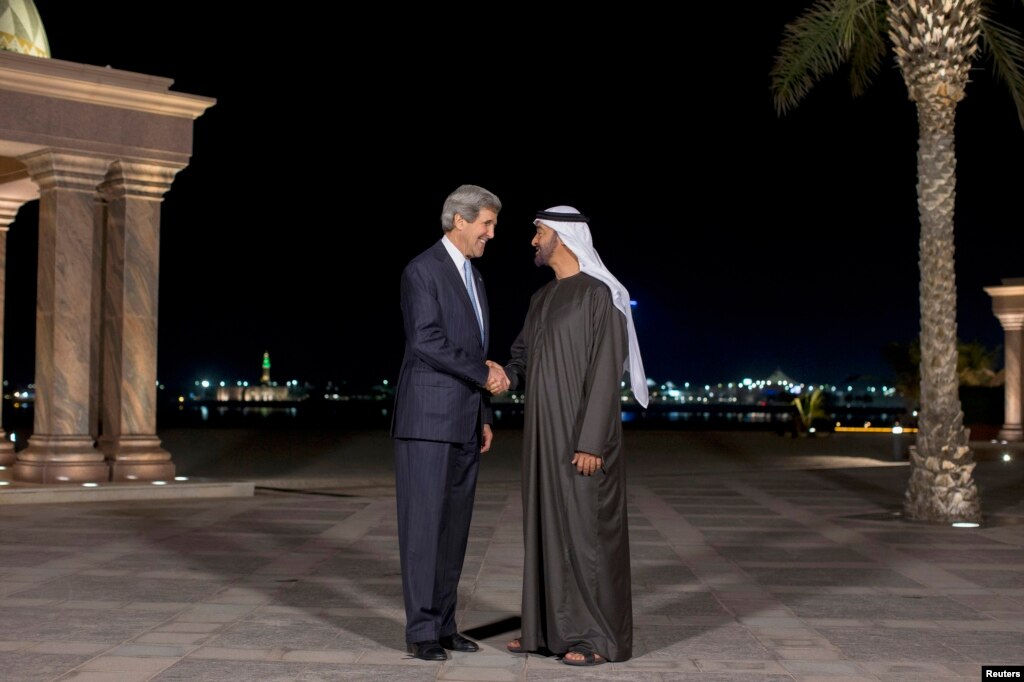
Kerry Sees ‘Finite’ Time for Iran Nuclear Talks

U.S. Secretary of State John Kerry (L) speaks to Abu Dhabi's Crown Prince Sheikh Mohammed bin Zayed al-Nahyan before their meeting at the Emirates Palace in Abu Dhabi, March 4, 2013.

U.S. Secretary of State John Kerry (L) speaks to Abu Dhabi’s Crown Prince Sheikh Mohammed bin Zayed al-Nahyan before their meeting at the Emirates Palace in Abu Dhabi, March 4, 2013.

TEXT SIZE
Reuters

Clock Runs as Obama Faces Pressure for Strike on Iran – Bloomberg

March 5, 2013

Clock Runs as Obama Faces Pressure for Strike on Iran – Bloomberg.


Clock Runs as Obama Faces Pressure for Strike on Iran

U.S. Vice President Joe Biden said there remains “time and space” for diplomacy aimed at averting military action to prevent Iran from becoming a nuclear weapons power.

Still, the pressure on President Barack Obama’s administration to move toward military action is growing as Iran advances its uranium enrichment capabilities, and U.S. lawmakers, Israel and Persian Gulf allies press for results.

U.S. Vice President Joe Biden, who addressed some 13,000 people at the Aipac conference shortly before Netanyahu spoke, said that Obama “is not bluffing” when he says he will prevent Iran from getting a nuclear weapon. Photographer: Chip Somodevilla/Getty Images

Today, U.S. Secretary of State John Kerry said negotiating time is “finite.”

“The clock is ticking and the president has made that clear,” Kerry said in an interview in Doha with Andrea Mitchell of NBC News. “The president’s policy is that Iran will not get a nuclear weapon.”

Iran is using negotiations to “buy time” to pursue a nuclear weapons program, Israeli Prime Minister Benjamin Netanyahu said yesterday in a video address to the American Israel Public Affairs Committee’s annual conference in Washington. Although Iran’s uranium enrichment activities have yet to cross Israel’s “red line,” the Islamic Republic is “getting closer” to the point where it would be capable of quickly producing a nuclear weapon, he said.

U.S. Senator John McCain, an Arizona Republican, told the group, a major pro-Israel lobby, that diplomatic efforts with Iran “have failed, and it is very clear that they are on the path of having a nuclear weapon.”

Saudi Doubts

Separately, Saudi Foreign Minister Saud al-Faisal, following a meeting in Riyadh with Kerry, said yesterday that negotiations with Iran should have a time limit because the Iranians “have not proved to anybody that they are sincere” in their talks.

Biden, who addressed about 13,000 people at the Aipac conference shortly before Netanyahu spoke, said that Obama “is not bluffing” when he says he will prevent Iran from getting a nuclear weapon. “We are looking to and ready to negotiate peacefully, but all options, including military force, are on the table,” Biden said.

For now, it’s important to show that the U.S. and its partners have made a real attempt to settle the issue peacefully, he said.

“If, God forbid, the need to act occurs, it is critically important for the whole world to know we did everything in our power, we did everything that reasonably could have been expected, to avoid any confrontation,” Biden said. “And that matters because, God forbid, if we have to act, it’s important that the rest of the world is with us.”

Contingency Planning

The Pentagon is pursuing “serious contingency planning” – – along with the administration’s strategy of “tough-minded” and “crippling” sanctions — “with the objective of preventing Iran from acquiring a nuclear weapon,” Defense Secretary Chuck Hagel said in written answers to the Senate Armed Services Committee obtained yesterday by Bloomberg News.

Iran was the No. 6 producer in the Organization of Petroleum Exporting Countries in February, and any rise in tensions would hit oil markets. After declining in the past month, West Texas Intermediate crude for April delivery advanced 33 cents, or 0.4 percent, to $90.45 a barrel at 9:01 a.m. on the New York Mercantile Exchange.

The U.S. and its negotiating partners — France, the U.K., Russia, China and Germany — presented a new offer to Iran last week at talks in Kazakhstan. If Iran agrees to cease its output of 20 percent enriched uranium, the group would ease restrictions on Iran’s exports of petrochemical products and some additional items, Russia’s chief negotiator and Deputy Foreign Minister Sergei Ryabkov said in an interview.

Next Round

Negotiations are slated to continue on a technical level in Istanbul and then resume in Almaty on April 5, when world powers will be looking for a clear response from Iran. “The ball remains in the Iranian court,” European Union foreign affairs spokesman Michael Mann told reporters in Brussels yesterday.

In the meantime, Iran announced that it’s moving ahead with plans to install 3,000 new-generation centrifuges at its Natanz uranium-enrichment facility. Iran says its atomic program is for civilian energy and medical uses, and the UN’s International Atomic Energy Agency says it hasn’t detected any diversion of enriched uranium for possible military use.

The head of the IAEA, Yukiya Amano, publicly urged Iran yesterday to allow inspectors to visit the Parchin military site in response to intelligence that Iran had secretly operated a blast chamber there for testing nuclear-weapons components. Iran has cleaned up the site about 20 kilometers (12 miles) southeast of Tehran while preventing IAEA inspectors from visiting, saying it’s not covered by inspection requirements.

‘Red Line’

“Diplomacy has not worked,” Netanyahu said, speaking via satellite from Israel. Iran is “running out the clock. It has used negotiations, including the most recent ones, in order to buy time to press ahead with its nuclear program.”

Netanyahu said Iran hasn’t yet crossed the “red line” that he laid out in a speech at the United Nations last September, meaning the Islamic Republic hasn’t stockpiled enough medium-enriched uranium to fuel a nuclear weapon if further enriched.

“We have to stop its nuclear enrichment program before it’s too late,” the Israeli leader added.

Netanyahu’s remarks indicated that his timeline for possible military action is shorter than Obama’s. The prime minister “made clear that the gaps between his position on Iran and President Obama’s remain considerable,” Shimon Stein, a research fellow at Tel Aviv University’s Institute for National Security Studies, said in a telephone interview.

Senate Resolution

Last week, 15 U.S. senators co-sponsored a non-binding resolution by Republican Senator Lindsey Graham of South Carolina that cites concern about Iran’s nuclear activities and expresses support if “Israel is compelled to take military action in self-defense.” Today, some of the Aipac conference attendees will lobby their representatives on Capitol Hill.

In public remarks yesterday in Riyadh with Kerry, the Saudi foreign minister criticized Iran for continuing negotiations “to ask for more negotiation in the future.”

“They reach common understanding only on issues that require further negotiation,” said Prince Saud, whose Arab, Sunni Islamic country is the U.S.’s most important Gulf ally and a nation historically hostile to Persian Shiite Iran.

Kerry repeated the U.S. priority on negotiations to stop Iran from acquiring a nuclear weapon, while cautioning that “talks will not go on for the sake of talks.”

To contact the reporters on this story: Indira A.R. Lakshmanan in Washington at ilakshmanan@bloomberg.net; Terry Atlas in Washington at tatlas@bloomberg.net
Clock Runs as Obama Faces Pressure for Strike on Iran

U.S. Vice President Joe Biden said there remains “time and space” for diplomacy aimed at averting military action to prevent Iran from becoming a nuclear weapons power.

Still, the pressure on President Barack Obama’s administration to move toward military action is growing as Iran advances its uranium enrichment capabilities, and U.S. lawmakers, Israel and Persian Gulf allies press for results.

U.S. Vice President Joe Biden, who addressed some 13,000 people at the Aipac conference shortly before Netanyahu spoke, said that Obama “is not bluffing” when he says he will prevent Iran from getting a nuclear weapon. Photographer: Chip Somodevilla/Getty Images

Today, U.S. Secretary of State John Kerry said negotiating time is “finite.”

“The clock is ticking and the president has made that clear,” Kerry said in an interview in Doha with Andrea Mitchell of NBC News. “The president’s policy is that Iran will not get a nuclear weapon.”

Iran is using negotiations to “buy time” to pursue a nuclear weapons program, Israeli Prime Minister Benjamin Netanyahu said yesterday in a video address to the American Israel Public Affairs Committee’s annual conference in Washington. Although Iran’s uranium enrichment activities have yet to cross Israel’s “red line,” the Islamic Republic is “getting closer” to the point where it would be capable of quickly producing a nuclear weapon, he said.

U.S. Senator John McCain, an Arizona Republican, told the group, a major pro-Israel lobby, that diplomatic efforts with Iran “have failed, and it is very clear that they are on the path of having a nuclear weapon.”

Saudi Doubts

Separately, Saudi Foreign Minister Saud al-Faisal, following a meeting in Riyadh with Kerry, said yesterday that negotiations with Iran should have a time limit because the Iranians “have not proved to anybody that they are sincere” in their talks.

Biden, who addressed about 13,000 people at the Aipac conference shortly before Netanyahu spoke, said that Obama “is not bluffing” when he says he will prevent Iran from getting a nuclear weapon. “We are looking to and ready to negotiate peacefully, but all options, including military force, are on the table,” Biden said.

For now, it’s important to show that the U.S. and its partners have made a real attempt to settle the issue peacefully, he said.

“If, God forbid, the need to act occurs, it is critically important for the whole world to know we did everything in our power, we did everything that reasonably could have been expected, to avoid any confrontation,” Biden said. “And that matters because, God forbid, if we have to act, it’s important that the rest of the world is with us.”

Contingency Planning

The Pentagon is pursuing “serious contingency planning” – – along with the administration’s strategy of “tough-minded” and “crippling” sanctions — “with the objective of preventing Iran from acquiring a nuclear weapon,” Defense Secretary Chuck Hagel said in written answers to the Senate Armed Services Committee obtained yesterday by Bloomberg News.

Iran was the No. 6 producer in the Organization of Petroleum Exporting Countries in February, and any rise in tensions would hit oil markets. After declining in the past month, West Texas Intermediate crude for April delivery advanced 33 cents, or 0.4 percent, to $90.45 a barrel at 9:01 a.m. on the New York Mercantile Exchange.

The U.S. and its negotiating partners — France, the U.K., Russia, China and Germany — presented a new offer to Iran last week at talks in Kazakhstan. If Iran agrees to cease its output of 20 percent enriched uranium, the group would ease restrictions on Iran’s exports of petrochemical products and some additional items, Russia’s chief negotiator and Deputy Foreign Minister Sergei Ryabkov said in an interview.

Next Round

Negotiations are slated to continue on a technical level in Istanbul and then resume in Almaty on April 5, when world powers will be looking for a clear response from Iran. “The ball remains in the Iranian court,” European Union foreign affairs spokesman Michael Mann told reporters in Brussels yesterday.

In the meantime, Iran announced that it’s moving ahead with plans to install 3,000 new-generation centrifuges at its Natanz uranium-enrichment facility. Iran says its atomic program is for civilian energy and medical uses, and the UN’s International Atomic Energy Agency says it hasn’t detected any diversion of enriched uranium for possible military use.

The head of the IAEA, Yukiya Amano, publicly urged Iran yesterday to allow inspectors to visit the Parchin military site in response to intelligence that Iran had secretly operated a blast chamber there for testing nuclear-weapons components. Iran has cleaned up the site about 20 kilometers (12 miles) southeast of Tehran while preventing IAEA inspectors from visiting, saying it’s not covered by inspection requirements.

‘Red Line’

“Diplomacy has not worked,” Netanyahu said, speaking via satellite from Israel. Iran is “running out the clock. It has used negotiations, including the most recent ones, in order to buy time to press ahead with its nuclear program.”

Netanyahu said Iran hasn’t yet crossed the “red line” that he laid out in a speech at the United Nations last September, meaning the Islamic Republic hasn’t stockpiled enough medium-enriched uranium to fuel a nuclear weapon if further enriched.

“We have to stop its nuclear enrichment program before it’s too late,” the Israeli leader added.

Netanyahu’s remarks indicated that his timeline for possible military action is shorter than Obama’s. The prime minister “made clear that the gaps between his position on Iran and President Obama’s remain considerable,” Shimon Stein, a research fellow at Tel Aviv University’s Institute for National Security Studies, said in a telephone interview.

Senate Resolution

Last week, 15 U.S. senators co-sponsored a non-binding resolution by Republican Senator Lindsey Graham of South Carolina that cites concern about Iran’s nuclear activities and expresses support if “Israel is compelled to take military action in self-defense.” Today, some of the Aipac conference attendees will lobby their representatives on Capitol Hill.

In public remarks yesterday in Riyadh with Kerry, the Saudi foreign minister criticized Iran for continuing negotiations “to ask for more negotiation in the future.”

“They reach common understanding only on issues that require further negotiation,” said Prince Saud, whose Arab, Sunni Islamic country is the U.S.’s most important Gulf ally and a nation historically hostile to Persian Shiite Iran.

Kerry repeated the U.S. priority on negotiations to stop Iran from acquiring a nuclear weapon, while cautioning that “talks will not go on for the sake of talks.”

To contact the reporters on this story: Indira A.R. Lakshmanan in Washington at ilakshmanan@bloomberg.net; Terry Atlas in Washington at tatlas@bloomberg.net

Israel envoy urges UN action to stop fire from Syria | The Times of Israel

March 5, 2013

Tuesday, March 5, 2013

Adar 23, 5773

10:21 pm IST

Site updated 1 minute ago

About Us

Send us content

Get our newsletter

The Jewish world’s

fastest-growing

news site

Home Israel & the Region Jewish Times Israel Inside Ops & Blogs The Jewish Planet Start-Up Israel Daily Edition Spotlight

Home >

Israel & the Region

Israel envoy urges UN action to stop fire from Syria

‘Up until now, Israel has displayed restraint. You must act before things deteriorate,’ warns Ron Prosor

By Ron Friedman March 5, 2013, 1:50 am 3

Email

Print

Share

Israel’s Ambassador to the UN Ron Prosor (photo credit: Courtesy)

Israel’s Ambassador to the UN Ron Prosor (photo credit: Courtesy)

Related Topics

Ron Prosor

UN Security Council

Israeli-Syrian border

Israel will not stand by while its citizens’ lives are in danger, Israel’s Ambassador to the UN Ron Prosor warned in an urgent letter to the UN Security Council Monday, following a weekend that saw three mortars fired from Syria land in the southern Golan Heights.

“Up until now, Israel has displayed restraint. You must act before things deteriorate,” wrote Prosor, adding that the cross-border fire constituted a violation of the ceasefire agreement between Israel and Syria and had potential to stir up the already restive region.

The Saturday incident that saw mortars land near moshav Ramat Magshimim was the deepest and southernmost penetration of Syrian fire into Israeli territory in years. IDF officials believed it to be a case of errant fire. The mortar fire caused no injuries or damage.

Israel promptly filed a complaint with the UN observer force stationed on the Israeli-Syrian border.

On Wednesday, a tank shell from Syria landed in the central Golan community of Alonei Habashan.

No damage was reported in that incident, either. The shell, believed to have been an errant shot from a battle between Syrian government forces and rebels, landed in an open area and did not explode. Sappers later disarmed it.

On January 30, foreign media reported Israeli warplanes attacked a target inside Syria close to the Lebanese-Syrian border. Most sources indicated the target was a weapons convoy that was set to bring anti-aircraft defense systems and other weaponry to Hezbollah.

Syria maintained that Israel had bombed a “scientific research center,” and released footage purporting to show the damaged facility.

via Israel envoy urges UN action to stop fire from Syria | The Times of Israel.

.:Middle East Online::Kerry: no question of army Syria rebels:.

March 5, 2013

Kerry: no question of army Syria rebels

US Secretary of State promises to empower Syrian opposition, warns Iran time of nuclear talks could run out.

Middle East Online

By Nicolas Revise – ABU DHABI

‘There is no guarantee that one weapon or another might not fall in (to) the wrong hands’

US Secretary of State John Kerry has promised to “empower” Syria’s opposition, while warning arch-foe Iran that time for talks on Tehran’s nuclear ambitions could run out.

Kerry, on his first tour to the Gulf region since taking up the post, held talks with Gulf Cooperation Council (GCC) officials on Monday and also met in Riyadh with Palestinian president Mahmud Abbas, who flew in unannounced.

Kerry stressed there was no question of arming the Syrian opposition, even as his Saudi counterpart Prince Saud al-Faisal insisted on the right of Syrians to self-defence.

The United States will continue to work with its “friends to empower the Syrian opposition,” Kerry told reporters during a joint press conference with Prince Saud.

Asked about reports of arms being sent to Syria’s rebels from countries such as Qatar and Saudi Arabia, Kerry replied: “The moderate opposition has the ability to make sure that the weapons are getting to them and not to the wrong hands.”

However, he added, “there is no guarantee that one weapon or another might not fall in (to) the wrong hands.”

Kerry will spend day three of his maiden Gulf tour in Qatar on Tuesday, with the Syrian conflict and Iran’s disputed nuclear programme still topping the agenda.

The United States has so far refused to arm Syrian rebels locked in a two-year war against President Bashar al-Assad’s loyalists.

Several oil-rich monarchies of the six-member GCC, notably Saudi Arabia and Qatar, have supported the rebellion against Assad, a staunch ally of their regional arch-foe Iran.

The GCC members are dissatisfied at the refusal of US President Barack Obama’s administration to arm Syrian rebels and its perceived lenient attitude towards Tehran, analysts say.

The United States praised the holding of elections for a council to run rebel-held areas of Syria’s Aleppo province, as well as the new opposition leader’s first visit to the country.

Ahmed Moaz al-Khatib’s decision to visit the largely rebel-held northern province was a “really courageous choice,” State Department deputy acting spokesman Patrick Ventrell said in Washington.

Khatib, head of the Syrian National Coalition, slipped into the country on Sunday as elections were being held for the Aleppo provincial council.

The vote was being held in the Turkish town of Gaziantep for security reasons, but the future body will be based inside Syria.

Syrian rebels overran the northern city of Raqa on Monday, scoring their biggest victory since the rebellion against Assad erupted.

Kerry said his discussions with Gulf officials on Monday had also covered ongoing talks between world powers and Iran on its disputed nuclear programme.

Talks with Iran “will not go on for the sake of talks,” he said. “Talks cannot become an instrument for delay that in the end makes the situation more dangerous. So there is a finite amount of time.”

“Obama has made it clear that Iran will not get nuclear weapons,” said the top US diplomat. “There is a huge danger of proliferation.”

World powers negotiating with Iran to rein in its nuclear programme concluded another round of talks in Kazakhstan last week, after putting forward a proposal to ease biting sanctions if Tehran halts the sensitive work of enriching uranium

The world powers accuse Tehran of masking a weapons programme under the guise of a civilian atomic drive, charges Iran denies.

Israeli Prime Minister Benjamin Netanyahu warned on Monday that Iran was getting closer to crossing a crucial “red line.”

“Iran enriches more and more uranium, it installs faster and faster centrifuges,” and it is “running out the clock” on diplomatic efforts to prevent it from obtaining a nuclear capability, Netanyahu said.

During a flurry of meetings in Riyadh on Monday, Kerry also held talks with Saudi Crown Prince Salman bin Abdul Aziz but not King Abdullah.

He also met Abbas at a luncheon meeting which had not been scheduled.

“Well, Mr. President I have been waiting for this meeting and I think you have too,” Kerry told Abbas. “That’s right, that’s right,” replied Abbas.

Prior to their meeting Palestinian envoy in Riyadh Jamal al-Shawbaki told the official Voice of Palestine radio that Abbas “will present the Palestinian point of view to the new US administration ahead of Obama’s visit”.

Obama is due to meet Israeli and Palestinian leaders in Jerusalem and the West Bank city of Ramallah during a visit on March 20-22.

After winding up the Saudi leg of his tour, Kerry headed to Abu Dhabi where he was to meet the Emirati crown prince, Sheikh Mohammed bin Zayed Al-Nahayan, and Foreign Minister Abdullah bin Zayed Al-Nahayan.

via .:Middle East Online::Kerry: no question of army Syria rebels:..

Top US commander: Iran sanctions not working | Boston Herald

March 5, 2013

Top US commander: Iran sanctions not working

March 5, 2013

WASHINGTON — The top U.S. commander in the Middle East says the current sanctions and diplomatic efforts to stop Iran from gaining nuclear capabilities are not working. He says Tehran has a history of denial and deceit and is enriching uranium beyond any plausible peaceful purpose.

Gen. James Mattis, head of U.S. Central Command, is telling the Senate Armed Services Committee that it may still be possible to use sanctions and other pressure to bring Tehran to its senses. He says Iran is using the negotiations to buy time.

He was asked if the U.S. can bring Iran to its knees. Mattis says the U.S. has a number of ways to do that, even short of open conflict

via Top US commander: Iran sanctions not working | Boston Herald.

Russia claims no ‘assurances’ with U.S. on the war in Syria

March 5, 2013

Russia claims no ‘assurances’ with U.S. on the war in Syria

Tuesday, 05 March 2013

Russia’s U.N. Ambassador Vitaly Churkin, president of the U.N. Security Council for March, said on Monday that ‘assurances’ from Moscow on a rapprochement with the United States on the conflict in Syria did not happen.(Reuters)

By Al Arabiya

[Pin It] inShare1

Russia’s U.N. Ambassador Vitaly Churkin, president of the U.N. Security Council for March, said on Monday that ‘assurances’ from Moscow on a rapprochement with the United States on the conflict in Syria did not happen.

He made clear that Russia still has major differences with the U.S. especially after it recently announced its support for providing non-lethal aid to the Syrian opposition forces.

Churkin also spoke about the security situation between Syria and Israel and said the Jewish state was being threatened by “a very new and dangerous phenomenon” of armed groups operating in a so-called area of separation in the Golan Heights between the countries.

Israel captured the Golan Heights from Syria in a 1967 war. Syrian troops are not allowed in the area of separation under a1973 ceasefire formalized in 1974. Israel and Syria are still technically at war. The area is patrolled by U.N. peacekeepers.

“It’s something which potentially can undermine security between Syria and Israel,” Churkin told reporters, adding that the U.N. peacekeeping force, known as UNDOF, was unable to cope with the situation.

“Unfortunately there is nothing in the UNDOF mandate that allows them or equips them to deal with that situation because they are unarmed observers,” Churkin said.

Israel will not ‘stand idle’

Israel warned the U.N. Security Council that it could not be expected to “stand idle” as Syria’s civil war spills over its border, while Russia accused armed groups of undermining security between the states by fighting in a demilitarized zone.

Israeli U.N. Ambassador Ron Prosor wrote to the 15-member council to complain about shells from Syria landing in Israel.

“Israel cannot be expected to stand idle as the lives of its citizens are being put at risk by the Syrian government’s reckless actions,” Proser wrote. “Israel has shown maximum restraint thus far.”

Israel does not have a reputation for being idle. Israeli Defense Minister Ehud Barak said that an attack on a Syrian arms complex on Jan. 30 showed Israel was serious about preventing the flow of heavy arms into Lebanon, appearing to acknowledge that the Jewish state carried out the strike.

The United Nations says more than 70,000 people have been killed during a two-year revolt against Syrian President Bashar al-Assad, which began as peaceful protests but turned violent when Assad’s forces cracked down on the demonstrations.

With nearly 1 million Syrian refugees flooding neighboring Turkey, Jordan, Iraq and Lebanon as the conflict worsens, the United Nations has warned that the fighting has developed sectarian overtones and could

via Russia claims no ‘assurances’ with U.S. on the war in Syria.

Israel warns it cannot “stand idle” as Syria war spills over border – AlertNet

March 5, 2013

Israel warns it cannot “stand idle” as Syria war spills over border

Mon, 4 Mar 2013 21:21 GMT

Source: reuters // Reuters

* Israel seen as behind Jan. 30 strike on Syria arms complex

* Russia: U.N. peacekeepers unable to cope with situation

By Michelle Nichols

UNITED NATIONS, March 4 (Reuters) – Israel warned the U.N. Security Council on Monday that it could not be expected to “stand idle” as Syria’s civil war spills over its border, while Russia accused armed groups of undermining security between the states by fighting in a demilitarized zone.

Israeli U.N. Ambassador Ron Prosor wrote to the 15-member council to complain about shells from Syria landing in Israel.

“Israel cannot be expected to stand idle as the lives of its citizens are being put at risk by the Syrian government’s reckless actions,” Proser wrote. “Israel has shown maximum restraint thus far.”

Israel does not have a reputation for being idle. Israeli Defense Minister Ehud Barak said that an attack on a Syrian arms complex on Jan. 30 showed Israel was serious about preventing the flow of heavy arms into Lebanon, appearing to acknowledge that the Jewish state carried out the strike.

The United Nations says more than 70,000 people have been killed during a two-year revolt against Syrian President Bashar al-Assad, which began as peaceful protests but turned violent when Assad’s forces cracked down on the demonstrations.

With nearly 1 million Syrian refugees flooding neighboring Turkey, Jordan, Iraq and Lebanon as the conflict worsens, the United Nations has warned that the fighting has developed sectarian overtones and could engulf the region.

Russia’s U.N. Ambassador Vitaly Churkin, president of the Security Council for March, said the security situation between Syria and Israel was also being threatened by “a very new and dangerous phenomenon” of armed groups operating in a so-called area of separation in the Golan Heights between the countries.

Israel captured the Golan Heights from Syria in a 1967 war. Syrian troops are not allowed in the area of separation under a 1973 ceasefire formalized in 1974. Israel and Syria are still technically at war. The area is patrolled by U.N. peacekeepers.

“It’s something which potentially can undermine security between Syria and Israel,” Churkin told reporters, adding that the U.N. peacekeeping force, known as UNDOF, was unable to cope with the situation.

“Unfortunately there is nothing in the UNDOF mandate that allows them or equips them to deal with that situation because they are unarmed observers,” Churkin said.

Croatia’s government said on Thursday that it planned to pull out of UNDOF as a precautionary step following media reports that Croatian arms were being sent to Syrian rebels fighting Assad. Croatia has 98 troops in the 1,000-strong force.

The U.N. peacekeeping department is attempting to find replacements for the Croatians but it will not be easy given the tension in the region, U.N. officials told Reuters on condition of anonymity.

The U.N. Security Council has been deadlocked on Syria since 2011 over Russian and Chinese refusal to consider sanctions against Assad’s government. They have vetoed three resolutions condemning Assad’s crackdown on the opposition groups. (Reporting by Michelle Nichols; Editing by Xavier Briand

via Israel warns it cannot “stand idle” as Syria war spills over border – AlertNet.

Saudi FM: Negotiations with Iran are a waste of time

March 5, 2013

Saudi FM: Negotiations with Iran are a waste of time | The Times of Israel.

Arab observers turn to the Muslim Brotherhood for answers on ongoing violence along the Suez Canal

March 5, 2013, 3:58 pm
Egyptian army soldiers and military police secure a funeral procession for civilians killed overnight during street battles with police forces, in Port Said, Egypt, Monday, March 4, 2013 (photo credit: AP/Ahmed Ramadan)

Egyptian army soldiers and military police secure a funeral procession for civilians killed overnight during street battles with police forces, in Port Said, Egypt, Monday, March 4, 2013 (photo credit: AP/Ahmed Ramadan)

American impatience with the seemingly endless negotiations on Iran’s nuclear program features high in Arab news Tuesday, which quotes statements by Secretary of State John Kerry in Saudi Arabia and Vice President Joe Biden at the AIPAC conference in Washington.

“Washington: All the options are on the table with Iran,” reads the headline of a report in Al-Jazeera‘s Arabic website, featuring a photo of Biden with a backdrop of US and Israeli flags at the AIPAC conference.

According to the Qatar-based station, Biden told participants at the pro-Israel lobby conference on Monday that the window of opportunity for negotiations with Iran will not remain open forever.

The issue of Iran’s nuclear program also came up in talks between Secretary of State John Kerry, visiting Saudi Arabia on a Middle East tour, and his Saudi counterpart Saud Al-Faisal.

According to London-based daily Al-Hayat, Faisal was no less impatient with Iran’s procrastination than Kerry. Using unusually blunt terms, Faisal waged a scathing attack on Iran’s negotiating tactics.

“The meaning of negotiation is to discuss matters seriously and rationally and place clear commitments for all,” said Faisal. “Negotiation is not to bring someone who will deceive us and play with us. This is the wrong way to negotiate.”

“These elements are missing with the Iranians. They have not proved their seriousness in negotiations to anyone, and have continued to negotiate for the sake of continuing to negotiate in the future.”

Faisal added that if negotiations continue in such a manner, and no clear timetable is put in place, Iran will produce a nuclear weapon.

Violence in Egypt; Brotherhood soul-searching

Mass demonstrations in the northern Egyptian city of Port Said lead the news in the London-based daily Al-Quds Al-Arabi.

The daily reports that civil disobedience continues in numerous Suez Canal cities, reaching Cairo as well and thus “expanding the map of violence and the unknown.”

Egyptian daily Al-Ahram‘s website reports that clashes between police and protesters continued on Tuesday near the security building, with protesters hurling stones and Molotov cocktails at police cars, which responded by firing teargas. The daily, siding with the government, dubs the protests “violent acts.”

“The schism of the Egyptian street between political Islam and civil forces may seem like a political divide, but it may be a class divide in essence,” writes Al-Ahram columnist Mostafa El-Feky. “Both camps are internally divided as well, with the ruling Islamic stream not able to provide a clear road map.”

Meanwhile, Egyptian columnist Fahmi Huwaidi argues in Al-Jazeera that a delicate balance must be struck in Egypt between religion and state, with neither complete separation nor the alternative of a “religious state.”

“The Islamic condition is facing a major challenge following the revolution, as a result of the crash landing from the skies of its slogans and teachings to the ground of reality, fraught with landmines. This has forced [Islamism] to reconsider many of its positions and statements,” writes Huwaidi.

Liberal columnist Mohammed Salmawi, writing for the independent Egyptian daily Al-Masry Al-Youm, comments on the misguided reasons that led the US to support the Muslim Brotherhood as successors to Mubarak.

“All the reasons that led the United States to support the Brotherhood in reaching power in Egypt following the revolution were proved wrong. The main reason was its naive belief that on the merit of being the largest political organization after the disappearance of the National Party, the Brotherhood would be able to achieve stability in a way that would guarantee American interests.”

“In fact, this theory, which the United States adopted in its support of the Muslim Brotherhood, collapsed the moment Mohammed Morsi took office, before the initial 100-day period had lapsed.”  

Al-Quds Al-Arabi, as is its custom, looks for the silver lining around the Egyptian cloud. It dedicates its lead editorial Tuesday to Israel’s concern regarding Egypt’s instability.

“The democratic change which toppled the regime of Hosni Mubarak in Egypt has disrupted Israel’s military and security calculations. The Egyptian front has remained peaceful for over 40 years thanks to the Camp David accords first and foremost, and the former Egyptian regime’s steadfastness in respecting them.”

“The first direct reflections of Israel’s concern regarding the Egyptian and Syrian fronts is the building of a security wall which is close to completion on the border with Sinai, and a plan to build another security wall on the Golan Heights.”

Russia and Israel each warn trouble building up on Golan border

March 5, 2013

Russia and Israel each warn trouble building up on Golan border.

DEBKAfile Special Report March 5, 2013, 5:05 AM (GMT+02:00)


Russian UN Ambasador Vitaly Churkin

At UN Center in New York, Israeli and Russian delegates separately warned Monday, March 4, of a dangerous situation developing in the area of separation on the Golan captured by Israel in the 1967 war. Syrian troops were forbidden to enter this area under a ceasefire formalized in 1974 between Syria and Israel.

Israeli UN Ambassador Ron Prosor complained to the Security Council about five shells fired from this very area which landed in Israel Saturday, March 2. “Israel cannot be expected to stand idle as the lives of its citizens are being put at risk by the Syrian government’s reckless actions,” Proser wrote in a Note to the council. “Israel has shown maximum restraint thus far.”

Russia’s UN Ambasador Vitaly Churkin then spoke of “a very new and dangerous phenomenon” of armed groups operating in the Golan area of separation. “It’s something which potentially can undermine security between Syria and Israel,” said Churkin, who is acting Security Council president for March. He pointed out that the UN peacekeeping force is unarmed and unable to cope with this new situation. Israel and Syria are technically in a state of war.

debkafile’s military and intelligence sources note that the exchange of warnings between Israel and Russia touched two sensitive nerves:

1. It occurred the day before definitive talks open in Moscow between the Syrian government and opposition. The Russians fear Israel might embark on military action in response to the round of shells fired from the Syrian Golan Saturday, and force a delay in the talks. The last time this happened, in late January, Israel reacted with a cross-border attack on Syrian military installations.
2. Saturday, too, debkafile exposed the no-man’s lands unfolding along Syria’s borderlands with Israel and Jordan following the withdrawal of the bulk of Syrian forces from these areas. Moscow fears additionally that Israel’s armed forces will seize strategic points in the abandoned territory to clear out armed bands of the pro-al Qaeda Jabhat al Nusra, which are believed responsible for the latest round of shelling into the Israeli Golan.
Churkin’s warning referred to “armed groups” as the potential troublemakers, but he was also cautioning Israel to desist from fighting back so as not to upset Moscow’s diplomatic initiative for resolving the Syrian civil war.


