Archive for January 2013

Our Situation Has Never Been More Complicated

January 19, 2013

Our Situation Has Never Been More Complicated.

Will 2013 be a good or bad year in defense for Israel? Several clarifications on the eve of Israel’s elections
Our Situation Has Never Been More Complicated

The main characteristics of the regional situation picture at the start of 2013 are an absence of stability (since 2011) and complexity. Therefore, the claim that Israel’s strategic situation has improved is simplistic (not to say expressly: incorrect).

Let us start with the good news: the analysis recently presented by the Israeli Ministry of Foreign Affairs is accurate with regards to at least two issues. Iran-Syria-Hezbollah axis has indeed weakened considerably in the past year due to the Syrian civil war; and the pragmatism displayed by the Muslim Brotherhood regime in Egypt (and its influence on Hamas in Gaza) is encouraging and even very surprising. In the short range, there is no danger of war against a regular army following the disintegration of the Syrian military, and due to the internal affairs in which Egypt finds itself immersed.

Now for the not so good news: the main reason Hezbollah has been holding its fire since the Second Lebanon War is not Israeli deterrence, but rather a strategic decision by Iran not to let Hebzollah get into trouble in any entanglement with Israel until “judgment day.” Iran strengthened Hezbollah’s strength in recent years, but only as a threat to Israel’s home front, for the day that it is attacked. This threat is not like the weapon arsenal possessed by Hassan Nasrallah in 2006, nor is it like Hamas’ fire from Gaza during Operation Pillar of Defense.

Hezbollah’s weapon stockpiles include missiles with warheads of hundreds of kilograms and precision of up to dozens of meters. Meanwhile, Iran is advancing towards acquiring a nuclear weapon according to its strategy. Next spring, it can announce the suspension of the uranium enrichment, thus neutralizing any option for an attack against it (the short route to a bomb will be continued far from the eyes of the UN inspectors, even if it takes several years). There should be no mistake: even if an attack eventually occurs, Iran and Hezbollah are capable of attacking Israel with heavy weaponry, at a scope that the Iron Dome and Arrow systems will find it difficult to confront.

The situation in Egypt is not encouraging either: when the Muslim Brotherhood establishes its rule, it might gradually dissolve the peace treaty with Israel, and even gradually become an enemy again. The situation in Jordan is not stable, and the possibility of the collapse of the Hashemite rule is no less than a defense nightmare from Israel’s perspective. The situation in Syria might be encouraging in the long range (if a moderate Sunni government will be established after Assad), but in the short range, the instability might lead to terror attacks and even the fire of missiles towards Israel. What about the Judea and Samaria region? There a wave of popular terror has begun, in part due to the growing perception in the Palestinian street that the path of struggle against Israel is the correct path.

Worst of all is the fact that Israel’s strategic support, the US, is no longer the only all-capable superpower as in the past. Furthermore, for the first time in decades, Israel does not even have one significant ally in the Middle East (after initially losing Iran, and later Turkey and Egypt). Is there anyone in Israel that wouldn’t want to return the situation in the region back by at least a few years? Perhaps only in the Ministry of Foreign Affairs.

A Morsi moment in the media

January 19, 2013

A Morsi moment in the media | Simon Plosker | Ops & Blogs | The Times of Israel.

While it took the New York Times days before it reported on anti-Semitic comments made by Egypt’s President Mohammed Morsi in 2010, it took only a few hours before the story made it all the way to the top.

The White House Press Secretary Jay Carney condemned Morsi’s comments in no uncertain terms, saying: “The language that we have seen is deeply offensive. We completely reject these statements, as we do any language that espouses religious hatred.”

Coming as they did with a congressional delegation in Cairo where Egypt’s aid package and security cooperation with the US will be on the table, the elevation of Morsi’s comments made some three years ago before he could ever have dreamt of rising to the Egyptian presidency, have the power to affect Egyptian-US relations in a deeply negative way.

So what have we learned from a media perspective from this episode?

Firstly, the fact that this story became a hot issue for the White House has demonstrated that the New York Times is still the paper of record. Only after the Times saw fit to publish the story of Morsi’s comments did it break out into the wider mainstream media and beyond.

That it took some eleven days before the paper woke up and published the piece also speaks volumes. The Middle East Media Research Institute (MEMRI) as well as Palestinian Media Watch (PMW) both regularly expose incidents of Arab anti-Semitism and incitement to such an extent that statements such as those of Morsi are clearly not an exception but the norm.

Why do the mainstream media have such an aversion to covering what is potentially a key issue when it comes to the Arab-Israeli conflict? The material that both of these organizations produces doesn’t need to be hyped up or manipulated. The anti-Semitism and incitement are straight from the horses’ mouths. The videos say it all.

In the Morsi case, it was only when the New York Times picked up on the story that others felt that it had a “kosher certificate” that made it publishable, making its way into other media outlets such as the BBC, Reuters and AP.

But what did it take before the Times published? Bureau chiefs in Jerusalem could hardly have failed to notice the story, which made headlines in the English-language Israeli press such as the Jerusalem Post and The Times of Israel. The story, however, failed to take off until Forbes writer Richard Behar started to ask questions of the American media, particularly the New York Times.

Nobody likes to be criticized by their peers. The New York Times is no different and evidently started to investigate further. Furthermore, when Jeffrey Goldberg of the Atlantic, a commentator with good ties to the White House, also weighed in, the story grew legs and ran.

While this is a potentially “teachable moment” for the media, it is probably too early to say whether or not this is the wake-up call that defines future coverage. For this to happen, entire frameworks and worldviews will have to be shattered.

Irrespective of whether one agrees or disagrees with Israeli policies, particularly those which have been deemed “obstacles to peace” in the prevailing discourse, the media has singularly failed to question the motivations behind the other side, namely the Arab world and the Palestinians.

Placing the entire focus on issues such as settlements turns the Middle East conflict into a black and white dispute over territory. If only it were so simple. For even if the Palestinians were to be given a state on the majority of the West Bank and Gaza Strip and even if workable agreements could be found to core issues such as Jerusalem and the so-called Palestinian right of return, it may be generations before the Arab people can be detoxified from the hatred that they have been raised on.

If the conflict, inspired by radical Islamism and anti-Semitism, cannot be brought to an end through peace treaties and land swaps, then the entire prism through which the media and politicians view it becomes far more complex.

On a more basic level, it means that the media should start asking the difficult questions of the Arab world concerning attitudes towards Israel. Morsi’s comments, after all, indicated a visceral hatred of Israel and Jews that goes far deeper than the Palestinian issue.

How can the media and ultimately the public, possibly begin to understand the currents within the Arab world when only statements from Arab politicians made in English to an international audience are reported? All too often, what is said, broadcast or written in Arabic bears no relation to the statements specifically aimed for western consumption.

History tells us, however, that Arab rejectionism does little to promote sympathy towards Israel. From the three no’s of Khartoum in 1967 (no peace, no recognition and no negotiations with Israel) to the Hamas Charter, Arab and Muslim attitudes and motivations are simply skipped over. While Yasser Arafat’s rejection of Ehud Barak’s peace proposals met with an outbreak of violence and terror which was accompanied by the most vicious anti-Israel media coverage.

Will this latest Morsi moment break new ground? Perhaps it will have a major bearing on how the US handles a Muslim Brotherhood-led Egypt. For the media, however, we can only hope, wait and see.

President Obama’s appalling silence on Syria

January 19, 2013

President Obama’s appalling silence on Syria | Shmuley Boteach | Ops & Blogs | The Times of Israel.

Surely the first African-American president has a special responsibility to promote human freedom and the infinite worth of the human person. The same obligation would be incumbent upon the first Jewish President, whoever he or she may be. Two communities who have experienced wholesale decimation have a special responsibility to promote the infinite value of human life. 

Why is President Obama so silent on Syria? The report on Tuesday that 80 students were blown to smithereens was particularly appalling. President Obama taught at the University of Chicago. Having attended some of the world’s leading universities, he has a special feeling for academia, as indeed he should. So can he really turn a blind eye to the image of a female hand with a pen still in it, dismembered from the rest of her body?

I’m genuinely puzzled. Manhattan is a one hour flight from Washington. Can’t the President come up to the UN and deliver the following speech:

People of the world, I am here to discuss the greatest humanitarian tragedy in the world today. Our Arab brothers and sisters of Syria are being mowed down by machine-gun fire, slaughtered from the air by planes and helicopters, and murdered in their homes with gun shots at point blank range to the head. College students are being killed in their dorm rooms. Their crime? To wish to live as free men and women, which is their God-given right.

But standing in the way of that most basic of all human desires is a tyrant who will hold on to power at all costs. If it takes brutalizing small children and having them shot at the family dinner table, he will do that. If it means shooting pregnant women to enforce his brutal will, he will do that too. He will stop at nothing to hold on to the levers of power.

As the President of the United States I am here today to tell Mr. Assad – I will not call him President because any man who slaughters who is own people has lost all legitimacy to rule – that my nation regards him as a war criminal responsible for crimes against humanity. I am urging the United Nations to immediately pass a resolution proclaiming the same.

Mr. Assad, I’m here today to tell you that the long arm of international justice will catch up with you. Today you’re a brutal dictator killing men, women, and children in order to stay in power. But one day, in the not too distant future, we will catch up with you. You will be arrested for crimes against humanity and tried for your butchery and mass murder. It may not happen today or tomorrow. But I assure that you one day, in the not too distance future, in the dead of night when you least expect it, it will happen. Soldiers of civilized nations will apprehend you and take you to the International Court of Justice at The Hague where you will stand trial before the world for your cruelty. And you will be held accountable for your appalling crimes.

My country is right now engaged in a difficult war in Afghanistan. We are fighting terrorists with the help of Pakistan and other nations around the world and we still have not extricated ourselves fully from our decade-long war in Iraq. In short, we are overextended. And while we may not be able to act against you, Mr. Assad in the short term, I want you to know that the blood of so many innocents that you have spilled cry out for justice. And they will receive their justice.

Mr. Assad, the eyes of the world are upon you and brutal regime. You will not get away with it. I am personally telling you today that if it’s the last thing I do as President, I will ensure that you are arrested and tried for these unspeakable crimes. When we Americans say “Never Again” we mean every word. We will never allow unpunished, wholesale slaughter to transpire in the world ever again.

And to back up my  pledge, I am today putting a bounty of $25 million dollars on the head of Mr. Assad. We will pay this amount to the individual, or individuals, responsible for the arrest of Mr. Assad so that he can stand trial.

Atlantic columnist Jeffrey Goldberg recently reported that President Obama said that Israelis don’t know what’s good for them. Bibi wants to build in Jerusalem but doesn’t realize that he is isolating Israel further in the international community.

I appreciate the President’s concerns. No doubt Israelis are especially grateful for the American President’s ability to divine Israel’s security needs even better than their chosen leaders. But perhaps our President should focus less on construction of apartments and homes and do something instead about the bombs and rockets that are killings tents of thousands of innocent Arabs. Syria is arguably the greatest humanitarian crisis that President Obama has had on his watch and, with all due respect, he is failing miserably in doing anything about it.

Arabs are my brothers. Arabs are my sisters. I believe with all my heart that they will one day see the democracy of the State of Israel as the best friend they have in the Middle East, not the tyranny of Saudi Arabia or the murderous designs of Hamas and Hezbollah.

But regardless of my prediction for the future, I am today calling upon the President of the United States to employ his considerable mastery of words to take up the mantle of Martin Luther King and be a drum major for justice, a beacon for freedom. Sound the clarion call for liberty, Mr. President.

In the book of Genesis God asks Cain where his brother Abel is. Cain has just killed him and, in an effort to protect himself, famously asks, “Am I brother’s keeper?” God’s response is ferocious. “What have you done? Your brother’s blood cries out to me from the ground.”

We who witnessed the repeated genocides of the twentieth century – from Armenia and the Holocaust to Cambodia and Rwanda – will one day be called to account for our silence in the face of dead students and children.

Get off the fence, Mr. President, and stand up for Arab life and liberty. Stop the slaughter in Syria. You owe it to the brave African-Americans who died yearning and fighting for equality and liberty. You owe it to American patriots who founded the first modern Republic by casting off British tyranny. And you owe it to the people of the world who look to America for leadership, hope, and change.

Don’t be fooled: Iran wants the bomb

January 19, 2013

Don’t be fooled: Iran wants the bomb | Ahmad Hashemi | Ops & Blogs | The Times of Israel.

Iran’s top nuclear negotiator Saeed Jalili recently said his country has agreed to resume talks on its nuclear program later this month. At the same time, the IAEA and the international community, particularly the European countries, have stepped up efforts to revitalize the futile negotiating process. 

During my four and a half years as an employee of the Iranian foreign ministry, I learned beyond doubt, that my country’s participation in talks is purely a stalling tactic. Having fled to Turkey to seek political asylum, I know that I’m far from the first Iranian to try and warn the world of Tehran’s determination to obtain weapons of mass destruction.

It was almost a decade ago that the People’s Mujahedin, Iran’s leftist opposition in exile, first revealed the clandestine nuclear activities carried out by the regime, providing the exact addresses of some of the facilities, and letting the world know about the Islamic theocracy’s true ambitions for acquiring nuclear bombs. Since then, Iran has attended dozens of negotiating rounds merely to convince naïve politicians and dewy-eyed peaceniks that it is telling the truth. Within this context, Tehran maintains that it is trying to use diplomatic means to prove that Iran is merely working to harness nuclear energy for peaceful purposes in order to meet increasing domestic energy demand as it runs out of fuel. Iran likewise exploits the matter at home, whipping up populist nationalism with leftist-style demagoguery that depicts its nuclear program as a cardinal matter of national pride.

The author (center) with President Ahmadinejad and Azerbaijani official, October 2011 (photo: Iranian President's website)

The author (center) with President Ahmadinejad and Azerbaijani official, October 2011 (photo: Iranian President’s website)

But a lie remains a lie, whether it is repeated ceaselessly in international forums or broadcast all day to the Iranian masses. While at the Iranian foreign ministry, I served as interpreter for visiting dignitaries, diplomats and officials. I paid close attention to public proclamations and official statements. And I was present at inner-circle conversations in which a number of high-profile Iranian officials made no secret of their intention to go atomic. I personally witnessed the following examples:

Former Revolutionary Guards commander: ‘Holy Islamic bomb is a must’

In April 2005, after organizing several meetings in his office at the Discernment Council headquarters, I was invited to a meeting at the home of Mohsen Rezai, the Secretary of the Expediency Discernment Council and a former commander of the Islamic Revolutionary Guards Corps (IRGC) during the Iran-Iraq war. I was invited in my capacity as a founding member of of the short-lived Islamic Association for Students and Academicians (IASA, which was dissolved the next year), together with Ruhollah Solgi, the IASA secretary general. (Today, Solgi is the governor of Aran va Bidgol County in the Isfahan region.) We were asked to come and exchange views on the overall situation on the upcoming presidential election campaign in which Mr. Rezai was preparing to run as a presidential nominee.

Rezai’s home was located in the Shahrak Shahid Daghayeghi Complex at the outskirts of the Lavizan forests in northeast Tehran. We went to a spacious, concrete villa on the last block of the fenced in and tightly patrolled neighborhood, which provides housing primarily for IRGC officers and other high-profile officials.

When we arrived, Rezai was busy meeting various military and political figures, including generals from the IRGC. At this private meeting in his house, while castigating former reformist president Khatami for his compromising approach towards the West, Mohsen Rezai strongly advocated the idea of acquiring nuclear bombs for “deterrent purposes.” He referred to such a weapon as a “holy Islamic bomb” needed to defy the bullying approach of global arrogance. Mentioning that even Khomeini approved of acquiring an atomic bomb to safeguard the interests of Islam during Iran-Iraq war, he argued that everything is allowed for the sake of Islam, including using WMDs and the mass killing of civilians.

The A-bomb and Iran’s National Security Council

In early 2012, Ali Bagheri, the deputy secretary of Iran’s Supreme National Security Council, was meeting his Indian counterpart at a dinner reception at India’s embassy in Tehran. While we waited for the Indian official, who had been delayed in traffic, to arrive, I heard the Iranian foreign ministry’s director for Europe and America, Ahmad Sobhani, ask Mr. Bagheri about the Supreme Leader’s latest views on the 5+1 negotiations. Bagheri replied that Ayatollah Ali Khamenei remained adamant and increasingly convinced that “we should expedite our efforts and diversify our secret facilities to achieve our goal before it is too late.”

The author with WHO regional director Ala Alwan and Vice President Rahimi (photo: Iranian President's Website)

The author with WHO regional director Ala Alwan and Vice President Rahimi (photo: Iranian President’s Website)

North Korea’s contribution

In early February 2012, I was present at a confidential meeting at which Iran’s deputy head of the Islamic Revolution Mostazafan Foundation was negotiating with the North Korean ambassador in order to obtain nuclear technology for Iran in exchange for financial support.

The chemical weapons precedent

In my foreign ministry position, I interpreted at meetings between my country and international chemical weapons inspectors. The Iranian side, known as the Escort Team, included officials from the Foreign Ministry, Ministry of Intelligence, Ministry of Defense, Ministry of Industry. They met with representatives from the Hague-based chemical weapons watchdog, the Organisation for the Prohibition of Chemical Weapons, known as Inspection Team.

I was present throughout these encounters, which included a Pre-Inspection Briefing prepared for the visitors by Iran, on-site visits at chemical production plants, and summation deliberations and conclusions.

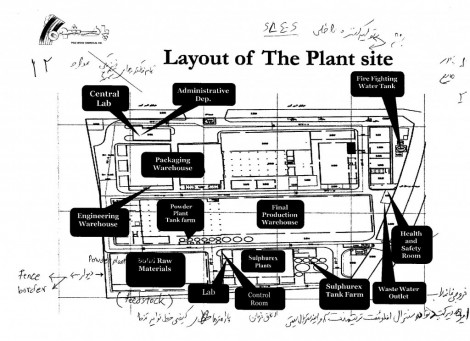
I witnessed Iranian involvement in the mass production of chemical weapons at a variety of installations including Pakshooma, Arak Petrochemical Complex and in particular the Shahid Meisami Complex located in the city of Karaj, which were designated as producers of chemical material for civilian use, such as detergents, but were also producing chemical weapons for the Defense Industries Organization, which is affiliated with the Ministry of Defense.

From an official Iranian presentation for the Pre-Inspection Briefing for the Pakshoo Chemical Co., September 2010 (scan: Ahmad Hashemi)

From an official Iranian presentation for the Pre-Inspection Briefing for the Pakshoo Chemical Co., September 2010 (scan: Ahmad Hashemi)

I interpreted as the Iranian defense officials misinformed and deceived the inspectors. With such a history of producing weapons of mass destruction in the form of chemical weapons, why should anyone believe that Iran is not intent on producing an atomic bomb?

Another futile round of talks

All previous meetings between Iran and the 5+1 failed because Iran was never serious about curbing its nuclear programs. After seven years, the West and particularly the Obama administration are still hopeful that they can achieve progress through negotiations. Tehran may have slowed down tactically, but undoubtedly, as the former commander of Iran’s revolutionary guards Mohsen Rezai once said, “Iran’s long-term policy and strategic vision is to acquire a holy Islamic atomic bomb.”

Only a real and result-oriented negotiation with a specific agenda with the Ayatollahs, smarter economic sanctions, more unified diplomatic isolation around Iran, and actual support for the demands of the Iranian people may bring real change.

Using a well-known concept in Shiite jurisprudence known as the expedient or altruistic lie, Iranian officials are perfectly willing to lie when it comes to their intentions and programs. The enlightened nations would do well to understand the religious underpinnings of Iranian diplomats’ big lies in contrast with European negotiators. Once the extent of the deception is understood, the question should be not whether Iran’s nuclear program is peaceful but rather when and how the program can be safely terminated.

Ahmad Hashemi, was born in Qom in 1977. He earned a Bachelor’s Degree in Political Science at the University of Tehran and has a Master’s Degree in American Studies from the Iranian Foreign Ministry’s School of International Relations. In January 2008, he joined the Ministry of Foreign Affairs as an English, Turkish and occasionally Arabic interpreter. When the popular uprising began in 2009, he was actively involved in the pro-democracy Green Movement protests. For this and other reasons, he was summoned and dismissed from his job in May 2012. From early May 2012, he began to contribute articles for the leading reformist dailies such as Shargh and Etemaad newspapers. Because of his classified information with regard to some of the regime’s proliferation programs, Ahmad Hashemi says he was subject to constant threats, mental torture and restrictions. He fled his country and currently is seeking political asylum in Turkey. In his work as a writer and freelance journalist, he contributes to Persian-language and international media.

Mali conflict exposes White House-Pentagon split – latimes.com

January 19, 2013

Mali conflict exposes White House-Pentagon split – latimes.com.

Officials disagree on the degree of danger posed by Islamist militants in West Africa. Some top U.S. military officials warn aggressive action is needed.

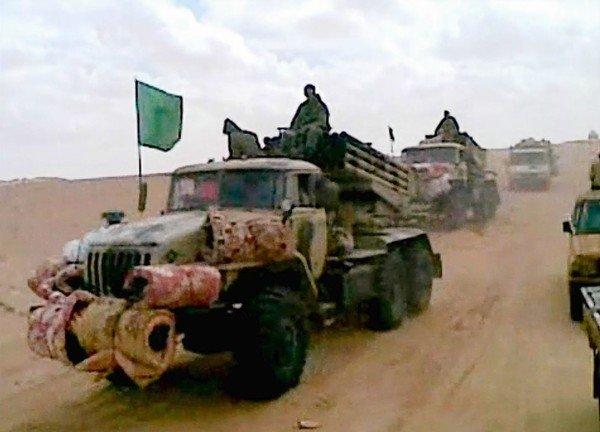
Militants in desert of Mali

A cellphone image shows a militant convoy in the Malian desert. The French military intervention in Mali and a terrorist attack on a gas complex in neighboring Algeria have prompted debate in Washington over whether the threat warrants a military response. (AFP/Getty Images / January 19, 2013)

WASHINGTON — The widening war in Mali has opened divisions between the White House and the Pentagon over the danger posed by a mix of Islamist militant groups, some with murky ties to Al Qaeda, that are creating havoc in West Africa.

Although no one is suggesting that the groups pose an imminent threat to the United States, the French military intervention in Mali and a terrorist attack against an international gas complex in neighboring Algeria have prompted sharp Obama administration debate over whether the militants present enough of a risk to U.S. allies or interests to warrant a military response.

Some top Pentagon officials and military officers warn that without more aggressive U.S. action, Mali could become a haven for extremists, akin to Afghanistan before the terrorist attacks of Sept. 11, 2001.

Militants in Mali, “if left unaddressed, … will obtain capability to match their intent — that being to extend their reach and control and to attack American interests,” Army Gen. Carter Ham, head of the U.S. Africa Command, said in an interview.

But many of Obama’s top aides say it is unclear whether the Mali insurgents, who include members of the group Al Qaeda in the Islamic Maghreb, or AQIM, threaten the U.S.

Those aides also worry about being drawn into a messy and possibly long-running conflict against an elusive enemy in Mali, a vast landlocked country abutting the Sahara desert, just as U.S. forces are withdrawing from Afghanistan.

“No one here is questioning the threat that AQIM poses regionally,” said an administration official who spoke on condition of anonymity when discussing internal deliberations. “The question we all need to ask is, what threat do they pose to the U.S. homeland? The answer so far has been none.”

Another U.S. official, who is regularly briefed on such intelligence, said the groups’ goals were often hard to distinguish.

“AQIM and its allies have opportunistic criminals and smugglers in their midst, but they also have some die-hard terrorists with more grandiose visions,” the official said. “In some cases, the roles may overlap.”

The internal debate is one reason for a delay in U.S. support for the French, who airlifted hundreds of troops into Mali last weekend and launched airstrikes in an effort to halt the militants from pushing out of their northern stronghold toward Bamako, the Malian capital.

The Pentagon is planning to begin ferrying additional French troops and equipment to Mali in coming days aboard U.S. Air Force C-17 cargo jets, according to Air Force Maj. Robert Firman, a Pentagon spokesman.

Military planners are still studying the airport runways in Bamako to determine whether they can handle the huge C-17s. If not, they will land elsewhere and the French troops will be flown into Mali on smaller aircraft. French officials have asked the U.S. to transport an armored infantry battalion of 500 to 600 soldiers, plus vehicles and other equipment.

The U.S. is also providing France with surveillance and other intelligence on the militants.

But the administration has so far balked at a French request for tanker aircraft to provide in-air refueling of French fighter jets because the White House does not yet want to get directly involved in supporting French combat operations, officials said.

U.S. officials have ruled out putting troops on the ground, except in small numbers and only to support the French.

“I think the U.S. ambivalence about moving into Mali is very understandable,” said Richard Barrett, a former British diplomat who serves as United Nations counter-terrorism coordinator. Noting the instances where U.S. forces have been drawn into conflict with Islamic militants, he said, “Why would they want another one, for God’s sake? It’s such a difficult area to operate in.”

After 2001, Washington tried to tamp down Islamic extremism in Mali under a counter-terrorism initiative that combined anti-poverty programs with training for the military. The U.S. aid was halted, however, when military officers overthrew the government last March in a violent coup.

Gen. Ham has warned for months that AQIM was growing stronger and intended to carry out attacks in the region and elsewhere. To combat the threat, some officers favor building closer ties with governments in the region and boosting intelligence-gathering and special operations.

But other administration officials question the need for a bigger U.S. effort.

Johnnie Carson, who heads the Africa bureau at the State Department, told Congress in June that AQIM “has not demonstrated the capability to threaten U.S. interests outside of West or North Africa, and it has not threatened to attack the U.S. homeland.”

Official: Iran won’t stop uranium enrichment

January 19, 2013

Official: Iran won’t stop uranium enrichment – Israel News, Ynetnews.

Despite international community’s demands that Islamic Republic halt nuclear program, diplomat states his country will continue with uranium enrichment

Associated Press

Published: 01.19.13, 11:54 / Israel News

An Iranian diplomat says Tehran will not stop uranium enrichment “for a moment,” defying demands from the UN and world powers to halt its suspect nuclear program.

The comments by Ali Asghar Soltanieh, Iran’s delegate to the International Atomic Energy Agency, come just two days after senior IAEA investigators ended two days of intensive talks with Iranian officials on allegations the Islamic Republic may have carried out tests on triggers for atomic weapons.

His remarks reiterate Iran’s longstanding assertion that its enrichment program is for producing nuclear fuel and other peaceful purposes, and thus is Tehran’s right under the Nuclear Nonproliferation Treaty.

Soltanieh’s comments were reported by the official IRNA news agency Saturday. Iran and the IAEA agreed to hold another round of negotiations on Feb. 12.

On Friday, UN experts returned from Tehran without sealing a long-sought deal that would restart a probe of suspicions that Iran worked on atomic arms, adding to doubts that upcoming talks between six world powers and the Islamic Republic will succeed.

Al Qaeda offers to swap 2 US hostages for 2 jailed terrorists

January 19, 2013

Al Qaeda offers to swap 2 US hostages for 2 jailed terrorists.

DEBKAfile Special Report January 18, 2013, 6:46 PM (GMT+02:00)


Long-sought Algerian terrorist Moktar Belmoktar

The North Afrfican Al Qaeda group which seized hostages from 10 nations at the remote Algerian gas field in In Aminas Wednesday, Jan. 16, has addressed its first demand to the United States: The release of two American hostages for two high-profile Islamist terrorists jailed in the US: Egyptian Omar Abdel-Rahman, the Blind Sheikh convicted of masterminding the 1993 World Trade Center bombing and Pakistani-American neuroscientist Aafia Siddiqui, convicted for trying to kill US troops and FBI agents in Afghanistan in 2009.

The offer from Moktar Belmoktar, head of al Qaeda’s Signed-in-Blood Battalions, was relayed by a Mauritanian news site Friday afternoon Jan 18. Until now, their most pressing demand was for France to end its military operation in Mali.
The Obama administration has not released information about the Americans held hostage at the gas field. They are believed to number seven.

Friday afternoon, as Algerian special forces were still unable to overpower the terrorists holed up with hostages at a gas facility, US military transports began lifting foreign nationals out of Algeria. Most are oil and gas facility personnel and their families. Their evacuation, which will badly affect the operation of Algeria’s energy industry, indicates fears that more terrorist attacks on oil and gas sites are still to come, with devastating impact on world energy markets.

Military sources in London reported that a British MI6 secret service plane has landed near the Algerian hostage site carrying a command and control team specializing in terrorist situations.
British Prime Minister David Cameron called the Cobra emergency cabinet into session Friday night, its third since the hostage crisis erupted. Addressing Parliament earlier, Cameron promised the UK would hunt down the terrorists responsible for the brutal and savage attack in Algeria.

According to the first tentative hostage figures released by Algeria Friday afternoon, the second day of its rescue operation, a total of 650 hostages were taken, of whom 573 were freed – most of them Algerian – indicating that 77 were killed or missing. A total of 132 foreign nationals from 10 nations were taken of whom 66 were freed, which leaves 66 dead or unaccounted for.
None of these figures will be final before the gas field is finally cleansed and secure.
debkafile:  Al Qaeda’s demand for the Blind Sheikh’s release from an American jail is intended to embarrass Egyptian President Mohamed Morsi, who has said he would press for this when he visits Washington soon. This now puts Morsi on the same side as al Qaeda.
Bucked up by their success in keeping the Algerian army at bay and dragging out their first  multinational hostage crisis into another day, Al Qaeda in North Africa upped the ante by directly confronting the United States in what is unlikely to be their last demand.

Rand Paul: Cuts to Israel aid would not be ‘dramatic’

January 18, 2013

Rand Paul: Cuts to Israel aid would not be ‘dramatic’ | The Times of Israel.

( I have to say there’s something to Rand Paul’s position.  I agree that over time Israel could and should become completely independent of foreign assistance {aka control}.  A look at this week’s posts here show us why. – JW )

Tea Party leader returning from visit says Israel would benefit from economic independence from the US

January 18, 2013, 1:40 am 1
Sen. Rand Paul in Jerusalem, January 12, 2013 (photo credit: Raphael Ahren/Times of Israel)

Sen. Rand Paul in Jerusalem, January 12, 2013 (photo credit: Raphael Ahren/Times of Israel)

WASHINGTON (JTA) — U.S. Sen. Rand Paul said he does not favor immediate cuts to defense assistance to Israel, but believes Israel ultimately would benefit from economic independence from the United States.

Paul (R-Ky.), in a conference call Wednesday marking his return from a weeklong visit to Israel, said his first priority in targeting foreign assistance would be those nations where people “burn the American flag and say death to America.”

Israel, he said, has been a “great friend” to the United States.

“Something I would be in favor of would not be immediate, dramatic or draconian, it would be evolving,” he said of his favoring cuts in assistance to Israel. “I’m for an independent, strong Israel that is not a client state and not a reliant state.”

Asked particularly about missile defense cooperation, he said there was a “great argument” for such programs and he believes that American cities should have missile defense infrastructure.

Of Iron Dome, the Israeli anti-missile system that Israel says repelled 80 percent of rocket attacks during the recent Gaza War, Rand said, “There’s a great argument for the Iron Dome,” although he would want to examine “exactly how it is funded.”

Iron Dome is funded currently by hundreds of millions of dollars in grants on top of the $3 billion Israel receives annually in defense assistance from the United States.

Paul said he understands how his calls for reducing aid to Israel make him an outlier among fellow senators, but that he believes his position is more pro-Israel than theirs.

The Kentucky lawmaker also said it was “presumptuous” of American politicians to dictate to Israel where it should build, and that he leans toward recognition of Jerusalem as Israel’s capital, although he understands arguments that such recognition could be “provocative.”

Paul, who met on his trip with Israeli leaders including Prime Minister Benjamin Netanyahu, said he was concerned about defense assistance to Egypt in part because its president, Mohamed Morsi, has made anti-Semitic remarks, but also because such sales fuel an arms race with Israel.

Paul has gently distanced himself from the positions of his father, Rep. Ron Paul (R-Texas), a perennial presidential candidate who also has favored cutting assistance to Israel but often has cast those arguments as criticism of Israeli policies. The younger Paul is seen as likely to bid for the Republican presidential nomination in 2016.

New clips show Morsi in 2010 calling Obama a liar, urging Jew-hatred

January 18, 2013

New clips show Morsi in 2010 calling Obama a liar, urging Jew-hatred | The Times of Israel.

US says Egyptian president’s subsequent pledge rejecting discrimination and incitement to violence is an important, but inadequate, first step

January 18, 2013, 4:54 am 10
The Muslim Brotherhood's Mohammed Morsi gives an interview to Lebanese Al-Quds TV, in October 2010 (image capture MEMRI video)

The Muslim Brotherhood’s Mohammed Morsi gives an interview to Lebanese Al-Quds TV, in October 2010 (image capture MEMRI video)

Additional statements made by Egypt’s President Mohammed Morsi before entering office, in which he accuses US President Barack Obama of lying in his 2009 Cairo speech and urges Muslims “to nurse our children and grandchildren on hatred towards those Zionists and Jews,” were published Thursday by media watchdog group MEMRI.

“One American president after another — and most recently, that Obama — talks about American guarantees for the safety of the Zionists in Palestine. [Obama] was very clear when he uttered his empty words on the land of Egypt. He uttered many lies, of which he couldn’t have fulfilled a single word, even if he were sincere — which he is not,” Morsi says in the latest clips, referring to Obama’s 2009 speech, delivered at Cairo University.

Morsi made the remarks in a speech in 2010 when he was a leading Muslim Brotherhood figure. These and other remarks were revived when an Egyptian TV show aired them last week to highlight and mock Morsi’s current policies.

In the same address, Morsi said: “Dear brothers, we must not forget to nurse our children and grandchildren on hatred towards those Zionists and Jews, and all those who support them. They must be nursed on hatred. The hatred must continue.”

The new quotes — found, translated, reposted and transcribed by MEMRI (the Middle East Media Research Institute) — emerged hours after the Obama administration issued a statement saying the Egyptian presidency’s clarification over a previous set of anti-Jewish and anti-Israel comments was welcome, but not enough to ease the White house’s concerns.

A statement by Morsi’s office rejected discrimination and incitement to violence based on religion. The State Department called it “an important first step,” but said the US continues to look for Morsi and other Egyptian leaders to demonstrate a commitment to religious tolerance and Egypt’s peace treaty with Israel.

The US has said Morsi’s previous 2010 remarks — in which he urged hatred of Jews and called Zionists “pigs” and “bloodsuckers” — are “deeply offensive” and need to be repudiated.

State Department spokeswoman Victoria Nuland would not say if Washington is demanding that Morsi personally repudiate the remarks, but she made clear the US needs to see more than the statement from his office to be convinced he no longer holds to the earlier views.

“From our perspective, that statement was an important first step to make clear that the type of offensive rhetoric that we saw in 2010 is not acceptable, not productive and shouldn’t be part of a democratic Egypt,” she told reporters. “That said, we look to President Morsi and Egyptian leaders to demonstrate in both word and in deed their commitment to religious tolerance and to upholding all of Egypt’s international obligations.”

On Wednesday, Morsi sought to defuse Washington’s anger over his past remarks, telling a group of visiting US senators that his comments were taken out of context and were a denunciation of Israeli policies and not Israel itself or the Jewish people, according to a spokesman. The spokesman said Morsi told the lawmakers that a distinction must be made between the two.

Later Wednesday, after the State Department declined to comment on the spokesman’s explanation, Morsi’s office went further by releasing an English-language statement that said “the president strongly believes that we must respect and indeed celebrate our common humanity and does not accept or condone derogatory statements regarding any religious or ethnic group.”

Nuland said Thursday that her comments applied to that statement and not the spokesman’s remarks.

The flap is a new twist in Morsi’s attempts to reconcile his background as a veteran of the Muslim Brotherhood — a vehemently anti-Israel and anti-US group — and the requirements of his role as head of state, which include keeping the strategic relationship with Washington, which wants Egypt to continue to honor its 1979 peace deal with Israel.

Morsi has promised to abide by Egypt’s 1979 peace treaty with Israel and has continued security cooperation with Israel over the volatile Sinai Peninsula and their border. In November, Morsi brokered a truce between the Jewish state and Gaza’s Hamas rulers in November, a feat that won him warm praise from the Americans.

Algerian militants may trade hostages for terrorists

January 18, 2013

Algerian militants may trade hostages for terrorists | The Times of Israel.

60 hostages remain unaccounted for three days into bloody Sahara gas plant siege; French minister calls situation ‘murky’

January 18, 2013, 4:55 pm Updated: January 18, 2013, 5:03 pm 2
A satellite image taken in October shows the Amenas Gas Field in Algeria (photo credit: AP/DigitalGlobe)

A satellite image taken in October shows the Amenas Gas Field in Algeria (photo credit: AP/DigitalGlobe)

ALGIERS, Algeria (AP) — About 60 foreign hostages are still unaccounted for three days into a bloody siege with Islamist militants at a gas plant deep in the Sahara, Algeria’s state news service said Friday.

The militants, meanwhile, offered to trade two American hostages for terror figures jailed in the United States, according to a statement received by a Mauritanian news site that often reports news from North African extremists.

It was the latest surprising development in a hostage drama that began Wednesday when militants seized hundreds of workers from 10 nations at Algeria’s remote Ain Amenas natural gas plant. Algerian forces retaliated Thursday by storming the plant in an attempted rescue operation that killed at least four hostages and left leaders around the world expressing strong concerns about the hostages’ safety.

Algerian special forces resumed negotiating Friday with the militants holed up in the refinery, according to the Algerian news service, which cited a security source.

The report said “more than half of the 132 hostages” had been freed in the first two days, but it could not account for the remainder, saying some could be hidden throughout the sprawling desert site.

Militants on Friday offered to trade two American hostages for two prominent terror figures jailed in the United States: the mastermind of the 1993 World Trade Center bombing and a Pakistani scientist convicted of shooting at two U.S. soldiers in Afghanistan.

The offer, according to a Mauritanian news site that frequently broadcasts dispatches from groups linked to al-Qaeda, came from Moktar Belmoktar, an extremist commander based in Mali who apparently masterminded the operation.

Algeria’s government has kept a tight grip on information, but it was clear that the militant assault that began Wednesday with an attempted bus hijacking has killed at least six people from the plant — and perhaps many more.

Workers kidnapped by the militants came from around the world — Americans, Britons, French, Norwegians, Romanians, Malaysians, Japanese, Algerians. Leaders on Friday expressed strong concerns about how Algeria was handing the situation and its apparent reluctance to communicate.

British Prime Minister David Cameron went before the House of Commons on Friday to provide an update, seeming frustrated that Britain was not told about the military operation despite having “urged we be consulted.”

Terrorized hostages from Ireland and Norway trickled out of the Ain Amenas plant, 800 miles (1,300 kilometers) south of Algiers, the capital. BP, which jointly operates the plant, said it had begun to evacuate employees from Algeria.

“This is a large and complex site and they are still pursuing terrorists and possibly some of the hostages,” Cameron said. He told lawmakers the situation remained fluid and dangerous, saying “part of the threat has been eliminated in one part of the site, a threat still remains in another part.”

Algeria’s army-dominated government, hardened by decades of fighting Islamist militants, shrugged aside foreign offers of help and drove ahead alone.

The US government sent an unarmed surveillance drone to the BP-operated site, near the border with Libya, but it could do little more than watch Thursday’s military intervention. British intelligence and security officials were on the ground in Algeria’s capital but were not at the installation, said a British official who spoke on condition of anonymity because he was not authorized to speak to reporters.

A US official said while some Americans escaped, other Americans were either still held or unaccounted for.

El Mokhtar Ould Sidi, editor of the Mauritanian news site ANI, said several calls on Thursday came from the kidnappers themselves giving their demands and describing the situation.

“They were clearly in a situation of war, the spokesman who contacted us was giving orders to his colleagues and you could hear the sounds of war in the background…. He threatened to kill all the hostages if the Algerian forces tried to liberate them,” he said.

With the hostage drama entering its second day Thursday, Algerian security forces moved in, first with helicopter fire and then special forces, according to diplomats, a website close to the militants, and an Algerian security official. The government said it was forced to intervene because the militants were being stubborn and wanted to flee with the hostages.

Militants claimed 35 hostages died when the military helicopters opened fire as they were transporting hostages from the living quarters to the main factory area where other workers were being held.

The group — led by a Mali-based al-Qaeda offshoot known as the Masked Brigade — suffered losses in Thursday’s military assault — but garnered a global audience.

The militants made it clear that their attack was in revenge for the French intervention against Islamists who have taken over large parts of neighboring Mali. France has encountered fierce resistance from the extremist groups in Mali and failed to persuade many Western allies to join in the actual combat.

Even violence-scarred Algerians were stunned by the brazen hostage-taking Wednesday, the biggest in northern Africa in years and the first to include Americans as targets. Mass fighting in the 1990s had largely spared the lucrative oil and gas industry that gives Algeria its economic independence and regional weight.

The official Algerian news agency said four hostages were killed in Thursday’s operation, two Britons and two Filipinos. Two others, a Briton and an Algerian, died Wednesday in the initial militant ambush on a bus ferrying foreign workers to an airport. Citing hospital officials, it said six Algerians and seven foreigners were injured.

APS said some 600 local workers were safely freed in the raid — but many of those were reportedly released the day before by the militants themselves.

One Irish hostage managed to escape: electrician Stephen McFaul, who’d worked in North Africa’s oil and natural gas fields off and on for 15 years. His family said the militants let hostages call their families to press the kidnappers’ demands.

“He phoned me at 9 o’clock to say al-Qaeda were holding him, kidnapped, and to contact the Irish government, for they wanted publicity. Nightmare, so it was. Never want to do it again. He’ll not be back! He’ll take a job here in Belfast like the rest of us,” said his mother, Marie.

Dylan, McFaul’s 13-year-old son, started crying as he talked to Ulster Television. “I feel over the moon, just really excited. I just can’t wait for him to get home,” he said.

Copyright 2013 The Associated Press.