Archive for November 23, 2012

Muslim Brotherhood offices torched in anti-Morsi riots

November 23, 2012

Muslim Brotherhood offices torched in anti-Morsi riots | The Times of Israel.

Thousands clash in the streets of Cairo over Egyptian president’s power grab in worst protests since 2011 revolution

November 23, 2012, 7:12 pm 0
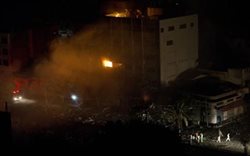
Protesters storm an office of Egyptian President Mohammed Morsi's Muslim Brotherhood Freedom and Justice party and set fires in the Mediterranean port city of Alexandria, Egypt, Friday, Nov. 23 (photo credit: AP Photo/Amira Mortada, El Shorouk Newspaper)

Protesters storm an office of Egyptian President Mohammed Morsi’s Muslim Brotherhood Freedom and Justice party and set fires in the Mediterranean port city of Alexandria, Egypt, Friday, Nov. 23 (photo credit: AP Photo/Amira Mortada, El Shorouk Newspaper)

CAIRO (AP) — Thousands of opponents of Egypt’s Islamist president clashed with his supporters in cities across the country Friday, burning several offices of the Muslim Brotherhood, in the most violent and widespread protests since Mohammed Morsi came to power, sparked by his move to grant himself sweeping powers.

The violence reflected the increasingly dangerous polarization in Egypt over what course it will take nearly two years after the fall of autocrat Hosni Mubarak.

Critics of Morsi accused him of seizing dictatorial powers with his decrees a day earlier that make him immune to judicial oversight and give him authority to take any steps against “threats to the revolution”. On Friday, the president spoke before a crowd of his supporters massed in front of his palace and said his edits were necessary to stop a “minority” that was trying to block the goals of the revolution.

“There are weevils eating away at the nation of Egypt,” he said, pointing to old regime loyalists he accused of using money to fuel instability and to members of the judiciary who work under the “umbrella” of the courts to “harm the country.”

Clashes between his opponents and members of Morsi’s Muslim Brotherhood erupted in several cities. In the Mediterranean city of Alexandria, anti-Morsi crowds attacked Brotherhood backers coming out of a mosque, raining stones and firecrackers on them. The Brothers held up prayer rugs to protect themselves and the two sides pelted each other with stones and chunks of marble, leaving at least 15 injured. The protesters then stormed a nearby Brotherhood office.

Protesters hurl stones during clashes between supporters and opponents of President Mohammed Morsi in Alexandria, Egypt, Friday, Nov. 23 (photo credit: AP/Tarek Fawzy)

Protesters hurl stones during clashes between supporters and opponents of President Mohammed Morsi in Alexandria, Egypt, Friday, Nov. 23 (photo credit: AP/Tarek Fawzy)

In the capital Cairo, security forces pumped volleys of tear gas at thousands of pro-democracy protesters clashing with riot police on streets several blocks from Tahrir Square.

Tens of thousands of activists massed in Tahrir itself, angered at the decisions by Morsi. Many of them represent Egypt’s upper-class, liberal elite, which have largely stayed out of protests in past months but were prominent in the streets during the anti-Mubarak uprising that began Jan. 25, 2011.

Protesters chanted, “Leave, leave” and “Morsi is Mubarak … Revolution everywhere.”

“We are in a state of revolution. He is crazy if he thinks he can go back to one-man rule,” one protester at Tahrir, Sara Khalil, said of Morsi. “This decision shows how insecure and weak he is because he knows there is no consensus.”

“If the Brotherhood’s slogan is ‘Islam is the solution’ ours is ‘submission is not the solution’,” said Khalil, a mass communications professor at the American University in Cairo. “And this is Islamic because God does not call for submission to another man’s will.”

Frustration had been growing for months with Morsi, Egypt’s first freely elected president who came to office in June. Critics say the Muslim Brotherhood, from which he hails, has been moving to monopolize power and that he has done little to tackle mounting economic problems and continuing insecurity, much less carry out deeper reforms.

Supporters of Egyptian President Mohammed Morsi chant slogans and wave his campaign posters outside the Presidential palace, background, in Cairo, Egypt, Friday, Nov. 23 (photo credit: AP/Ahmed Abd el Fatah)

Supporters of Egyptian President Mohammed Morsi chant slogans and wave his campaign posters outside the Presidential palace, background, in Cairo, Egypt, Friday, Nov. 23 (photo credit: AP/Ahmed Abd el Fatah)

Morsi’s supporters, in turn, say he has faced constant push-back from Mubarak loyalists and from the courts, where loyalists have a strong presence. The courts have been considering a string of lawsuits demanding the dissolution of the Islamist-dominated assembly writing the next constitution. The courts already dissolved a previous version of the assembly and the Brotherhood-led lower house of parliament.

On Thursday, Morsi unilaterally issued amendments to the interim constitution that made all his decisions immune to judicial review or court orders. He gave similar protection to the constitutional panel and the upper house of parliament, which is dominated by the Brotherhood and also faced possible disbanding by the courts.

Morsi, who holds legislative as well as executive powers, also declared his power to take any steps necessary to prevent “threats to the revolution,” public safety or the workings of state institutions. Rights activists warned that the vague — and unexplained — wording could give him even greater power than those Mubarak held under emergency laws throughout his rule.

The decree would be in effect until a new constitution is approved and parliamentary elections are held, not expected until the Spring.

The state media described Morsi’s decree as a “corrective revolution,” and the official radio station aired phone calls from listeners praising the president’s decree. The president’s supporters cast the decrees as the next logical step to consolidate the gains of the 2011 uprising that overthrew Mubarak, and the only way to break through the political deadlock preventing the adoption of a new constitution.

But many veteran activists who organized that uprising say Morsi’s decree puts him in the same category as Mubarak, who argued his autocratic powers were necessary only to shepherd Egypt to a new democratic future.

Mohamed ElBaradei, former head of the U.N.’s nuclear agency, called Morsi a “new pharaoh.” The president’s one-time ally, the April 6 movement, warned that the polarization could bring a “civil war.”

One of Morsi’s aides, Coptic Christian thinker Samer Marqous, resigned to protest the “undemocratic” decree.

“This is a crime against Egypt and a declaration of the end of January revolution to serve the interest of the Muslim Brotherhood dictatorship,” wrote Ibrahim Eissa, chief editor of daily Al-Tahrir. “The revolution is over and the new dictator has killed her. His next step is to throw Egypt in prison.”

In front of the presidential palace, Muslim Brotherhood supporters and other Islamists changed “the people support the president’s decree” and pumped their fists in the air.

“God will humiliate those who are attacking our president, Mohammed Morsi,” said ultraconservative cleric Mohammed Abdel-Maksoud. “Whoever insults the sultan, God humiliates him,” he added.

Outside the capital, the rival groups clashed.

State TV reported that protesters burned offices of the Brotherhood’s political arm in the Suez Canal cities of Suez, Ismalia and Port Said, east of Cairo.

In the southern city of Assiut, ultraconservative Islamists of the Salafi tend and former Jihadists outnumbered liberal and leftists, such as the April 6 youth groups. The two sides exchanged insults and briefly scuffled with firsts and stones.

With his decrees, Morsi was playing to widespread discontent with the judiciary. Many — even Brotherhood opponents — are troubled by the presence of so many Mubarak era-judges and prosecutors, who they say have failed to strongly enough prosecute the old regime’s top officials and security forces for crimes including the killing of protesters.

In his decrees, Morsi fired the controversial prosecutor general and created “revolutionary” judicial bodies to put Mubarak and some of his top aides on trial a second time for protester killings. Mubarak was sentenced to life in prison for failing to stop police from shooting at protesters, but many were angry he was not found guilty of actually ordering the crackdown during the uprising against his rule.

In his speech Friday. Morsi told supporters that his decisions were meant to stop those “taking shelter under judiciary.”

He said the courts had been about to disband the upper house of parliament.

“This is minority but they represent a threat to the revolution goals,” he said. “It is my duty if I see this, to go forward along the path of the revolution and prevent any blockage.”

Copyright 2012 The Associated Press.

Liberman: We did the best we could in Gaza, and now wasn’t the time for a ground operation

November 23, 2012

Liberman: We did the best we could in Gaza, and now wasn’t the time for a ground operation | The Times of Israel.

Barak says public doesn’t have all the facts; Hamas has nothing to celebrate

November 22, 2012, 10:47 pm 7
Foreign Minister Avigdor Liberman seen at the Foreign Ministry in Jerusalem in October, 2012. (photo credit: Yoav Ari Dudkevitch / FLASH90)

Foreign Minister Avigdor Liberman seen at the Foreign Ministry in Jerusalem in October, 2012. (photo credit: Yoav Ari Dudkevitch / FLASH90)

Operation Pillar of Defense achieved its objectives, Foreign Minister Avigdor Liberman said Thursday amid accusations that the costly operation had been cut short prematurely without subduing Hamas.

“I believe power lies not just in striking, but also in restraint,” Liberman told Channel 2 News, saying that the issue of Hamas rule in Gaza was far from resolved – but now was not the time to resolve it.

Soldiers sit atop a tank outside Gaza on Thursday. (photo credit: Yossi Zeliger/Flash90)

Soldiers sit atop a tank outside Gaza on Thursday. (photo credit: Yossi Zeliger/Flash90)

“Everyone in the state of Israel, every mother and father, should be aware that a [ground operation in Gaza] is a last resort for when there is no other option … I don’t want to go into too much detail, but let everyone imagine our soldiers entering all the alleyways of the refugee camps, all the streets of Gaza, Rafah – it’s not going to be easy,” he stressed.

A senior diplomatic source told the channel that a full-fledged ground operation could have cost Israel some 200 lives, well above the death tolls for 2008′s Operation Cast Lead, in which 13 soldiers were killed, and the 121 soldiers killed in 2006′s war with Hezbollah in Lebanon.

Liberman, together with Prime Minister Benjamin Netanyahu and Defense Minister Ehud Barak, has been under heavy pressure from the Israeli public to defend the decision to end the operation Wednesday.

Residents in the south held protests Wednesday and Thursday against the government’s decision, complaining that the country’s leaders had accomplished nothing and the rocket fire would soon continue.

Barak and Liberman told the channel that they could not make decisions only based on public opinion.

“There’s no use in listening to the Israeli public where these matters are concerned –- the leadership has to make decisions,” Barak said, adding that the leadership had a wider field of vision on which to base its decisions. ”I remember situations in which the 80 percent of the Israeli public supported something, and after 10 days it turned out that it was a huge failure. We decided the time hadn’t come for a large-scale operation to enter Gaza and conquer it … we may get there in the future, but it’s very important that we get there when the international community, and especially the United States, understands our position.”

Liberman, considered the most hawkish of the triumvirate, said the government had done the best it could given the situation it was in.

“It’s clear to me that in the circumstances we were in, we made the best possible decision. It’s impossible to share all the considerations, all the data, all the deliberations – and there were many – with the public. But at the end of the day, we created a new reality: we defined the objectives of the operation in a precise and measured way. It wasn’t a strategic operation,” said Liberman. He stressed that Operation Pillar of Defense had three main objectives, all of which were fulfilled, he said – “ending the rocket fire against Israeli civilians, rehabilitating our power of deterrence and destroying [Hamas’s] Fajr 5 stockpiles.”

An apartment building in Rishon Lezion that was hit by a Fajr rocket from Gaza on Tuesday evening (photo credit: Miriam Alster/Flash90)

An apartment building in Rishon Lezion that was hit by a Fajr rocket from Gaza on Tuesday evening (photo credit: Miriam Alster/Flash90)

Liberman referred to former prime minister Yitzhak Rabin, who he said received a Nobel Peace Prize for his role in the creation of the Oslo Accords. “When they told him, ‘What will we do if there is shooting from Gaza?’, he said, ‘What’s the problem? We’ll reconquer Gaza.’ Apparently, it’s not so easy to conquer Gaza.”

The foreign minister stressed that a partial ground operation would not suffice to fulfill Israel’s long-term strategic goals. “If you go for a ground operation, you go all the way,” he said, adding that in the current “international circumstances” Israel could not have sent combat forces into Gaza. “It’s not a two-day operation … I think it’s clear that conquering Gaza, subduing Hamas, that won’t take two months, not three months and not even four months. I don’t think it would have been right to make such a decision now, at this time,” he said. “I think we did the best we could.”

Liberman said the battle against Hamas wasn’t conducted just on the military front. “There’s a diplomatic front as well … and sometimes it’s no less important,” he said. “I say that in this case – and it isn’t possible to share all the considerations with everyone – it was the right decision, it’s the right decision even if it’s unpopular at times, and I can understand the public sentiment that an opportunity was missed.”

Palestinian Authority President Mahmoud Abbas meets with Hamas leader Khaled Mashaal in February (photo credit: Mohammed al-Hums/Flash90)

Palestinian Authority President Mahmoud Abbas meets with Hamas leader Khaled Mashaal in February (photo credit: Mohammed al-Hums/Flash90)

Asked if the Israeli government had deliberately decided to negotiate with Hamas after pushing West Bank-based Palestinian Authority President Mahmoud Abbas to the sidelines, Liberman responded that Abbas was simply implementing a “division of labor” by engaging in “political terrorism,” leaving the “terrorism on the ground” to Hamas. “We aren’t talking to Hamas. We’re talking to Egypt,” Liberman said.

Hamas emerged from the conflict with a significant gain in international credibility, with Arab and Turkish diplomats pouring into the Palestinian territory to show support. Though it is defined as a terror group by Israel, the United States and others, it was treated as an equal partner with Israel during indirect cease-fire talks in Egypt. As the Arab Spring brings Islamists to power across the region, Hamas’s influence appears to be on the rise.

Barak told Channel 2, however, that while the group was celebrating its “victory,” it had not won anything at all.

“In Gaza, they are deceiving their people,” he said. “They are celebrating the shooting down of the F-16, as well as the rockets that allegedly landed in Jerusalem and Tel Aviv. We know the truth,” said Barak, referring to false Hamas claims.

Prime Minister Benjamin Netanyahu and Defense Minister Ehud Barak on Wednesday, November 14, the first day of Operation Pillar of Defense (photo credit: Kobi Gideon/GPO/Flash90)

Prime Minister Benjamin Netanyahu and Defense Minister Ehud Barak on Wednesday, November 14, the first day of Operation Pillar of Defense (photo credit: Kobi Gideon/GPO/Flash90)

He added that the mere memory of Operation Pillar of Defense would prevent Hamas from breaking the ceasefire.

“In my estimation, today we will obtain a relatively long hiatus,” Barak said. ”A long line of commanders was targeted, and their military chief is dead and buried … they don’t really have achievements.”

Obama’s pledge of US troops to Sinai next week won Israel’s nod for ceasefire

November 23, 2012

Obama’s pledge of US troops to Sinai next week won Israel’s nod for ceasefire.

( Debka is the only news source reporting this so far.  If so, it would appear that operation Pillar of Defense was actually a success without too many lives being lost.  Of course, this is short term.  Americans are not going to sit on the Gaza border indefinitely.  But maybe they will long enough for the source of all the trouble in the Middle East, Iran, to be neutralized.  Obama gets to be Israel’s hero.  He also gets to keep the US involved in Egypt and perhaps help prevent it from following the Iranian model. – JW )

DEBKAfile Exclusive Report November 23, 2012, 3:11 PM (GMT+02:00)

Obama on the phone to Netanyahu with key pledge

Israeli Prime Minister Binyamin Netanyahu agreed to a ceasefire for halting the eight-day Israeli Gaza operation Wednesday night, Nov. 21, after President Barack Obama personally pledged to start deploying US troops in Egyptian Sinai next week, debkafile reports. The conversation, which finally tipped the scales for a ceasefire, took place on a secure line Wednesday morning, just hours before it was announced in Cairo. The US and Israeli leaders spoke at around the time that a terrorist was blowing up a Tel Aviv bus, injuring 27 people.
Obama’s pledge addressed Israel’s most pressing demand in every negotiating forum on Gaza: Operation Pillar of Cloud’s main goal was a total stoppage of the flow of Iranian arms and missiles to the Gaza Strip. They were smuggled in from Sudan and Libya through southern Egypt and Sinai. Hostilities would continue, said the prime minister, until this object was achieved.
Earlier, US officials tried unsuccessfully to persuade Israel to accept Egyptian President Mohamed Morsi’s personal guarantee to start launching effective operations against the smugglers before the end of the month. The trio running Israel’s Gaza campaign, Netanyahu, Defense Minister Ehud Barak and Foreign Minister Avigdor Lieberman, were willing to take Morsi at his word, except that Israeli security and intelligence chiefs assured them that Egypt has nothing near the security and intelligence capabilities necessary for conducting such operations.
When Secretary of State Hillary Clinton arrived in Jerusalem from Bangkok Tuesday, she tried assuring Netanyahu that President Obama had decided to accelerate the construction of an elaborate US system of electronic security fences along the Suez Canal and northern Sinai. It would also cork up the Philadelphi route through which arms are smuggled into the Gaza Strip. (The US Sinai fence project was first disclosed exclusively by DEBKA-Net-Weekly 564 on Nov. 9).
US security and civilian units will need to be deployed in Egyptian Sinai to man the fence system and operate it as an active counter-measure for obstructing the smuggling of Iranian weapons supplies.

The prime minister said he welcomed the president’s proposal to expedite the fence project, but it would take months to obtain Egyptian clearance. Meanwhile, the Palestinians would have plenty of time to replenish their weapons stocks after Israel’s Gaza campaign. It was therefore too soon to stop the campaign at this point or hold back a ground incursion.
Clinton was sympathetic to this argument. Soon after, President Obama was on the phone to Netanyahu with an assurance that US troops would be in place in Sinai next week, after he had obtained President Morsi’s consent for them to go into immediate action against Iranian smuggling networks.

Netanyahu responded by agreeing to a ceasefire being announced in Cairo that night by Clinton and the Egyptian foreign minister, and to holding back the thousands of Israeli reservists on standby on the Gaza border.
debkafile’s military sources report that the first air transports carrying US special forces are due to land at Sharm el Sheikh military airfield in southern Sinai in the next 48 hours and go into action against the arms smugglers without delay.
This development is strategically significant for three reasons:

1.  Once the missile and arms consignments depart Iranian ports or Libyan arms bazaars, Tehran has no direct control of their transit from point to point through Egypt until they reach Sinai and their Gaza destination. All the same, a US special forces operation against the Sinai segment of the Iranian smuggling route would count as the first overt American military strike against an Iranian military interest.

Netanyahu, Barak and Lieberman are impressed by the change the Obama administration has undergone since the president’s reelection. Until then, he refused to hear of any military action against Iran and insisted that Tehran could only be confronted on the diplomatic plane.
2.  President Morsi, by opening the Sinai door to an American troop deployment for Israel’s defense, recognizes that the US force also insures Israel against Cairo revoking or failing to honor the peace treaty Egypt signed with Israel in 1979.

3.  In the face of this US-Israel-Egyptian understanding, Hamas cannot credibly claim to have won its latest passage of arms with Israel or that it obtained guarantees to force Israel to end the Gaza blockade.
Indeed, Gaza’s Hamas rulers will be forced to watch as US troops in Sinai, just across its border, break up the smuggling rings filling their arsenals and most likely laying hands on the reserve stocks they maintain under the smugglers’ guard in northern Sinai, out of reach of the Israel army. This means that the blockade on Gaza has been extended and the focus of combat has switched from Gaza to the Sinai Peninsula.

Islamophobia… GIMMEE A BREAK !

November 23, 2012

Islamophobia… GIMMEE A BREAK ! – YouTube.

phobia
pho·bi·a
[foh-bee-uh]
noun
a persistent, irrational fear of a specific object, activity, or situation that leads to a compelling desire to avoid it.

Pat Condell demonstrates conclusively that it doesn’t exist.

Additionally, fear of radical Islam is far from “irrational.”  Given history and current events, any other view would be foolhardy. – JW

Alan M. Dershowitz: Why Gaza Cease-Fire Will Fail

November 23, 2012

Why Gaza Cease-Fire Will Fail.

Alan M. Dershowitz’s Perspective:

A cease-fire between Israel and Hamas may end the immediate exchange of rockets, but it is not likely to be of long duration. That is because every time Hamas fires rockets into Israel, it creates a win-win-win situation for itself.

The first win is that it terrorizes Israeli civilians, killing some, wounding others and creating panic among millions of Israelis who fear being hit. This show of strength enhances Hamas’ standing within much of the Muslim world.
The second win is that by firing these rockets from densely populated areas in Gaza City, rather than from the many open fields outside of the populated areas in the Gaza Strip, Hamas provokes Israel into targeting the rockets and the terrorists who fire them. As soon as the terrorists fire the rockets, they run to special underground bunkers that are open only to the terrorists, thereby leaving civilians above ground and vulnerable to Israeli rockets.

This is a deliberate tactic employed by Hamas over many years and designed to bring about international condemnation of Israel for inadvertently killing Palestinian civilians. Israel’s only other options would be to allow Hamas rockets to be fired unanswered into Israel, or to conduct a ground war which would result in even greater international condemnation.

The third win for Hamas is that every time it fires rockets into Israel and provokes Israel into returning fire, it weakens the Palestinian Authority — its arch enemy in the West Bank. The Palestinian Authority has renounced violence, but it has no choice other than to support Hamas’ violence against Israel, which is popular among many Palestinians. The end result is a strengthened Hamas, which is seen as doing something and a weakened Palestinian Authority, which is seen as doing nothing.

The proof that this win-win-win strategy is working for Hamas can be seen on television, in the newspapers, at the United Nations and among the chattering classes. Virtually everyone acknowledges that Israel has the right to defend itself, but that Israeli military actions — particularly if they are tough enough to achieve a modicum of success — do more harm than good to Israel’s standing around the world. That is precisely the reaction that Hamas has been counting on — and with repeated success.

They attack Israel, thus committing the double war crime of using Palestinian civilians as human shields and targeting Israeli civilians. Yet it is Israel that is criticized for engaging in entirely lawful activities, such as conducting a military blockade of Gaza designed to prevent new rockets and rocket material from reaching Hamas terrorists, and targeting Hamas terrorist leaders and Hamas fighters who fire rockets at Israeli civilians.

So long as this dynamic continues, it will be in Hamas’ interest to do precisely what it did in 2008 and again now: start a new battle by firing rockets at Israeli civilians from behind its Palestinian human shields, provoke Israel into responding, and calling on the international community to condemn Israel for killing its babies.

This “dead-baby strategy” has been acknowledged by Hamas leaders, who refer to the victims as “martyrs” and proclaim that Palestinian children and women “have formed human shields . . . in order to challenge the Zionist bombing machine.” This strategy always works with an international media that cannot resist showing pictures of the dead babies who are brought to them by Hamas leaders (even when, as in one case, the baby was killed by a misfiring Hamas rocket.)

The real victims of this gruesome strategy are the Palestinian civilians who are cynically used as human shields. Hamas leaders refer to them as martyrs, because they are being used to implement this win-win-win strategy. There is growing evidence that at least some Gaza civilians are fed up with the Hamas strategy. They complain that too few Hamas fighters are being killed and too many Palestinian civilians are dying. They complain that Hamas has deliberately built underground bunkers only to protect its fighters but not its civilians.

Unfortunately, the Gaza Strip is not a democracy. It is tyranny ruled by Hamas killers, who have no hesitation in murdering Palestinians who express disagreement with their strategy. It is unlikely, therefore, that the views of the dissatisfied Palestinians in Gaza will have any impact on the Hamas strategy.

What we can expect, therefore, is a relatively short truce — Hamas calls it a “hudna” — that will last until Hamas decides it is time to invoke its strategy once again. Israel will respond, as it has in the past. In Israel this is called, “mowing the lawn” — cutting down Hamas periodically with no real expectation that the deadly grass will not continue to grow.

The only solution to this recurring problem is for the international community and the media, once and for all, to expose the Hamas strategy, to condemn it, and to deny Hamas the diplomatic and media victory it seeks to achieve by its double war crimes.

Alan M. Dershowitz’s Perspective: A cease-fire between Israel and Hamas may end the immediate exchange of rockets, but it is not likely to be of long duration. That is because every time Hamas fires rockets into Israel, it creates a win-win-win situation for itself.

The first win is that it terrorizes Israeli civilians, killing some, wounding others and creating panic among millions of Israelis who fear being hit. This show of strength enhances Hamas’ standing within much of the Muslim world.

gaza-nov--21.jpg
Palestinians inspect damage moments after an Israeli airstrike in Gaza City on Wednesday.
(AP Photo)

The second win is that by firing these rockets from densely populated areas in Gaza City, rather than from the many open fields outside of the populated areas in the Gaza Strip, Hamas provokes Israel into targeting the rockets and the terrorists who fire them. As soon as the terrorists fire the rockets, they run to special underground bunkers that are open only to the terrorists, thereby leaving civilians above ground and vulnerable to Israeli rockets.

This is a deliberate tactic employed by Hamas over many years and designed to bring about international condemnation of Israel for inadvertently killing Palestinian civilians. Israel’s only other options would be to allow Hamas rockets to be fired unanswered into Israel, or to conduct a ground war which would result in even greater international condemnation.

The third win for Hamas is that every time it fires rockets into Israel and provokes Israel into returning fire, it weakens the Palestinian Authority — its arch enemy in the West Bank. The Palestinian Authority has renounced violence, but it has no choice other than to support Hamas’ violence against Israel, which is popular among many Palestinians. The end result is a strengthened Hamas, which is seen as doing something and a weakened Palestinian Authority, which is seen as doing nothing.

The proof that this win-win-win strategy is working for Hamas can be seen on television, in the newspapers, at the United Nations and among the chattering classes. Virtually everyone acknowledges that Israel has the right to defend itself, but that Israeli military actions — particularly if they are tough enough to achieve a modicum of success — do more harm than good to Israel’s standing around the world. That is precisely the reaction that Hamas has been counting on — and with repeated success.

They attack Israel, thus committing the double war crime of using Palestinian civilians as human shields and targeting Israeli civilians. Yet it is Israel that is criticized for engaging in entirely lawful activities, such as conducting a military blockade of Gaza designed to prevent new rockets and rocket material from reaching Hamas terrorists, and targeting Hamas terrorist leaders and Hamas fighters who fire rockets at Israeli civilians.

So long as this dynamic continues, it will be in Hamas’ interest to do precisely what it did in 2008 and again now: start a new battle by firing rockets at Israeli civilians from behind its Palestinian human shields, provoke Israel into responding, and calling on the international community to condemn Israel for killing its babies.

This “dead-baby strategy” has been acknowledged by Hamas leaders, who refer to the victims as “martyrs” and proclaim that Palestinian children and women “have formed human shields . . . in order to challenge the Zionist bombing machine.” This strategy always works with an international media that cannot resist showing pictures of the dead babies who are brought to them by Hamas leaders (even when, as in one case, the baby was killed by a misfiring Hamas rocket.)

The real victims of this gruesome strategy are the Palestinian civilians who are cynically used as human shields. Hamas leaders refer to them as martyrs, because they are being used to implement this win-win-win strategy. There is growing evidence that at least some Gaza civilians are fed up with the Hamas strategy. They complain that too few Hamas fighters are being killed and too many Palestinian civilians are dying. They complain that Hamas has deliberately built underground bunkers only to protect its fighters but not its civilians.

Unfortunately, the Gaza Strip is not a democracy. It is tyranny ruled by Hamas killers, who have no hesitation in murdering Palestinians who express disagreement with their strategy. It is unlikely, therefore, that the views of the dissatisfied Palestinians in Gaza will have any impact on the Hamas strategy.

What we can expect, therefore, is a relatively short truce — Hamas calls it a “hudna” — that will last until Hamas decides it is time to invoke its strategy once again. Israel will respond, as it has in the past. In Israel this is called, “mowing the lawn” — cutting down Hamas periodically with no real expectation that the deadly grass will not continue to grow.

The only solution to this recurring problem is for the international community and the media, once and for all, to expose the Hamas strategy, to condemn it, and to deny Hamas the diplomatic and media victory it seeks to achieve by its double war crimes.

Read Latest Breaking News from Newsmax.com http://www.newsmax.com/Newsfront/Israel-Gaza-cease-fire-Hamas/2012/11/21/id/465051#ixzz2D2SixJCv

Alan M. Dershowitz’s Perspective: A cease-fire between Israel and Hamas may end the immediate exchange of rockets, but it is not likely to be of long duration. That is because every time Hamas fires rockets into Israel, it creates a win-win-win situation for itself.

The first win is that it terrorizes Israeli civilians, killing some, wounding others and creating panic among millions of Israelis who fear being hit. This show of strength enhances Hamas’ standing within much of the Muslim world.

gaza-nov--21.jpg
Palestinians inspect damage moments after an Israeli airstrike in Gaza City on Wednesday.
(AP Photo)

The second win is that by firing these rockets from densely populated areas in Gaza City, rather than from the many open fields outside of the populated areas in the Gaza Strip, Hamas provokes Israel into targeting the rockets and the terrorists who fire them. As soon as the terrorists fire the rockets, they run to special underground bunkers that are open only to the terrorists, thereby leaving civilians above ground and vulnerable to Israeli rockets.

This is a deliberate tactic employed by Hamas over many years and designed to bring about international condemnation of Israel for inadvertently killing Palestinian civilians. Israel’s only other options would be to allow Hamas rockets to be fired unanswered into Israel, or to conduct a ground war which would result in even greater international condemnation.

The third win for Hamas is that every time it fires rockets into Israel and provokes Israel into returning fire, it weakens the Palestinian Authority — its arch enemy in the West Bank. The Palestinian Authority has renounced violence, but it has no choice other than to support Hamas’ violence against Israel, which is popular among many Palestinians. The end result is a strengthened Hamas, which is seen as doing something and a weakened Palestinian Authority, which is seen as doing nothing.

The proof that this win-win-win strategy is working for Hamas can be seen on television, in the newspapers, at the United Nations and among the chattering classes. Virtually everyone acknowledges that Israel has the right to defend itself, but that Israeli military actions — particularly if they are tough enough to achieve a modicum of success — do more harm than good to Israel’s standing around the world. That is precisely the reaction that Hamas has been counting on — and with repeated success.

They attack Israel, thus committing the double war crime of using Palestinian civilians as human shields and targeting Israeli civilians. Yet it is Israel that is criticized for engaging in entirely lawful activities, such as conducting a military blockade of Gaza designed to prevent new rockets and rocket material from reaching Hamas terrorists, and targeting Hamas terrorist leaders and Hamas fighters who fire rockets at Israeli civilians.

So long as this dynamic continues, it will be in Hamas’ interest to do precisely what it did in 2008 and again now: start a new battle by firing rockets at Israeli civilians from behind its Palestinian human shields, provoke Israel into responding, and calling on the international community to condemn Israel for killing its babies.

This “dead-baby strategy” has been acknowledged by Hamas leaders, who refer to the victims as “martyrs” and proclaim that Palestinian children and women “have formed human shields . . . in order to challenge the Zionist bombing machine.” This strategy always works with an international media that cannot resist showing pictures of the dead babies who are brought to them by Hamas leaders (even when, as in one case, the baby was killed by a misfiring Hamas rocket.)

The real victims of this gruesome strategy are the Palestinian civilians who are cynically used as human shields. Hamas leaders refer to them as martyrs, because they are being used to implement this win-win-win strategy. There is growing evidence that at least some Gaza civilians are fed up with the Hamas strategy. They complain that too few Hamas fighters are being killed and too many Palestinian civilians are dying. They complain that Hamas has deliberately built underground bunkers only to protect its fighters but not its civilians.

Unfortunately, the Gaza Strip is not a democracy. It is tyranny ruled by Hamas killers, who have no hesitation in murdering Palestinians who express disagreement with their strategy. It is unlikely, therefore, that the views of the dissatisfied Palestinians in Gaza will have any impact on the Hamas strategy.

What we can expect, therefore, is a relatively short truce — Hamas calls it a “hudna” — that will last until Hamas decides it is time to invoke its strategy once again. Israel will respond, as it has in the past. In Israel this is called, “mowing the lawn” — cutting down Hamas periodically with no real expectation that the deadly grass will not continue to grow.

The only solution to this recurring problem is for the international community and the media, once and for all, to expose the Hamas strategy, to condemn it, and to deny Hamas the diplomatic and media victory it seeks to achieve by its double war crimes.

Read Latest Breaking News from Newsmax.com http://www.newsmax.com/Newsfront/Israel-Gaza-cease-fire-Hamas/2012/11/21/id/465051#ixzz2D2SixJCv

Alan M. Dershowitz’s Perspective: A cease-fire between Israel and Hamas may end the immediate exchange of rockets, but it is not likely to be of long duration. That is because every time Hamas fires rockets into Israel, it creates a win-win-win situation for itself.

The first win is that it terrorizes Israeli civilians, killing some, wounding others and creating panic among millions of Israelis who fear being hit. This show of strength enhances Hamas’ standing within much of the Muslim world.

gaza-nov--21.jpg
Palestinians inspect damage moments after an Israeli airstrike in Gaza City on Wednesday.
(AP Photo)

The second win is that by firing these rockets from densely populated areas in Gaza City, rather than from the many open fields outside of the populated areas in the Gaza Strip, Hamas provokes Israel into targeting the rockets and the terrorists who fire them. As soon as the terrorists fire the rockets, they run to special underground bunkers that are open only to the terrorists, thereby leaving civilians above ground and vulnerable to Israeli rockets.

This is a deliberate tactic employed by Hamas over many years and designed to bring about international condemnation of Israel for inadvertently killing Palestinian civilians. Israel’s only other options would be to allow Hamas rockets to be fired unanswered into Israel, or to conduct a ground war which would result in even greater international condemnation.

The third win for Hamas is that every time it fires rockets into Israel and provokes Israel into returning fire, it weakens the Palestinian Authority — its arch enemy in the West Bank. The Palestinian Authority has renounced violence, but it has no choice other than to support Hamas’ violence against Israel, which is popular among many Palestinians. The end result is a strengthened Hamas, which is seen as doing something and a weakened Palestinian Authority, which is seen as doing nothing.

The proof that this win-win-win strategy is working for Hamas can be seen on television, in the newspapers, at the United Nations and among the chattering classes. Virtually everyone acknowledges that Israel has the right to defend itself, but that Israeli military actions — particularly if they are tough enough to achieve a modicum of success — do more harm than good to Israel’s standing around the world. That is precisely the reaction that Hamas has been counting on — and with repeated success.

They attack Israel, thus committing the double war crime of using Palestinian civilians as human shields and targeting Israeli civilians. Yet it is Israel that is criticized for engaging in entirely lawful activities, such as conducting a military blockade of Gaza designed to prevent new rockets and rocket material from reaching Hamas terrorists, and targeting Hamas terrorist leaders and Hamas fighters who fire rockets at Israeli civilians.

So long as this dynamic continues, it will be in Hamas’ interest to do precisely what it did in 2008 and again now: start a new battle by firing rockets at Israeli civilians from behind its Palestinian human shields, provoke Israel into responding, and calling on the international community to condemn Israel for killing its babies.

This “dead-baby strategy” has been acknowledged by Hamas leaders, who refer to the victims as “martyrs” and proclaim that Palestinian children and women “have formed human shields . . . in order to challenge the Zionist bombing machine.” This strategy always works with an international media that cannot resist showing pictures of the dead babies who are brought to them by Hamas leaders (even when, as in one case, the baby was killed by a misfiring Hamas rocket.)

The real victims of this gruesome strategy are the Palestinian civilians who are cynically used as human shields. Hamas leaders refer to them as martyrs, because they are being used to implement this win-win-win strategy. There is growing evidence that at least some Gaza civilians are fed up with the Hamas strategy. They complain that too few Hamas fighters are being killed and too many Palestinian civilians are dying. They complain that Hamas has deliberately built underground bunkers only to protect its fighters but not its civilians.

Unfortunately, the Gaza Strip is not a democracy. It is tyranny ruled by Hamas killers, who have no hesitation in murdering Palestinians who express disagreement with their strategy. It is unlikely, therefore, that the views of the dissatisfied Palestinians in Gaza will have any impact on the Hamas strategy.

What we can expect, therefore, is a relatively short truce — Hamas calls it a “hudna” — that will last until Hamas decides it is time to invoke its strategy once again. Israel will respond, as it has in the past. In Israel this is called, “mowing the lawn” — cutting down Hamas periodically with no real expectation that the deadly grass will not continue to grow.

The only solution to this recurring problem is for the international community and the media, once and for all, to expose the Hamas strategy, to condemn it, and to deny Hamas the diplomatic and media victory it seeks to achieve by its double war crimes.

Read Latest Breaking News from Newsmax.com http://www.newsmax.com/Newsfront/Israel-Gaza-cease-fire-Hamas/2012/11/21/id/465051#ixzz2D2SixJCv

Read Latest Breaking News from Newsmax.com http://www.newsmax.com/Newsfront/Israel-Gaza-cease-fire-Hamas/2012/11/21/id/465051#ixzz2D2SbciKe

Only 1 in 5 think Israel ‘won’ the eight-day battle against Hamas

November 23, 2012

Only 1 in 5 think Israel ‘won’ the eight-day battle against Hamas | The Times of Israel.

Netanyahu gets ‘good’ rating from 38%; chief of staff Gantz’s performance seen as good by 79%

November 22, 2012, 9:35 pm 5
Prime Minister Benjamin Netanyahu, Foreign Minister Avigdor Liberman and Defense Minister Ehud Barak announce a ceasefire with Hamas at a joint press conference in Jerusalem, on Wednesday, November 21 (photo credit: Miriam Alster/Flash90)

Prime Minister Benjamin Netanyahu, Foreign Minister Avigdor Liberman and Defense Minister Ehud Barak announce a ceasefire with Hamas at a joint press conference in Jerusalem, on Wednesday, November 21 (photo credit: Miriam Alster/Flash90)

Only a fifth of Israelis think Israel “won” the eight day conflict with Hamas that ended on Wednesday, and fewer than two fifths feel Prime Minister Benjamin Netanyahu handled the conflict well, according to an opinion poll taken Thursday.

The findings reflect disappointment among many Israelis that Operation Pillar of Defense ended with Hamas hailing victory and a sense that the Gaza-ruling terror group may not have been deterred for long from resuming its rocket fire on southern Israel.

In the survey, for Channel 2 news, 29% of those polled felt Hamas had been the winner in the conflict, 20% said Israel, 46% chose neither, and 5% had no answer.

Netanyahu’s performance was classified as good by 38%, not good by 28%, medium by 28%, and 6% did not venture an opinion.

Defense Minister Ehud Barak fared fairly similarly, with 40% giving him a rating of good, 25% not good, 29% medium, and 6% not making a classification.

Both men spoke on Thursday about a readiness to resume military attacks on Hamas if the ceasefire is not maintained, and insisted that the goals of the resort to force had been achieved.

In contrast to their mediocre ratings, the Israeli public felt IDF chief of General Staff Benny Gantz performed well in the conflict. He got a rating of good from 79%, with only 4% calling his performance bad, 10% classifying it as medium, and 7% offering no opinion.

An earlier opinion poll Thursday, examining voting preferences ahead of the January 22 elections, showed Netanyahu’s Likud, which is partnered by Foreign Minister Avigdor Liberman’s Yisrael Beytenu party, slipping to 33 seats; the two parties’ combined representation in the outgoing Knesset totals 42 seats. In the course of the conflict, polls had shown Likud-Yisrael Beytenu heading for 38-41 seats.

Thursday’s poll showed votes for the Likud going instead to more right-wing parties, with Netanyahu therefore still looking well set for reelection but at the head of a more hawkish coalition.

US pins its hopes on Egypt after Gaza ceasefire

November 23, 2012

US pins its hopes on Egypt after Gaza ceasefire | The Times of Israel.

Despite lukewarm relations in recent months, Obama administration looks to Egypt’s Morsi to shepherd the peace

November 23, 2012, 9:18 am 0
Egyptian President Mohammed Morsi waves to a Cairo crowd in October before making a speech on the national holiday that marks Egypt's 1973 war with Israel (photo credit: AP/Egyptian Presidency)

Egyptian President Mohammed Morsi waves to a Cairo crowd in October before making a speech on the national holiday that marks Egypt’s 1973 war with Israel (photo credit: AP/Egyptian Presidency)

WASHINGTON (AP) — In Egypt we trust.

In frantic diplomacy, the Obama administration helped seal a ceasefire that puts heavy responsibility on Egypt’s young Islamist government to ensure the end of Hamas rockets from the Gaza Strip. If Egypt delivers, the United States will have rediscovered the stalwart regional partner it has lacked since the autocratic Hosni Mubarak was overthrown in a popular revolt last year. If it fails, stability across the region will suffer.

Much depends on whether the agreement brokered by Egyptian President Mohammed Morsi proves durable and halts not only a week of open warfare that killed more than 160 Palestinians and six Israelis, but definitively ends rocket attacks on southern Israel from Gaza that grew increasingly frequent in recent months.

Standing beside Morsi’s foreign minister in Cairo, Secretary of State Hillary Rodham Clinton said the deal would improve conditions for Gaza’s 1.5 million people while offering greater security for the Jewish state — but the fierceness of the recent encounter meant no one was declaring it a success yet.

And US officials familiar with Clinton’s last-minute diplomatic shuttling warned against making any judgments until the ceasefire proves to hold.

The US is counting on Morsi to shepherd the peace. The former Muslim Brotherhood leader emerged from his first major international crisis with enhanced prestige and now has a track record as someone who can mediate between the two sworn enemies, something the United States cannot do because it considers Hamas a terrorist organization and doesn’t allow contacts between its members and American officials.

Hours into the ceasefire, Morsi seemed to have persuaded Hamas, a Brotherhood offshoot, to abide by its conditions.

He won immediate praise from Washington, with President Barack Obama thanking Morsi “for his efforts to achieve a sustainable ceasefire and for his personal leadership in negotiating a ceasefire proposal.” In their sixth phone call since last week, Obama on Wednesday welcomed Morsi’s “commitment to regional security” and the leaders agreed to work toward a “more durable solution to the situation in Gaza,” according to a White House statement.

The diplomacy clearly strengthened a US-Egyptian partnership that has been strained in the 21 months since Egyptians toppled Mubarak. In that time, Washington angrily protested Cairo’s crackdown on US-funded pro-democracy groups, its slow response to attacks on the Israeli and US embassies, and its inconsistent control over the Sinai Peninsula. The US regularly threatened to withhold aid, and Obama remarked in September that he no longer considered Egypt an ally.

That breakdown was a marked reversal from the legacy of Mubarak’s three-decade autocracy, when the Arab world’s most populous and influential country closely cooperated with the United States in fighting al-Qaeda, containing the influence of Iran and mediating between Israel and the Palestinians. Although Morsi’s government has promised to abide by the 1979 Camp David Accords with Israel, his Muslim Brotherhood resume had raised concerns about his true commitment. And continued comments against the peace treaty from Brotherhood members raised ire in Israel and the US.

Getting Egypt back on board as a good-faith mediator appeared to be a major selling point in winning the Israelis to the conditions of the ceasefire. “Egypt shall receive assurances from each party” that they are committed to the deal, the ceasefire agreement says. “Each party shall commit itself not to perform any acts that would break this understanding. … In case of any observations, Egypt — as the sponsor of this understanding — shall be informed to follow up.”

In a telephone conversation with Israeli Prime Minister Benjamin Netanyahu, Obama seemed to be trying to re-establish the strong triangular relationship between the US, Israel and Egypt that had been a bulwark of regional security under Mubarak.

The president expressed his “appreciation” for Netanyahu’s willingness to work with Egypt’s government on the package and reiterated full US support for Israel’s right to self-defense. But the White House noted that Obama had specifically “recommended” that Netanyahu accept the Egyptian proposal. Obama also vowed to help the Israelis address the smuggling of weapons and explosives into Gaza and pledged additional funding for Iron Dome and other US-Israeli missile defense programs.

Israel launched well over 1,500 airstrikes and other attacks on targets in Gaza, while more than 1,000 rockets pounded Israel.

According to the ceasefire agreement, Israel and all Palestinian militant groups agreed to halt “all hostilities.” For the Palestinians, that means an end to Israeli airstrikes and assassinations of wanted militants. For Israel, it brings a halt to rocket fire and attempts at cross-border incursions from Gaza.

After a 24-hour cooling-off period, the ceasefire calls for “opening the crossings and facilitating the movement of people and transfer of goods, and refraining from restricting residents’ free movement.” That could amount to the biggest easing of Israel’s blockade of Gaza since it shut off the territory from much of the world five years ago. Hamas officials said details on the new border arrangements would have to be negotiated.

If the ceasefire holds, Israel and Egypt will be clear beneficiaries. But Hamas, too, comes out a winner, having long been isolated by Washington’s Arab allies but now embraced by much of the region.

The Western-backed government of Palestinian President Mahmoud Abbas, in charge of the West Bank, was cut out of the ceasefire equation, and Clinton reminded him during her visit to Ramallah that Washington remains firmly opposed to his plan for UN recognition of an independent Palestine.

The Obama administration hopes the end to the immediate crisis could advance a broader Mideast strategy that promotes Israeli-Palestinian peace, reinforces the Israel-Egypt peace treaty and reduces Iran’s influence in Gaza. The calculation is that Morsi’s mediation between Israel and Hamas and elevated standing on the world stage brings with it a responsibility to maintain the ceasefire, forcing him to deliver on Israel’s behalf.

In the US view, maintenance of the truce also means cracking down on Iranian weapons shipments to Gaza. Iran has long used Hamas and other groups as proxy forces against Israel.

The goal of a larger peace treaty that allows for the establishment of an independent Palestine may remain far away, but it would not be feasible if Hamas continues to launch projectiles at the Jewish state and Arab powers led by Egypt aren’t engaged in the process.

Half of Israelis think government should have continued Gaza operation, poll shows

November 23, 2012

Half of Israelis think government should have continued Gaza operation, poll shows | The Times of Israel.

Same survey shows Netanyahu’s alliance with Yisrael Beytenu losing some support after Pillar of Defense, but still in position to form next government

November 23, 2012, 10:59 am 0
An Israeli soldier stands next to a tank near the Gaza border on Sunday (photo credit: Tsafrir Abayov/Flash90)

An Israeli soldier stands next to a tank near the Gaza border on Sunday (photo credit: Tsafrir Abayov/Flash90)

JERUSALEM — A poll released Friday shows that about half of Israelis think their government should have continued its military offensive against Palestinian militants in Hamas-ruled Gaza.

The independent Maagar Mohot poll shows 49 percent of respondents feel Israel should have kept going after squads who fire rockets into Israel. Thirty-one percent supported the government’s decision to stop. Twenty percent had no opinion.

Twenty-nine percent thought Israel should have sent ground troops to invade Gaza.

Israel and Hamas agreed to a ceasefire two days ago.

The poll of 503 respondents had an error margin of 4.5 percentage points.

The same survey showed Prime Minister Benjamin Netanyahu’s Likud Party and electoral partner Yisrael Beytenu losing some support, but his hard-line bloc still able to form the next government. Elections are scheduled for Jan. 22.

Netanyahu’s chief rival in the last elections, former Kadima party chief Tzipi Livni, is expected to announce her bid for the Knesset as the head of a new party early next week, after former prime minister Ehud Olmert officially bows out of the race.

Netanyahu trying to convince Israeli hawks he won the Gaza war

November 23, 2012

Netanyahu trying to convince Israeli hawks he won the Gaza war Israel News | Haaretz Daily Newspaper.

It takes great courage to stand in front of your voters when they are mad at you and don’t understand you. They seemed to have thought Netanyahu was what he said he was, but they will most likely calm down by January 22.

By | Nov.23, 2012 | 10:05 AM | 6
Netanyahu at police headquarters in Jerusalem - Reuters - Nov. 22, 2012

Prime Minister Benjamin Netanyahu looks up during his visit to the police headquarters in Jerusalem November 22, 2012. Photo by Reuters
Olivier Fitoussi

Prime Minister Netanyahu, Foreign Minister Lieberman, and Defense Minister Barak in Jerusalem, November 21, 2012. Photo by Olivier Fitoussi

The night after, Wednesday night to Thursday morning, Prime Minister Benjamin Netanyahu slept for eight hours. Over the seven nights of Operation Pillar of Defense, he made sure to sleep at least five hours a night, otherwise he didn’t trust himself. “I need to drive,” he said, using the Hebrew word that shares the same root as to “lead.”

All told, he looks satisfied, at least outwardly. Netanyahu completely understands the dissatisfaction among broad sections of the public, especially in the south, and in particular among his voters and soldiers. “When I was a soldier and Moshe Dayan or the prime minister canceled our operation, we were furious. … Today I am prime minister and I am committed to do the right thing for the country,” said Netanyahu in private conversations Thursday.

“Sometimes it is hard not to get carried away. I remember what happened to my predecessor [Ehud Olmert]. At some point the events took control of him. We controlled the events. Everything was very, very precise. I set goals and met them: We exacted a heavy price from them, and damaged their armaments. We erased years of stockpiling long- and medium-range missiles. Beforehand, I said I preferred to achieve these goals without entering [Gaza], and that is what we did. We also have other fronts. We must take into account the entire picture,” said Netanyahu.

There were those who reminded the prime minister Thursday of the harsh declarations he made when he was in the opposition about how he would eradicate the Hamas government when he became prime minister. “I intend on also being the next prime minister,” said Netanyahu.

MKs and ministers from the Likud, who will be fighting in the party primary at the beginning of next week for their position on the Likud list for the next Knesset, expressed their fears that the party would lose seats to the right-wing parties now. “I know that is a possibility, but I am convinced I acted correctly. It is wrong to ask such a political question at such a juncture. It is not the role of a leader. The opposite, it is the responsibility of a leader to make decisions even when they exact a political price from him,” Netanyahu said. He sounded quite certain that in the end, the political price would not be too painful.

Netanyahu was also not willing to commit to how long the cease-fire would last. It depends on the other side, he said: If the rockets return, Israel is ready for every scenario. Netanyahu wants quiet for as long as possible, and in the meantime wants to prevent the continued arming of Hamas and other organizations. He reached agreements with U.S. President Barack Obama on this.

Hamas’ victory celebrations in Gaza did not impress Netanyahu: The terrorists who just on Thursday morning crawled out of their hiding places, for the first time understood the scope of destruction. They want to call that victory? Let them, said Netanyahu. “They were surprised by the force of the response,” he said.

“We acted correctly, we even acted harmoniously,” said the prime minister. By harmoniously, Netanyahu means the troika of him, Defense Minister Ehud Barak and Foreign Minister Avigdor Lieberman. They were authorized by the cabinet to lead the operation. As to whether in his opinion this same threesome will remain in the same positions after the election in January: “These matters are in the hands of the creator,” said Netanyahu. “But that is a good assessment.”

In the hours before the declaration of the cease-fire, Netanyahu made a furious round of telephone calls to senior Likud officials. He pleaded with them to represent him faithfully in the press and spread the good news, based on the following messages: 1. Egypt under Morsi and the Muslim Brotherhood will back the agreement and is committed to keeping it, which is a great achievement for Israeli policy and regional stability. 2. A ground operation inside Gaza would have turned out to be very problematic and the results would have included many dead, a bogged-down army and continued rocket fire – a heavy price for a small benefit. 3. The relationship between Netanyahu and Obama, as expressed in the telephone calls between them and the presidential statements from the White House, is supportive, effective and smooth. No revenge for backing Mitt Romney. 4. Netanyahu also asked his ministers to practice, and repeat, each in their own style, four words: Responsibility, discretion, wisdom and statesmanship.

Netanyahu is not the first prime minister who abandoned all his principles at the moment of truth, and threw all his speeches, articles and writings into the trash, making a U-turn from all his promises to the voters. He is marching down the same road paved by many of his predecessors: Ehud Olmert metamorphosed overnight from a member of the Likud’s right wing to the leader of the left; Ariel Sharon, builder of the settlements, evacuated without blinking an eye the entire Katif Bloc in Gaza, and recognized a Palestinian state; and Menachem Begin returned all of Sinai down to the last clod of dirt. Even Yitzhak Shamir was dragged kicking and screaming to the Madrid Conference at a time when the words “international conference” were considered disgraceful. And these are only the Likud prime ministers.

To Netanyahu’s credit, or disgrace, depending on the eye of the beholder, we must acknowledge that he is truly the champion of flexibility. The two foundations on which he built his political persona over the last 20 years were these: We will not release terrorist murderers for abducted Israelis, such as in the Ahmed Jibril deal; and we will not blink in the face of terror. But when his great test came 13 months ago, Netanyahu ordered the release of hundreds of arch-terrorists in return for Gilad Shalit. During his second great test this week, he blinked once again. In the face of a fruitless ground campaign, and under great international pressure, he backed down a second time.

It takes great courage to stand in front of your voters when they are mad at you and don’t understand you. They seemed to have thought Netanyahu was what he said he was. They will most likely calm down by January 22.

Israel Bombed Sudan Arms Factory Over Flow of Advanced Rockets to Hamas

November 23, 2012

Israel Bombed Sudan Arms Factory Over Flow of Advanced Rockets to 

Around this time last month, a Sudanese arms plant went up in flames in what the genocidal state of Sudan claimed was an Israeli attack. Now there may be an explanation for why Israel would have gone after Sudan.

Sudan has played a key role in arming Hamas militants with sophisticated Iranian-made rockets, experts said.

The Israeli Defense Forces’ (IDF) principal objective in Gaza is to rid Palestinian terrorists of sophisticated Iranian-produced rockets that are capable of striking deep into Israel’s heartland, including Jerusalem and Tel Aviv.

These rockets originated in Sudan and were then smuggled into Gaza with Iran’s help, sources said.

The existence of these advanced Fajr-5 rockets reveals the deepening ties between Iran and its terrorist proxies in Gaza and Sudan, where the rockets were housed before shipment.

“To put it simply, it was Iranian-made Fajr-5s, imported via Sudan, that prompted this war,” said Jonathan Schanzer, vice president for research at the Foundation for the Defense of Democracies. “Iran’s fingerprints are all over this.”

Considering the range of these rockets and the Iranian connection, it would be no surprise that Israel would have launched such an operation, particularly since allowing Iran a base in Sudan could have led to a pipeline for even more dangerous weapons.

Here incidentally is how the Sunday Times described that attack.

Eight Israeli F-15I planes — four carrying two one-ton bombs, escorted by four fighters — struck the giant Yarmouk factory on the southwestern outskirts of Khartoum, the capital, in the early hours of Wednesday.


