Archive for November 15, 2012

UNSC fails to agree on course of action on Gaza violence

November 15, 2012

Jerusalem Post – Breaking News.


By REUTERS


LAST UPDATED: 11/15/2012 06:31


UNITED NATIONS – The UN Security Council held an emergency meeting on Wednesday night to discuss Israeli strikes against the Gaza Strip but took no action, as Israel threatened a wider offensive in the Palestinian enclave to stem rocket salvos by Hamas terrorists.

Indian Ambassador Hardeep Singh Puri, president of the 15-nation Security Council this month, told reporters after the 90-minute closed-door meeting that council members had only agreed to issue a communique stating that an emergency meeting took place and other procedural details.

Speaking on behalf of India, not the Security Council, Puri expressed the hope that the fact the council meeting took place would help to ease tensions in the Middle East and prevent an escalation of the conflict.

“The message that must be taken from this meeting is the violence must stop,” he said, adding that the council was prepared to meet again on Gaza if necessary.

Gazans fire 90 rockets; cabinet approves reserve call-up

November 15, 2012

Gazans fire 90 rockets; cabinet approves reser… JPost – Defense.

LAST UPDATED: 11/15/2012 03:00
IDF assassinates Hamas terror chief Ahmed Jabari and begins Operation Pillar of Defense, with intense aerial strikes throughout the Gaza Strip; 8 Palestinians killed in air strikes; IDF infantry forces deployed to Gaza border.

Iron Dome fires interceptor rocket south of Ashdod Photo: REUTERS

The IDF on Wednesday opened a campaign to remove the rocket menace afflicting the South with the targeted killing of Hamas terror chief Ahmed Jabari.

Named Operation Pillar of Defense (in Hebrew, Operation Pillar of Cloud), the intense aerial strikes also targeted Hamas rocket arsenals throughout the Gaza Strip.

Hamas responded with heavy rocket fire into Israel, and the IDF deployed infantry brigades to the Gaza border ahead of a possible ground offensive.

The first wave of air strikes killed eight Palestinians, Palestinian sources said. Around 90 Palestinians were also injured in the IAF strikes, according to Palestinian news agency Ma’an.

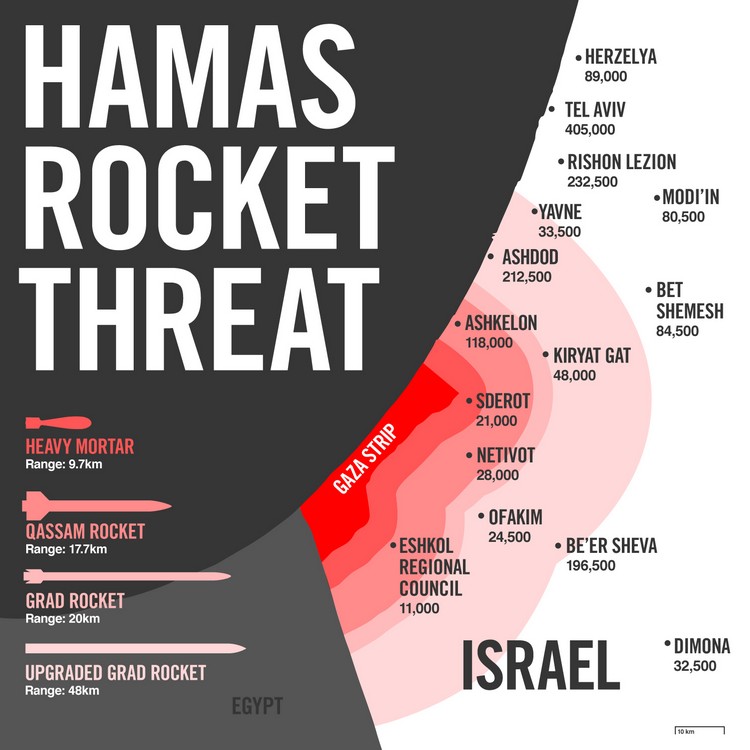
As 90 rockets exploded across southern Israel on Wednesday night, schools within 40 km. of the Gaza Strip were declared closed, and residents were urged to follow directives from the IDF Home Front Command. The Iron Dome rocket defense system intercepted 29 rockets.

Schools and universities will be closed in the South on Thursday from Beersheba to Ashdod.

Gaza-border communities are in lockdown, with residents ordered to remain in their homes if they live within 7 km. of Gaza.

Explosions have been reported as far away as Dimona, some 75 km. from the Gaza Strip.
Courtesy of IDF Spokesman

At an emergency meeting in Tel Aviv, the security cabinet authorized Defense Minister Ehud Barak to mobilize reservists if needed.

The cabinet also agreed that the IDF should continue to act against terrorist infrastructure and activity in Gaza. It instructed the Foreign Ministry to begin a diplomatic public relations campaign to explain that Israel was acting in self-defense against military targets, because the continued rocket barrage had become intolerable.

Prime Minister Binyamin Netanyahu spoke on the telephone on Wednesday night with US President Barack Obama, Vice President Joe Biden and EU foreign policy chief Catherine Ashton. He was also scheduled to speak with UN Secretary-General Ban Kimoon.

The prime minister thanked Obama and Biden for taking the position that Israel had a right to defend itself.

The military operation immediately increased tensions with Egypt, which condemned Israel’s actions and recalled its ambassador.

But Barak and Netanyahu held a joint press conference to explain that they had no choice.

“Today we relayed a clear message to the Hamas organization and other terrorist organizations,” Netanyahu told reporters. “And if there is a need, the IDF is prepared to broaden the operation. We will continue to do everything in order to protect our citizens.

Barak said, “We are still at the beginning of the event, not at the end, and we expect some complicated tests ahead. It will require vigilance; not only in Gaza, but also in Israel and in Judea and Samaria. But in the long run I believe that this operation will contribute to strengthening deterrence and reinstituting the calm in the South.”

He added that the operation was designed to damage rocket- launching networks, deliver a “painful blow” to Hamas and other terrorist organizations, and protect the home front.

On Tuesday, it had appeared as if an uneasy calm had been restored. Barak and Netanyahu helped to strengthen that impression, by traveling to the North and talking about Syria, even as they gave the final authorization for Wednesday’s targeted killing.

The operation began at 4 p.m. over Gaza City, where a missile hit a car carrying Hamas armed wing chief Jabari, killing him and a second man. Conflicting reports emerged over whether the second casualty was Jabari’s bodyguard or his son. An air strike in southern Gaza killed a second senior Hamas man.

The IDF warned all terrorists in Gaza to remain underground if they wished to live.

The strikes were accompanied by a series of sorties targeting underground launchers loaded with long-range Hamas missiles that can reach more than 40 km. away from Gaza, such as Fajr missiles. The air strikes eliminated most of Hamas’s long-range capabilities, the IDF believes.

“The first aim of this operation is to bring back quiet to southern Israel, and the second target is to strike at terrorist organizations,” IDF spokesman Brig.-Gen. Yoav Mordechai said. “The home front must brace itself.”

He described Jabari as a man with “a lot of blood on his hands,” and Gaza as a “forward Iranian base” where terrorist factions had spent years building up a rocket arsenal.

“This is the beginning of the operation,” Mordechai warned. “All options are available,” he added, alluding to the possibility of a ground incursion.

Hamas warned that “the gates of hell had opened,” as it struggled in the first few hours after the strikes to regain its footing. As the evening drew on, the Hamas regime fired increasing numbers of rockets across the border into southern Israel

Following the Hamas attacks, the IDF struck dozens of underground rocket launchers loaded with medium-range projectiles that can reach as far as 40 km.

Israel Navy ships also fired at Hamas terrorist targets along the Gaza coast.

Prior to the operation, IDF Chief of Staff Lt.-Gen. Benny Gantz spent two days finalizing its details, as the defense minister repeatedly visited the Gaza Division to go over the plans.

Most of the Gaza weapons storage sites targeted by the Israel Air Force were located in civilian residential buildings.

“This is further evidence of Hamas’s pattern of using the population in Gaza as human shields,” an IDF source stressed.

Before the operation was launched, four rockets – believed to have come from Egypt’s Sinai Peninsula – exploded in the Eshkol region.

The operation came after Hamas and Islamic Jihad fired 128 rockets into southern Israel earlier this week.

Arab countries condemned Israel’s actions, while the US called on Hamas to stop its attacks against Israel.

“We strongly condemn the barrage of rocket fire from Gaza into southern Israel, and we regret the death and injury of innocent Israeli and Palestinian civilians caused by the ensuing violence. There is no justification for the violence that Hamas and other terrorist organizations are employing against the people of Israel,” the US State Department said.

“We call on those responsible to stop these cowardly acts immediately. We support Israel’s right to defend itself, and we encourage Israel to continue to take every effort to avoid civilian casualties,” it said.

US backs Israel; UN calls for de-escalation

November 15, 2012

US backs Israel; UN calls for de-escalation – Israel News, Ynetnews.

Obama speaks to Netanyahu, Morsi and reiterates US support for Israel’s right to self-defense; Ban Ki-moon discusses need to prevent further deterioration with two leaders

Yitzhak Benhorin

Published: 11.15.12, 04:23 / Israel News

Leaders around the world are closely monitoring the conflict between the IDF and Gaza’s terrorist groups. While the US is standing by Israel‘s side, the majority of the world’s leaders called both sides to exercise restraint.

Leaders in the Arab world strongly condemned Israel for killing top Hamas military commander Ahmed Jabari.

On Wednesday, US President Barack Obama spoke to Prime Minister Benjamin Netanyahu and Egyptian President Mohamed Morsi and reiterated US support for Israel’s right to self-defense in light of rocket attacks from Gaza, the White House said.

“The President urged Prime Minister Netanyahu to make every effort to avoid civilian casualties. The two agreed that Hamas needs to stop its attacks on Israel to allow the situation to de-escalate,” the statement said.

“The two leaders agreed to stay in close touch in the coming days. Earlier today, Vice President Biden received a briefing from Prime Minister Netanyahu on the events in Gaza,” the statement noted.

Netanyahu and Ban Ki-moon (Archive photo: Avi Ohayon, GPO)


“The President also spoke with President Morsi given Egypt’s central role in preserving regional security. In their conversation, President Obama condemned the rocket fire from Gaza into Israel and reiterated Israel’s right to self-defense,” it said.

United Nations Secretary-General Ban Ki-moon called for an “immediate de-escalation of tensions.” In a statement, Ban said that “Both sides should do everything to avoid further escalation and they must respect their obligations under international humanitarian law to ensure the protection of civilians at all times.”

Ban’s press office said in two separate statements that he also spoke on the telephone with Netanyahu and Morsi.

“(Ban) expressed his concern (to Netanyahu) about the deteriorating situation in southern Israel and the Gaza Strip, which includes an alarming escalation of indiscriminate rocket fire from Gaza into Israel and the targeted killing by Israel of a Hamas military operative in Gaza,” the UN said.

Ban also voiced his expectation that “Israeli reactions are measured so as not to provoke a new cycle of bloodshed.”

He also discussed with Morsi “the need to prevent any further deterioration,” the UN said in a second statement.

The UN Security Council will hold a closed emergency meeting on Wednesday night to discuss Israeli strikes against the Gaza Strip.

Anti-Israel protests in Egypt (Photo: AP)


The US on its part backed Israel’s decision to launch Operation Cloud Pillar. “We support Israel’s right to defend itself, and we encourage Israel to continue to take every effort to avoid civilian casualties,” Deputy State Department spokesman Mark Toner said in a statement.

Toner added that Washington “strongly condemns the barrage of rocket fire from Gaza into southern Israel, and regrets the death and injury of innocent Israeli and Palestinian civilians caused by the ensuing violence.

“There is no justification for the violence that Hamas and other terrorist organizations are employing against the people of Israel. We call on those responsible to stop these cowardly acts immediately.”

Also Wednesday, a group of five US senators issued a statement expressing their support for Israel after being briefed by Israel Ambassador in Washington Michael Oren about the situation in Israel’s south.

The senators, Republicans and Democrats alike, said in the statement “We strongly support Israel’s right to defend its people and call on those responsible for the violence to cease their attacks against Israel immediately.” They denounced “the reprehensible and indiscriminate” rocket attacks launched against innocent Israeli citizens.

On the other side of the Atlantic, Britain issued a more neutral statement. “We continue to call on all sides to exercise restraint to prevent a dangerous escalation that would be in no-one’s interests,” a British Foreign Office statement said.

Qatar: Filthy crime

Meanwhile, leaders in the Arab world blamed Israel for the escalation.

Egyptian Foreign Minister Mohamed Kamel Amr condemned Israel’s airstrikes in Gaza remarking that “the Israeli escalation comes at a critical point in the Middle East which threatens to harshly exacerbate matters.”

The Muslim Brotherhood called on the Arab world to boycott Israel while the Freedom and Justice Party said that Cairo will not ignore the harming of Palestinians.

The party said that “this crime warrants a swift Arab and international move in order to stop the acts of carnage against the Palestinian people in Gaza which Israel’s government uses as bargaining chip as part of the political conflict in Israel.”

Qatar’s Foreign Minister Hamad Bin Jassim al-Thani strongly condemned the Israeli strikes in Gaza calling them “a filthy crime” that must not be ignored. “The Security Council must meet its obligation to maintain peace and security in the world,” he said.

Syrian officials also commented on the recent developments. “The Syrian government condemns the barbaric acts committed by the Israeli army against the Palestinian people in Gaza.” Damascus called on the international community to exert pressure on Israel to end “its aggression” in Gaza.

A stunning initial success for the IDF. Now what?

November 15, 2012

A stunning initial success for the IDF. Now what? | The Times of Israel.

The killing of Ahmed Jabari and the strategic blow to Hamas’s Fajr rocket capacity represent remarkable achievements for the IDF and the Shin Bet. The next phases are less clear

November 15, 2012, 3:09 am 5
Smoke from Israeli air strikes rising over Gaza on Wednesday (Photo credit: Edi Israel/ Flash 90)

Smoke from Israeli air strikes rising over Gaza on Wednesday (Photo credit: Edi Israel/ Flash 90)

Operation Pillar of Defense, from a military perspective, has begun with a resounding success. Ahmed Jabari, perhaps the strongest man in Hamas, is dead. And in a strike that is surely the result of years of methodical intelligence work, the IAF eliminated the majority of Hamas’s medium-range Fajr-5 rockets, which have the capacity to reach Tel Aviv.

These two strikes were cleverly unheralded by Prime Minister Benjamin Netanyahu and Defense Minister Ehud Barak, who kept their gaze ostentatiously on the Golan Heights earlier Wednesday – after the strike had already been ordered – perhaps lulling Jabari and others into an imprudently incautious state of mind.

Unlike the launch of the Second Lebanon War in 2006 – which began on Hezbollah’s terms but also featured the stunning elimination of nearly all of Hezbollah’s long-range rockets on Day One – the early stages of this operation appear to have been coordinated from the bottom up.

Barak defined the goals of the mission in clear terms, a step that was not taken during Operation Cast Lead in 2008-9. Dressed in his security chief garb of black leather jacket and black shirt, he said that Israel seeks to strengthen its deterrence; deplete and disrupt the Hamas rocket infrastructure; inflict wounds on Hamas and the other terror organizations; and minimize the damage to the Israeli homefront.

The first three goals have, to an extent, already been attained; Hamas will do absolutely everything in its power to ensure that the fourth is not until it has an achievement to present to the people of Gaza.

The IDF will keep up the relentless air pressure with the unspoken threat of launching a ground operation if Hamas and the other terror groups strike at Tel Aviv or other strategic areas.

Beyond that little is clear, for Hamas knows that Israel does not want to topple the regime entirely and usher in an era of chaos in the Gaza Strip, and Israel knows that it is very difficult to score points against a terror organization reared on the ethos of suicide and dispersed among one of the most densely populated civilian areas in the world.

“This is the beginning of an event and not the end,” Barak said, adding that the IDF was prepared “to broaden” the operation.

The initial airstrike, at 4 pm Wednesday afternoon, required both terrific intelligence work and incredibly fast cooperation between the Shin Bet and the Air Force.

Maj. Gen. (res.) Eitan Ben-Eliyahu, the commander of the Air Force from 1996-2000, said on Channel 2 news that in this case, much like the assassination of Hamas spiritual leader and founder Ahmed Yassin in 2004, the Air Force probably didn’t have more than 20 seconds to execute the strike.

Jabari was traveling along with his son on Omar al-Mukhtar St. in central Gaza. The mere fact that he had managed to head the Murabiton, Hamas’ army, for the better part of 10 years means that he was not a foolhardy individual. He did not talk much, if at all, on the phone. He kept careful company. He did not repeat his movements day after day. Otherwise he would have met his end long before.

For the Shin Bet to be able to deliver the commander of the military wing at the start of a serious military confrontation is a startling achievement. One need only compare it to the fate of Mullah Muhammad Omar, the leader of the Taliban on the eve of the United States’ invasion of Afghanistan, who is reportedly still alive and well.

But the second part of the strike may even be more significant (depending on whether Jabari proves to have been an irreplaceable commander in the image of Hezbollah’s military chief Imad Mughniyeh). Within minutes the IDF wiped out “the majority” of Hamas’s Fajr rockets, Barak said.

Such a strike requires enormous amounts of accurate intelligence, painstakingly assembled and verified, since organizations like Hamas and Hezbollah hide their strategic weapons amid the civilian population.

The IDF carried out a similar strike during the night of July 12-13, 2006, when the Second Lebanon War began. In the space of 34 minutes the IAF managed to wipe out the majority of Hezbollah’s medium and long range rockets.

The IDF Spokesperson at the time, Brig. Gen. (res.) Miri Regev (now a Likud MK), said that had she known about the success of what was codenamed Operation Mishgal Seguli, on the first night of the war, she could have created sufficient media leverage to end the war then and there.

This time the IDF Spokesperson’s Office published the achievement immediately.

But the situation, of course, is different.

Israel has eliminated Hamas’s chief of staff. “The first thing they’ll do is seek revenge,” said a former deputy commander of the Shin Bet, MK Yisrael Hasson, on Army Radio, indicating that the organization will make a desperate and steadfast attempt to launch rockets into Israel or draw Israeli blood in some other fashion.

The second stage for Hamas, Hasson said, would be to cling “to their strategic holdings, the deterrence they have achieved with Israel.”

This means that it is extremely unlikely we will see Hamas calling for a ceasefire in the near future. It cannot afford to seem weak — even at the cost of an operation that is sure to end with a severely lopsided body count.


