Archive for November 1, 2012

Was The Alleged Attack on Sudan Prelude to Iran?

November 1, 2012

Was The Alleged Attack on Sudan Prelude to Iran? | Defense Update Portal.
Posted by

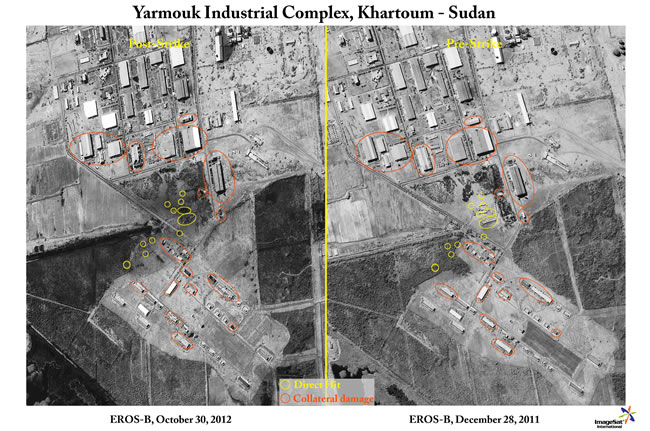
EROS Satellite images of the Yarmouk ammunition plant in Khartum, Sudan, before and after the pre-dawn attack October 24, 2012. Photos: Imagesat

A powerful explosion at the Yarmuk military factory rocked Sudan’s capital before dawn, sending detonating ammunition flying through the air and causing panic, the Sudan official news agency and local media reports said. Thick black smoke covered the sky over the Military Industrial Complex in southern Khartoum. Sudan’s media reported that nearby buildings were damaged by the blast, their roofs blown off and their windows shattered. The effects of the blast suggested a “highly volatile cargo” was at the epicenter of the explosion.

The Sudanese minister who immediately accused Israel of carrying out an aerial strike on a weapons factory near Khartoum apparently knew what he was talking about. Although located inside a strong security perimeter around it, the so-called Yarmuk compound run by the Military Industry Corporation, is well known to Sudanese as Iranian territory, serving as a stopover in weapons smuggling to Hamas Gaza. The minister showed journalists a video of a huge crater next to two destroyed buildings and what appeared to be an unidentified rocket motor lying on the ground. Analysing the explosions and the massive fire which blazed for hours, setting off more fires even days after the attack, it seems that the “factory” must have contained a large amount of explosives and inflammatory substances, indicating military nature. It also seems viable that the target could have been a series of containers stored inside the compound, which were loaded and ready for dispatch.
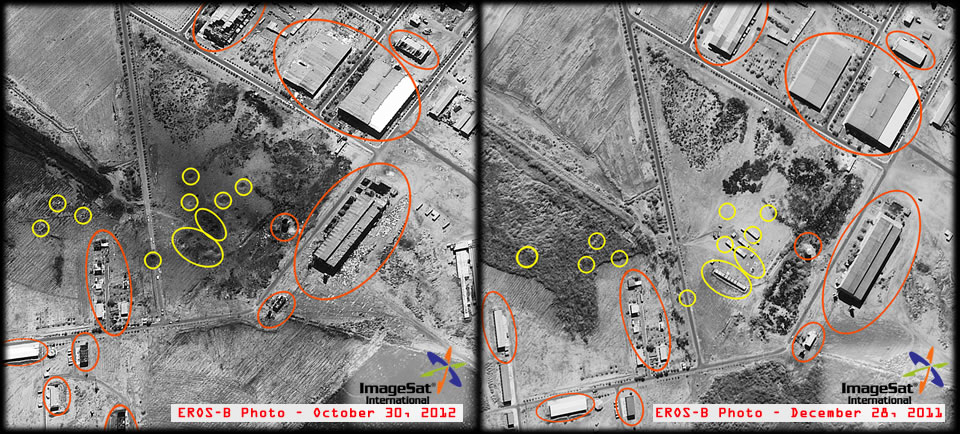
Two images of the Yarmouk ammunition plant in Khartum, Sudan, taken by the Israeli EROS-B spy satellite, before and after the attack.

Two images of the Yarmouk ammunition plant in Khartum, Sudan, taken by the Israeli EROS-B spy satellite, before and after the attack. The image on the right, taken December 28, 2011 shows the container storage area. The image on the left, taken after the attack, October 30, 2012 shows 11 craters, most probably created by aerial weapon’s explosions. Most of the hits are in the storage area where the containers were parked in the open since late last year. It is likely these containers were storing explosives and propellants or finished missiles, loaded with both. The craters at the site indicate relatively small weapons, but the effects of a huge secondary explosion are evident at distance of up to 500 meters. Structures facing the parking area that exploded were shuttered, debris on the opposite side indicate the impact of the blast. The fire that erupted from the trailer park consumed a wide area around the base as well. Several hits marked outside the target area, including one that has hit the access road, are believed to be misses. Photos: Imagesat

Witnesses testified to seeing jets fly over the area at dawn should not be reliable, as manned aircraft would not have flown so close to the ground in an attack to be identified. However, the so-called aircraft could have been weaponized unmanned aerial vehicles, or drones performing post-strike battle-damage assessment. Israel has long-range UAV, some of these very large aircraft, but so far the authorities have denied them carrying weapons.

This factory, which is situated inside a military compound near Khartoum and allegedly manufactures various types of rockets and light weapons, was constructed with Iran’s assistance some four years ago in the framework of a cooperation agreement between the two ‘pariah’ states.

Sudan is isolated from the international community due to the genocide in Darfur, and the West has imposed crippling sanctions against Iran over its nuclear program. Both governments have an interest in transferring arms to Hamas in Gaza. In 2009, a convoy carrying weapons in northeastern Sudan was targeted from the air, killing dozens. It was widely believed that Israel carried out the attack on a weapons shipment headed for Palestinian militants in the Gaza Strip. Israel never confirmed or denied that.

Sudan is already a well known major hub for al-Qaeda militants and remains a transit for weapon smugglers and African migrant traffickers. Israeli officials believe arms that originate in the Iranian port of Bandar Abbas go through Sudan before crossing Egypt’s lawless Sinai desert and into Gaza through underground tunnels.

In May 2010 the Sudanese newspaper Ray Al-Sha’b reported that the Iranian Revolutionary Guards Corps was operating a secret weapons factory in Sudan to supply weapons to terrorist groups across Africa and the Middle East. It also suggested Iran was cooperating with Sudan to produce nuclear weapons. The Khartoum regime closed the paper immediately and arrested the deputy-editor.

The factory’s name, “Yarmouk,” also alludes to the identity of its Palestinian “clients.” As part of the deal, the Sudanese earned money and apparently received weapons, while the Iranians shortened the supply routes to Hamas in Gaza, Hezbollah in Lebanon and perhaps even to Syria, thus decreasing the risk of Israeli attacks on arms convoys – or so they thought at the time.

In 1998, Human Rights Watch published a report based on information from Sudanese opposition organizations which said that the Yarmouk plant was used to store chemical weapons for Iraq. Sudan vehemently denied the allegations.

That year, the United States used cruise missiles to bomb a Khartoum pharmaceutical factory suspected of links to al-Qaeda in the aftermath of the terror group’s bombings of U.S. embassies in Kenya and Tanzania that killed 224 people.

The Sudanese regime has a “distinguished pedigree” supporting international terrorism. In the 1990s it gave sanctuary to so many outlaws, the capital, Khartoum, was known as “the Holiday Inn for Terrorists.” Al Qaeda, Hamas, Islamic Jihad and Carlos the Jackal all called Khartoum home. It was Khartoum’s five years playing gracious host to Osama bin Laden that earned it US sanctions in 1997.

Moreover, Sudan is a terrorist state in its own right. The same Arab nations condemning Israel this week have been mute in the face of Khartoum’s ruthless suppression of its own Muslim citizens in Darfur since 2003, and thirty years of ethnically cleansing those within its own borders it considers insufficiently enthusiastic about its version of Islamism.

Should the Sudanese minister’s claim that four Israeli warplanes bombed the arms factory be reliable, then this was an impressive display of the IDF’s long strategic arm. The Israeli Air Force already proved 27 years ago that it can successfully attack targets located over 1,500 kilometers away. In 1985 Israeli jets bombed the PLO headquarters in Tunis, but the fact that the target was situated near the coast helped Israeli forces approach it undetected. Khartoum, on the other hand, is located deep inside Sudanese territory and is surrounded by numerous radar facilities.

The Sudanese minister said Israeli planes used electronic countermeasures to avoid detection by Sudanese air defenses, but experts say they could have flown over “dead areas” where they could not be detected by radars. In any case, the Sudanese cannot prove Israel attacked the arms factory.

However, if Israeli jets did carry out the strike, it means it took place some 1,600 kilometers from Israel, nearly the same distance between central Israel and the uranium enrichment plants in Iran – one near the city of Kashan (“Natanz”) and the other near Qom (“Fordo”). Therefore, the attack, if it was carried out by Israel, also sent a strong message to Tehran.

The Satellite Sentinel Project, an American monitoring group said on Saturday that satellite images of the aftermath of the Wednesday explosion suggested the site was hit by an airstrike. The images released by the Satellite Sentinel Project to the Associated Press showed at least six 52-foot (16-meter) wide craters at the compound. The Israeli EROS-B imagery confirms these facts with higher resolution images, (displayed above). The EROS_B images also indicate at least four ‘near misses’ which may have caused some of the fires that erupted around the compound.

Until now the Iranians did not take Israel’s threats seriously. They did not believe Israel had the ability to attack its nuclear installations or that the Israeli government would have the courage to risk losing dozens of pilots and planes. But now, after the attack in Sudan and the bombing of a Syrian reactor in 2007, which foreign media attributed to Israel, the Iranians may reassess Netanyahu and Barak’s seriousness when they declare that “all options are on the table.”

There is no doubt that the explosions at the Sudanese arms factory have given elements in Khartoum, Gaza and Tehran something to think about.

Syria war puts anti-US alliance on the defensive

November 1, 2012

Syria war puts anti-US alliance on the defensive.

FILE -- In this Thursday February 25, 2010 file photo, released by the Syrian official news agency SANA, Hezbollah leader sheik Hassan Nasrallah, right, speaks with Syrian President Bashar Assad, left, upon their arrival for a dinner, in Damascus, Syria. The powerful alliance of Iran, Syria and militant groups Hezbollah and Hamas, once dubbed the "Axis of Resistance," is fraying. Iran

Associated Press

(AP) When the Hamas rulers of Gaza recently gave a hero’s welcome to the ruler of Qatar, an arch foe of the Syrian regime, it sent a strong message reverberating across the capitals in Tehran, Damascus and Beirut.

The powerful, anti-American alliance of Iran, Syria and militant groups Hezbollah and Hamas, once dubbed the “Axis of Resistance,” is fraying.

Iran’s economy is showing signs of distress from nuclear sanctions, Syria’s president is fighting for his survival and Hezbollah in Lebanon is under fire by opponents who blame it for the assassination of an anti-Syrian intelligence official. Hamas the Palestinian arm has bolted.

“We’re seeing basically the resistance axis becoming much more vulnerable and under duress. So even if it survives, it’s really under tremendous pressure,” said Fawaz Gerges, director of the Middle East Center at the London School of Economics.

“The Hamas shift to the Saudi-Qatari-Turkish orbit represents a major nail in the coffin of the resistance axis,” he said. “Now you are talking about Iran and Syria and to a lesser extent Iraq and this undermines the social element because Hamas added the very important Sunni dimension.”

The axis is one of two powerful camps that divide the Middle East into spheres of competing influence. It faces off against the wealthy, powerful monarchies of Saudi Arabia and Qatar allied loosely with most of the other Arab countries and neighboring Turkey, which like Iran is Muslim but not Arab.

The fault line is sharply sectarian Iran and Hezbollah are Shiite and Assad’s regime is dominated by the Alawite sect, an offshoot of Shiite Islam. Hamas, which is Sunni, had been the exception before it strayed. Qatar, Saudi Arabia and other Sunni Muslim-led Arab countries in the Gulf have been trying to stem the regional influence of Iran.

Also, the Sunni countries, along with Turkey, support the Sunni-dominated opposition waging the civil war against Assad’s rule in Syria.

The axis had been gaining power over the decade before the Syrian uprising began in March 2011 and formed a powerful front against Israel and the key U.S. allies in the Middle East such as the oil-rich Gulf states. Iran has long supported Hezbollah and Hamas as proxies in its battle against Israel. And Tehran also troubled the west with its dogged pursuit of uranium enrichment, a program the U.S. and its allies suspect is aimed at producing nuclear weapons but which Iran says is for peaceful purposes.

Syria has long boasted about being one of the few protectors of militant groups fighting Israel. It is the main transit point of weapons brought from Iran to Hezbollah and a collapse of Assad’s regime would make it difficult for arms to reach the militant group that has been exchanging threats with the Jewish state and fought a 2006 war with Israel.

The axis also spread its influence to Shiite majority Iraq, where the fall of Saddam Hussein and his Sunni-dominated regime gave way to a government controlled by Shiites.

Only few years ago, the coalition was becoming so powerful that King Abdullah of Jordan warned of a “Shiite crescent,” meaning countries from Iran, Iraq, Syria and Lebanon.

A new boldness was seen in 2010 when Hezbollah leader Sheik Hassan Nasrallah emerged from hiding for a rare public trip to Damascus, where he attended a meeting with his powerful regional allies, Assad and Iranian President Mahmoud Ahmadinejad. The leaders smiled confidently and appeared relaxed in footage of their meetings, a show of force meant to deter and demonstrate the unshakable power of the “Axis of Resistance.”

The uprising against Assad that erupted 19 months ago, amid tumultuous changes sweeping the Arab world, shook a major pillar of the alliance.

“The fate of the alliance rests on the future of the Assad regime. If Assad goes, Iran and Hezbollah will suffer and find it much more difficult to plan, coordinate, and communicate,” said Bilal Saab, a Middle East expert at the Monterey Institute of International Studies.

The brutal crackdown by Assad’s regime on the Sunni-dominated uprising was an embarrassment to Hamas, the main Palestinian arm of the coalition. Hamas leaders in exile, who had been based in Damascus since the late 1990s, left for Egypt, Qatar and other countries.

Hamas officials said privately that they could not be seen supporting a regime that was brutally suppressing a popular rebellion, particularly since most of those rising up against Assad are fellow Sunni Muslims.

This about-turn also caused new tensions with the Palestinian movement’s main financial backer, Iran. Tehran demanded that Hamas step up and support Assad publicly. Hamas refused to do so, but didn’t break ties entirely with Tehran, for lack of an alternative source of funds.

However, another benefactor may now be stepping forward.

Last week, the emir of Qatar, a vociferous critic of Assad, became the first foreign leader to visit the Gaza Strip. In a way, it formally sealed the break by Hamas from the “Axis of Resistance.”

The trip offering the internationally isolated Hamas leadership there an unprecedented stamp of approval and Qatar promised more than $400 million in development projects for the impoverished territory.

The Qatari leader’s generosity will likely give him some leverage over Hamas’ decision-making at a time of growing debate within the movement over whether to stay in the orbit of Iran and other radical groups or move closer to the more moderate Gulf Arab camp.

Syria’s president has painted the uprising against him as a universal attack designed to destroy the entire “Axis of Resistance.” Last month, Assad told Iran’s visiting foreign minister that the fight against his government “targets resistance as a whole, not only Syria.”

“There will have to be serious adjustments in the axis should Assad go and preparations in Tehran for the day after are, I assume, already underway,” Saab said.

Hezbollah, which supported revolutions in Tunisia, Egypt, Yemen, Libya and Bahrain, backed Assad in the crackdown. That support turned much of the Middle East’s Sunni population against the group they once looked up to.

The group came under renewed pressure and criticism earlier this month when a car bomb in Beirut on Oct. 19 killed one of the country’s top intelligence officials, an anti-Syrian figure. Hezbollah’s opponents at home immediately pointed fingers at the group, calling for the resignation of the government Hezbollah now dominates.

Iran, the wealthiest and most powerful member of the alliance, has reportedly sent billions of dollars to Assad to help suppress the uprising, according to a recent report by Times of London. Tehran has given Hezbollah billions since the group was created in 1982.

But now Iran is struggling to cope with Western sanctions that have ravaged its economy. The sanctions aim at thwarting its nuclear program.

The distress was all too apparent in the freefall of Iran’s currency the rial, which lost more than a third of its value in a week. The decline is widely tied to the effects of sanctions.

Israel has threatened to carry out a military strike against Iran’s nuclear facilities to prevent Iran from acquiring nuclear weapons. Gen. Amir Ali Hajizadeh, who heads the Iran’s powerful Revolutionary Guard’s aerospace division, warned that Iran will target U.S. bases in the region in the event of war with Israel.

“The question is not whether it (the alliance) will survive or not. The question is will it have the capacity to act offensively,” said Gerges. It is on the defensive.”

___

Associated Press writers Karin Laub and Zeina Karam contributed to this report.

Mofaz: Netanyahu Preparing ‘Nuclear Spring’

November 1, 2012

Mofaz: Netanyahu Preparing ‘Nuclear Spring’ – Inside Israel – News – Israel National News.

Kadima chairman says Prime Minister has messianic Iran obsession, wants to embroil Israel in war.

By Gil Ronen

First Publish: 11/1/2012, 8:09 PM


Mofaz at news conference

Mofaz at news conference
Israel news photo: Flash 90

Kadima chairman Shaul Mofaz opened his party’s election campaign in a news conference Thursday, by accusing Prime Minister Binyamin Netanyahu of a reckless policy vis-à-vis Iran.

“In the last four years, Netanyahu has been busy with just one thing: bombing Iran,” said MK Mofaz. “Nothing else interests him. Not society, not the economy, nothing; just a messianic urge to attack and bomb the Iranian nuclear project… Anyone who has been in the Prime Minister’s Office knows that this has become an obsession with him.”

The merger between Likud and Yisrael Beytenu is a dangerous one, he warned. “The irresponsible man has joined forces with the man who has no brakes. Bibi and Lieberman together. Bibi with the messianic belief in attacking Iran, and Lieberman, the man with no brakes, who threatened to bomb the Aswan Dam.”

“Netanyahu is preparing a nuclear spring for us and wants to embroil us in war,” the former Defense Minister said.

MK Danny Danon (Likud) reacted by saying: “Kadima’s death throes are embarrassing. The decision to base its campaign on attacking the prime minister indicates that the end is near for the spineless supermarket party known as Kadima.”

Libyan cop was caught photographing inside of US consulate in Benghazi on morning of September 11, TV report says

November 1, 2012

Libyan cop was caught photographing inside of US consulate in Benghazi on morning of September 11, TV report says | The Times of Israel.

US officials wrote worried letters to Libyan authorities, protesting inadequate security, hours before Ambassador Stevens was killed

November 1, 2012, 7:14 pm 0
The Alaan TV report broadcast November 1. (photo credit: MEMRI screenshot)

The Alaan TV report broadcast November 1. (photo credit: MEMRI screenshot)

A Libyan policeman was caught photographing the inside of the US Consulate in Benghazi on the morning of September 11, hours before US Ambassador Chris Stevens was killed in a terror attack there, and worried US consular staff complained to the Libyan Foreign Ministry over the security breach, an Arabic TV station reported on Thursday, quoting from letters found at the consulate after it was attacked.

A document shown in the Alaan TV report broadcast November 1. (photo credit: MEMRI screenshot)

A document shown in the Alaan TV report broadcast November 1. (photo credit: MEMRI screenshot)

Alaan TV, a channel based in the United Arab Emirates, said the letters also showed that the Americans had been urging the Libyan authorities to provide special security arrangements for Stevens’ visit — including a 24-hour police guard at the front and rear gates of the consulate, a mobile patrol and a bomb-sniffing dog — but these requests were not granted. The consulate was left for many hours “with no police support at all,” one letter complained.

In excerpts of the TV broadcast recorded and translated by MEMRI (the Middle East Media Research Institute), Alaan TV said it was basing its report on documents written by US consulate staff on September 11 and found “in the Tactical Operations Center building” of the consulate.

The report referred to two letters — one addressed to the Libyan Ministry of Foreign Affairs, and the other, almost identical in content, addressed to the Benghazi police chief.

“In the letters, the Americans complained about an incident that occurred on the morning of September 11, an incident they described as ‘troubling’,” the report said.

It quoted from one of the letters, as follows: “‘Early this morning, on September 11, 2011 [sic], at precisely 06:43, one of our diligent guards made a troubling report. Near our main gate, a member of the police force was seen [in] the upper level of a building across from our compound. It is reported that this person, who belongs to the police unit sent to protect the U.S. Special Mission, was photographing the inside of the U.S. consulate.”

The letter said a Libyan police car was seen at the scene, and specified: “The police car stationed where this event occurred was number 322.”

The TV report said it seemed clear “from the tone of the letter that the Americans were extremely concerned about this incident, describing it as ‘troubling’… They were hoping that the Libyan authorities would conduct an official investigation into this incident.”

The report said the letters revealed that, since September 9, “the Americans had been requesting special security arrangements in preparation for the arrival of Ambassador Chris Stevens to Benghazi. These arrangements included the police guarding the front and rear gates of the consulate around the clock, in addition to a mobile patrol and a bomb-sniffing dog.

“The Americans, however, were not granted these requests, as was made clear from the letter, dated September 11, just hours before the attack.” The TV report quoted from this letter as follows, “We are saddened to report that we have only received an occasional police presence at our main gate. Many hours pass when we have no police support at all.”

The TV report ended by stating, “This is how the attack on the U.S. consulate began, 15 hours after the policeman was seen photographing the building.”

Alaan TV, which operates from Dubai, began broadcasting in August 2006, MEMRI said, adding: “It states that its aim is the cultural enrichment of Arab women, and it has often focused on Al-Qaeda and other terror organization from a critical point of view, inter alia interviewing family members of jihadi leaders.”

Obama and the crumbling world order

November 1, 2012

Israel Hayom | Obama and the crumbling world order.

Daniel Doron

“The results will be what they may, but Israel will have a friend in the White House in January of 2013,” according to Oded Eran and Owen Alterman from the Institute for National Security Studies at Tel Aviv University. The pair analyzed the final debate between U.S. President Barack Obama and his Republican rival Mitt Romney, and drew their conclusion from positive comments the candidates made about Israel during the debate.

There is a risk, of course, in trusting a candidate’s declarations on the eve of elections, especially if he needs the Jewish vote. It is prudent to paint a complete picture, based on the candidate’s past statements and actions.

Romney has never determined U.S. foreign policy, but in many of his statements he has shown a deep understanding of Israel’s difficult geopolitical reality. Obama, who has determined foreign policy in the Middle East, lets us conclude from what he has said and done that he does not especially excel in his support of Israel. One can argue, of course, that he wants the best for Israel, at least for those who think that helping Israel includes creating another Arab country alongside it. However, the crude pressure he has applied and his attitude toward Israel — specifically during his speech in Cairo in which he compared Palestinian Arab refugees to Holocaust refugees — do not place him in the “friend” category.

Obama’s approach to Israel is derived from a world view that includes hostile attitudes toward the “capitalist” West, where he identifies a system of evil regimes that exploit and subjugate Third World nations. There is reasonable reason to worry that as the close friend of Professor Rashid Khalidi, who was close to Yasser Arafat and a student of Edward Said, Obama sees the creation of Israel as an imperialistic invasion into the Islamic world. He demands that Israel compensate the Palestinians by establishing an Arab state to correct the injustice caused to them.

The immense risk that Hamas could take control over this state, and use it to conduct a bloody war, apparently does not trouble the president.

Obama’s world view influenced the profession he chose for himself following his university studies and before entering Chicago’s corrupt political system.

Obama was a community organizer, a job invented by Saul Alinsky, a Jewish thinker who described in his book “Rules for Radicals” how it was possible to change the existing public order through cadres of extremist activists who recruit young people from universities, churches and even street gangs to partake in uninhibited subversive activity.

Machiavelli wrote “The Prince,” according to Alinsky, “to preserve the power of those with means. My book is intended to aid those without the means to control the government … it is for those who want to change the world from what it is, to what they believe it should be.” (In Hebrew, this would be for the “social activists” who believe that the “people want social justice.”)

To carry out a successful revolution, the radical community organizer must first win the trust of the prevailing system, and then destroy it from the inside by inflaming hatred and divisions that motivate young people to rebel and tear down the existing social order.

“The first step toward community organizing is to destroy the existing system,” Alinsky writes. There is no doubt that Lenin and Stalin would have nodded in satisfaction (Dostoyevsky, who authored “Demons,” would have nodded loathingly), despite Alinsky’s characterization as more of an anarchist than a Marxist.

Obama’s world view is important because only by understanding it can we see that the president is not a failure, as his rivals claim, but a supremely talented individual who conquered the presidency out of nowhere, undermined the world order within four years and made the U.S. economy dependent on the government. All this in order to build a new world on the ruins of the old, one in which the sect of “elected officials” completely control the fate of “the people,” exactly according to his guru and teacher, Alinsky.

Obama tried “saving” the American economy, the secret of American strength, from a severe crisis by nationalizing the healthcare system and increasing the national debt by $5 trillion, which flooded the market with money (which will lead to unmitigated, devastating inflation), and by increasing regulations and taxes on small businesses, the main job creators in the entire economy. The results thus far have been devastating.

Obama made the U.S. weak, even to the point that Iran is ignoring it, and China and Russia continually goad it. He also helped Islamic radicals take over the Arab Spring.

These are all considerable achievements for the community organizer. If he is elected again, the destruction will be made complete.


Gov’t Establishes Dual Cyber Security Program

November 1, 2012

Gov’t Establishes Dual Cyber Security Program – Defense/Security – News – Israel National News.

Israel creating dual cyber security program to promote research and development, serving both civilian and defense goals.
By Chana Ya’ar

First Publish: 11/1/2012, 2:29 PM


IDF computer operations room

IDF computer operations room
Flash 90

Israel will create a dual cyber security program to promote research and development to serve both civilian and defense goals, the PMO says.

The government is to create a dual cyber security program to promote research development that will serve both civilian and defense goals, the Prime Minister’s Office announced Wednesday.

The project, to be named MASAD, will be a joint effort of the Israel National Cyber Bureau and Ministry of Defense Directorate for Research and Development.

The program is intended “to strengthen and advance Israel’s capabilities in cyberspace, turn it into a leading country in cyber technology and thereby serve as a new growth engine for the Israeli economy,” the PMO said in a statement.

The new project will begin with a starting budget of NIS 10 million in the coming year. It is designed for all those involved in the cyber field, from start ups to established companies and academia, the PMO said.

“The plan is an additional stage in advancing the technological infrastructure of the State of Israel and turning it into a global cyber power,” said Dr. Eviatar Matania, head of the INCB. “Cooperation with the DDR&D as a leading agency in the field of defense R&D in Israel, as well as the NIS 50 million 3-year-plan to encourage academic research and the plan for boosting the cyber security industry in Israel – are a significant component en route to reaching this goal.”

MoD DDR&D director Ofir Shoham added, “The plan is an additional layer in the MoD’s preparations to meet the cyber challenges currently facing the State of Israel and will continue to be so in the future… The MASAD plan is expected to link technological vectors based on the know-how and capabilities of companies and academia with common defense and civilian needs.”

Iran Offers to Send Emergency Aid Team to Stricken New York – NYTimes.com

November 1, 2012

Iran Offers to Send Emergency Aid Team to Stricken New York – NYTimes.com.

( Now this is really funny… – JW )

TEHRAN — Iranian rescuers and aid workers are on standby to fly to New York City to provide assistance to those affected by Hurricane Sandy, the head of Iran’s Red Crescent Organization said on Wednesday.

“We are ready to help the flood-stricken people of America,” Mahmud Mozaffar, who leads the organization, told the semiofficial Fars News Agency.

His men stand ready to board planes and fly to the United States to help out, assuming the American government accepts Iran’s offer, he said.

“If American authorities agree, we can send our rescuers with equipment and tools to American cities in the shortest period of time,” Mr. Mozaffar said.

Mark C. Toner, a spokesman for the State Department, said in an email message late Wednesday, “We have seen reports in the media, but at this time have received no official offer of assistance from the Iranian government or any Iranian entity.”

Dealing regularly with floods and earthquakes, Iran’s Red Crescent Organization is experienced in providing immediate assistance following disasters. But the organization, the Islamic version of the Red Cross, is closely affiliated with Iran’s government. According to documents disclosed by WikiLeaks, American officials suspect that some Red Crescent employees operate as spies when providing help in other countries.

The United States and Iran have not had diplomatic relations since the aftermath of the 1979 hostage taking of the United States Embassy in Tehran, but natural disasters have sometimes been a way of engaging in direct communication, beyond politics.

In 2003, the United States sent a C-130 military transport plane with a rescue team and an ambulance to the southeast Iranian city of Bam where 25,000 people died in a devastating earthquake, and in August the United States offered to do the same when more than 300 people were killed in two deadly earthquakes in the northwestern part of the country.

While Iranian authorities turned down the most recent offer, the United States Treasury Department temporarily lifted sanction restrictions to allow charities to send goods and money to the stricken area.

In June 2010, Iran’s Foreign Ministry and the Revolutionary Guards Corps said they were ready to help out the United States in controlling the oil spill in the Gulf of Mexico.

Hezbollah deploys advanced video surveillance along border

November 1, 2012

Israel Hayom | Hezbollah deploys advanced video surveillance along border.

Cameras placed on tree trunks and branches provide live video coverage 24 hours a day to an operations center in one of the nearby Shiite villages • Senior IDF officer: Israel to greatly reduce use of cluster bombs in any future war with Hezbollah.

Daniel Siryoti, News Agencies and Israel Hayom Staff
IDF soldiers at the Lebanese-Israeli border.

|

Photo credit: Reuters

Anti-U.S. alliance ‘under duress’

November 1, 2012

Anti-U.S. alliance ‘under duress’ – THonline.com: National/World: asia, politics, anti-zionism, islam and antisemitism, resistance movements.

The Iran, Syria, Hezbollah, Hamas connection is fraying at the edges.

Posted: Thursday, November 1, 2012 12:00 am | Updated: 6:09 am, Thu Nov 1, 2012.

BEIRUT — When the Hamas rulers of Gaza recently gave a hero’s welcome to the ruler of Qatar, an arch foe of the Syrian regime, it sent a strong message reverberating across the capitals in Tehran, Damascus and Beirut.

The powerful, anti-American alliance of Iran, Syria and militant groups Hezbollah and Hamas, once dubbed the “Axis of Resistance,” is fraying.

Iran’s economy is showing signs of distress from nuclear sanctions, Syria’s president is fighting for his survival and Hezbollah in Lebanon is under fire by opponents who blame it for the assassination of an anti-Syrian intelligence official. Hamas — the Palestinian arm — has bolted.

“We’re seeing basically the resistance axis becoming much more vulnerable and under duress. So even if it survives, it’s really under tremendous pressure,” said Fawaz Gerges, director of the Middle East Center at the London School of Economics.

“The Hamas shift to the Saudi-Qatari-Turkish orbit represents a major nail in the coffin of the resistance axis,” he said. “Now you are talking about Iran and Syria and to a lesser extent Iraq and this undermines the social element because Hamas added the very important Sunni dimension.”

The axis is one of two powerful camps that divide the Middle East into spheres of competing influence. It faces off against the wealthy, powerful monarchies of Saudi Arabia and Qatar allied loosely with most of the other Arab countries and neighboring Turkey, which like Iran is Muslim but not Arab.

The fault line is sharply sectarian — Iran and Hezbollah are Shiite and Assad’s regime is dominated by the Alawite sect, an offshoot of Shiite Islam. Hamas, which is Sunni, had been the exception before it strayed. Qatar, Saudi Arabia and other Sunni Muslim-led Arab countries in the Gulf have been trying to stem the regional influence of Iran.

Also, the Sunni countries, along with Turkey, support the Sunni-dominated opposition waging the civil war against Assad’s rule in Syria.

The axis had been gaining power over the decade before the Syrian uprising began in March 2011 and formed a powerful front against Israel and the key U.S. allies in the Middle East such as the oil-rich Gulf states. Iran has long supported Hezbollah and Hamas as proxies in its battle against Israel. And Tehran also troubled the west with its dogged pursuit of uranium enrichment, a program the U.S. and its allies suspect is aimed at producing nuclear weapons but which Iran says is for peaceful purposes.

Syria has long boasted about being one of the few protectors of militant groups fighting Israel. It is the main transit point of weapons brought from Iran to Hezbollah and a collapse of Assad’s regime would make it difficult for arms to reach the militant group that has been exchanging threats with the Jewish state and fought a 2006 war with Israel.

The axis also spread its influence to Shiite majority Iraq, where the fall of Saddam Hussein and his Sunni-dominated regime gave way to a government controlled by Shiites.

Only few years ago, the coalition was becoming so powerful that King Abdullah of Jordan warned of a “Shiite crescent,” meaning countries from Iran, Iraq, Syria and Lebanon.

A new boldness was seen in 2010 when Hezbollah leader Sheik Hassan Nasrallah emerged from hiding for a rare public trip to Damascus, where he attended a meeting with his powerful regional allies, Assad and Iranian President Mahmoud Ahmadinejad. The leaders smiled confidently and appeared relaxed in footage of their meetings, a show of force meant to deter and demonstrate the unshakable power of the “Axis of Resistance.”

The uprising against Assad that erupted 19 months ago, amid tumultuous changes sweeping the Arab world, shook a major pillar of the alliance.

“The fate of the alliance rests on the future of the Assad regime. If Assad goes, Iran and Hezbollah will suffer and find it much more difficult to plan, coordinate, and communicate,” said Bilal Saab, a Middle East expert at the Monterey Institute of International Studies.

The brutal crackdown by Assad’s regime on the Sunni-dominated uprising was an embarrassment to Hamas, the main Palestinian arm of the coalition. Hamas leaders in exile, who had been based in Damascus since the late 1990s, left for Egypt, Qatar and other countries.

Hamas officials say they could not be seen supporting a regime that was brutally suppressing a popular rebellion, particularly since most of those rising up against Assad are fellow Sunni Muslims.

This about-turn also caused new tensions with the Palestinian movement’s main financial backer, Iran. Tehran demanded that Hamas step up and support Assad publicly. Hamas refused to do so, but didn’t break ties entirely with Tehran, for lack of an alternative source of funds.

However, another benefactor may now be stepping forward.

Last week, the emir of Qatar, a vociferous critic of Assad, became the first foreign leader to visit the Gaza Strip. In a way, it formally sealed the break by Hamas from the “Axis of Resistance.”

The trip offering the internationally isolated Hamas leadership there an unprecedented stamp of approval and Qatar promised more than $400 million in development projects for the impoverished territory.

The Qatari leader’s generosity will likely give him some leverage over Hamas’ decision-making at a time of growing debate within the movement over whether to stay in the orbit of Iran and other radical groups or move closer to the more moderate Gulf Arab camp.

Syria’s president has painted the uprising against him as a universal attack designed to destroy the entire “Axis of Resistance.” Last month, Assad told Iran’s visiting foreign minister that the fight against his government “targets resistance as a whole, not only Syria.”

“There will have to be serious adjustments in the axis should Assad go and preparations in Tehran for the day after are, I assume, already underway,” Saab said.

Hezbollah, which supported revolutions in Tunisia, Egypt, Yemen, Libya and Bahrain, backed Assad in the crackdown. That support turned much of the Middle East’s Sunni population against the group they once looked up to.

The group came under renewed pressure and criticism earlier this month when a car bomb in Beirut on Oct. 19 killed one of the country’s top intelligence officials, an anti-Syrian figure. Hezbollah’s opponents at home immediately pointed fingers at the group, calling for the resignation of the government Hezbollah now dominates.

Iran, the wealthiest and most powerful member of the alliance, has reportedly sent billions of dollars to Assad to help suppress the uprising, according to a recent report by Times of London. Tehran has given Hezbollah billions since the group was created in 1982.

But now Iran is struggling to cope with Western sanctions that have ravaged its economy. The sanctions aim at thwarting its nuclear program.

The distress was all too apparent in the freefall of Iran’s currency the rial, which lost more than a third of its value in a week. The decline is widely tied to the effects of sanctions.

Israel has threatened to carry out a military strike against Iran’s nuclear facilities to prevent Iran from acquiring nuclear weapons. Gen. Amir Ali Hajizadeh, who heads the Iran’s powerful Revolutionary Guard’s aerospace division, warned that Iran will target U.S. bases in the region in the event of war with Israel.

“The question is not whether it (the alliance) will survive or not. The question is will it have the capacity to act offensively,” said Gerges. It is on the defensive.

Report: Arabs Won’t Help in Iran Attack

November 1, 2012

Report: Arabs Won’t Help in Iran Attack – Defense/Security – News – Israel National News.

Arab countries want to see Iran contained, but they won’t help in the effort, a report says
By David Lev

First Publish: 11/1/2012, 12:19 PM
Hamas leader Khaled Mashaal in Dubai

Hamas leader Khaled Mashaal in Dubai
Flash 90


A report in the Guardian Thursday said that senior American military officials have warned Israel that if Jerusalem carries out an attack on Iran, it should not expect any help from Arab countries in the Middle East. According to the report, the U.S. was recently told by several of its allies in the Middle East that they would refuse to get involved in the conflict, not even providing passive assistance, and even if the U.S. was involved – because of fear of the “Arab street” that would probably look unkindly on such assistance, and concern that if the strike was unsuccessful, or only partially succesful, Iran would seek vengeance against them.


The thinking in Israel had been, according to many experts, that conservative Arab countries like Saudi Arabia and the Gulf States were themselves afraid of Iran’s influence in the Middle East, and would welcome an Israeli attack on Tehran’s nuclear facilities, to eliminate the threat of a “Shi’ite bomb” that Iran could use to blackmail them into surrendering them into Tehran’s sphere of influence.


Several Israeli scenarios included the possibility of a direct flyover and even secret refueling in Arab countries, at U.S. bases. However, the new information puts those plans into jeopardy, as the governments in question would probably not even allow a flyover, much less a refueling, of planes on a bombing mission to Iran.


Quoting a serious U.S. military official, the report laid out the dilemma faced by Arab countries – and by extension, the U.S. and Israel. “The Gulf states’ one great fear is Iran going nuclear. The other is a regional war that would destabilize them,” the official said. “They might support a massive war against Iran, but they know they are not going to get that, and they know a limited strike is not worth it, as it will not destroy the program and only make Iran angrier.”


