Archive for October 4, 2012

Iran police on watch after currency protests

October 4, 2012

Iran police on watch after currency protests – Yahoo! Finance.

Iranian police boost presence on streets, on watch after unrest over plunging currency

TEHRAN, Iran (AP) — Iran deployed riot police at key Tehran intersections on Thursday, after tensions flared over the nation’s plunging currency in the most widespread display of anger linked to the country’s sanctions-hit economy.

The show of force reflects the authorities’ concerns in the wake of sporadic protests Wednesday over the plummeting currency, which has sharply driven up prices. It has also put Iranian leaders under the most pressure from dissent since crushing the opposition movement after the disputed re-election of President Mahmoud Ahmadinejad in 2009.

Most shops in Tehran’s main bazaar were reopened on Thursday, the first day of the Iranian weekend, and no unrest was reported.

Many bazaar merchants had closed their shops the day before and authorities reported arrests amid efforts to clampdown on black market money exchangers, who effectively set the rates around the country. Trash bins were set ablaze during sporadic confrontations with security forces.

The Prosecutor’s Office in Tehran said 16 people have been detained for “disrupting” the currency — an apparent reference to speculators trying to take advantage of the rial’s declining value.

Iran’s rial has lost nearly 40 percent of its value against the U.S. dollar in the past week. The rate Thursday — about 32,000 rials for the dollar — was a bit higher than the record low earlier this week.

The semi-official Mehr news agency reported that the heads of several business guilds in Iran — production, distribution and technical services — all agreed that shops will also reopen on Saturday, after the Iranian weekend.

The guilds have asked police to provide protection and security for the shops at the Tehran bazaar. According to Mehr, the guilds said “the main problem is government’s economic performance” and pledged loyalty to the ruling system.

Ahmadinejad critics say his government has added to the frenzy to dump rials with policies such as limiting bank interest rates — which led depositors to pull their cash in fear it wouldn’t keep pace with inflation.

But officials in Washington claim the plummet of the rial is a combination of Iranian government mismanagement and the bite from tighter sanctions, which have targeted Iran’s vital oil exports and cut off access to international banking networks. Both measures have reduced the amount of foreign currency coming into the country.

In Washington, Secretary of State Hillary Rodham Clinton said Iran’s leaders deserve responsibility for what is going on.

“They have made their own government decisions, having nothing to do with the sanctions, that have had an impact on the economic conditions inside the country,” Clinton told reporters Tuesday. She said the sanctions have had an impact as well, but that could be quickly remedied if the Iranian government were willing to work with the international community “in a sincere manner.”

The West suspects that Iran is using its civilian nuclear program as a cover to develop the capacity to build nuclear weapons. Iran insists its program is peaceful and geared toward generating electricity and medical radioisotopes to treat cancer patients.

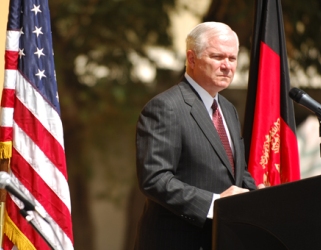
Robert Gates: War on Iran Would Be ‘Catastrophic,’ Make Tehran Nukes ‘Inevitable’

October 4, 2012

Robert Gates: War on Iran Would Be ‘Catastrophic,’ Make Tehran Nukes ‘Inevitable’ — News from Antiwar.com.

Former defense secretary Robert Gates said a US strike on Iran would ‘haunt us for generations’

by John Glaser, October 04, 2012

A US or Israeli attack on Iran would “prove catastrophic” and “make a nuclear-armed Iran inevitable,” former Secretary of Defense Robert Gates said in a speech Wednesday night.

Neither the United States nor Israel is capable of wiping out Iran’s nuclear capability, Gates said, and “such an attack would make a nuclear-armed Iran inevitable. They would just bury the program deeper and make it more covert.”

Not only would Iran be likely to reconstitute its defunct nuclear weapons program, but Tehran might also respond by disrupting world oil traffic in the Persian Gulf and launching a wave of terrorism across the region, Gates claimed.

“The results of an American or Israeli military strike on Iran could, in my view, prove catastrophic, haunting us for generations in that part of the world.”

Gates was reiterating what has become an emergent consensus within the military and intelligence community in the United States, that  a war on Iran – which Israel and many hawks in Congress have been pushing for – would not only be entirely discretionary, but would have disastrous consequences for Iran, the region, and the United States.

A report released last month by former government officials, national security experts and retired military officers concluded also that an attack would motivate Iran to restart its weapons development, and that the ensuing war would end up being “more taxing than the Iraq and Afghanistan wars combined.”

On the war strategists’ own terms, a war on Iran would backfire. But the human cost of such a war would also be immense. Even if a US or Israeli strike only targeted Iran’s nuclear sites and it didn’t result in larger land war, the toxic plumes released as a result of the strikes could kill or injure up to 70,000 civilians in nearby cities and towns.

Six Things the $450 Million Aid to Egypt Will Pay For

October 4, 2012

Six Things the $450 Million Aid to Egypt Will Pay For | #1 News Site on the Threat of Radical Islam.

Attack on US Embassy in Egypt (Photo: Reuters

The U.S. government is about to add $450 million to its $16 trillion debt for the sake of Muslim Brotherhood-run Egypt.

According to the New York Times, the emergency cash transfer is part of a $1 billion aid package pledged in May. The original plan was to provide $190 million as soon as possible, but the declining economic conditions of Egypt convinced the Obama Administration to more than double that amount.  Another $260 million will be delivered once Egypt secures a $4.8 billion loan from the International Monetary Fund.

And it doesn’t stop there. The Times reports:

“In addition to the $1 billion in assistance, the administration is working with Egypt to provide $375 million in financing and loan guarantees for American financiers who invest in Egypt and a $60 million investment fund for Egyptian businesses. All of that comes on top of $1.3 billion in military aid that the United States provides Egypt each year (emphasis mine).”

Here are six things that American taxpayers’ money will pay for once it arrives in Egypt:

1. The Unraveling of the Peace Treaty With Israel.

The pledge by Egypt’s Muslim Brotherhood President Mohammed Morsi to honor the peace treaty with Israel means nothing. The Brotherhood’s line has always been that Israel is the one violating, and therefore nullifying, the treaty.

After a meeting with Secretary of State Clinton, the Egyptian Foreign Minister said, “Mr. President [Morsi] has repeatedly reaffirmed, on all occasions, that Egypt continues to respect all treaties signed as long as the other party to the treaty respects the treaty itself.”

He then implied that Israel was in violation of the treaty. “…Egypt’s understanding of peace is that it should be comprehensive, exactly as stipulated in the treaty itself. And this also includes the Palestinians, of course, and its right to – their right have their own state on the land that was – the pre June 4, 1967 borders with Jerusalem as its capital.”

Secure America Now’s excellent new pamphlet about Morsi quotes him as saying on April 24, 2004 hat a parliamentary committee is needed “to draft a popular political program to restructure Egyptian-American relations and set a timetable to dispose the so-called peace agreement with the Zionist entity.”

There is no reason to believe that his opinion has changed, especially when the Brotherhood openly states its objective as the destruction of Israel. The Brotherhood Supreme Guide, Mohammed Badie, said on June 14 that Muslims are required to perform “jihad of self and money” for the sake of “imposing Muslim rule throughout beloved Palestine.”

2. Supporting Hamas.

The charter of the Hamas terrorist group states it is “one of the wings of the Muslim Brothers in Palestine.” In December 2011, Hamas even changed its name to “The Islamic Resistance Movement—a branch of the Muslim Brotherhood-Palestine.” The Brotherhood has never condemned Hamas. On the contrary, it has endorsed the terrorist group at every turn and preached to the Muslim world that it is the “resistance” to Israel.

In June 2007, Morsi said, “Muslim Brotherhood support of Hamas is a support of the Palestinian resistance.” In 2011, he told CNN, “We do not use violence against anyone. What’s going on [in] the Palestinian land is resistance.”

At one of Morsi’s campaign stops, a musician performed a song with lyrics that included “brandish your weapons, say your prayers” and “Come on, you lovers of martyrdom, banish the sleep from the eyes of all Jews. Come on, you lovers of martyrdom, you are all Hamas. Indeed, all the lovers of martyrdom are Hamas.”

Hamas, with good reason, believes Egypt will end cooperation with Israel’s blockade of the Gaza Strip. Hamas chief Khaled Meshal praised the “new era” in the Egyptian-Palestinian relationship after he met with Morsi in June. The next month, Morsi told Hamas Prime Minister Ismail Haniyeh that “Egypt and Palestine are one entity.”

3.  Sharia Law.

Don’t be fooled by the Brotherhood’s adoption of popular terms like “democracy.” Its senior cleric, Sheikh Yousef Qaradawi, explains that their version of “democracy” is different than that in the West. To them, democracy means the level of freedom permitted within the confines of Sharia Law.

Consider the Muslim Brotherhood’s official motto: “Allah is our objective/The Prophet is our leader/The Quran is our law/Jihad is our way/Dying in the way of Allah is our highest hope.”

On April 21, Morsi pledged his commitment to “instituting the religion of Allah” because “every aspect of life is to be Islamicized.” He even promised the radical Salafists, who are even more radical than the Brotherhood, that he’d appoint a clerical council to review all legislation to make it is in compliance with Islam as they see it. Of the 27 members of the National Council for Human Rights, 9 are Islamists, including two Salafists and the Secretary-General of the Brotherhood.

On May 13, Morsi recited the Brotherhood pledge to an adoring audience.

“The Sharia, then the Sharia and finally, the Sharia…I take an oath before Allah and before you all that regardless of the actual text [of the constitution]…Allah willing, the text will truly reflect [Sharia], as will be agreed upon by the Egyptian people, by the Islamic scholars, and by legal and constitutional experts,” he said.

Morsi’s government has arrested a Coptic Christian for allegedly posting the anti-Islam “Innocence of Muslims” film online. Another was sentenced to six years in prison for posting cartoons of Mohammed on Facebook. This is only the beginning. The Brotherhood follows a doctrine of “gradualism” where Sharia Law is implemented in stages. For example, Sheikh Qaradawi advised Egypt to wait five years before cutting off the hands of robbers.

On September 30, a Brotherhood preacher named Wagdy Ghoneim (who used to be an imam in California until he was arrested in 2004) called for prosecution secularists for apostasy. “If anyone tells you that he is a liberal, tell him directly that he is an infidel,” he said.

4. Anti-Semitism and Anti-Americanism

The Brotherhood views the U.S. and Israel essentially as one unit. To them, the U.S. is secretly controlled by the anti-Muslim Zionists. In July 2004, Morsi talked about the “crisis of the Zionist and American enemy.” In 2010, Brotherhood Supreme Guide Badi preached that “resistance is the only solution against the Zio-American arrogance and tyranny.” The context of the statement clearly referred to violent jihad. He opined, “The U.S. is now experiencing the beginning of its end, and is heading towards its demise.”

Morsi has insinuated that the 9/11 attacks were an “inside job” on numerous occasions, claiming in 2007 that the U.S. “never presented any evidences on the identity of those who committed that incident.” This conspiracy theory almost invariably holds that “Zionist” elements within the U.S. government collaborated with Israel to carry them out.

The Muslim Brotherhood’s former Supreme Guide, Mohammed Akef, came to Ahmadinejad’s defense in 2005 about “the myth of the Holocaust.” Strangely, Ahmadinejad caused a furor in the U.S. and around the world when he said the 9/11 attacks were an “inside job” and denied the Holocaust but not a word is said when the Brotherhood says the exact same things.

The Brotherhood’s anti-Semitism is just as vulgar as anything that has come from Ahmadinejad’s mouth. In November 2004, Morsi said the “Quran established that the Jews are the ones with the highest degree of enmity towards Muslims” and “there is no peace with the descendants of the apes and pigs.” In July 2007, he talked about the “way to free the land from the filth of the Jews.”

The charter of Hamas is explicit in its anti-Semitism, quoting an Islamic verse that reads, “The time will not come until Muslims fight the Jews (and kill them); until the Jews hide behind the rocks and trees, which will cry: O Muslim! There is a Jew hiding behind me, come on and kill him!”

5. Building the Caliphate

This isn’t an exaggeration. The Brotherhood and its allies won the elections in Egypt, Tunisia and Somalia. Hamas controls the Gaza Strip. In Yemen, the Brotherhood’s Islah affiliate is the strongest party as the country undergoes a transition. The Brotherhood is a major force behind the rebels in Syria and the Brotherhood is gearing up to destabilize Jordan. The Sudanese regime says it is instituting full-blown Sharia Law and if it doesn’t, the Muslim Brotherhood’s affiliate may overthrow it. The Brotherhood suffered a major setback in Libya’s elections, but it remains a potent force in that country.

Resurrecting the Caliphate sounds like a fantasy but the Brotherhood is certain that it is destiny and, if you look around the region, it’s easy to see why they are confident that it will happen soon. At one of Morsi’s campaign rallies, a cleric proclaimed, “We are seeing the dream of the Islamic Caliphate come true at the hands of Mohammed Morsi” and “the capital of the Caliphate and the United Arab States is Jerusalem.” Morsi nodded.

6. Keeping the Brotherhood in Power

If American money helps the Egyptian economy succeed, it helps the Brotherhood succeed. It’s as simple as that. If Morsi succeeds in improving the economy, even if it’s because of international assistance, he gets the credit.

At the same time, Morsi is doing whatever he can to preserve the Brotherhood’s hold on power. There was an argument to be made in favor of U.S. financial assistance when the Supreme Council of the Armed Forces were the real power-brokers and served as a check on the Brotherhood’s power. That is no longer the case. Morsi was able to depose the top leaders and replace them with Brotherhood supporters.

At the same time, Morsi is issuing administrative orders to shut down independent television stations. About 50 editors of state newspapers have been replaced with his allies. The state television is giving him positive coverage. The individual who was arrested for posting “Innocence of Muslims” online was also charged with insulting the President and a newspaper that criticized Morsi was confiscated, the best examples attacks on free speech you could ever ask for.

This is what Americans are paying $450 million for. And there’s no money-back guarantee if they are unsatisfied.

Finish what you started…

October 4, 2012

Israel Hayom | Finish what you started.

Dan Margalit

The heart rejoices at the sight of protests in the center of Tehran, smack dab in the middle of an indoor market. Finally, results. The heavy sanctions imposed by the enlightened world on the dark ayatollah regime are finally bearing fruit. The crowd was not chanting “death to America” or even “death to Israel” — they were chanting “death to Syria.”

Channel 2 commentator Dr. Arad Nir poured some cold water on all the excitement: the demonstrators didn’t make any mention of the country’s nuclear program — the cause of their dire economic situation and the Iranian currency’s recent free fall. Allow me to disagree: it would be counterproductive for them to protest against their country’s nuclear program. If they did, the ayatollahs would call them anti-patriotic and accuse them of undermining national security. Whether by instinct or by design they are avoiding this eventuality, and I hope they continue to do so.

The authorities’ response to the protests is interesting. President Mahmoud Ahmadinejad has censored television footage, both domestic and foreign. The blocked internet access around the country wasn’t an act of cyberwar initiated by another country — it was the Iranian government’s doing. This was the first demonstration, relatively small, a first spark if you will. But you can safely say that the ayatollahs are now afraid. Not of this protest, but of the ones that will surely follow.

But the ayatollah regime is not like Hosni Mubarak’s leadership in Egypt or Moammar Gadhafi’s in Libya. It isn’t even like Bashar al-Assad’s murderous regime in Syria. Mubarak was a hollow leader, and apparently so was Gadhafi, and ever since the outbreak of the Syrian rebellion, Assad has represented a minority regime with strong ties to Sunni circles. That is not the case in Tehran. There, the ayatollahs are steadfast, and the regime has so far relied on the support of the majority of the Iranian people.

But the protest on Wednesday, and the ones that will follow, don’t yet pose any actual threat to the regime. The die is not yet cast, as Natan Alterman once wrote. Anyone looking on at the cruelty with which Assad, with the help of the Iranian regime, is butchering his people, must realize that they are capable of such cruelty not only on the streets of Damascus but also in the Tehran marketplace. There is no mercy, outward or inward.

The battle will be drawn out, and even if the ayatollahs are forced to withdraw their involvement from Syria, Lebanon and Gaza in order to focus their resources on their own economy, the megalomaniacal Iranian nuclear program will be the last budget cut to be made, and it will only be cut as a very last resort. On the contrary, Ahmadinejad and his cohorts will push the nuclear program onto the center of the country’s public agenda to rally the disgruntled masses around it before they ever decide to give it up, if they ever do. That is how a centralized, near-dictatorial regime carries out diplomacy and propaganda.

The obvious conclusion is twofold: The economic sanctions on Iran could be effective if toughened. At the current level they are an obstacle for the malicious Iranian regime, but they are not posing a threat to its continued reign. The vicious tiger is moderately wounded, but if it isn’t killed it could pose a bigger threat than it already is now. A job half done could, God forbid, prove to be even more dangerous than no action at all. The world’s democracies must finish it.

Liberman: West must be prepared to aid Iranians in ‘Persian Spring’

October 4, 2012

Liberman: West must be prepared to aid Iranians in ‘Persian Spring’ | The Times of Israel.

With presidential elections approaching, regime faces ‘critical moment,’ says foreign minister

October 4, 2012, 10:21 am 2
Foreign Minister Avigdor Liberman (photo credit: Flash90)

Foreign Minister Avigdor Liberman said Thursday that Israel has a deep interest in supporting those calling for a regime change in Iran and should press the international community to aid dissenters. Liberman made the comment a  day after protesters clashed with police in the streets of Tehran over increasing economic hardships and the steep drop in the country’s currency value.

“The Foreign Ministry has long pointed out that we are on the way from the Arab Spring to the Persian Spring. What we are seeing now is just the first buds,” said Liberman in an interview with Army Radio. “As we approach presidential elections in Iran, in June 2013, we will see much more of this.”

Liberman said that the West made a mistake when it didn’t take a more active role in supporting the reformist protesters during the last elections in 2009 and that the international community must be prepared to assist with money and institutions.

When asked by the interviewer whether US President Barack Obama had made a mistake by not fanning the flames enough during the 2009 protests and subsequently perhaps cutting off Iran’s nuclear rush, Liberman said the mistake was not Obama’s but that of all Western nations.

Addressing Israel’s role vis-a-vis the popular protests in Iran, Liberman said, “The best help Israel can offer is not to disrupt things by interfering. I don’t think we have a special status that forces us to lead initiatives, but we should definitely follow matters closely and encourage the UN Security Council, the EU, the world powers and others to take action.”

“I have no doubt the Iranian regime is approaching a critical moment. The only question is what will come first — the fruition of its nuclear program, or the Persian Spring. We must be prepared for both possibilities.”

Thousands of Iranians took to the streets of Tehran on Wednesday as public anger over economic problems in the sanction-hit country erupted violently. The protests were the most dramatic in Iran since bitter demonstrations erupted after the 2009 presidential elections: Approximately 150 people were arrested.

TV footage showed the protesters shouting slogans of “Death to the corrupt regime” and “Get out of Syria, and start taking care of us” — a reference to Iranian involvement in helping President Bashar Assad repel the Syrian-rebel efforts to oust his regime.

Police reportedly used tear gas to disperse about 100 people who had gathered outside the capital’s central bank and were chanting anti-government slogans.

Washington on Monday pointed to the drop in the rial’s value as proof that sanctions on the country were working.

The West has leveled restrictions, described by the US State Department as “punishing,” against Iran’s oil and banking sectors in a bid to halt the country’s nuclear program.

The rial’s sharp decline is attributed to a combination of Western sanctions and government policies — such as fueling inflation by increasing the money supply, while also holding down bank interest rates. That prompted many people to withdraw their rials to exchange for foreign currency over the past months.

On Tuesday, Iranian president Mahmoud Ahmadinejad told reporters that the country would overcome the sanctions, but that restrictions on the banking industry were taking a toll.

Continuous Turkish artillery barrage cuts out 10-km buffer strip inside Syria

October 4, 2012

Continuous Turkish artillery barrage cuts out 10-km buffer strip inside Syria.

DEBKAfile Exclusive Report October 4, 2012, 1:29 PM (GMT+02:00)


Turkish artillery barrage against Syria

Constrained from a substantial military incursion into Syria by US President Barack Obama’s veto and Saudi and Qatari refusals to help pay for it, Turkey’s government and military decided to make do with carving out a buffer strip 10 kilometers deep into Syria by continuous artillery barrages.
Thursday morning, Oct. 4 at 0300 GMT, Ankara ordered the Turkish army to keep up its cross-border shelling of Syria after the first bombardment Wednesday night in response to the deaths of five Turkish civilians and eight injured by Syrian mortar shells which exploded in their village.

debkafile‘s military sources report the artillery squads were told to aim primarily at Syrian military targets inside this strip, including bases, outposts and Syrian forces on the move.
Several Syrian bases and outposts have been hit so far and a large number of Syrian soldiers killed or wounded. Neither Ankara nor Damascus is offering information on casualties. They have imposed a heavy blackout on events so as to keep them under control and avoid the risk of a full-blown war.
It was the first time in the 18-month Syrian uprising that Turkey had staged military action against Syria.
The first Turkish barrage was fired as NATO foreign ministers met in emergency session in Brussels and the UN Security Council in New York condemned Syria.
US Secretary of State Hillary Clinton also harshly condemned the Syrian shelling but did not commit to any action against Syria except to state that Washington stands behind Ankara

According to our sources, Turkish Prime Minister Tayyip Erdogan’s hands are tied. When he asked Washington in the last 48 hours whether the Syrian attack would serve as the pretext for imposing a no-fly zone over northern and central Syria with US Air Force participation, the Turkish prime minister encountered a flat refusal.
He was told by administration officials that the president would not change his mind about withholding US military intervention in Syria – especially after US intelligence briefed him last week that, according their latest assessment, Syrian President Bashar Assad would not hold out more than another six months. That is, until February-March 2013 at latest.

At the same time, say debkafile‘s Washington sources, the White House did not rule out a limited Turkish border operation for forcing Syrian troops to go on the run and giving the Syrian rebels greater freedom of movement to cross back and forth for arms supplies and medical treatment.

We reported in September that Turkish officers had taken command of two Syrian rebel brigades, the North Liberators and the Tawhid Brigade, which operate mostly in Aleppo. Turkish officers orchestrate their operations without crossing into Syria themselves.
By the saturation bombardment of the 10-kilometer strip inside Syria, Turkey plans to drive the Syrian military presence out and enable the two rebel brigades to move in and start establishing a 50-kilometer long protected corridor from Aleppo up to the Killis region of southern Turkey.
The big question is how long will Syrian President Bashar Assad tolerate Turkish artillery control of this border strip without fighting back. This decision is not only up to Assad but also to Tehran and Hizballah, both of which are deploying large-scale military strength in Syria in his support.

Experts: Iranian military stuck in the past

October 4, 2012

Experts: Iranian military stuck in the past – Israel News, Ynetnews.

Iran may be technologically advanced but its military capabilities are so limited it can’t risk war on its own soil, Israeli experts claim

Shiri Hadar

Published: 10.04.12, 10:38 / Israel News

If war breaks out with Iran, the Islamic Republic would prefer fighting on foreign soil due to its outdated equipment, claim Israeli experts who believe Iran’s nuclear program is a cover for its limited military capabilities.

“Their most advanced aircraft is still the phantom, which we used in the Yom Kippur War 40 years ago,” says Dr. Soli Shahvar of the Haifa University.

On Wednesday, the New York Times exposed a Pentagon intelligence report which suggested that in 2008, the Iranian military was so wary of an Israeli attack it fired on its own aircraft.

Iran’s leaders may not miss a chance to threaten Israel but its ability to realize those threats is almost non existent, experts claim.

“As far as conventional technological capabilities, Iran is behind 30 years,” Dr. Shahvar explains. “Aware of this handicap, Iran has been smart enough to develop a-symmetric warfare methods and this is a successful strategy indeed. Iran operates elements such as Hezbollah, Hamas and the Islamic Jihad and goes unpunished.”

What it lacks in military capabilities, Iran makes up in satellite and nuclear energy development based on collaboration with North Korea. “Iran is technologically advanced, but that doesn’t win wars on the battlefield,” Dr. Shahvar says.

But the ayatollahs are good at playing the game. Iran frequently releases images from military parades, missile tests and large-scale air and navy maneuvers.

“It’s mainly a game of deterrence,” says Dr. Emily Landau of the National Security Studies Institute (INSS).

“Iran has a tendency to constantly report about its military advancements but its de facto capabilities are unimpressive. Conversely, it is very advanced as far as missile technology.”

Landau claims that for these reasons, Iran uses its missile technology to create deterrence but at the same time tries to avoid missile warfare on its soil knowing it will not be able to respond.

“Based on its conduct in the past decade, Iran is signaling that it has no interest in a war on its own soil,” she says.

“Iran’s use of Hezbollah and Hamas coupled with its nuclear program proves it is ready for battle, but on foreign territory. ”

Landau estimates that Iran will not risk any escalation on its soil knowing that the US is far superior in terms of military capabilities. “If a country obtains a nuclear weapon, it should not be so concerned over its military capabilities.”

Meir Javedanfar of the Interdisciplinary Center believes that even if Iran meets its nuclear goals it would still not be strong enough to confront the West.

“I don’t believe Iran has the amount of centrifuges it claims it has. If it does, they are 1970s centrifuges,” he says.

Javedanfar claims that Tehran puts up a front mainly due to domestic reasons.

“The regime has to show the people how strong it is, particularly after the 2009 coup attempt. They also need to show their Shiite allies in Iraq, Lebanon and in Hezbollah that they’re a superpower. In reality, Iran is years behind in a military sense.”

He estimated that the crisis over the country’s weakening economy will affect both its military and nuclear capabilities.

Obama’s anti-Israel agenda

October 4, 2012

Obama’s anti-Israel agenda – Israel Opinion, Ynetnews.

Op-ed: Pre-election polls sad reflection of how unimportant Israel is to majority of US Jews

Dan Calic

Published: 10.04.12, 00:57 / Israel Opinion

With American elections only weeks away, relations between Israeland the US have become a key issue in the campaign. Try as he might, President Obama can’t do enough to hide how strained relations are between the two countries. The fact that the state of relations is being debated almost daily is enough of an indicator they are decidedly worse than prior to his presidency. In other words, when they are clearly good, there’s no need to debate the issue.

His dislike of Netanyahu is as clear as his love for the Muslim call to prayer, as he noted in his 2009 Cairo speech, when he called it the “sweetest sound on earth.”

At a time when tensions in the Middle East are as high as they’ve ever been, he rejected the request to meet with the leader of the only true democracy and America’s best friend in the region, when both leaders were in the same city. Ultimately he did agree to a phone meeting, which lasted 20 minutes.

When interviewed on 60 Minutes this past week, he referred to Netanyahu as “noise” which he “blocks out,” instead of a respectful comment such as “I’m always interested in hearing what the leader of our most loyal ally in the Middle East has to say.”

He referred to Israel as “one of our closest allies in the region.” In other words Israel is no closer than any other country? Please Mr. President, tell us who is as close as Israel?

When Netanyahu asks him to impose a “red line” on Iran, his response is “there is still time for sanctions to work.” In almost four years of his administration sanctions have yet to work. In fact, not only have sanctions not worked, Iran has actually increased the pace of its nuclear program. Does he actually think sanctions will suddenly have their effect in the remaining weeks before the election? Moreover, when will Mr. Obama think time has run out? After Iran engages in a pre-emptive strike killing scores of Israeli civilians?

His UN speech was distinctly absent of passion, nor did he take advantage of the opportunity to invite the nations of the world to stand in unity against Iran’s defiance. This shouldn’t surprise us. Let’s not forget this is a president who in 2010 openly and warmly welcomed Mahmoud Abbas to the White House, despite the fact Abbas has repeatedly said he will never accept Israel as a Jewish state. Conversely, Netanyahu was quietly shuffled into the White House through a side door, and in a clear statement of disrespect left on his own for dinner.

Rose-colored glasses

Also in 2010, 76 US Senators did something quite unusual. They were so disappointed in Obama’s consistent unfair treatment of Israel they sent him a letter asking him to be more fair toward the Jewish State. No previous president has received such a letter. In 2011 Obama chose to undermine Netanyahu when he made his famous “1967 borders” speech as the Israeli PM was airborne en route to meet with him to explain, among other things, why ’67 borders would be “indefensible.”

Leaders of both Republicans and Democrats, Obama’s own party, were so angry with the president’s speech they publically spoke out to distance themselves from his comments about ’67 borders. Just days later both parties sent him another strong message by giving Netanyahu 30 standing ovations when he spoke to a joint session of Congress.

Plus, after the two leaders met privately, Obama’s clear bent against Israel left Netanyahu with no choice, but to tell the president, while the cameras were rolling, that Israel cannot return to indefensible borders and must reserve the right to decide when and how to defend itself. It’s quite a sad moment when Israel needs to publically beg the US for the right to defend itself against a country which has repeatedly threatened to annihilate it and is unabatedly pursuing the very weapons to accomplish its oft stated goal.

More recently, Obama has been trying to put the brakes on Netanyahu’s requests that he publically stand with Israel, and confront Iran. Obama had yet another opportunity during his UN speech, and once again stopped short of ‘red lining’ Iran.

I believe Obama’s conduct is motivated by both political and personal reasons. The political aspect is that he is engaged in an election campaign, and doesn’t want his chances for re-election damaged. If Israel and Iran tangle, he’ll be under tremendous pressure from the American public, Congress and Western allies to support Israel, and possibly take military action. Should this happen it will damage relations with his other so-called “closest allies in the region.” He also risks a hostile reaction such as another oil embargo, like the one imposed after the 1973 war, during which President Nixon re-supplied Israel’s military.

On a personal level, given his background and upbringing, both of which have been significantly influenced by Islam, he doesn’t want to damage the effort to reach out to the Muslim world, an effort which began with the 2009 Cairo speech and has continued throughout his administration.

One would think his anti-Israel agenda would be obvious and negate most of the 78% Jewish vote he received in ’08. Not so. Polls predict that roughly 60-65% of Jews still support him. This is a sad reflection of how unimportant Israel is to the majority of American Jews. While many will outwardly claim they love Israel, and even argue with you over their support for Israel, at the end of the day, their votes reflect no difference from the average non-Jewish liberals who see Obama through rose-colored glasses.

It’s difficult to imagine relations between Israel and the US getting worse, but should Obama win a second term and not need to worry about being elected again, it’s highly likely his anti-Israel agenda will grow from a tropical storm to a category 5 hurricane.

To this I say Mr. Obama, you can run, but your attitude can’t hide.

Syrian soldiers killed in Turkish strike

October 4, 2012

Syrian soldiers killed in Turkish strike – Israel News, Ynetnews.

Turkey continues to bombard Syrian posts following mortar attack that killed five Turks; Turkish parliament set to discuss further military action

News agencies

Published: 10.04.12, 07:23 / Israel News

Turkish artillery hit targets inside Syria on Wednesday, killing several Syrian soldiers according to activists, after a mortar bomb fired from Syria killed five Turkish civilians and prompted NATO to call for an immediate end to Syria’s “aggressive acts.”

In the most serious cross-border escalation of the 18-month uprising in Syria, Turkey hit back at what it called “the last straw” when a mortar hit a residential neighborhood of the southern border town of Akcakale.

The Syrian Observatory for Human Rights said several Syrian soldiers were killed in the Turkish bombardment of a military post near the Syrian town of Tel Abyad, a few miles across the frontier from Akcakale. It did not say how many soldiers died.

The Turkish parliament is set to convene Thursday to discuss further military action. On Wednesday night, Turkey asked the UN Security Council to take the “necessary action” to stop Syrian aggression and ensure that Syria respect its territorial sovereignty.

Turkey’s government said sought parliament approval for the deployment of Turkish troops beyond its borders, according to a memorandum sent to parliament.

Ibrahim Kalin, a senior adviser to Prime Minister Tayyip Erdogan, said on his Twitter account that Turkey had no interest in a war with Syria but would protect its borders. He said political and diplomatic initiatives would continue.

Turkey’s Anadolu news reported that Turkish artillery fire, carried out by a unit stationed near the Akcakale village, had caused massive blasts in the Syrian side of the border. Security sources said that Turkey had amassed additional forces in the border area.
נפגעים בטורקיה אתמול (צילום: EPA)

Turks injured by Syrian mortar (Photo: EPA)

On Wednesday, the Turkish prime minister’s office announced Ankara’s swift response to the Syrian mortar attack. “Our armed forces at the border region responded to this atrocious attack with artillery fire on points in Syria that were detected with radar, in line with the rules of engagement,” the statement said.

“Turkey, acting within the rules of engagement and international laws, will never leave unreciprocated such provocations by the Syrian regime against our national security,” the office of Prime Minister Recep Tayyip Erdogan said in a statement.
"בעשרת הימים האחרונים הכפר שלנו מופגז" (צילום: EPA)

Blasts in Turkish village of Akcakale (Photo: EPA)

Turkish media said Turkey has prepared a parliamentary bill for Syria that is similar to one that authorizes the Turkish military to intervene in northern Iraq in pursuit of Kurdish militants who have bases there. The bill is expected to be discussed in parliament on Thursday, Anadolu agency reported.

If approved, the bill could more easily open the way to unilateral action by Turkey’s armed forces inside Syria, without the involvement of its Western and Arab allies.

Secretary of State Hillary Rodham Clinton said the US was “outraged that the Syrians have been shooting across the border,” adding that she would speak with Turkish Foreign Minister Ahmet Davutoglu on the matter.

“It’s a very, very dangerous situation,” Clinton said. “And all responsible nations need to band together to persuade the Assad regime to have a cease-fire, quit assaulting their own people and begin the process of a political transition.”

NATO said it stood by member-nation Turkey and urged Syria to put an end to “flagrant violations of international law.”

The US-led Western military alliance held an urgent late night meeting in Brussels to discuss the matter and later on Wednesday in New York, Turkey asked the UN Security Council to take the “necessary action” to stop Syrian aggression.

In a letter to the president of the 15-nation Security Council, Turkish UN Ambassador Ertugrul Apakan called the firing of the mortar bomb “a flagrant violation of international law as well as a breach of international peace and security.”

UN diplomats said Security Council members hoped it would issue a non-binding statement on Thursday that would condemn the mortar attack “in the strongest terms” and demand an end to violations of Turkey’s territorial sovereignty.

AP and Reuters contributed to this report

‘Several Syrian soldiers killed in Turkish bombardment’

October 4, 2012

‘Several Syrian soldiers killed in Turkish bombardment’ –.

By REUTERS
10/04/2012 07:39
Turkish security sources say retaliatory strikes against Syrian border district continuing; Ankara asks UN Security Council to stop Syrian aggression after mortar fire from Syria kills 5 Turks.

Turkey’s military continued to launch artillery strikes early on Thursday targeting the Tel Abyad district around 10 km inside the Syrian border, Turkish security sources said.

The sources said a mortar bomb fired from Syria that killed five Turkish civilians on Wednesday had been fired from Tel Abyad. They said soldiers loyal to Syrian President Bashar Assad had been killed by the Turkish artillery fire.

NATO said it stood by member-nation Turkey and urged Syria to put an end to “flagrant violations of international law”.

The US-led Western military alliance held an urgent late-night meeting in Brussels to discuss the matter and later on Wednesday in New York, Turkey asked the UN Security Council to take the “necessary action” to stop Syrian aggression.

In a letter to the president of the 15-nation Security Council, Turkish UN Ambassador Ertugrul Apakan called the firing of the mortar bomb “a flagrant violation of international law as well as a breach of international peace and security.”

UN diplomats said Security Council members hoped it would issue a non-binding statement on Thursday that would condemn the mortar attack “in the strongest terms” and demand an end to violations of Turkey’s territorial sovereignty.

Members had hoped to issue the statement on Wednesday, but Russia – a staunch ally of Syria’s, which along with China has vetoed three UN resolutions condemning President Bashar Assad’s government – asked for a delay, diplomats said.

“Our armed forces in the border region responded immediately to this abominable attack in line with their rules of engagement; targets were struck through artillery fire against places in Syria identified by radar,” Turkish Prime Minister Tayyip Erdogan’s office said in a statement.

“Turkey will never leave unanswered such kinds of provocation by the Syrian regime against our national security.”

Syria sends condolences to Turkish victims, urges restraint

Syria said it was investigating the source of the mortar bomb and urged restraint. Information Minister Omran Zoabi conveyed his condolences to the Turkish people, saying his country respected the sovereignty of neighboring countries.

Turkey’s parliament was due to vote on Thursday on extending a five-year-old authorization for its military to carry out cross-border operations, an agreement originally intended to allow strikes on Kurdish militant bases in northern Iraq.

That vote would now be extended to include operations in Syria, a ruling party deputy told Turkish television.

Washington sees Turkey as a pivotal player in backing Syria’s opposition and planning for the post-Assad era. The White House said on Wednesday it stood by “our Turkish ally”. But Ankara has found itself increasingly isolated and frustrated by a lack of international consensus on how to end the conflict.

US Secretary of State Hillary Clinton expressed outrage at the mortar from Syria and said Washington would discuss with Ankara what the next steps should be, calling the spread of violence a “very, very dangerous situation”.

Turkish Foreign Minister Ahmet Davutoglu said Clinton had assured him of Washington’s full support at the United Nations and NATO.