Archive for June 2012

U.S. sending floating naval base through the Suez Canal

June 22, 2012

U.S. sending floating naval base through the Suez Canal – CNN Security Clearance – CNN.com Blogs.

U.S. sending floating naval base through the Suez Canal

 By Barbara Starr

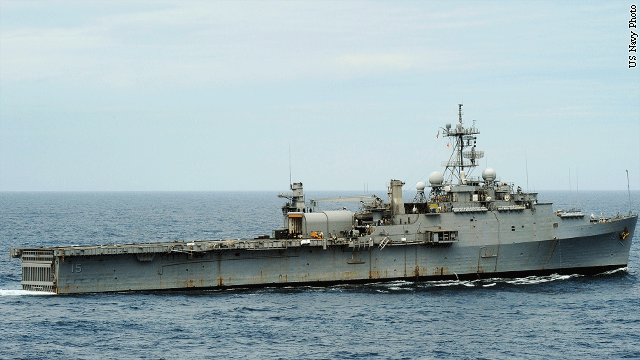
A U.S. warship designed as a floating base for naval special forces is scheduled to transit through the Suez Canal for the first time as early as Friday, Navy officials say.

The USS Ponce, an amphibious transport ship, recently finished a complete overhaul that now has it configured to operate as a floating staging platform for the military. It is being launched into the oil shipping lanes at a time of heightened tensions across the region, U.S. Navy officials told CNN.

The ship began approaching Suez on Thursday and is expected to enter the canal shortly on its way to the Persian Gulf.

The ship will function as a staging base for special operations forces and small patrol boats, including mine countermeasure vessels, in gulf waters that Iran has previously threatened to shut down.

Gen. James Mattis, commander of U.S. Central Command, which oversees U.S. military operations in the Middle East, had long pressed for the conversion of the Ponce in order to have a mobile platform from which troops could quickly deploy at a time when budget cuts are restricting large-scale deployments.

The Ponce is specifically tailored to maritime missions in the Persian Gulf region, where land-based forces often do not have ready access and concerns persist about maintaining open access to the Strait of Hormuz for international shipping.

The ship has a mixed crew of Navy officers and enlisted personnel, as well as civilian government mariners.

The ship is expected to reach Bahrain about 10 days after making it through the canal. It is not clear when combat forces may board the ship.

Clinton: Iran wants to be attacked

June 22, 2012

Clinton: Iran wants to be attacked – Israel News, Ynetnews.

Secretary of State discusses potential of nuclear Tehran with seasoned diplomat James Baker; says attack would unify Iranian public, legitimize regime. ‘US is only country in world that can stop Iran,’ says Baker

Yitzhak Benhorin

Published: 06.21.12, 19:52 / Israel News

WASHINGTON – US Secretary of State Hillary Clinton discussed on Wednesday the top priorities of US diplomacy around the world, saying that Iran wants to be attacked by somebody because it would unify the Iranian public and legitimize the Islamic regime.

However, Clinton clarified in an interview with Charlie Rose and Former Secretary of State James Baker, that the US is “serious that they (Iran) cannot be allowed to have a nuclear weapon.”

In an installment of “Conversations on Diplomacy,” which was moderated by Rose, Clinton made a series of harsh analytical remarks regarding the possibility of nuclear arms development in Tehran.

Baker and Clinton spoke about the necessity of preventing Iran from developing a nuclear weapon, noting that containment is not an option, and in the opinion of Baker, any military strike on Iran’s nuclear facilities should come from the United States because it is the only country with the ability to stop Iran’s program with force.
"איראן גרעינית תגרור את האזור למרוץ חימוש". קלינטון ובייקר (צילום: רויטרס)

Baker, Clinton discussing potential of a nuclear Tehran (Photo: Reuters)

“We ought to try every possible avenue we can to see if we can get them to correct their desire and goal of acquiring a nuclear weapon, but we cannot let them acquire that weapon. We are the only country in the world that can stop that,” Baker said.

“The Israelis, in my opinion, do not have the capability of stopping it. They can delay it. There will also be many, many side effects, all of them adverse, from an Israeli strike. But at the end of the day, if we don’t get it done the way the Administration’s working on it now – which I totally agree with – then we ought to take them out, “he added.

Clinton shared Baker’s estimated timeframe regarding a possible attack on a nuclear Iran, saying it could be a year or maybe more. The Secretary of State reiterated that “It’s not only about Iran and about Iran’s intentions. It’s about the arms race that would take place in the region with such unforeseen consequences.”

“You name any country with the means, anywhere near Iran that is an Arab country, if Iran has a nuclear weapon – I can absolutely bet on it and know I will win – they will be in the market within hours. And that is going to create a cascade of difficult challenges for us and for Israel and for all of our friends and partners,” Clinton added.

When asked about the Islamic Republic’s true intentions, Clinton explained that during every meeting with Iran the US tries to “probe and see what kinds of commitments we can get out of them. Now, at this point we don’t have them, so I can’t speak to what they might be if they are ever to be presented. But that’s why we have to take this meeting by meeting and pursue it as hard as we can.”

According to Clinton, “there is a vigorous debate going on within the leadership decision-making group in Iran.”

While some in Iran say that an attack would unify the country and grant it legitimacy, “there are those who say look, these sanctions are really biting, we’re not making the kind of economic progress we should be making, we don’t give up that much by saying we’re not going to do a nuclear weapon and having a verifiable regime to demonstrate that.”

Meanwhile, UN leader Ban Ki-moon and Iran’s President Mahmoud Ahmadinejad discussed on Thursday the showdown over Iran’s disputed nuclear programs during the talks on the sidelines of the United Nations Conference on Sustainable Development in Rio de Janeiro.

‘Key figures in Assad’s inner circle may soon join rebels’

June 22, 2012

‘Key figures in Assad’s inner circle may soon join rebels’ – Israel News,

Several of Syrian president’s closest associates are planning exit strategies in case Damascus regime falls. US denies guaranteeing Assad safe passage for peace talks with rebels

Ynet

Published: 06.22.12, 10:48 / Israel News

Several key figures in Syrian President Bashar Assad‘s regime have been secretly planning to defect to the opposition if Damascus’ hold on power is shaken any further, the Daily Telegraph reported Friday.

According to the report, several top members of Assad’s inner circle “have begun planning exit strategies and establishing lines of communication with the rebels to discuss how they would be received if they deserted.”

A Syrian Air Force colonel became the first senior officer to defect on Thursday, after he decided to abort an attack mission on Dera’a and landed his MiG 21 fighter jet in Jordan.
מטוס המיג הסורי שטייסו ערק לירדן  (צילום: AFP/HO/AMMON NEWS )

Syrian jet in Jordan (Photo: AFP)

A Washington source quoted by the British newspaper confirmed that several top officials were preparing to flee: “We are seeing members of Bashar Assad’s inner circle make plans to leave,” he said.

Syrian opposition groups said that they were “actively courting” the United States’ help to encourage defections.

“I know for sure there are some high-ranking officers who are waiting for the right chance to defect. We have names of people in the presidential palace. There are rumors that there is one who is really close to the president and we are expecting to see him out of the country soon,” the Telegraph quoted a senior opposition source as saying.

Meanwhile, Washington denied reports that it had guaranteed Assad’s safe passage to Geneva to meet opposition leaders.

Washington said it was not its role to decide Assad’s fate, but outside pressure nevertheless built on his regime, following a report the CIA was now vetting the flow of arms provided by Middle Eastern powers to Syrian rebels.

State Department spokeswoman Victoria Nuland said there was “no truth” to a report that Assad could be offered safe passage to Geneva for a conference on Syria that could take place this month.

“Issues of accountability in cases like this when you have grave human rights abuses against your own people are fundamentally a decision for the people of the country to make… we would not presume to speak for them.”

White House spokesman Jay Carney said there was no sign that Assad was ready to exit and accept the power transition the United States demands.

Ynetnews.

Iran says – “massive cyber attack” detected on nuclear facilities

June 22, 2012

Iran says – “massive cyber attack” detected on nuclear facilities.

Iran has detected a planned “massive cyber attack” against its nuclear facilities, state television said on Thursday, after talks with major powers this week failed to resolve a row over Tehran’s disputed nuclear activities. Iran’s Intelligence Minister Heydar Moslehi said the country’s arch enemies the United States and Israel, along with Britain, had planned the attack.

“Based on obtained information, America and the Zionist regime (Israel) along with the MI6 planned an operation to launch a massive cyber attack against Iran’s facilities following the meeting between Iran and the P5+1 in Moscow,” Iran’s English-language Press TV quoted him as saying. “They still seek to carry out the plan, but we have taken necessary measures,” he added, without elaborating.

Security experts said last month a highly sophisticated computer virus, dubbed “Flame”, had infected computers in Iran and other Middle Eastern countries.

Iranian officials were quick to say the country had defeated the virus, capable of snatching data and eavesdropping on computer users. It was not clear if the cyber attack referred to by Moslehi was “Flame”, or a new virus.

A new threat, Flame Virus

Attacking Iran?

Iran’s nuclear program came under attack in 2010 by the Stuxnet computer worm which caused centrifuges to fail at the main Iranian enrichment facility. Tehran accused the United States and Israel of deploying Stuxnet. Iran has been locked in a row for nearly a decade with Western countries over its disputed nuclear programme which the West believes is aimed at making nuclear weapons. Tehran denies the charge, saying it only wants peaceful nuclear technology to generate.

Earlier this month current and former U.S. officials said the United States under former President George W. Bush began building Stuxnet to try to prevent Tehran from completing suspected nuclear weapons work without resorting to risky military strikes against Iranian facilities. They said President Barack Obama accelerated the efforts after succeeding Bush in 2009.

World powers and Iran failed to secure a breakthrough at talks on Tehran’s nuclear programme in Moscow on Tuesday, despite the threat of a new Middle East conflict if diplomacy collapses. After two days of talks, European Union foreign policy chief Catherine Ashton said significant differences remained and the two sides had agreed only on a technical follow-up meeting in Istanbul on July 3.

Tehran has repeatedly said that as a member of the nuclear Non-Proliferation Treaty (NPT), it can develop a full nuclear fuel cycle, and, if this is recognized, talks with the permanent members of the U.N. Security Council – Britain, France, Russia, China, the United States – and Germany (the P5+1) can succeed.

“If the other side agrees to recognize Iran’s (nuclear) rights based on international regulations, Iran is ready to negotiate anything,” Ali Akbar Velayati, an adviser to Iran’s Supreme Leader Ayatollah Ali Khamenei was quoted as saying by the official IRNA news agency on Thursday.

Reuters

Iran: We Stopped a Cyber Attack on Nuclear Facilities

June 22, 2012

Iran: We Stopped a Cyber Attack on Nuclear Facilities – Latest News Briefs – Israel National News.

Iran stopped a cyber attack on its nuclear facilities, according to Thursday-evening reports in Iranian media.

The reports say the attack attempts took place after a failure in talks between the Islamic Republic and Western powers regarding its nuclear development program. Iranian Intelligence Minister Heydar Moslehi said that Tehran is facing online threats on a daily basis. We knew that the attack would come and we were prepared for it.” He blamed Israel, the United States and Britain for being behind the threat.

Expert: ‘Flame’ can sabotage computers, attack Iran

June 22, 2012

Expert: ‘Flame’ can sabotage com… JPost – Iranian Threat – News.

By REUTERS
06/22/2012 08:58
Flame computer virus not only does espionage, but also sabotages computer systems, likely was used to attack Iran.

Hacked (illustrative)
Photo: Thinkstock/Imagebank
BOSTON – The powerful Flame computer virus is not only capable of espionage but it can also sabotage computer systems and likely was used to attack Iran in April, according to a leading security company, Symantec Corp.

Iran had previously blamed Flame for causing data loss on computers in the country’s main oil export terminal and Oil Ministry. But prior to Symantec’s discovery, cyber experts had only unearthed evidence that proved Flame could spy on conversations on the computers it infects and steal data.

Symantec researcher Vikram Thakur said on Thursday that the company has now identified a component of Flame that allows operators to delete files from computers, which means it can cause critical programs to fail or completely disable operating systems.

“These guys have the capability to delete everything on the computer,” Thakur said. “This is not something that is theoretical. It is absolutely there.”

Flame was deployed at least five years ago and is the most sophisticated cyber spying program ever discovered. Researchers have been racing to better understand its capabilities ever since Moscow-based Kaspersky Lab uncovered Flame last month after the security firm was asked by a United Nations agency to look for a virus that Iran said had sabotaged its computers, deleting valuable data.

Last week, researchers at Kaspersky Lab linked some of the software code in Flame to the Stuxnet cyber weapon, which was widely believed to have been used by the United States and Israel to attack Iran’s nuclear program. Symantec later also said Stuxnet and Flame shared some code.

Current and former US and Western national security officials told Reuters this week that the United States played a role in creating Flame. The Washington Post reported that US and Israel jointly developed Flame and used it to collect intelligence to help slow Iran’s nuclear program.

Iran complained about the threat of cyber attacks again on Thursday, saying it had detected plans by the United States, Israel and Britain to launch a “massive” strike after the breakdown of talks over Tehran’s nuclear activities. . It was not clear if the cyber attack referred to Flame, or a new virus.

Symantec declined to comment on who the firm believes is behind Flame.

If Symantec’s conclusions are validated, that means Flame could be used as a weapon to attack computers that run critical infrastructure systems, including dams, chemical plants and manufacturing facilities, security specialists said.

Boldizsár Bencsath, an expert on cyber warfare with Hungary’s Laboratory of Cryptography and System Security, said there was at least a 70 percent chance that Flame was used to attack Iran in April.

“Of course it can be used for sabotage,” said Bencsath, who began investigating Flame several weeks before it was first reported to the public. “It may have been used to attack critical infrastructure and it may be used in the future.”

Sean McGurk, a former Department of Homeland Security official who helped direct the US effort to protect critical infrastructure from cyber attacks, said that Flame was not the first piece of malicious software designed to sabotage systems by deleting data.

What makes it unique, he said, is that the data-wiping module works alongside a suite of other programs including the espionage tools that have previously been identified.

“It could render computing devices useless,” said McGurk, who is now chief executive of a consulting firm known as NExt Generation Micro LLC.

That presents a threat, he said, because computers are used in all sorts of industrial control systems, affecting everything from critical processes at manufacturing plants to the pressure inside water networks. “Cyber elements can have catastrophic impacts,” he said.

Putin visit aims to show Moscow is a player in the region

June 22, 2012

Putin visit aims to show Moscow i… JPost – Diplomacy & Politics.

06/22/2012 07:28
Official purpose of the Russian president’s visit is to dedicate a memorial in Netanya, but talks with Netanyahu will center on Russia’s support for Assad in Syria, nuclear talks with Iran.

Russia's Putin with Netanyahu in Moscow in 2011
Photo: RIA Novosti / Reuters

Russian President Vladimir Putin, whose support for Syrian President Bashar Assad is straining his ties with the West, is scheduled to visit Israel on Monday for a short trip one diplomatic official said is designed to send a clear message to the world: Russia is a key player in the region that needs to be taken into account.

While the official purpose of the 24-hour visit will be to dedicate a memorial in Netanya to the Red Army defeat of the Nazis, talks between Putin and Prime Minister Binyamin Netanyahu will center on Russia’s policy of propping up Assad in Syria and on the talks with Iran. Russia is a member of the P5+1 group – which also includes the US, China, France, Britain and Germany – negotiating with Tehran.

Putin last visited Israel in 2005, during his first term as president in a ground-breaking first-ever Russian presidential visit here. While one diplomatic official acknowledged the differences of opinions between Moscow and Jerusalem on issues surrounding Iran, Syria and the diplomatic process with the Palestinians, it was critical for Israel to keep open a good channel of communication with the Kremlin.

Moscow, the official said, also recognizes that Israel is a central player in the region, even if it is firmly in the American camp.

Another diplomatic official – again not downplaying the policy differences between Israel and Russia – said that there has been an “amazing improvement” in ties with Moscow since the Soviet era, when the Kremlin actively helped Israel’s worst enemies with the goal of hurting Israel.

“Obviously we don’t agree about everything,” the official said, “but we have a constructive dialogue.”

During an interview published Thursday in The Washington Post, Defense Minister Ehud Barak alluded to the conversation that needed to be had with Russia regarding Syria.

Asked whether he thought the West should arm the Syrian opposition, Barak said many steps should be taken, adding that “Russia has invested a lot of political capital and money in the [Assad] regime. They should have a certain role if we want to succeed.”

Barak said that if “America and Russia talk[ed] together about who can use what leverage, that could be extremely effective… It’s time for the world to dictate to Mr. Assad to move out of power or else. But the ‘or else’ can be convincing only if America and Russia will join hands,” he said.

Barak said he thought the Russians could “in an honest, frank discussion” be convinced to cooperate on Syria. “They could have a major role in helping to solve the Syrian issue.”

Putin, accompanied by a delegation that includes a large entourage of 60 journalists, will land Monday morning and be met by Foreign Minister Avigdor Liberman, who met him in Moscow late last year and declared that the presidential elections there were fair and democratic. That position was controversial and at odds with the declared position of US Secretary of State Hillary Clinton.

Putin will go directly to Netanya for the dedication of the memorial, believed to be one of the only, if not the only, memorial to the Red Army in a country that was not formerly part of the Soviet bloc. One government official said this showed “the unique historic relationship between the two countries.”

Netanyahu announced the plans to build the memorial commemorating the Red Army’s victory over Germany in World War II during his visit to Moscow in February 2010.

Approximately 25 million Soviets were killed during World War II, including some 11 million Red Army soldiers.

The number of Jews who fought in the Red Army has been put at around 500,000, of which nearly 200,000 are believed to have been killed.

Following the dedication ceremony, Putin will go to Jerusalem for meetings with Netanyahu. There will be a one-on-one meeting between the two leaders, followed by statements to the press and a working luncheon with staff.

Liberman will attend that meeting, as well as a meeting in the evening between Putin and President Shimon Peres.

Peres will then host a state dinner in the Russian leader’s honor.

The next day, Putin will travel to Bethlehem to dedicate a Russian cultural center, and then on to Jericho where a meeting is expected with Palestinian Authority President Mahmoud Abbas. From there, he will go to Jordan for talks with King Abdullah II, and then back to Moscow.
Barak: World’s paralysis over Syria bodes ill for bid to halt Iran’s nuclear program

June 21, 2012

Barak: World’s paralysis over Syria bodes ill for bid to halt Iran’s nuclear program – Israel News | Haaretz Daily Newspaper.

Speaking to the Washington Post, defense minister says all options on the table to stop Iran from going nuclear, adding there were ‘a lot of preparations on the technical level.’


By Natasha Mozgovaya | Jun.21, 2012 | 10:27 AM


Ehud Barak - Tomer Appelbaum

Ehud Barak. Photo by Tomer Appelbaum


The international community’s “paralysis” in the face of ongoing strife and violence in Syria highlights the importance of a unified global front against Iran’s nuclear program, Defense Minister Ehud Barak said in an interview to U.S. media on Wednesday.


Barak’s comments came on the heels of a recent round of P5+1 nuclear talks with Iran in Moscow earlier this week, which ended in apparent failure after the sides were unable to reach an agreement on the inspection of certain nuclear and military installations.


Speaking about the prospect of resolving the West’s nuclear standoff with Iran through diplomatic means, Barak told the Washington Post on Wednesday that while Israel hoped “it will be solved by the free will of the ayatollahs, by the effectiveness of the sanctions, by the creativity of diplomacy or by any other miracle.”


“When we say that we are determined to prevent them, and we should all be determined, including the American leadership, the European leadership, the Russians, the Chinese, we mean what we say and that is all I can say,” Barak said.


The defense minister then indicated that the international community’s lack of resolve in dealing with ongoing Syria violence served as a warning against such inaction with Iran, saying Syrian President Bashar Assad was “living proof of the paralysis that sometimes takes over the world, even when there is no need for any further proof that something totally unacceptable that costs human life is happening.”


“Basically, [Assad] is slaughtering his own people and using every form of crime. Here you have real-time pictures of the actual crimes, the rows of buried children,” Barak told the Washington Post.


In an apparent link between the crisis in Syria and the standoff with Iran, Barak said that the world’s lack of resolve on Syria showed that “even when there is no need for any further proof, however tangible and visible the nature of the crimes, it doesn’t mean the world can mobilize the will to do something about it.”


“It’s a fact of life that we should bear in mind when we look at the overall picture around us. We are living in a tough neighborhood — no mercy for the weak, no second opportunity for those who cannot defend themselves. We have to be able to defend ourselves,” he added.


When asked whether or not Israel would launch a nuclear strike against Iran, the defense minister said: “You can’t expect me to answer directly.”


“We [the United States and Israel] are using the same rhetoric when we say that we are all determined to prevent Iran from turning into a nuclear military power, and we both say that all options are on the table. We mean it and we recommend to them to mean it,” he added.


Asked whether he felt the United States sincerely meant it weighed all options, Barak said: “At least on a technical level, there are a lot of preparations,” adding, however, that it was “not a secret that America prefers that it will be solved through diplomacy. We all hope that [diplomacy] will be successful, but time is not unlimited in this regard.”

Iran to build more ships, boost naval presence

June 21, 2012

Iran to build more ships, boost naval presence – Israel News, Ynetnews.

Navy commander says deployments meant to ‘safeguard interests of Islamic Republic, strengthen military power to defend Iran’

Reuters

Published: 06.21.12, 14:04 / Israel News

The Iranian navy has announced plans to build more warships and increase its presence in international waters at a time of growing tension in the Middle East over Tehran’s nuclear program.

Navy commander Rear Admiral Habibollah Sayyari said the deployments would protect Iranian cargo ships around the world, in particular in the Gulf of Aden and the northern part of the Indian Ocean, according to state news agency IRNA.

The navy wanted to guard Iranian ships from Somali pirates, the report said.

IRNA did not mention Israel although the Jewish state has hinted it might take military action against Iran’s nuclear program.

An Israeli official repeated the veiled threat on Wednesday following the failure of the latest round of international talks to make progress on the issue.

Iranian naval drill (Archive photo: Mehrnews.com)

State-owned Press TV quoted Sayyari as saying: “Our presence in international waters is aimed at safeguarding the interests of the Islamic Republic and strengthening military power to defend Iran.”

“So we will multiply our efforts to enhance our military might and have a presence in international waters,” he said.

The navy’s deputy chief for technical affairs said the force planned to build 10 more vessels, including destroyers and missile-launching frigates, Press TV said.

Work on building the ships would start after construction of “Velayat” a Mowj-2 class destroyer is completed. That is due at the end of the Iranian calendar year next March.

Iranian military officials often assert their military strength in the region, particularly in the Strait of Hormuz, the world’s most important oil transit channel carrying supplies from Gulf producers to the West.

Tehran has previously threatened to block the waterway if attacked.

Two Iranian warships entered the Mediterranean through the Suez Canal in February 2011 for the first time, and naval vessels also called at a Syrian naval base this February in a show of support for its ally President Bashar al-Assad.

Syrian fighter jet reported missing lands in Jordan; pilot asks for political asylum

June 21, 2012

Syrian fighter jet reported missing lands in Jordan; pilot asks for political asylum.

A Syrian MiG which was reported to have lost contact with its tower has made an emergency landing in Jordan. (File photo)

A Syrian MiG which was reported to have lost contact with its tower has made an emergency landing in Jordan. (File photo)

A Syrian air force Russian-made MiG, which was reported missing by Syrian state TV on Thursday afternoon amid reports that its pilot had defected to Jordan, made an emergency landing at a military base in the neighboring country, reports AFP.

Syrian state television named the pilot as Colonel Hassan Hamada, saying communications were lost with his plane while he was on a training mission near the border with Jordan.

Hamada has asked for political asylum in Jordan, the country’s Minister of State for Information Samih al-Maaytah said.

“The Syrian air force Russian-made MiG made an emergency landing at the King Hussein air base in Mafraq,” in northern Jordan near the border with Syria.

“[The pilot] is being debriefed at the moment,” Maaytah told Reuters.

Syrian state television said communication was lost with a plane of the same model at 10:34 a.m. .

The Syrian National Council along with activists had claimed the pilot had defected prior to confirmation of the news.

Georges Sabra, spokesman for the SNC told AFP: “The plane took off at high speed and flew at low altitude from a military base situated between Daraa and Sweida in the south of the country. These planes usually fly in twos or threes, not alone.

“It is certain that the pilot has defected,” he added. “It is not normal that a jet should take off at such speed. It is to avoid detection by the radars.”

He added that the pilot is from Deir Ezzor (in eastern Syria) “and his family is known for its opposition” to Assad’s regime.

Activists said this was the first defection involving an aircraft since the start of the 15-month-old uprising against President Bashar al-Assad.

More than 120,000 Syrians fleeing the violence in their homeland have taken refuge in Jordan, according to the Amman government. The United Nations has registered 20,000 of them.

More than 15,000 people have been killed in the Syrian uprising, according to Syrian Observatory for Human Rights on Thursday.


