Archive for June 25, 2012

Turkey: Syrian forces fired at 2nd Turkish plane

June 25, 2012

Jerusalem Post – Breaking News.


By REUTERS


06/25/2012 20:20


Turkey said on Monday that Syrian forces had fired at a second Turkish plane which was searching for an F-4 reconnaissance jet shot down by Syria last week, but the second plane was not brought down.

Deputy Prime Minister Bulent Arinc told a news conference that Turkey would protect itself, within the framework of international law, against what it called Syria’s “hostile action” of downing its warplane last week.

He said at the end of a seven-hour cabinet meeting on the incident that Syria’s downing of the reconnaissance jet would “not go unpunished.”

PM Netanyahu’s meeting with Russian President Putin

June 25, 2012

The first video released of the meeting.  It is silent and short but worthy of seeing if only to contrast it with Putin’s recent meeting with Obama.  Looks to me like the two leaders are more than OK with each other.  Hey, I’ll grasp at any straw you offer… – JW


Iran focus of Russian president’s visit to Israel

June 25, 2012

Iran focus of Russian president’s visit to Israel – Timesonline.com: Middle-east:.

Iran focus of Russian president's visit to Israel

Associated Press

Israel’s prime minister says Russian President Vladimir Putin agrees that a nuclear Iran would pose a “grave danger” to the world.

Benjamin Netanyahu pressed for further sanctions on the Islamic Republic to quash its budding nuclear program. In statements after their meeting Monday, Putin acknowledged that the talks covered Iran and the uprising in Syria, but added that he saw negotiations as the only solution for such matters.

Russia has blocked drastic action against Iran and Syria, while Israel has repeatedly hinted it may act militarily to stop Iran’s nuclear program.

THIS IS A BREAKING NEWS UPDATE. Check back soon for further information. AP’s earlier story is below.

The West’s standoff with Iran over its nuclear program topped the agenda on Monday as Russian President Vladimir Putin began a 24-hour visit to Israel.

The two countries enjoy deep economic and cultural relations bolstered by the more than 1 million immigrants from the former Soviet Union who now live in the Jewish state. But they have deeply differing approaches to the Iranian nuclear program and the uprising in Iran’s close ally Syria.

Upon arrival, Putin attended the inauguration of a memorial to the Soviet Red Army in the coastal city of Netanya, paying tribute to the fallen soldiers of World War II.

“The memory of the fallen is sacred in my eyes. I am moved that you feel the same thing in Israel,” he said, facing the sculpture of a massive pair of wings on a wind-swept hilltop overlooking the Mediterranean Sea.

The memorial honors the millions of troops, including tens of thousands of Jews, who died to defeat the Nazis. Israeli Prime Minister Benjamin Netanyahu proposed the concept to Putin when he visited Moscow two years ago.

Foreshadowing the substance of Putin’s discussions with Israeli leaders, President Shimon Peres told those assembled: “I am confident that Russia, which defeated fascism, will not allow similar threats today. Not the Iranian threat. And not the bloodshed in Syria.”

Later in the day, Putin met with Netanyahu. Israeli officials said Iran would top the agenda.

Israeli officials hope to persuade Putin to do more to pressure Iran to abandon elements of its nuclear program, which world leaders suspect is aimed at producing a nuclear weapon but Tehran insists is only for peaceful purposes such as electricity generation.

Israel sees a nuclear-armed Iran as a mortal threat, citing the Islamic Republic’s frequent calls for destruction of the Jewish state and Tehran’s support for anti-Israel militants and its arsenal of ballistic missiles. It has said repeatedly that it would not tolerate a nuclear Iran, and hinted of using a military strike as a last resort. Israel itself is widely believed to possess nuclear weapons.

Russia, in concert with China, has frustrated Israel by watering down four sets of international sanctions against Tehran over the nuclear issue, but now stands to influence the country’s behavior after joining world powers in negotiations. A new set of low-level negotiations has been set for July, after the last round yielded no breakthroughs.

Putin will also likely face questions over Russia’s arms sales to Israel’s arch-foe Syria, which have continued during the violent popular uprising against President Bashar Assad. Israel is afraid Russian weapons in Syria will fall into the hands of allied Hezbollah militants in neighboring Lebanon, something Israel says happened during its 2006 war with the Lebanese group.

Netanyahu and Putin were also expected to discuss the victory of the Muslim Brotherhood’s Mohammed Morsi in Egyptian presidential elections, as well as stalled Israeli-Palestinian peacemaking. The Russian leader came with an entourage of hundreds of officials and businesspeople, who will be exploring possible military, technology and energy deals between the two countries.

On Tuesday, Putin heads to the West Bank and Jordan.

Netanyahu: Israel, Russia agree on Iran

June 25, 2012

Netanyahu: Israel, Russia agree on Iran – Israel News, Ynetnews.

Jerusalem, Moscow agree that Iranian nukes would constitute grave danger, PM Netanyahu says following meeting with Putin; two leaders addressed Iran issue in detail, Russian president says

Omri Ephraim

Latest Update: 06.25.12, 17:45 / Israel News

A beautiful friendship? Israel and Russia agree that Iranian nuclear weapons would constitute grave danger for the Jewish state and for the whole world, Prime Minister Benjamin Netanyahu said Monday following his meeting with Russian President Vladimir Putin.

“I believe that we should be doing two things now: Boosting the sanctions (on Iran) and also boosting the demands,” Netanyahu said.

Related stories:

Speaking earlier, President Putin said the two leaders “spoke in detail about the Syria issue and about the Iranian nuclear program.”

“I would like to stress again that the negotiations were detailed and very effective,” he said. “I’m convinced that the cooperation between Russia and Israel will develop later as well, and this matter certainly meets the demands and interests of both states, in the region and in the world at large.”

‘Friendly ties’

Speaking to the media after meeting PM Netanyahu, Putin thanked Israel’s leadership for inviting him to visit.

“My visit here reinforced the assumption that we have friendly relations, and these are not just friendly relations,” Putin said. “This is a solid basis for building dialogue and partnership.”

Putin greeted by PM's wife (Photo: Amos Ben Gershom, GPO)
Putin greeted by PM’s wife (Photo: Amos Ben Gershom, GPO)

Earlier Monday, President Shimon Peres greeted Putin in a dedication ceremony for a memorial to the Red Army’s victory over Nazi Germany in Netanya. Peres said he is certain that Russia, which fought fascism, will not tolerate similar threats, “not an Iranian threat and not bloodshed in Syria.”

Signal to Egypt

During the press conference, Netanyahu also addressed regional realities, referring to the Islamist victory in Egypt’s presidential elections.

The PM said that Israel “appreciates the democratic process in Egypt” and respects the Egyptian election results.

“We look forward to working together with the new administration on the basis of the peace agreement between us,” Netanyahu said. “I believe peace is important for Israel. I believe peace is important for Egypt.”

Meanwhile, President Putin addressed the Israeli-Palestinian conflict, asserting that “against the backdrop of events in the Middle East, it is important to resolve longtime conflicts.”

“We urge all sides to renew negotiations; this is the only way to resolve the problem,” the Russian president said.

Putin: Israel, Russia strive for peaceful resolution to Iran nuclear issue

June 25, 2012

Putin: Israel, Russia strive for peaceful resolution to Iran nuclear issue – Israel News | Haaretz Daily Newspaper.

Speaking at joint press conference with Netanyahu, Russian leader says Israel-Russia ties based on ‘deep friendship’; PM: Israel, Palestinians must resume peace talks.

By Eli Shvidler | Jun.25, 2012 | 5:35 PM
Vladimir Putin in Israel - GPO - 25.6.2012

Vladimir Putin speaking at the Red Army memorial in Netanya, June 25, 2012. Photo by GPO

Israel and Russia will continue consultations geared at resolving the nuclear standoff with Iran through peaceful means, Russian President Vladimir Putin said in a joint press conference with Prime Minister Benjamin Netanyahu on Monday, adding that Israel-Russia relations are based on a “deep friendship.”

Putin arrived in Israel earlier in the day, in what Israeli officials hoped would be an opportunity to recruit Russia’s government to join their efforts against Iran’s nuclear program.

Speaking following a lengthy meeting between Netanyahu and Putin later in the day, the Russian leader said that he felt he was “among friends,” adding that the ties between Israel and Russia were ones of “deep friendship, no something that will pass, and that will endure in the future.”

“We held a thorough discussion of the issue of Iran’s nuclear program, and, even in the current situation, I estimate that we will continue to consult and work together, and that these issues will be resolved peaceful for the good of all sides,” Putin added.

Netanyahu spoke at the press conference for the need to restart peace talks with the Palestinians, saying: “One of two things can happen. Either [Palestinian President Mahmoud Abbas comes over here, or I go over there. Either way, we must start talking.”

Alluding to the standoff with Iran, Netanyahu said at the joint press conference that there “are those who wish to deny the Holocaust, and there are those who erect monuments to honor the actions of the Red Army, which saved Jews in the Holocaust.”

The premier was referring to a visit by Putin to the city of Netanya earlier Monday, where he inaugurated a new memorial to the Red Army.

During a speech given at the memorial, Putin called the Holocaust “the darkest, most shameful chapter in human history,” and praised the Soviet Army was the one to “smash the head of the Nazi monster and allowed all nations to survive.”

Putin added that he was “very excited” and thanked Netanyahu, Peres and “all of his Israeli friends” for the establishment of the monument.

President Shimon Peres was the main Israeli representative at the dedication ceremony. He praised the Soviet Union’s actions against Nazi Germany, as well as the current Russian government’s efforts to promote peace between Israel and the Palestinians.

PM: Israel, Russia agree a nuke-armed Iran is world danger

June 25, 2012

Jerusalem Post – Breaking News.

By JPOST.COM STAFF
06/25/2012 17:01
( Assuming this is more than empty “dip lo-speak,” it deserves to be in red… – JW ) 

Prime Minister Binyamin Netanyahu said that both Israel and Russia agree that Iranian proliferation of nuclear weapons poses a great danger to both Israel and the world, speaking at a joint press conference with Russian President Vladimir Putin in Jerusalem on Monday.


Speaking after Putin, Netanyahu made three demands for Iran: that it must cease all uranium enrichment in the country, that it transfer all enriched uranium out of the country, and that it disassemble its underground nuclear facilities.

Netanyahu also spoke about his hope to hear how Russia can contribute to the Israeli-Palestinian peace process. Putin is scheduled to meet with Palestinian Authority President Mahmoud Abbas in Bethlehem later in his visit.

The media’s despicable silence on Israel.

June 25, 2012

The media’s despicable silence on Israel | Ronn Torossian | Ops & Blogs | The Times of Israel.

( Glad to see I’m not the only one who was sickened… – JW )

The world’s media constantly blasts and attacks Israel. A simple monitoring of the media over the last few days shows a deafening silence on issues – and there’s no explanation other than media bias against Israel:

In the last week, there have been 150 rockets fired into Israel, and it’s far from major news. It’s a non-issue for the Western media – damage to a school and factory on Saturday. It will become news when Israel responds and kills some terrorist(s), and world headlines will speak of “tit for tat violence.” No, in reality it’s a sane democratic country defending herself from terrorism.

Think if Israel fired 150 rockets into Gaza it wouldn’t be in the media?

Mainstream media has by and large ignored a huge NYC mural which compares gay rights in Israel and Arab states. There’s an outline of two men holding hands, above them are the words, “Who Would YOU Want at Your Wedding?” The figures also hold two balancing scales. Above one scale, on the side of the mural that reads “Israel,” there’s a description of how the recent gay pride parade in Israel attracted tens of thousands of people, that Israel allows same-sex couples to adopt children, and that “gay people serve openly in the military and government” in Israel.

Above the scale on the side of the mural labeled “Israel’s neighbors,” the text notes that homosexuality is illegal in Syria and punishable by death in Iran. “There is no pride parade in Egypt, Jordan or Gaza,” reads the mural. Why no huge media spreads worldwide?

Literally every single week Israel is harmed by biased media. It’s sickening. An interesting person this month surfaced on this issue: Kasim Hafeez, a British Muslim who today calls himself a “proud Zionist.” He says the British community he grew up in calls “for the destruction of all Jews,” which led him to believe that Israel is a “terror state.”

But now he realizes that “People don’t know the facts. I would say to anybody, come to Israel. See the rights that Muslims have. People can vote for their leaders. People of all colors, all races, all backgrounds co-exist here, and people just don’t know.”

He particularly criticized media bias, saying that Israel can “do no right in the UK press.” “Israel is always wrong and everything has a very negative slant.” The media is simply biased about Israel – constantly, worldwide and not just in the UK.

Meanwhile, The New York Times runs an op-ed by Nathan Thrall of the International Crisis Group promising violence against Israel. Thrall speaks of how bleak the situation is: poor Israel has lost its chance with Abbas, Palestinians have lost hope of ever getting a state, and armed confrontation, a third intifada, is inevitable. But not once does the op-ed blame them for the inevitable violence that will occur. Despicable.

Ze’ev Jabotinsky, the Zionist leader said: “Silence is despicable, it leads to a loss of flesh and blood.” He’s right: Media bias against Israel leads to dead Jews, and it is incumbent upon anyone concerned with decency who knows right from wrong not to remain silent. We must all help improve Israel’s public image and help however we can with Israel’s public relations.

US-Israel Anti-Iran War Games Set near Elections

June 25, 2012

US-Israel Anti-Iran War Games Set near Elections – Global Agenda – News – Israel National News.

The US and Israel are planning war games, with simulated attacks against Iran, just before U.S. elections. A coincidence?

By Tzvi Ben Gedalyahu

First Publish: 6/25/2012, 12:13 PM


Israel and US officers in joint drill

Israel and US officers in joint drill
Israel news photo: IDF spokesman

The United States and Israel are planning war games involving simulated attacks against Iran and Syria. Coincidence or not, the exercises will take place less than a month before elections November 6.

Thousands of soldiers will participate in the war games under simultaneous and simulated missile fire from Syria and Iran, the Hebrew language Maariv newspaper reported. It said that the exercise will be named “dress rehearsal,” a thinly veiled message to Iran of the possibility of a military attack on its unsupervised nuclear program if Tehran does not cooperate with United Nations inspectors.

President Barack Obama is seen as wanting to postpone any military action until after the elections, in which he will be running for re-election against Republican Mitt Romney.

Iran has suffered numerous cyber attacks in the past year, presumably originating from Israel and the United States, in an effort to cripple computer programs operating nuclear facilities, particularly those where Iran is enriching uranium, a key element for a nuclear weapon.

On the military front, Israel has beefed up its submarine force, which is reportedly equipped with nuclear weapons.

Recent U.S. defense contracts to arm its navy with more Tomahawk cruise missiles may possibly be intended to deplete reserves that were used for bombing missions against Muammar Qaddafi but also may be designated for a future attack, Business Insider noted.

“Taking out radar and aircraft defenses would be one step in an Iranian attack. Another, equally as vital, would be determining where Tehran’s fleet of submarines may be parked in the Persian Gulf,” it said.

The U.S. Navy also has ordered 17,000 sonar buoys that are used to work with other buoys to locate underwater objects but also might be intended for research for an unknown mission.

Morsy: I will work to expand bilateral ties with Iran

June 25, 2012

Morsy: I will work to expand bilateral tie… JPost – Middle East.

By REUTERS, JPOST.COM STAFF
06/25/2012 10:17
Newly-elected Egyptian president says strengthening of relations with Tehran will “create a balance of pressure in the region”; comments come after Morsy promises to “preserve int’l obligations” in apparent reference to Israel.
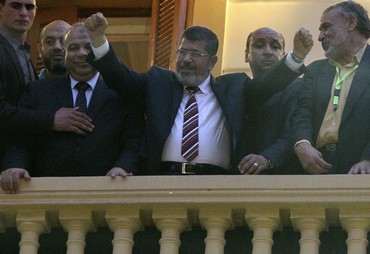
Muslim Brotherhood's Mohamed Morsy Photo: Suhaib Salem / Reuters

Egyptian President-elect Mohammed Morsy is looking to expand ties with Tehran to create a strategic “balance” in the region, according to an interview with Iran’s semi-official Fars news agency published Monday.

Diplomatic relations between the two countries have been severed for more than 30 years, but both sides have signalled a shift in policy since former president Hosni Mubarak was overthrown last year in a popular uprising.

Fars quoted him as saying he was interested in better relations with Tehran. “This will create a balance of pressure in the region, and this is part of my program.”

Asked to comment on reports that, if elected, his first state visit would be to Iran’s regional arch-rival Saudi Arabia, Morsy said: “I didn’t say such a thing and until now my first international visits following my victory in the elections have not been determined”.

Fars said he was speaking a few hours before the results of the Egyptian election were announced on Sunday.

Morsy’s comments on Iran came just prior to his first speech since his election win, during which he vowed to “preserve international accords and obligations,” in what appeared to be a reference to the peace treaty with Israel.

Morsy attempted to allay fears that he would immediately act to Islamize Egypt, promising to be a president to all Egyptians, “Muslims, Christians, the elderly, children, women, men, farmers, teachers, workers, those who work in the private and public sectors, and the merchants.”

The new Egyptian president thanked the “martyrs” that had lost their lives during the uprising that led to the ouster of former president Hosni Mubarak, saying the he would not have become president without their sacrifice.

Morsy did not call out a challenge to Egypt’s military leaders for their recent attempts to limit presidential powers, instead praising the army and police as “brothers.”

Morsy defeated former Mubarak prime minister and general Ahmed Shafik in a run-off last weekend by a convincing 3.5 percentage points, or nearly 900,000 votes, taking 51.7 percent of the total, officials said. It ended a week of disputes over the count that had frayed nerves.

Morsy succeeds Mubarak, who was pushed aside by his fellow officers 16 months ago to appease the Arab Spring revolution.

The military council which has ruled the biggest Arab nation since then, curbed the powers of the presidency by decree last week, meaning the head of state will have to work closely with the army on a planned democratic constitution.

The generals say they want to hand over to civilian rule but are plainly set on defending their privileges and suspicious of the ability of Egypt’s fragmented, and long oppressed, political movements to establish a stable constitutional democracy.

Obama calls to congratulate Morsy on victory

US President Barack Obama called Morsy on Sunday to congratulate him on his victory. According to a White House statement, Obama underscored that the US will continue to support Egypt’s transition to democracy and stand by the Egyptian people as they fulfill the promise of their revolution. He emphasized his interest in working together with Morsy, on the basis of mutual respect, to advance the many shared interests between Egypt and the United States.

Morsy welcomed Obama’s support and the two leaders affirmed their commitment to advancing the US-Egypt partnership and agreed to stay in close touch in the weeks and months ahead, according to the statement.

Obama also called Shafik, commending him on a well-run campaign, according to the US State Department.

Putin-Netanyahu talks to focus on rising Islamist power: Cairo then Damascus

June 25, 2012

Putin-Netanyahu talks to focus on rising Islamist power: Cairo then Damascus.

DEBKAfile Exclusive Analysis June 25, 2012, 10:23 AM (GMT+02:00)


Russian president Vladimir Putin on short Israel visit

The Muslim Brotherhood’s rise to power in Egypt – and soon, possibly, in Syria – will have pushed to the sidelines such obvious topics as Iran and gas when Monday, June 25, Russian President Vladimir Putin on a short visit to Israel meets Prime Minister Binyamin Netanyahu.
On this subject at least, the Russian and Israeli leaders will find common ground:  Both are concerned, to put it mildly, by the chain of Muslim Brotherhood governments rolling out along Middle East shores – Libya, last year; Egypt, yesterday; and Syria, tomorrow. In their view, this process is a menace to regional stability which rivals even that of a nuclear-armed Iran.
Putin counts US President Barack Obama’s sponsorship of Muslim Brotherhood power as a strategic threat to Russian national security because of it could be the match which lights the flame of radical Islam in the Caucasus and among the Russian Muslim populations of the Volga River valleys.
As for Netanyahu, his calm-sounding congratulations for the new, democratically-elected Egyptian president, disguise trepidation. After one domino fell in Cairo, he fears another will fall in Damascus leaving Jordan vulnerable to having its king pushed over by the kingdom’s powerful Muslim Brotherhood.

Israel would then be under siege from three Islamist-ruled neighbors – “moderate” in Obama’s eyes, alarmingly “extremist and expansionist” in the view of Putin and Netanyahu.
In contrast to the Israeli prime minister, the Russian president makes no bones about his utter disapproval of the US President’s “pro-Islamic” policies. His blunt words in support of Syria’s Bashar Assad at the G20 in Mexico Sunday, June 18, were meant as a monkey wrench for US plans to continue to install Muslim power in Arab lands.
Not surprisingly, their conversation on the summit sidelines was described as “candid” – a euphemism for “difficult” – and must have raised a stop sign against the “reset” of ties heralded last year by Washington.

The Israeli Prime Minister keeps on smiling to Obama while grinding his teeth over the security avalanche set in motion at Israel’s front and back doors and wracking his brains for a plan of cooperation with Moscow to arrest the slide.
Israel has already had a foretaste of the trouble to come from Cairo. It bounced all the way from Libya’s Islamist regime to land this month with a sinister bang across Egyptian Sinai’s border with southern Israel.

In the past year, since a new regime took power in Tripoli, the strategic peninsula has been transformed into a major smuggling eden for the distribution of contraband arms and infiltrating Islamist terrorists, including Muslim Brotherhood adherents, into the Hamas-ruled the Gaza Strip and onward to other countries in the region.
For Putin the math is simple: If Libyan Islamists can travel 1,360 kilometers to reach Israel’s borders without anyone stopping them, why not 2,558 kilometers to the Russian Caucasian?
Ironically, the victim of the first suicide attack the Libyan terrorists mounted inside Israel from Sinai was an Israeli Muslim from Haifa, Said Fashasha, who died in a bombing-shooting ambush on Route 10 to Eilat Sunday, June 18. On the same day, the “candid” Obama-Putin conversation also took place at Los Cabos.
Now as then, President Obama continues to push the Russian leader to accept the compromise of Syria’s Vice President Farouk al-Sharaa, a Sunni Muslim, replacing Bashar Assad, with Assad’s brother-in-law, deputy chief of staff Gen. Shawqat Asif, serving alongside him. With those chips in place, Washington believes Assad might be persuaded to go into exile in Moscow.
What Putin hears is that Obama is so eager to have a Sunni Muslim installed in Damascus that he is willing to put up with retaining the Assad clan in power, even Gen. Asif, a chief instigator of the regime’s bloody savagery.
So  both Putin and Netanyahu, when they talk in Jerusalem Monday, know they are stumped for a strategy to hold back the Islamist tide washing across this region and potentially farther afield – any more than a diplomatic solution has been found to stall Iran’s nuclear plans.


