Archive for April 2012

Gantz: IDF’s ‘Steely Arm’ will Hit Back at Enemies

April 19, 2012

Gantz: IDF’s ‘Steely Arm’ will Hit Back at Enemies – Defense/Security – News – Israel National News.

Maj. Gen. Gantz: “We are the defensive shield of the nation that will never again stand helpless and defenseless.”
By Gil Ronen

First Publish: 4/18/2012, 11:13 PM


Lt. Gen. Gantz

Lt. Gen. Gantz
IDF Spokesman’s Unit

Maj. Gen. Benny Gantz, IDF Chief of Staff, warned Israel’s enemies Wednesday that any attempt to harm Israel will be met with a painful response.

“The IDF draws from the memory of Holocaust Remembrance Day military strength and moral resilience that directs it in every crossroad and leads it to victory time after time,” Gantz said, in a ceremony at the Masua Institute at Tel Yitzchak.

“This strength of both body and soul is with us at all times and especially now – when the winds of revolution undermine the stability of the Middle East and create an extremely complicated, multi-front challenge,” he said, “while in the background we witness attempts to harm the State of Israel, its residents and Jewish people around the world.”

“As the children, the grandchildren and the great grandchildren of Holocaust survivors, we now stand in IDF uniform, as the steadfast protectors of the State of Israel – a nation that was and still is the essence of their hope and their dream.”

“On this day of self examination we once again renew our oath to those who experienced the horrors of the Holocaust, and the promise that the Jewish people will never again stand defenseless.”

“We will ensure that here, in the flourishing living project in our forefathers’ land, the Jewish people will continue to grow, develop and be an example for the nations of the world.”

Gantz added: “I say tonight to those who wish us ill, in the loud and clear voice of tens of thousands of IDF soldiers who are standing guard: we are the steely arm that will hit back hard at any attempt to harm the Jewish people. We are the defensive shield of the nation that will never again stand helpless and defenseless. Never again!”

Netanyahu: Israel obligated to prevent nuclear-armed Iran

April 19, 2012

Netanyahu: Israel obligated to pr… JPost – Diplomacy & Politics.


04/18/2012 23:17
At Yad Vashem ceremony marking Holocaust Remembrance Day, PM pushes back against critics saying he should not draw parallels between Iran and the Holocaust: The people of Israel are strong enough to hear the truth.

Prime Minster Binyamin Netanyah at Yad Vashem

Photo: Marc Israel Sellem

It is the world’s duty to keep Iran from acquiring nuclear arms, but first and foremost it is Israel’s obligation, Prime Minister Binyamin Netanyahu said on Wednesday at the state’s Holocaust Remembrance Day ceremony at Yad Vashem.

In a speech that dealt heavily with Iran, Netanyahu said the obligation Israel must take from the Holocaust is not only to remember the past, “but to learn the lessons and more importantly to implement those lessons to ensure the future of our people.”

He noted that this was especially true in this generation, when there are those calling for the destruction of the Jewish state, and when Iran is working toward obtaining the means of achieving that goal.
“The truth is that an Iran armed with nuclear weapons is an existential threat to Israel’s existence,” Netanyahu said. “The truth is that a nuclear Iran is an immediate threat to other nations in the region, and a grave threat to the peace of the world. And the truth is that it is necessary to prevent Iran from getting nuclear arms. That is the obligation of the world, but first and foremost it is our obligation.”

Netanyahu’s comments came at the ceremony whose theme this year – under the banner of “My Brother’s Keeper” – was Jewish solidarity during the Holocaust.

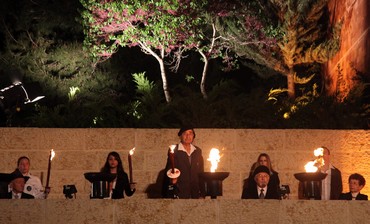
Hundreds of survivors attended, and six survivors who assisted other Jews during the Holocaust were honored during a torch lighting ceremony.

“In one week we will raise the flags of Israel’s independence which rose for the first time 64 years ago,” President Shimon Peres told the crowd.

“Today, it is clear that the reality we have built is the vision we once dreamed.”

“We used to be a question mark; today we are a strong country,” he said. “Humanity has no choice but to learn from the lessons of the Holocaust and stand strong in the face of existential threats, before it is too late.”

Peres told the audience that during Passover he traveled all over the country.

“Blue skies, blooming fields, lovely children, hardworking people,” he said. “I wondered about the communities they originated from which are no longer. For a moment, I replaced Tel Aviv with Vilna, Haifa with Bialystok, Deganya, Nahalal, Beersheba with Plonsk, Riga, Odessa. Not a single Jew remains there.”

Tragic events earlier in the day cast a shadow over the proceedings, when a 20-year-old soldier from Mevaseret Zion, Hila Bezaleli, was killed during rehearsals at nearby Mount Herzl for the Independence Day ceremony next week.

Netanyahu also paid tribute to her at the start of his comments, as well as to 19-year-old soldier Yehoshua Hefetz, of Jerusalem, who collapsed and died during a tryout for an elite unit.

The prime minister, who came under a great deal of domestic criticism last month after delivering a speech at the AIPAC Policy Conference in Washington drawing parallels between the Iranian threat and the Holocaust, pushed back hard against those critics who said this argument both trivialized the Holocaust and sowed panic in the country.

“I know there are those who don’t like when I say these types of unpleasant truths,” Netanyahu said. “They prefer not to talk about a nuclear Iran as an existential threat, and claim that this statement, even if it is correct, only sows fear and panic.”

Netanyahu said Israel dealt with existential threats – in 1948 and 1967 – when the country was infinitely less strong than it is today, and that during those periods the country’s leaders, first David Ben-Gurion and then Levi Eshkol, told the nation the truth about the dangers it faced.

The nation did not panic, but rather united to defend itself, Netanyahu said.

“I believe in the Jewish people’s ability to deal with the truth, and I believe in our ability to defend ourselves against those who want to kill us.”

Netanyahu charged that those who dismiss the Iranian threat as being exaggerated or not serious have not learned anything from the Holocaust.

He said there were always those among the Jewish people who preferred to scorn unpleasant truths rather than face them head on. This, he added, was the way certain Jewish intellectuals dealt with revisionist leader Ze’ev Jabotinsky, ridiculing his warnings to Polish Jews in 1938 of the oncoming disaster.

To those who argue that the singular evil of the Holocaust should not be raised when talking about the present dangers and that doing so in some way cheapens the Holocaust and insults the victims, Netanyahu replied, “I completely reject that approach.”

On the contrary, to be deterred from speaking the truth and saying that today, like then, there are those who want to destroy millions of Jews, “that is cheapening the Holocaust, that is an insult to the memory of the victims, that is ignoring its lessons.”

While the Jewish people had neither a voice to stir the world to action, or an army to defend itself during the Holocaust, today the reality is different, Netanyahu said.

“Today we have a state, today we have an army,” he said. “We have the ability, obligation and determination to defend ourselves.”

Netanyahu pledged that as prime minister he would not hesitate to tell uncomfortable truths to the world, nor to his own people, which “is strong enough” to hear it.

Obama ready to yield on Iran’s nuclear transparency. Israel:Tehran will cheat

April 19, 2012

DEBKAfile, Political Analysis, Espionage, Terrorism, Security.

DEBKAfile Special Report April 18, 2012, 9:23 PM (GMT+02:00)


Ayatollah Ali Khamenei: A nuclear weapon is a sin…

In the direct, secret exchanges between the US and Iran which led up to the Istanbul talks with the six powers, of Saturday, April 14, President Barack Obama quietly backed off from his demand that Iran “come clean” on its nuclear activities and open up to international inspection, debkafile reports.
This concession paved the way for Tehran’s consent to discuss his framework proposal to stop enriching uranium to 20 percent, halt work at its underground facility for higher enrichment near Qom, and export its stockpile of highly enriched uranium for final processing to 20 percent for use in medical isotopes. This would be presented as a deal for settling the nuclear controversy.
debkafile’s military sources: The Iranians may find it worth their while to accept this framework. After all, once sanctions are lifted by the end of June – as Tehran demands – and they are freed of IAEA oversight, the Iranians can go forward with their plans for building a nuclear weapon undisturbed and Washington can celebrate a breakthrough.

Israel has not received word of this deal.

debkafile’s Washington sources report that in contrast with the downbeat mood in Israel, Washington is already celebrating its success in resolving the Iranian nuclear conundrum and averting war.
Our sources have two points to make in this regard:

1. Tehran has not yet put pen to paper to approve the American proposal and agreed only to move forward in their back-door negotiations without prejudice:

2. Obama will eventually have to level with Israel, the American people and the rest of the world on his deal with Iran.
There is no chance of Israel’s Binyamin Netanyahu going along with agreements on the lines under discussion between Washington and Iran, because they would allow Iran to develop nuclear armaments relieved of the hindrances of international oversight and sanctions.
The Israeli prime minister, when he addressed the state ceremony marking the annual Holocaust Remembrance Day Wednesday night, spoke at length of the mortal danger a nuclear Iran for the Jewish state. He said those who maintained Israel lacked the military capacity for dealing with the Iranian menace were wrong.
“We can and will defend ourselves,” he said.“I won’t stop stating the truth (about Iran) at the UN, in Washington and in Jerusalem.”

debkafile reported earlier Wednesday, April 18:  Officials in Jerusalem angrily dismissed reports of a breakthrough in last Saturday’s nuclear negotiations in Istanbul between six world powers (P5+1) and Iran and most emphatically the claim that “Israeli Prime Minister Benjamin Netanyahu played his expected role in this choreography” by criticizing the negotiators for giving Iran a five-week freebie for continuing enrichment without limitation, as cited in a Washington Post article on Wednesday, April 18, by the columnist David Ignatius.
Iran is presented as ready to agree to stop enriching uranium to 20 percent and halt work at its underground facility for higher enrichment near Qom, and export its stockpile of highly enriched uranium for final processing to 20 percent for use in medical isotopes. Israeli sources say this report is false: Far from this being the shape of an eventual settlement, it was the shape of American demands relayed to Tehran in side-channels going via Paris and Vienna. Israel was never informed of Iran accepting this formula or its presentation to the Istanbul meeting.

Above all, they stressed, Netanyahu has not and will not play a role in any choreography of this kind staged by the Obama administration.
The Americans appear to have been taken in by the Iranian Supreme Leader Ayatollah Ali Khamenei’s public pledge in February not to commit the “grave sin” of building a nuclear weapon as representing the Islamic regime’s face-saver for caving in to US pressure. The WP article is indeed captioned” “The stage is set for a deal with Iran.” Nothing, say debkafile‘s military and intelligence sources, is farther from the truth. According to our Iranian sources, there is no sign of the Iranians caving in.
The article itself appears to represent Washington’s comeback for a radio interview aired a few hours earlier, Tuesday, April 17, by Israeli Deputy Prime Minister and Minister for Strategic Affairs Moshe Ya’alon, in which he sharply criticized the Obama administration for its handling of the nuclear dispute with Iran: “We (Israel) no longer believe in the Americans, and on the Iran issue, we are not in the same boat.”

“Three years ago, Iran had 1,200 kilos of low enriched uranium; today it has five and a half tons,” he pointed out.

Ya’alon also warned that after the way the proceedings went in Istanbul, right after the second round of talks on May 23 in Baghdad, “Israel will review its steps,”
Citing the classical Hebrew adage: If I do not watch out for myself, who will? (אם אין אני לי מי לי?) , he noted: “Obama too has said Israel has the right to self-defense.”

The deputy prime minister was the first Israeli national figure to suggest that, after May 23, the Netanyahu government would approach a decision on the date for a countdown to an attack on Iran’s nuclear program.

Yaalon certainly said enough to cause some agitation in Washington, judging by the flood of phone calls debkafile’s sources report coming in from Washington with requests for clarifications.
Earlier that Tuesday, Defense Minister Ehud Barak said in another radio interview that the“P5+1” group’s talks with Iran must result in a clear-cut resolution, the end of Iran’s nuclear program. He did not believe they would, although he hoped to be proved wrong.
The two Israeli ministers would not have delivered their downbeat comments if indeed US talks with Iran over and under the negotiating table had achieved, or even approached, the breakthrough depicted in Washington.

Israel: Reported US-Iranian nuclear deal – wishful thinking

April 18, 2012

DEBKAfile, Political Analysis, Espionage, Terrorism, Security.

DEBKAfile Special Report April 18, 2012, 2:05 PM (GMT+02:00)


Ayatollah Ali Khamenei: A nuclear weapon is a sin…

Officials in Jerusalem angrily dismissed reports of a breakthrough in last Saturday’s nuclear negotiations in Istanbul between six world powers (P5+1) and Iran and most emphatically the claim that “Israeli Prime Minister Benjamin Netanyahu played his expected role in this choreography” by criticizing the negotiators for giving Iran a five-week freebie for continuing enrichment without limitation, as cited in a Washington Post article on Wednesday, April 18, by the columnist David Ignatius.
Iran is presented as ready to agree to stop enriching uranium to 20 percent and halt work at its underground facility for higher enrichment near Qom, and export its stockpile of highly enriched uranium for final processing to 20 percent for use in medical isotopes. Israeli sources say this report is false: Far from this being the shape of an eventual settlement, it was the shape of American demands relayed to Tehran in side-channels going via Paris and Vienna. Israel was never informed of Iran accepting this formula or its presentation to the Istanbul meeting.

Above all, they stressed, Netanyahu has not and will not play a role in any choreography of this kind staged by the Obama administration.
The Americans appear to have been taken in by the Iranian Supreme Leader Ayatollah Ali Khamenei’s public pledge in February not to commit the “grave sin” of building a nuclear weapon as representing the Islamic regime’s face-saver for caving in to US pressure. The WP article is indeed captioned” “The stage is set for a deal with Iran.” Nothing, say debkafile‘s military and intelligence sources, is farther from the truth. According to our Iranian sources, there is no sign of the Iranians caving in.
The article itself appears to represent Washington’s comeback for a radio interview aired a few hours earlier, Tuesday, April 17, by Israeli Deputy Prime Minister and Minister for Strategic Affairs Moshe Ya’alon, in which he sharply criticized the Obama administration for its handling of the nuclear dispute with Iran: “We (Israel) no longer believe in the Americans, and on the Iran issue, we are not in the same boat.”

“Three years ago, Iran had 1,200 kilos of low enriched uranium; today it has five and a half tons,” he pointed out.

Ya’alon also warned that after the way the proceedings went in Istanbul, right after the second round of talks on May 23 in Baghdad, “Israel will review its steps,”
Citing the classical Hebrew adage: If I do not watch out for myself, who will? (אם אין אני לי מי לי?) , he noted: “Obama too has said Israel has the right to self-defense.”

The deputy prime minister was the first Israeli national figure to suggest that, after May 23, the Netanyahu government would approach a decision on the date for a countdown to an attack on Iran’s nuclear program.

Yaalon certainly said enough to cause some agitation in Washington, judging by the flood of phone calls debkafile’s sources report coming in from Washington with requests for clarifications.
Earlier that Tuesday, Defense Minister Ehud Barak said in another radio interview that the“P5+1” group’s talks with Iran must result in a clear-cut resolution, the end of Iran’s nuclear program. He did not believe they would, although he hoped to be proved wrong.
The two Israeli ministers would not have delivered their downbeat comments if indeed US talks with Iran over and under the negotiating table had achieved, or even approached, the breakthrough depicted in Washington.

US Senate looks to keep pressure on Iran through sanctions

April 18, 2012

US Senate looks to keep pressure… JPost – Iranian Threat – News.

By REUTERS
04/18/2012 04:56
Senate Majority Leader Harry Reid says Congress should pass new oil-, banking-related sanctions to pressure Tehran to abandon its nuke program; Republicans, Democrats considering amendments to month-old sanctions bill.

Senate Majority Leader Reid speaking in Senate
Photo: REUTERS/Joshua Roberts

WASHINGTON – Senate Majority Leader Harry Reid said on Tuesday Congress should pass a proposed package of new oil- and banking-related sanctions to keep up the pressure on Tehran to abandon its nuclear program.

Aides from Reid’s office met on Tuesday with undisclosed “outside parties” to discuss the sanctions, his spokesman said, describing the meeting as “routine.”

“Each day that goes by without Iran feeling more of our censorship, I think that’s too bad for the world and helpful to Iran,” Reid said. “We need to move forward on this as quickly as possible.”

Last month, Reid had insisted that a package of penalties developed by the Senate Banking Committee should advance without amendments to speed its passage.

Several Senators from both parties wanted the opportunity to make changes.

Republican Senator Mark Kirk has a package of amendments he wants to propose, including one that would ban insurers from covering shipments of Iranian oil to countries that fail to make “significant” cuts to their purchases from Tehran.

Ambiguous results from nuclear talks in Istanbulbetween Iran, the United States and five other world powers this past weekend further galvanized lawmakers’ resolve to pursue new sanctions.”My staff is meeting with interested parties to see if there’s something that can be worked out,” Reid told reporters on Tuesday, noting he still believed it was best to proceed without amendments “unless we can get agreement from basically everyone.

After Netanyahu’s criticism, U.S. official says Israeli PM was briefed on Iran talks

April 18, 2012

After Netanyahu’s criticism, U.S. official says Israeli PM was briefed on Iran talks – Haaretz Daily Newspaper | Israel News.

In upcoming round of talks, six major powers will demand an Iranian commitment to suspend uranium enrichment at 20 percent, says senior American official.

In their upcoming round of talks next month with Iran over its nuclear program, the six major powers will demand an Iranian commitment to suspend uranium enrichment at the relatively high level of 20 percent, a senior American official said. There has been concern in the West that enrichment at 20 percent would put the Islamic Republic closer to levels required for nuclear weapons.


Nuclear research plants require enrichment levels of 3.5 percent.


Benjamin Netanyahu Prime Minister Benjamin Netanyahu
Photo by: Emil Salman


The initial round of talks with Iran took place on Saturday in Istanbul with senior representatives of the United States, Britain, France, Russia, China and Germany. The European Union’s foreign policy chief, Catherine Ashton, also participated in the meeting, which resulted in a joint commitment to pursue further discussions in Baghdad on May 23.


The senior American official said Prime Minister Benjamin Netanyahu was fully briefed both before and after the Istanbul meeting on the strategy being adopted by the six major powers.


On Sunday Netanyahu was critical of the outcome of the talks, saying that the Iranians had been given a “freebie” by the major powers to pursue their nuclear program without limitations until the Baghdad talks.


The American official told Haaretz that in the weeks prior to the Istanbul conference, detailed discussions were held with Israel, both face to face and by telephone, on coordination of the approach to the talks. In addition, it was noted that the head of the U.S. delegation to the talks, Wendy Sherman, fully briefed Israel’s ambassador in Washington, Michael Oren, by phone several hours after the talks concluded in Turkey.


According to French and German diplomats with knowledge of the talks in Turkey, officials from French President Nicolas Sarkozy’s office, as well as those from the office of German Chancellor Angela Merkel, also briefed officials from Netanyahu’s bureau over plans for negotiations with Iran both before and after the Istanbul meeting.


Prior to Saturday’s meeting in Turkey, it was made clear to Israel that the initial round in Istanbul was seen as an opportunity to gauge Iran’s seriousness in engaging in negotiations without an expectation that the parties would take immediate concrete steps. Netanyahu’s criticism of the five-week period between the talks in Turkey and the second round in Baghdad therefore took officials by surprise, not only in Washington but also in Berlin, Paris and London, particularly over his statement that Iran had been given a “freebie.”


The senior American official said the United States understands Netanyahu’s desire for the international community to take as tough a stance as possible with the Islamic Republic but does not accept the criticism that the Istanbul talks gave Iran a “freebie.” The official said the six powers represented in the talks in Turkey, including Russia and China, took a tough, unified stance that Iran must take the first steps to carry out confidence-building measures to prove its seriousness.


In talks between U.S. administration officials and Israel’s Ambassador to Washington, Michael Oren, as well as with Netanyahu’s advisers, it was made clear that the Americans have no intention of allowing discussions to go on for an unlimited time frame. In addition, the Americans clarified that discussions would be held with lower-level Iranian representatives during the five weeks between the two rounds of formal talks with Iran, and that therefore the talks would not be a waste of time from the American perspective.


These talks will also be held between Helga Schmidt, senior advisor to Ashton, and Iran’s deputy negotiator Ali Bagheri. According to the American official, in these honest talks it will be made clear to the Iranians that they are expected to notify the Baghdad discussions that they are taking a trust-building move in the shape of suspending the enrichment of uranium to 20 percent.


The senior U.S. official emphasized that an agreement is in place between the six world powers that even if Iran carries out trust-building steps and suspends uranium enrichment to 20 percent, it will not receive anything in return. He added that it was made clear to the Iranians in these discussions that there would be no suspension of sanctions on the part of the United States and the European Union, nor would there be a postponement of the European oil embargo, which will come into effect on July 1.


The representatives of America, France, Hamburg and Britain who participated in the Istanbul talks were surprised by the Iranian reaction, which was relatively committal. “For the first time, the Iranians did not beat around the bush, and agreed to talk directly about their nuclear program,” said one senior European official. “We did not hear their regular accusations on the hypocrisy and arrogance of the West and their stance focused on the continuation of a civilian nuclear program and the existence of sanctions.”

The senior American official also noted that Washington is satisfied with the Iranian approach to the first round of talks. There were signs that the Iranians have serious intentions, the official explained, adding that such signs have not been seen for a long time. However, he emphasized that Iran has not yet taken the necessary steps to regain the trust of the international community, and that this will only become clear in the second round of talks in Bagdad, when Iran will be required to take physical steps – not just talk.

Israel develops new weapons for next war – UPI.com

April 17, 2012

Israel develops new weapons for next war – UPI.com.

Published: April 17, 2012 at 2:41 PM

The Israeli military unveiled a new 120mm tank shell said to be able to penetrate reinforced targets, including in populated areas.

https://i0.wp.com/ph.cdn.photos.upi.com/sv/ph/UPI-29841334688079/f397218825bcd0b15dee74ab746915d1/Israel-develops-new-weapons-for-next-war.jpg

TEL AVIV, Israel, April 17 (UPI) — Amid a flurry of warnings that Lebanon and Hezbollah will be hammered in any new conflict, the Israeli military unveiled a new 120mm tank shell said to be able to penetrate reinforced targets, including in populated areas.

“Such a capability — to accurately target terrorists hiding inside homes — is believed to be crucial for the army as it faces future conflicts with Hezbollah and Hamas, both terrorist groups which embed themselves within civilian infrastructure,” The Jerusalem Post reported.

In the same edition, the daily’s military correspondent, Yaakov Katz, quoted senior defense officials as saying that “Israel will attack Lebanese government targets during a future war with Hezbollah.”

This blitzkrieg, it says, would be triggered by retaliatory attacks on Israel by the heavily armed, Iranian-backed Shiite movement if Israel launches pre-emptive strikes against Iran’s nuclear facilities.

The report was headlined “Lebanese targets fair game in war with Hezbollah.”

In 2006, the Israelis said they deliberately didn’t target Lebanese facilities since the Beirut government didn’t support Hezbollah. But now Hezbollah dominates the government, the Israelis say all bets are off.

“It was a mistake not to attack Lebanese government targets during the Second Lebanon War in 2006,” one senior officer said. “We will not be able to hold back from doing so in a future war.”

This is known as the “Dahiya Doctrine,” after the Israeli air force’s relentless bombing of the Dahiya district in south Beirut during that 34-day conflict. Only next time it will much, much worse.

Suburban Dahiya was considered to be the nerve center of the Hezbollah leadership and large areas were flattened.

The reports about the new shell developed by Israel Military Industries is one of several recent instances of Israeli authorities saying the military’s ready to unleash massive strikes not just against Hezbollah, on the Jewish state’s northern border, but Palestinian militants in the Hamas-ruled Gaza Strip to the south.

A 20,000-strong Israeli force invaded Gaza Dec. 27, 2008, to crush Hamas and its allies in a 22-day battle that led to a global outcry against the Jewish state and allegations of war crimes.

Some 1,400 Palestinians, 960 of them civilians, were killed and thousands wounded. Damage totaled $2 billion. Some 5,000 homes were destroyed. Israeli casualties were 13 killed, 10 of them by friendly fire.

Israeli newspapers have reported how the army, still smarting from being fought to a humiliating standstill by Hezbollah’s outgunned irregulars in 2006, plans to deploy special units go after the Hezbollah is in the elaborate defense networks they’ve constructed since 2006.

Last week, the army rehearsed dropping ammunition and other supplies, even Humvees, from Lockheed Martin C-130 transports to “forces operating deep behind enemy lines.”

Newspapers reported that Israeli troops will be equipped with new miniature backpack radars with a range of only a few miles to detect hostile forces on the ground.

Combat infantry battalions are equipped with unmanned aerial vehicles, such as the Skylark I and Skylark II developed by Elbit Systems, for tactical surveillance.

Chief of Staff Lt. Gen Benny Gantz is reported to be carrying out surprise inspections of army brigades and air force bases to check on readiness, dreaming up emergencies to determine his forces’ reaction times.

Gantz, who became Israel’s top soldier in February 2011, has a background in special operations and is keen on mounting covert ops. In December he set up a unit known as Deep Corps for deep penetration operations and has put officers with unconventional warfare experience in command positions for the next conflict.

He’s also put much greater emphasis on cyberwarfare, not just for conventional enemies like Iran and Syria but for irregular forces like Hezbollah, Hamas, Palestinian Islamic Jihad and others.

Hezbollah figures high on this list because for the last few years it has been constructing an elaborate network of secure communications, much of it using fiber optics, impervious to Israeli penetration.

This links its forward military units in south Lebanon, with command centers in Beirut and the movement’s stronghold and logistics center in the Bekaa Valley of northeastern Lebanon on the Syrian border.

Another invasion of Gaza is also in the cards. Public Security Minister Yitzhak Aharonovich warned in March that the next Israel operation there “will be more violent than previous rounds.”

© 2012 United Press International, Inc. All Rights Reserved.

Iranian ‘Stuxnet’ attack was inside job

April 17, 2012

Iranian ‘Stuxnet’ attack was inside job – WTOP.com.

Tuesday – 4/17/2012, 6:47am  ET

AP: da4fb9d4-62c0-437e-ad4a-c07bbe5dbc42

A file satellite image taken Sept. 27, 2009, provided by DigitalGlobe, shows a suspected nuclear enrichment facility under construction inside a mountain located north of Qom, Iran. (AP Photo/DigitalGlobe, File)

J.J. Green, wtop.com

WASHINGTON – In March 2010, Iran’s Natanz uranium enrichment plant was infected by the “Stuxnet” virus. Originally it was heralded as a “cyberattack,” but recent developments suggest the attack was launched on-site by a person who plugged a 32MB memory stick into a computer at the facility. The resulting infection and activity temporarily crippled Iran’s effort to develop nuclear weapons.

It was no accident. A Western intelligence source says an Iranian double agent working at the facility did it.

That would explain the October 2010 statement from Iran Intelligence Minister Heidar Moslehi, who said “an unspecified number of nuclear spies were arrested in connection with Stuxnet.”

But in keeping with the zipped-up world of intelligence, Moslehi gave few details.

Intelligence experts now believe that mole was assisted by a sophisticated support network that was based on real-time, human intelligence from inside the facility.

“(It) was probably several state actors, because the sophistication and the time that was required to build the thing means they had a budget,” says Yael Shahar, director of the Intelligence Project at the Israeli Institute of Counter-terrorism.

Press reports suggest the spy who detonated the virtual bomb that corrupted more than one-fifth of Iran’s centrifuges is a member the Iraqi terrorist organization Mujahedeen-e-Khalq (MEK).

Intelligence sources say there are a number of factors that might point to a coalition between the U.S. and Israel, including relationships with the MEK. The CIA declined to comment, and the Israeli Embassy in Washington told WTOP, “We don’t know about it. We do not comment about it.”

Seymour Hersh of The New Yorker magazine reported April 6 that U.S. Special Forces trained elements of the MEK inside the U.S. at a remote site north of Nevada in 2005.

U.S. military and intelligence officials will not confirm the report and there is little evidence that the training ever happened. In fact, the MEK has been on the State Department’s list of Foreign Terrorist Organizations for more than a decade.

The New Yorker article also suggests the MEK has very close ties to Israel’s Mossad, which if true would explain the group’s involvement in the Stuxnet operation.

However, former CIA Director Michael V. Hayden is not so sure.

“Reports that anyone would be using the MEK against the Iranian government — from my point of view that’s strange credulity,” he says.

Part of Hayden’s thinking is based on U.S. law. The MEK is No. 29 (alphabetically) on the State Department’s list of Foreign Terrorist Organizations.

According to U.S. law, “It is unlawful for a person in the United States or subject to the jurisdiction of the United States to knowingly provide ‘material support or resources’ to a designated FTO. That definition includes training, expert advice or assistance, weapons, lethal substances, explosives, personnel and transportation, except medicine or religious materials.”

There have been efforts in recent years to get the FTO designation lifted from MEK because of claims the group is no longer involved in terrorist activities.

The identity of the actual perpetrator of the cyberattack may never be known, but regardless of who the tip of the spear was in the Stuxnet operation, Israel is suspected of involvement.

“I think it’s a good bet, (they were involved). I don’t know for sure. But, even if Israel had no part in it, it would be in Israel’s interest to make people think they had some involvement in it,” Shahar says.

Iran has regenerated some of the capability that the virus took away, but Shahar says Iran’s challenges go much further and wider than that malware attack.

“Stuxnet, in a sense, was the latest in the whole process of sabotaging the Iranian nuclear machine. The whole idea here is to sell them components that aren’t what they are intended to be, to sabotage components that are going to them through third countries,” she says.

Shahar says forcing Iran to go through black market channels makes them just as vulnerable as a common black market criminal.

“It doesn’t help them that they have to buy all their things on the sly through rather shady characters and I think they’ve been jilted by criminals more than they’ve been jilted by actual saboteurs,” he says.

Iran’s Best Defense

April 17, 2012

Iran’s Best Defense | FrontPage Magazine.

As US officials again ask Iran to stop its atom bomb program, President Barack Obama seems to be working hard to shield Iran and to prevent Israel from striking at Iran’s nuclear weapons potential. US officials are believed to be behind stories about Israel readying basing and refueling options in countries near Iran, like Azerbaijan.

The Azeris quickly denied they allowed Israel to use their land., and this is a sign the Azeris are feeling pressure not to help Israel, even as Obama reportedly used the Islamist and strongly anti-Israel leader of Turkey, Recep Erdogan, to send a message to Iran that the US would be willing to accept “an Iranian civilian nuclear program.”

For Israel—and for Saudis, Jordanians and Egyptians—Iran’s  bomb is not a matter that can be indefinitely delayed in a diplomatic ping-pong match.

President Obama has been rotating his top officials on and off the diplomatic playing field to deter an attack on Iran. Secretary of Defense Leon Panetta, National Security Advisor Tom Donilon, Chairman of the Joint Chiefs Martin Dempsey, and many others have been sent to Jerusalem to tell Israel NOT to attack Iran.

“It’s not prudent at this point to decide to attack Iran,” said General Dempsey, in  an interview with CNN. Meanwhile, Secretary Panetta openly discussed some of Israel’s options and possible time tables in ways that make them less surprising and effective for possible use against Iran.

At the same time, Obama has been seen using the playbook of his favorite pundit,  CNN’s Fareed Zakaria, whose book is often under Obama’s  arm, and  Zakaria  says “Within the context of Iranian politics, Ahmadinejad is the pragmatist.” For more than three years, President Obama has agreed, trying to “engage” such “pragmatists.”

“Pragmatist” has a special meaning for Zakaria/Obama or maybe they have not heard Ahmadinajad brag about how he felt a halo appear around him when he told the UN that everyone should pray for the Mahdi,  an Islamic messiah Ahmadinajad believes has to be born out of a fire that will cleanse the world.

Ahmadinajad and Iran’s supreme leader, Ali Khamenei, want such a mighty Mahdi. Their ideas are so extreme that Ayatollah Khomeini—hardly a moderate—outlawed them when he was alive. He felt the Mahdi cult would cause Iran’s destruction.

Zakaria thinks attacking Iran is dumb because Iran is run by “rational” men like those who led the Soviet Union.  Zakaria has said this for a long time, and he has been wrong for a long time.

The Soviets were led by conservative old men who said Communism would beat the West as part of an “inevitable dialectic.”  They could afford to wait. They did not run around handing out weapons of mass destruction to terrorists or client states. Iran is different. It helped Syria build a nuclear program and sends missiles to Venezuela.

Iran’s leaders are not careful old atheists who are deterred or avoid confrontation. They feel God is on their side. They think God wants them to move things along quickly to His paradise on Earth. They sent thousands of children to certain death, to clear minefields with their bare hands, with only “keys to paradise” dangling from their necks. Blood clearly does not deter Iran’s leaders, not even the blood of children.

Obama feels Iran can be swayed by non-military means before it gets a bomb. Recently, Obama has urged “tough” sanctions on Iran, but it took him three years to move away from engaging Iran to trying to strangle it.

However, this is not a real option. Russia and the China will not allow real sanctions, vetoing it at the UN. Obama’s earlier model of talking nicely to the Iranians was really just a huge waste of time, but for Iran, it was time used  building a bomb

For a decade, Iran has played the world for fools, processing yellow cake uranium to uranium hexafluoride  gas and then to weapons grade uranium. Iran claimed it was  working for “civilian purposes.” There is method to Iran’s madness, but it is not playing by the Western playbook or US-Soviet doctrines of deterrence.

Some suggest President Obama wants to reserve for himself the option to face Iran himself in a way that can achieve a dramatic victory a few days before the November elections. More likely, Obama just does not like to use force and also has trouble admitting his various game plans of “engaging Iran” and now “sanctions” have failed.

Still, President Obama needs to recall that this is no game for the Israelis and Iran’s Arab neighbors who realize that Iran is not just playing games.

Israel and many Arab countries—Egypt, Jordan, Saudi Arabia—are not going to wait forever for President Obama to get his game plan together.

Dr. Michael Widlanski is an expert on Arab politics and communications. He is the author of  of the new book, Battle for Our Minds: Western Elites and the Terror Threat.

Syrian Forces Widen Attacks as Cease-Fire Unravels

April 17, 2012

Syrian Forces Widen Attacks as Cease-Fire Unravels | Middle East | English.

Image taken from YouTube on April 17, 2012, shows smoke rising from reported shelling by Syrian government forces on the district of Khalidiya in the flashpoint central city of Homs

Photo: AFP
Image taken from YouTube on April 17, 2012, shows smoke rising from reported shelling by Syrian government forces on the district of Khalidiya in the flashpoint central city of Homs

Activists say Syrian government forces widened their attacks on opposition strongholds Tuesday, killing two civilians and wounding dozens more as a U.N.-brokered cease-fire continued to unravel despite the presence of foreign observers.

The Britain-based Syrian Observatory for Human Rights said the casualties occurred when army tanks shelled the town of Busra al-Harir, a stronghold of the rebel Free Syrian Army in southern Daraa province.

Updated Syrian Death Map, tolls through April 14, 2012.

voa

The activist group said troops loyal to Syrian President Bashar al-Assad also continued to shell the Khaldiyeh neighborhood in the central city of Homs, a center of the anti-government revolt. Homs has been under continuous attack, with only a short break on the first day of the cease-fire.

The casualties could not be independently verified.

In Damascus, the head of an advance team of six unarmed United Nations observers said it would take time for monitors to reach the hardest hit areas. Col. Ahmed Himmiche said Tuesday the group’s mission “is a difficult process [that] requires coordination and planning…we should move step by step.”

An additional 25 monitors are expected to arrive within days.

The shaky cease-fire is part of international envoy Kofi Annan’s six-point peace plan to launch talks between Assad’s government and opposition forces attempting to oust him.

Annan travels to Doha, Qatar Tuesday to brief the Arab League on the situation in Syria. Diplomats and finance ministry officials from the Arab world, the West and elsewhere also are meeting Tuesday in Paris to coordinate sanctions against Damascus.

In Moscow, Russian Foreign Minister Sergei Lavrov accused unspecified external forces of seeking to undermine Annan’s efforts to end more than a year of bloodshed in Syria, saying support for government foes is threatening the fragile cease-fire.

In televised remarks Tuesday, Lavrov said such actors “are doing this by delivering arms to the Syrian opposition and stimulating the activity of rebels who continue to attack both government and civilian facilities.”

Russia has provided Syria with weapons and – along with China – shielded Assad by blocking U.N. Security Council resolutions condemning his government for a crackdown in which the U.N. says its forces have killed more than 9,000 people since March 2011.

Moscow has pledged its full support for Annan’s peace plan and last week called on the Syrian government to step up implementation, but Russia has also put much of the blame for the bloodshed on opposition forces.

On Monday, U.N. Secretary-General Ban Ki-moon said Damascus has a “responsibility” to ensure that observers on the ground in Syria can move freely to monitor the truce, which took effect last Thursday. Ban also urged Syrian security forces to exercise restraint and called on rebels to fully cooperate with the cease-fire, which he acknowledged is “very fragile.”

Annan has called for the monitoring team to be expanded to 250 personnel, but a second Council resolution is required for such a step.

The U.S. ambassador to the United Nations, Susan Rice, said Monday that if Syria’s violence persists despite the cease-fire, “it will call into question the wisdom … of sending in the full monitoring presence.”

U.N. human rights investigators said Monday they have gathered evidence of Syrian government attacks on civilian areas since the truce began. The panel also said it continued to receive reports of human rights abuses committed by anti-government groups.


