Archive for April 2012

Iran ships ‘off radar’ as Tehran conceals oil sales

April 13, 2012

Iran ships ‘off radar’ as Tehran… JPost – Iranian Threat – News.


By REUTERS


04/13/2012 20:52
Tehran’s ships disable tracking systems to avoid scrutiny; Asia most likely destination for Iranian oil, traders say.

Oil tanker [illustrative photo]

Photo: Francisco Bonilla / Reuters

LONDON – Iran is concealing the destination of its oil sales by disabling tracking systems aboard its tanker fleet, making it difficult to assess how much crude Tehran is exporting as it seeks to counter Western sanctions aimed at cutting its oil revenues.

Most of Iran’s 39-strong fleet of tankers is now “off-radar” after Tehran ordered captains in the National Iranian Tanker Co (NITC) to switch off the black box transponders that are used in the shipping industry to monitor vessel movements, oil industry, trading and shipping sources said.

“Iran, helped by its customers, is trying to obfuscate as much as possible,” said a senior executive at a national oil company that has done business with Iran.

And Iran may have countered a reported reduction in its oil sales in March by offering big discounts in the form of free freight, finance and insurance and generous credit terms, the sources said.

Europe’s July 1 oil embargo, and US and European financial sanctions against Iran’s nuclear program have seen Tehran’s oil sales drop to most Western destinations and drawn promises from some Asian buyers that they will cut pruchases.

But cheap, covert sales may have curbed or even reversed the reduction in shipments, the sources say.

Discretion is paramount.

Ship captains steering NITC supertankers have switched off recognition systems and customers are keeping business strictly under wraps.

“People are being very secretive right now. They are not talking about this on email, Yahoo or mobile,” said the head of a crude oil desk at a top oil trading houses.

A Reuters’ survey of the Iranian fleet via the ship tracking system AIS (Automatic Identification System) Live shows only seven of its 25 very large crude carriers are still operating on-board transponders, allowing computers to track vessels.

Only two of NITC’s nine smaller Suezmax size tankers now have their tracking systems in operation, shipping sources say.

“NITC oil tankers are going to operate in stealth mode,” said a shipping official, who declined to be identified.

Under normal circumstances, tankers would generally not turn off their tracking systems, which were introduced to improve safety at sea and allow marine authorities to locate vessels.

Ships are obliged by international law to have a satellite tracking device on board when traveling at sea. However, a ships’ master has the discretion to turn off the device on safety grounds with the permission on the vessel’s flag state.

Some tankers turned off their trackers to avoid detection last year during the Libyan civil war in order to trade with the Gaddafi government.

As sanctions make it harder to pay for and ship oil from Iran, it is increasingly difficult to gauge how much is moving out of the country’s main terminal at Kharg Island.

Iran’s Oil Minister, Rostam Qasemi, has said Tehran’s crude exports are steady at last year’s rate of 2.2 million barrels per day. But that has been hard to square with tanker tracker data and market intelligence.

Expert opinion is that Iran’s visible crude oil sales fell to about 1.9 million bpd in March.

These calculations are backed by some of the best oil industry forecasters in the business including the International Energy Agency and Geneva-based Petrologistics, the respected tanker tracking consultant which monitors global oil shipments.

New estimates for April put Iranian exports down by as much as 500,000 bpd from last year.

The trouble is there is no hard evidence that Iran’s oil production has actually fallen or that it is going into storage.

Millions of barrels of Iranian oil that were in storage in Iranian tankers a few weeks ago now seem to have disappeared, ship tracking data shows.

So where is it going? Has it been re-routed, has production been shut in or is the oil being stored somewhere else? Is it all being stored at sea?

“It’s the million-dollar question – the billion-dollar question even,” a senior executive in Asia at a large oil trading house said.

The hunt is getting more complicated as OPEC’s second biggest producer comes up with a range of tactics to avoid scrutiny.

“Some big Asian companies may be taking oil on Iranian ships provided they switch off the transponders,” said another European shipping industry source.

A trader in Singapore said Iran has managed to sell all the crude stored on half a dozen vessels floating off Singapore earlier in the year. The buyers were mainly Chinese and South Korean.

Given the lack of visibility of NITC’s fleet, it will become increasingly difficult to measure floating storage. Industry sources say parts of the fleet were storing up to 12 million barrels of crude in March. That has now disappeared.

An NITC official, contacted by Reuters, declined to comment. NITC have declined to give press interviews for several weeks.

Tehran is about to have greater flexibility in disguising the locations for oil sales. NITC will take delivery of the first of 12 new supertankers to be delivered from China in May.

Obama threatens more Iran sanctions; Ahmadinejad defiant

April 12, 2012

Obama threatens more Iran sanctio… JPost – Diplomacy & Politics.

By YONI DAYAN
LAST UPDATED: 04/12/2012 22:36
US, French presidents speak via telephone, express hope Iran will take advantage of upcoming P5+1 meetings; Clinton says she sees signs that Tehran will bring concrete ideas to the table.

An Iranian oil worker
Photo: REUTERS/Morteza Nikoubazl

The US will continue to pressure the Iranian regime through sanctions if the upcoming P5+1 talks fail to lead to a negotiated settlement over Tehran’s nuclear program, US President Barack Obama said Thursday.

Obama’s comments followed a defiant speech made earlier Thursday by Iranian President Mahmoud Ahmadinejad, who said that Tehran would not surrender its nuclear rights “even under the most difficult pressure.”

The US president spoke via telephone about the contentious issue with French President Nicolas Sarkozy. In a press conference, White House press secretary Jay Carney said that “both leaders expressed hope that Iran would take advantage of the upcoming P5+1 talks to address the international community’s concerns about the Iranian nuclear program.”

He added that “the president and President Sarkozy agreed to continue increasing the pressure on the Iranian regime through sanctions and other measures if Tehran remains unresponsive.”

US Secretary of State Hillary Clinton expressed optimism that the P5+1 talks would bear fruit. Speaking at the conclusion of a G-8 meeting late Thursday, Clinton said that “we are receiving signals that (the Iranians) are bringing ideas to the table.”

“We want them to demonstrate clearly in the actions they propose that they have truly abandoned any nuclear weapons ambition,” she stated. “We are looking for concrete results.”

Clinton suggested that the international community would only continue to pursue a strategy of diplomacy with regards to Iran’s nuclear program as long as negotiations were progressing.

“I do think it is clear to everyone, certainly in the P-5+1 but far beyond, that the diplomatic window for negotiations is open but will not remain open forever,” she said.

Talks between Iran and the United States, France, Germany, China, Russia and Britain are set to resume in Istanbul on Saturday with the major powers hoping Iran will give enough ground to continue negotiations and avert the threat of a Middle East war. They are the first such talks in more than a year.Iran has promised to put forward “new initiatives” but has given no details.

Reuters contributed to this report.

Beware of Faulty Intelligence – NYTimes

April 12, 2012

Beware of Faulty Intelligence – NYTimes.com.

Tel Aviv

IN January 2007, Israeli intelligence officials were horrified by information acquired when Mossad agents broke into the hotel room of a senior Syrian official in London and downloaded the contents of his laptop. The pilfered files revealed that Syria, aided by North Korea, was building a nuclear reactor that could produce an atomic bomb.

Until then, according to military intelligence officials, Israeli intelligence thought Syria had no nuclear program. But that was because Syria’s president, Bashar al-Assad, had set up a parallel and separate system of command and control for building the reactor. The discovery caused a panic in Israel, and grave concern in Washington, which had relied heavily on Israel’s assurances that it knew everything about Syria. By the time the reactor was discovered, it was almost ready to become operational. Deeming it too late for diplomatic action, Israel asked the Americans to attack the facility that spring. President George W. Bush refused, so Israel went ahead on its own, destroying the reactor in a bombing raid on Sept. 6, 2007, and risking a war.

The lesson in humility that intelligence agencies should have learned from this affair is evident. I was therefore surprised by the assertions of American and Israeli officials I interviewed while researching a recent article on the prospect of an Israeli attack against Iran. They repeatedly stated, “we will know,” when we talked about the possibility of Iran’s moving to produce nuclear weapons.

This month, playing down reports of disagreements between the United States and Israel, a senior American official said it plainly. “There is day-to-day intelligence cooperation between the United States and Israel,” he told me. “If and when the Iranians decide to go over to nuclear weapons production,” he added, “we’ll know about it and we’ll share the information between us.”

Today, the two countries agree that Iranians have not begun to assemble a nuclear device, won’t do so until their supreme leader gives them a go-ahead, and would need about nine months to create a bomb. Both countries are convinced that they will obtain unequivocal intelligence when the order to start is given.

Here and in Washington, officials assume that as soon as information is received that Iran has moved to build nuclear weapons, Israel will decide to attack its nuclear facilities. Therefore, any exchange of intelligence between Israel and the United States could have far-reaching consequences for the Middle East — and the world.

In other words, the momentous decision will be driven to an extraordinary extent by intelligence reports. But even though intense focus on Iran’s nuclear program has presumably increased the volume of intelligence gathered about it, it remains true that intelligence officers tend to rely heavily on a few trusted sources. And it may be only human for a case officer to be excited by discovering something that appears to be a secret.

Bits of data can be misread, however, and erroneous analysis has a habit of finding its way to those most eager to use it. So in watching Iran’s nuclear project, even a slight intelligence gaffe could have an outcome of historic proportions.

In the late 1980s, the United States and Israel believed that they had good intelligence on Iraq, but they missed the extent of Saddam Hussein’s pursuit of unconventional weapons — until after he invaded Kuwait. Like the Syrian nuclear project, that stands as a warning of the dangers of overconfidence that a threat is absent. A parallel case in Iran might arise if the supreme leader were to convey his order to assemble a nuclear bomb via channels the C.I.A. and Mossad knew nothing about.

A surprise could also come from the opposite direction — as a result of overestimating the other side’s capabilities and intentions; in Iran’s case, that could lead to a premature Israeli attack.

Could that happen? It did — to America when it relied on faulty intelligence to justify its invasion of Iraq in 2003, claiming that it knew Saddam Hussein was hiding unconventional weapons.

This year, an equally fateful decision may well rely on the quality of available intelligence. So, caution is in order: Relying on intelligence as the chief touchstone for decisions about whether and when to attack creates a wide opening for misunderstandings, divergent interpretations and vulnerabilities to parties with an interest in either attack or delay.

Both Israel and America should acknowledge that scraps of information cannot serve as the basis for action against Iran, and they should find new criteria for such a decision.

The direct talks that begin on Friday in Istanbul offer a chance to develop at least some new measures of Iran’s willingness to cooperate. This could work on two levels. Publicly, Iran can be judged on its willingness to meet the world’s demands. Under the surface, a continuing dialogue between Iran and the West — which will require much consultation and interaction among Iranians themselves — can reveal or clarify information about Iran and its decision making that would not have surfaced otherwise.

Even without firm knowledge that the supreme leader had ordered his scientists to assemble a bomb, such information could help guide analysis and decision making, which nobody can afford to approach lightly. A miscalculation could be the worst possible outcome.

Ronen Bergman, a senior political and military analyst for Yediot Aharonot, is at work on a history of the Mossad.


Last chance for a deal with Iran on nuclear weapons? – The Washington Post

April 12, 2012

Last chance for a deal with Iran on nuclear weapons? – The Washington Post.

By Editorial Board, Published: April 11

THE NEGOTIATIONS with Iran due to begin this week in Istanbul may be the last chance for a peaceful settlement on its nuclear program, at least in a negative sense: If Tehran again refuses to make concessions, and continues to press ahead with uranium enrichment at a new underground facility, military action by Israel or the United States may become inevitable.

Hardly anyone, however, thinks it likely that the United States and its five partners in the group negotiating with Iran will be able to strike a deal that ends the Iranian nuclear threat or satisfies United Nations resolutions on the issue. Supreme Leader Ali Khamenei appears firmly opposed to any lasting accord.

The pressing question, then, is whether some kind of partial bargain can be made that would break what looks like a slide toward war. Partly in public and partly in private briefings, the Obama administration has spelled out what it thinks is necessary: an Iranian agreement to cease its higher-level enrichment of uranium to the level of 20 percent; to export the some 100 kilograms of fuel already processed to that level; and to close down the new facility buried under a mountain near the city of Qom. While the administration hasn’t detailed what it would be prepared to give Iran in return, the minimum looks like a pledge to freeze further sanctions and possibly to repeal some of the harshest already adopted, such as those aimed at the Iranian central bank.

A deal along those lines would offend Israel and many in Congress. Like them, we have taken the position that Iran should stop all enrichment, as required by the U.N. resolutions, in order to obtain sanctions relief. But Iranian compliance with the administration’s terms could greatly reduce tensions. It would represent the first voluntary curb by Iran on its program since 2003, and it could prevent the program from moving into what Israel describes as a “zone of immunity,” in which it could be invulnerable to a conventional Israeli air attack.

For those who, like us, believe that military action against Iran is neither necessary nor wise in the coming months, a deal in which Iran met the administration’s terms would be a relief — but an unsatisfying one. It probably would prevent war. But the risk is that it would be counterproductive in the medium term, because it would ease what is now mounting economic pressure on Iran and allow the regime breathing space. It could leave the nuclear program in a stronger position than it was when the Obama administration began negotiations in the fall of 2009 — with more centrifuges and enough low-enriched uranium to make several nuclear bombs with further processing. If the regime refused a more comprehensive deal, or cheated, it might be difficult to restore sanctions that only now finally appear to be biting.

With the presidential election looming, President Obama might be happy to trade those problems for avoiding a major international crisis in the coming months. For us, the call is closer. But most likely the Iranians themselves will settle the matter. For better or for worse, the chances the regime will meet Mr. Obama’s terms don’t look good.

© The Washington Post Company

Israel has to give Iran nuclear talks a chance

April 12, 2012

Israel has to give Iran nuclear talks a chance – Haaretz Daily Newspaper | Israel News.

Israel can take credit for the international mobilization on Iran, but it must not dismiss in advance the diplomatic effort and treat it as redundant and hopeless.

Haaretz Editorial

The talks due to be renewed in Istanbul on Saturday between Iran and the five permanent members of the UN Security Council along with Germany have already been dubbed “the last diplomatic opportunity.”

Despite this, it is doubtful the meeting will yield decisive results that would calm down the West and Israel, or, alternatively, make it clear there is no other option but a military offensive.

A nuclear reactor in Bushehr A nuclear reactor in Bushehr, Iran.
Photo by: Bloomberg

There have been reports that U.S. President Barack Obama will present a more flexible stance regarding the development of Iran’s nuclear program for peaceful purposes. The Iranians have declared their intention of enriching only a limited amount of uranium to a 20-percent level, which is a potential transition stage to weapons-grade fuel. These reports indicate both sides will present proposals that could form a basis for continued dialogue.

Israel does not believe, perhaps rightly so, in the power of diplomacy to remove the Iranian threat. It continues to brandish the sword of attack on Iran. The differences between the prime minister and defense minister involve secondary issues. The threat of attack, even if not real, has already raised international support for imposing unprecedented sanctions on Iran, while at the same time accelerating the diplomatic process.

At this stage, and at least until the diplomatic move’s results are clear, the ball is in the court of the world powers, which fear an Israeli attack no less than the Iranian nuclear weapon. Such an attack, the leading nations presume, could embroil the region in war, undermine stability and damage their vital interests.

Israel can take credit for the international mobilization, designed to prevent Iran from developing a nuclear program for military purposes. But it also means Israel must not dismiss in advance the diplomatic effort and treat it as redundant and hopeless.

Israel’s confidence in its ability to attack Iranian nuclear sites successfully may be valid; but the cost in life such an attack would exact and the risk of confrontation with the international powers following a disputed attack require Israel to support the diplomatic move, refrain from judging it before it has begun – and first and foremost listen to what all sides have to say.

Waiting for a meltdown

April 12, 2012

Waiting for a meltdown – Haaretz Daily Newspaper | Israel News.

Don’t get your hopes up for the upcoming Istanbul talks on Iran’s nuclear project: Tehran and Washington are both upping the rhetorical ante instead of laying the groundwork for a compromise.

Despite the dramatic media reports, don’t get too excited about the next round of talks between Iran and six nations regarding Tehran’s nuclear ambitions. Those discussions are scheduled to start in Istanbul late this week. Anyone who calls this encounter “fateful” is likely overlooking the fact that meetings like this were held in the past.

The unlikeliness of a breakthrough can be surmised given the rigid declarations in Tehran and Washington. Also, as of Wednesday, the U.S. government intended to send only mid-level professional diplomats to Istanbul, further attesting to the low expectations. Were Barack Obama’s administration to believe the Istanbul discussions – which include the United States, the United Kingdom, France, Germany, China and Russia – would be fraught with potential to guarantee regional peace, it would send a top-caliber representative, perhaps even Secretary of State Hillary Clinton herself.

A float depicting Iranian President Ahmadinejad in Germany two weeks ago. A float depicting Iranian President Ahmadinejad in Germany two weeks ago.
Photo by: Reuters

Last year’s talks halted when the Iranians refused to engage in an in-depth discussion about their nuclear program. Iran conditioned the discussion on international recognition of its right to enrich uranium and the lifting of sanctions. This time Iran appears to have relented on these preconditions.

Another change has to do with the timetable. That issue may not be as pressing as Israel’s government insists it is, but the international community, including Russia and China (which display the most indulgence toward Iran ), does realize that Tehran is still working toward obtaining nuclear weapons capability.

No less important is the change in America’s approach to the issue. Around November, when Israeli officials began voicing concrete threats to attack Iranian nuclear installations, officials in Washington apparently had their eureka moment and grasped the seriousness of the issue.

Overlooking the Iranian threat is no longer an option, Obama said at the AIPAC gathering in March. His government has toughened its stance on Tehran, and this change has been felt on the ground, he said. Proof of this is the tougher banking sanctions and the gradual consolidation of U.S. naval forces in the Persian Gulf; a veritable armada has been deployed there.

The factors motivating Obama go beyond a potential Israeli raid, which the U.S. government seeks to forestall. Domestic U.S. political events cannot be ignored. The long series of primary debates between Republican presidential hopefuls has made Iran an urgent foreign policy issue. With Republicans vying among themselves to come off as hawkish as possible on Tehran, the incumbent Democrat could not really stand idle. Conventional U.S. political wisdom holds, however, that presidential elections are decided based on domestic issues, particularly economic ones, as opposed to foreign policy matters.

Yet Obama has two reasons to look anxiously toward the Persian Gulf. First, an Israeli attack before the elections would trigger an oil crisis that would directly affect American consumers. Second, since Iran appears likely to become the supreme test of Obama’s foreign policy – as opposed to the Israeli-Palestinian conflict – the president is inclined to act with both prudence and urgency. Should he be reelected, which seems likely, he would not be able to blame his predecessor George Bush for the Iranian morass.

Iran is liable to go nuclear during Obama’s second term. No U.S. president would want this to happen under his watch. Though the Americans are still a long way from attacking Iran’s nuclear facilities themselves (this would appear to be an option only after the election ), Obama’s new stance is indisputably an achievement for Prime Minister Benjamin Netanyahu and Defense Minister Ehud Barak. If, as some skeptics suspect, it turns out that focusing on Iran is nothing more than a ruse to deflect world attention from the Palestinian issue, then Netanyahu has pulled off one of recent history’s most adroit machinations.

Americans get tough

The Obama administration gave conflicting messages ahead of the Istanbul talks this week. The United States will demand the closure of the underground uranium enrichment facility at Fordow, near Qom, and that the Iranians halt uranium enrichment beyond specified levels, according to a leak published in The New York Times.

Meanwhile, Dennis Ross, until recently a close Obama adviser and now a member of the Washington Institute for Near East Policy, published an article detailing all the demands the six nations should make of the Iranians. Ross, an authority on the American and Israeli positions, added some points that Israel may look upon favorably: He advocated international agreement to low-level uranium enrichment of 3.5 percent via no more than 1,000 centrifuges, and letting the Iranians possess up to 1,000 kilograms of 3.5-percent enriched uranium.

Ross expressed doubt about the prospects of forging an agreement, but also broached a proposal for an interim arrangement: that the Iranians assent to the most imperative demands (halting enrichment beyond specified levels, and closing the Fordow facility ) in exchange for the easing of sanctions and the lifting of a military threat.

The day after these proposals were published, Iran rejected the American conditions. The White House responded by stiffening its demands, calling for the complete cessation of any uranium enrichment.

Michael Singh, director of the Washington Institute, published an article saying the U.S. government positions reported by The New York Times were tepid. Obama, Singh claimed, is in a good bargaining position: an Israeli military raid has become a possibility, and the sanctions are devastating Iran’s economy. But Obama is not taking advantage of this unprecedented momentum, and is merely issuing weak demands that would let Tehran proceed with its nuclear program and enjoy implicit international recognition of its right to enrich uranium, he said. America should demand that uranium enrichment stop altogether, and that Iran consent to full transparency and unfettered International Atomic Energy Agency (IAEA ) monitoring, Singh added.

Adding to the confusion, top Israeli officials have recently presented conflicting positions. While Netanyahu demanded that enrichment be halted entirely, Barak stated he would agree to limited, low-level enrichment. The defense minister’s office called the discrepancy “tactical differences.”

Negligible as it might be, this is the first public difference of opinion heard between the two officials on the Iranian issue in the last three years. Still more interesting is their relative restraint over the past few weeks regarding threatening Iran. In November, ahead of an IAEA meeting on Iran, Israel dropped a number of rather belligerent. In March, speaking to the AIPAC convention and then the Knesset a week later, Netanyahu climbed to new rhetorical heights, almost sounding as if he was promising an attack. Since then, a welcome silence has surrounded the issue.

Two weeks ago, Amir Oren commented in Haaretz about the importance of a Pentagon statement that Israel would receive more financial help to buy Iron Dome anti-missile batteries. This display of public generosity helped reinforce the ties between Jerusalem and Washington, and happened shortly after Netanyahu and Barak visited Washington. A military raid on Iran despite Obama’s express request, and despite the significant boost from more Iron Dome systems, would probably be viewed as an ungrateful Bronx cheer.

In the flood of reports over the past few weeks, one other significant leak did not escape Israel’s attention: U.S. battle and contingency planners presume that an Israeli raid on Iran would risk the lives of U.S. soldiers in the Persian Gulf. In the complex web of relations between the two countries, almost no warning could be more severe: Israel is being blamed in advance for the loss of American life.

It’s hard to say whether officials in Jerusalem and Washington have reached an explicit or implicit agreement regarding Iran. Whatever the level of understanding, it cannot be denied that the harsher financial sanctions, the start of the European oil embargo in two months, the funding for more Iron Dome systems and explicit American warnings to Tehran – all have had an effect. In exchange, Israel may be willing to give more time for negotiations. As the 1980s public service commercial for preventing road accidents put it, together we’ll get through the summer in peace.

Iranian red lines

Meanwhile, the Iranians made their own statements ahead of the Istanbul talks. The country observed a “national day for nuclear technology” this week. Fereydoon Abbasi-Davani, head of Iran’s Atomic Energy Organization, gave a celebratory interview on national television, and released a trial balloon: Iran has decided to start enriching uranium to 20 percent, but will not seek to go beyond that, he warned. Plus, Tehran will be happy to offer its nuclear services to the international community, he said.

Abbasi-Davani, a nuclear scientist, has been directly involved in Iran’s push to obtain nuclear weapons, according to Western reports, and is likely to be the person who guides Tehran toward its first nuclear bomb. In 2007, he was one of a few Iranians who faced personal UN Security Council sanctions for involvement in “ballistic or nuclear” activity. In November 2010, he was injured in an assassination attempt in Tehran.

This did not deter him. In the interview, Abbasi-Davani announced that Iran would deliver all 20-percent enriched uranium to the Fordow facility this year, and suggested that Iran will speed up production of this uranium. Should this happen, and Iran accelerates its uranium enrichment via 1,200 advanced centrifuges, by the end of the year it will have sufficient material to create enough 90-percent enriched uranium to produce a nuclear bomb, say nuclear experts. Once it has this material, it will need only three months to actually assemble a bomb.

Abbasi-Davani’s pronouncements were probably not intended to help forge a compromise. Instead, he set red lines. First, he explained that his country would halt 20-percent enrichment and return to 3.5% only after it has enough material for its “consumers.”

“Enriching uranium to 20 percent beyond the quantities needed for a nuclear reactor in Tehran is not part of the country’s long-term plan,” he said. The 20-percent enrichment is being done to meet a specific need, and “once we meet this need, we will reduce production, and perhaps also return to 3.5% enrichment,” he declared.

These statements lead to a few conclusions. First, Iran is willing to negotiate over how much uranium it will enrich to 20-percent level, yet it is unlikely to allow foreign inspectors to monitor this process, as the six nations have demanded. Should the materials remain in Iran for enrichment, as opposed to being taken out of the country, Tehran would be only a few months from producing a bomb. Second, the international community cannot expect Tehran’s enrichment project to halt entirely. Third, as Abbasi-Davani explained, Iran does not intend to cease activity at Qom.

Clearly, Tehran will try to prolong negotiations. Iranian television has reported that a second round of international talks has been scheduled in Baghdad. In the meanwhile, 20-percent enrichment will continue.

Abbasi-Davani’s statements can be interpreted as having a domestic purpose, too: telling citizens that the regime intends to be flexible, and that it’s the Western powers that are being unjustifiably intransigent. Ayatollah Ali Khamenei, Iran’s spiritual leader, is conscious of mounting internal opposition, led partly by former President Akbar Hashemi Rafsanjani.

This month, Rafsanjani declared that Iran should hold talks with the United States and not undertake an adventurous policy that uses Hamas and Hezbollah as proxies. Indeed, Khamenei should be worried that obstinately clinging to the nuclear program could lead to stronger sanctions, which could ignite domestic protest and encourage efforts by people like Rafsanjani to undermine his rule.

Ahmadinejad: Iran won’t surrender atomic rights‎

April 12, 2012

Ahmadinejad: Iran won’t surrender atomic rights‎ – Israel News, Ynetnews.

Defiant Iranian president says Tehran will not forfeit nuclear rights ‘even under the most difficult pressure’

Reuters

https://i0.wp.com/www.ynetnews.com/PicServer2/13062011/3552301/0EPA02995598392188_wm.jpg

Iranian President Mahmoud Ahmadinejad struck a defiant tone on Thursday two days ahead of key atomic talks with major powers, saying the Islamic state would not surrender its nuclear rights “even under the most difficult pressure”.

Talks between Iran and the United States, France, Germany, China, Russia and Britain are set to resume in Istanbul on Saturday with the major powers hoping Iran will give enough ground to continue negotiations and avert the threat of a Middle East war. They are the first such talks in more than a year.

On Monday, the head of Iran’s Atomic Energy Organisation, Fereydoon Abbasi-Davani, raised the possibility that Iran could suspend enrichment to the 20% level of fissile purity if its needs were met.

Iran has promised to put forward “new initiatives” but has given no details.

“You should know that the Iranian nation is insisting on its fundamental rights and even under the most difficult pressure will not retreat even one iota from its rights,” Ahmadinejad said of the upcoming talks, according to the official IRNA news agency.

While the substance of Ahmadinejad’s comments on Thursday are not new – he has made similar defiant statements many times before – the timing is likely to be interpreted as a sign that Tehran may be unwilling to accept limits on its enrichment of uranium.

The head of Iran’s Supreme National Security Council Saeed Jalili will represent Tehran at the talks.

But in comments on Wednesday he did not make it clear whether Iran would be willing to address its disputed uranium enrichment drive or not.

Previous rounds of talks between Iran and world powers have foundered, in part because of Tehran’s refusal to negotiate on the scope of its enrichment work, with it instead floating general proposals for trade and security cooperation.

‘Iran’s political rivalries cloud nuclear policy’

April 12, 2012

‘Iran’s political rivalries cloud nuclear policy’ – Israel News, Ynetnews.

Cracks appear in façade of Iranian unity ahead of nuclear negotiations with Western powers; as tensions between Khamenei, Ahmadinejad seep into strategic policies

Ynet

Internal political divisions in Iran seem to be impeding the Islamic Republic’s efforts to present a united front vis-à-vis the West in the coming round of negotiations over its nuclear program.

A Wall Street Journal analysis hedged Thursday that the tensions between Iran’s Supreme Leader, Ayatollah Ali Khamenei and President Mahmoud Ahmadinejad may make it harder for the former to negotiate a compromise on Tehran’s controversial atom work.

The report noted that “A popular saying in Iran these days… is that Khamenei should drink the jar of poison and compromise with the West.”

The talks between Iran and the five permanent members of the UN Security Council and Germany, have been set to begin on Saturday in Istanbul. Iran initially suspended the negotiations in 2009.

The West wants Iran to suspend or – at the very least – significantly reduce its uranium enrichmentactivities, as well as allow UN inspectors unlimited access to its nuclear sites.

“The international community is united, Iran is isolated, the way to change that dynamic is for Iran to live up to its international obligations and to forsake its nuclear weapons ambitions,” White House Press Secretary Jay Carney said on Wednesday.
אחמדינג'אד מנשק את ידו של חמינאי, אוגוסט 2005 (צילום: AP)

Keeping up appearances? (Archives: AP)

Iran insists that its nuclear program serves peaceful purposes, but the West believes Tehran is striving to achieve nuclear weapons.

Iran’s relentless refusal to change its nuclear policies has sparked speculations of a possible military strike by Israel.

Iran has so far presented a “grand policy” of bargaining with the West, i.e. – it presents a united front which aims to rise above domestic rivalries.

But with just days ahead of the talks, the rivalries between Khamenei and Ahmadinejad appear to have seeped into the country’s sensitive nuclear policy.

“I am doubtful that there are creative technical resolutions to the nuclear conflict absent a broader (domestic Iranian) political accommodation,” Karim Sadjadpour, of the Carnegie Endowment for International Peace, told the newspaper.

While Iranian officials have made contradictory comments on whether Tehran would be willing to compromise on the matter, it is widely known that Khamenei has the final say on all state matters. But the brewing domestic divisions could sway his stance.
חמינאי וחומייני. "שישתה את צנצנת הרעל" (צילום: EPA)

The strongman. Khamenei (Photo: Reuters)

“If Khamenei feels the internal divisions are getting serious he will not give in because he sees concession as a sign of weakness,” the report quoted an adviser in Iran’s Foreign Ministry.

Iran’s Foreign Minister Ali Akbar Salehi and top nuclear negotiator Saeed Jalili – both of whom are affiliated with the ayatollah – have expressed hope that Iran and the West would be able to reach a compromise. .

“Iran’s representatives will bring innovative ideas to the negotiating table and we hope that the five plus one countries have a productive outlook as well,” Jalili said Wednesday at a news conference in Tehran.

Head of Iran’s Atomic Energy Organization Fereydoon Abbasi-Davani said Monday that Iran could suspend enrichment to the 20% level of purity if its needs were met.

Ahmadinejad, however, reiterated his stance that Iran will not give so much as one iota on the matter.

“Iran will not back down… you (Western countries) will be forced to change your attitude toward Iran,” he said.

But on Tuesday Tehran’s Parliament passed – with an overwhelming majority vote – a bill that would “pave the way for an easy and quick process to impeach Ahmadinejad.”

Political woes aside, the Iranian public’s support of the nuclear program is also waning, as the people seem more divided than ever on the matter, as the West’s biting sanctions have all but crippled the economy.

Obama Administration Leaks ANOTHER Israeli Defense Secret

April 11, 2012

Obama Administration Leaks ANOTHER Israeli Defense Secret.

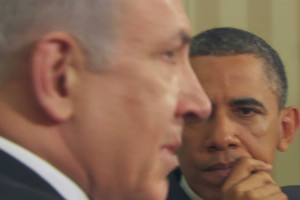
https://i0.wp.com/cdn.breitbart.com/mediaserver/Obama%20Netanyahu.jpg

The leaks continue from the Obama administration with regard to Israeli defense secrets. On Sunday, the New Yorker printed a report stating that US had worked with the Iranian opposition group Mujahideen-e-Khalq (MEK). The US was apparently receiving intelligence from the group, including intercepted cell phone calls and text messages. But sources also confirmed that Mossad was helping to funnel resources and train members of the MEK. As Seymour Hersh writes:


[E]arly last month NBC News quoted two senior Obama Administration officials as confirming that the attacks were carried out by M.E.K. units that were financed and trained by Mossad, the Israeli secret service. NBC further quoted the Administration officials as denying any American involvement in the M.E.K. activities. The former senior intelligence official I spoke with seconded the NBC report that the Israelis were working with the M.E.K., adding that the operations benefitted from American intelligence. He said that the targets were not “Einsteins”; “The goal is to affect Iranian psychology and morale,” he said, and to “demoralize the whole system—nuclear delivery vehicles, nuclear enrichment facilities, power plants.” Attacks have also been carried out on pipelines. He added that the operations are “primarily being done by M.E.K. through liaison with the Israelis, but the United States is now providing the intelligence.”


So what would be the purpose of the leak this time? The same as the last time: it’s supposed to tip off the Iranians to efforts against them, and it’s supposed to dissuade the Israelis from doing anything to stop the Iranian nuclear program. And those efforts are largely Israeli – Secretary of Defense Leon Panetta has already denied any US involvement in the assassinations of the Iranian nuclear scientists.


This leak is just the latest in a pattern of leaks from the Obama administration, which has already leaked information about a covert Israeli deal with Azerbaijan to use airbases in that country as a staging point for an attack on the Iranian nuclear facilities. In 2010, the Obama administration leaked information of a covert deal between Israel and Saudi Arabia to use Saudi airspace for such an attack.


The Obama administration is desperate to prevent any sort of aggressive Israeli action on Iran before the election. That’s because Obama knows it would put him between a rock and a hard place – his leftist base hates Israel, and yet the American people love Israel overall. Meanwhile, Obama recognizes that he’s going to have to go to OPEC and ask them to ratchet up production prior to election, and he will want to make promises about battering Israel in order to secure that ramped-up oil production. All in all, Obama would prefer to wait until after his re-election for any Israel-Iran blow-up, because at that point, he’ll have more “flexibility.”

Exclusive: Iran’s “new initiatives” place Israel at center of nuclear talks

April 11, 2012

DEBKAfile, Political Analysis, Espionage, Terrorism, Security.

DEBKAfile Exclusive Report April 11, 2012, 10:20 PM (GMT+02:00)


Iran’s top nuclear negotiator Saeed Jalili

The head of Iran’s National Security Council Saeed Jalili suggested enigmatically Wednesday, April 11, that its representatives would present “new initiatives” at the negotiations with six world powers starting in Istanbul next Saturday.  “We hope,” he said, “that the powers will also enter talks with constructive approaches; the language of threat and pressure against the Iranian nation has never yielded results.”

Although Jalili, who will lead the Iranian negotiating team, did not divulge the nature of the new initiatives, debkafile’s Iranian and intelligence sources have obtained their content:

1. Iran will continue to enrich low-grade 3.5 percent uranium but not consent to a cap on quantities;

2. The removal of enriched uranium outside Iran’s borders is not open to discussion and will not be permitted;
3. Iran is prepared for a deal whereby the six powers endorse Iran’s right to enrich as much high-grade 20-percent enriched uranium as it wishes according to a three-part fomula:

a) A joint panel of the six powers and Iran will determine the amounts required to meet the needs of its reactor and the production of isotopes for medical research; b) Iran will sell the surfeit on the international market and become the world’s No. 1 exporter of 20-percent enriched uranium; c) Excess quantities over and above a) and b) will be downgraded by a reverse process from 20 to 3.5 percent.
4.  Iran will reject demands to shut down the underground enrichment plant at Fordow, near Qom, but agree to signing the Non-Proliferation Treaty’s Additional Protocol – which would permit IAEA inspectors to make spot checks at all suspect nuclear sites in Iran, including Fordow – with one proviso: The six powers must also require Israel to sign the NPT plus the Additional Protocol. If Israel doesn’t sign both parts of this treaty, neither will Iran endorse the AP.
5. The “Israeli dossier” tops the tactical agenda set out by Iran’s top strategic team for the forthcoming nuclear negotiations Istanbul.
Its representatives will be briefed to turn aside every demand the world powers make of Tehran by twisting it around and pointing it at Israel’s alleged nuclear program. They will argue that they are acting to promote President Barack Obama’s avowed vision of a nuclear-free Middle East. By using this stratagem, the Iranians expect to come away from the negotiating table sitting pretty, having extracted international permission both for enriching as much high-grade uranium as they want and for keeping the Fordow facility in full operation.