Archive for April 11, 2012

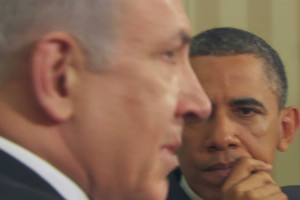
Obama Administration Leaks ANOTHER Israeli Defense Secret

April 11, 2012

Obama Administration Leaks ANOTHER Israeli Defense Secret.

https://i0.wp.com/cdn.breitbart.com/mediaserver/Obama%20Netanyahu.jpg

The leaks continue from the Obama administration with regard to Israeli defense secrets. On Sunday, the New Yorker printed a report stating that US had worked with the Iranian opposition group Mujahideen-e-Khalq (MEK). The US was apparently receiving intelligence from the group, including intercepted cell phone calls and text messages. But sources also confirmed that Mossad was helping to funnel resources and train members of the MEK. As Seymour Hersh writes:


[E]arly last month NBC News quoted two senior Obama Administration officials as confirming that the attacks were carried out by M.E.K. units that were financed and trained by Mossad, the Israeli secret service. NBC further quoted the Administration officials as denying any American involvement in the M.E.K. activities. The former senior intelligence official I spoke with seconded the NBC report that the Israelis were working with the M.E.K., adding that the operations benefitted from American intelligence. He said that the targets were not “Einsteins”; “The goal is to affect Iranian psychology and morale,” he said, and to “demoralize the whole system—nuclear delivery vehicles, nuclear enrichment facilities, power plants.” Attacks have also been carried out on pipelines. He added that the operations are “primarily being done by M.E.K. through liaison with the Israelis, but the United States is now providing the intelligence.”


So what would be the purpose of the leak this time? The same as the last time: it’s supposed to tip off the Iranians to efforts against them, and it’s supposed to dissuade the Israelis from doing anything to stop the Iranian nuclear program. And those efforts are largely Israeli – Secretary of Defense Leon Panetta has already denied any US involvement in the assassinations of the Iranian nuclear scientists.


This leak is just the latest in a pattern of leaks from the Obama administration, which has already leaked information about a covert Israeli deal with Azerbaijan to use airbases in that country as a staging point for an attack on the Iranian nuclear facilities. In 2010, the Obama administration leaked information of a covert deal between Israel and Saudi Arabia to use Saudi airspace for such an attack.


The Obama administration is desperate to prevent any sort of aggressive Israeli action on Iran before the election. That’s because Obama knows it would put him between a rock and a hard place – his leftist base hates Israel, and yet the American people love Israel overall. Meanwhile, Obama recognizes that he’s going to have to go to OPEC and ask them to ratchet up production prior to election, and he will want to make promises about battering Israel in order to secure that ramped-up oil production. All in all, Obama would prefer to wait until after his re-election for any Israel-Iran blow-up, because at that point, he’ll have more “flexibility.”

Exclusive: Iran’s “new initiatives” place Israel at center of nuclear talks

April 11, 2012

DEBKAfile, Political Analysis, Espionage, Terrorism, Security.

DEBKAfile Exclusive Report April 11, 2012, 10:20 PM (GMT+02:00)


Iran’s top nuclear negotiator Saeed Jalili

The head of Iran’s National Security Council Saeed Jalili suggested enigmatically Wednesday, April 11, that its representatives would present “new initiatives” at the negotiations with six world powers starting in Istanbul next Saturday.  “We hope,” he said, “that the powers will also enter talks with constructive approaches; the language of threat and pressure against the Iranian nation has never yielded results.”

Although Jalili, who will lead the Iranian negotiating team, did not divulge the nature of the new initiatives, debkafile’s Iranian and intelligence sources have obtained their content:

1. Iran will continue to enrich low-grade 3.5 percent uranium but not consent to a cap on quantities;

2. The removal of enriched uranium outside Iran’s borders is not open to discussion and will not be permitted;
3. Iran is prepared for a deal whereby the six powers endorse Iran’s right to enrich as much high-grade 20-percent enriched uranium as it wishes according to a three-part fomula:

a) A joint panel of the six powers and Iran will determine the amounts required to meet the needs of its reactor and the production of isotopes for medical research; b) Iran will sell the surfeit on the international market and become the world’s No. 1 exporter of 20-percent enriched uranium; c) Excess quantities over and above a) and b) will be downgraded by a reverse process from 20 to 3.5 percent.
4.  Iran will reject demands to shut down the underground enrichment plant at Fordow, near Qom, but agree to signing the Non-Proliferation Treaty’s Additional Protocol – which would permit IAEA inspectors to make spot checks at all suspect nuclear sites in Iran, including Fordow – with one proviso: The six powers must also require Israel to sign the NPT plus the Additional Protocol. If Israel doesn’t sign both parts of this treaty, neither will Iran endorse the AP.
5. The “Israeli dossier” tops the tactical agenda set out by Iran’s top strategic team for the forthcoming nuclear negotiations Istanbul.
Its representatives will be briefed to turn aside every demand the world powers make of Tehran by twisting it around and pointing it at Israel’s alleged nuclear program. They will argue that they are acting to promote President Barack Obama’s avowed vision of a nuclear-free Middle East. By using this stratagem, the Iranians expect to come away from the negotiating table sitting pretty, having extracted international permission both for enriching as much high-grade uranium as they want and for keeping the Fordow facility in full operation.

Report: Iran to make new proposals at nuke talks

April 11, 2012

Report: Iran to make new proposals at nuke talks – Israel News, Ynetnews.

Iran’s Press TV says new offers aim to ease concerns about nuclear program, strengthen Islamic Republic’s position ahead of talks with West

Reuters

Iran will present new proposals at talks on Saturday aimed at easing concerns about its nuclear activity, state television said, but it was unclear if Tehran was willing to address its disputed uranium enrichment drive as six world powers want.

It was the latest apparent attempt to strengthen Iran‘s position ahead of the talks, which the powers insists must tackle its higher-grade enrichment activities seen in the West as a disguised effort to develop nuclear weapons capability.

Related stories:

The Islamic Republic says the program is solely for power generation and medical needs.

“Iran’s representatives will participate in the negotiations with new initiatives and we hope that the P5+1 countries will also enter talks with constructive approaches,” said the head of Iran’s Supreme National Security Council, Saeed Jalili, according to English-language news network Press TV.
מפת הכורים הגרעיניים באיראן

Map of major Iranian nuclear facilities

Jalili, Iran’s chief nuclear negotiator, said it was “ready to hold progressive and successful talks on cooperation” but that “the language of threat and pressure against the Iranian nation has never yielded results”.

Previous rounds of talks – the last was in January 2011 – foundered in part because of Iran’s refusal to negotiate on the scope of its enrichment work, instead floating general proposals for trade and security cooperation.

In February Jalili wrote to EU Foreign Policy Chief Catherine Ashton saying Iran would put forward new initiatives in any future talks but did not spell out what they were.

On Monday, the head of Iran’s Atomic Energy Organization, Fereydoon Abbasi-Davani, raised the possibility of Iran suspending enrichment to the 20% level of fissile purity if its needs were met.

The proposal did not address Western concerns about what would happen to Iran’s existing stockpile of higher-grade enrichment uranium.

Uranium needs to be refined only to the 5% level for use in running power plants. A 90% threshold is required for atomic bomb material. Iran says it needs a 20% stockpile to fuel a medical isotope reactor. Western powers fear Iran’s underlying goal is to advanced towards bomb-grade purity.

‘Security situation isn’t all doom and gloom’

April 11, 2012

‘Security situation isn’t all doom and gloom’ – JPost – Defense.

By ARIEH O’SULLIVAN / THE MEDIA LINE
04/11/2012 11:47
Amos Gilad: Palestinians quiet, Syria in turmoil, Iran sanctioned, but trouble in Cairo looms.

IDF soldiers north of Eilat, Sinai
Photo: Reuters/Ronen Zvulun

It’s not often that you hear an Israeli general saying the country’s security situation is fine, that everything isn’t gloom and doom, and that the defense budget is adequate.

But, breaking from that military tradition, Maj.-Gen. (res.) Amos Gilad, the director of Policy and Political-Military Affairs at the Defense Ministry, contends that the country is in a stronger position than it has been in a long time. “This has been the most convenient year from a security point of view,” he says.

Suicide bombings are history, Palestinian terrorism has been defeated, Israeli deterrence is keeping Hamas rockets at bay, Syria’s army is pre-occupied with rebellion at home and Iran does not yet have nuclear weapons. The peace treaties with Jordan and Egypt are still in force and Israel continues to enjoy cooperation of the Egyptian military.

“Of course, we are enjoying the good services of Egypt. The Egyptians do have dramatic influence,” he said.

A former top intelligence officer and liaison with Egypt, Gilad didn’t take long, however, to sour that pleasant note when he warned that the ongoing political upheaval in Egypt and the rise of the Muslim Brotherhood could spell trouble in the future.

“I’m not hiding from you that we are concerned,” Gilad told foreign journalists and diplomats at a briefing at the Jerusalem Center for Public Affairs, an Israeli think-tank. “The leaders of the Muslim Brotherhood keep declaring, ‘We are committed to this peace.’ I am not so sure.”

He said the Islamists regard Israel as “Waqf, holy land,” or property bequeathed by Muslims for religious purposes.  He noted that it was the Egypt’s Brotherhood-dominated parliament that called for expelling Israel’s ambassador and reviewing bilateral ties after Israel launched a military strike on Gaza last month.

Last Friday, a member of parliament for the Freedom and Justice Party, the political arms of the Muslim Brotherhood, said the movement would not put the peace treaty with Israel to a referendum vote. “We will not put the Camp David accords, or any other agreement Egypt has signed to a national referendum,” said Abd Al-Maujood Al-Dardiri.

But the Brotherhood is currently engaged in a public relations effort to convince the US and other Western powers that it can be relied on and it has reversed itself on positions in the past.

“All these developments, we will need to look at them very carefully. Because they can declare they are committed to peace but they can find excuses to undermine it,” Gilad said.

Israel regards the 33-year-old peace treaty with Egypt as a pillar of its national security. Egypt was the first Arab nation to make peace with the Jewish state and Gilad said he couldn’t imagine peace deals with other Arab countries in the future without Egyptian support.

Nevertheless, lawlessness is growing in the Sinai Peninsula, which abuts Israel.  Al-Qaida and Palestinian terrorists are using it as a launch pad for strikes against Israel and disgruntled Bedouin routinely attack the pipeline that delivers natural gas to Israel and Jordan. Egyptian forces have failed to keep order since Husni Mubarak was toppled over a year ago.

On Monday, terrorists blew up the pipeline supplying gas to Israel and Jordan near Al-Arish in the northern Sinai, the 14th time since the revolt that ousted Mubarak. Two days before, a pair of Grad rockets that hit the southern Israeli resort town of Eilat. Israel says they were fired from the Sinai, a charge the Egyptians have denied.

Israeli security sources have labeled Sinai a “terror Incubator,” a transit point for huge quantities of arms, rockets and contraband originating in Iran and Libya headed for Hamas-controlled Gaza Strip.

In response to the growing anarchy there, Egypt, with coordination with Israel, has been dramatically boosting its military presence in the Sinai to restore control. At least seven Egyptian military battalions, comprising some 3,000 troops, together with 150 special forces police were expected to deploy gradually in the Sinai, according to the Palestinian Ma’an news agency.

These forces were in addition to 1,000 Egyptian security forces Israel agreed to allow the last year into what is officially a demilitarized zone under the Egyptian-Israeli peace treaty.

“Without Egypt, I cannot imagine stability on our southern front,” Gilad said. “They are the only ones who know how to convince all the crazy guys there, all the extremists, to be calm and quiet.

He added cryptically that anything except success by the Egyptian forces could lead to Israeli action. “There are some hidden laws of the game,” Gilad said.

The 1979 peace treaty between Israel and Egypt calls for limited force presence since even the slightest spark has the risk of damaging relations, particularly during this volatile time in Egypt.

Under the peace treaty, a “hot pursuit” clause allows forces of one country to pursue an armed threat across the border of the other. But last year, a diplomatic crisis erupted after the Israeli military mistakenly killed a number of Egyptian security forces following a cross-border ambush by at least a dozen gunmen that killed eight people and wounded over 40.

Setting aside Egypt’s will to control Sinai, its ability to do so remains in doubt.

Mofaz slams Obama for weak stance on Iran nukes

April 11, 2012

Mofaz slams Obama for weak stance… JPost – Diplomacy & Politics.

04/11/2012 00:28
New opposition leader tells ‘The Jerusalem Post’ that a ‘bi-national state is a bigger threat to Israel than Tehran.”

Kadima MK Shaul Mofaz Photo: REUTERS

New opposition leader Shaul Mofaz issued rare criticism of US President Barack Obama in an interview with The Jerusalem Post that will be published in Thursday’s Passover edition.

Mofaz has been one of the most positive voices among Israeli politicians about Obama, with whom he is seeking a meeting to boost his prime ministerial credentials. He has repeatedly defended Obama’s policies, especially on the Palestinian issue.

But Mofaz said he did not endorse Obama’s idea to permit Iran to have a civilian nuclear program as long as it did not become a military program. Obama reportedly sent a secret message to Iranian Supreme Leader Ayatollah Ali Khamenei expressing a willingness to accept a civilian program if Iran could prove it would not pursue nuclear weapons.

Washington Post columnist David Ignatius wrote that Obama had sent Khamenei the message via Turkish Prime Minister Recep Tayyip Erdogan, who was was in Iran last week.

“It would be too hard to monitor [a civilian program],” Mofaz said. “Iran has military ambitions and abilities, so we cannot close our eyes. Allowing Iran to obtain even a civilian nuclear capability would change the balance of power in the Middle East. America realizes why Israel cannot accept this.”

Mofaz said he believed the Obama administration was committed to stopping the Iranian nuclear program. Calling for an intensification of Americanled sanctions against Iran, he said the military option was the last option but that Israel must be ready for it.

“If we see Iran getting closer to a military nuclear capability and the US acting against its own interest and allowing a sword on our neck, I will be the first to support Israel taking action,” he said. “On this there would be no coalition and opposition. But the sword is not there yet.”

Mofaz outlined his diplomatic plan, which calls for a two-stage withdrawal from 60 percent of the West Bank and then from 100% via land swaps. He said the dramatic changes taking place in the Middle East required Israel to expedite rather than delay diplomatic efforts.“The biggest danger for Israel is not the Iranian threat but Israel becoming a bi-national state,” he said. “Losing the Jewish majority endangers Israel more than anything. I will not let it happen.”

The Ghost of Iran’s Future – Brookings Institution

April 11, 2012

The Ghost of Iran’s Future – Brookings Institution.

When analyzing “the centrality of Iran in the Republican narrative,” Suzanne Maloney insightfully points out that the presidential candidates are playing to their conservative base. Note, however, that they are simultaneously exploiting a key vulnerability in the Obama campaign, which is haunted by a vision of the Iranian prime minister, Mahmoud Ahmadinejad, standing next to a nuclear-tipped missile draped with banners and calling for the destruction of the United States and Israel. Surrounded by stern mullahs, imposing generals, and white-coated nuclear technicians, he has a broad smile on his face. Preventing this from happening—or allowing it—is the most consequential decision that President Barack Obama faces in this election year.

For the past eight years Americans have heard from two presidents that an Iranian nuclear weapon is “unacceptable.” Yet with each passing day they are closer to witnessing a celebration in Tehran. The Iranian centrifuges have been slowed by international sanctions and covert sabotage. Nevertheless, they continue to spin, and the stockpiles of enriched uranium steadily grow. According to Secretary of Defense Leon Panetta, Iran will have the capability to build a weapon within a year or two—even faster if its supplies of enriched uranium are augmented by a foreign source. Panetta also says of the Iranians, “If they proceed and we get intelligence that they are proceeding with developing a nuclear weapon, then we will take whatever steps necessary to stop it.”

The implications are grave. President Obama will be forced either to accept the rise of a nuclear Iran or to launch a war to stop it. This is not a decision that this president—or, for that matter, any president—wants to make. But, above all, it is not a decision that Obama wants to make before November.

If Iran succeeds in gaining the use of nuclear weapons, Obama’s foreign policy will be fundamentally undermined, making him vulnerable to Republican attacks. The president summarized his achievements in the opening moments of the State of the Union address: “For the first time in nine years,” there are no Americans fighting in Iraq. For the first time in two decades, Osama bin Laden is not a threat to this country. Most of al Qaeda’s top lieutenants have been defeated. The Taliban’s momentum has been broken, and some troops in Afghanistan have begun to come home.” Boiled down to its essence, these statements tell a simple story that epitomizes the administration’s policy toward the Middle East: “By accepting limited goals, dialing back American pretensions, and focusing on counterterror tactics, I won the war against al Qaeda and brought the troops home.”

The apparent success of this approach protects the president from attack when the Republicans trot out their perennial accusation that Democrats are soft on defense. In fact, Obama has already been defending himself effectively. During a White House press conference in December 2011, the president was asked about the GOP candidates’ accusation that he is an appeaser in the Middle East. “Ask Osama bin Laden and the twenty-two of top thirty al Qaeda leaders who have been taken off the field whether I engage in appeasement. . . . Ask them about that,” said Obama.

It was a good answer, not only because the counterterror tactics have worked, but also because they shift attention away from war. The White House and its allies have nixed proposals for ticker tape parades for the returning troops. Obama is running not on victory in either Iraq or Afghanistan but, rather, on extrication. As the nation heads into the general election, his message will go something like this: “I got us out of the mess that my predecessor created. I am putting some distance between us and the Middle East and, therefore, we are safer.”

In many ways, this is a better story to tell than victory. In a year when the perilous state of the economy will dominate the election, it sends the right message about priorities: “I’m focused on our problems here.” It also insulates the president from the growing instability in Iraq. Some of the president’s critics believe that if Iraq falls into civil war—a very real possibility—the mess can be laid at his doorstep. They are wrong. Chaos will simply reinforce the basic wisdom of the decision to cut losses and pull back. In fact, bad news from anywhere in the Middle East strengthens the president.

From anywhere, that is, but Iran. The Islamic Republic with nuclear weapons undermines Obama’s message. For more than thirty years, Tehran has been working hard to establish itself in the American mind as a wily, malevolent, and dangerous villain. Some Iran experts reject this image, dismissing it as a pernicious caricature. Regardless of the merits of their position, the image exists. Americans will regard a nuclear Iran—or even a nearly nuclear Iran—as a direct threat to their personal security (and to the security of Israel, which is a deep concern to them).

The campaign’s goal, therefore, is to keep Iran out of the headlines until after November. But this may prove impossible, because the centrifuges continue to spin and the Israelis are planning—also according to Panetta—to attack Iranian nuclear facilities in the spring of 2012.

The electoral calendar in the United States may well be influencing the Israelis’ timing. It cannot have escaped notice in Jerusalem that Israel loses leverage over the United States if Obama is reelected. After the election, the president can continue to play for time: delaying the decision to take drastic action and at the same time forcing restraint on Israel. By contrast, if the Israelis push ahead with their plan to attack in the spring, they will compel Obama to make a clear decision.

The Israeli plan gives Obama three stark options: to restrain Israel, unleash it, or launch an attack himself. These all work against the administration’s efforts to make the extrication of troops from Iraq and Afghanistan the big and politically beneficial achievement of its Middle Eastern policy. The simplest solution for the president would be to persuade the Israelis, behind the scenes, to hold off. But if he tries, word will get out. The last thing Obama needs in a closely contested election is a debate about whether he is shielding Iran and placing Israel in harm’s way. That debate will cast him as an appeaser, even if he did kill Osama bin Laden and his deputies. Were it not for Iran’s relentless pursuit of nuclear weapons, Obama would have a good story to tell on foreign policy.

Iran Seeks Increased Regional Role with Threats and Diversions

April 11, 2012

The Iranian Threat

via The Cutting Edge News.

April 10th 2012
Iranian Revolutionary Guard

For centuries, the dilemma facing Iran (and before it, Persia) has been guaranteeing national survival and autonomy in the face of stronger regional powers like Ottoman Turkey and the Russian Empire. Though always weaker than these larger empires, Iran survived for three reasons: geography, resources and diplomacy. Iran’s size and mountainous terrain made military forays into the country difficult and dangerous. Iran also was able to field sufficient force to deter attacks while permitting occasional assertions of power. At the same time, Tehran engaged in clever diplomatic efforts, playing threatening powers off each other.

The intrusion of European imperial powers into the region compounded Iran’s difficulties in the 19th century, along with the lodging of British power to Iran’s west in Iraq and the Arabian Peninsula following the end of World War I. This coincided with a transformation of the global economy to an oil-based system. Then as now, the region was a major source of global oil. Where the British once had interests in the region, the emergence of oil as the foundation of industrial and military power made these interests urgent. Following World War II, the Americans and the Soviets became the outside powers with the ability and desire to influence the region, but Tehran’s basic strategic reality persisted. Iran faced both regional and global threats that it had to deflect or align with. And because of oil, the global power could not lose interest while the regional powers did not have the option of losing interest.Whether ruled by shah or ayatollah, Iran’s strategy remained the same: deter by geography, protect with defensive forces, and engage in complex diplomatic maneuvers. But underneath this reality, another vision of Iran’s role always lurked.

Iran as Regional Power

A vision of Iran — a country with an essentially defensive posture — as a regional power remained. The shah competed with Saudi Arabia over Oman and dreamed of nuclear weapons. Ahmadinejad duels with Saudi Arabia over Bahrain, and also dreams of nuclear weapons. When we look beyond the rhetoric — something we always should do when studying foreign policy, since the rhetoric is intended to intimidate, seduce and confuse foreign powers and the public — we see substantial continuity in Iran’s strategy since World War II. Iran dreams of achieving regional dominance by breaking free from its constraints and the threats posed by nearby powers.

Since World War II, Iran has had to deal with regional dangers like Iraq, with which it fought a brutal war lasting nearly a decade and costing Iran about 1 million casualties. It also has had to deal with the United States, whose power ultimately defined patterns in the region. So long as the United States had an overriding interest in the region, Iran had no choice but to define its policies in terms of the United States. For the shah, that meant submitting to the United States while subtly trying to control American actions. For the Islamic republic, it meant opposing the United States while trying to manipulate it into taking actions in the interests of Iran. Both acted within the traditions of Iranian strategic subtlety.

The Islamic republic proved more successful than the shah. It conducted a sophisticated disinformation campaign prior to the 2003 Iraq war to convince the United States that invading Iraq would be militarily easy and that Iraqis would welcome the Americans with open arms. This fed the existing U.S. desire to invade Iraq, becoming one factor among many that made the invasion seem doable. In a second phase, the Iranians helped many factions in Iraq resist the Americans, turning the occupation — and plans for reconstructing Iraq according to American blueprints — into a nightmare. In a third and final phase, Iran used its influence in Iraq to divide and paralyze the country after the Americans withdrew.

As a result of this maneuvering, Iran achieved two goals. First, the Americans disposed of Iran’s archenemy, Saddam Hussein, turning Iraq into a strategic cripple. Second, Iran helped force the United States out of Iraq, creating a vacuum in Iraq and undermining U.S. credibility in the region — and sapping any U.S. appetite for further military adventures in the Middle East. I want to emphasize that all of this was not an Iranian plot: Many other factors contributed to this sequence of events. At the same time, Iranian maneuvering was no minor factor in the process; Iran skillfully exploited events that it helped shape.

There was a defensive point to this. Iran had seen the United States invade the countries surrounding it, Iraq to its west and Afghanistan to its east. It viewed the United States as extremely powerful and unpredictable to the point of irrationality, though also able to be manipulated. Tehran therefore could not dismiss the possibility that the United States would choose war with Iran. Expelling the United States from Iraq, however, limited American military options in the region.

This strategy also had an offensive dimension. The U.S. withdrawal from Iraq positioned Iran to fill the vacuum. Critically, the geopolitics of the region had created an opening for Iran probably for the first time in centuries. First, the collapse of the Soviet Union released pressure from the north. Coming on top of the Ottoman collapse after World War I, Iran now no longer faced a regional power that could challenge it. Second, with the drawdown of U.S. forces in the Persian Gulf and Afghanistan, the global power had limited military options and even more limited political options for acting against Iran.

Iran’s Opportunity

Iran now had the opportunity to consider emerging as a regional power rather than solely pursuing complex maneuvers to protect Iranian autonomy and the regime. The Iranians understood that the moods of global powers shifted unpredictably, the United States more than most. Therefore it knew that the more aggressive it became, the more the United States may militarily commit itself to containing Iran. At the same time, the United States might do so even without Iranian action. Accordingly, Iran searched for a strategy that might solidify its regional influence while not triggering U.S. retaliation.

Anyone studying the United States understands its concern with nuclear weapons. Throughout the Cold War it lived in the shadow of a Soviet first strike. The Bush administration used the possibility of an Iraqi nuclear program to rally domestic support for the invasion. When the Soviets and the Chinese attained nuclear weapons, the American response bordered on panic. The United States simultaneously became more cautious in its approach to those countries.

In looking at North Korea, the Iranians recognized a pattern they could use to their advantage. Regime survival in North Korea, a country of little consequence, was uncertain in the 1990s. When it undertook a nuclear program, however, the United States focused heavily on North Korea, simultaneously becoming more cautious in its approach to the North. Tremendous diplomatic activity and periodic aid was brought to bear to limit North Korea’s program. From the North Korean point of view, actually acquiring deliverable nuclear weapons was not the point; North Korea was not a major power like China and Russia, and a miscalculation on Pyongyang’s part could lead to more U.S. aggression.

Rather, the process of developing nuclear weapons itself inflated North Korea’s importance while inducing the United States to offer incentives or impose relatively ineffective economic sanctions (and thereby avoiding more dangerous military action). North Korea became a centerpiece of U.S. concern while the United States avoided actions that might destabilize North Korea and shake loose the weapons the North might have.

The North Koreans knew that having a deliverable weapon would prove dangerous, but that having a weapons program gave them leverage — a lesson the Iranians learned well. From the Iranians’ point of view, a nuclear program causes the United States simultaneously to take them more seriously and to increase its caution while dealing with them. At present, the United States leads a group of countries with varying degrees of enthusiasm for imposing sanctions that might cause some economic pain to Iran, but give the United States a pretext not to undertake the military action Iran really fears and that the United States does not want to take.

Israel, however, must take a different view of Iran’s weapons program. While not a threat to the United States, the program may threaten Israel. The Israelis’ problem is that they must trust their intelligence on the level of development of Iran’s weapons. The United States can afford a miscalculation; Israel might not be able to afford it. This lack of certainty makes Israel unpredictable. From the Iranian point of view, however, an Israeli attack might be welcome.

Iran does not have nuclear weapons and may be following the North Korean strategy of never developing deliverable weapons. If they did, however, and the Israelis attacked and destroyed them, the Iranians would be as they were before acquiring nuclear weapons. But if the Israelis attacked and failed to destroy them, the Iranians would emerge stronger. The Iranians could retaliate by taking action in the Strait of Hormuz. The United States, which ultimately is the guarantor of the global maritime flow of oil, might engage Iran militarily.

Or it might enter into negotiations with Iran to guarantee the flow. An Israeli attack, whether successful or unsuccessful, would set the stage for Iranian actions that would threaten the global economy, paint Israel as the villain, and result in the United States being forced by European and Asian powers to guarantee the flow of oil with diplomatic concessions rather than military action. An attack by Israel, successful or unsuccessful, would cost Iran little and create substantial opportunities. In my view, the Iranians want a program, not a weapon, but having the Israelis attack the program would suit Iran’s interests quite nicely.

The nuclear option falls into the category of Iranian manipulation of regional and global powers, long a historical necessity for the Iranians. But another, and more significant event is under way in Syria.

Syria’s Importance to Iran

As we have written, if the Syrian regime survives, this in part would be due to Iranian support. Isolated from the rest of the world, Syria would become dependent on Iran. If that were to happen, an Iranian sphere of influence would stretch from western Afghanistan to Beirut. This in turn would fundamentally shift the balance of power in the Middle East, fulfilling Iran’s dream of becoming a dominant regional power in the Persian Gulf and beyond. This was the shah’s and the ayatollah’s dream. And this is why the United States is currently obsessing over Syria.

What would such a sphere of influence give the Iranians? Three things. First, it would force the global power, the United States, to abandon ideas of destroying Iran, as the breadth of its influence would produce dangerously unpredictable results. Second, it would legitimize the regime inside Iran and in the region beyond any legitimacy it currently has. Third, with proxies along Saudi Arabia’s northern border in Iraq and Shia along the western coast of the Persian Gulf, Iran could force shifts in the financial distribution of revenues from oil. Faced with regime preservation, Saudi Arabia and other Gulf states would have to be flexible on Iranian demands, to say the least. Diverting that money to Iran would strengthen it greatly.

Iran has applied its strategy under regimes of various ideologies. The shah, whom many considered psychologically unstable and megalomaniacal, pursued this strategy with restraint and care. The current regime, also considered ideologically and psychologically unstable, has been equally restrained in its actions. Rhetoric and ideology can mislead, and usually are intended to do just that.

This long-term strategy, pursued since the 16th century after Persia became Islamic, now sees a window of opportunity opening, engineered in some measure by Iran itself. Tehran’s goal is to extend the American paralysis while it exploits the opportunities that the U.S. withdrawal from Iraq has created. Simultaneously, it wants to create a coherent sphere of influence that the United States will have to accommodate itself to in order to satisfy the demand of its coalition for a stable supply of oil and limited conflict in the region.

Iran is pursuing a two-pronged strategy toward this end. The first is to avoid any sudden moves, to allow processes to run their course. The second is to create a diversion through its nuclear program, causing the United States to replicate its North Korea policy in Iran. If its program causes an Israeli airstrike, Iran can turn that to its advantage as well. The Iranians understand that having nuclear weapons is dangerous but that having a weapons program is advantageous. But the key is not the nuclear program. That is merely a tool to divert attention from what is actually happening — a shift in the balance of power in the Middle East.

George Friedman is the founder and editor STRATFOR, from where this article is adapted.
Robert Naiman: A Contrarian Optimist Views the Upcoming Iran Nuclear Talks

April 11, 2012

Robert Naiman: A Contrarian Optimist Views the Upcoming Iran Nuclear Talks.

When President Obama nominated global health superhero Dr. Jim Young Kim to lead the World Bank, Harvard development economist Dani Rodrik remarked, “It’s nice to see that Obama can still surprise us.”

Is it possible that Obama could pleasantly surprise us in the upcoming talks with Iran over its nuclear program? Much of the media coverage would have you think otherwise.

Nonetheless, there are actually quite a few positive signs that we can point to:

1. There have been no reported major explosions in Iran or assassinations of Iranian scientists recently, as have seemed to occur in the run-up to previous talks. This could be a sign that U.S. pressure on Israel and the Iranian MEK terrorist group is working to keep things quiet on that front. There is some evidence that this might be the case.

2. No-one appears to be talking about Israel much at all. Israeli officials appear to be keeping a relatively low profile, and Israeli Defense Minister Barak recently put forward a proposed list of Western demands that is at least on the planet of plausibility — in particular, Barak made no demand that Iran cease enriching uranium.

3. Thanks in no small part to the leadership of Senate Majority Leader Reid, Congress has also been relatively quiet. And this week Congress is out of session.

4. No-one is talking about pre-conditions for the talks, except for an expectation that the talks be serious.

5. Nobody is talking about lifting all Western sanctions on Iran. Just as ending all uranium enrichment in Iran is a non-starter for Iran, so ending all Western sanctions on Iran is a non-starter for the West. The horizon that we can see right now is an intermediate deal that addresses the most pressing concerns on each side. Since an interim deal is not going to address all the concerns of one side, it’s not going to address all the concerns of the other side.

The impending tightening of the oil sanctions is widely perceived as a real threat to Iran (as well as to the world economy.) Just as Iran has proved that it is willing to endure significant pain in the form of sanctions to keep its nuclear program, so the West has proved that it’s willing to endure pain in the form of significantly higher oil prices in order to increase pressure on Iran. Regardless of whether arriving to this point was the result of the wisest possible course, at least we can now say that each side has had the opportunity to publicly stick its hand into the fire.

6. None of the demands that the U.S. has put forward ahead of the talks would represent humiliations for Iran, with the arguable exception of the last-minute demand to close the Fordow enrichment facility, which I explore further below. In particular, the demand that Iran cease all enrichment of uranium has largely disappeared from view. The U.S. has signaled ahead of the talks that its dealbreaker bottom line is that Iran stop adding to its stockpile of 20 percent enriched uranium, on the grounds that 20 percent is too close to nuclear weapons grade, and thus the further accumulation of a stockpile of 20 percent enriched uranium makes the gap between Iran and the immediate ability to produce a nuclear weapon too small for comfort. This is a plausible concern not just from a nonproliferation of nuclear weapons point of view, but also from a nonproliferation of conventional warfare point of view.

For better and for worse, the U.S. has clearly put out that a decision by Iran to produce a nuclear weapon is the U.S. “red line” — that is, an evidenced-based U.S. belief that Iran had made such a decision would trigger the U.S. use of military force. On the downside: this threat is a flagrant violation of the UN Charter; nothing in international law gives the U.S. the unilateral right to use or threaten force against Iran if Iran were to decide to produce a nuclear weapon; furthermore, laying down the explicit threat could have the effect of locking the U.S. into using military force if Iran clearly made such a decision. On the upside: if this is the underlying U.S. policy, it’s far better for everyone to know this in advance; it’s a million times better than having a fuzzy — and much closer — “red line” like “nuclear weapons capability” as Sens. Lieberman, Graham, and McCain would like; and the Iranians have said clearly and repeatedly that they have no intention of trying to produce a nuclear weapon ever, therefore so long as these remain the bottom line U.S. and Iranian positions, then we can have peace between the U.S. and Iran forever. Given that a decision by Iran to produce a nuclear weapon is the U.S. red line, it’s in the broad interests of humanity to have a big grassy field that everyone can see between Iran and the immediate ability to produce a nuclear weapon.

Of course, there are a lot of big grassy fields that one can imagine. The UN Security Council could issue a fatwa that from now on, no-one in Iran is allowed to study physics. But big grassy fields that can’t be achieved don’t do us any good. The consensus of reasonable expert opinion is that barring Iran from enriching uranium is a big grassy field that cannot realistically be achieved. But an Iranian agreement to cease enrichment of uranium to 20 percent and/or to address concerns about its 20 percent stockpile — that is a different story.

7. What’s the ultimate evidence that the demand to stop stockpiling 20 percent enriched uranium is plausible? Iranian officials have clearly indicated that they agree that it is a plausible thing to talk about. The Washington Post reports:

In a signal that Iran is willing to negotiate over its stockpile of 20 percent enriched uranium, the head of the Atomic Energy Organization of Iran, Fereydoon Abbasi, said Sunday that his country was considering a stop to the activity and [lowering] the enrichment levels.

“We do not produce more 20 percent fuel than we need,” Abbasi told the Iranian Students’ News Agency. He said it was easy to change the centrifuges now enriching uranium up to 20 percent and use them for making nuclear fuel up to 3.5 percent enriched. “Our systems are capable of making this change,” Abbasi said.

AP reports:

Abbasi said production of uranium enriched up to 20 percent is not part of the nation’s long-term program — beyond amounts needed for its research reactor in Tehran — and insisted that Iran “doesn’t need” to enrich beyond the 20 percent levels.

“The job is being carried out based on need,” he said. “When the need is met, we will decrease production and it is even possible to completely reverse to only 3.5 percent” enrichment levels.

None of this guarantees that there will be a deal. But at least on the core U.S. demand, U.S. and Iranian officials are playing on the same ballfield.

8. Now, what about that last-minute demand that Iran shut down and eventually dismantle its underground enrichment facility at Fordow? Stephen Walt finds the demand alarming and questions whether it means that the U.S. isn’t serious about a negotiated solution. Walt’s concern is sensible, but here is the contrarian optimist view.

a. As the New York Times notes, “opening bids in international negotiations are often designed to set a high bar.” If the talks fail, the U.S. can say it took a hard line. If the Iranians agree to a reasonable deal that addresses the 20 percent enrichment and stockpiling issues, the Fordow demand can be deferred indefinitely. Indeed, if the U.S. drops the Fordow demand in the context of a deal, this could help Iranian officials sell the deal to the Iranian public. “See,” they can say, “we gave up 20 percent enrichment, but we stood firm against the running dog imperialists when they demanded that we close Fordow.”

b. The question of Fordow is deeply entangled with the 20 percent enrichment issue. A significant component of why Fordow is considered provocative by the West is because 20 percent enrichment is happening there. If 20 percent enrichment stops and/or Iran agrees to a reasonable deal to address the issue of its 20 percent enrichment stockpile, then Fordow is less of an issue.

c. The question of Fordow is also deeply entangled with the threat of an Israeli or U.S. military strike. The Israelis find Fordow particularly annoying because it would be especially hard for Israel to bomb it.

On the one hand, it’s easy to see why the Iranians would see the expression of this concern in negotiations to be quite annoying. There is no international law or agreement that says you have to make your nuclear facilities available for easy bombing (indeed, even the threat to bomb Iran’s nuclear facilities is a flagrant violation of the UN Charter.)

On the other hand, at the end of the day, all these issues are entangled; tunnels aren’t the only way, and at the end of the day they are not the best way, for Iran to deter an Israeli or U.S. strike. There are four reasons for Iran to have a nuclear program, stated and not-so-stated: energy, medical isotopes, national prestige, and deterring a U.S. or Israeli attack. At the end of the day, all four of these Iranian national goals can be achieved without the operation of the facility at Fordow; and in the context of a deal that addresses the other pressing concerns of both sides, Fordow will be less of an issue to both sides.

In particular, a perverse benefit of all the warmongering against Iran is that every time U.S. officials counter the warmongering by saying that a military strike against Iran would be counterproductive because it would drive the Iranians towards nuclear weaponization, it underscores the fact that Iran derives important national security benefits from enrichment without ever needing to crack a textbook on weaponization, nor enrich to 20 percent, nor build a deeper tunnel. If I’m an official in Iran’s enrichment program, every time a U.S. official says that a military strike on Iran’s nuclear program would be counterproductive to U.S. interests, I get a little bit more convinced that I’m never going to need to try to build a nuclear weapon to protect my country from military attack.

‘Lebanese targets fair game in future Hezbollah war’

April 11, 2012

‘Lebanese targets fair game in future Hezbolla… JPost – Defense.

04/11/2012 01:12
Defense officials: It was a mistake not to have said this in during the Second Lebanon War in 2006; IDF has significantly boosted its ‘target bank,’ which is now said to contain thousands of Hezbollah targets.

Hezbollah, Lebanon flags near Beirut airport Photo: REUTERS/Sharif Karim

Israel will attack Lebanese government targets during a future war with Hezbollah, senior defense officials said amid speculation that a war could erupt in the North following a future strike on Iran’s nuclear facilities.

“It was a mistake not to attack Lebanese government targets during the [Second Lebanon] War in 2006,” a senior defense official explained. “We will not be able to hold back from doing so in a future war.”

After the outbreak of the 2006 war, the official said, the US asked Israel to refrain from bombing Lebanese government targets so as not to weaken the prime minister at the time, Fuad Siniora, who was aligned with the West.

Israel complied and restricted its bombings to Hezbollah targets.

“This will not be the same in the future, particularly now that Hezbollah and the government are effectively one and the same,” the official said.

In general, the IDF has significantly boosted its “target bank” since the 2006 war. Today’s bank is said to contain thousands of Hezbollah targets, compared to the approximately 200 that the IDF had on July 12, 2006, when Hezbollah abducted reservists Eldad Regev and Ehud Goldwasser.

Hezbollah is believed to have amassed over 50,000 rockets and missiles, and most of the weaponry is thought to be stored in some 100 villages throughout southern Lebanon.

The new thinking regarding bombing government institutions is part of a revised IDF strategy on how to damage Hezbollah and facilitate a faster end to a war than the 34 days it took in 2006. The guerrilla group, which embeds its military capabilities within civilian infrastructure, does not have a clear power base, which if destroyed could help end such a war.

Talk of the possible bombing of Lebanese government targets comes as Israel prepares for a possible war with Hezbollah that could result from either an Israeli strike against Iran’s nuclear facilities or a preemptive strike to stop the transfer of sophisticated weaponry from Syria to Lebanon.

Western countries have prepared various contingency plans for such a scenario, including the possible bombing of a convoy if it were detected, as well as the possible insertion of commando forces to secure the chemical stockpile if and when Syrian President Bashar Assad falls.

Iran Talks Must Yield a Deal Even Reagan Could Accept – Bloomberg

April 11, 2012

Iran Talks Must Yield a Deal Even Reagan Could Accept – Bloomberg.

Apologies to Ronald Reagan as we mangle his catchphrase, but what the U.S. and other world powers need to do in negotiations with Iran later this week is to “accept, but verify” an Iranian nuclear-fuel program that’s limited to producing low civilian-grade fuel.

Only the most reckless gambler would bet on a breakthrough in the talks, due to take place in Istanbul on April 14. Ten years of abject diplomatic failure, distrust and Iranian filibustering have fed a justifiable cynicism. Nor is an election year a good time to ask President Barack Obama to make the kinds of compromises that any negotiated deal would have to include.

Still, some important facts surrounding the nuclear debate have changed since the two sides last met — disastrously –more than a year ago, again in Istanbul. Both Iran and the Obama administration should seize the opportunity to use these changes, because the alternatives to a deal are far worse.

The most important development is the pressure that harsh U.S.-led economic sanctions have placed on Iran, severely crimping the oil revenues on which the government budget relies and halving the real value of the currency. For the first time, Iran now faces clear and imminent costs and penalties should it refuse to engage with negotiators from the so-called P5+1 — the U.S., Russia, China, France, the U.K. and Germany — as it did last January. Were it not for the ramped-up sanctions, Iran would probably not have agreed to discuss its nuclear program this weekend at all.

The U.S. and the P5+1 meanwhile, also for the first time, will go into this weekend’s talks ready to drop the demand that Iran freeze all uranium enrichment, distinguishing instead between the low enriched fuel used for power generation, and higher grades of uranium that could be processed more quickly for use in a weapon.

To understand why these new facts might be important, it helps to remember how we got here. For the decade since Iran’s covert nuclear-fuel program was first exposed to the general public, diplomats have sought to span an unbridgeable divide: The goal of the U.S. and its European allies was to persuade Iran to abandon, or in more recent years to freeze, all enrichment of uranium, a process that can be used to make either civilian or weapons-grade fuel. Iran’s goal was to confirm its right to enrich uranium, enshrined in the Treaty on the Non- Proliferation of Nuclear Weapons, to which it’s a signatory. There wasn’t, in reality, a whole lot to talk about. To put it mildly, there was zero trust.

Instead, negotiators spent the years discussing so-called confidence-building measures, such as a temporary suspension of enrichment that Iran agreed to in 2004-2005, and a 2009 proposal to ship most of the country’s stock of enriched uranium abroad, in exchange for ready-made fuel rods. But these measures generally involved the Iranians making concessions aimed at slowing its enrichment program. With no significant penalty if they refused, after 2005 the Iranians just continued enriching.

So, we would rather not hear about any further confidence- building measures at the Istanbul talks. What’s needed now is an agreement that offers a better chance of stopping Iran from acquiring a bomb — with lower risks of unintended consequences — than military action.

A recent New York Times report suggests the U.S. and its allies will focus on getting Iran to halt the enrichment of uranium to 20 percent, the level required for a medical reactor in Tehran, and transferring out of the country the roughly 100 kilograms (220 pounds) of the fuel that Iran has already produced in exchange for ready-made fuel rods. An initial response from the Iranian Atomic Energy Organization head, Fereydoun Abbasi, suggests Iran could be open to such a deal.

This would be a concession on previous U.S. negotiating positions — and our own previous recommendations — as it would, in effect, allow Iran to go on enriching fuel for power generation at 3.5 percent to 5 percent. But the goal of ending all enrichment was to prevent Iran from mastering the technology that would allow it to create fuel for a bomb, should it decide to build one. That technology has been mastered and can’t be unlearned. Focusing instead on intrusive monitoring is the right move. Israeli Defense Minister Ehud Barak also endorsed the concession in a CNN interview last weekend, though he saw it as an initial step before returning to a demand for a total ban on enrichment.

To make this work, the P5+1 would need to demand Iran’s full implementation of the International Atomic Energy Agency’s additional protocols; comprehensive monitoring of all Iranian nuclear sites; and full cooperation with the IAEA in investigating unexplained evidence that suggests Iran sought to develop nuclear-weaponization technologies. Iran has repeatedly failed to live up to its legal duties in this area, utterly undermining trust in its claims to be running a purely civilian program. No deal is possible without Iran’s complete commitment to transparency.

But here comes the hard part: U.S. officials have also indicated they will demand the closure and dismantling of the enrichment facility Iran has built under a mountain near the city of Qom, in order to immunize its nuclear program against potential Israeli or U.S. air strikes. There’s no prospect that Iran would agree to the facility’s closure so long as the threat of attack persists. Provided the Qom facility is fully monitored by the IAEA, the site’s existence shouldn’t be allowed to obstruct a deal. Closure should be left to future negotiations, when the threat of attack may have been lifted and tensions with Israel reduced.

From Iran’s point of view, the purpose of making any concessions will be to get sanctions lifted. Any deal would have to involve a staged easing of sanctions that would progress in parallel with Iran’s carrying out the agreement. That could prove a hard sell to the U.S. Congress, which legislated some of the most important sanctions, and a week ago proposed to expand them further.

Congress shouldn’t use its sanctions to block a deal that the administration is ready to make. The purpose of sanctions, after all, is to be traded away to secure goals. If Republican legislators are worried that Obama may emerge with a diplomatic coup to boost support in November’s elections, they should relax. Any agreement will be a long time coming, and none that can be reached will make Obama look much like a victor.


