Archive for April 2012

Another Round with Jeffrey Goldberg: Is the Bomb-Iran Threat Receding? – James Fallows

April 30, 2012

Another Round with Jeffrey Goldberg: Is the Bomb-Iran Threat Receding? – James Fallows – International – The Atlantic.

Apr 30 2012, 3:27 AM ET

A month ago my Atlantic colleague Jeffrey Goldberg joined me for two rounds of Q-and-A about the heated military rhetoric between Israel and Iran. My main question was whether Prime Minister Netanyahu could really be serious in his threats to bomb Iranian facilities if he thought that Iranian progress toward nuclear-weapon capability has passed a “point of no return” — and that the United States wasn’t going to attack on its own.

I phrased it that way — could he really be serious? — because the judgments I had heard from US and international military figures for nearly a decade had so consistently indicated that this was not a plausible plan. A spasm, yes; something that made either tactical or strategic sense, no. (I am aware of the main counterargument: the claim from strike advocates that, even if bombing Iran is a bad idea, Israel would have no choice about averting an “existential” threat.)

Therefore I thought that at some level this had to be bluff — to force the U.S. toward a harder-line policy, to ramp up international pressure, generally to move the options and terms of argument in the direction Netanyahu preferred. You can read the previous rounds, and Jeff Goldberg’s explanation of why he thinks Netanyahu has been in complete earnest, here: first, second, and third.

A lot has happened in this past month, and Jeff Goldberg has agreed that it’s time to continue the discussion. So here goes.
__

Dear Jeff:

Thanks for agreeing to further discussions on the state of relations among Israel, Iran, and the United States. And after the preamble above, I’ll try to limit myself to one question: shouldn’t we feel better about this whole situation than we did a month ago?

It’s just one question, but naturally it will take me some space to set it up!

By “better” I mean that the chance of an Israeli strike in the foreseeable future has gone down. You and I agree that such a strike would have terrible military, economic, and diplomatic consequences. The question is whether the Netanyahu government will conclude that nonetheless it must go ahead — and that Israel could sanely and prudently go ahead with a strike. “Prudently” in terms of the reaction from the United States, possible retaliation against Israel, ramifications for the world economy, and other effects.

That seems less likely and imminent now, for two reasons.

The minor reason is the upshot of the “P5 + 1” talks in Istanbul this month. To save you saying it: I realize that talks like this usually go nowhere. And I recognize that it’s not easy to think of an agreement that will simultaneously satisfy
– the Iranians, who insist on the right to some uranium-enriching capacity within their borders, for “peaceful” purposes, as in principle they can do under the terms of the Non-Proliferation Treaty;
– the United States (and a slew of other countries), who insist on for-real, intrusive inspections to make sure that the enrichment stays within those peaceful terms; and
– the Israeli government, which is so skeptical of any guarantees, commitments, or even inspections involving the Iranians that it believes it cannot safely live with any Iranian enrichment capacity at all.

But there are many recent reports suggesting that the talks were not an automatic and instant failure. Here are a few: from a LA Times reporter, another from the LAT, from the BBC, and from Bloomberg.

Maybe this is all a ruse and playing-for-time ploy by the Iranians. But maybe not. Negotiations on “impossible” issues do not always fail – Dayton, Northern Ireland, the Camp David talks of 1978, the Shanghai Communique of 1972. Conceivably this could be another for the list.

The major reason for the changed prospects is something else. In my view it is the recently widened international publicity about longstanding disputes within the Israeli security establishment over the apocalyptic, “never again!”-Holocaust framing that Prime Minister Netanyahu has brought to coping with Iran.

Last week it was the Chief of Staff of the Israeli Defense Force, Benny Gantz,  with his “let’s slow down here” message. As you pointed out at the time, Israel’s military leadership, like America’s, is distinctly less enthusiastic than some politicians about launching an attack. (Although of course if politicians gave the order, military leaders would carry them out.)

diskin.jpgIt seems to me that things reached a significant new level over the weekend with statements from the recent head of Shin Bet, Yuval Diskin (right), that the overall approach from Netanyahu and his defense minister, Ehud Barak, to Iran was reckless and irresponsible. For readers who, unlike you, haven’t followed this, these quotes from Haaretz convey the point:

“I don’t believe in either the prime minister or the defense minister. I don’t believe in a leadership that makes decisions based on messianic feelings,” [Diskin] added…

“They are misleading the public on the Iran issue. They tell the public that if Israel acts, Iran won’t have a nuclear bomb. This is misleading. Actually, many experts say that an Israeli attack would accelerate the Iranian nuclear race,” said the former security chief.

There is another Haaretz account to the same effect. And as the NYT story today put it:

Analysts here say there has long been a rift between the elected leaders and the defense and intelligence professionals over the urgency of the Iran threat, the efficacy of an independent Israeli strike and its likely repercussions.

I take the attention to these comments as good news, and only in part because I agree with the warnings that Gantz, Diskin, and others are giving. The real significance of the statements, I think, lies in exposing the American public to a reality everyone in Israel understands: that there is deep disagreement within the country’s military and intelligence experts on the wisdom of confronting Iran in the way Netanyahu has.

It has been convenient for Benjamin Netanyahu to present the following maxims to America:
– If you care about Israel’s security, you must agree with me;
– If you don’t agree with me (about bombing Iran, settlements, etc), it therefore follows that you must not care about Israel’s security, and further that you probably are callous about the lessons of the Holocaust and the welfare of Jews worldwide.

This argument is bad from America’s perspective, because it presents a glossed-over version of disagreements within Israel. I think it’s not just bad but dangerous from Israel’s perspective, since an Israeli attack would drag the US into a war our own military and political leadership opposes — and which, we now can see, many influential Israelis view in the same way.

To bring this back to my one question for you: Is it right to think that the odds of an Israeli strike are lower than they were a month ago? Because there is at least some chance that the combination of sanctions-plus-negotiations will produce an agreement? And because we are getting a more realistic and rounded view of the range of opinion within Israel?

Please tell me that my “war is not at hand” inference is correct. Or, if you can’t do that, tell me how you read this recent news.

Thanks, Jim

The deep strangeness of Israel’s national security debate

April 30, 2012

The deep strangeness of Israel’s national security debate | Daniel W. Drezner.

Posted By Daniel W. Drezner Share

Buried within James Risen’s interesting New York Times front-pager about the easing of Iran tensions is an even more interesting story about the deep weirdness that is going on within Israel’s national security establishment on Iran: 

At the same time in Israel, the conservative government of Prime Minister Benjamin Netanyahu has been rocked by a series of public comments from current and former Israeli military and intelligence officials questioning the wisdom of attacking Iran.

The latest comments came from Yuval Diskin, the former chief of Shin Bet, Israel’s domestic security service, who on Friday said Mr. Netanyahu and Defense Minister Ehud Barak should not be trusted to determine policy on Iran. He said the judgments of both men have been clouded by “messianic feelings.” Mr. Diskin, who was chief of Shin Bet until last year, said an attack against Iran might cause it to speed up its nuclear program.

Just days before, Israel’s army chief of staff suggested in an interview with the Israeli newspaper Haaretz that the the Iranian threat was not quite as imminent as Mr. Netanyahu has portrayed it. In his comments, Lt. Gen. Benny Gantz suggested that he agreed with the intelligence assessments of the United States that Iran has not yet decided whether to build a nuclear bomb.

Iran “is going step by step to the place where it will be able to decide whether to manufacture a nuclear bomb. It hasn’t yet decided whether to go the extra mile,” General Gantz told Haaretz. He suggested that the crisis may not come to a head this year. But he said, “Clearly, the more the Iranians progress, the worse the situation is.”

Last month, Meir Dagan, the former chief of the Israeli spy agency Mossad, said he did not advocate a pre-emptive Israeli strike against Iran’s nuclear program anytime soon. In an interview with CBS’s “60 Minutes,” Mr. Dagan said the Iranian government was “a very rational one,” and that Iranian officials were “considering all the implications of their actions.”

As someone who thought the Iran rhetoric coming from Jerusalem was decidedly overheated, I nevertheless have more mixed feelings about these developments than, say, Peter Beinart.  What’s disturbing is that even though Israel’s actual opposition party is evincing many of the same sentiments as the former military officers quoted above, they are not the ones moving the policy debate — it’s the ex-military/intel guys.

That’s a problem.  As much as candidates for higher office like to talk about “consulting the commanders on the ground” and the like, big decisions about national security policy should be the province of elected leaders.  Civilians need to be in control of these decisions — the moment that elected leaders give up this control, then the voters have forfeited the most vital decisions of a republic.  This is why, in the United States, one of the rare sources of continuing bipartisan agreement is that when military commanders voice their policy opinions to the press in a way that contradicts the President, they need to be canned.

Now, recently retired military and intelligence officials are in a slightly different category, but there’s still a danger here.  I respect that these ;people should have a voice, particularly if they feel their country is on the precipice of a policy disaster — but should their voice be louder than that of the main opposition party?  I don’t think so, and it’s a sign that there’s a problem with Israeli democracy if that’s the case.  I don’t think this is entirely the fault of ex-IDF and Shin Bet leaders, mind you — Netanyahu and Barak are part of the problem as well.  Still, at least the latter people won elections and must go back to the voters again.

Developing… in a  very problematic manner.

Iranian media hails Israeli ‘differences of opinion’

April 30, 2012

Israel Hayom | Iranian media hails Israeli ‘differences of opinion’.


Iran’s Press TV runs report with the headline: “Former ISA chief says Netanyahu and Barak are not worthy of leading the regime” • Iranian lawmaker: Deployment of sophisticated stealth fighters in U.A.E. is U.S.-Israel plot to create regional instability.

Eli Leon and News Agencies
Former ISA chief Yuval Diskin lacks trust in Netanyahu and Barak. [Archive]

|

Photo credit: Yossi Zeliger

<< 1 2 >>

Bombings spread in Syria as Al Qaeda seizes control of rebel factions

April 30, 2012

DEBKAfile, Political Analysis, Espionage, Terrorism, Security.

DEBKAfile Exclusive Report April 30, 2012, 7:09 PM (GMT+02:00)


Syrian military center in Idlib

Around the first anniversary of the death of al Qaeda’s iconic leader Osama bin Laden at the hands of US special forces, the jihadist movement is making an operational comback in the Arab world and Africa. The suicide bombings hitting Damascus and Idlib in the last 24 hours were the work of Al Qaeda in Iraq – AQI, whose operatives have been pouring into Syria in the last two weeks, debkafile’s counter-terror sources report.

Washington has not asked Iraqi premier Nouri al-Maliki to stem the outward flow, realizing he is glad to see the backs of the terrorists and waving them across the border into Syria. Our sources report from Western agencies fighting al Qaeda that several thousand operatives have arrived in Syria to fight the Assad regime, most entering the country from the north. They come fully armed with quantities of explosives. Among them are hundreds of Saudis, Egyptians, Lebanese, Palestinians, Iraqis and Sudanese.

They quickly join up with the hundreds of al Qaeda fighters from Libya present at Free Syrian Army-FSA training camps in southeast Turkey. There, they are instructed in the geography of Syrian government, army and security forces locations, led across the border and transported to their targeted locations by special guides.
Monday, April 30, the day after Norwegian Maj. Gen. Robert Hood took command of a painfully inadequate force of UN UN truce supervisors, al Qaeda let loose with a spate of bombings in Damascus and the northeastern flashpoint town of Idlib. I

In the capital, they bombed the Syrian central bank with RPG grenades, ambushed a police patrol in the town center and blew up a bomb car against a Syrian military convoy driving through the Qudsiya district. Two days earlier, a suicide bomber blew himself up at the Zain al-Abideen mosque of Damascus, killing at least 9 worshippers.
These attacks were followed later Monday with three bomb blasts in Idlib at security and intelligence centers in the town, killing some 20 people, most of them security personnel. One command center was destroyed and hundreds were injured by the force of the blasts.
The Syrian ruler Bashar Assad keeps on complaining that his regime is under assault by terrorists and many of the fatalities reported are members of his army and police. But his own brutal methods against dissidents have deafened the West to these complaints and the world addresses its demands to halt the violence to him and him alone.
There is nothing new about the refusal in the West to heed the fact that al Qaeda infiltrators are increasingly responsible for violence in the various parts of the Arab Revolt. In Libya too, Muammar Qaddafi warned repeatedly that his overthrow would result in al Qaeda-linked groups seizing control of the country and commandeering his vast arsenals of weapons.
In the seven months since the Qaddafi regime was destroyed, Washington, London and Paris have turned a blind eye to the impossibility of establishing a stable government in Tripoli because rebel factions and militias identified with al Qaeda which control Libya’s main towns are too busy running the biggest arms smuggling network ever seen in North Africa.
Rockets, explosives and every kind of weapon is reaching al Qaeda elements and affiliates in abundant quantities across northern Africa and the Middle East, including their offshoots in Egyptian Sinai and the Gaza Strip.

Groups identified with al Qaeda have seized control of large parts of Mali and directly threaten the stability of the Algerian government.
debkafile’s counter-terror and Washington sources report fears that Syria might go the same way as Libya. Syrian officers and agents who have deserted from Syrian military and security agencies have made their way to Washington to implore administration officials to abandon the US policy of non-intervention in Syria. They warn that the rebel Free Syrian Army is falling into the clutches of al Qaeda. It won’t be long, they say, before these jihdist terrorists not only wreak mayhem in Syria, but turn that country into their haven and base for cross-border attacks against Turkey, Lebanon, Israel, the West Bank and Jordan.

Their pleas have not moved the Obama administration. Our military sources note that so long as the Americans stay out of involvement in Syria, France, Turkey and Arab League nations will also stand aside, because the US alone is capable of establishing combined commands and infrastructure for coordinating an operation with multiple air support on the scale required for Syria.

By opting out of action in Syria, the West and the Arab League not only give Assad free rein to continue slaughtering his people but leave the door open for al Qaeda to move in on the various Syrian rebel movements and add the element of terror to the ongoing carnage.

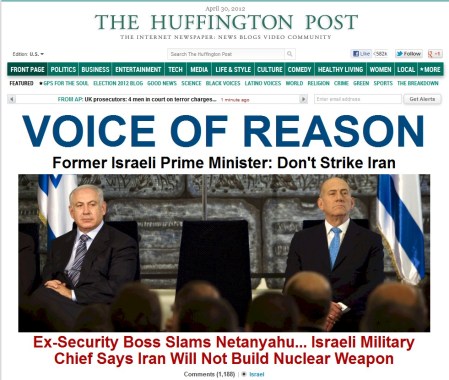
Huffpo elated!

April 30, 2012


Never mind Diskin, what about Gantz?

April 30, 2012

Never mind Diskin, what about Gantz? | The Times of Israel.

The ex-Shin Bet chief has unleashed a firestorm with his personal assault on Netanyahu and Barak over Iran. All but ignored, the head of the IDF has expressed his own differences

IDF Chief of Staff Benny Gantz walks by Prime Minister Benjamin Netanyahu and Defense Minister Ehud Barak last year. (photo credit: Yossi Zeliger/Flash90)

IDF Chief of Staff Benny Gantz walks by Prime Minister Benjamin Netanyahu and Defense Minister Ehud Barak last year. (photo credit: Yossi Zeliger/Flash90)
When one of your trio of ex-security chiefs goes public to undermine your declared assessments and strategies regarding Iran, you might reasonably challenge the credibility of his argument by claiming that he carries some kind of personal grudge against you, or is about to enter the political battlefield in a party other than yours.

When two of them do it, your questioning of their motives starts to look a little more wobbly. When all three weigh in, with varying degrees of stridency, it is the credibility of your positions, not theirs, that can start to become the issue.

Such is the case now that Yuval Diskin, the head of the internal intelligence Shin Bet agency until a year ago, has publicly savaged the handling of the Iranian nuclear threat by Prime Minister Benjamin Netanyahu and Defense Minister Ehud Barak.

Gabi Ashkenazi, the IDF chief of general staff until February of last year, is on record from as long ago as last summer as declaring that sanctions, rather than military intervention, represent the best means to thwart Iran’s nuclear program, while also stressing the need to keep “all the options on the table.” In his private dealings with the political leadership while in uniform, he is widely reported to have used language far more forceful than that mild formulation.

Ashkenazi’s comments have long since been eclipsed by ex-Mossad chief Meir Dagan’s repeated public declarations that military intervention at this stage would be an act of supreme foolishness. Time and again in the past year, Dagan has said that an Israeli strike might not significantly impact the Iranian program, but would prompt a war with Iran, possibly escalating to regional conflict. Sanctions and sabotage, Dagan keeps indicating, are the way to counter the Iranian drive to the bomb. Anything else is “stupid.”

Even Dagan’s hammering critiques have been overshadowed, however, by Diskin’s march onto the Iranian battlefield. In his comments Friday, he not only expressed doubts about the potential effectiveness of an Israeli military option. He didn’t merely reiterate Dagan’s concerns about starting a war whose scale and consequences were unpredictable. He also personalized the onslaught, declaring that he had “no faith” in the Netanyahu-Barak duo — no faith in what he called their “messianic” decision-making processes, no faith in what he suggested were their misleading presentations to the Israeli public, no faith in their ability to steward a military assault on Iran that might develop into war.

As with Dagan, the response has been an effort at character assassination. Ashkenazi and Dagan were speaking out, it was said, because they had wanted to stay on longer in their posts, or they were about to embark on political careers. So too Diskin, according to prime ministerial aides, would surely have resigned long before the end of his term if he were truly so scandalized by the incompetence of his political masters. In fact, though, he was speaking only because he was poised to enter politics (according to Barak), or was disgruntled at having been passed over for the top Mossad job (according to those in Netanyahu’s circle).

In the days since Diskin vented his criticisms, ministers have been lining up to take potshots at him. Some have aired the not unreasonable complaint that a man who was trusted with the state’s most sensitive information is breaching that trust by making public assessments based upon it. That, too, is a complaint that has been leveled against Dagan.

For those people — almost everyone, that is — who are not privy to the accumulated intelligence and consequent assessments of Iran’s nuclear program and how to stop it, there is simply no way to judge whether Netanyahu and Barak are right to declare that sanctions just aren’t working, that the moment of truth is mere months away and that, as Barak said just last week, “now is the time” for the international community to prepare to put the Iranian program to “a decisive end.”

There is no way of knowing whether Dagan, a seven-year Mossad chief, and Diskin, who ran the Shin Bet for six, overestimate what can be achieved by the clandestine means in which their agencies specialize. There is no way to gauge whether and how any personal frustrations, now that they find themselves outside the circles of real power, are impacting on their judgement.

After all, impressive though the track records of these ex-security chiefs may be, they are ex-security chiefs. For a year and more, they have been out of the loop. And whatever Dagan’s successor, Tamir Pardo, may think about tackling Iran, however Diskin’s successor Yoram Cohen judges the imperative for action, neither man has vouchsafed any assessment publicly.

Only one of the present trio of security chiefs, indeed, has gone public with an assessment of the nature of the challenge posed by Iran — the current chief of the General Staff. Ashkenazi steered his way through four years as IDF chief without ever giving a substantive interview to the written Israeli media. Gantz, 14 months into the job, spoke to Haaretz ahead of Independence Day last week.

He left no doubt that he regards the Iranian threat with the same kind of potential gravity as do Netanyahu and Barak. “If Iran goes nuclear it will have negative dimensions for the world, for the region, for the freedom of action Iran will permit itself,” he said. That freedom of action might be used “against us, via the force Iran will project toward its clients: Hezbollah in Lebanon, Islamic Jihad in Gaza. And there’s also the potential for an existential threat. If they have a bomb, we are the only country in the world that someone calls for its destruction and also builds devices with which to bomb us.”

But he also sounded somewhat less urgent than Netanyahu and Barak have done. “Clearly, the more the Iranians progress the worse the situation is,” he said. “This is a critical year, but not necessarily ‘go, no-go.’”

In contrast to the Netanyahu-Barak line, he also reportedly asserted — the Haaretz interview did not feature a direct quote on this — that international diplomatic and economic pressure on Iran is beginning to bear fruit.

But perhaps most strikingly, Gantz said Iran’s supreme religious leader Ayatollah Ali Khamenei has not yet decided whether he wants to advance the program “to the acquisition of a nuclear bomb” and that he didn’t actually think Khamenei would do so. Ultimately, he added, Iran’s leaders were “very rational.” That’s certainly not the thrust of the Netanyahu-Barak thinking.

The push to a bomb, Gantz said, “will happen if Khamenei judges that he is invulnerable to a response. I believe he would be making an enormous mistake, and I don’t think he will want to go the extra mile. I think the Iranian leadership is composed of very rational people. But I agree that such a capability, in the hands of Islamic fundamentalists who at particular moments could make different calculations, is dangerous.”

In the days since that interview, aides and advisers to Netanyahu, Barak and Gantz have sought to play down any impression of differences between the chief of staff and his employers. But the differences are plainly there.

In contrast to Gantz, Netanyahu told CNN last week that, where Iran’s leaders are concerned, “I don’t think you can bet on their rationality.” In contrast to Gantz, Netanyahu told AIPAC in March that, “Amazingly, some people refuse to acknowledge that Iran’s goal is to develop nuclear weapons.”

And Gantz is still in the loop, still privy to the latest classified information.

Curiously, ministers, aides and advisers to Netanyahu and Barak have not been lining up to take potshots at him. Ex-security chiefs are relatively easy prey; those who are still serving carry a certain aura of integrity — certainly those who are newish and unsullied in the job.

The best tactic here, the political leadership has evidently decided, is the finesse, not the confrontation. Criticism leveled at Gantz would likely bounce back… or, at the very least, further highlight the differences. Far more astute to quietly move on, and focus instead on softer targets.

Israeli-Iranian secret war

April 30, 2012

Israeli-Iranian secret war.
by Musa Keilani

Israel’s military chief of staff, Major-General Benny Gantz, has contradicted a report about the country’s super-secret agency Mossad by disclosing that the Israeli military has dramatically increased the number of covert operations against “enemy countries” across the world.

“You almost won’t find a point in time where something isn’t happening somewhere in the world,” Gantz said in an interview published in Israel’s Yedioth Ahronoth daily last week.

“I am escalating all those special operations.”

One would not have expected Gantz to give details and he did not. His disclosure of stepped-up Israeli covert operations is in stark contrast to reports that Mossad was said to have scaled back its assassination campaigns against Iranian nuclear scientists at the order of Prime Minister Benjamin Netanyahu, what was said to fear that the operations might “go awry”.

Well, Netanyahu should know. He had first-hand experience, as an Israeli prime minister, when a Mossad operation gets bust.

It was Netanyahu, as is the Israeli custom, who, as prime minister, authorised the failed 1998 attempt against Hamas leader Khaled Mishaal in Amman. The plot blew up in his face when the two Mossad agents who were carrying forged passports were caught. At the time, King Hussein skilfully negotiated the delivery of an antidote for the poison that was administered to Mishaal in return for the release of the undercover agents. In the bargain, King Hussein also secured the release of Hamas leader Ahmad Yassin from Israeli detention (Yassin was killed in an Israeli “targeted” assassination later on).

Yet another Mossad blunder came when, under Netanyahu’s premiership in January 2010, closed circuit television footage and false passports exposed that Mossad agents were present in a Dubai hotel where Hamas leader Mahmoud Al Mabhouh was found murdered.

Time magazine reported last month that Mossad had scaled down covert operations inside Iran by “dozens of per cent” in recent months, in a campaign to disable or delay the Iranian nuclear programme.

“The reduction runs across a wide spectrum of operations, cutting back not only alleged high-profile missions such as assassinations and detonations at Iranian missile bases, but also efforts to gather firsthand on-the-ground intelligence and recruit spies inside the Iranian programme,” according to Israeli security officials quoted by Time.

No country other than Israel ever boasts with its covert intelligence-related activities, let alone state-sponsored assassinations. Of course, Israel never issues any official statements on such operations, except an occasional and implicit denial when it suits it. However, comments by unnamed officials clearly indicated Mossad’s involvement in many assassinations of “Israel’s enemies” in foreign lands.

Former Mossad director Meir Amit said: “We are like the official hangman or the doctor on death row who administers the lethal injection. Our actions are all endorsed by the state of Israel. When Mossad kills it is not breaking the law. It is fulfilling a sentence sanctioned by the prime minister of the day.”

An Iranian Mossad agent, Majid Jamali Fashid, confessed on Iranian television that the Israeli agency was behind the January 2010 killing of nuclear scientist Massoud Ali Mohammedi. Confirming that the confession was genuine, Israeli officials told Time that an unnamed third country was behind exposing the Mossad cell in Iran.

At the time, the confession did not make waves because of Iran’s routine of blaming anything and everything that goes wrong on “foreign powers”.

In January this year, Iranian nuclear scientist Mostafa Ahmadi-Roshan was killed. In an unusual move, the United States “categorically” denied involvement in the death and issued a condemnation. That approach pointed the finger at Israel, which was furious because it thought that the US should not have issued such a statement.

Israel was said to be responsible for a November 2011 explosion at a missile base outside Tehran, which also claimed the life of the commander of Iran’s missile programme.

Iran has been trying to hit back. It is suspected of having been behind recent foiled plots against Israeli targets in Thailand, Azerbaijan, Singapore and Georgia.

Indian officials blamed Iran for an attack in New Delhi, where the wife of an Israeli diplomat was injured by a magnetic bomb attached to her car. It was the modus operandi seen in the killings of Iranian scientists.

When Israeli’s military chief says that Mossad is involved in “something… happening somewhere in the world” all the time, one had better believe him.

A tale of three capitals

April 30, 2012

A tale of three capitals – JPost – Opinion – Op-Eds.

By CHUCK FREILICH
04/29/2012 23:25
According to recent reports, the US and EU have reconciled themselves to the need to allow Iran to retain some nuclear enrichment capability.

Iran nuclear talks in Istanbul Photo: REUTERS/Tolga Adanali/Pool

The need to resolve the growing international crisis over Iran’s nuclear program has never been greater.

In Jerusalem, fears of a threat to Israel’s very existence, at the very least of a dire strategic threat, have animated the public bluster of recent months. Designed first and foremost to put pressure on the international community to finally deal with the Iranian issue effectively, so that Israel will not actually have to strike, rather than as a true indication of imminent action, the policy has worked well. The world has finally gotten serious about Iran and Tehran is clearly worried, jingoistic bravado notwithstanding. Israel may ultimately be forced to act militarily, but clearly hopes that the hard-line approach will forestall the need to do so.

In Washington, a marked upturn in both bluster and activity regarding the issue reflect a sincere belief in the dangers attendant to a nuclear Iran and a determination to address the issue, as well as a desire to stave off the possibility of an Israeli attack, at least until the upcoming elections. Having put unprecedented sanctions in place, Washington still hopes, albeit with little real expectation, that Iran will buckle and prevent the need for military action, American or Israeli. If the likelihood of a diplomatic resolution remains as elusive as ever, Obama has at least brought Iran back to the negotiating table and bought time, his immediate objective.

In Tehran, the bluster of recent months reflects a recognition of Iran’s increasingly difficult circumstances, with heavy international sanctions taking a growing toll on its economy and the likelihood of a military attack growing, but also a sense of partial vindication.

According to recent reports, the US and EU have reconciled themselves to the need to allow Iran to retain some nuclear enrichment capability, if only at a level appropriate to a civilian program, and are willing to forgo the previous demand for a complete cessation, an unlikely outcome given the domestic consequences for the Iranian government. In the meantime, Iran remains defiant, committed to its nuclear efforts

All three capitals thus see some gain, but have much at risk. In such circumstances, it is commonplace to believe that diplomatic solutions are more likely. It is entirely unclear, however, whether last week’s US/EU talks with Iran, scheduled to resume May 23, constitute a basis for a last-minute breakthrough, or merely a façade that provides Iran with further time to promote its nuclear capability.

Based on all previous experience, it is highly unlikely that Iran truly wishes to take advantage of this opportunity to reach a deal. Nevertheless, a good-faith effort must be made to reach an agreement, if only to prove to the American people and international community that all avenues have been exhausted and that military action, should it come to that, is indeed the last resort. To this end, a narrowly focused initial American offer should be presented by the next round of talks, along the lines mentioned above, to achieve an immediate cessation of enrichment at the dangerous 20 percent level, leaving final resolution of the issue for further talks.

TO SUCCEED, this “carrot approach” should be backed up by a clear “stick,” a firm resolve to further heighten sanctions if Iran fails once again, as it so often has in the past, to step up to the plate. The onus will then be entirely on Iran

In what may be surprising to some, Israel will probably take an even more pragmatic approach than the US, in which the Iranian nuclear issue has become a part of the presidential campaign and partisan political discourse generally and where many believe that its resolution should also be tied to Iran’s human rights violations, suppression of domestic dissent and involvement in terrorism.

In Israel, although a range of views exists regarding the means of dealing with the nuclear threat, the approach is very narrowly focused; just prevent, or at least significantly delay, an Iranian bomb, even at the expense of other issues in which Israel has vital interests, such as Iran’s massive arming of Hezbollah. The nukes come first and unlike many other issues in Israel, differences on Iran are substantive, not partisan. It is further likely – even if this is not, for obvious tactical reasons, the official policy – that Israel would accept any deal that achieved the desired prevention or delay, under strict safeguards, even if otherwise painful compromises are required.

The writer, a Senior Fellow at Harvard’s Kennedy School, was a deputy national security adviser in Israel.

US Reportedly Moves Stealth Combat Aircraft Within Striking Distance Of Iran

April 30, 2012

The Cutting Edge News.

April 29th 2012
F-22s at Sunset
An F-22 formation

Tehran and Washington are at odds over Iran’s nuclear program. The U.S. and Israel say Iran is seeking nuclear weapons, a charge Tehran denies. The two countries have not ruled out military action against Iranian facilities.

In an interview with ABC News, USAF spokesman Lt. Col. John Dorrian said the aircraft were “not a threat to Iran.” Dorrian said the deployments were meant to “strengthen military-to-military relationships, promote sovereign and regional security, improve combined tactical air operations, and enhance interoperability of forces, equipment and procedures.”

Due to field security, Dorrian refused to disclose how many F-22s were deployed to the UAE or their objective, but did say that due to their advanced technology, the transfer of any number of the stealth aircraft is a significant move.

The move was the second time F-22s have been deployed to the UAE, with the first time being in 2009 for a military exercise in the country. Despite the fact that F-22 has not been used in combat, officials at Lockheed Martin, the company that manufactures the F-22, have said that the aircraft is suitable for complex missions against well-defended targets in countries such as Iran and North Korea.

At a Pentagon press conference in March, a U.S. air force commander said, “If we will need to penetrate an aerial corridor during a conflict to confront an air force that is trying to prevent our forces from advancing on the ground, the F-22 will be called upon to handle the mission.” The move comes at a time when Iran and six Western powers are engaged in talks concerning Iran’s nuclear program. After a first round of talks that took place in Istanbul on April 14, with both Iran and the P5+1 powers (Russia, China, the U.S., Britain and France, plus Germany) claiming they were constructive, a second round was set for May 23 in Baghdad.

Fearing that Iran is moving quickly toward nuclear capability, Israel has repeatedly hinted of an attack, but Iranian Foreign Minister Ali Akbar Salehi dismissed talk of a possible Israeli attack on his country’s nuclear facilities as empty threats. On a visit to Tunisia on April 23, Salehi said threats from Israel were “empty words, bluffing.” Salehi also said he was “optimistic” about the next round of talks with the six world powers.

Israeli Vice Prime Minister and Strategic Affairs Minister Moshe (Bogie) Ya’alon said on April 22 that the debate in Israel over a possible attack on Iran centers on the point at which “Israel will feel a knife at its throat.”

“We are facing the threat of extreme jihadist ideology that cannot be appeased through dialogue,” he said.

Yoni Hirsch writes for HaYom from where this article is adapted.

Analysis: A cacophony that cannot be ignored

April 30, 2012

Analysis: A cacophony that cannot… JPost – Diplomacy & Politics.

04/30/2012 01:55
Leaders at the ‘Post’ conference: Israel shouldn’t lead Iran strike, should improve relationship with Obama.

Panel on diaspora at Jerusalem Post Conference
Photo: Marc Israel Sellem

The Middle East might be thousands of miles away, but on Sunday New York became the battleground for the Israeli-Iranian conflict as former top Israeli government and security officials spoke out against the government’s policies on Iran.

Former prime minister Ehud Olmert, former chief of staff Lt.- Gen. (res.) Gabi Ashkenazi and former Mossad director Meir Dagan all said at The Jerusalem Post Conference that Israel should not lead the campaign against Iran, should not plan an attack in the near future and should instead try and improve its working relationship with the Obama administration.

Both Olmert and Ashkenazi warned against a premature military strike, with the former prime minister taking it a step further, questioning whether Israeli unilateral action would even be effective in stopping Iran.

On their own, the comments could be viewed as just a bit more criticism of Prime Minister Binyamin Netanyahu and Defense Minister Ehud Barak. It could, however, be something more.

On Friday, former Shin Bet (Israel Security Agency) chief Yuval Diskin spoke out in an unprecedented way against the government and said that Barak and Netanyahu were guided by “messianic” impulses and were lying about the projected effectiveness of an Israeli strike on Iran.

Diskin’s comments came just a few days after a series of interviews IDF Chief of Staff Lt.-Gen.

Benny Gantz gave the Israeli press in which he claimed that the sanctions were effective. He also predicted that Iran would ultimately decide not to build a nuclear weapon. At the same time, though, Gantz stressed that the IDF has the ability to attack Iran and set back its nuclear program if ordered to do so by the government.

While Netanyahu and Barak tried to frame Diskin’s comments as being made by a bitter exsecurity chief who was not given the job he wanted (as head of the Mossad), this cacophony is not something that can be ignored. This is especially true when it includes the former heads of the IDF, the Shin Bet and the Mossad as well as a former prime minister who is just as knowledgeable when it comes to the pros and cons of a strike on Iran’s nuclear facilities.

While there seems to be a major divide between the way these former officials view the Iranian threat and the way Netanyahu and Barak see it, all agree that Israel needs to wait and give the sanctions time before taking action. The difference is on the nuance and particularly on how long Israel should wait.

While Barak, for example, speaks about the so-called “immunity zone” that Iran is moving into that could make an Israeli attack ineffective, these officials argue that there is still time. As Ashkenazi said on Sunday: A strike does not need to be launched tomorrow morning.

On the other hand, all of this talk could be connected to a sense that a government decision on Iran is coming up soon and that this might be the last chance to affect how the cabinet votes.

All ultimately agree on two things – Iran cannot be allowed to have a nuclear weapon and time is not on Israel’s side. The difference is on when the clock will run out.