Archive for March 2012

Iran Welcomes Nuclear Talks Amid Threats

March 15, 2012

Iran Welcomes Nuclear Talks Amid Threats – Defense/Security – News – Israel National News.

One day after the US asked Russia to convey a warning to Iran over its nuclear program, Tehran has ‘welcomed’ the renewed dialogue.


By Gavriel Queenann

First Publish: 3/14/2012, 8:19 PM


Iran's IAEA envoy Ali Asghar Soltanieh smiles at IAEA meeting

Iran’s IAEA envoy Ali Asghar Soltanieh smiles at IAEA meeting
Reuters


Iran on Wednesday welcomed renewed nuclear talks with major powers saying the two sides should set “the date and venue” of the talks.

“In a letter to (EU foreign policy chief) Catherine Ashton, Iran’s nuclear negotiator Saeed Jalili welcomed the political will of 5+1 countries to return to the talks. He also said the two sides had to stay in contact to set a date and venue for future talks,” IRNA reported.

Tehran’s statement came on the same day reports surfaced that the United States had asked Russia to convey to Iran that the upcoming talks would be its “last chance” to avoid a nuclear strike on its nuclear program.

At the same time, Iranian General Mohammad Hossein Dadras told Iran’s Fars News Agency that Tehran was unconcerned about Washington’s decision to boost its striking power should Iran’s naval forces be targeted in the Persian Gulf and the Strait of Hormuz.

“At present, the military forces of the arrogant powers are present in the region, but no one, including them, dares to approach the Iranian waters which are part of the country’s borders,” Dadras said.

His remarks come as tensions remain high over Iran’s nuclear program and speculation runs rampant about a potential military strike by Israel or the United States.

Israel, the United States, its Western allies, and Gulf Arab nations charge that Iran is seeking nuclear weapons. Iran denies the charge.

The International Atomic Energy Association has issued two reports in recent months indicating Iran has sought – and continues to seek – nuclear technology that has solely military applications.

It has also raised pointed questions about Iran’s push to enrich its uranium stockpiles to 20% purity, a key jumping off point should Iran make a dash to enrich its uranium to the 93% needed for nuclear weapons.

Iran says it is enriching uranium to 20% in order to research medical isotopes, but proliferation experts note that Tehran is enriching far more uranium than is necessary for that purpose and does not have a sufficiently advanced medical research sector to support the claim.


Netanyahu: We’ve Never Left Our Fate to Others

March 15, 2012

Netanyahu: We’ve Never Left Our Fate to Others – Defense/Security – News – Israel National News.

Netanyahu reiterates his commitment to Israel’s security, hints he would launch an attack on Iran even without American approval.
By Elad Benari

First Publish: 3/15/2012, 5:45 AM


Prime Minister Binyamin Netanyahu addresses the Knesset

Prime Minister Binyamin Netanyahu addresses the Knesset
Israel news photo: Flash 90

In one of his most fierce speeches on the Iranian nuclear threat, Prime Minister Binyamin Netanyahu reiterated his commitment to Israel’s security, hinting that he would launch an attack on Iran even without American approval.

Speaking during a discussion in the Knesset, Netanyahu spoke of his recent visit to the United States and his meeting with President Barack Obama and said, “We have the right and obligation to be responsible for our fate. Israel has never left its fate to others, not even in the hands of its best friends. This is an obligation which is imposed on me as prime minister of Israel.”

He compared the decisions he will need to make to those made by former Prime Minister Menachem Begin, who decided to attack Iraq’s nuclear reactor in 1981.

“[Begin] was led by his duty when he was well aware of the international criticism, including from the United States, our friend,” said Netanyahu. “He carried out his duty and acted. In time it became clear that our relations with the United States not only were not damaged but rather became stronger.”

However, Netanyahu made it clear that “we prefer that Iran abandon its nuclear program peacefully. The obligation which is imposed on me is to maintain Israel’s ability to defend itself against any challenge.”

The prime minister also referred to recent events in the south, following the launching of over 200 rockets over four days by terrorists, and said that despite the success of the Iron Dome anti-missile system, it does not provide a full response to the rocket threat.

“There is no hermetic protection and there never will be,” said Netanyahu. “The combination of the power of attack and the capacity of national strength is a winner and it should be fostered.”

He added, “Gaza has become a base for Iran. The Kadima party and the disengagement put Iran into Gaza, and we will pull Iran out of Gaza. Every place we left, Iran entered. Lebanon, Gaza, there are those who offer to withdraw from Judea and Samaria – Iran will enter there as well. We warned that a unilateral withdrawal from Gaza will lead to exactly these results. We must not agree to it over a long period of time. At the end of the day, Israel will not tolerate an Iranian terrorist base in Gaza, and sooner or later this base will be uprooted.”

Referring to the deadlock in negotiations with the Palestinian Authority, Netanyahu said, “There are many reasons to reach an agreement with the Palestinians – because we want peace and quiet and because I do not want a bi-national state.

“However, to think that an agreement with [PA Chairman] Abbas will stop Iran and its proxies is a dangerous illusion, and some people here excel in illusions,” he added, hinting at some members of the opposition who were present.

Meanwhile on Wednesday, Obama warned Iran that the diplomatic window for dealing with its nuclear program is “shrinking.”

Obama said he still preferred a diplomatic track for getting Iran to abandon its nuclear program, but added that “requires someone on the other side of the table who is taking the matter seriously.”

He added that he hoped Iran understands that diplomacy is their “best bet” and the Islamic regime “needs to seize that opportunity.”

Obama: Window for diplomacy in Iran shrinking

March 15, 2012

via Obama: Window for diplomacy in I… JPost – Iranian Threat – News.


By HILARY LEILA KRIEGER AND JPOST CORRESPONDENT


03/14/2012 21:27
US President says administration will do “everything we can” for diplomatic solution, but urges Tehran to negotiate.
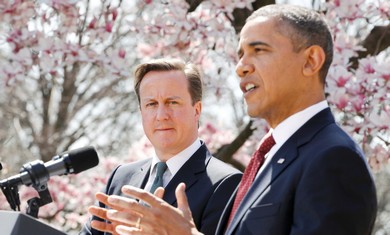
US President Barack Obama, UK PM David Cameron By REUTERS/Jason Reed

WASHINGTON – US President Barack Obama warned Wednesday that the window to resolve the crisis over Iran’s nuclear program diplomatically was shrinking, and that Tehran would face consequences if it didn’t take fresh talks seriously.

“Because the international community has applied so many sanctions, because we have employed so many of the options that are available to us to persuade Iran to take a different course, the window for solving this issue diplomatically is shrinking,” Obama said during a Rose Garden press conference with British Prime Minister David Cameron.

“I hope that the Iranian regime understands that this is their best bet for resolving this in a way that allows Iran to rejoin the community of nations and prosper, and feel secure themselves,” Obama said.

Obama was responding to a reporter’s question of whether the talks recently announced by the P5+1 group of world powers were Tehran’s final opportunity to resolve the nuclear issue before military action was taken.

Russian newspaper Kommersant reported Wednesday that US Secretary of State Hillary Clinton sent a message to Iran, with which it does not have diplomatic relations, via Russian Foreign Minister Sergei Lavrov, that the negotiations were Iran’s “last chance,” according to an unnamed Russian diplomatic source.

“The Israelis are de facto blackmailing Obama. They put him into an interesting position: Either he backs the war or loses the support [of the American Jewish lobby],” the well-connected newspaper quoted a Russian diplomatic source as saying, Reuters reported.

The State Department did not respond to a request for confirmation from The Jerusalem Post, and the Kommersant article wasn’t cited during the Rose Garden press conference.

But Obama did say that “I have sent a message very directly to them publicly that they need to seize this opportunity of negotiations with the P5+1 to avert even worse consequences for Iran in the future.”

Cameron joined Obama in warning that should Tehran refuse to meet the conditions on its nuclear program imposed by the international community, the US, Britain and other international partners would “continue to increase the political and economic pressure to achieve a peaceful outcome to this crisis.” He added that “nothing is off the table.”

Obama welcomed Cameron to Washington with a state dinner set for Wednesday night, and on Tuesday brought the British leader to a college basketball game in Ohio. The two leaders also discussed Syria, Afghanistan and the economic difficulties facing both nations.

The pair touched on these issues in a joint op-ed published in The Washington Post ahead of the prime minister’s visit, in which they “there is time and space to pursue a diplomatic solution” with Tehran.

Their consultations follow the visit last week of Prime Minister Binyamin Netanyahu, who stressed that time is running out and that Iran has used diplomacy as a stalling tactic in the past.

Obama acknowledged this concern in his remarks Wednesday.

He pointed to Tehran’s history of looking “to delay, stall, to do a lot of talking but not actually move the ball forward” in talks and warned them not to take such a similar approach this time.

Meanwhile, polls on attitudes toward a strike on Iran yielded conflicting results.

A Reuters/Ipsos poll released Tuesday found that 56 percent of Americans would support US military action against Iran if there were evidence of a nuclear weapon program, while 39% were opposed.

Nearly the same number, 53%, said they would back strikes even if they led to higher gas prices, with slightly more, 42%, saying they would not.

In addition, 62% of Americans would support Israel taking military action against Iran for the same reasons, according to the Reuters/Ipsos poll.

But that finding was in direct contrast to the determination of another survey, released by the Brookings Institution on Tuesday, which indicated that only one in four Americans favors Israel conducting a military strike against Iran’s nuclear program. Some 69% preferred for the US and world powers to consider diplomacy with Iran.

The polling project was supervised by Steven Kull, director of the Program on International Policy Attitudes, and Shibley Telhami, the Anwar Sadat Chair for Peace and Development at the University of Maryland and a Brookings senior fellow.

In addition to phrasing the question as a choice between an Israeli attack and American pursuit of diplomacy, the poll also differed with that of Reuters/Ipsos in that the latter added the context of evidence of a nuclear weapon program, while the poll released by Brookings gave no such additional context.

A third poll, to be released Thursday, found that 50% of Israelis believe the IDF should not attack Iranian nuclear reactors, even if diplomatic attempts fail. Only 43% support such a strike, the poll found.

While 78% of the Israeli public believes a military strike would postpone Iran’s acquisition of a nuclear weapon by several years, only 16% believe it would eliminate its nuclear capability altogether, according to the poll.

Jerusalem Post staff and Reuters contributed to this report.

Netanyahu says ‘Gaza is Iran’ – JPost – Diplomacy & Politics

March 14, 2012

Netanyahu says ‘Gaza is Iran’ – JPost – Diplomacy & Politics.

By JPOST.COM STAFF
03/14/2012 17:48
PM says won’t accept terror-backing Iran getting nukes, blames 2005 Disengagement Plan for Gaza situation.

Prime Minister Binyamin Netanyahu in the Knesset By REUTERS/Ronen Zvulun

Iran is the primary actor responsible for escalations in the Gaza Strip, Prime Minister Binyamin Netanyahu said Wednesday. “Gaza is Iran,” the prime minister told a special Knesset session in which he was obligated to speak.

Connecting the recent round of violence in Gaza and the Iranian nuclear threat, Netanyahu said he is not prepared to accept a situation in which the country, which backs terrorist groups, becomes a nuclear power.

The prime minister went on to lay blame for Iran’s influence in the Strip on the 2005 Gaza Disengagement Plan and those politicians who supported it. “You inserted Iran into Gaza,” he told members of Knesset.

In general, and regarding the Iranian threat in particular, Netanyahu praised Israel’s alliance with the United States but said Israel’s ability and right to defend itself was even more important .

During his recent trip to Washington, during which he met with US President Barack Obama, Netanyahu paraphrased former prime minister Menachem Begin to explain why he emphasized and reiterated Israel’s right to defend itself.

“Israel has never put its fate in the hands of others and that is my primary responsibility as prime minister,” he said.
__________________________________________________

January 14, 2009

This war is between Israel and Iran.  NOT the Palestinians.

Iron Dome intercepts Grad rocket fired toward Beersheba

March 14, 2012

Iron Dome intercepts Grad rocket fired toward … JPost – Defense.

03/14/2012 19:04
Launche is the most serious breach of an informal cease-fire reached after a violent weekend during which over 200 rockets were fired from Gaza into southern Israel; second rocket reportedly explodes in an empty field.

Gaza air strike By REUTERS/Nir Elias

A Grad rocket was fired at Beersheba from the Gaza Strip Wednesday night, Police spokesman Mickey Rosenfeld said. The IDF confirmed that a rocket had been fired in the direction of Beersheba.

The Iron Dome rocket defense system successfully intercepted the Grad. A second rocket exploded in an empty field, Army Radio reported.

No damage or injuries were reported but several people were being treated for shock.

The rockets come a day after a reported informal cease-fire between Israel and Palestinian terrorist groups in Gaza took effect. A number of rockets and mortars were fired after the cease-fire came into effect, but Wednesday’s launches appeared to be the most serious breach, reaching deep into Israeli territory.

On Tuesday night, terrorists in Gaza fired a Grad rocket into the center of the southern town of Netivot, lightly injuring one man. Eleven others were treated for shock.

Earlier on Tuesday evening two rockets landed in the Ashkelon Coast Regional Council, marking the first such attacks since midday. Previously, Palestinian terrorists fired five mortar shells and two rockets at southern Israel just before noon. No injuries or damage were reported in the attacks.

School was scheduled to be back in session in the South on Wednesday after rocket attacks from Gaza kept students at home for the past three days.

More than 200 rockets have been fired from Gaza into southern Israel during hostilities that began on Friday when the IDF killed two Islamic Jihad terrorists that Israel charged were plotting a cross-border terror attack from Sinai.

The Israel Air Force responded to rocket attacks throughout the period of escalation, killing 26 Palestinians in air strikes, 22 of whom were armed terrorists.

Palestinian media reported on Tuesday afternoon that the IDF shot and injured three Palestinians that approached the Gaza security fence during a funeral procession for two terrorists that were killed in an IAF strike a day earlier. The funeral was for Islamic Jihad members Bassam al-Ejla and Mohammed Daher.

The IDF said that some fifty Palestinians came close to the security fence, and that they fired in order to distance them.

An Egyptian security official told Reuters on Tuesday that both sides had “agreed to end the current operations,” with Israel giving an unusual undertaking to “stop assassinations,” and an overall agreement “to begin a comprehensive and mutual calm.”

“There is an understanding,” Homeland Defense Minister Matan Vilna’i told Army Radio Tuesday morning. “At the moment the direction is toward calm and it appears, unless there are last minute developments, that this round is now behind us.”

Also Tuesday morning, an Islamic Jihad spokesman said the group would respect the quiet as long as Israel stopped assassinations of terrorist leaders, saying it would respond if more assassinations take place.

JPost.com staff contributed to this report.

‘IDF Tested Gaza Terrorists before Attack on Iran’

March 14, 2012

‘IDF Tested Gaza Terrorists before Attack on Iran’ – Defense/Security – News – Israel National News.

Hizbullah and Hamas said IDF strikes on Gaza were a “test” of reactions in advance of an attack on Iran, a Lebanese newspaper reported.
By Tzvi Ben Gedalyahu

First Publish: 3/14/2012, 1:15 PM


Hassan Nasrallah video speech at rally

Hassan Nasrallah video speech at rally
Reuters

Hizbullah and Hamas said IDF strikes on Gaza terrorists were a “test” of  reactions in advance of an attack on Iran, a Lebanese newspaper reported. Leaders of Hizbullah and Hamas also reportedly said they are coordinating with Egypt’s Muslim Brotherhood in the event of a war  “waged by the Zionist enemy.”

Hizbullah supreme leader Hassan Nasrallah met with the Hamas number two leader in Lebanon, according to the Al-Sapir Arabic-language newspaper.

An alliance between the Iranian-Syrian-Hizbullah axis in the north with Hamas in Gaza and the Muslim Brotherhood would squeeze Israel from both ends of the country.

The meeting between Hizbullah and Hamas’ Dr. Moussa Abu Marzouk focused on the rebellion in Syria and the IDF’s counterterrorist strike on two Gaza terrorist leaders and the retaliation that followed a resumption of Hamas and Islamic Jihad missile attacks on Israel.

Nasrallah and Marzouk met on Monday and charged that “the Israeli enemy is responsible for the recent escalation of Israel’s counterterrorist measures in Gaza, which they said were intended “to pressure the resistance forces” and test their preparations for an Israeli attack on Iran’s nuclear plants.

The newspaper said that Hizbullah and Hamas discussed their relationship with the Muslim Brotherhood in light of the situation in Gaza and the current discussion in the West of intervening in Syria to stop the slaughter of civilians by Syrian President Bashar Assad.

Nasrallah also told Hamas leaders that Assad wants a political solution to the crisis facing his regime.

Hamas said it is holding meetings with other Arab factions in Lebanon and with representatives of the Palestinian Authority for a planned “million-man” march on Israel later this month.

‘Azerbaijan arrests 22 over terror plot against Israel, US’

March 14, 2012

‘Azerbaijan arrests 22 over terror plot … JPost – International.

By JPOST.COM STAFF
03/14/2012 15:05
Azeri National Security Ministry says suspects were cooperating with Iran’s Revolutionary Guards to carry out attacks on Israeli, US embassy, AFP reports; arrests come after Azeri defense minister visits Tehran.

government building in baku, azerbaijan
By Reuters

Officials in Azerbaijan announced the arrest of 22 people suspected of plotting attacks on Israeli and US embassies in the capital Baku on behalf of Iran, AFP reported Wednesday.

“Twenty-two citizens of Azerbaijan were arrested by the national security ministry for cooperating with [Iran],” the Azeri National Security Ministry said according to AFP, connecting the plots to the Iranian Revolutionary Guards.

The arrests mark the second time this year Baku said it made arrests over a foiled terrorist plot involving Iran, the first being in February.

The announcement of these new arrests came a day after Azerbaijani Defense Minister Safar Abiyev met with senior officials in Tehran for talks centered around maintaining good relations, after Tehran expressed dissatisfaction with an arms deal to the tune of $1.6 Baku made with archenemy Israel.

“We will not allow Azerbaijan’s soil to be used against Iran under any conditions,” Abiyev was quoted by the ISNA news agency as saying after meeting his Iranian counterpart Ahmad Vahidi in Tehran, in an apparent attempt to soothe Iranian nerves jittery over neighboring Azerbaijan’s increasingly close ties with Israel.

Iran accused Azerbaijan of allowing Mossad agents to operate from Azeri territory in order to gather intelligence on the Islamic Republic.

On February 21, Baku announced it had arrested a number of people with links to Iran and Lebanese Hezbollah that were planning to attack foreign citizens in the Eurasian nation, though reports did not identify Israeli or US targets.

The state TV report said the suspects had bought weapons including firearms and explosives, and had gathered intelligence on potential targets. The suspects had links to Iran’s intelligence agency and to Lebanese Hezbollah.

According to reports, one of those arrested was an Iranian member of the Quds Force.

Reuters contributed to this report

Iran’s MAD Gambit

March 14, 2012

Iran’s MAD Gambit » Publications » Family Security Matters.

Twice in a span of one month, Israeli government ministers had claimed that Iran was working on an intercontinental ballistic missile (ICBM). First, in early February, deputy prime minister and minister for strategic affairs, Moshe Yaalon said that a blast last November at a missile base of Iran’s Islamic Revolutionary Guards Corps (IRGC) hit a system “getting ready to produce a missile with a range of 10,000 kilometers (6000 miles).”
Later that month Israeli Finance Minister Yuval Steinitz said in a CNBC interview that Iran was investing billions of dollars to develop inter-continental ballistic missiles. “We estimate that in 2-3 years they will have the first inter-continental ballistic missiles that can reach the east coast of America.”

Predictably, the New York Times was quick to cite “American officials” as saying they believed the “assertions were at best premature, and at worst badly exaggerated…the officials said that Iran might harbor the ambition of having missiles that could reach the United States, but that it was not close to achieving that goal.”

Accordingly, the Israeli statements were politically motivated. Jerusalem, the Times reported, “was trying to make the point that the Iranian nuclear program is a threat not only to Israel but to other nations.” Yet this is hardly the end of the story.
Even the skeptics are not disputing the information that the Iranians are laboring to manufacture an ICBM. Thus, the questions should be what are Iran’s motives and what are the implications of its effort to acquire such weapons rather than just focusing on how close it is to having an operational ICBM.
Undoubtedly the pursuance of an intercontinental missile capability is meant to boost the Iranian regime’s domestic standing. As well, it is geared to enhance Iran’s regional prestige and political clout. But more importantly, an Iranian ICBM effort provides the telltale sign that Tehran is pursuing nuclear weapons. It is simply inconceivable that Tehran will undertake such a costly and technologically challenging project just to deliver a conventional payload to the American continent. Never mind that such a payload would have to be especially small given the distance the missile would have to travel. An ICBM venture would make no strategic, economic or operational sense unless the Iranians are aiming to equip the missile with an unconventional warhead.
Indeed, the way Iran is going about developing its ICBM is a carbon copy of the route it took in its efforts to acquire nuclear weapons. In the latter case Tehran, while developing missiles capable of reaching Israel, armed its proxy– the Lebanese terror organization Hizballah–with a vast array of rockets aimed at Israeli citiesto provide a makeshift deterrent against an Israeli attack on its nuclear sites. In the words of Yadallah Javani, politburo chief of the IRGC last November “The Islamic Republic of Iranhas some means and possibilities in areas very close to the Zionist regimeand can easily give a response to Israel to make its leaders repent their action.” Not surprisingly, some of the rockets supplied by Iran could reportedly reach Israel’s Dimona nuclear reactor undoubtedly to directly counter any Israeli threat to Iran’s facilities.
Now Iran is acting similarly with regard to developing its intercontinental delivery capability. As in Lebanon, it has created stopgap deterrents that range from the establishment of terror cells in Latin America and Canada to open threats to target U.S. bases and forces deployed in theater in case of conflict. For example last June, Commander of the IRGC Aerospace Force Brigadier General Amir Ali Hajizadeh said that about 70% of the U.S. bases in the Middle East are no farther than 300 to 400 kilometers away from Iran, suggesting all of them are within the scope of the IRGC’s short- and medium-range missiles. “The Americans have reduced our labors,” he told Iran’s Fars News Agency, “Their military bases in the region are in a range of 130, 250 and maximum 700 km in Afghanistan which we can hit with these missiles.” As before, the idea is to assure that Iran’s progress toward acquiring an unmistakably ominous capability is not impeded– in this case by Washington.
Acquisition of an ICBM capability would severely undermine America’s credibility in the region especially the offer made by U.S. Secretary of State Hillary Clinton back in July 2009 to extend a “defensive umbrella” over the Middle East vis-à-vis Tehran. In a word, the possession by Iran of intercontinental missiles would wreck the foundation of America’s regional alliances.
In contrast, the addition of an ICBM component to its strategic weapons mix would enhance the reliability of the nuclear shield Iran is likely to provide its allies– all united by their hatred of America and Israel—once it gets the bomb.Already, Iran’s Navy Commander Rear Admiral Habibollah Sayyari declared in September 2010 that the Iranian Navy’s presence on the high seas and international waters (like its recent sailings into in the Mediterranean) is part of Tehran’s strategy for “defending its interests abroad.”
Iran’s freedom of action is also likely to grow. It could even engage in deliberate provocations in support of its allies. For example, Tehran could stir up trouble on its border with Iraq or in the Gulf in a bid to stretch U.S. forces thin in case of a future North Korean-U.S. crisis. Besides, neutralizing America’s strategic commitment could not but increase the odds of an attack on Israel.
Finally, acquisition of nuclear-armed intercontinental missiles would mean Iran has adopted a Samson-type strategic posture vis-à-vis the U.S.  Doubtlessly hoping to capitalize on their oft-proclaimed penchant for martyrdom, the mullahs are seeking a deterrence posture akin to a poor-man’s Mutual Assured Destruction (or MAD). They aim to put Washington on notice that endangering their political survival would also spell doom for the U.S. (that is at least as long as the U.S. remains vulnerable to even a rogue ICBM attack). After all, if an obscure terrorist organization such as al-Qaeda at the time was able to single-handedly bring the U.S. financial system to the brink of collapse in all of one day, and by employing nothing more than counter-conventional means, a nuclear hit on New York City or Washington D.C. could debase the seat of “world arrogance” for good.
Through its ICBM gambit Iran is thus pursuing a master plan aimed to deal with the two Satans—the Great one (America) and the Little one (Israel)–simultaneously. The new missile capability would enable Tehran to brandish a deterrent –i.e. defensive– strategy globally so as to allow it the prosecution of regional hegemony offensively.

Diplomats: US issued ultimatum to Iran via Russia

March 14, 2012

Diplomats: US issued ultimatum to Iran via Russia – Israel News, Ynetnews.

Russian source says Clinton asked Lavrov to warn Tehran that failure to resolve nuclear crisis peacefully will result in attack before year’s end; ‘Israelis blackmailing Obama,’ he claims

Ynet

The US has asked Moscow to warn Iran that it has one last chance to resolve the nuclear crisis peacefully or face an attack in the coming months, Russian diplomatic sources told the Kommersant daily.

The Russian newspaper quoted one diplomat as saying that the threat was voiced by US Secretary of State Hillary Clinton during a meeting with her Russian counterpart Sergey Lavrov in New York on Monday.

“The invasion will happen before year’s end. The Israelis are de facto blackmailing (President Barack) Obama. They’ve put him in this interesting position – either he supports the war or loses the support of the Jewish lobby,” the Russian diplomat told the Russian newspaper.

According to the source, Clinton said Iran has to make progress in the negotiations with the P5+1 group, which consists of the five permanent members of the UN Security Council and Germany.

The group is expected to negotiate on Iran’s controversial nuclear program with Iranian officials sometime in April. The negotiators demand clarifications from Iran over the potential militarization of its nuclear program. They also demand access for International Atomic Energy Agency (IAEA) inspectors to a suspected nuclear site in Parchin.

When asked about the reported American ultimatum, Russian Deputy Foreign Minister Sergey Ryabkov criticized the “last chance” rhetoric.

“Speaking in this way is unprofessional. There is no such thing as a last chance. It’s an issue of political will, and Russia does everything to foster such will rather than let it wane,” he told Kommersant.

The deputy FM said that the negative trend in the conflict is apparent, suggesting that “those tempted to use military force should restrain themselves and search for a diplomatic solution.”

“A war will not solve any problems, but will create a million new ones,” Ryabkov warned.

The West believes Iran is trying to build a nuclear weapon under the guise of its civilian nuclear program. Tehran denies the allegation, insisting that all its nuclear activities are purely peaceful.

Kommersant’s report was posted on the Russian website RT.

Iran’s new protege

March 14, 2012

Israel Hayom | Iran’s new protege.

In contrast to the Lebanese arena, where Iran has tied itself to and used Hezbollah as its representative and proxy, in the Palestinian arena Tehran has based its strategy on two parallel axes. The first is fostering its relationship with Hamas and providing it with funds to build and establish the organization’s power base in Gaza. The second is strengthening its relationship with the Palestinian Islamic Jihad and cultivating the group as a close and valued protege, even closer to Tehran’s heart than Hamas is.

The Iranians haven’t ignored Hamas’ strength over the years, and in recent months have also invested considerable effort to maintain ties with it, despite the cooling of the relationship between Hamas’ leadership and the Syrian regime of Bashar al-Assad.

And yet, even during the peak of Iran’s relationship with Hamas, in the days after the organization took control over the Gaza Strip by force, Tehran couldn’t ignore the clear advantages which lay in developing closer ties with the Islamic Jihad.

Firstly, the Islamic Jihad was prepared to get closer to Iran, and not just militarily and diplomatically. It was willing to get closer ideologically as well, and to find a bridge between it, a Sunni group, and the large Shiite power.

Hamas, for its part, chose to tie itself ideologically to Sunni spiritual authorities, such as Sheik Yousef Qaradawi, the Muslim Brotherhood’s spiritual leader, and to the Muslim Brotherhood in general throughout the Arab world, which has never hidden its hostility toward Iran.

Secondly, the Islamic Jihad has never made a claim to dominion and authority. This makes it an uncompromising ally, free of the restrictions that Iran itself must navigate. Hamas, on the other hand, is guided by more complex, usually pragmatic considerations.

Indeed, while Hamas has proceeded to disconnect itself from the Syrian regime under moral claims, the Islamic Jihad remains loyal to Assad. Presently, as the Islamic Jihad leads the current round of fighting against Israel from Gaza, Hamas is playing the game of “realpolitik” as an observer from the sidelines.

Be the results as they may after this round of fighting, what is clear is that the alliance between Tehran and the Islamic Jihad is only getting stronger.


